Archives for category: NCLB (No Child Left Behind)

A time to laugh and celebrate that the dumb policies of No Child Left Behind and Race to the Top are widely recognized as failures and will soon go into the dustbin of history, where they belong. To make a better world for children and educators, the fight goes on, to replace poor leaders and failed policies, to save public education from privatization, and to make real the elusive promise of equality of educational opportunity: for all, not some.


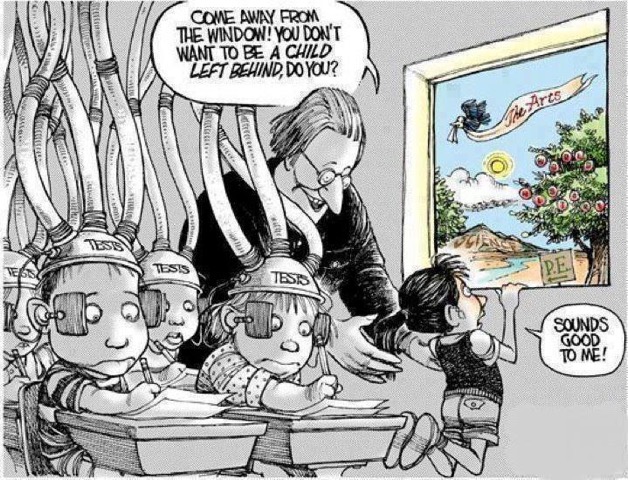
nclb_cartoon

This morning, Politico.com has a roundup of reactions to the new legislation–the Every Student Succeeds Act–that will replace the disastrous No Child Left Behind, under which almost every public school in the nation was a “failing” school. Please note that former Secretary of Education Margaret Spellings is very unhappy that NCLB has been rewritten to remove the punishments. So now we have ESSA, and now we wait for that happy day to arrive when “every student succeeds” because of federal legislation.


GETTING TO KNOW ESSA: The education world is eagerly awaiting a bill expected early next week that could replace No Child Left Behind – and waivers, too – by the end of the year. So what’s going to be in the Every Student Succeeds Act? A lot has been written (some of it by us) but Morning Education will be laying out even more on the forthcoming bill, based on information currently available, in the days to come. Spot something interesting and wonky in an outline or draft bill? Send it our way.


– The new SIG: The framework for updating NCLB includes a 7 percent set-aside in Title I for school support and improvement. Schools will receive the funds for plans that are “evidence-based,” and the framework has language laying out the bar those plans will have to meet in order to qualify as “evidence-based.” Districts and schools will also have to consult with teachers, parents, principals and others when they’re putting together plans for school improvement.


– The new tests: The framework allows for computer-adaptive tests that were hard to use under NCLB, which required all students to take the same tests. That made it difficult to measure progress made by students who were either above or below their grade level. Fordham Institute President Michael Petrilli said he’s “especially glad” to see this provision because it “should open the door to true adaptive tests, which will lead to lots more accuracy for kids way above or below grade level (and thus more accuracy in their growth scores – important for schools and teachers).”


– Joel Packer has the roundup of which programs are funded, and by how much, based on details currently available: http://bit.ly/1leOqj8.


– Mailbag: Maggie Severns’ story about how many on the left fear that the bill could hurt poor and minority kids [http://politico.pro/1LuNeNT ] elicited this response from an education advocate who’s been involved with the reauthorization process: “There seems to be collective amnesia about waivers among the chattering class,” the advocate said. “Under waivers, individual groups of students don’t have to matter at all in school ratings. And when it comes to improvement action, states and districts are invited to ignore all but a small fraction of schools with under-performing groups.” Ultimately, the new agreement “gets us back closer to the intent of Title I: Expectations and support for vulnerable students.”


– Bush-era Education Secretary Margaret Spellings slammed the rewrite while in Austin earlier this week, Houston Chronicle reports: http://bit.ly/1R2wF2Z. But Sen. Patty Murray sang its praises at a Seattle elementary school last week. The Columbian: http://bit.ly/1P4ZVXF.


And then there is a wail of anguish from the once-liberal, now conservative Brookings Institution about the AERA blast at VAM. For VAM-lovers, who want to use test scores as both the measure and goal of education, the AERA statement (as well as a statement by the American Statistical Association) is a punch in the gut:


TEACHER EVALUATION NIRVANA: Brookings is critiquing a recent policy statement from the American Educational Research Association that was skeptical of using value-added scores when making decisions about teachers. AERA said the conditions needed to make VAM scores accurate can’t be met in many cases: [http://politico.pro/1Tbil7y ]. But Michael Hansen, deputy director of the Brown Center on Education Policy, said VAM should be measured in the context of other performance measures, “not relative to a nirvana that does not exist.” Alternatives to VAM like teacher observation have their own problems, he wrote. He agreed with AERA that more research would be valuable, but argued, “If we are looking for a performance measure that has zero errors, we ought to abandon performance evaluation altogether.” More: http://brook.gs/1QER2Ej


Brookings turned rightwing when it hired Grover Whitehurst, the George W. Bush education research director, as leader of its education program. Instead of being a neutral referee of education policy, Brookings became an advocate for choice and high-stakes testing.


The House-Senate conference committee overwhelmingly (39-1) endorsed an overhaul of the No Child Left Behind, which was the latest (and worst) revision of the 1965 Elementary and Secondary Education Act (ESEA). The new ESEA, which still must be approved by both houses of Congress, is called the Every Student Succeeds Act.


The ESSA limits the federal role, a direct rebuke to Arne Duncan’s belief that he was the national superintendent of schools. The law retains a large chunk of George W. Bush’s legacy, including annual testing, a practice not found in any high-performing nation. The law no longer requires teacher evaluation by test scores.


The Republicans wanted to restore state and local control, while the Democrats ironically defended Bush’s accountability emphasis. The outcome is a compromise.


Most everyone seems to have forgotten that the original purpose of ESEA was equity for the neediest students, meaning federal dollars to high-poverty schools. Don’t you long for the day when laws were given descriptive titles, rather than aspirational ones? “Every Student Succeeds” is the flip side of “No Child Left Behind.” What was wrong with “the Elementary and Secondary Education Act”?


I don’t want to sound cynical, but I’m prepared to wager any sum that 7 years, 10 years, or 15 years from now, no one will say that every student is now succeeding. So long as nearly a quarter of our nation’s children live in poverty, “success” will remain elusive. So long as experienced teachers are underpaid and disrespected, so long as the anti-teacher lobby files lawsuits to strip teachers of their rights, “success”will escape our grasp. So long as jobs continue to be outsourced and eliminated by technology, we must continue to worry about whether and how young people will be motivated to “succeed.”


But for the moment, let’s celebrate the demise of a terrible law that saw punishment as the federal strategy for school reform. Let’s celebrate that no future Secretary of Education will have the power to impose his or her flawed ideas on every public school and teacher in the nation. Let’s thank Senator Lamar Alexander and Senator Patty Murray for finally ending a failed and punitive law.


Education Week reports that the Senate and House are near agreement on a deal to reauthorize NCLB, aka the Elementary Secondary and Elementary Act.


While it is too soon to know what will emerge from the conference committee, it is disappointing to see that the accountability Hawks kept the burden of annual testing, which is not found in any high-performing nation. The administration of George W. Bush and the testing companies won on this one.


“The compromise uses the Senate bill as a jumping-off point here. Quick refresher: That means states would still have to test students in grades 3-8 and once in high school in reading and math. But states would get to decide how much those tests count for accountability purposes. And states would be in the driver’s seat when it comes to goals for schools, school ratings, and more.


“States would be required to identify and take action in the bottom 5 percent of schools, and schools where less than two-thirds of kids graduate


“States would also have to identify and take action in schools that aren’t closing the achievement gap between poor and minority students and their peers. But importantly, the bill doesn’t say how many of those schools states would have to pinpoint, or what they would have to do to ensure that they are closing the gaps—the bill allows state leaders to figure all that out.


“On opt-outs: The bill largely maintains the Senate language, which would allow states to create their own opt-out laws (as Oregon has). But it maintains the federal requirement for 95 percent participation in tests. And unlike under No Child Left Behind, in which schools with lower-than-95 percent participation rates were automatically seen as failures, local districts and states get to decide what should happen in schools that miss targets. States would have to take low testing participation into consideration in their accountability systems. Just how to do that would be up to them, though.”


After 15 years or more of not “closing the gap,” federal law will require states to punish schools that don’t do it. Does anyone in D.C. understand that the gap is a product of standardized tests? That standardized tests are burned on a bell curve? That bell curves never close? That mandating it doesn’t make it so? A mandate to reduce class sizes to no more than 12 for the neediest children would be far more effective than a demand to “do something.”


Carol Burris carefully reviewed the NAEP scores. Listen to her interview on public radio. Unlike many commentators, she has the advantage of being an experienced educator and is also executive director of the Network for Public Education.

Marc Tucker is glad to see the U.S. Department of Education acknowledging that American students spend too much time being tested and preparing for tests. But, he writes, it didn’t go far enough to take responsibility for the multiplication of redundant tests.

He writes:

A new report from the Council of the Great City Schools has done what seemingly nothing or no one has yet been able to do: Convince the current administration that the rampant over-testing in U.S. schools is proving harmful for the quality of education that our students receive.

The report found that students take, on average, more than 112 standardized tests between pre-K and grade 12, with the average student taking about eight standardized tests per year. Some are intended to “fulfill federal requirements under No Child Left Behind, NCLB waivers, or Race to the Top (RTT), while many others originate at the state and local levels. Others were optional.”

Now the administration is signaling that they see the error of their and their predecessors’ ways. Calling for a two percent cap on the amount of classroom time that is spent on testing, and a host of other proposals, the administration’s mea culpa is an unexpected demonstration of what can occur when the facts are laid bare for all to see. How much is actually done to reverse the over-testing trend will be decided by the actions of incoming acting Secretary of Education John King.

The tone of flexibility in the Department’s announcement is new and welcome, as is its recognition that the Department may share some culpability in the national revolt against testing. Its call for fewer and higher quality assessments is on target, as is its willingness to help the states come up with more sensible approaches.

What I don’t see in the administration’s proposals is understanding that the vast proliferation of indiscriminate testing with cheap, low quality tests is the direct result of federal education policies beginning with No Child Left Behind and continuing with Race to the Top and the current waiver regime. I offer you one phrase in the Department’s announcement in evidence of this proposition: “The Department will work with states that wish to amend their ESEA flexibility waiver plans to reduce testing…while still maintaining teacher and leader evaluation and support systems that include growth in student learning.”

But it is precisely the federal government’s insistence on requiring testing regimes that facilitate teacher and leader evaluations that include student growth metrics that caused all this over-testing in the first place.

Outstanding principals I’ve talked with tell me that when tough-minded, test-based accountability came into vogue, they created or found good interventions that came with their own assessments, each keyed to the intervention they were using. They had always done that. But their district superintendents, also fearful for their jobs under the new regime, mandated other interventions, with their own tests. Then the state piled on with their own mandated programs and tests, all driven by the fear of leaders, at each level, that if student performance did not improve at the required rate, their own jobs were on the line. Few of these interventions were aligned with the new standards or with each other. But time was of the essence. Better a non-aligned instructional program than none at all. Better a cheap test of basic skills they could afford than a much more expensive one they could not afford.

What sent the numbers right over the cliff was pacing. School administrators, focused on having their students score well on the basic skills tests used by the state accountability systems, pushed schools enrolling large numbers of disadvantaged students to figure out where the students needed to be at set intervals during the year. This determined the pace of instruction. It also made it much easier for administrators to get control over the instruction. All that remained was to administer a test at each of those intervals—say every month or couple of months—to see whether the teachers were keeping pace with the scripted curriculum and the students were making enough progress to do well at the end of the semester or year….

The key for great school leaders isn’t formal evaluation and it isn’t firing people. Only Donald Trump, evidently, fired his way to the top. The key is running a great school that great people want to work in, and then spending a lot of time identifying, recruiting and supporting those great people. Principals who work this way often let their staff know that they expect them to work hard. Those who do not want to work so hard go elsewhere. But these principals do not depend on test-based accountability systems to identify the slackers nor do they depend on test-based accountability systems to identify the teachers they want to hire or to develop them once they are hired.. Why should they? They are in classrooms all the time, talking and observing, coaching and supporting.

The data reported by the Council of the Great City Schools reveal a calamity. The cause is our national accountability system. The flexibility offered by the Department of Education is welcome and refreshing, but it is not the answer. The answer will have to wait for the day when the federal government no longer insists that the states and schools use test-based accountability and value-added strategies to assess individual teachers with consequences for individual teachers. John King did not create this system. Perhaps he can help this country change it. We’ll see.

The Badass Teachers association responded to Arne Duncan’s mea culpa on testing with this statement:

FOR IMMEDIATE RELEASE: October 24, 2015
More information contact:
Marla Kilfoyle, Executive Director BATs or Melissa Tomlinson, Asst. Executive Director BATs
Contact.BATmanager@gmail.com

Today the Obama Administration released a statement calling for “a cap on assessment so that no child would spend more than 2 percent of classroom instruction time taking tests. It called on Congress to ‘reduce over-testing’ as it reauthorizes the federal legislation governing the nation’s public elementary and secondary schools.” (http://www.nytimes.com/2015/10/25/us/obama-administration-calls-for-limits-on-testing-in-schools.html?_r=0)

The Badass Teachers Association, an education activist organization with over 70,000 supporters nationwide, are reluctantly pleased with this announcement. Our vision statement has always been to refuse to accept assessments, tests and evaluations created and imposed by corporate driven entities that have contempt for authentic teaching and learning. Our goals have always been to reduce or eliminate the use of high stakes testing, increase teacher autonomy in the classroom, and include teacher and family voices in legislative decision-making processes that affect students.

Since No Child Left Behind and Race to The Top we have seen our children and communities of color bear the brunt of the test obsession that has come in with the wave of Corporate Education Reform. When resources should have been used for funding and programming, politicians and policy makers were focusing on making children take more tests in hopes that equity in education would occur. It didn’t work, and it will not work. We know as educators you cannot test your way out of the education and opportunity gap. The blame and punish test agenda has not closed either the education or opportunity gap . We are reluctantly pleased that the President and his administration are finally taking a stand, but sadly the devastation has already been done. We are confident that if the President and his administration make a commitment to work with educators, parents, and students we can fix it and make it right.

“Although this is a step in the right direction I feel we need to see what the policy is before we count this as a win. Given his actions in New York, I have no reason to trust John King, and I’m concerned that this is a ploy to get teachers on the side of Democrats aka Hillary Clinton.” – BAT Board of Director Member Dr. Denisha Jones

“The policy that stems from this statement needs to be mindful that important discussions about exactly what kind of testing is most beneficial to our students. BATS advocates for teacher-driven tests with immediate and relevant feedback that can be used to drive current instructional practices.” – BAT Assistant Executive Director Melissa Tomlinson

“The policies of Sec. Duncan and the USDOE have caused an immense amount of damage to our educational system, student morale, and teacher morale. I am very reluctant to be happy about this announcement and will watch closely as to what the President plans to do to fix the damage that has been done. Will he stand up to Corporate Education Reform? Will he end the test, blame, punish system for schools, students, and teachers? Will he return the elected school board? Will he end mass school closings?” – BAT Executive Director Marla Kilfoyle

The Badass Teachers Association would like to extend its voice and expertise to help get public education on the right track. Together we can work towards the real solutions that will make great schools for all children. We will be watching closely as this unfolds.

The Obama administration acknowledged that students are spending too much time on testing and recommended that no more than 2% of classroom instructional time be devoted to testing.

Apparently the administration is reacting to bipartisan opposition and widespread parent protests against the diversion of time and billions of dollars to high-stakes testing. Public sentiment, as recorded in recent polls, opposes the overuse of standardized testing.

In addition, the Times reports, the administration was reacting to a new report from the Council of Great City Schools, which found that the current regime of testing has not improved achievement.

You might say that the Obama administration is lamenting the past 13 years of federal policy, which mandated annual testing, and made test scores the determinative factor in the evaluation of teachers, principals and schools.

In short, the Bush-Obama policies have been a disaster.

This is a classic case of too little, too late. Think of the thousands of teachers and principals who were unjustly fired and the thousands of pubic schools wrongly closed when they should have gotten help. This administration and the George W. Bush cannot be absolved for the damage they have done to American education by issuing a press release.

The story says:

“Faced with mounting and bipartisan opposition to increased and often high-stakes testing in the nation’s public schools, the Obama administration declared Saturday that the push had gone too far, acknowledged its own role in the proliferation of tests, and urged schools to step back and make exams less onerous and more purposeful.

“Specifically, the administration called for a cap on assessment so that no child would spend more than 2 percent of classroom instruction time taking tests. It called on Congress to “reduce over-testing” as it reauthorizes the federal legislation governing the nation’s public elementary and secondary schools.

“I still have no question that we need to check at least once a year to make sure our kids are on track or identify areas where they need support,” said Arne Duncan, the secretary of education, who has announced that he will leave office in December. “But I can’t tell you how many conversations I’m in with educators who are understandably stressed and concerned about an overemphasis on testing in some places and how much time testing and test prep are taking…”

“And even some proponents of newer, tougher tests said they appreciated the administration’s acknowledgment that it had helped create the problem, saying it did particular damage by encouraging states to evaluate teachers in part on test scores.

“But the administration’s so-called “testing action plan” — which guides school districts but does not have the force of law — also risks creating new uncertainty on the role of tests in America’s schools. Many teachers have felt whiplash as they rushed to rewrite curriculum based on new standards and new assessments, only to have politicians in many states pull back because of political pressure.

“Some who agreed that testing has run rampant also urged the administration not to throw out the No. 2 pencils with the bath water, saying tests can be a powerful tool for schools to identify weaknesses and direct resources…

“What happens if somebody puts a cap on testing, and to meet the cap ends up eliminating tests that could actually be helpful, or leaves the redundancy in the test and gets rid of a test that teachers can use to inform their instruction?” asked Michael Casserly, the executive director of the Council of the Great City Schools, an organization that represents about 70 large urban school districts.

“The administration’s move seemed a reckoning on a two-decade push that began during the Bush administration and intensified under President Obama. Programs with aspirational names — No Child Left Behind, Race to the Top — were responding to swelling agreement among Democrats and Republicans that higher expectations and accountability could lift the performance of American students, who chronically lag their peers in other countries on international measures, and could help close a chronic achievement gap between black and white students….

“But as the Obama administration pushed testing as an incentive for states to win more federal money in the Race for the Top program, it was bedeviled by an unlikely left-right alliance. Conservatives argued that the standards and tests were federal overreach — some called them a federal takeover — and called on parents and local school committees to resist what they called a “one size fits all” approach to teaching.

“On the left, parents and unions objected to tying tests to teacher evaluations and said tests hamstrung educators’ creativity. They accused the companies writing the assessments of commercializing the fiercely local tradition of American schooling.

“As a new generation of tests tied to the Common Core was rolled out last spring, several states abandoned plans to use the tests, while others renounced the Common Core, or rebranded it as a new set of local standards. And some parents, mostly in suburban areas, had their children opt out of the tests.

“Mr. Duncan’s announcement — which was backed by his designated successor, John B. King Jr. — was prompted in part by the anticipation of a new survey from the Council of the Great City Schools, which set out to determine exactly how much testing is happening among its members.

“That survey, also released Saturday, found that students in the nation’s big-city schools will take, on average, about 112 mandatory standardized tests between prekindergarten and high school graduation — eight tests a year. In eighth grade, when tests fall most heavily, they consume an average of 20 to 25 hours, or 2.3 percent of school time. The totals did not include tests like Advanced Placement exams or the ACT.

“There was no evidence, the study found, that more time spent on tests improved academic performance, at least as measured by the National Assessment of Educational Progress, a longstanding test sometimes referred to as the nation’s report card.”
Peter Greene watched the debate and became outraged, as only he can.

So this is how it’s going to be. The GOP is going to have a cartoon discussion about education, focusing on how to use charters to dismantle public ed and on how to find wacky ways to pretend that we’re not havin’ that Common Core stuff. And the Democratic line on public ed? The Clinton campaign locked in on their line months ago– stick to the safe-and-easy topics of universal pre-K and accessible, cheaper-somehow college education.

That mantra is comfortable and easy. Plain folks can listen to it and hear, “Aww, more pre-school for those precious cute little kids, and a chance for young Americans to make something of themselves,” while corporate backers, thirsty hedge funders, and ambitious reformsters can hear, “Expanding markets! Ka-ching!!”

The unions made their endorsement early. Did that take education off the table as an issue?

Really? We don’t want to hear anything about the disastrous policies of the last twelve years that have systematically broken down and dismantled American public education and the teaching profession? Dang, but I could have sworn we wanted to hear about that. But I guess now that the union is on Team Clinton, our job is not to hold her feet to the fire so much as it is to give them a little massage and carry some baggage for her so that she can save her strength for other issues. Important issues. Issues that aren’t US public education.

Sanders, with his focus on how the rich have commandeered so many parts of our democratic society, is so close to making useful statements about the education debates, but it just doesn’t happen. And I’m not sure how somebody helps it happen at this point. And those other guys? Generic Candidates #3-5? I don’t know what they think about education, but I suppose now that the education vote is supposedly locked up by Clinton, they won’t feel the need to go there.

Bottom line– US public education, despite the assorted crises associated with it (both fictional and non-fictional) is shaping up to be a non-issue once again in Presidential politics. I would say always a bridesmaid, never a bride, but it’s more like always the person hired for a couple of hours to help direct the car parking in the field back behind the reception hall. Or maybe the person who cleans up the reception hall after the bridal party has danced off happily into the night.

In response to the post about the “school-to-prison-pipeline, a frequent commenter who signs as Raj, submitted the following comment. It begins like this, you can read the full comment after the original post:

Raj wrote:

This is what ACLU says:

“WHAT IS THE SCHOOL-TO-PRISON PIPELINE?

The “school-to-prison pipeline” refers to the policies and practices that push our nation’s schoolchildren, especially our most at-risk children, out of classrooms and into the juvenile and criminal justice systems. This pipeline reflects the prioritization of incarceration over education. For a growing number of students, the path to incarceration includes the “stops” below.

Failing Public Schools

For most students, the pipeline begins with inadequate resources in public schools. Overcrowded classrooms, a lack of quali­fied teachers, and insufficient funding for “extras” such as counselors, special edu­cation services, and even textbooks, lock students into second-rate educational envi­ronments. This failure to meet educational needs increases disengagement and dropouts, increasing the risk of later court­involvement. (1) Even worse, schools may actually encourage dropouts in response to pressures from test-based accountability regimes such as the No Child Left Behind Act, which create incentives to push out low-performing students to boost overall test scores. (2)

Zero-Tolerance and Other School Discipline

Lacking resources, facing incentives to push out low-performing students, and responding to a handful of highly-publicized school shootings, schools have embraced zero-tolerance policies that automatically impose severe punishment regardless of circumstances. Under these policies, students have beenexpelled for bringing nail clippers or scissors to school. Rates of suspensionhave increased dramatically in recent years—from 1.7 million in 1974 to 3.1 million in 2000 (3) — and have been most dramatic for children of color.

Overly harsh disciplinary policies push students down the pipeline and into the juvenile justice system. Suspended and expelled children are often left unsupervised and without constructive activities; they also can easily fall behind in their coursework, leading to a greater likelihood of disengagement and drop-outs. All of these factors increase the likelihood of court involvement. (4)

As harsh penalties for minor misbehavior become more pervasive, schools increasingly ignore or bypass due process protections for suspensions and expulsions. The lack of due process is particularly acute for students with special needs, who are disproportionately represented in the pipeline despite the heightened protections afforded to them under law.

Raj,

This is an excellent contribution to understanding the “school-to-prison-pipeline.” Thank you.

For most students, the pipeline begins with inadequate resources in public schools.

Overcrowded classrooms. Bill Gates and Arne Duncan have both said that class size doesn’t matter, and that great teachers can teach larger classes than they have now. Mayor Bloomberg even suggested that a “great” teacher could teach double the number currently assigned, which would mean a class size of 50-70 students. Surveys repeatedly show that both parents and teachers want small classes, and research shows that the greatest benefit of small classes goes to the neediest students, who need extra attention with the teacher.

A lack of qualified teachers. State after state has been staffing the neediest schools with inexperienced, unqualified teachers from Teach for America. There would be more qualified teachers if state legislatures raised teacher pay, stopped cutting pay raises for experience and additional relevant degrees, and stopped fighting due process for teachers. Such actions literally drive teachers out of their chosen profession.

Insufficient funding for “extras” such as counselors, special edu­cation services, and even textbooks, lock students into second-rate educational envi­ronments: The ACLU hits the nail on the head. So much money is diverted to testing and test prep and consultants, and not enough is appropriated for the services and personnel that meet the real needs of students. You understand that underfunded schools do not choose to be underfunded. Decisions about funding are made by the Congress, the state legislatures and governors, and district leadership. The blame for the shortage of these resources in the schools that enroll the most vulnerable students must be placed squarely on federal, state, and local leadership.

Even worse, schools may actually encourage dropouts in response to pressures from test-based accountability regimes such as the No Child Left Behind Act, which create incentives to push out low-performing students to boost overall test scores. Test-based accountability, including NCLB and the Race to the Top, increase the numbers of students who fall into the STPP. The emphasis on testing and the consequences for failing to teach a bar set too high discourage the students in the bottom half of the bell curve (all standardized tests are normed on a bell curve). The Common Core tests have shifted the norm so that 65-70% of students “fail.” If students fail and fail and fail, they give up. What shall we do for them?

The next section of the ACLU statement aptly describes “no-excuses” charter schools:

Zero-Tolerance and Other School Discipline

Lacking resources, facing incentives to push out low-performing students, and responding to a handful of highly-publicized school shootings, schools have embraced zero-tolerance policies that automatically impose severe punishment regardless of circumstances.

Charter schools, especially of the no-excuses variety, have higher suspension rates than public schools. They engage in harsh disciplinary policies that are not allowed in public schools. They can push out students for minor offenses.

Raj, thank you for this useful description of the “school-to-prison pipeline” by the ACLU.

We should all take heed.

Arne Duncan, who is talking about the STPP today at 4 pm EST on Sirius “Urban View” could reduce the pipeline by abandoning high-stakes testing and cutting off federal funding for “no-excuses” charter schools.

Each and every child should be able to enroll in a school with a humane and caring environment.