Archives for category: NCLB (No Child Left Behind)

Every blogger who has written about MSNBC’s Public Education Forum expressed gratitude that a big cable network paid attention to our most important democratic institution.

Nancy Bailey is angry about the issues that were ignored, the ones that threaten the future of students, teachers, and public education.

She is also streamed that the program was not on live TV. Public education not important enough for live TV? 50 million children are in public schools. They have parents. Quite an audience to overlook.

Good work, Nancy!

She writes (in part, read it all):

Candidates talked about making the wealthy pay their fair share of taxes to help schools, but no one mentioned Bill Gates, the Waltons, Eli Broad, Mark Zuckerberg or any of the corporate reformers who are taking control of public schools.

They didn’t mention Common Core or the failure of the initiatives funded by the Gates Foundation and taxpayers. Nor did they speak about portfolio schools, the latest corporate endeavor to push choice and charters.

No one mentioned using Social Impact Bonds or Pay for Success to profit off of public schools. See: “Wall Street’s new way of making money from public education — and why it’s a problem” by Valerie Strauss.

CEO Tom Steyer mentioned corporate influence towards the end, but it was brief, and no moderator attempted to explore what he said.

Ed-Tech

No one mentioned what might be the biggest threat to public education, the replacement of teachers and brick-and-mortar schools with technology.

Disruption was initially described by Clayton Christensen and Michael Horn in their book Disrupting Class: How Disruptive Innovation Will Change the Way the World Learns. This is seen as the revolution by those in business and the tech industry and is being played out in online charter schools like Summit and Rocketship. Summit also has an online virtual school.

Many students across the country get school vouchers to be used for substandard online instruction like K12 and Connections Academy.Preschoolers are subjected to unproven Waterford UPSTART.

The candidates might want to review Tultican’s “Ed Tech About Profits NOT Education.”

Wrench in the Gears is another blog good at describing the threat of technology.

Teach for America

Teach for America corps members with little training have taken over classrooms, and they run state departments of education!

Do Democratic candidates have Teach for America corps members as consultants on their campaigns? It’s troubling if they do. They should not be wooing teachers with professional degrees and experience while relying on TFA behind the scenes.

Other insidious reform groups are also about replacing education professionals. Relay Graduate School, The New Teacher Project, New Leaders are a few.

This needs to be addressed, sooner, not later.

Betsy DeVos et al.

I don’t know anyone who doesn’t enjoy hearing Democratic candidates say they’re going to boot Education Secretary Betsy DeVos out.

But President Obama had individuals from the Bill & Melinda Gates Foundation, and other corporate reform groups, working in the U.S. Department of Education. Arne Duncan was no friend to teachers or public schools.

So, while applause against DeVos are justifiable, now’s the time to address the role Democrats have played (and continue to play) in corporate school reform.

The fact is, many groups and individuals are working to end public education, who wear Democratic name tags. It’s imperative that Democratic candidates address this.
 

Nancy Bailey writes here about the idea–promoted by NCLB, Race to the Top, and Common Core– that kindergarten children should know how to read. She says this is wrong.

Young children should be encouraged to speak and listen, she writes, which is something they do while playing and interacting with other children.

She writes:

With No Child Left Behind, Race to the Top, and Common Core State Standards, some adults have been led to believe that four- and five-year-old children should read by the end of kindergarten. Preschoolers are pushed to be ready for formal reading instruction by the time they enter kindergarten.

This is a dangerous idea rooted in corporate school reform. Children who struggle to read might inaccurately believe they have a problem, or reading could become a chore they hate.

Pushing children to focus on reading means they miss listening and speaking skills, precursors to reading. These skills are developed through play, which leads to interest in words and a reason to want to read.

Some children might learn to read in kindergarten, and others might show up to kindergarten already reading, but many children are not ready to read when they are four or five years old. And just because a child knows how to read in kindergarten, doesn’t mean they won’t have other difficulties with speech and listening.

When children come to schools from poor home environments, much of what they’ve missed involves a variety of language skills like speech and learning how to listen. When children have disabilities, speaking and listening skills are critical.

Forcing children to focus on reading early denies children opportunities to work on those other missing skills.

Also, there’s no research, no evidence that a child’s brain has evolved to indicate children can and should read earlier. Our culture has changed, but children have not. Even if new reading methods are developed that assist children to be better readers, there’s no reason to push children to read before they are ready.

In the drive for higher test scores, play has been minimized or eliminated. This is a crime against children.

This is a good time to recommend some reading: Pasi Sahlberg and William Doyle, Let the Children Play: How More Play Will Save Our Schools and Help Children Thrive. 


In the era of Bush-Obama education policy, it became conventional wisdom to blame schools for the effects of poverty. Civil rights lawyer Wendy Lecker explains that the test-and-punish regime continues by blaming schools and punishing them for chronic absenteeism. 

She writes:

NCLB measured school quality based on standardized test scores and relied on sanctions such as school turnaround, takeover and privatization. After almost two decades under NCLB, and the acknowledgment that the metric was inaccurate and the prescriptions were ineffective, the federal government decided to try a tweaked version of its failed test-and-punish regime.

The ESSA system employs multiple “indicators” of school quality. Each indicator provides schools and districts with points that together dictate what types of sanctions are imposed. The dashboard showing the schools’ and districts’ points for each indicator are also published online.

Nowhere on this dashboard is the state graded for whether or not it adequately funds Connecticut public schools, even though nationwide evidence proves a causal connection between school spending and student achievement.

One indicator under Connecticut’s ESSA plan is chronic absenteeism. The rationale Connecticut provides for including this indicator is the research and data demonstrating an association of chronic absenteeism to student academic achievement and high school graduation. What the ESSA plan does not detail are the causes of absenteeism.

A new study from Wayne State University tracks the incidence of chronic absenteeism across U.S. cities. The researchers found that nationwide, certain factors are significantly correlated with chronic absenteeism, namely: long-term population change, asthma rates, poverty and unemployment rates, residential vacancy rates, violent crime rates, average monthly temperature, and racial segregation.

Thus, although under Connecticut’s accountability system, chronic absenteeism is an indicator of school quality, and can contribute to a school or school district being subjected to increasingly draconian sanctions, none of the factors listed above that are significantly correlated with chronic absenteeism has anything to do with school.

Common sense in federal education policy would be nice for a change.

John Merrow writes here about the stagnant scores reported on NAEP, PISA, and every other measure. They are an indictment of the test-centric policies of Bush, Obama, and Trump, he says.

He writes:

Given the PISA results and the harsh truth that NAEP scores have been disappointing for many years, it’s time to rename NAEP. Let’s call it the National Assessment of Educational Paralysis, because paralysis accurately describes what has been going on for more than two decades of “School Reform” under the test-centric policies of George W. Bush and Barack Obama.

Unless and until we renounce these misguided “School Reform” policies developed under No Child Left Behind and Race to the Top, educational paralysis will continue, and millions of children will continue to be mis-educated and under-educated.

Right now, too many school districts over-test, which means their teachers under-teach. Too often their leaders impose curricula that restrict teachers’ ability to innovate.  At the same time, these narrow curricula have curtailed or eliminated art, music, physical education, recess, drama, and even science.  Today many districts judge teachers largely by student test scores, leading teachers to devote more and more class time to test-prep, not teaching and exploration of idea.  This is what I and others label the ‘test-and-punish’ approach to education, instead of a far more desirable ‘assess to improve’ philosophy.

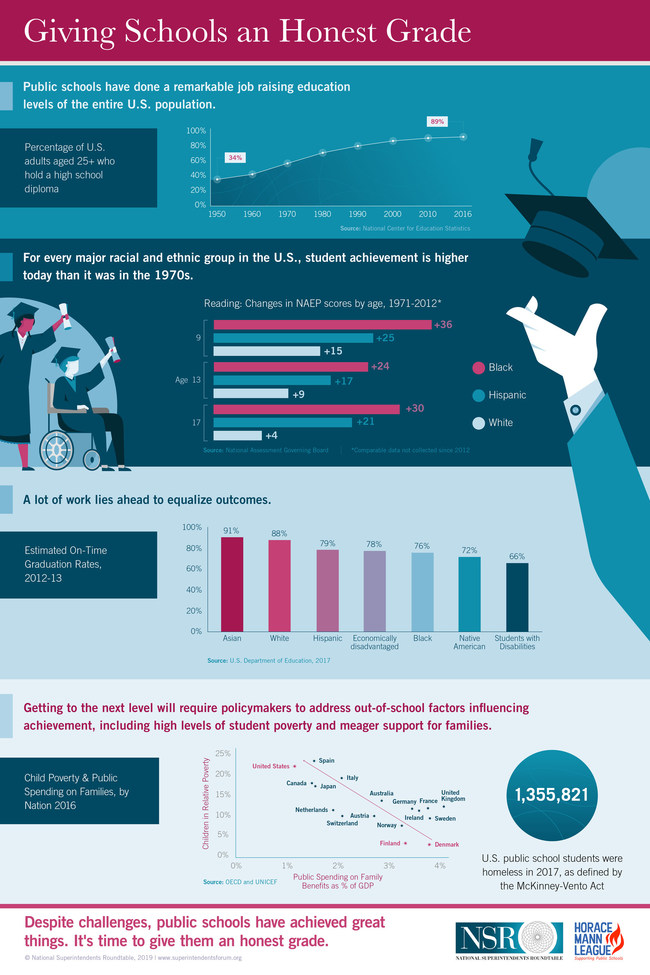
The National Superintendents Roundtable has a message for the public: be fair when judging our public schools. Schools today are far better than they were 40 or 50 years ago, by all conventional measures. what they might have added was that schools made steady progress until about 2007 or so, when No Child Left Behind took hold, then things were made worse by Race to the Top and Common Core. The proliferation of choice has flattened the progress made from 1970 to 2007.

Last night there was a grand event at the Kennedy Center where veterans of the Bush and Obama education world joined together to wring their hands about the crisis at hand. The crisis is not the mess they made of American education for the past 20 years. The crisis is that the tests are not hard enough, the punishments are not tough enough, and the nation needs to buckle down and keep on testing and firing and demanding more from everyone. Except them. Of course.

Our reader Laura Chapman explains what was behind the big party:

“I wanted to look past the PR for this one event. The event is a launch for a new campaign capitalizing on “stagnating” NAEP scores and persistent gaps among students “who have been underserved.”

“The reformists are calling for “evidence based” methods of teaching using only “high quality, standards-aligned, content-rich curriculum.” Suddenly these reformists think “deficits in content-knowledge” matter. But these reformists are really fans of the Common Core and have a lonh history of ignoring much else worthy of study, content in the arts and humanities for example.

“In addition to being sponsored by the Collaborative for Student Success, this “new literacy campaign” is sponsored by Achieve, The Alliance for Excellent Education, The Thomas B. Fordham Institute, Learning Heroes, Literacy Now, National Association of Elementary School Principals, National Council on Teacher Quality, National Urban Alliance, National Urban League, Military Child Coalition, and The Education Trust. These have been supporters of the Common Core, and many love high-stakes tests.

“The Collaborative for Student Success is a multi-faced project of the New Venture Fund. It is supported by: Bloomberg Foundation, Carnegie Corporation of New York, ExxonMobil, Bill & Melinda Gates Foundation, William and Flora Hewlett Foundation, The Charles and Lynn Schusterman Family Foundation. The website markets three of the Collaborative’s favorite math programs, but it also features “campaigns” of the Collaborative. Each campaign has a separate website. All campaigns are based on the premise that states are not living up to the requirements of ESSA. Truly, the sponsors of the Literacy Initiative are die-hard defenders of the Common Core and ESSA. Here are the camaigns in progress.

“A web-based “Assessment HQ” offers test scores and demographic breakouts for test scores “for more than half of states in grades 3-8.” This campaign is designed to claim that state assessments are not tough enough or fully reported to parents. The Collaborative scoops up state assessment results in math and ELA and puts these together in an interactive map. The Assessment HQ is actually sluggish and out of date. It is presenting data from the 2014-15 school year and it was designed to push PARCC and Smarter Balanced tests.

“The “Check State Plans” campaign offers ratings of the state plans for ESSA based on their strict conformity to ESSA. The Collaborative asked 45 reviewers to judge state plans, back in 2017, at about the same time that Bellwether Education Partners also put together a panel to review state ESSA plans. The Collaborative wanted to see “the following principles” honored in state plans. “Set the bar high for what students need to know and understand; Focus on closing the achievement gap in math and English; Ensure that parents and communities have access to meaningful data; Have a real plan for helping those schools that have been historically failing.”

“The “Educators for High Standards” campaign has offered about 12 fellowships to teachers willing to voice enthusiasm for ESSA, along with “partners” from the following groups, all known to push for high-stakes tests and the Common Core: The National Network of State Teachers of the Year, Smarter Balanced Assessment Consortium, PARCC, Teach Plus, Student Achievement Partners (Achieve the Core), National Board of Professional Teaching Standards, Council of Chief State School Officers (CCSSO), Hope Street Group, The New Teacher Project (TNTP), Teach for America, Center for Teacher Quality, and Educators4Excellece.
The” Military Families for High Standards” campaign features the work of advocates for schools serving military families. Among the resources is an article from the Center for American Progress titled “How the Common Core Improves Education for Military-Connected Children.”

“The Honesty Gap” campaign asserts that states must take NAEP’s definition of “proficiency” as the standard for judging the “honesty” in state tests. State tests that claim students are “proficient “are dishonest unless the state standard is the same as for NAEP tests. The “honesty gaps” for each state are shown on an interactive map. The explicit message is that schools are often lying to parents about student achievement. The website should be called Arne Duncan’s BS. https://www.npr.org/templates/story/story.php?storyId=246201831
The “Understanding ESSA” campaign provides news about USDE activities (up-to-date) and links to state actions that comply with ESSA.

The whole website is devoted to belligerent judgments of states, districts, and schools while bolstering advocacy groups who will insist on “strict fidelity” to ESSA in state plans.

These birds of a feather intent on repeating the misery of two decades of top down reform.


Political Morning Education reports a big event in D.C. tonight where partisans of the test-and-punish education policies of the past twenty years will gather to rededicate themselves to their failed programs. Will these advocates for accountability accept any accountability for the misguided practices they have foisted on American education? Will they hold themselves accountable for the billions of dollars spent on testing and privatization that should have been spent on reducing class sizes and raising teachers salaries and opening health clinics in schools? Wouldn’t it be something if they invited someone like Jonathan Kozol or Anthony Cody to explain why NCLB and RTTT failed and how to have a better approach to teaching and learning other than carrots and sticks?


BUSHES SPOTLIGHT READING, LITERACY AMID GRIM ASSESSMENTS: Events starting tonight at the John F. Kennedy Center for the Performing Arts will bring together members of the Bush family, best-selling authors and entertainers, philanthropists, and education and business leaders to celebrate reading and mark the foundation’s 30th anniversary.

— “I believe that literacy is an essential foundation for democracy,” former first lady Laura Bush said in a statement provided to POLITICO. Bush, one of tonight’s honorary co-chairs, will deliver remarks during a program that will include a special performance by country music singer Tim McGraw and Pulitzer Prize-winning biographer Jon Meacham, co-authors of “Songs of America: Patriotism, Protest, and the Music that Made a Nation.”

— The events, including the foundation’s inaugural summit on adult literacy on Wednesday, coincide with grim results on the Nation’s Report Card and an announcement today from the Collaborative for Student Success about an effort with 11 other organizations to address the results.

— Among the organizations are The Education Trust, the National Urban League, the Thomas B. Fordham Institute and the National Association of Elementary School Principals. They’re calling for, among other things, increasing federal investment in evidence-based, comprehensive literacy efforts at the state and local levels.

— “The persistent gaps in reading achievement for students from low-income backgrounds, students of color, English learners, and students with disabilities on the NAEP require urgent action,” said John B. King Jr., former Education secretary and president and CEO of The Education Trust.


Guy Brandenburg offers a graph of 8th Grade scores on NAEP from 1992-2019 for four jurisdiction and invites you to find a miracle , if you can.

The 2019 ACT scores, which are supposed to measure “college readiness,” dropped to a record low. 

This follows nine years after the release of the Common Core State Standards, which were supposed to promote “college and career readiness.”

Nick Anderson of the Washington Post writes:

ACT scores for the high school Class of 2019 show that rates of college readiness in English and math have sunk to record lows, testing officials reported Wednesday.

Among nearly 1.8 million in the class who took the college admission test at least once, ACT — the nonprofit group that administers it — reported that 59 percent reached a score indicating readiness in English and 39 percent did so in math. Those results continued a several-year slide. The English readiness rate was the lowest since the readiness measure debuted in 2002, and the math readiness rate equaled a record low set in 2002.

ACT defines its readiness benchmark as a score indicating a student has at least a 50 percent chance of getting a B or higher in a corresponding first-year college course. For English, the ACT benchmark is 18 out of a maximum 36. For math, it is 22.

When students took a strong course load through high school, ACT found, they fared better.

“Our findings once again indicate that taking core courses in high school dramatically increases a student’s likelihood for success after graduation,” ACT chief executive Marten Roorda said in a statement. “That’s why we need to ensure that all students of all backgrounds have access to rigorous courses and that we are supporting them not only academically, but socially and emotionally as well.”

The ACT — one of two major admission tests — assesses students in English, reading, math and science with multiple-choice questions that take nearly three hours to complete, not counting an optional essay-writing exam. More than a dozen states pay for all high school students to take the ACT during school hours, and others fund the testing on an optional basis….

Among 15 states where officials said nearly all graduates took the test, only four posted an average composite score of 20 or higher: Nebraska, Ohio, Utah and Wisconsin.

********

Education activist Leonie Haimson, executive director of Class Size Matters, commented:

This ACT report along with stagnant or dropping NAEP scores provides a devastating indictment of the Gates/Coleman/Duncan Common Core reform agenda – which was supposed to have provided the opposite result.  And yet Duncan doesn’t acknowledge this in the WaPost (big surprise).
https://www.washingtonpost.com/opinions/what-we-can-learn-from-the-state-of-our-nations-education/2019/10/31/0e365c64-fbfa-11e9-8906-ab6b60de9124_story.html
http://www.act.org/content/dam/act/unsecured/documents/cccr-2019/National-CCCR-2019.pdf
College Readiness levels in English, reading, math, and science have all decreased since 2015, with English and math seeing the largest decline.
States and districts have spent billions of dollars to adopt the Common Core standards–on new textbooks, new tests, new professional development, new technology, all aligned to the Common  Core.
The same amount might have been devoted to reducing class sizes, putting a nurse in every school, increasing teachers’ salaries.
The definition of a corporate reformer is someone who never admits he or she was wrong. They apparently live by the John Wayne credo of “never apologize, mister, it’s a sign of weakness.”
In this case, however, it might be a good sign to let educators adapt to the students in front of them rather than follow a script written in D.C. that is not working.

Gary Rubinstein, math teacher at Stuyvesant High School, is a skilled myth buster. He frequently unmasks “miracle” stories.

In this post, he demolishes the claim that Louisiana has improved faster in 8th grade math than other states.

This is the last gasp of the Disruption movement, which has controlled federal and state policy for 20 years but has little to show for it.

As Rubinstein shows, Arne Duncan and John White are leading the effort to find the “bright side” of the latest NAEP results, which were stagnant In 2019 and have been stagnant for a decade.

Duncan says the nation should look to Louisiana for inspiration. Louisiana ranked among the bottom  states on NAEP, 44th to 49th, depending on the grade and the subject. But how creative to point to one of the lowest performing states as a national model! Do what Louisiana did and your state too can rank among the bottom five states in the nation!

Gary points out that Louisiana has indeed improved, but its 2019 scores on 8th grade math were actually a point lower than its scores were in 2007! In other words, Louisiana hasn’t gained at all for the past dozen years!.

Wouldn’t it be refreshing if the leaders of the Disruption movement admitted that their 20-year-long policy of test-and-punish is both stale and failed?

Wouldn’t it be great if they said, “Whoa! We’re on the wrong track. We’ve inflicted nonstop testing on the nation’s children since 2002. We have spent billions on testing and test-prep. Scores went up for a few years but leveled off in 2007. Enough! Our answers are wrong. Time for fresh thinking.”