Archives for category: Media

The Pitt is an award-winning series on cable about daily life in an emergency room in Pittsburgh. Each episode represents the traumas and rhythm of one hour in one day. It’s gripping and sometimes so gory in its realism that I divert my eyes.

Two articles recently gave the program the highest praise. One, which appeared in Fortune, said that The Pitt exemplifies DEI in action and demonstrates how it saves lives. Patients in extremis often need someone who looks like them to communicate candidly.

But race, color, ethnicity, gender are beside the point. What matters most is saving lives, expressing empathy for people who are in pain and often terrified.

The cast is white, Black, Indian, Hispanic, Filipino, Christian, Jewish, Muslim, male, female, and even includes a staff member in a wheelchair. It is the quintessence of DEI, and none of it is frivolous. It’s just who they are: trained doctors, nurses, psychologists, social workers: people who have chosen to work in a high-pressure emergency room.

The article in Fortune by Robert Raben reminds us of why DEI is valuable.

As diversity, equity, and inclusion programs are under relentless attack, HBO’s medical drama The Pitt offers a masterclass in what DEI truly looks like when these values are woven into the fabric of an institution and put into practice. And how DEI benefits all of us.

There is nothing artificial about “The Pitt.” It is a gripping drama of everyday life in an urban emergency room.

Frank Bruni writes in The New York Times that The Pitt is the most patriotic show on television.

“It’s an empathy exam. It’s a civics lesson. Above all, it’s a study of people under intense pressure — as they are when a pulse is fading, or when a nation is fraying — and the importance of muddling through and making things better, no matter the odds, no matter the obstacles…”

It makes an argument for diversity that’s smart and true, looking beyond the usual dividing lines — race, religion, gender — to less politically charged differences. A brand-new doctor who grew up on a farm in rural America draws on a sensibility that peers lack. A medical student suggests a way to lessen an uninsured patient’s financial distress that her co-workers didn’t think of. It occurred to her not because she’s Asian American but because she grew up in a family with limited means and daunting medical bills, so she was schooled in impediments and options…

There’s a war in America between erudition and improvisation, science and superstition, head and heart. The Pitt might be expected to come down unconditionally on the side of expertise. But it doesn’t, not exactly. While it routinely and rightly exalts medicine’s wondrous advances, it also suggests that experts can be hidebound, timid. And it understands that the wiring of people and of societies demands room for both proper procedure and imagination. 

One of the great things about The Pitt is that the executive producer–Dr. Joe Sachs– is an emergency room doctor who also has a degree in cinema. Every episode is overseen by medical specialists and expert nurses. Every word, every procedure is medically accurate.

One of the shocking actions of Trump’s first year of his second term was his decision to shutter the widely respected Voice of America. Not only were almost all employees laid off, but the leadership of the government agency was put in the hands of MAGA zealot Kari Lake. Lake ran for governor and senator in Arizona, losing both races.

Scott Nover of The Washington Post reported:

Voice of America employees have spent a full year on paid administrative leave while President Donald Trump’s administration has tried to shrink the international broadcaster to its “statutory minimum.” That extended absence is coming to an end.

A federal judge ruled Tuesday that the wind-down of operations at the U.S. Agency for Global Media, VOA’s parent, is unlawful and ordered the agency to bring more than 1,000 employees back to work.

U.S. District Judge Royce C. Lamberth ruled that the near-total shutdown of USAGM, which oversees VOA and funds several international broadcasters such as Radio Free Asia, violated federal administrative law. He ordered the full-time employees to return to work by March 23 and told the agency to resume international broadcasting, which it has mostly abandoned during the past year — save for some airing in languages such as Farsi.

Lamberth, a Ronald Reagan appointee, criticized the government’s “flagrant and nearly year-long refusal” to uphold statutory requirements set by Congress and lambasted Kari Lake, the Trump official who oversaw the dismantling of the agency. Lamberth recently ruled that Lake has been running the agency illegally. “The defendants’ persistent omission and withholding of key information in this case has been a Hallmark production in bad faith,” he wrote of Lake and the government in a footnote.

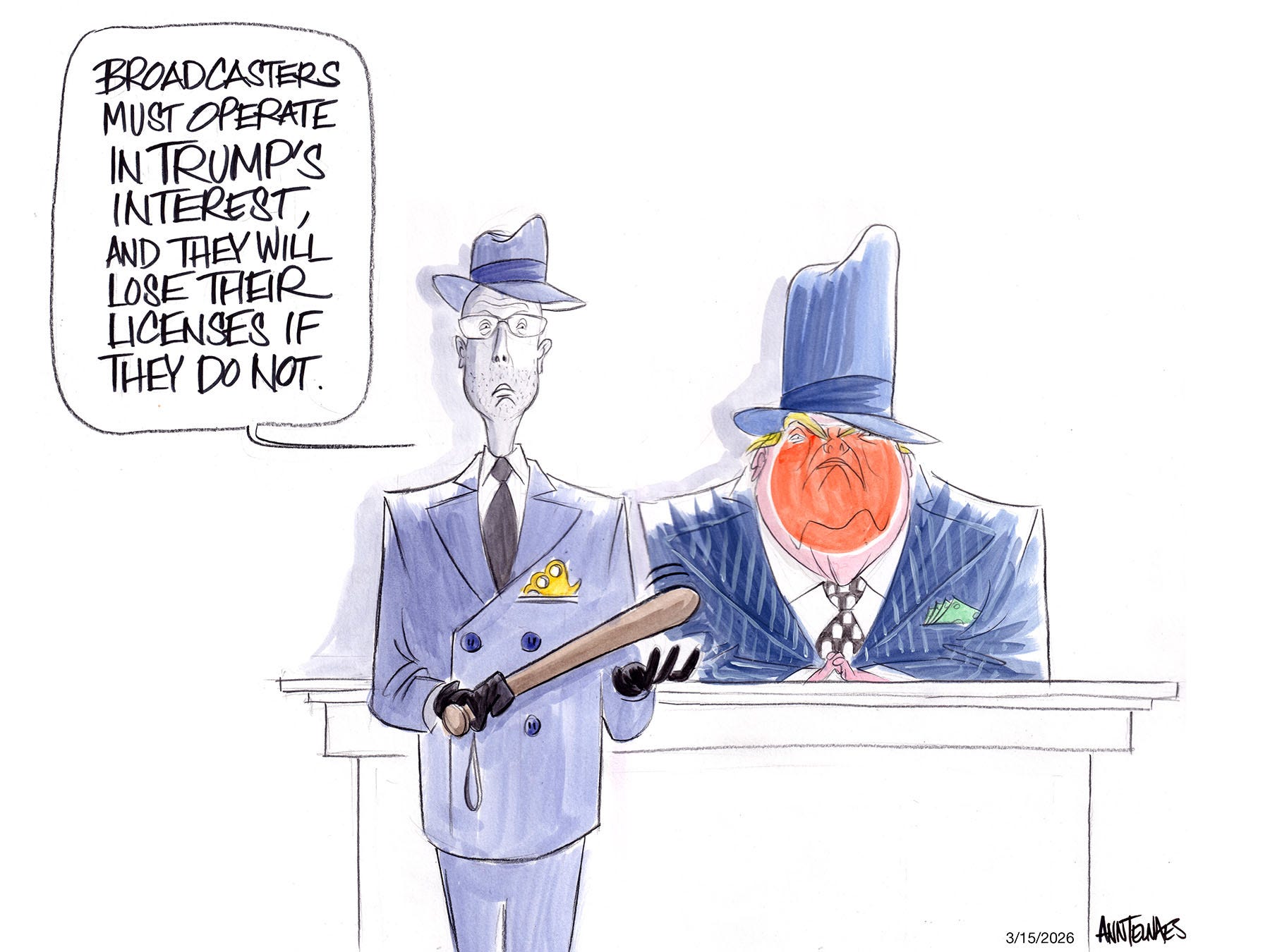
Brendan Carr, selected as chairman of the Federal Communications Conmission, threatened to revoke the licenses of stations that were too negative in their coverage of the war in Iran.

Ann Telnaes was an editorial cartoonist for The Washington Post. She drew a cartoon showing billionaires bowing down to Trump. One of them was Jeff Bezos, owner of the Post. Her editor wouldn’t publish her cartoon. She resigned.

She now has her own blog on Substack where she is never censored.

It’s not the public interest Carr cares about

The FCC Chairman wants to make the boss happy

ANN TELNAES

Trump wants propaganda, not news coverage of his war and FCC Chairman Brendan Carr is making threats to get it. 

One of Trump’s most puzzling decisions last year was shutting down the Voice of America. It had 360 million listeners every week around the world and was widely respected as a source of news, not propaganda.

Trump put Kari Lake in charge of VOA’s parent agency, the U.S. Agency for Global Media, will appeal the decision. Her assignment was to close down VOA and turn whatever remained open into a Trump propaganda machine. Lake is an election denier and failed candidate from Arizona.

Judge Royce Lamberth, a Reagan appointee, said that she was serving illegally because she had never been confirmed by the U.S. Senate and voided her decisions.

Some 1,000 journalists and staff are expected to return to their jobs if she loses on appeal.

The shutdown of VOA was the first salvo in Trump’s ongoing efforts to gain control of the media.

The New York Times reported:

In his ruling, Judge Lamberth called Mr. Trump’s decision to have Ms. Lake lead the global media agency without Senate confirmation or appropriate procedures required for an acting head “violence to the statutory and constitutional scheme.”

The judge found that Ms. Lake’s appointment violated the law that determines who can serve as an acting head of an agency whose permanent leader would require Senate confirmation. The law, the Vacancies Act, requires that an acting head must be the second senior officer of an agency, be appointed by the president with the Senate’s consent or be a senior officer who had been at the agency before a vacancy arose.

Judge Lamberth found that Ms. Lake did not satisfy those conditions.

Ms. Lake claimed that she had not assumed the official title of the acting chief executive of the media agency, but rather, that the authority of its chief executive position had been delegated to her. That allowed her to exercise sweeping power over layoffs, funding cuts and contract terminations at the news agency, she said.

But the judge rejected her argument, writing that “allowing the president to circumvent Congress’s carefully crafted limitations” through delegations would violate the spirit of the Constitution.

A very interesting blog called Status covers the media. It usually has the inside scoop on what’s going on behind the scenes, which journalists are seeing or leaving, what’s happening inside the major corporations.

In this post, Status explains how difficult it is to cover the war in Iran. The regime does not admit journalists. CNN is trying to provide coverage, as is The New York Times, but its reporters are not in Iran. The Washington Post is suffering from self/-influcted wounds because just a few weeks ago, Jeff Bezos eliminated his foreign correspondents in a cost-cutting move. Really smart for a guy with a net worth of $250 billion.

Natalie Korach wrote for Status:

As U.S. and Israeli forces launch deadly strikes on Iran, the inherent challenges of covering the country are exacerbated by recent newsroom cuts, social media distortion, and a White House prone to telling lies. When the U.S. invaded Iraq in 2003, Americans watched the war unfold through footage captured by journalists embedded with troops across the region. Two decades later, when Russia invaded Ukraine, foreign correspondents from U.S.-based networks raced to Kyiv and other areas of conflict, broadcasting live as missiles struck Ukrainian territory. But when the United States and Israellaunched strikes on Iran over the weekend, there were few, if any, Western journalists in the country to document the damage firsthand. 

In a nation largely closed to Western media and with broadly limited internet access, the conflict is unfolding as something of an information black box, forcing news organizations to cover one of the most consequential military escalations in years largely from the outside. Adding to the challenge: Whether they can trust pronouncements coming from a Trump administration that has exhibited few compunctions about lying, from the president on down; and the degradation of social media, especially X, which is no longer a reliable source of information in breaking news situations. 

Major television news networks and newspapers tasked with covering the war are having to piece together events from government statements, grainy videos circulating online, and reports from Iranian state media. In an era where many news organizations have been forced to scale back foreign bureaus and reporting resources—most notably the recent and devastating cuts at The Washington Post—the conflict is quickly becoming a test for media, exacerbated by the fact that Iran remains one of the most difficult places on earth for journalists to operate safely. 

The geographic spread of the reporting team at CNN, the U.S. network with arguably the most foreign reporting resources, illustrates the challenge. The network has reporters fanned out across the region—Erin BurnettNick Paton Walsh, and Jeremy Diamond in Tel AvivNic Robertson in RiyadhBecky Anderson in Abu DhabiPaula Hancocks in Dubai, and Clarissa Ward reporting from Erbil in northern Iraq. Elsewhere across cable news, Fox News had Trey Yingst reporting live from Tel Aviv, Nate Foy on the ground in Cyprus, and Lucas Tomlinson in Istanbul. But none appeared to be inside Iran as of Sunday afternoon. 

The New York Times is similarly mobilizing its global newsroom to cover the unfolding conflict. A spokesperson for the paper told Status that “hundreds of journalists from across The Times’ global newsroom–in New YorkWashingtonLondonSeoul and a large and growing reporting team on the ground in the region–have been coming together to produce comprehensive coverage of every aspect of this military action.” 

But few news organizations still possess the global infrastructure to support half a dozen or more reporters monitoring the situation on the ground in neighboring countries. Years of budget cuts have thinned the ranks of foreign correspondents in the region across the industry. At The Post, recent layoffs hit international coverage particularly hard, with the paper’s entire Middle East desk laid off. In January, Post reporter Yeganeh Torbati, who had been covering Iran, publicly appealed to owner Jeff Bezos on social media alongside colleagues, noting that she had spent months covering developments inside the country and wanted to continue the work. The appeals to Bezos to save the foreign reporting staff went unheeded. 

“If I were The Washington Post right now, I’d still want international journalists,” Ian Bremmer wrote on social media, where many experts called attention to the terrible timing of The Post’s retrenchment during this moment of crisis abroad. Spokespersons for The Post did not respond to requests for comment, but the paper’s rolling coverage of the conflict dominated its homepage all weekend.

Steve Benen of MS NOW wrote about the censorship of Stephen Colbert’s show by CBS. Since CBS was purchased by the Ellison family, who support Trump, the network is careful to screen out criticism of Trump. Since Talarico is running against Jasmine Crockett, the calculation must have been to undermine him, assuming that Republicans want Crockett as the nominee, not Talarico.

Colbert was already fired by CBS. He’s thus free to say whatever he wants. His last show airs in May.

Benen wrote:

With just a couple of weeks remaining before Texas’ closely watched Democratic U.S. Senate primary, there’s considerable interest in state Rep. James Talarico, one of the leading contenders. With this in mind, the candidate was scheduled to be on CBS’ “The Late Show” on Monday for an interview with Stephen Colbert, which likely would have been interesting and newsworthy.

Except those tuning in to see the interview were left wanting. Colbert told his audience, referring to Talarico, “He was supposed to be here, but we were told in no uncertain terms by our network’s lawyers, who called us directly, that we could not have him on the broadcast.”

The host went on to note that the network that employs him suggested he wasn’t supposed to talk about the apparent fact that it told him not to have Talarico on the show — which, naturally, led Colbert to talk about it at some length and in considerable detail.

The host, whose award-winning show will end in May, told viewers about the Federal Communications Commission and its newfound interest in an old policy called the “equal-time rule,” which has never applied to news interviews and talk-show programs.

As MS NOW reported about a month ago, however, FCC Chairman Brendan Carr suggested a shift in the policy, declaring that shows hosting political candidates will not automatically qualify as “bona fide news” programs, which are exempt from the equal-time requirements.

And so, Colbert lowered the boom:

Let’s just call this what it is: Donald Trump’s administration wants to silence anyone who says anything bad about Trump on TV, because all Trump does is watch TV, OK? He’s like a toddler with too much screen time. He gets cranky and then drops a load in his diaper.

MS NOW has reached out to CBS and the FCC for comment. This post will be updated if they respond.

It’s worth emphasizing that Colbert did, in fact, interview Talarico — it just wasn’t aired on “The Late Show” as planned. Instead, the program posted the entirety of the appearance on its YouTube channel. (Ironically, the broader controversy likely generated additional interest in the interview beyond the audience it was probably going to receive in the first place, offering a fresh example of the Streisand effect.)

The latest clash between Colbert and CBS comes against a backdrop of allegations that the network is moving to the right under its new corporate ownership, but the comedian’s comments about the incumbent president were of particular interest because of the broader pattern.

Indeed, Trump has positioned himself as the nation’s most enthusiastic critic of late-night hosts in recent months, with the Republican repeatedly taking aim at Colbert, ABC’s Jimmy Kimmel, NBC’s Jimmy Fallon, Comedy Central’s Jon Stewart, NBC’s Seth Meyers and Trevor Noah. A few days ago, the president added HBO’s Bill Maher to the list.

As recently as November, Trump insisted that late-night hosts who mock him are engaged in “probably illegal” misconduct, the First Amendment be damned. Two months later, Carr issued a new declaration related to the equal-time policy, and the month after that, Colbert wasn’t allowed to show viewers of his television show an interview with a Democratic Senate candidate

I thought of canceling my subscription to The Washington Post when Jeff Bezos blocked the editorial board from endorsing Kamala Harris for President in 2024.

But I didn’t because there were so many writers whose work I appreciated, both opinion writers and news reporters. .

I have a special connection to The Washington Post.

I worked as a copyboy for The Post in the summer between my junior and senior years in college. It was a menial job but I loved it. It was a badge of honor (in my mind) to work there.

When my book The Death and Life of the Great American School System: How Testing and Chiice Are Undermining Education was published, Valerie Strauss of The Post decided to give the book maximum exposure. First, she interviewed me for Book TV, then she wrote a glowing review.

I read The Post everyday and enjoyed the reporting, the editorials, and the opinions.

But now, it is impossible to remain a subscriber after Jeff Bezos cut the heart out of the paper. Since he realized how vengeful Trump is, he became Trump’s sycophant. He hired a Murdoch guy as publisher. He hired a conservative as editor. He fired 1/3 of the news writers. He laid off bureau chiefs all over the world. His focus now is politics and national security.

As one ex-staffer put it, he murdered The Post. What was once was a great liberal (but not leftwing) newspaper is now a conservative paper. No more investigative reporting if the kind that toppled Nixon. No more deeply researched reporting from other nations.

He cut the heart out of the newspaper I loved to read for decades.

Jeff Bezos left a loyal reader like me no alternative. I canceled. There are so many other sources of news today that I don’t need to read a newspaper that sold out its principles.

Ruth Marcus started her career at The Washington Post in 1984. She rose through the ranks and eventually became an editorial writer, a columnist, and deputy editor of the editorial page.

She wrote in The New Yorker about why she ultimately quit:

I stayed until I no longer could—until the newspaper’s owner, Jeff Bezos, issued an edict that the Post’s opinion offerings would henceforth concentrate on the twin pillars of “personal liberties and free markets,” and, even more worrisome, that “viewpoints opposing those pillars will be left to be published by others.” I stayed until the Post‘s publisher, Will Lewis, killed a column I filed last week expressing my disagreement with this new direction. Lewis refused my request to meet. (You can read the column in full below, but—spoiler alert—if you’re craving red meat, brace for tofu. I wrote the piece in the hope of getting it published and registering a point, not to embarrass or provoke the paper’s management.)

Is it possible to love an institution the way you love a person, fiercely and without reservation? For me, and for many other longtime staff reporters and editors, that is the way we have felt about the Post. It was there for us, and we for it. One Saturday night, in May, 1992, the investigative reporter George Lardner, Jr., was in the newsroom when he received a call that his twenty-one-year-old daughter, Kristin, had been shot and killed in Boston by an abusive ex-boyfriend. As I recall, there were no more flights that night to Boston. The Post’s C.E.O., Don Graham, chartered a plane to get Lardner where he needed to go. It was typical of Graham, a kindness that engendered the loyalty and affection of a dedicated staff.

Graham’s own supreme act of loyalty to the Post was his painful decision to sell the paper, in 2013, to Bezos, who made his vast fortune as the founder of Amazon. The Graham family was hardly poor, but in the new media environment—and under the relentless demands of reporting quarterly earnings—they were forced, again and again, to make trims, at a time when investment was needed. Instead of continuing to cut and, inevitably, diminish the paper that he loved, Graham carried out a meticulous search for a new owner with the resources, the judgment, and the vision to help the Post navigate this new era. Bezos—the “ultimate disrupter,” as Fortune had called him a year earlier—seemed the right choice.

For a long time, she writes, Bezos was a hands-off manager. During Trump’s first term, Bezos supported the newspaper’s editorial opposition to Trump’s 2016 election and its tough coverage of the chaotic Trump term.

She liked Bezos: In my experience of that time, Bezos came off as charming, smart, and unpretentious.

In 2020, the Washington Post endorsed Biden.

In 2024, Bezos stopped the editorial board from publishing its endorsement of Kamala Harris. The man Bezos selected as publisher was Will Lewis, a Brit who had worked in Rupert Murdoch’s media empire. Lewis defended the non-endorsement. Two opinion writers resigned, most signed a letter to Bezos objecting to his decision. Some 300,000 people cancelled their subscriptions.

After the election, Bezos seemed to fawn over Trump, defending him at every turn, donating to his inauguration fund. Two months after the election, Bezos offered Nelania $40 million to produce a documentary about her life in the White House. Many saw it as protection money.

Bezos defended his new view about Trump by saying that Trump had grown, was more deliberative since his last term. He told a reporter from The New York Times that Trump “is calmer than he was the first time and more confident, more settled.” Marcus said Bezos displayed “willful self-delusion.”

In early January, before the Inauguration, a cartoon by Pulitzer Prize-winning Ann Telnaes depicting the billionaires bowing to Trump was rejected by the editor David Shipley on grounds that it slduicated a column already published. Marcus thought this was an example of “obeying in advance,” that would not have happened if Bezos were not in charge.

Then came the order from Bezos on February 25, 2025, to editorial writers that The Post would publish only editorials and opinions that supported “free markets and personal liberties.” Those with opposing views would not appear in The Post.

No editorial writer had worked under these restrictions before. Marcus submitted a piece objecting to the restrictions; the publisher (Will Lewis) rejected it. She was stunned.

She tried to see him, but was told, “The decision is final.”

Marcus wrote:

So, too, was mine. I submitted my letter of resignation on Monday, to Bezos and Lewis. “Will’s decision to not run the column that I wrote respectfully dissenting from Jeff’s edict—something that I have not experienced in almost two decades of column-writing—underscores that the traditional freedom of columnists to select the topics they wish to address and say what they think has been dangerously eroded,” I wrote. “I love the Post. It breaks my heart to conclude that I must leave.”

The Washington Post that she had known and loved for forty-one years was dead.

Glenn Kessler is the relentless fact-checker who spent many years at The Washington Post and now writes his own blog at Substack, still fact-checking.

He wrote recently about Jeff Bezos’s plan to lay off a large number of staff at the venerable newspaper. News of the impending cuts circulated for days. When it finally happened, journalists were shocked by the depth of the cuts. One third of the writers lost their jobs. The sports section was eliminated. Foreign coverage was slashed. Local reporting, a Post specialty, was cut hard.

As things now stand, one of America’s most consequential newspapers is in a death spiral, accelerated by Jeff Bezos. It is not often that we witness the destruction of a great institution by those entrusted with its care.

Ashley Parker, a former reporter for The Washington Post, wrote in The Atlantic about “The Murder of the Washington Post.”

Over recent years, they’ve repeatedly cut the newsroom—killing its Sunday magazine, reducing the staff by several hundred, nearly halving the Metro desk—without acknowledging the poor business decisions that led to this moment or providing a clear vision for the future. This morning, executive editor Matt Murray and HR chief Wayne Connell told the newsroom staff in an early-morning virtual meeting that it was closing the Sports department and Books section, ending its signature podcast, and dramatically gutting the International and Metro departments, in addition to staggering cuts across all teams. Post leadership—which did not even have the courage to address their staff in person—then left everyone to wait for an email letting them know whether or not they had a job. (Lewis, who has already earned a reputation for showing up late to work when he showed up at all, did not join the Zoom.)

The Post may yet rise, but this will be their enduring legacy.

Kessler wrote:

You’re right. I did lose a million dollars [on the newspaper] last year. I expect to lose a million dollars this year. I expect to lose a million dollars next year. You know, Mr. Thatcher, at the rate of a million dollars a year, I’ll have to close this place in…sixty years.”

—Charles Foster Kane, speaking to his ex-guardian, in Citizen Kane (1941)

[Diane’s note: if Jeff Bezos subsidized the Post at $100 million a year, he would run out of money in 2,500 years, or 4526, that is, assuming that he wasn’t growing his wealth at the same time.]

When Jeff Bezos bought The Washington Post in 2013, his net worth was about $25 billion. Now, as he prepares to order devastating layoffs at the newspaper, his net worth is about $250 billion — even after giving one-quarter of his Amazon shares to his ex-wife, MacKenzie Scott.

Bezos is a businessman, and the Washington Post is not a charity, so I understand the inclination to demand that losses be stemmed. The newsroom should be able to stand on its own feet. But even if the losses are still around $100 million a year — the figure announced a couple of years ago — for a person of Bezos’ wealth, that would mean he’d have to close the place in…2,500 years.

I don’t think the layoffs have much to do with saving money. Amazon, after all, just spent $75 million buying and promoting a documentary about Melania Trump. It’s about power and influence in Donald Trump’s second term.

After Trump won the first time in 2016, I was among a small group of reporters and editors invited to have lunch with Bezos. With a booming laugh and big smile, he said he wanted to hear war stories about covering the wild Trump-versus-Clinton campaign.

At one point, someone asked if he was concerned that Trump would seek retribution against his other businesses. (I’m writing this from memory, not notes, so I won’t use quotation marks.)
Bezos acknowledged that Trump would assume any negative story about him had been ordered up by Bezos, because that’s what Trump would do if he owned a newspaper. But he said that wasn’t our problem. We only had to write the best stories possible; he could handle the heat if Trump got mad.

Those were comforting words at the time. As far as I know, Bezos has never interfered with any news coverage during his 13 years as owner — even stories critical of Amazon or coverage of Bezos’s personal life, let alone politics. For many years, he didn’t even appear to get very involved with the editorial page, even though, as owner, he could dictate whatever opinion-page policy he wanted.

As Bezos predicted, Trump in his first term often fumed about the “Amazon Washington Post” — they are not connected — and his administration took actions that were costly to Bezos. The Pentagon gave a $10-billion cloud-computing contract to Microsoft, and Amazon sued in 2020, saying Trump intervened because of his anger at The Post. (In 2022, the Microsoft contract was scrapped, and the business was split among four firms, including Amazon.)

Yet Bezos was unbowed. He embraced and promoted a new slogan — Democracy Dies in Darkness — that seemed aimed directly at Trump’s administration. He boosted the size of the staff and increased the ambitions of The Post. He appeared to embrace the idea, dare I say, that he was the steward of a public trust.

Presidential-level threats disappeared with Trump’s defeat in 2020, though Joe Biden was no fan of the tech industry. But when Trump ran again and the Democrats were on the ropes, Bezos’s calculation changed. He could afford Trump’s first term; a second could be ruinous, especially as Elon Musk, his main rival in the space business, embraced Trump.

I used to think billionaires had enough “fuck-you” money to do what they pleased. But in Trump’s creeping autocracy, and with his campaign of retribution, billionaires have too much to lose.

Mark Zuckerberg of Meta spent $100 million to fund fact-checking around the globe. But once Trump was elected, Zuckerberg pulled the plug on funding U.S. fact-checkers, shutting many down. Bezos scrubbed a planned newspaper endorsement of Kamala Harris and announced a rightward shift in the opinion pages, leading hundreds of thousands of subscribers to cancel their subscriptions. That, of course, likely increased the losses.

If there was ever a time for a news organization to need help from a billionaire, it’s now — when AI is killing search traffic and new ways to attract readers are needed. This is when investments are required, not cutbacks.

Even before Trump re-emerged, Bezos appeared to have grown less interested in The Post. The New York Times capitalized on subscriber growth during Trump’s first term to make acquisitions that expanded its reach (The Athletic, Wordle). The Post made no such moves. Subscriber growth stalled, then slipped. Bezos lavished attention on his new love, Lauren Sánchez, whom he married last year in Venice in a $50-million extravaganza. He also spent $500 million on the most expensive superyacht in the world — twice what he paid for The Post.

Unlike Scott — who has given away more than $19 billion to 2,000 non-profit organizations— Bezos has set aside a pittance of his net worth for philanthropy. Many Post reporters hoped Bezos would simply give the newspaper to his ex-wife, believing she had a greater sense of social responsibility (and none of his corporate conflicts).

No longer engaged, Bezos appears to have embraced a crude calculus: laying off staff and trimming the sails of a once-great news organization sends a message to an audience of one at 1600 Pennsylvania Avenue, even if the decision ruins the lives of scores of talented reporters and editors.

After all, since the election Bezos has worked hard to ingratiate himself with Trump —making a $1 million donation (via Amazon) to the inaugural fund., dining at the White House, visiting Mar-a-Lago and, according to Trump, solving “a problem very quickly.” (Amazon had planned to list the cost of tariffs with products, but canceled that after Trump called Bezos.)

Trump views any news that is not favorable as “fake news.” He couldn’t have been happy with The Post’s aggressive coverage last year of the dismantling of the federal government, which led to an FBI raid on a reporter’s home in January.
But Trump views Bezos as trying to make the newspaper “more fair,” as he put it in a March interview with Clay Travis. “I think it’s great,” Trump gushed. “It’s such a difference between now and the first…He’s really trying to be more fair. But they actually did a couple of bad articles that everybody said, ‘This is crazy.’”

In another interview, with Sharyl Attkisson, Trump said, “I’ve gotten to know him and I think he’s trying to do a real job. Jeff Bezos is trying to do a real job with the Washington Post. And that wasn’t happening before.”

And so far in the second term, not once has Trump referred to the “Amazon Washington Post.”

In looking around, trying to learn more about Sharyn Alfonsi, I came across a commencement address she delivered at the journalism school at the University of Mississippi. It is hilarious!

She offers an abundance of wit, mingled with great career advice for aspiring journalists.

You get insight into the character of the “60 Minutes” reporter who spoke out and stood up to her bosses when they censored her reporting about CECOT, the terrorist prison in El Salvador.

As Dan Rather said, Sharyn Alfonsi is “One Courageous Correspondent.”