Archives for category: Los Angeles

Glenn Sacks is a veteran social studies teacher in a Los Angeles public high school. Many of the students he teaches are immigrants. He describes here what he has learned about them.
He writes in Huffington Post:

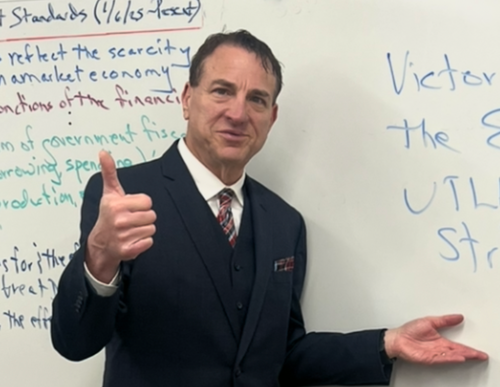
The author teaching in June 2025.

Teacher Glenn Sacks

“If they spit, we will hit, and I promise you, they will be hit harder than they ever have been hit before. Such disrespect will not be tolerated!” — Donald Trump

President Trump says he is defending Los Angeles from a “foreign invasion,” but the only invasion we see is the one being led by Trump. 

Roughly a quarter of all students in the Los Angeles Unified School District are undocumented. The student body at the high school where I teach consists almost entirely of immigrants, many of them undocumented, and the children of immigrants, many of whose parents and family members are undocumented. This week we held our graduation ceremony under the specter of Trump’s campaign against our city.

Outside, school police patrolled to guard against potential Immigration and Customs Enforcement raids. Amidst rumors of various actions, LAUSD decided that some schools’ graduations would be broadcast on Zoom. 

For many immigrant parents, graduation day is the culmination of decades of hard work and sacrifice, and many braved the threat of an ICE raid and came to our campus anyway. Others, perhaps wisely, decided to watch from home.

They deserve better.

Trump’s Homeland Security Secretary Kristi Noem calls us a “city of criminals,” and many Americans are cheering on the Trump administration and vilifying immigrants. What we see in LAUSD is an often heroic generation of immigrant parents working hard to provide for their children here while also sending remittance money to their families in their native countries. We see students who (usually) are a pleasure to teach, and parents who are grateful for teachers’ efforts.

Watching the students at the graduation ceremony, I saw so many who have had to overcome so much. Like the student in my AP U.S. government class who from age 12 worked weekends for his family’s business but made it into UCLA and earned a scholarship. There’s the girl who had faced homelessness this year. The boy with learning issues who powered through my AP class via an obsessive effort that his friends would kid him about, but which he committed to anyway. He got an “A,” which some of the students ribbing him did not.

Many students have harrowing, horrific stories of how they got to the U.S. — stories you can usually learn only by coaxing it out of them.

There’s the student who grew up in an apartment complex in San Salvador, where once girls reached a certain age they were obligated to become the “girlfriend” of a member of whatever gang controlled that area. When she was 14 they came for her, but she was ready, and shot a gang member before slipping out of the country, going all the way up through Guatemala and Mexico, desperate to find her father in Los Angeles. 

As she told me this story at parent conference night, tears welled up in her father’s eyes. It’s also touching to watch their loving, long-running argument — he wants her to manage and eventually take over the small business he built, and she wants to become an artist instead. To this day she does not know whether the gang member she shot lived or died. 

At the graduation ceremony, our principal asks all those who will be joining the armed forces to stand up to be recognized. These students are a windfall for the U.S. military. I teach seniors, and in an average class, three or four of my students join the military, most often the Marines, either right out of high school or within a couple years. 

Were these bright, hard-working young people born into different circumstances, they would have gone to college. Instead, they often feel compelled to join the military for the economic opportunity — the so-called “economic draft.” 

Some also enlist because it helps them gain citizenship and/or helps family members adjust their immigration status. A couple years ago, an accomplished student told me he was joining the Marines instead of going to college. I was a little surprised and asked him why, and he replied, “Because it’s the best way to fix my parents’ papers.”

Immigrants are the backbone of many of our industries, including construction and homebuilding, restaurants, hospitality and agriculture. They are an indispensable part of the senior care industry, particularly in assisted living and in-home care. Of the couple dozen people who cared for my ailing parents during a decade of navigating them through various facilities, I can’t remember one who was not an immigrant. There is something especially disturbing about disparaging the people who care for us when we’re old, sick, and at our most vulnerable. 

Immigrants are woven into the fabric of our economy and our society. They are our neighbors, our co-workers, our friends, and an integral part of our community. The average person in Los Angeles interacts with them continually in myriad ways — and without a thought to their immigration status. 

Immigrants are also maligned for allegedly leeching off public benefits without paying taxes to finance them. This week conservative commentator Matt Walsh called to ”ban all third world immigration″ whether it’s “legal or illegal,” explaining, “We cannot be the world’s soup kitchen anymore.”

One can’t teach a U.S. government and politics class in Los Angeles without detailing the phenomenon of taxpayers blaming immigrants for the cost of Medicaid, food stamps and other social programs. My students are hurt when they come to understand that many Americans look at their parents, who they’ve watched sacrifice so much for them, as “takers.”

Nor is it true. 

Californians pay America’s highest state sales tax. It is particularly egregious in Los Angeles, where between this and the local surcharge, we pay 9.75%. As I teach my economics students, this is a regressive tax where LAUSD students and their parents must pay the same tax rate on everything they buy as billionaires do.

Moreover, most immigrants are renters, and they informally pay property taxes through their rent. California ranks 7th highest in the nation in average property taxes paid. 

Our state government estimates that immigrants pay over $50 billion in state and local taxes and over $80 billion more in federal taxes. Add this to the enormous value of their labor, and America is getting a bargain. 

Part of what is driving the current protests is the sense that once somebody is taken by ICE, their families won’t know their fate. Where will they be sent? Will they get due process? Will they end up in a Salvadoran megaprisonwhere, even if it’s ordered that they be returned home, the president may pretend he can’t get them back? It is fitting that the flashpoint for much of the protests has been the federal Metropolitan Detention Center downtown. 

We also question the point of all this, particularly since the Trump administration can’t seem to get its story straight as to why ICE is even here. 

Trump’s border czar Tom Homan says the raids are about enforcing the laws against hiring undocumented workers and threatens “more worksite enforcement than you’ve ever seen in the history of this nation.” By contrast, Homeland Security Assistant Secretary Tricia McLaughlin, citing “murderers, pedophiles, and drug traffickers,” says the purpose of the raids is to “arrest criminal illegal aliens.” 

And now, having provoked protests, the Trump administration uses them as a justification for escalating his measures against Los Angeles.

Amid this, our graduating students struggle to focus on their goals. One Salvadoran student who came to this country less than four years ago knowing little English managed the impressive feat of getting an “A” in my AP class. He’d sometimes come before school to ask questions or seek help parsing through the latest immigration document he’d received. Usually, whatever document I read over did not provide him much encouragement.

He earned admission to a University of California school, where he’ll be studying biomedical engineering. Perhaps one day he’ll help develop a medicine that will benefit some of the people who don’t want him here. 

When we said goodbye after the graduation ceremony, I didn’t know what to say beyond what I’ve often told him in the past — “Just keep your head down and keep marching forward.”

“I will,” he replied.

Glenn Sacks teaches government, economics, and history in the Los Angeles Unified School District. His columns on education, history, and politics have been published in dozens of America’s largest publications.
The Los Angeles Times reported that Trump used the devastating Los Angeles fires to stage a pointless stunt: He sent the Army Corps of Engineers to release water from two Northern California reservoirs. He claimed that he released the water to help put the fires out, but by the time he did it, the fires were almost completely extinguished, and it would not have flowed to Los Angeles anyway.

Now the farmers who rely on the water in the reservoirs are worried if they will have enough water this summer.

Days after President Trump startled some of his most ardent supporters in California’s San Joaquin Valley by having the Army Corps of Engineers suddenly release water from two dams, many in the region and beyond were still perplexed.

Acting on an order from Washington, the corps allowed irrigation water to flow down river channels for three days, into the network of engineered waterways that fan out among farm fields in the San Joaquin Valley. Coursing from rivers to canals to irrigation ditches, much of the water eventually made its way to retention basins, where it soaked into the ground, replenishing groundwater.

“It’s been recharged to the ground,” said Tom Barcellos, president of the Lower Tule River Irrigation District and a dairyman and farmer. That sounds good, except farmers in parts of the San Joaquin Valley typically depend on water from the two dams to irrigate crops in the summer. In other words, the release of water this time of year, when agriculture usually doesn’t require it, means that growers are likely to have less water stored in the reservoirs this summer, during a year that so far is among the area’s driest on record….

The sudden, unplanned release of water from the dams has led to criticism from some residents, water managers and members of Congress, who say the unusual discharge of water seems to have been intended to make a political statement — to demonstrate that Trump has the authority to order federal dams or pumps to send more water flowing as he directs.

“These kinds of shenanigans, they hurt smaller farmers,” said Dezaraye Bagalayos, a local water activist. Small growers have already been struggling, and the release of water from the dams means they will have less when they need it, Bagalayos said.

“The last thing in the world California water management needs is somebody like Trump calling shots when he doesn’t know how anything works,” Bagalayos said. “It’s making an already hard situation very, very difficult. We don’t have a lot of wiggle room in the state of California to be messing around with our water supply like this….”

The action occurred after Trump’s visit to fire-devastated Los Angeles, when he pledged to “open up the valves” to bring the region more water — even though reservoirs that supply Southern California’s cities were at record levels (and remain so).

As the water poured from the dams, Trumpposted a photo of one of them, saying it was “beautiful water flow that I just opened in California.” The Army Corps of Engineers said the action was “consistent with the direction” in Trump’s recent executive order, which calls for maximizing water deliveries.

Neither Trump nor the Army Corps of Engineers provided details about where the water was intended to go. But water released from the two dams serves agriculture in the eastern San Joaquin Valley. It typically does not reach the Los Angeles area, which depends instead on supplies delivered from the aqueducts of the State Water Project on the other side of the valley.

The water releases lowered the levels of the two reservoirs: Lake Success, near Porterville, had been about 20% full. It fell to 18%. Lake Kaweah, near Visalia, was roughly 21% full and similarly dropped to 19% of capacity over the weekend.

Federal records show that more than 2 billion gallons were released from the reservoirs over three days.

If anyone knows of a cure for “stupid,” please contact the White House.

Governor Gavin Newsom has been fighting a two-front war: the devastating fires in Los Angeles and the massive amount of disinformation about the state’s efforts.

One widespread rumor is that Governor Newsom cut the state’s firefighting budget by $100 million in the year before the LA fires.

Politifact reviewed the facts. As usual, it’s complicated. Newsom did cut the fire budget by $100 million at the same time that the overall fire budget increased. If you want to see how this happened, read the report in full.

Here is the conclusion.

Cal Fire’s budget and spending have grown

Cal Fire’s total base wildfire protection budget has nearly tripled over the past 10 years (from $1.1 billion in 2014‑15 to $3 billion in 2023‑24), according to a March analysis by the Legislative Analyst’s Office before the 2024-25 budget was approved.

Cal Fire’s overall budget also has increased, with its combined budget for fire protection, emergency fire suppression, resource management and fire prevention more than doubling over the past 10 years from $1.7 billion in 2014‑15 to $3.7 billion in 2023‑24. (Newsom’s office sent us similar information showing budget increases.)

The number of staff members working in fire prevention have similarly grown during that same decade rising from 5,756 to 10,275.

Another way to look at Cal Fire is through expenditures rather than the budgeted amount because it’s not unusual for the state to dip into other pots of money to spend more than budgeted for addressing fires. 

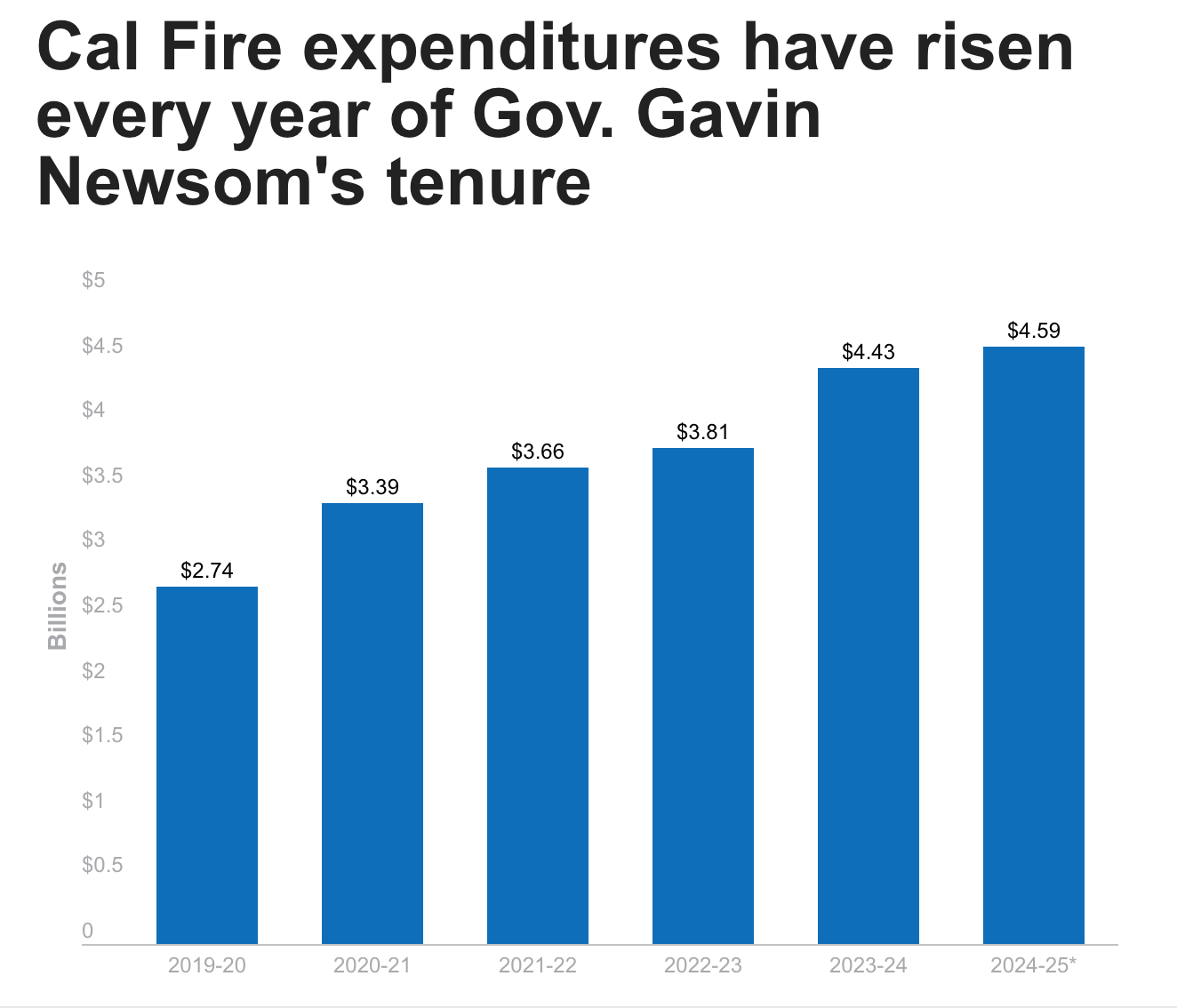
The legislative analyst’s office estimated total Cal Fire expenditures have risen during Newsom’s tenure:

* The 2024-25 amount does not yet reflect additional costs being incurred for the current Los Angeles-area wildfires.

Source: California Legislative Analyst’s office estimate, not adjusted for inflation, provided to PolitiFact

Jeff Tiedrich is a web designer and graphic artist who has a consistently hilarious and outrageous blog. I can’t redact all the F words, so forgive that. I curse at home, but never in public or in print. Jeff has different rules.

He posted this commentary about Trump politicizing the fires in Los Angeles.

He titled it: Elderly Convict Won’t Stop Running His Ignorant Mouth About L.A. Fires.”

He wrote:

no one has ever accused America’s First Felon of learningDonny Convict knows what he knows, and he’ll be god-fucking-damned if he’s going to let something stupid like facts change his stubborn mind. 

we saw this during the botched response to Covid, where Donny never stopped insisting that that virus that was killing thousands of people a day was going to magically disappear all on its own, “like a miracle.”

we’re seeing again right now, where, as Southern California burns to the ground, he’s refusing to allow a single fact to penetrate his thick skull.

it’s not like experts haven’t already worn themselves out trying to explain to Donny how climate change will affect California’s ecosystem.

CA official: “if we ignore the science and put our head in the sand … we’re not going to succeed together in protecting Californians.”
Donny: “it’ll start getting cooler. you just watch.”
CA official: “I wish science agreed with you.” 
Donny: “I don’t think science knows, actually.”

that was Donny in 2020, insisting — without any facts or evidence — that “it’ll start getting cooler,” because “science doesn’t actually know.” 

let’s fast forward to right now, and see if Donny was right.

hmm. I’m no expert, but I’m pretty sure a hurricane made of fucking fire is not a hallmark of lower temperatures in California.

the First Felon continues to flap his gums about California’s water system. he was at it again the other day.

“Governor Gavin Newscum should immediately go to Northern California and open up the water main, and let the water flow into his dry, starving, burning State, instead of having it go out into the Pacific Ocean. It ought to be done right now, NO MORE EXCUSES FROM THIS INCOMPETENT GOVERNOR. IT’S ALREADY FAR TOO LATE!”

oh look — the location of the imaginary building-sized faucet that takes a day to turn has moved from Canada to Northern California. where will it pop up next? maybe right here in the room with us?

praise the lord, someone in the media finally pointed out that most of Los Angeles’ water does not come from Northern California.

Trump appeared to be referring to water imported south from the Bay-Delta, fed by Northern California rivers and snowmelt. But most Los Angeles water does not come from Northern California. It comes via the city’s 112-year-old aqueduct that runs from the Owens Valley east of the Sierra Nevada, not the Delta, as well as groundwater. The city also imports water from the Metropolitan Water District, which relays water from the Colorado River and Delta to numerous local agencies. The city was the main motivating force for the building of the Colorado River Aqueduct in the 1930s.

and, of course, we’ve all explained until we were blue in the face that Los Angeles’ hydrant problem stems from having to fight too many fires in too many locations all at once, not because there’s some imaginary faucet that Gavin Newsom won’t turn — but MAGA isn’t listening. they don’t give a fuck about explanations. not when there are political points to be scored.

here’s a thing that happened way back in 2016. the town of Gaitlinburg burned to the ground in what to date has been one of Tennessee’s largest natural disasters.

The 2016 Great Smoky Mountains wildfires, also known as the Gatlinburg wildfires, were a complex of wildfires which began in late November 2016. Some of the towns most impacted were Pigeon Forge and Gatlinburg, both near Great Smoky Mountains National Park. The fires claimed at least 14 lives, injured 190, and is one of the largest natural disasters in the history of Tennessee

as happened this week in Los Angeles, the fires severely overtaxed Gaitlinburg’s infrastructure, to the point where —

Firefighters from across the state flocking to Gatlinburg to battle a growing firestorm couldn’t be sure the fire hydrants they uncapped would provide any water.

And within two hours of the mega wildfire reaching the city on Nov. 28, the hydrants were running dry.

the wingnutsphere must have shit a massive brick, and called for then-Governor Bill Haslam to resign, right? because as we all know from this week’s howls of MAGA outrage, empty fire hydrants are a sure sign of gubernatorial incompetence. 

nope, crickets. there was nary a peep from the Fox News crowd. no one blamed it on DEI, and no one called for witholding aid to Tennesee until they change their conservation policies — which is definitely a thing Republicans are threatening to do right now to California.

let’s see how Loudmouth J. Fuckwad reacted.

“My thoughts and prayers are with the great people of Tennessee during these terrible wildfires. Stay safe!”

oh, huh. no bombast, no accusations, no demands that Governor Haslam travel to god knows where and open some imaginary spigot. nope, just some worthless thinking and praying.

why were Donny and the screech-monkeys of the MAGAverse silent? because Bill Haslam was a Republican, and there were no political points to be scored.

On Tuesday January 9, a fire broke out in The Pacific Palisades, a beautiful, lush, historic neighborhood in Los Angeles. It contains the homes of celebrities, as well as the modest homes of people who bought there decades ago.

The fire started in the Palisades but soon exploded in other neighborhoods. Thousands of homes and businesses have been destroyed, and many people are homeless.

In the 1930s and 1940s, the Palisades was a haven for people who were refugees from Hitler. Thomas Mann had a home there, which is now a retreat for German artists, writers, and scholars. The German government bought both the Mann house and Villa Aurora in the Palisades, which are administered by a foundation and funded by the German government. Villa Aurora sheltered Bertolt Brecht, Charlie Chaplin, and others who escaped the war in Europe. So far, neither has been consumed by the fires. But the fires are close.

Scientists say that the Los Angeles conflagration is the result of climate change.

Ian James wrote in the Los Angeles Times:

The devastating wildfires that have ravaged Southern California erupted following a stark shift from wet weather to extremely dry weather — a phenomenon scientists describe as “hydroclimate whiplash.”

New research shows these abrupt wet-to-dry and dry-to-wet swings, which can worsen wildfires, flooding and other hazards, are growing more frequent and intense because of human-caused climate change.

Altadena, CA - January 09: A view of burned down homes and cars along W. Manor Street after the Eaton fire destroyed both sides of the street and thousands of others in Altadena Thursday, Jan. 9, 2025. (Allen J. Schaben / Los Angeles Times)

“We’re in a whiplash event now, wet to dry, in Southern California,” said Daniel Swain, a UCLA climate scientist who led the research. “The evidence shows that hydroclimate whiplash has already increased due to global warming, and further warming will bring about even larger increases.”

The extreme weather shift over the last two years in Southern California is one of many such dramatic swings that scientists have documented worldwide in recent years.

NPR also reported on “hydroclimate whiplash.”

But no matter what scientists say, there is a determined group of people who are certain that the cause of the fires was nefarious and had nothing to do with climate change.

I scanned the Twitter feed of Governor Gavin Newsom and read scores of tweets that insisted on the following claims:

1. The state of California recently changed the zoning laws to make it easier to convert single-family lots to apartments for multiple families.

@HustleBitch wrote:

GAVIN NEWSOM WORKING WITH DEVELOPERS TO CHANGE ZONING IN BURN AREAS TO ALLOW MASS APARTMENTS

Newsom is allegedly working with developers to convert zoning in Pacific Palisades from R1 (single family) to R3 (apartments)

CONNECT THE DOTS.

Newsom commented: This is not true.

Dozens of other tweets insisted that the fire was deliberately set to enable the development of massive apartment buildings.

2. The fires got out of control not because of climate change or the Santa Ana winds of 80-100 mph, but because the Fire Department embraced DEI (diversity, equity, and inclusion) policies. Too many gays, Blacks, Hispanics, and women in the leadership of the Fire Department.

3. The fires were so bad because the state and city diverted money from the Fire Department to buy supplies and housing for illegal immigrants. Or to buy needles and drugs for drug addicts.

4. The green agenda is a plot.

@ptmoon tweeted a video of Rosa Koire explaining that the UN green agenda is a dangerous conspiracy.

Rosa Koire Agenda 21 (aka Agenda for the 21st Century) is: “The inventory and control plan for all land, water, minerals, plants, animals, construction, means of production, food, energy, information — and all human beings in the world.”

Another tweet said that Oregon sent 60 fire trucks to fight the blazes, but the trucks and firefighters were detained in Sacramento for emissions testing. Governor Newsom said this was untrue, that Oregon firefighters have been on site battling the fires for days.

Another tweet said:

LOOTING: Newsom and California Democrats literally decriminalized looting baring [sic] police from arresting looters and prosecutors from prosecuting them. Now he’s opposed to looting.

This was retweeted approvingly by Elon Musk as an example of disastrous WOKE policies.

There were scores of tweets attacking Newsom and his WOKE agenda.

Many of the conspiracy theories originated with Trump’s wild claims blaming Newsom for the fires.

This is all so sad. A tragedy of this scale should be a time when Americans unite to offer help, not nitpick and criticize those on the front lines.

Dr. Patrick Soon-Shiong, the billionaire publisher of the Los Angeles Times, recently revealed that the newspaper would employ a technology that will tell “both sides” of every story. Journalists are outraged by the implication that their stories are biased. After the publisher’s decision to prohibit an endorsement in the Presidential race, the chief editor of the editorial board resigned, followed by others.

At that time, the published defended

The New York Times reported:

Dr. Patrick Soon-Shiong, the billionaire owner of The Los Angeles Times, said on Thursday that he planned to introduce a “bias meter” next to the paper’s news and opinion coverage as part of his campaign to overhaul the publication.

Dr. Soon-Shiong, who in October quashed a planned presidential endorsement for Vice President Kamala Harris from The Los Angeles Times’s editorial board, said in an interview that aired on Scott Jennings’s podcast “Flyover Country” that he had begun to see his newspaper as “an echo chamber and not a trusted source.”

He previously said he planned to remake the paper’s editorial board and add more conservative voices. He has asked Mr. Jennings, a CNN political commentator and a Republican strategist, to join it.

Dr. Soon-Shiong, who bought The Times in 2018, said on the podcast that he had been working with a team to create the so-called bias meter using technology he had been building in his health care businesses.

On news and opinion articles, “you have a bias meter so somebody could understand, as a reader, that the source of the article has some level of bias,” he explained in the interview. “And what we need to do is not have what we call confirmation bias, and then that story automatically — the reader can press a button and get both sides of that exact same story based on that story, and then give comments.”

He said he planned to introduce the tool in January.

Dr. Soon-Shiong’s latest comments set off immediate pushback from the L.A. Times Guild, which represents journalists at the paper.

“Recently, the newspaper’s owner has publicly suggested his staff harbors bias, without offering evidence or examples,” the union’s leadership said in a statement on Thursday. The union said all Times staff members abided by ethics guidelines that call for “fairness, precision, transparency, vigilance against bias and an earnest search to understand all sides of an issue.”

In the comments that followed the article, many ridiculed the idea of the “bias meter.” One imagined an article that reported on an earthquake rated 9.5, which said that people feared that the earthquake would cause massive destruction of lives and property; those seeking a different perspective would press the bias meter to read an article saying that most people were not afraid of a 9.5 earthquake and say it’s no big deal.

The legendary Jackie Goldberg is retiring from the Los Angeles school board, which means there is an open seat. Carl J. Petersen, an LAUSD parent, sent questions to both candidates for the seat, but only one answered.

Petersen writes:

Karla Griego

LAUSD Board District 5 covers Northeast Los Angeles from East Hollywood to Eagle Rock and extends through Koreatown and Pico-Union to include much of Southeast L.A. (“SELA”) from Vernon to South Gate and also part of South LA. With its representative, Jackie Goldberg, taking a well-deserved retirement, a rare open-seat election is occurring in November.

As voters begin receiving their ballots, the two remaining candidates, Karla Griego and Graciela Ortiz, have been given one last opportunity to answer questions about issues facing the Los Angeles Unified School District (LAUSD). Throughout the campaign, Ortiz has failed to answer questions sent to her as part of the LAUSD Candidate Forum series and this last set of questions were no different. Griego continued to participate and her answers to the first half of the questions can be found below:

  • According to the District, charter schools currently owe $3,003,768 in delinquent overallocation fees, some of this debt is several years old. How would you force the District to ensure that these debts are paid?

Charter Corporations should not be allowed to continue expanding while carrying outstanding debt to our district and our students. I would propose specific limits to their expansion and contract renewals until such debts are paid off.

  • After telling the LAUSD School Board for years that state law required the District to classify classrooms used to provide Special Education services as “empty” and are, therefore, available to be given away when providing space under PROP-39, the Director of the Charter School Division admitted this year that it was, instead, the policy of the district. As a result, some of our most vulnerable children were receiving these services in closets and stairwells. How should Jose Cole-Guitierez, Director of the Charter School Division, be held accountable for misleading the Board?

It is unconscionable that Charter corporations have deceived our districts’ decision-makers and that LAUSD has not yet held Charter companies accountable. In conjunction with the community schools model, schools should have the decision-making power to use their facilities to best benefit their students, and not be at risk of space being taken to expand or co-locate charters.

  • The LAUSD is required to have a Homeless Liaison for each school per the McKinney Vento Homeless Assistance Act. What are the candidate’s positions on LAUSD partnering with the Department of Neighborhood Empowerment Homelessness Liaisons in Neighborhood Councils to notify our constituents about homeless services for students and their parents at their schools?

LAUSD should at the very least have a homeless liaison in each school, and be in communication with existing partners so that our students and their families are aware of homeless services available to them. But we need to do more. With rising housing costs in Los Angeles, LAUSD has the responsibility– and the ability–to address homelessness in creative ways that offer vital services to our students. This includes using vacant lots to build housing for our students and their families and partnering with community based organizations, city and county offices to address the homelessness crisis.

  • What statement(s) from the opposing campaign team would like to address?

My opponent claims that it is not her place to evaluate the Superintendent, her boss. I disagree. I believe that as an educator, and as a School Board member, it will be my responsibility to hold the Superintendent accountable to the students we serve and to the many qualified employees of the District. We need to focus on funding services for our students, not new digital platforms that no one asked for. We need to focus on serving our special education population, not overtesting our kids. We need to focus on providing enrichment, arts education, and mental health services to our students, not selling our kids out to more privately-run charters. We need to evaluate his decisions every step of the way, and demand better.

  • Given the rhetoric around cutting wasteful spending, please provide one specific part of the budget where you believe waste exists and how would you make cuts that would not affect the classroom?

It seems that there are too many high paid administrators at the District and Local District levels as well as contracts with outside consultants, marketing and testing companies. One of those contracts, the recent AI Bot named Ed, whose company filed for bankruptcy, is an example of expenditures that were made at the top level without stakeholder input.

  • One of the basic jobs of a School Board Member is to hire and fire the Superintendent. How should a Superintendent be evaluated?

Evaluation should be based on progress towards goals which are predetermined by the school board. These goals should be informed by stakeholder input and priorities. Beyond progress toward academic achievement, graduation and attendance, goals should include school climate and culture, safety, wellness and progress toward improving the overall educational experience of all of our students. Data toward these goals should be collected throughout the Superintendent’s tenure, to provide guidance and opportunities to make changes and improvements on actions designated to achieve these goals.

  • Nurses need equipment and the proper size office to care for students. Have all school Administrators established a HIPAA compliant Health Office where the nurse has confidential work space to talk with students, parents, staff members, and doctors regarding students health needs, reporting abuse or neglect? Do they have a private area to do procedures, other than in a bathroom which is not appropriate to do give a Insulin Injection, or to do a Gastronomy Tube feeding or to put the tube back into a student in a space large enough and as sterile or clean as possible?

I support equipping our nurses with the resources and facilities necessary at all schools to provide safe and secure health services to our students.

  • Do Special Education Centers and special day classes have a place in the District’s continuum of services. If not, why? If yes, what will you do to ensure that families have an ability to choose them during the IEP process?

Special Ed Centers and Special Day Classes should have a place in the District’s continuum of services. Although it is part of the IEP meeting discussion, it is not necessarily one that is delved into deeply. Sometimes parents do not understand the difference between programs and placements. An action step toward making this conversation meaningful and collaborative with the whole IEP team, is to provide information to help parents be aware of their rights. They must also be encouraged and empowered to participate in the meetings. An accountability piece is adding space in the IEP document that records the conversation; holding local regional meetings at least 4 times a year that informs and supports parents’/caregivers’ understanding of the IEP process, their rights and engagement in the process. Furthermore, this meeting would also inform families and students what various Special Education Programs are offered in the LAUSD.

  • There is a wide consensus that the IEP process has become increasingly adversarial. How will you ensure that parents are equal partners in guiding special education services?

Some of the first steps of action to remedy this, is to ensure that case carriers/teachers’ caseloads/class size is honored and respected. This way, teachers and case carriers can meet with family members to review the IEP process and meeting. Building relationships and respecting families/caregivers and approaching the IEP meeting from a place of compassion and understanding while centering the child’s needs, is critical to build trust. Meetings should include norms of collaboration that are agreed upon by the IEP team, which explicitly states that everyone on the team is an equal partner (although these norms exist, they are not always reviewed at IEP meetings.)

Additional responses from either candidate will be published as they are received. Griego’s previous participation in the LAUSD Candidate Forum Series can be found in the following articles: Special EducationPROP-39 Co-LocationsStudent SafetyThe BudgetInclusion and Diversity, and Charter School Accountability.

By a vote of 4-3, the Los Angeles Unified Schiol District Board adopted a policy barring charter schools from co-locating in public schools with high-needs students. The charter lobby immediately threatened to sue the district. Currently one of every five students in the LAUSD district attends a charter school. For years, billionaires such as Eli Broad, Reed Hastings, Bill Bloomfield, the Walton family, and Michael Bloomberg have poured millions into school board races on behalf of privatization. But for the moment, the anti-privatization supporters of public schools have a slim majority.

The seats of two of the four-person majority—Scott Schmerelson and George McKenna—are up for election next month. Both are veteran educators and pro-public schools. Schmerelson is running for re-election; McKenna is retiring and has endorsed veteran educator Sherlett Hendy Newbill. I endorsed both Scott Schmerelson and Sherlett Hendy Newbill.

The new policy could be ditched by pro-charter replacements or by a legal challenge from the charter lobby.

Howard Blume wrote in the Los Angeles Times:

The struggle between traditional and charter schools intensified Tuesday when a narrow Los Angeles school board majority passed a sweeping policy that will limit when charters can operate on district-owned campuses. 

Access to public school campuses for charter schools is guaranteed under state law — and charter advocates immediately threatened to sue over the new restrictions.

The policy, passed 4 to 3, prohibits the new location of charters at an unspecified number of campuses with special space needs or programs. One early staff estimate put the number close to 350, but there’s uncertainty over how the policy will be interpreted. The school system has about 850 campuses, but advocates are concerned that charters could be pushed out of areas where they currently operate, making it difficult for them to remain viable.

Under the policy, district-operated campuses are exempt from new space-sharing arrangements when a school has a designatedprogram to help Black students or when a school is among the most “fragile” because of low student achievement. Also exempt would be community schools — which incorporate services for the broader health, counseling and other needs of students and their families. 

The district argued these programs need space beyond the normal allotments for classrooms, counselors, health staff and administrators — for example, rooms for tutoring, enrichment or parent centers. Such spaces had frequently been tabulated as unused or underutilized — and then made available to charters…

In the current school year 52 independent charters operate on 50 campuses, according to L.A. Unified. The number is expected to be smaller for next year and down significantly from a peak of more than 100. But even 50 schools would make for one of the larger school systems in California.

In all, there are 221 district-authorized charters and 25 other local charters approved by the county or state, serving about 1 in 5 public school students within the boundaries of L.A. Unified — about 535,000 students total. Most charters operate in their own or leased private buildings.

The L.A. school system has more charters than any other district in the nation. Most were approved under charter-friendly school boards and under state laws — since changed — that made it difficult for school districts to reject charters.

I am pleased to endorse Sherlett Hendy Newbill for election to the Los Angeles Unified School District Board in District 1. The accomplished incumbent George McKenna is retiring, and Newbill would be an outstanding replacement for him.

Sherlett is a native of Los Angeles and a graduate of the Susan Miller Dorsey Senior High School in Los Angeles, where she has spent her professional career after earning her bachelor’s degree at Xavier University in New Orleans.

She has worked as a physical education teacher, department chair, director of athletics, and dean of students since 1998. As a PE teacher and dean, she has been deeply engaged in the physical and mental health and well-being of students. Since 2007, she has been the UTLA representative at her school.

In recent years, she has worked in the office of George McKenna, the District 1 board member, as an education policy advisor. She has worked with district stakeholders and understands the needs of the district.

She was endorsed by the Los Angeles County Democratic Party, the Los Angeles Sentinel, PST (Parents Supporting Teachers), a large grassroots parents organization. She has also been endorsed by the incumbent LAUSD board member, George McKenna, as well as LAUSD board members Jackie Goldberg and Scott Schmerelson.

Visit her website.

Please vote for Sherlett Hendy Newbill for LAUSD Dictrict 1!

I warmly, heartily, enthusiastically endorse Scott Schmerelson for re-election to the LAUSD board, representing District 3. I have known Scott since he was first elected in 2015, and I admire his dedication to the children, families, and educators of the schools in his district. He is a steadfast champion of public schools.

It was Scott who told me in 2019 that 80% of the charter schools in Los Angeles had empty seats. When I saw him a year ago, he told me that the percentage of vacant seats is even higher now.

The best way to introduce Scott, aside from expressing my heartfelt admiration for him, is to post his story, which appears on his website. No razzle-dazzle here: just an experienced and dedicated educator who wants to work to make the schools better for all children. Here is his campaign website.

Scott Schmerelson knew when he graduated from high school that he wanted to become a teacher. The first member of his family to attend college, he graduated from Temple University with a B.A. in Foreign Language Education and soon began his career as a high school Spanish teacher in Philadelphia. In 1978, he moved to Los Angeles and joined the LAUSD family.

Scott’s commitment and service to the children of LAUSD began with 12 years at Virgil Middle School as a teacher, school counselor and Assistant Principal. He later became an Assistant Principal at Griffith Middle School in East Los Angeles for 5 years and the Principal at Lawrence Middle School in Chatsworth for 5 years. Scott retired as Principal of Johnnie L. Cochran, Jr. Middle School in South Los Angeles after 10 years of leadership that included significantly improving test scores, a deteriorated physical plant, and student, teacher and parent morale.

After almost four decades in the classroom, and school counseling and administration, Scott could not envision a retirement that did not include continuing to advocate for the future of public education in the second largest school district in the United States. In 2014, at the urging of colleagues and community members, Scott decided that he could make a difference for kids and for our neighborhood public schools, which he considers the heart of our communities, by running for School Board.

On July 1, 2015, Scott Mark Schmerelson took the oath of office as the duly elected LA Unified School Board Member representing Board District 3. He was re-elected on November 3, 2020.

Scott has been a proud member of the Associated Administrators of Los Angeles, United Teachers Los Angeles, and the Philadelphia Federation of Teachers. He also served as the treasurer of the Middle Schools Principals’ Association and is currently the treasurer of the Cuban-American Teachers’ Association. He is a member of the Association of California School Administrators (ACSA) and served a two-year term as President of ACSA Region 16. He is past Executive Director of Region 16 which encompasses the entire Los Angeles Unified School District.

If you live in School District 1 in Los Angeles, please cast your vote for Scott Schmerelson!