Archives for category: Joy

Ben Meiselas of the Meidas Touch blog had the rare opportunity to interview President Joe Biden in the White House. Please watch the interview.

What comes through is that President Biden is thoughtful, well-informed, and fully functional. This interview should shut up the hyenas who claim that he is senile. Trumper recently wrote on this blog that Biden was a “vegetable.” So many lies, so much hatred for a man who has tried to solve problems and help people.

The other thing that shines through is that Joe Biden is a good man. A good man. He has tried to do what is best for the American people. He has a conscience. He has a soul. He is decent. His heart is filled with kindness, not hate. He is not angry. He does not have an enemies’ list. What he does have is a long list of legislative accomplishments.

Could anyone say the same about the other guy? No.

Meiselas has been getting threats just for airing the interview. He is not intimidated.

Robert Hubbell is one of my favorite bloggers. I could not resist reposting his Thanksgiving commentary. It’s so beautiful!

He wrote:

We are living through challenging times. It isn’t easy to feel gratitude in the midst of trying circumstances. The answer to regaining a sense of gratitude is to expand our perspective—which allows us to look beyond today’s troubles to the greater blessings that will endure for generations to come.

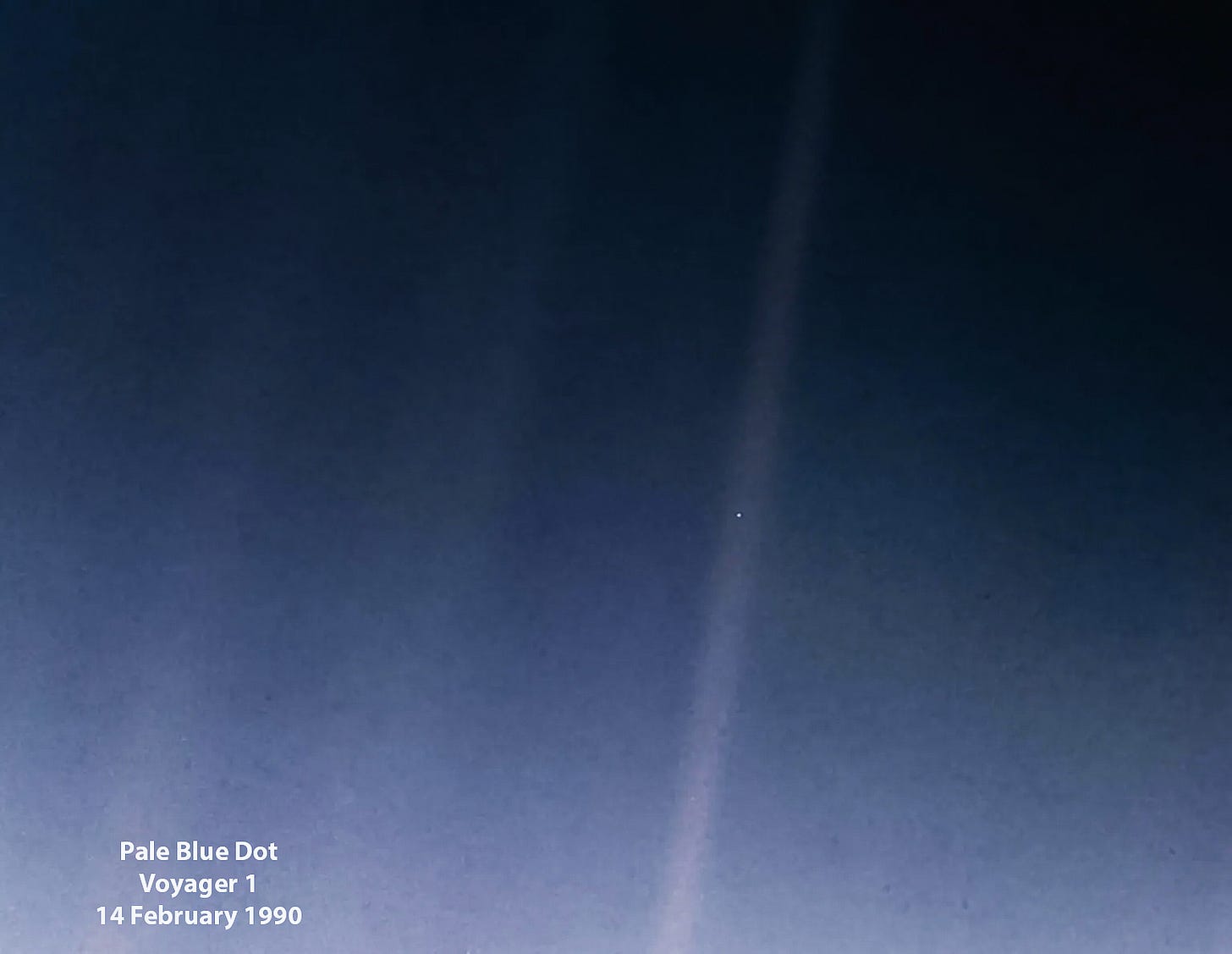
To help regain perspective, I suggest reading an excerpt from Carl Sagan’s book Pale Blue Dot, which references our home planet. The Planetary Society website explains the background for Sagan’s reflection and quotes the most famous passage from his book. It is a fitting reflection for Thanksgiving.

Many readers have used Sagan’s Pale Blue Dot as their reflection for Thanksgiving dinner.

First, this introduction from The Planetary Society: 

The following excerpt from Carl Sagan’s book Pale Blue Dot was inspired by an image taken, at Sagan’s suggestion, by Voyager 1 on 14 February 1990. As the spacecraft was departing our planetary neighborhood for the fringes of the solar system, it turned around for one last look at its home planet.

Voyager 1 was about 6.4 billion kilometers (4 billion miles) away, and approximately 32 degrees above the ecliptic plane, when it captured this portrait of our world. Caught in the center of scattered light rays (a result of taking the picture so close to the Sun), Earth appears as a tiny point of light, a crescent only 0.12 pixel in size.

Here is Carl Sagan’s reflection on the photo and our place in the cosmos:

Look again at that dot. That’s here. That’s home. That’s us. On it everyone you love, everyone you know, everyone you ever heard of, every human being who ever was, lived out their lives. The aggregate of our joy and suffering, thousands of confident religions, ideologies, and economic doctrines, every hunter and forager, every hero and coward, every creator and destroyer of civilization, every king and peasant, every young couple in love, every mother and father, hopeful child, inventor and explorer, every teacher of morals, every corrupt politician, every “superstar,” every “supreme leader,” every saint and sinner in the history of our species lived there–on a mote of dust suspended in a sunbeam.

The Earth is a very small stage in a vast cosmic arena. Think of the rivers of blood spilled by all those generals and emperors so that, in glory and triumph, they could become the momentary masters of a fraction of a dot. Think of the endless cruelties visited by the inhabitants of one corner of this pixel on the scarcely distinguishable inhabitants of some other corner, how frequent their misunderstandings, how eager they are to kill one another, how fervent their hatreds.

Our posturings, our imagined self-importance, the delusion that we have some privileged position in the Universe, are challenged by this point of pale light. Our planet is a lonely speck in the great enveloping cosmic dark. In our obscurity, in all this vastness, there is no hint that help will come from elsewhere to save us from ourselves.

The Earth is the only world known so far to harbor life. There is nowhere else, at least in the near future, to which our species could migrate. Visit, yes. Settle, not yet. Like it or not, for the moment the Earth is where we make our stand.

It has been said that astronomy is a humbling and character-building experience. There is perhaps no better demonstration of the folly of human conceits than this distant image of our tiny world. To me, it underscores our responsibility to deal more kindly with one another, and to preserve and cherish the pale blue dot, the only home we’ve ever known.

Carl Sagan, Pale Blue Dot, Copyright © 2006 by Democritus Properties, LLC.

I watched Tim Walz speak to a crowd in his home state of Nebraska, and he was wonderful.

I encourage you to watch this good, decent man. He knows that what matters most in our leaders is their character and their values. He has them.

The above link is for Tim Walz’s speech.

If you want to watch the whole event, including his introduction by his wife Gwen, open this link. If you are a teacher, you will love her call-out to teachers, and the crowd roaring “TEACHERS! TEACHERS! TEACHERS!”

Ok, this clip is neither about education nor politics, but I watched it four times and loved it. Think of it as a testament to discipline, determination, and training. The guy who was heavily favored to win came in second.

I recently visited the Metropolitan Museum of Art, one of the world’s finest museums, to see a memorable exhibition. It’s called “The Harlem Renaissance and Transatlantic Modernism.”

It is a spectacular collection of works by and about African-American artists. The art is drawn from museums around the country. You may never see these artworks in one space again.

The quality of the art is breath-taking. I know that many of you don’t live in or near New York City, but this is a good reason to plan a trip. The show runs through the end of July.

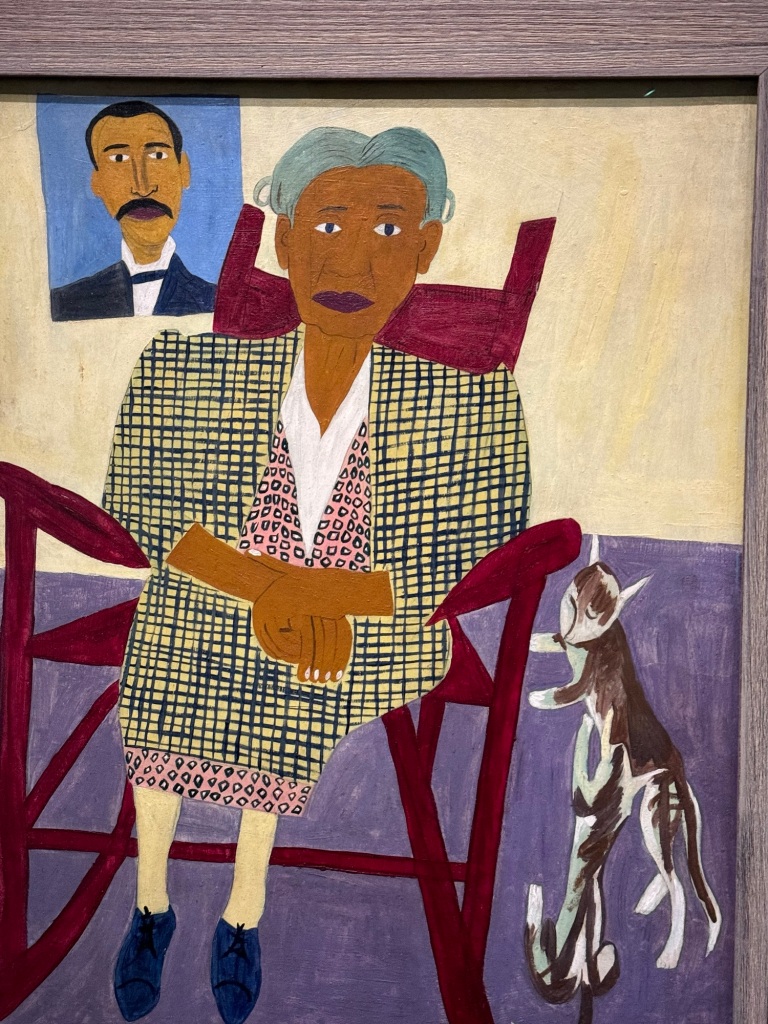
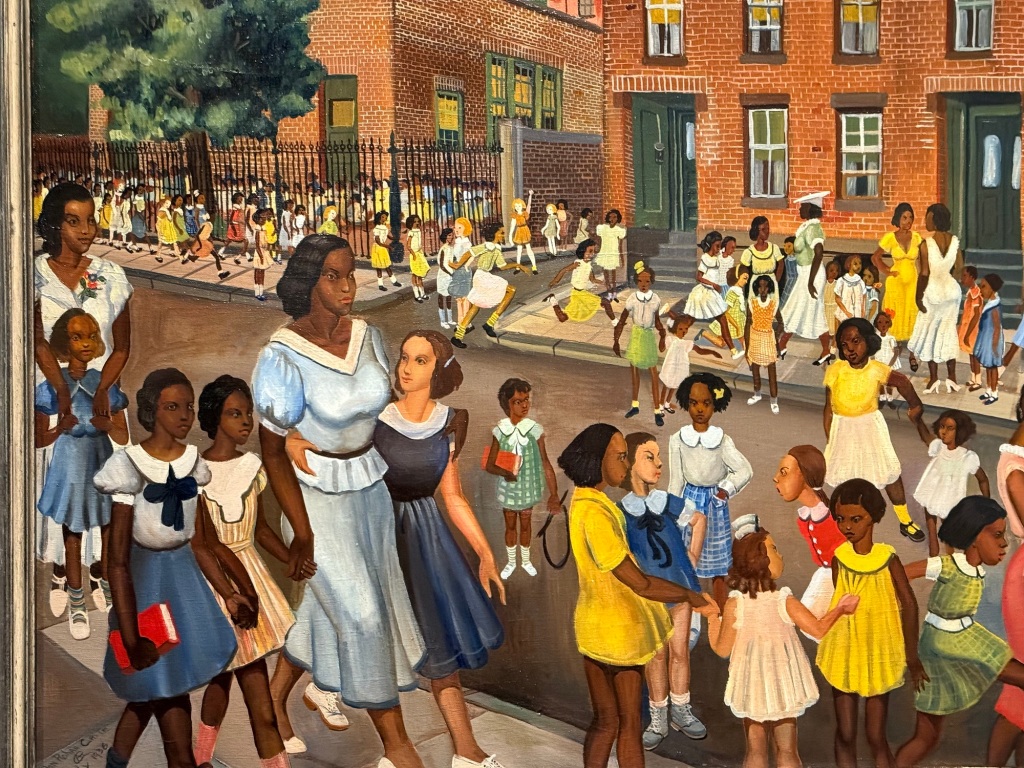
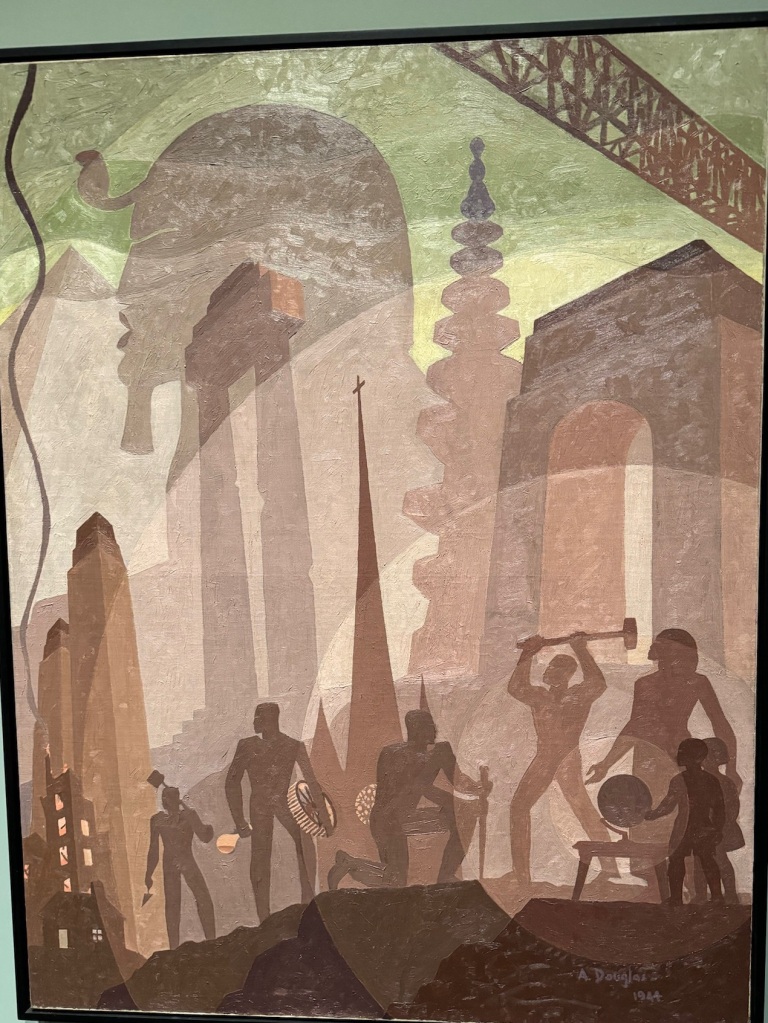
Here are a few of the photos I took with my cell phone. I wish I had taken more. Some of the pictures are off-center because the crowds were large, and I didn’t have a clear path.

Painted by William H. Johnson (1901-1970), “Mom and Dad, 1944.” This folk-art painting of the artist’s mother and a portrait of his late father was borrowed from the Smithsonian American Art Museum.

Painted by Allan Rohan Crite (1910-2007). It is titled “School’s Out” and was painted in 1936. It depicts children emerging from Everett Elementary School in Boston. It was lent to the exhibition by the Smithsonian American Art Museum.

Painted by Aaron Douglas (1879-1979). Titled “Building More Stately Mansions, 1944.” It is owned by the Fisk University Galleries in Nashville. According to the artist, “his objective was to spotlight the contributions of exploited Black labor to great civilizations worldwide. He thus resituated African American history in a global context, in which the sphinx of Egypt appears together with the spire of a Western cathedral, the tiers of an Asian Buddhist pagoda, and a building crane extending over American skyscrapers, emblems of modernity meant to connote growth.”

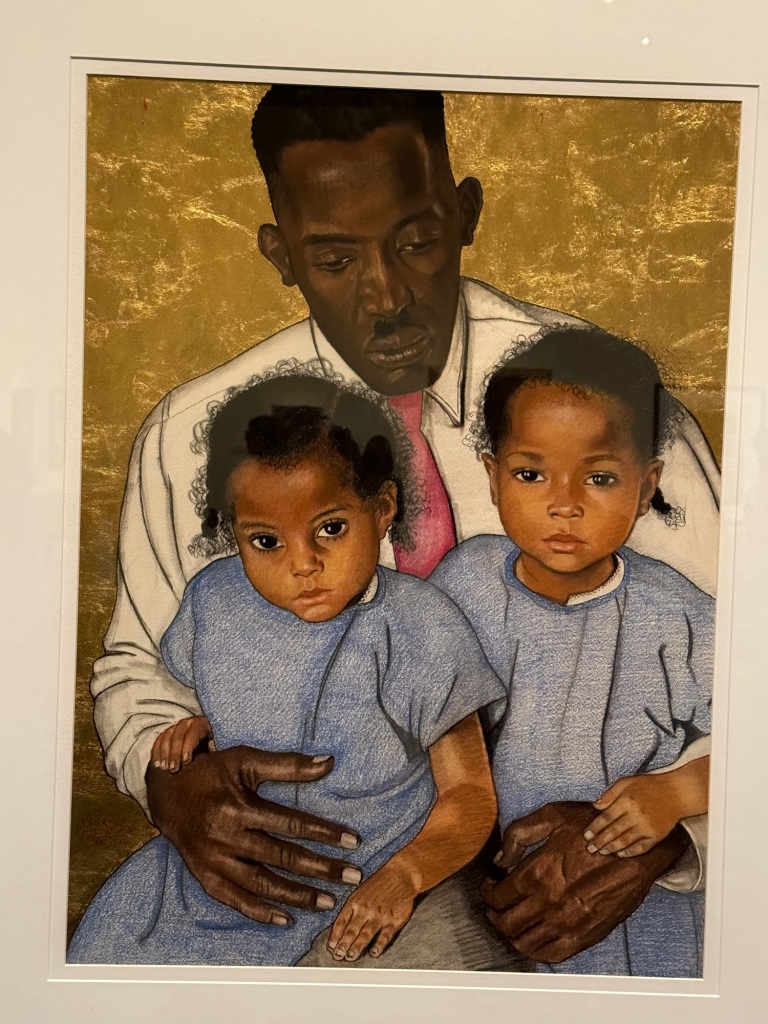
Painted by Winold Reiss (1886-1953), who emigrated from Germany to America. It is a painting of Fred Fripp, a graduate of the Penn School and a teacher, with his daughters Carol and Evelyn. The painting is owned by the Fisk University Galleries in Nashville.

The caption of the portrait says:

“The sitter looks away in introspection while his young daughters gaze outward, settled into the security of their father’s steadying embrace.

“Reiss met Fred Fripp when he traveled to South Carolina to portray the Gullah-speaking Black residents of St. Helena Island, whose ancestors were among the last enslaved West African people forcibly brought to the United States. The luminous triple portrait, its triangular composition and gold leaf background reminiscent of Renaissance madonnas, celebrates Fripp as a teacher, scholar, and parent.”

As I viewed this magnificent exhibit, I kept wondering about the African-American artists. In their wildest dreams, did they ever imagine that their paintings and sculptures would one day be shown in the nation’s premiere museum?

The exhibition is a large and rich portrayal of the artists and intellectuals of the Harlem Renaissance. If you can’t get to New York by July 28, the last day, you might consider buying the catalogue from the Met.

Jack Burgess, retired teacher, military veteran, added his own poem in the comments section. Thank you, Jack!

How War Ends

by Jack Burgess, Sp3, US Army, 894th Tank Battalion 

…and they shall beat their swords into plowshares, and their spears into pruning hooks: nation shall not lift up sword against nation, neither shall they learn war any more. 

                             Isaiah

This is how war ends:

The guns stop everywhere.

Fifty-ton tanks roll to a stop,

war ships dock,

fighters and bombers come down from the sky,

and two moments of silence follow.

The war dead honored by the first,

the 2nd silence is for reflection,

for hearing frogs, and your own breath.

This is followed by a single voice,

then a murmur. Screwdrivers and crow bars

come out, and the green tanks are

dismantled, gas siphoned for school buses.

Troop ships sail home from a hundred shores,

so that husbands and wives can kiss unvirtually,

and children see the strong eyes of their fathers,

feel their love and their arms about them.

Uniforms become keepsakes and relics.

All flags are fine and flying.

Those in congresses clear their throats

apologetically and say, “What shall we do with

the leftover money?”  Children with swollen bellies,

working as lobbyists, shout, “Food!” Others say,

“Let’s build a thousand new schools and parks.” 

Lots of people hug and dance

and make love.  Some cry.

The news is good at 6:00 o’clock.

More at 11:00.

John Merrow was the PBS correspondent on education for many years. Since he stepped down from this important role, I have discovered that he is quite a wonderful person. I didn’t think so when he burnished Michelle Rhee’s reputation, but he redeemed himself when his last hour-long segment on her delved into the cheating scandal that consumed her final year as chancellor of the DC schools.

But now I know John as a generous friend. When I was suffering in the aftermath of knee surgery, he printed out “Dr. Merrow’s Advice.” Every year, he is committed to riding the same number of miles as his age and thus far he has kept his pledge. He very kindly recommends organizations to receive donations in support of his bike ride, and NPE has been among them. We were very gratified by his recognition and support.

And now he has created an award he calls “TAMPU”—Towards a More Perfect Union. I love the award because its first recipient is Peter Greene, who is one of the best educational thinkers and writers of our time.

He writes at his blog, The Merrow Report:

I’ve always loved the elegant, aspirational phrase, “Toward a More Perfect Union,” found in the opening sentence of our Constitution.  It was our Founding Fathers’ first priority, ahead of establishing justice, ensuring domestic tranquility, providing for the common defense, promoting the general welfare, and securing the blessings of liberty to ourselves and our posterity.

I think it’s time to do more to honor those who in their daily lives attempt to move us “Toward a More Perfect Union.” To that end, and only slightly with tongue in cheek, I suggest we create an award–call it the TAMPU Prize–acknowledging those who are attempting to push the envelope forward.  

While someone else works out the rules and timing, I am jumping the gun and awarding the TAMPU Prize to three remarkable people who are on my mind this week.  Please read on, and please add your own names.

The first TAMPU recipient is from the world of education, Peter Greene. Mr. Greene, whom I do not know, spent 39 years teaching English and now devotes his time to turning over rocks to expose wrong-doing in public education, to celebrate accomplishments, and to make us think.  You can find a lot of his well-researched columns here on Forbes Magazine, but he also blogs regularly at ‘Curmudgucation,’ a word I assume he made up.  

Here’s how Mr. Greene describes himself:  I started out life in New Hampshire and finished growing up in Northwest Pennsylvania. I attended a non-traditional education program that no longer exists at Allegheny College, a small liberal arts college, student taught in Cleveland Heights, and landed my first job in Lorain, Ohio. The year started with a strike and ended with a large workforce layoff, so I came back home, bought a mobile home, and lived in a trailer court while I subbed in three districts.

After a year, I started landing year-long sub jobs with the same school district I had graduated from in the mid-seventies. It was not the plan, but there was a woman… After thirty-some years in that district, I’ve taught pretty much every brand of English we have here, 7-12. But high school is my home; middle schoolers are, as I said back when I taught them, the emotional equivalent of having someone scream in your ears all day. God bless, MS teachers. And now, after thirty-nine total years in the classroom, I’ve retired.

My second recipient is Jessica Craven, a veritable ‘Energizer Bunny’ who’s working to help our democracy survive extremism of all sorts, but particularly MAGA.  She blogs almost every day, with a newsletter she calls “Chop Wood, Carry Water,” a title that carries a message: This is what you do when the chips are down–Get to work!

Click here to begin the “Chop Wood, Carry Water” experience.  Here’s how she introduces herself and her newsletter: 

What goes on here? Well, this newsletter is dedicated to saving democracy, addressing the climate crisis, preserving our freedoms, electing better lawmakers, and, in general, creating a better country—one simple action at a time. As the author, I’m essentially a bundler. Not of donations, but of easy things each of us can do to make a difference. I do these things, too—because I want my kid to grow up in a democracy AND because doing them makes me feel less anxious. My motto? Hope is an action.

I have no idea where Ms Craven lives with her husband, child, cat, and dog. Ms Craven publishes at least six times a week and always tells readers how to get involved.  She makes activism easy, no small feat.   “Chop Wood, Carry Water” is free, but I hope you will do as I do and subscribe ($60 per year). 

My final TAMPU recipient (this time around) is National Book Award recipient Jonathan Kozol, whose new book, “An End to Inequality,” is the 12th in his illustrious career. Now 87, Jonathan burst on the scene in 1967 with “Death at an Early Age,” which I can remember devouring.  His new book–which he says will be his last–is a passionate call for racial justice in education and the larger society.  Never one to call for compromise, he rejects all forms of tokenism.  “There is no such thing as perfectible apartheid. It’s all a grand delusion,” he writes. “Apartheid education isn’t something you can ‘fix.’ It needs to be dismantled.”  For more, see Dana Goldstein’s recent profile of Jonathan in the New York Times.

(Digression: I’ve known Jonathan for a long time, and he kindly wrote a glowing preface to a book of mine, “Choosing Excellence,” back in 2001. Unfortunately, my (inept) publisher misspelled his first name. Jonathon!  When they sent me an advance copy, I saw the error and immediately called the publisher.  “Sorry,” they said, “But the initial printing is only 5,000 copies. We will correct it on the next printing.” 

I explained very calmly that I would sue their asses if they released that printing, and I suggested that they shred those 5,000 copies and reprint it.  Instead, they hired people to paste over the error with a small sticker that spelled his name correctly. Somewhere I have the uncorrected version and a pasted-over version, as well as a clean copy from the second printing.)

So those three, Jessica Craven, Peter Greene, and Jonathan Kozol, are pushing and pulling us toward A More Perfect Union.  Who else deserves our attention?  Make your suggestions here.  

Thanks, 

John

I am not a huge fan of professional ice skating but I am a huge fan of excellence. I just watched a 10–minute clip of Ilia Malinin’s World Championship performance yesterday in Montreal. It was mesmerizing!

Ilia was born in Virginia. His parents were professional skaters in Uzbekistan, as was his grandfather. His parents are his coaches.

Watching this brilliantly accomplished young man reminded me of the book written by Senator John F. Kennedy in 1958 titled A Nation of Immigrants.

The subject was on my mind because yesterday I saw a moving and beautiful film called Cabrini. That too made me reflect on today’s hateful rhetoric about immigrants.

Ilia’s magnificent performance in Montreal was hailed by the sportscasters as one of the most remarkable events in the history of ice skating. Watch it!

Bob Shepherd, author, editor, assessment developer, story-teller, and teacher, read a book that he loved. He hopes—and I hope—that you will love it too.

He writes:

Like much of Europe between 1939 and 1945, education in the United States, at every level, is now under occupation. The occupation is led by Bill Gates and the Gates Foundation and abetted by countless collaborators like those paid by Gates to create the puerile and failed Common Core (which was not core—that is, central, key, or foundational—and was common only in the sense of being vulgar. The bean counting under the occupation via its demonstrably invalid, pseudoscientific testing regime has made of schooling in the U.S. a diminished thing, with debased and devolved test preppy curricula (teaching materials) and pedagogy (teaching methods).

In the midst of this, Gayle Greene, a renowned Shakespeare scholar and Professor Emerita at Scripps University, has engaged in some delightful bomb throwing for the Resistance. Her weapon? A new book called Immeasurable Outcomes: Teaching Shakespeare in the Age of the Algorithm.

OK. Maybe I’ve pushed the occupation/resistance metaphor to the edge of its usefulness. Let’s try another. If Gates’s test-and-punish movement, ludicrously called “Education Reform,” is a metastasizing cancer on our educational system, and it is, then Professor Greene’s book is a prescription for how to reverse course and then practice prevention to end the stultification of education and keep it from coming back. The book is a full-throated defense of the Liberal Arts and of traditional, humane, in-person, discussion-based education in a time when Liberal Arts schools and programs are being more than decimated, are being damned-near destroyed by bean counters and champions of ed tech. Here’s the beauty and value of this book: contra the “Reformers,” Greene details the extraordinary benefits of the broad, liberal educations that built in the United States people capable of creating the most powerful, vibrant, and diverse economy in history. She makes the case (I know. It’s bizarre that one would have to) for not taking a wrecking ball to what has worked. And best of all, she does so not at some high level of abstraction, but backs up any generalizations with concrete, vivid, fascinating, moving, delightful examples from her classrooms. How do you build a world-class human? Well, you give him or her the benefits of a broad, humane, liberal arts education that confers judgment, wisdom, vision, and generosity. Greene shows us, from her own classes over three decades, exactly how that happens.

And she shows us how, under the “standards”-and-testing occupation, all that is being lost.

Years ago, I knew a fellow who retired after a lucrative, successful career. But a couple months later, he was back at his old job. I asked him why he had decided not simply to enjoy his retirement. He certainly had the money to do so.

“Well, Bob,” he said, “there’s only so much playing solitaire one can do.”

I found this answer depressing. I wondered if it were the case that over the years, the fellow had given so much time to work that when he no longer had that to occupy him, he was bored to tears. Had he not built up the internal resources he needed to keep himself happy and engaged ON HIS OWN? Greene quotes, in her book, Judith Shapiro, former president of Barnard College, saying, “You want the inside of your head to be an interesting place to spend the rest of your life.” The French novelist Honoré de Balzac put it this way: “The cultured man is never bored.” Humane learning leads to engagement with ideas and with the world, to fulfillment, to flourishing over a lifetime, to what the ancient Greeks calledeudaimonia—wellness of spirit. Kinda important, that.

In a time when Gates and his minions, including his impressive collection of political and bureaucratic action figures and bobble-head dolls, are arguing that colleges should become worker factories and do away with programs and requirements not directly related to particular jobs, it turns out that the people happiest in their jobs are ones with well-rounded liberal arts educations, and are the ones who are best at what they do. And it turns out that people taught how to read and think and communicate and be creative and flexible, people who gain a broad base of knowledge of sciences, history, mathematics, arts, literature, and philosophy, are self-directed learners who can figure out what they need to know in a particular situation and acquire that knowledge. Philosophy students turn out to be great lawyers, doctors, politicians, and political operatives. Traditional liberal arts instruction creates intrinsically motivated people.

All this and more about the value of liberal arts education Professor Greene makes abundantly clear, and she does so in prose that is sometimes witty, sometimes hilarious, sometimes annoyed, sometimes incredulous (as in, “I can’t believe I even have to protest this shit”); always engaging, human and humane, compassionate, wise, authentic/real; and often profound. As much memoir as polemic, the book is a delight to read in addition to being important politically and culturally.

Gates and his ilk, little men with big money to throw around, look at the liberal arts and don’t see any immediate application to, say, writing code in Python or figuring out how many pallets per hour a warehouse can move. What could possibly be the value of reading Gilgamesh and Lear? Well, what one encounters in these is the familiar in the unfamiliar. As I have said numerous times elsewhere, all real learning is unlearning. You have to step through the wardrobe or fall down the rabbit hole or pass through the portal in the space/time continuum to a place beyond your interpellations, beyond the collective fantasies that go by the name of common sense. Real learning requires a period of estrangement from the familiar. You return to find the ordinary transmuted and wondrous and replete with possibility. You become a flexible, creative thinker. You see the world anew, as on the first day of creation, as though for the first time. Vietnam Veterans would often say, “You wouldn’t know because you weren’t there, man.” Well, people who haven’t had those experiences via liberal arts educations don’t know this because they haven’t been there, man.

Gayle Greene has spent a lifetime, Maria Sabina-like, guiding young people through such experiences. Her classroom trip reports alone are worth your time and the modest price of this book. At one point, Professor Greene rifs on the meaning of the word bounty. This is a book by a bounteous mind/spirit about the bountifulness of her beloved liberal arts. Go ahead. Buy it. Treat yourself.  

If you plan to visit NYC (or live in it or near it), I have some recommendations for you.

You are not allowed to visit NYC without taking in a Broadway show. Did you know that?

I saw three outstanding shows recently, which I unequivocally recommend.

The great and timeless Ibsen play “An Enemy of the People” is spectacular. It has been updated. It stars Jeremy Strong (“Succession”) and Michael Imperioli (“The Sopranos” and “White Lotus”). What a great show!

If you want to laugh a lot, see “Spamalot,” a hilarious comedy-musical that was written by Eric Idle of the Monty Python troupe. It incorporates some of their funniest skits. The final performance is April 7.

If you want to see a spectacular musical, see “Moulin Rouge.” Boy George is one of the stars. Prepare to be dazzled. Don’t bring the children! It’s very bawdy, and there is quite a lot of female flesh.

You can often get cheap seats at a website called TodayTix. It also sells advance seats. In the center of Times Square, there is a large booth called TKTS where you can buy same-day tickets at a steep discount. Some theaters have standing-room tickets. It never hurts to ask at the box office before the performance. Sold-out shows sometimes get last-minute returns from ticket brokers.

Enjoy!