Archives for category: Joy

Tim Farley is principal of the Ichabod Crane Middle School in upstate New York.

He is also a member of the board of New York State Allies for Public Education, the leaders of Opt Out in New York.

And he has a great sense of humor and timing!

He told his eighth grade students that if they read 850 books this year, he would dance for them at the end of the school year. They read 869. Watch Tim Farley dazzle students, teachers, and parents!

Vicki Cobb, author of many children’s books about hands-on science, recently spoke at a children’s literature conference in Florida. She was disturbed to meet a new breed of teacher: teachers who had grown up in the era of high-stakes testing and scripted lessons. Too many thought that this is the way school was supposed to be, because it was all they had experienced.


She attributes the change to the takeover of education policy by non educators:


The business and government suits, who have hijacked educational policy in a top down approach, are not professional educators. Their knowledge of education comes primarily from what they themselves survived (endured?). Most do not know what good education looks like. Their idea of a well-ordered classroom is rows of desks with students quietly bent over a test. Now, the chickens are coming home to roost in the preparation of the next generation of Florida’s classroom teachers. Their professors tell me that they call them the “FCAT babies.” These young people are the pre-service teachers who have grown up in Florida’s test-taking climate. They have a “mother, may I?” permission-seeking approach to their own classroom behavior as teachers. They think test-taking and test prep is normal. They have seen nothing else. They are afraid to think for themselves.


As she posed questions to a group of students, she noticed that they answered quickly to her questions, not pausing to think. She sensed the test-prep culture, the reflexive search for the right answer. And that was not what she wanted to see.


She missed what she calls “the artist-teacher.” What is the “artist=teacher”? “An artist is someone who brings his or her own self-expression to an activity. An artist expresses personal, closely held views, thoughts, images and passions with such truth and clarity that others immediately connect with this revealed humanity. Thus the personal becomes the universal. Therein lies its power.”


Instead, teachers in Florida told her about scripted programs whose goal was to make sure that every teacher was on the same page at the same time teaching the same things. Scripted lessons are “turning teachers into automatons, when American education is crying out for the return of the artist-teacher. This is the teacher who takes one look at the textbooks and goes to the library to find much more powerful reading on the same subjects. This is the teacher who knows each student intimately and can write a poem for each one. This is the teacher who figures that good teaching trumps test prep and is not afraid for her kids’ test outcomes. This is the teacher who has the courage to justify what he’s doing and why he’s doing it to powers-that-be who are not fully equipped to evaluate creativity. It includes a lot of the “best teacher” awardees. This is the teacher who wants to spend more time creating powerful lessons and less time doing accountability paperwork. For the artist-teacher, teaching with autonomy, mastery and purpose is a subversive activity, much as art is subversive in a dictatorship.”


Our current educational culture, driven by No Child Left Behind, Race to the Top, and the Common Core standards, is rewarding robotic behavior and punishing artist-teachers. In the current climate, good teaching is a subversive activity.

Last weekend I attended a joyous family wedding and thus was preoccupied and failed to notice one of the seminal moments in reformer history. This was Michael Barber’s speech on “Joy and Data.” Barber is the chief education adviser to Pearson, and he gave this speech in Australia, hoping to debunk the claim that an undue emphasis on data takes away the joy of learning. Barber’s goal was to demonstrate that joy and data go together like a horse and carriage.

Valerie Strauss wrote about Barber’s speech here, and Peter Greene did his usual sharp vivisection of Barber’s ideology here. Strauss collects some of the witty Twitter responses to Barber’s speech; Greene contrasts it with Pearson’s activities and Barber’s publications.

Strauss summarizes:

“In his speech, Barber argues that the pursuit of data has wrongly been accused of sucking the creativity out of learning but that in his world view, data and joy are the two elements that will together improve learning systems around the world in the 21st Century.”

Greene says that Barber’s speech was a celebration of Oxymoron Day. He summarizes Barber’s Big Speech:

“The future of education will be more joyful with the embrace of data. Also, don’t get things wrong– the data does not undermine creativity and inspiration, nor does it tell us what to do, nor does it replace professional judgment. And I don’t even know how to link to all the places where Pearson has contradicted all of this. I would be further ahead to find links to Jeb Bush condemning charter schools and Common Core….

“If we lump all of Pearson’s visionary writing together, the picture that emerges is a Brave New World in which every single student’s action is tagged, collected, and run through a computer program that spits out an exact picture of the student’s intellectual, emotional and social development as well as specific instructions on exactly what the teacher (and, in this Brave New World, we’re using that term pretty loosely) should do next with/for/to the student to achieve the results desired by our data overlords.”

Greene is struck by the scary thought that Barber actually believes what he is saying; arguing with him would be like debating a religious fanatic.

As I read this contemplation of joy and data, I found myself wondering whether Mike Barber might be a cyborg. So I started reading about cyborgs and became persuaded that thos is not the right term to describe a man who confuses quantification with emotion. The right word seems to be android.

Robert Reich is concerned about over testing and the cost of higher education.

MoveOn pledges to promote the idea with the most votes. Vote for this one!

Here are Reich’s ideas:

“Make public higher education completely free, as it was in many states in the 1950s and 1960s.

“Stop the wall-to-wall testing that is destroying the love of teaching and learning, limit classrooms to 20 children so teachers can give students the individual attention they need, expand federal funding for education, and raise the pay and improve conditions for the men and women who power our schools.

“Provide high-quality, universal pre-school and after-school care.

“Offer high school seniors the option of a year of technical education, followed by two years of free technical education at a community college.”

What if every parent said, “I refuse”?


What if every parent said, “My child is not taking the test”?


What if everyone said, “No, thank you, I’d rather not”?


The message would resound from one corner of the nation to the others. It would be heard by the Congress, now about to impose another seven years of annual testing on the nation’s children, even though no high-performng nation in the world tests every child every year. It would be heard by the President, who says teachers should not teach to the test, but that teachers who can’t produce high test scores don’t belong in the classroom. It would be heard by Arne Duncan, who said that testing is taking the joy out of learning, but nonetheless insists that every child take the test every year, no excuses. It would be heard by governors and legislators. They would hear the voice of the people. This is what democracy sounds like.


And what then? Teachers would be judged by their peers and supervisors, not by test scores. Teachers would write their own tests, to see whether children learned what they were taught. Standardized tests would be used sparingly, preferably on a sampling basis. Students would have time to explore, time to play, time to read, time to experiment, time to learn without test prep and interim assessments, without fear and anxiety. Pearson would have to reduce its profits for the year.


Send a message. Save your children. Save learning. Stop the machine.

Joanne Yatvin, former teacher, principal and superintendent and literacy expert in Oregon, sent me the following email after reading the story in the New York Times about Success Academy and its regimented environment, focused on test scores:

Diane,

I read the New York Times article on the Success Academies around the same time that you did and came away shivering for the children who are being “educated” there. Here is my take on what those charters actually teach.

In my career as a teacher and principal I came to know a great deal about what children learn at school. It’s not only academics and proper school behavior, but also how to operate in personal relationships and the outside world. Reading the New York Times article about the Success Academy Charter Schools earlier this week, I saw some pretty tough demands being made of all kids and humiliating consequences for those who didn’t meet them. I can’t help wondering if Success Academy students aren’t also learning some or all of the following life lessons:
The only thing that matters is being a winner

Competition works better than cooperation

Do what you’re told even if it makes no sense to you

Keep quiet when you see other people being abused

Those who are not successful at their work are just lazy

Punishment and humiliation are good training for children

Prepare yourself for stressful situations by wearing a diaper

If that’s what children learn at the Success Academies, I’m glad my children went to mediocre public schools and emerged as independent thinkers and dedicated supporters of their less fortunate neighbors.

Vicki Cobb is a prolific writer of science books for children. She has written more than 85 nonfiction books. As a child, she attended the celebrated Little Red Schoolhouse in Greenwich Village, where experiential learning was valued. Today, she dedicates herself to educating children about science and the joy of learning. Imagine her surprise when she conducted a workshop and discovered that the children did not share her enthusiasm for school.


Here is her assessment of the legacy of today’s school reforms.


The other day I was doing a program for a group of 4th-6th graders at a local public library. I introduced myself to them by telling them how I had LOVED school so much when I was a kid that I basically recreate it for myself everyday as I write my books. The kids’ reaction to my confession was a unanimous, vociferous, vocal expression of how much they disliked school. I was startled. After all, I’ve told this to children many times before at school visits. Was this because the venue was not in school and they felt freer to express themselves? Or has something changed to make school more onerous? These were privileged kids from an affluent public school district. Could it be because they had just finished a month of standardized testing? What’s going on here?


This is just the latest piece of evidence that something is rotten in American education. It seems that many people in a position of power believe that education is too important to allow professional educators do their jobs because they have failed to produce a consistently excellent product of people who are college and career ready after twelve years of schooling. They believe the way to excellence is to first write a law decreeing “No Child Left Behind” or “All Children College and Career Ready” to set a policy, without consulting anyone who actually teaches children. And then to test, test, test, to see if these impossible standards have been met. Meanwhile, they are creating a population of quietly submissive students and teachers who narrow the curriculum to what they hope will be on the test while administrators are cutting art, music, physical education programs and librarians to pour more of their limited financial resources into test prep and test grading….


Let me take this opportunity to remind us that human beings, from the moment they appear on this earth, are born to learn. A baby is as smart as s/he will ever be. Through infancy every day is filled with wonder and discovery. And although there are hard lessons along the way, as learning progresses, so does mastery. We know from research that there are many different learning styles but eventually we all learn to walk and talk and think . As we get older, if we’re lucky, we discover a passion that drives us to master more skills and contribute to society. But the skill of high performance on a test, is not an essential skill. There are many other metrics for success — the number of patents held by Americans, for example. The current “reformers” for education are simply imposing ill-conceived laws of the state and federal governments on schools as if we were a dictatorship not a democracy.


Deep in my bones I know that I would not be creating science books for children if I had grown up in one of today’s repressive schools.


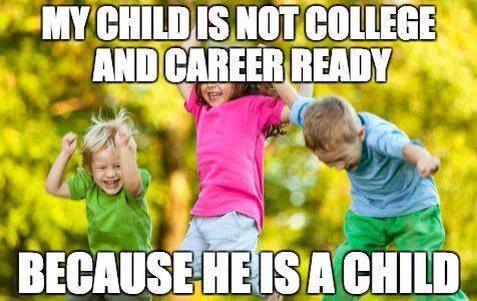
This wonderful photo is making the rounds on Twitter. The quote was taken from Monroe County ICPE (Indiana Coalition for Public Education) chairperson Cathy Fuentes-Rohwer’s speech at the Indiana State House last month. When I hear about “college and career ready standards” for elementary school and middle school children, I am reminded of the famous words of Secretary of Education Arne Duncan, who once famously said:


“We should be able to look every second grader in the eye and say, ‘You’re on track, you’re going to be able to go to a good college, or you’re not,’ ” he said. “Right now, in too many states, quite frankly, we lie to children. We lie to them and we lie to their families.”


When I look at my young grandchildren, ages 8 and not quite 2, this is the same thought that occurs to me, as I feel sure it does to most parents and grandparents:


collegeready

This article is a very interesting account of the life and accomplishments of Paul Weertz. He saved a block in Detroit by his love of agriculture and horticulture. He is of interest to readers of this blog because he was one of the leaders of the Catherine Ferguson Academy for pregnant girls in Detroit, now defunct.


CFA was a Detroit public school that enrolled pregnant girls. According to the article, it was incredibly successful and all of its graduates went on to college. The focus of the school that differentiated it from other schools was its agriculture program, which Paul Weertz created and nurtured. The students were very invested in raising their own food, and this was a motivating factor for the girls.


But despite the school’s success, the emergency manager decided to shut it down and turn it over to a charter operator (who had political connections).  At some point in this process, when it appeared the school was doomed, Rachel Maddow took an interest and reported on this situation. After a few years as a charter, the Catherine Ferguson Academy was closed permanently.


As the article tells the story:


Weertz is understandably proud of the success of his block of Farnsworth. But his other success story, his role as the teacher who helped build up the agricultural program at Catherine Ferguson Academy, ended badly. He says it had always been a struggle to justify the funding for a school that combined parent-focused teaching, day care, and an intense agricultural component, but the fact remains that all of the academy’s students went on to college, and the scholars’ children received excellent care. But instead of being imitated, it was terminated.


The beginning of the end came when a Lansing-appointed emergency manager stepped in and announced the school would be closed. This resulted in a battle that left the school open, but in the hands of a charter operator. The charter company, run by Blair Evans, brother of current Wayne County Executive Warren Evans, closed the school after running it for a few years.


“Well it’s always been ‘too much money,'” he says. “That’s why there were only five schools like that in the country. Pregnancy is the leading cause of dropout for young women. You think they’d have these at every state in the union, but it’s just a discrimination issue. You can hassle poor women or pregnant women; they’re not gonna say anything. With pregnant girls, we can somehow say, ‘It’s your fault.’


“It’s a sensitive issue to me because I’ve always felt like I donated a lot of my labor and material, so to speak, because it was the public. Blair Evans is a nice guy, but I’m not donating my time to him. I thought it was the public school. It’s like cleaning up a public park and finding out it’s a gated community. What happened there? So that’s the way it happened at Catherine Ferguson, and it was kind of a media frenzy. So many of us walked away like, ‘That wasn’t a victory,’ but that’s how the media presented it. ‘They’re saving the school and it’s OK!’ No one is doing a story now about what happened to the school. What is Detroit doing with their pregnant kids now?”


Rachel Maddow, you are needed now! Time for a follow-up story!


My friend Deborah Meier tells me she loves this school in Long Beach, California. It is a charter school that fulfills the original vision of what charters were supposed to be: innovative, risk-taking, open to all kinds of kids. That’s what this school is and does, but its test scores are low. The Long Beach school board wants to close it; they should not.

To the members of the Long Beach school board: Save the Néw City School. Let innovation thrive. Let this functioning community live.

This is the letter that Deb Meier forwarded to me:

Dear Dr. Ravitch:

Several hundred low-income kids in Long Beach, CA need your immediate help. Their teachers and parents are desperate.

I have been following your work over many years, in particular the series of letters between you and Debbie Meier – she is a friend of mine whom I met through the North Dakota Study Group. It is for this reason that I dare to write a request, will the full knowledge that I might come off as a bit crazy.

15 years ago, I co-founded the New City School in the center of our city. Long before most had heard of charter schools, we rescued an abandoned hospital building [and later a warehouse] and turned them into learning oases in a blighted community that had long been without a small, loving neighborhood school. Consistent with the original intent of charter school legislation, our school would innovate in a district that has a single-minded focus on Broad-funded test-prep. Our school is fully bilingual – Spanish speakers learn English AND English speaking students of many backgrounds learn to read and write in Spanish too. We feature lots of art, great literature with read-alouds every day in every grade, 2 huge libraries, and music instruction for all students, grades TK-8. Members of our community built the area’s biggest playground AND a 1/3-acre working organic farm, growing fresh fruits and vegetables with our students and their families.

Scholars, including Deborah Meier, Stephen Krashen, and Constance Kamii have visited and worked with our teachers to help them be the best they can be. Students share their accomplishments via quarterly public exhibitions in two languages. We are a neighborhood school that does not prequalify students for enrollment. Parents love the school and would do anything to help it survive.

The problem is that The Long Beach Unified School District cannot stand us because we don’t get high test scores and we won’t stop our teaching and learning practices in order to simply prepare students for exams day in and day out. For years, the LBUSD has threatened our school with closure for refusing to comply with their dystopian view of education as standardized test preparation. Two years ago they nearly closed us down, but we closed our high school and combined our 2 small elementary campuses into one, and kept moving forward. In addition to ideological blindness, LBUSD seems hell-bent on reclaiming the meager per pupil allocation our school manages to live on. We have no corporate sponsors or celebrities hosting galas on our behalf, just working-class parents and highly professional constructivist teachers sacrificing to save a school they love.

As you might imagine, the constant threat of closure distracts us from our mission of educating young people.

This Tuesday, November 18th, the LBUSD is holding ANOTHER hearing to discuss whether or not to renew our charter or close our school. When this happened a few years ago, the school district police ended up dragging parents out of the meeting and turned off their cameras! One parent was hospitalized in the melee.

You have an enormous platform to generate assistance for us. Would you please consider writing a letter of support? I would appreciate it so immensely if you could ask your colleagues and readers to do one of the following:

Send a message of solidarity and support for The New City School – a small community-centered, authentic public school – to the Long Beach Unified School District Board [Diana Craighead, President] and Superintendent Christopher Steinhauser. Long Beach Unified School District Board of Education – 1515 Hughes Way, Long Beach, CA 90810…send letters to info@newcityps.org

Visit the New City Public Schools (Long Beach) Facebook page or the New City Farm Facebook page and leave an encouraging message there – we will collect and send them as well – say why it matters to stand up to relentless testing and “accountability” that discounts parents’ involvement in teaching and learning, as well as their children’s development and interest!

For any support or encouragement you could offer to us, I will be forever in your debt.

Sincerely,

Stephanie nicole Lee
Public school educator since 1990