Archives for category: Immigration

A study of the crime rates of immigrants–both the documented and the undocumented–was released in September 2024. It found that undocumented immigrants had the lowest crime rates, compared to native-born citizens and documented immigrants.

This is directly counter to the current claim by Republicans that undocumented immigrants are responsible for vicious crimes.

The study was funded by the National Institute of Justice, which is part of the U.S. Department of Justice.

September 12, 2024

An NIJ-funded study examining data from the Texas Department of Public Safety estimated the rate at which undocumented immigrants are arrested for committing crimes. The study found that undocumented immigrants are arrested at less than half the rate of native-born U.S. citizens for violent and drug crimes and a quarter the rate of native-born citizens for property crimes.[1]

The question of how often undocumented immigrants commit crimes is not easy to answer. Most previous research on crime commission by immigrant populations has been unable to differentiate undocumented immigrants from documented immigrants. As a result, most studies treat all immigrants as a uniform group, regardless of whether they are in the country legally.

The estimates in this study come from Texas criminal records that include the immigration status of everyone arrested in the state from 2012 to 2018. These data enabled researchers to separate arrests for crimes committed by undocumented immigrants from those committed by documented immigrants and native-born U.S. citizens. (For more detail on the study’s data sources and methodology, see the sidebar “What Makes the Texas Data Unique?”)

The researchers tracked these three groups’ arrest rates across seven years (2012-2018) and examined specific types of crime, including homicides and other violent crimes.[2] They used these arrest rates as proxies for the rates of crime commission for the three groups. It should be noted that arrest is a commonly used, but imperfect measure of crime that in part reflects law enforcement activity rather than actual offending rates.

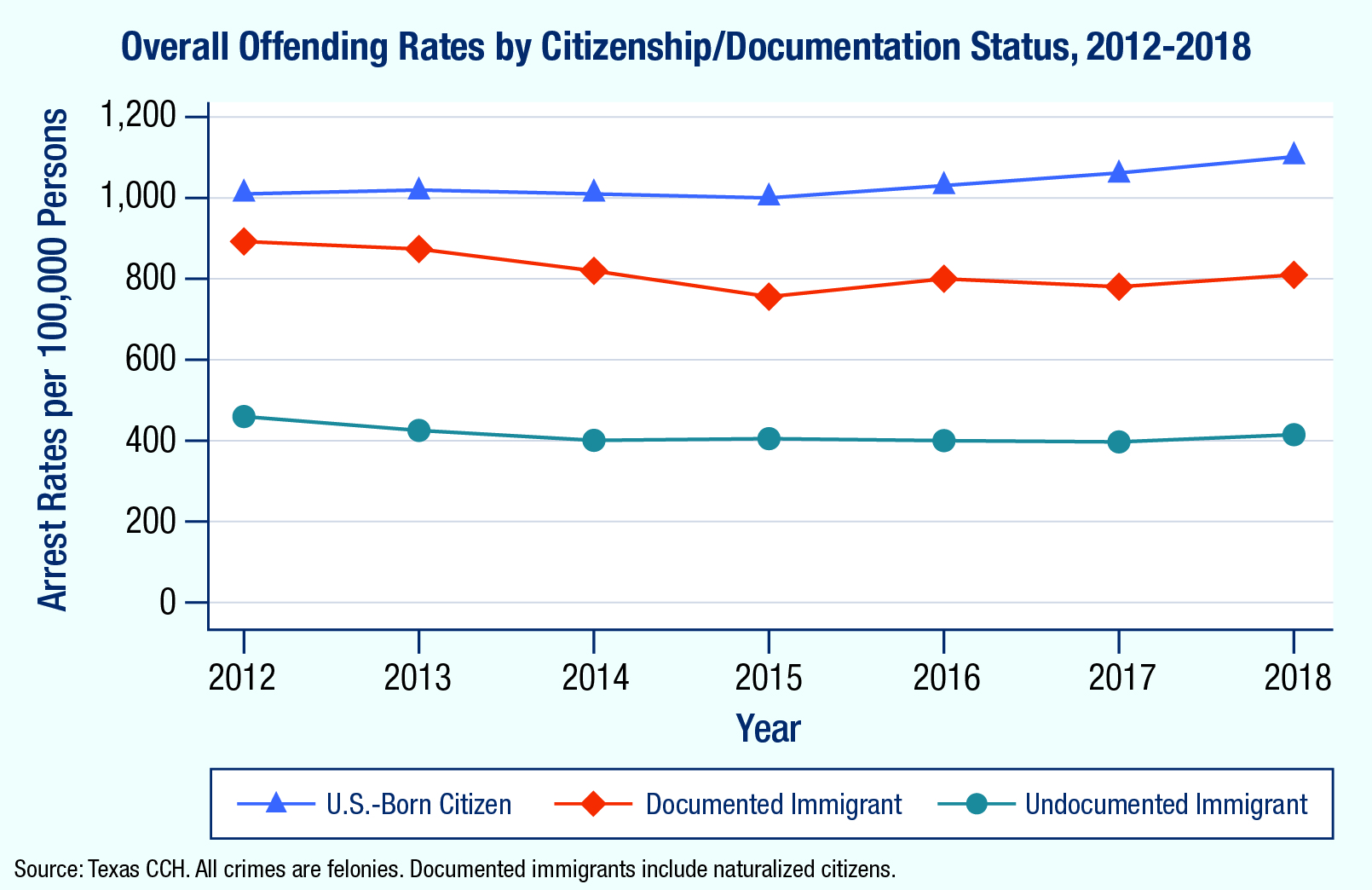
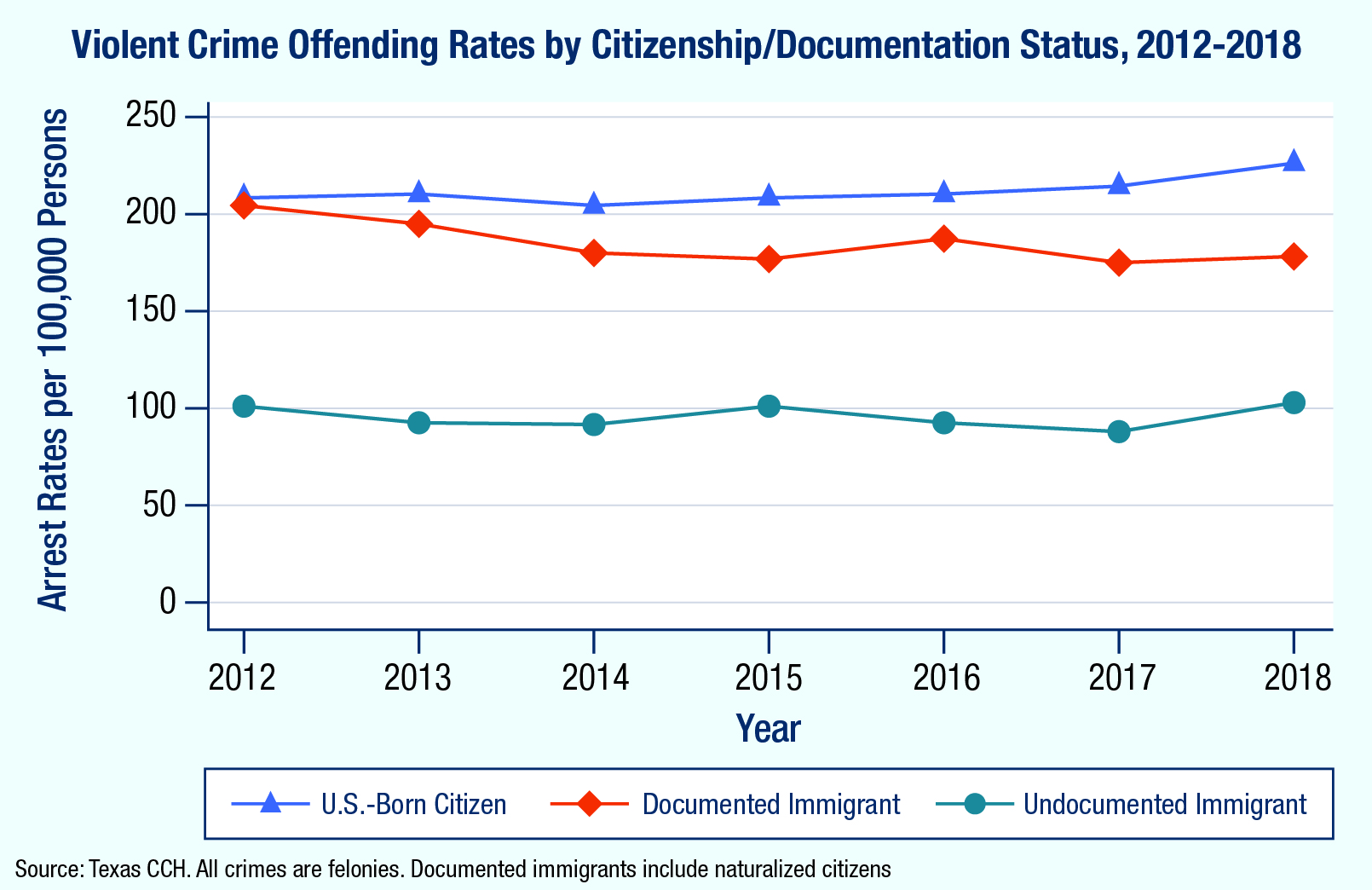
During this time, undocumented immigrants had the lowest offending rates overall for both total felony crime (see exhibit 1) and violent felony crime (see exhibit 2) compared to other groups. U.S.-born citizens had the highest offending rates overall for most crime types, with documented immigrants generally falling between the other two groups.

Exhibit 1.Total felony crime offending rates in Texas for U.S.-born citizens, documented immigrants, and undocumented immigrants

Total felony crime offending rates in Texas for U.S.-born citizens, documented immigrants, and undocumented immigrants

(View larger image.)

Exhibit 2.Violent felony crime offending rates in Texas for U.S.-born citizens, documented immigrants, and undocumented immigrants

Exhibit 2. Violent felony crime offending rates in Texas for U.S.-born citizens, documented immigrants, and undocumented immigrants

(View larger image.)

Researchers also looked specifically at homicide arrest trends. These rates tend to fluctuate more than the overall violent crime arrest rates because murders are relatively rare compared to other crimes. In addition, a large share of homicides go unsolved. Still, undocumented immigrants had the lowest homicide arrest rates throughout the entire study period, averaging less than half the rate at which U.S.-born citizens were arrested for homicide.[3] (The homicide rate for documented immigrants fluctuated. Sometimes it was higher than the rate for U.S.-born citizens and sometimes it was lower.)

Every other violent and property crime type the researchers examined followed the same general pattern. The offending rates of undocumented immigrants were consistently lower than both U.S.-born citizens and documented immigrants for assault, sexual assault, robbery, burglary, theft, and arson.

For drug offenses, too, undocumented immigrants were less than half as likely to be arrested as native-born U.S. citizens.[4] Moreover, the drug crime arrest rate for the undocumented population held steady throughout the seven years of data, while the rate for native-born citizens increased almost 30% during that time. As a result, undocumented immigrants had a smaller share of arrests for drug crimes in 2018 than they had in 2012.

Finally, the researchers conducted statistical tests to determine whether the share of crimes committed by undocumented immigrants had increased for any offense types between 2012 and 2018. They concluded, “There is no evidence that the prevalence of undocumented immigrant crime has grown for any category.”[5] As with drug offenses, evidence suggests the share of property and traffic crimes committed by undocumented immigrants decreased or remained close to constant throughout the period.

About This Article

The work described in this article was supported by NIJ award number 2019-R2-CX-0058, awarded to the University of Wisconsin.

This article is based on the grantee report, “Unauthorized Immigration, Crime, and Recidivism: Evidence From Texas” (pdf, 78 pages), by Michael T. Light.

Florida is one of 18 states that allow the children of undocumented immigrants to receive a lower tuition rate on state colleges. That law is under attack by Randy Fine, a state legislator who is running for Congress. Fine is an ardent supporter of Trump.

The Orlando Sentinel reported:

TALLAHASSEE — For a decade, children brought into the country illegally by their undocumented parents could enroll in a state college or university for the same fee as in-state residents, if they attended a Florida high school for three years.

But now, State Sen. Randy Fine, a Brevard County Republican who plans to resign mid-session to run for Congress, wants to repeal that law and end the educational benefit designed to help young immigrants known as “dreamers.”

Fine wants to end “sweetheart deals for college degrees to those who should not even be here,” he said in an email put out by his senate aide. “President Trump has made clear it is time to close the border and stop giving illegal immigrants rewards for breaking the law.”

His bill revives an effort to squelch the dreamers’ benefit that Gov. Ron DeSantis and some other Republicans tried — and failed — to make part of an immigration reform package in 2023.

Fine claimed the state spent $45 million to provide out-of-state tuition waivers to undocumented college and university students in 2021, but his staff did not respond to questions about the source of that figure.

Fine, a combative conservative who calls himself the “Hebrew Hammer,” filed a bill Monday that would repeal the waiver, which was signed into law in 2014 — two years before he was elected to the Legislature. The law was sponsored by Lt. Gov. Jeanette Nunez when she was a state senator. It was approved with bipartisan support and signed into law by then-Gov. Rick Scott, now the junior GOP senator from Florida.

Under the law, undocumented students who attended a Florida high school for three years and enrolled in a state college or university within 24 months of graduation would pay in-state tuition rates. But they are not eligible for state financial aid.

Without that waiver, they would pay out-of-state rates that are three to four times more. At the University of Central Florida, for example, the in-state rate is about $6,300 while out-of-state tuition is over $22,000…

More than 43,000 undocumented students are currently enrolled in Florida’s public colleges or universities, according to the American Immigration Council and the Presidents’ Alliance on Higher Education and Immigration. They make up just a sliver of the more than 1 million enrolled.

The state university system said it issued 2,005 nonresident tuition waivers last year but does not track how many of them went to undocumented students. The state also doesn’t track of the number of undocumented students enrolled in its universities.

Florida has already invested millions of dollars into the K-12 education of these students, and the 2014 law was seen as an incentive to get them to stay in Florida and complete their postsecondary education, said Renata Bozzetto, deputy director of the Florida Immigrant Coalition.

The result is a “a higher educated population and individuals who can pursue a career while working on their immigration status,” Bozzetto said.

Florida’s undocumented workers contribute $1 billion in spending power and $113 million in state and local taxes, according to the American Immigration Council….

“It’s a publicity stunt,” Sen. Carlos Guillermo Smith, a Democrat from Orlando, said of Fine’s new bill. “I’d be surprised if my Republican colleagues in the Senate even give it a hearing. It’s a mean-spirited and petty attack on immigrants that really defines the MAGA base.”

All in-state residents pay a tuition rate lower than the cost of their education, so state taxpayers are subsidizing all of them, and there is not a limit on the number of students who can receive in-state tuition, he said.

“They are paying tuition like every other student ,” Smith said. “They are not taking something away from other Floridians.”

The Texas Monthly contacted 100 Republican office holders to get their view of Trump’s plans for deporting millions of immigrants. Only two responded. In Texas, one in 20 residents is an undocumented immigrant. Their absence will have a big economic impact, as will the visuals of rounding up and detaining large numbers of people.

Michael Hardy wrote:

Shortly after he is sworn into office, on January 20, President-elect Donald Trump plans to launch a massive deportation operation targeting the estimated 11.5 million immigrants living illegally in the United States. Texas, with its 1,254-mile southern border and pro-Trump leaders, will play a central role in any such deportations. Stephen Miller, the chief architect of Trump’s immigration policies, has vowed that the administration will build “vast holding facilities that would function as staging centers,” likely on “open land in Texas near the border.” State land commissioner Dawn Buckingham recently offered the administration 1,400 acres in Starr County about 35 miles west of McAllen to build “deportation facilities.” 

In their eagerness to help Trump conduct sweeping roundups of undocumented Texas workers and their families, state leaders who vociferously supported Trump’s candidacy have mostly avoided reckoning with the likely economic consequences of such roundups—including the impact on inflation, a major issue in the presidential campaign. 

Earlier this month, Governor Greg Abbott said he expected the president-elect to begin by deporting immigrants who have committed crimes in the United States, but he would not say who he thinks should be expelled next under the far-reaching plan. “President Trump has made perfectly clear that this is a process and you have to have a priority list,” he said. “You begin with . . . the criminals.” 

But Texas is home to some 1.6 million undocumented immigrants—around one in every twenty residents—and the vast majority are not criminals. In fact, undocumented immigrants in our state commit crimes at a significantly lower rate than legal residents, according to a National Institute of Justice analysis of Texas Department of Public Safety data. Many among these 1.6 million power the state’s construction, farming, and meatpacking industries and work as housekeepers, landscape gardeners, and restaurant workers. 

Deporting every immigrant who is in the U.S. illegally—or even half of them—would cripple the economy. And Texas would be hit harder than most states. A recent report by the left-leaning American Immigration Council estimated that a mass-deportation campaign would reduce the national GDP by 4.2 percent to 6.8 percent—a similar hit to the one the nation took during the Great Recession. The price of groceries would skyrocket. A gallon of milk, for instance, would cost twice as much without immigrant labor, according to a 2015 estimate from Texas A&M University’s AgriLife Extension Service. Mass deportations would also punch a hole in the state budget, because undocumented Texans pay an estimated $4.9 billion in sales and payroll taxes every year, including for retirement benefits they are ineligible to collect. 

Trump has argued that deporting undocumented immigrants would open up jobs for American citizens. But the percentage of citizens willing to work in industries such as landscaping and construction has declined, and economic studies suggest that immigration, both legal and illegal, is a net benefit to the economy. Reducing illegal immigration likely would, over time, result in higher wages for legal workers in industries such as construction, assuming the supply of labor were to fall faster than demand. But suddenly removing a significant percentage of undocumented workers (one recent estimate found that 23 percent of construction workers nationally don’t have legal documents) would likely cause hundreds of building projects to stall, crops to go unharvested, and cattle to stack up in feedlots.

Trump’s program would also impose social costs on communities across Texas. According to the Pew Research Center, around 70 percent of undocumented immigrants in the country live in mixed-status households with at least one family member who is here legally. Expelling these migrants would separate families and decimate communities across the state. “The social, family, and economic impact would be very deep,” said Rice University political scientist Tony Payan. “It doesn’t make sense from any perspective. It would be madness for the U.S. to do that.” 

Some Texas officials, including Senator Ted Cruz, have long supported mass deportation as a campaign platform while remaining vague about how such an operation would be executed and what the consequences might be for the Texas economy. In an attempt to get more specifics, Texas Monthly reached out to top Texas officials and every Republican state legislator to ask about the incoming president’s mass-deportation plan. We posed four questions:

  • Do you support President Trump’s plan to deport all immigrants in the country illegally?
  • How would you like the deportations to be carried out?
  • Are you concerned about the potential economic damage to the Texas construction, farming, and restaurant industries from deporting undocumented immigrants? If so, how would you remedy that damage?
  • Are you concerned about the family separations that will occur if all undocumented Texas are deported?

Two legislators responded. Ninety-eight did not.

A loud silence.

Trump was interviewed by “Meet the Press” today.

He talked about his Day 1 goals.

He said he would pardon the January 6 insurrectionists, but the reporting did not clarify whether that would include those who brutalized police officers. If so, Republicans should stop calling themselves the party of law and order.

He said he would try to end “birthright citizenship,” the grant of citizenship to persons born in the U.S. He says he would achieve this goal by executive action but birthright citizenship is written into the 14th Amendment to the Constitution. Trump said that no other country in the world has birthright citizenship but NBC said that 30 other nations do.

As usual, Trump ranted about immigrant criminals but NBC pointed out that immigrants are half as likely to commit crimes as native-born citizens.

He also said he would work with Democrats to protect “Dreamers.” These are children who were brought to this country as young children.

Our reader “Democracy” explains why Trump chose Peter Hegseth to be Secretary of Defense. Trump has said that he wants the military to participate in rounding up, detaining, and expelling millions of immigrants. Hegseth won’t object. Trump has said he wants the military to crack down on protests or gatherings he doesn’t like. Hegseth won’t object. Hegseth also would block any prosecution of military members who are alleged to have committed war crimes.

“Democracy” writes:

What Elon Musk and others want to do in “cutting” government is to eliminate certain federal agencies, like the department of education, and to gut others, like Interior and the EPA, and to deplete the federal civil service while stocking it with Trump loyalists, competent or not.

What he’s doing with Defense appears to be a first step in weaponizing the US military, turning it into a Trump “army” to be used as he sees fit. As any sensible person knows, he IS unfit for office. That’s a genuine recipe for bad things to come.

Here’s how the Associated Press reported Trump’s selection of Pete Hegseth to be Secretary of Defense:

“Trump passed on a number of established national security heavy-hitters and chose an Army National Guard captain well known in conservative circles as a co-host of Fox News Channel’s ‘Fox & Friends Weekend.’…He has made it clear on his show and in interviews that, like Trump, he is opposed to ‘woke’ programs that promote equity and inclusion. He also has questioned the role of women in combat and advocated pardoning service members charged with war crimes.”

On a conservative podcast, Hegseth said this:

“‘First of all, you’ve got to fire the chairman of the Joint Chiefs. Any general, any admiral, whatever,’ who was involved in diversity, equity and inclusion programs or ‘woke shit has “got to go.’”

“Woke” as in being committed to democratic values and principles. “Woke” as in equality, and “liberty and justice for all.” “Woke” as in abiding by US and international law as defined in 18 USC 2441: War crimes.

As the Associated Press also reported,

“…women have successfully passed the military’s grueling tests to become Green Berets and Army Rangers, and the Naval Special Warfare’s test to serve as a combatant-craft crewman — the boat operators who transport Navy SEALs and conduct their own classified missions at sea.”

The Washington Post said this, in part, about the Hegseth pick:

“The breakneck speed of the Hegseth nomination also underscores the value Trump places on TV personalities who have used their platform to promote his agenda.”

Elon Musk. Kristi Noem. Pete Hegseth. All cause for deep concern. Is the next appointment going to be the Brainworm Boy at HHS? The McDonald’s Hamburglar at USDA?

But seriously, given who Hegseth is and what Trump has said, there’s a reason to fear. From CNN:

“There is not much the Pentagon can do to pre-emptively shield the force from a potential abuse of power by a commander in chief. Defense Department lawyers can and do make recommendations to military leaders on the legality of orders, but there is no real legal safeguard that would prevent Trump from deploying American soldiers to police US streets…it is also possible that forces could be sent into American cities if asked to help with the mass deportation plan Trump mentioned repeatedly on the trail.”

And this:

“The president’s powers are especially broad if he chooses to invoke the Insurrection Act, which states that under certain limited circumstances involved in the defense of constitutional rights, a president can deploy troops domestically unilaterally.”

AND this:

“In a video posted last year, Trump said if elected he would ‘immediately re-issue my 2020 Executive Order restoring the President’s authority to remove rogue bureaucrats…we will clean out all of the corrupt actors in our National Security and Intelligence apparatus, and there are plenty of them.’”

The plan is to make the defense and intelligence bureaucracies Trump subsidiaries, along with the Department of Justice. It doesn’t take a rocket scientist to understand why, and what he’ll do with that kind of “deep state” power.

Chris Tomlinson, a columnist for the Houston Chronicle, writes that Trump will break the economy unless he breaks five of his campaign promises. Fat chance.

The U.S. voter will soon see what happens when President-elect Donald Trump’s hyperbole meets reality.

The former and future president made a lot of big promises during his campaign, from blanket tariffs to mass deportations to budget cuts. Luckily, he broke half his campaign promises during his first term, PolitiFact reported.

For the good of the economy and Texas, here are five promises he needs to forget he ever made.

Blanket tariffs: Global trade is the bedrock of the U.S. economy, with consumers purchasing cheap foreign goods and turning foreign raw materials into high-value products. Trump’s track record proves that tariffs are a tax on American consumers and are not paid by foreign nations or corporations.

“The Trump administration imposed nearly $80 billion worth of new taxes on Americans by levying tariffs on thousands of products valued at approximately $380 billion in 2018 and 2019, amounting to one of the largest tax increases in decades,” the conservative Tax Foundation said.

Trump’s most constrained new tariff proposal would cost American consumers and companies another $524 billion annually, shrink the economy by at least 0.8% and wipe out 684,000 jobs, the foundation calculated. That does not include Trump’s most recent promise to impose 100% tariffs on our largest trading partner, Mexico.

Mass deportations: The U.S. construction and hospitality industries are entirely dependent on undocumented immigrants. Deporting millions of these workers would drive housing costs nationwide through the roof and shutter restaurants and hotels.

If Trump only managed to deport 1.3 million workers by 2028, he would shrink the economy by 1.2%, the nonpartisan Peterson Institute for International Economics calculated. If he were wildly successful and deported 8.3 million people, Trump would put the United States into a depression, decreasing economic activity by 7.4%

Inflation Reduction Act repeal: President Joe Biden is proud of his administration’s signature legislation to boost domestic manufacturing and fight climate change. Trump and his ally Elon Musk, CEO of Tesla and SpaceX, have promised to roll it back.

The IRA provides hundreds of billions of dollars in credits and grants for renewable energy, clean technology manufacturing, hydrogen development, carbon capture and nuclear power. Federal agencies have awarded $8 billion in grants to Texas alone.

Corporations have invested hundreds of billions more to collect credits and grants. Rolling back the entire act would effectively terminate hundreds of projects creating good jobs nationwide, including Texas projects valued at $8 billion.

Cutting incentives for wind, solar and battery storage, the cheapest methods of new electricity generation, would contradict another of Trump’s promises. Repealing the IRA would prevent him from supplying the “#1 Lowest Cost Energy and Electricity on Earth.”

Affordable Care Act repeal: Trump has never liked Obamacare and promised to replace it with “a concept of a plan” his staff is developing. Congressional Republicans are also excited about rolling back another signature Democratic program.

Obamacare subsidizes health insurance to nearly 30 million Americans, including 2.5 million Texans, most of whom work for employers who do not offer health insurance. The law also protects people with pre-existing conditions and allows parents to keep their kids on the program until they are 26.

Repealing the ACA without a replacement would leave most enrollees without health insurance. Those people would visit health care providers less often, possibly costing the industry 1.2 million jobs, the left-leaning Economic Policy Institute calculated.

Private insurers would also increase premiums because more people would rely on free emergency care, forcing hospitals to charge insured people more to make up for the uninsured.

Drastic budget cuts: The president-elect has always promised lower taxes and less government spending. His 2017 tax bill slashed taxes for corporations and the very wealthy, but he failed to cut the budget. Instead, he added $1 trillion to the federal deficit.

Trump’s proposed tax cuts would add $5.8 trillion to the deficit over a decade, according to the Wharton School. He has promised to cut government spending by $1 trillion yearly, while Musk has pledged to find $2 trillion, but they don’t say from what programs.

Trump seems to have forgotten that government spending buys goods and services from companies. Taking that much money away from those businesses will slow the economy.

Even a Republican-controlled Congress will likely block Trump’s most costly promises. Lobbyists will still wield a lot of power on Capitol Hill, and no member wants to explain why investments in their district were canceled.

However, Trump can implement the most dramatic and damaging policies on his own, especially tariffs and immigration enforcement. Hopefully, Trump will surround himself with people who will find ways to break his promises.
At the infamous Madison Square Garden hate rally, Trump’s close advisor Stephen Miller railed against immigrants. If Trump is elected, Miller will be in charge of the program to round up and expel millions of undocumented immigrants.

And Trump adviser Stephen Miller, who has shaped many of Trump’s immigration policies, said Americans are having their jobs “looted and stolen from them” and sent to foreign countries. 

He went even further: “America is for America and Americans only,” he said, a starkly anti-immigration view that advances what has already been said throughout the campaign. 

But President Ronald Reagan had a different message. This was his last message as President. He devoted it to welcoming immigrants. During his time in office, he passed legislation to reform the immigration system so that all immigrants entered legally. He extended amnesty to those who were in the U.S. without documents.

An immigration website describes Reagan’s bipartisan legislation:

President Ronald Reagan
Ronald Reagan

A few months into his presidency, Ronald Reagan issued a “Statement on United States Immigration and Refugee Policy” in which he outlined his goals to continue America’s tradition of welcoming people from other countries, especially those fleeing oppression. He called for the millions of undocumented “illegal immigrants” present in the country to be given recognition and a path to legal status — without encouraging further illegal immigration.

On Nov. 6, 1986 Ronald Reagan signed the Immigration Reform and Control Act of 1986, the most far-reaching immigration law passed during his presidency. The Act’s most significant effect was that it allowed immigrants who had entered the U.S. illegally before Jan. 1, 1982 to apply for legal status, provided they paid fines and back taxes. This provision — which Reagan himself referred to as “amnesty,” allowed around 3 million immigrants to secure legal status after paying $185, demonstrating “good moral character” and learning to speak English.

Yes, there is a federal program to verify the legal status of immigrants. It’s fast and efficient but most employers don’t use it. Why? They need laborers, and they don’t care about their legal status.

The Los Angeles Times reports:

  • A long-standing computer-based federal program called E-Verify makes it easy for prospective employers to spot and reject unauthorized immigrants seeking jobs.
  • Yet, in California, only about 16% of employer establishments are enrolled in E-Verify, even lower than the overall national figure of 27%, according to a Times analysis of federal data.
  • The program’s low use reflects the reality that many businesses — and the broader economy — have come to rely on undocumented immigrants. 

WASHINGTON — For all of Donald Trump’s railing against immigrants and Democrats’ insistence on creating a better pathway to citizenship, one thing almost no one ever talks about is a computer-based federal program that makes it easy for prospective employers to spot and reject unauthorized immigrants seeking jobs.

The program, known as E-Verify, is highly reliable and involves relatively little red tape. If fully utilized, many experts say, it could significantly curb the flow of undocumented immigrants by effectively removing one of the biggest reasons so many come to the United States illegally to begin with — getting a job.
Yet even though E-Verify is free for employers, with more than 98% of those checked being confirmed as work-authorized instantly or within 24 hours, the program is significantly underused.

Nationally the program is voluntary, except for certain businesses such as federal contractors. Most states don’t require employers to use it. In California, only about 16% of employer establishments are enrolled in E-Verify, even lower than the overall national figure of 27 %, according to a Times analysis of data from the U.S. Citizenship and Immigration Services and U.S. Bureau of Labor Statistics.

Its low use reflects the underlying reality that many businesses — and the broader economy — have come to rely on undocumented immigrants. And in many ways, it’s both symptomatic and an outcome of what both major political parties acknowledge is a “broken immigration system,” in which unauthorized employment has become an intractable condition that employers, consumers and politicians have lived with for years.

Employers face few sanctions for hiring undocumented workers. And the odds of getting inspected are even less than a taxpayer’s likelihood of being audited by the Internal Revenue Service.

Even during the Trump administration, which stepped up enforcement and publicized a few raids, such as the 2018 sweep of 7-Eleven stores in L.A. and other cities, federal agents closed 6,065 cases of unauthorized employment and labor exploitation nationwide in 2019, its peak year, involving fewer than 31,000 undocumented workers, according to data from U.S. Immigration and Customs Enforcement obtained through the Freedom of Information Act.

Sen. Mitt Romney (R-Utah), with Republican colleagues including Ohio Sen. JD Vance, former President Trump’s running mate, in June introduced a bill to make E-Verify mandatory across the country. But similar efforts in the past have repeatedly failed to win enough bipartisan support.

And one key reason: There are simply not enough “legal” workers to fill all the jobs a healthy, growing U.S. economy generates. And that’s especially so in low-wage industries.

Employers say that requiring E-Verify — without other overhauls to the immigration system, including easier ways to bring in workers — would be devastating.

“I think you would see a general overall collapse in California agriculture and food prices going through the roof if we didn’t have them do the work,” said Don Cameron, general manager at Terranova Ranch, which produces a variety of crops on 9,000 acres in Fresno County.

At least half of the 900,000 farmworkers in California are thought to be undocumented, even higher than what national surveys suggest, says Daniel Sumner, an agricultural economist at UC Davis. Neither Cameron nor most anyone else in California farms, among other sectors, is in favor of mandatory E-Verify.

Even in red states, which are more prone to require and use the program, E-Verify isn’t exactly widely popular in immigrant-heavy states. While Georgia’s participation rate is among the highest, at about 85%, only about 30% of employer establishments in Texas had signed up for it as of last year.

‘The status quo makes business sense’
And enrollment was even lower in Florida, although the state last year made E-Verify mandatory for employers with more than 25 workers, sparking an immediate backlash from some businessess.

“If the documents [presented by a prospective worker] look good on their face, it’s good enough for them because they’re desperate for labor,” said Chris Thomas, a Denver-based attorney who has counseled scores of companies facing government investigations of their immigration practices.

“It’s a wink and a nod,” he said. “ The status quo makes business sense. ”

It’s not simply a matter of not having enough workers to do the hard, often dead-end and low-wage jobs that most U.S. citizens don’t want to do. It’s the shortage of workers overall, experts say.

For decades, birth rates in the U.S. have been declining, as they have in most of the economically developed world. Today, the birth rate among American women of childbearing age has dropped below the level needed to meet the country’s replacement rate. California’s birth rate is at its lowest in a century.

If the economy is to grow and prosper, as almost all Americans say they want it to, additional workers must come from somewhere else.
“It’s not in our macroeconomic interest to prevent unauthorized immigrants from working, because the U.S. population is aging,” said Julia Gelatt, associate director at the Migration Policy Institute, a nonpartisan think tank in Washington. “Because we haven’t had immigration reform to allow in more immigrants legally, people are just coming anyway, and they come in bigger and smaller numbers as our economy demands them.”

David Bier, director of immigration studies at Cato, a conservative think tank, says there’s some evidence that large-scale immigration has kept the country out of recession and increased tax revenues, contrary to what Vance has said about undocumented immigrants draining Social Security funds. Most economists agree that new arrivals have been crucial in sustaining high employment by filling many job openings in recent years.

Immigrants, for example, many of them undocumented, make up 40% of California’s home healthcare and child day-care employment, according to The Times’ calculations of Census Bureau data. That, in turn, helps other moms to stay in the labor force.

“The whole idea that these workers are bad for native-born workers — there’s not much evidence for that,” Bier said.

Bottom line: Congress must act to pass a reorganization of our immigration laws so that all immigrants enter legally.

Barack Obama is a skilled orator, probably the best of our time. In this 3-minute clip, he asks the quintessential question. Trump says to Kamala, “You were there for four years, why didn’t you solve the border problem?” Obama asks of Trump, “Dude, you were there for four years, why didn’t you solve the problem?”

I follow whatever is posted by the Meidas brothers. They do a great job of pulling together clips from the campaign, to show you what’s happening.

This series of clips is an eye opener. It’s frankly disgusting to see the racist, anti-immigrant appeals that Trump and his surrogates deliver to the voters.

We used to pride ourselves on being a nation of immigrants. Now Trump wants us to see immigrants as murderers, rapists, and criminals.

He says he will invoke a law passed in 1798 to round-up millions of immigrants and deport them. Is this The Final Solution?

Can he be elected by serving up a steady diet of hatred and fear?