There was a good deal of excitement about the bipartisan deal on gun control, in which 10 Republican senators agreed to endorse proposed legislation. That’s enough to block a filibuster, if all 10 Republican senators vote for the legislation. When even one Republican agrees to any form of gun control, it’s cause for celebration.
Since the Uvalde massacre, public support for gun control has solidified along partisan lines. According to the latest NPR/PBS NewsHour/Marist poll, 59% favor curbing gun violence, while 35% do not. That includes 92% of Democrats in favor, along with 54% of independents. However, “70% of Republicans say it’s more important to protect gun rights. Notably, however, 56% of gun owners say it is more important to curb gun violence than protect gun rights.”
The proposal, which has not been written into legislative text, includes money to encourage states to pass and implement so-called “red flag” laws to remove guns from potentially dangerous people, money for school safety and mental health resources, expanded background checks for gun purchases for people between the ages of 18 and 21 and penalties for illegal straw purchases by convicted criminals.
It has been endorsed by major gun control groups, like Everytown for Gun Safety and Moms Demand Action, because it is the first such measure with a chance of passage since 1994, when Congress agreed to ban the sale of assault weapons, a ban that expired in 2004.
I say the proposed legislation is a nothing-burger. It is toothless, or to be fair, it has only one or two teeth.
It will not stop future massacres. It does not ban the sale or manufacture of AR15s or other automatic or semi-automatic weapons that have been used in massacres. It makes no attempt to buy back the 400 million weapons now owned by Americans.
It does not raise the age from 18 to 21 for buying a military-grade assault weapon, even though federal law prevents those under 21 from buying a handgun.
It does not require a waiting period of 2-3 weeks to buy an assault weapon, although there are heightened background checks for buyers under 21.
It does not ban internet sales of AR15s and other military-grade weapons.
It pours billions into mental health programs and school security, which is a good thing, but satisfies the Republican claim that guns are not the problem, mental health and school security are.
Under the terms of this bill, the Uvalde killer could still buy his weapons.
The murderer of 20 children and six school staff at the Sandy Hook massacre in 2012 would still have weapons because his mother bought them.
This is weak tea. Even the NRA could possibly endorse this bill, although it is just as likely to raise symbolic opposition to satisfy its most zealous members. The lead Republican negotiator was Texas Senator Jon Cornyn, a favorite of the NRA. He is one of the top recipients of NRA funding. The NRA gave him an A+ rating for his fidelity to its evil agenda (and he bragged about it on his website).
With this two-tooth bill, Republicans can crow that they supported “responsible” (I.e. limited) gun control. Democrats can claim victory too simply because a gun control bill was forged and might pass. Democrats will support it because a slice of bread, even a few crumbs, is better than nothing at all.
But this bill will do nothing to prevent future massacres in schools, churches, synagogues, nail salons, movie theaters, nightclubs, anywhere that people gather.
Until recently, teachers in Ohio were allowed to carry weapons to school but they had to take the same 700 hours of instruction as peace officers in the state.
The New York Times reported that a new Ohio law allows teachers to carry weapons with no more than 24 hours of training.
Teachers and other school employees in Ohio will be able to carry firearms into school with a tiny fraction of the training that has been required since last year, after Gov. Mike DeWine signed a bill into law on Monday.
While employees have for years been allowed to carry guns on school grounds with the consent of the local school board, the Ohio Supreme Court ruled in 2021 that state law required them to first undergo the same basic peace officer training as law enforcement officials or security officers who carry firearms on campus — entailing more than 700 hours of instruction.
That ruling, Mr. DeWine said on Monday, had made it largely impractical for Ohio school districts to allow staffers to carry firearms.
Under the new law, a maximum of 24 hours of training will be enough for teachers to carry guns at school, though the local board will still need to give its approval. Twenty-eight states allow people other than security personnel to carry firearms on school grounds, with laws in nine of those states explicitly mentioning school employees, according to the National Conference of State Legislatures. Polls in recent years show that a majority of Americans, and a large majority of teachers, oppose the idea of arming teachers…
The governor emphasized that local school districts would still have the ability to prohibit firearms on school campuses. “This does not require any school to arm teachers or staff,” he said. “Every school will make its own decision.”
Ohio’s new law, which moved suddenly and swiftly through the State Senate after the school shooting in Uvalde, Texas, passed on June 1 along roughly partisan lines, with two Republicans joining all Democrats in voting against it. The bill passed the House in November, also on a nearly party-line vote; one Republican joined the Democrats in voting against it.
In a speech on the Senate floor, State Senator Niraj Antani, a Republican, dismissed the “crocodile tears” of lawmakers who saw the bill as dangerous, arguing that armed teachers would deter school shootings and calling the bill “probably the most important thing we have done to prevent a school shooter in Ohio.”
A sizable opposition against the bill had grown against it during its journey through the Legislature. Hundreds packed into committee rooms for the bill’s hearings, with all but two or three speakers testifying against it. The opposition included gun control groups as well as teachers, school board members, police union representatives and police chiefs.
Robert Meader, who recently retired as commander of the Columbus, Ohio, Division of Police, called the training requirement in the bill “woefully inadequate,” arguing that it would “cause harmful accidents and potentially even needless deaths.”
The bill is the second major gun bill that Mr. DeWine, a Republican, has signed into law this year. The first, which went into effect on Monday, eliminates the requirement for a license to carry a concealed handgun.
Imagine this: a school shooter enters the building armed with an automatic assault weapon. Will teachers have equally powerful weapons? How terrifying will school be if teachers are carrying assault weapons? Terrifying not only for students, but for teachers and administrators.
A reader who signs as Quickwrit provided the following comment. Quickwrit described the Heller decision, written by conservative Justice Antonin Scalia. The decision overturned a D.C. law that prevented people from keeping handguns in their homes.
In his address to Americans on gun control, President Biden quoted from the Supreme Court’s Heller Ruling — a ruling which pro-gun advocates think was a huge victory for them…but they haven’t read the ENTIRE ruling: On pages 54-55 of their Heller decision, the CONSERVATIVE majority of the Court gave Congress and state lawmakers a guideline for presumptively constitutional gun control action.
Why hasn’t anyone previously focused on pages 54-55 of Heller on which the Supreme Court has provided lawmakers an action plan?
As President Biden noted in his address to our nation, in Heller the conservative Justices provide blanket approval for various kinds of gun control, declaring: “Like most rights, THE RIGHT SECURED BY THE SECOND AMENDMENT IS NOT UNLIMITED…” [it is] “…not a right to keep and carry any weapon whatsoever in any manner whatsoever and for whatever purpose.” Then the conservative Justices invite enactment of specific gun control laws by clearly pointing out which laws they would approve of, declaring: “Nothing in our opinion should be taken to cast doubt on longstanding prohibitions on the possession of firearms by felons and the mentally ill, or on laws forbidding the carrying of firearms in sensitive places such as schools and government buildings, or laws imposing conditions and qualifications on the commercial sale of arms.” The conservative Justices additionally state: “We also recognize another important limitation on the right to keep and carry arms. Miller [an earlier case decided by the Supreme Court] said, as we have explained, that the sorts of weapons protected were those ‘in common use at the time’ [when the 2nd Amendment was written]. We think that limitation is fairly supported by the historical tradition of prohibiting the carrying of ‘dangerous and unusual weapons’.” There were no automatic or semi-automatic guns “in common use at the time” the Second Amendment was written.
The CONSERVATIVE majority DID NOT HAVE TO write these things into their ruling — but they did in order to give lawmakers a clear path to constitutional gun control. The Court put the gun control ball into the hands of lawmakers.
[Please feel free to copy and share this information with your Friends and tell them to do the same because the more people who know about the Supreme Court’s ruling on constitutional gun control, the more likely it will happen.]
Since the massacre at Robb Elementary School in Uvalde, Texas, blame has been shifted to the school district’s police chief, Pete Arredondo, who led a force with six officers. He didn’t have a radio, he didn’t know that children in the locked classrooms were calling 911 for help, he didn’t have a key to the classrooms. More than 100 local, state, and federal law officers converged on the scene, and it was assumed that he was in charge. My own guess, from very far away, was that there was no command structure, and no one knew who was in charge. Nineteen officers congregated outside the connected classrooms where the killer was left alone for more than an hour. The Texas Tribune, a small, independent journal, got the first interview with the school district police chief.
Only a locked classroom door stood between Pete Arredondo and a chance to bring down the gunman. It was sturdily built with a steel jamb, impossible to kick in.
He wanted a key. One goddamn key and he could get through that door to the kids and the teachers. The killer was armed with an AR-15. Arredondo thought he could shoot the gunman himself or at least draw fire while another officer shot back. Without body armor, he assumed he might die.
“The only thing that was important to me at this time was to save as many teachers and children as possible,” Arredondo said.
The chief of police for the Uvalde school district spent more than an hour in the hallway of Robb Elementary School. He called for tactical gear, a sniper and keys to get inside, holding back from the doors for 40 minutes to avoid provoking sprays of gunfire. When keys arrived, he tried dozens of them, but one by one they failed to work.
“Each time I tried a key I was just praying,” Arredondo said. Finally, 77 minutes after the massacre began, officers were able to unlock the door and fatally shoot the gunman.
In his first extended comments since the May 24 massacre, the deadliest school shooting in Texas history, Arredondo gave The Texas Tribune an account of what he did inside the school during the attack. He answered questions via a phone interview and in statements provided through his lawyer, George E. Hyde.
Aside from the Texas Department of Public Safety, which did not respond to requests for comment for this article, Arredondo is the only other law enforcement official to publicly tell his account of the police response to the shooting.
Arredondo, 50, insists he took the steps he thought would best protect lives at his hometown school, one he had attended himself as a boy.
“My mind was to get there as fast as possible, eliminate any threats, and protect the students and staff,” Arredondo said. He noted that some 500 students from the school were safely evacuated during the crisis.
Arredondo’s decisions — like those of other law enforcement agencies that responded to the massacre that left 21 dead — are under intense scrutiny as federal and state officials try to decide what went wrong and what might be learned.
Whether the inability of police to quickly enter the classroom prevented the 21 victims — 19 students and two educators — from getting life-saving care is not known, and may never be. There’s evidence, including the fact that a teacher died while being transported to the hospital, that suggests taking down the shooter faster might have made a difference. On the other hand, many of the victims likely died instantly. A pediatrician who attended to the victims described small bodies “pulverized”and “decapitated.” Some children were identifiable only by their clothes and shoes.
In the maelstrom of anguish, outrage and second-guessing that immediately followed the second deadliest school shooting in American history, the time Arredondo and other officers spent outside that door — more than an hour — have become emblems of failure.
As head of the six-member police force responsible for keeping Uvalde schools safe, Arredondo has been singled out for much of the blame, particularly by state officials. They criticized him for failing to take control of the police response and said he made the “wrong decision” that delayed officers from entering the classroom.
Arredondo has faced death threats. News crews have camped outside his home, forcing him to go into hiding. He’s been called cowardly and incompetent.
The Texas Tribune thanks its sponsors. Become one.
Neither accusation is true or fair, he says.
“Not a single responding officer ever hesitated, even for a moment, to put themselves at risk to save the children,” Arredondo said. “We responded to the information that we had and had to adjust to whatever we faced. Our objective was to save as many lives as we could, and the extraction of the students from the classrooms by all that were involved saved over 500 of our Uvalde students and teachers before we gained access to the shooter and eliminated the threat.”
Arredondo’s explanations don’t fully address all the questions that have been raised. The Tribune spoke to seven law enforcement experts about Arredondo’s description of the police response. All but one said that serious lapses in judgment occurred.
Most strikingly, they said, by running into the school with no key and no radios and failing to take charge of the situation, the chief appears to have contributed to a chaotic approach in which officers deployed inappropriate tactics, adopted a defensive posture, failed to coordinate their actions, and wasted precious time as students and teachers remained trapped in two classrooms with a gunman who continued to fire his rifle.
Hyde, Arredondo’s lawyer, said those criticisms don’t reflect the realities police face when they’re under fire and trying to save lives. Uvalde is a small working-class city of about 15,000 west of San Antonio. Its small band of school police officers doesn’t have the staffing, equipment, training, or experience with mass violence that larger cities might.
His client ran straight toward danger armed with 29 years of law enforcement experience and a Glock 22 handgun. With no body armor and no second thoughts, the chief committed to stop the shooter or die trying.
77 minutes
One of Arredondo’s most consequential decisions was immediate. Within seconds of arriving at the northeast entrance of Robb Elementary around 11:35 a.m., he left his police and campus radios outside the school.
To Arredondo, the choice was logical. An armed killer was loose on the campus of the elementary school. Every second mattered. He wanted both hands free to hold his gun, ready to aim and fire quickly and accurately if he encountered the gunman.
Arredondo provided the following account of how the incident unfolded in a phone interview, in written answers, and in explanations passed through his lawyer.
He said he didn’t speak out sooner because he didn’t want to compound the community’s grief or cast blame at others.
Thinking he was the first officer to arrive and wanting to waste no time, Arredondo believed that carrying the radios would slow him down. One had a whiplike antenna that would hit him as he ran. The other had a clip that Arredondo knew would cause it to fall off his tactical belt during a long run.
Arredondo said he knew from experience that the radios did not work in some school buildings.
But that decision also meant that for the rest of the ordeal, he was not in radio contact with the scores of other officers from at least five agencies that swarmed the scene.
Almost immediately, Arredondo teamed up with a Uvalde police officer and began checking classrooms, looking for the gunman.
As they moved to the west side of the campus, a teacher pointed them to the wing the gunman had entered. As Arredondo and the Uvalde police officer ran toward it, they heard a “great deal of rounds” fired off inside. Arredondo believes that was the moment the gunman first entered adjoining classrooms 111 and 112 and started firing on the children with an AR-15 rifle.
Arredondo and the Uvalde officer entered the building’s south side and saw another group of Uvalde police officers entering from the north.
Arredondo checked to see if the door on the right, room 111, would open. Another officer tried room 112. Both doors were locked.
Arredondo remembers the gunman fired a burst of shots from inside the classroom, grazing the police officers approaching from the north. Some of the bullets pierced the classroom door, and others went through the classroom wall and lodged in the wall adjacent to the hallway, where there were other classrooms. The officers on the north end of the hallway retreated after being shot, but they weren’t seriously injured and returned shortly after to try to contain the gunman.
Because the gunman was already inside the locked classroom, some of the measures meant to protect teachers and students in mass shooting situations worked against police trying to gain entry.
Arredondo described the classroom door as reinforced with a hefty steel jamb, designed to keep an attacker on the outside from forcing their way in. But with the gunman inside the room, that took away officers’ ability to immediately kick in the door and confront the shooter.
Arredondo believed the situation had changed from that of an active shooter, to a gunman who had barricaded himself in a classroom with potential other victims.
Texas Department of Public Safety officials and news outlets have reported that the shooter fired his gun at least two more times as police waited in the hallway outside the classrooms for more than an hour. And DPS officials have said dispatchers were relaying information about 911 calls coming from children and teachers in the classrooms, begging the police for help.
Arredondo said he was not aware of the 911 callsbecause he did not have his radio and no one in the hallway relayed that information to him. Arredondo and the other officers in the hallway took great pains to remain quiet. Arredondo said they had no radio communications — and even if they’d had radios, his lawyer said, they would have turned them off in the hallway to avoid giving away their location. Instead, they passed information in whispers for fear of drawing another round of gunfire if the shooter heard them.
Finding no way to enter the room, Arredondo called police dispatch from his cellphone and asked for a SWAT team, snipers and extrication tools, like a fire hook, to open the door.
Arredondo remained in the hallway for the rest of the ordeal, waiting for a way to get into the room, and prepared to shoot the gunman if he tried to exit the classroom.
Arredondo assumed that some other officer or official had taken control of the larger response. He took on the role of a front-line responder.
He said he never considered himself the scene’s incident commander and did not give any instruction that police should not attempt to breach the building. DPS officials have described Arredondo as the incident commander and said Arredondo made the call to stand down and treat the incident as a “barricaded suspect,” which halted the attempt to enter the room and take down the shooter. “I didn’t issue any orders,” Arredondo said. “I called for assistance and asked for an extraction tool to open the door.”
Officers in the hallway had few options. At some point, Arredondo tried to talk to the gunman through the walls in an effort to establish a rapport, but the gunman did not respond.
With the gunman still firing sporadically, Arredondo realized that children and teachers in adjacent rooms remained in danger if the gunman started shooting through the walls.
The Texas Tribune thanks its sponsors. Become one.
“The ammunition was penetrating the walls at that point,” Arredondo said. “We’ve got him cornered, we’re unable to get to him. You realize you need to evacuate those classrooms while we figured out a way to get in.”
Lights in the classrooms had also been turned off, another routine lockdown measure that worked against the police. With little visibility into the classroom, they were unable to pinpoint the gunman’s location or to determine whether the children and teachers were alive.
Arredondo told officers to start breaking windows from outside other classrooms and evacuating those children and teachers. He wanted to avoid having students coming into the hallway, where he feared too much noise would attract the gunman’s attention.
While other officers outside the school evacuated children, Arredondo and the officers in the hallway held their position and waited for the tools to open the classroom and confront the gunman.
At one point, a Uvalde police officer noticed Arredondo was not wearing body armor. Worried for the chief’s safety, the Uvalde officer offered to cover for Arredondo while he ran out of the building to get it.
“I’ll be very frank. He said, ‘Fuck you. I’m not leaving this hallway,’” Hyde recounted. “He wasn’t going to leave without those kids.”
Without any way to get into the classroom, officers in the hallway waited desperately for a way to secure entry and did the best they could to otherwise advance their goal of saving lives.
“It’s not that someone said stand down,” Hyde said. “It was ‘Right now, we can’t get in until we get the tools. So we’re going to do what we can do to save lives.’ And what was that? It was to evacuate the students and the parents and the teachers out of the rooms.”
Tools that might have been useful in breaking through the door never materialized, but Arredondo had also asked for keys that could open the door. Unlike some other school district police departments, Uvalde CISD officers don’t carry master keys to the schools they visit. Instead, they request them from an available staff member when they’re needed.
Robb Elementary did not have a modern system of locks and access control. “You’re talking about a key ring that’s got to weigh 10 pounds,” Hyde said.
Eventually, a janitor provided six keys. Arredondo tried each on a door adjacent to the room where the gunman was, but it didn’t open.
Later, another key ring with between 20 and 30 keys was brought to Arredondo.
“I was praying one of them was going to open up the door each time I tried a key,” Arredondo said in an interview.
None did.
Eventually, the officers on the north side of the hallway called Arredondo’s cellphone and told him they had gotten a key that could open the door.
The officers on the north side of the hallway formed a group of mixed law enforcement agencies, including U.S. Border Patrol, to enter the classroom and take down the shooter, Arredondo said.
Ten days after the shooting, The New York Times reported that a group of U.S. Border Patrol agents ignored a directive spoken into their earpieces not to enter the room. The Times has since reported that Arredondo did not object when the team entered the room.
Hyde said if a directive delaying entry was issued, it did not come from Arredondo, but the Times reported that someone was issuing orders at the scene. Hyde said he did not know who that person was. The Border Patrol declined to comment.
At 12:50 p.m., as the officers entered the classroom, Arredondo held his position near the south classroom door in the hallway, in case the gunman tried to run out that door.
At last, the shooter, Salvador Ramos, 18, was brought down. A harrowing standoff rapidly became an effort to find the wounded and count the dead.
Once the officers cleared the room, Border Patrol agents trained to render emergency medical service assessed the wounded. Arredondo and other officers formed a line to help pass the injured children out of the hallway and to emergency medical care.
Expert analysis
A police officer intentionally ditching his radio while answering a call? “I’ve never heard anything like that in my life,” said Steve Ijames, a police tactics expert and former assistant police chief of Springfield, Missouri.
The discarded radio, the missing key and the apparent lack of an incident commander are some of questions raised by experts about the response of Arredondo and the various agencies involved.
Officers are trained never to abandon their radios, their primary communication tool during an emergency, said Ijames. That Arredondo did so the moment he arrived on scene is inexplicable, he said.
Ijames added that it is “inconceivable” that Arredondo’s officers did not have a plan to access any room or building on campus at any moment, given that the school district makes up the entirety of the tiny force’s jurisdiction.
The Texas Tribune thanks its sponsors. Become one.
The experts, which included active-shooting researchers and retired law enforcement personnel, homed in on the moment officers entered the school and found the doors to rooms 111 and 112 locked. Three said this moment afforded Arredondo a chance to step back, regroup and work with other officers to devise a new strategy.
“It takes having someone who has the wherewithal to come up with a quick, tactical plan and executing it,” said former Seguin police Chief Terry Nichols. “It may not be the best plan, but a plan executed vigorously is better than the best unexecuted plan in the world.”
Nichols, who teaches classes on active-shooter responses, said he understands the instinct for command staff to want to confront a gunman themselves. But he said commanders must not lose focus of their role in an emergency.
“We have to — as leaders, especially as a chief of police — step back and allow our men and women to go do what they do, and use our training and experience where they’re needed, to command and control a chaotic situation,” Nichols said.
Active-shooter protocols developed after the 1999 shooting at Columbine High School, where a slow police response delayed medical care that could have saved several victims, train police to confront shooters immediately, without waiting for backup and without regard for their personal safety. An active-shooting training that Uvalde school district police attended in March stressed these tactics, warning that responders likely would be required to place themselves in harm’s way.
“The training that police officers have received for more than a decade mandates that when shots are fired in an active-shooter situation, officers or an officer needs to continue through whatever obstacles they face to get to the shooter, period,” said Katherine Schweit, a retired FBI agent who co-wrote the bureau’s foundational research on mass shootings. “If that means they go through walls, or go around the back through windows, or through an adjoining classroom, they do that.”
Bruce Ure, a former Victoria police chief, said drawing conclusions about police conduct during the shooting is premature since the authorities have not completed their investigations. He said he believes Arredondo acted reasonably given the circumstances he faced.
Ure disagreed that Arredondo should have retreated into a command role once other officers arrived, since most active-shooter events last mere minutes. He argued that no amount of ad-hoc planning outside would have changed the outcome of the massacre once the shooter got inside the classrooms.
He said attempting to breach windows or open classroom doors by force were unrealistic options that would have exposed police and children to potentially fatal gunfire with little chance of success. Officers’ only choice, he said, was to wait to find a key, which he agreed should not have taken so long.
Hyde said attempting to enter through windows would have “guaranteed all the children in the rooms would be killed” along with several officers. He said this “reckless and ineffective” action, when police could not see where the shooter was, would have made officers easy targets to be picked off at will.
Ure, who as an attendee was wounded in the hand during the 2017 Las Vegas concert shooting that killed 60 people, acknowledged the post-Columbine wisdom that immediately confronting shooters is paramount. But he said the scene inside Robb Elementary presented a “perfect storm” of an active shooter barricaded with hostages.
“There’s no manual for this type of scenario,” Ure said. “If people need to be held appropriately accountable, then so be it. But I think the lynch-mob mentality right now isn’t serving any purpose, and it’s borderline reckless.”
Questions over command
The day after the shooting, Arredondo and other local officials stood behind Gov. Greg Abbott and DPS Director Steve McCraw as they held their first major news conference to address the slaughter.
Abbott lauded law enforcement agencies for their “amazing courage” and said the actions of police officers were the reason the shooting was “not worse.” McCraw said a school resource officer had “engaged” the shooter outside the building but was unable to stop him from entering.
To Arredondo, that information did not ring true. Arredondo turned to a DPS official, whom he declined to identify, and asked why state officials had been given inaccurate information.
In a stunning reversal at a news conference the next day, the DPS regional director for the area, Victor Escalon, retracted McCraw’s initial claim and said the gunman “was not confronted by anybody” before entering the school.
The Texas Tribune thanks its sponsors. Become one.
At a third news conference the following afternoon, Abbott said he was “livid” about being “misled” about the police response to the shooting. He said his incorrect remarks were merely a recitation of what officers had told him.
Hyde said the inaccurate information did not come from Arredondo, who had briefed state and law enforcement officials about the shooting before the first press conference. Abbott on Wednesday declined to identify who had misled him, saying only that the bad information had come from “public officials.”
McCraw also told reporters that Arredondo, whom he identified by his position rather than his name, treated the gunman as a “barricaded suspect” rather than an active shooter, which McCraw deemed a mistake. In the news conference, McCraw referred to Arredondo as the shooting’s “incident commander.”
Hyde said Arredondo did not issue any orders to other law enforcement agencies and had no knowledge that they considered him the incident commander.
The National Incident Management System, which guides all levels of government on how to respond to mass emergency events, says that the first person on scene is the incident commander. That incident commander remains in that charge until they relinquish it or are incapacitated.
Hyde acknowledged those guidelines but said Arredondo’s initial response to the shooting was not that of an incident commander, but of a first responder.
“Once he became engaged, intimately involved on the front line of this case, he is one of those that is in the best position to continue to resolve the incident at that time,” Hyde said. “So while it’s easy to identify him as the incident commander because of that NIMS process, in practicality, you see here he was not in the capacity to be able to run this entire organization.”
With no radio and no way to receive up-to-date information about what was happening outside of the hallway, Hyde said, another one of the local, state and federal agencies that arrived at the scene should have taken over command.
The Texas Tribune thanks its sponsors. Become one.
Nichols, the former Seguin police chief, dismissed the idea that another officer would seamlessly adopt the incident commander role simply because Arredondo never did. He said decisive commanders are especially important when multiple agencies respond to an incident and are unsure how to work together.
“You know the facility. You’re the most intimately knowledgeable about this,” Nichols said of Arredondo. “Take command and set what your priorities need to be, right now.”
On May 31, officials with DPS, which is investigating the Uvalde shooting, told news outlets that Arredondo was no longer cooperating with the agency. The agency’s investigative unit, the Texas Rangers, wanted to continue talking with the police chief, but he had not responded to the agency’s request for two days, DPS officials said.
Hyde said Arredondo participated in multiple interviews with DPS in the days following the shooting, including a law enforcement debriefing the day of the attack and a videotaped debriefing with DPS analysts and the FBI the day after.
He’d also briefed the governor and other state officials and had multiple follow-up calls with DPS for its investigation.
But after McCraw said at a press conference on May 27 that Arredondo made the “wrong decision,” the police chief “no longer participated in the investigation to avoid media interference,” Hyde said.
The Rangers had asked Arredondo to come in for another interview, but he told investigators he could not do it on the day they asked because he was covering shifts for his officers, Hyde said.
“At no time did he communicate his unwillingness to cooperate with the investigation,” Hyde said. “His phone was flooded with calls and messages from numbers he didn’t recognize, and it’s possible he missed calls from DPS but still maintained daily interaction by phone with DPS assisting with logistics as requested.”
Hyde said Arredondo is open to cooperating with the Rangers investigation but would like to see a transcript of his previous comments.
“That’s a fair thing to ask for before he has to then discuss it again because, as time goes by, all the information that he hears, it’s hard to keep straight,” Hyde said.
Children visited the memorial at Robb Elementary on May 28. Hundreds of people waited in line holding flowers and one another to pay their respects there. Credit: Kaylee Greenlee Beal for The Texas Tribune
“They loved those kids”
When the gunman was dead, police had another grim task: moving the tiny bodies of injured children out of the room and getting them emergency medical care as soon as possible.
A line was formed to gently but quickly move them out. Each child passed through Arredondo’s arms.
Later that night, Arredondo went to the Uvalde civic center, where families waited desperately for news that their loved ones had survived, or had at worst been taken to the hospital for treatment.
For Arredondo, his lawyer said, telling families that “no additional kids were coming out of the school alive was the toughest part of his career.”
The chaotic law enforcement response to the shooting by local, state and federal agencies is under investigation by the U.S. Department of Justice and the Texas Department of Public Safety. It is the subject of an investigative committee of the Texas Legislature and will be the source of months of scrutiny by public officials, survivors and the families of the deceased. Survivors and the families of victims have started contacting lawyers for potential legal action.
Arredondo’s role will be central to all of those probes.
For now, he is avoiding the public eye, having left his home temporarily because it is under constant watch by news reporters.
But he’s also been unable to mourn with his community.
Arredondo grew up in the community and attended Robb Elementary as a boy. He started his career at the Uvalde Police Department and spent 16 years there before moving to Laredo for work.
He returned to his hometown in 2020 to head up the school district’s police department. He and his police officers loved high-fiving the schoolchildren on his visits to the schools, Hyde said.
“It was the highlight of his days,” Hyde said. “They loved those kids.”
Arredondo’s ties to the shooting are also familial. One of the teachers killed by the gunman, Irma Garcia, was married to Arredondo’s second cousin, Joe Garcia. Garcia died suddenly two days after his wife’s death.
Arredondo grew up with Joe Garcia and went to school with him. But when the funeral services started, Arredondo said he opted against attending because he didn’t want his presence to distract from the Garcias’ grieving loved ones.
His small police department is also suffering.
Eva Mireles, another teacher killed by the gunman, was married to Uvalde Consolidated Independent School District police officer Ruben Ruiz.
“They lost a person that they consider family,” Hyde said.
The Texas Tribune thanks its sponsors. Become one.
To relieve his grieving officers, Arredondo has picked up extra shifts at the police department.
And he’s received death threats and negative messages from people he does not know.
“Those are people who just don’t know the whole story that are making their assumptions on what they’re hearing or reading. That’s been difficult,” he said. “The police in Uvalde, we’re like your family, your brothers and sisters. We help each other out at any cost, and we’re used to helping out the community, period, because that’s what most public servants are about.”
Arredondo said he remains proud of his response and that of his other officers that day. He believes they saved lives. He also believes that fate brought him back home for a reason.
“No one in my profession wants to ever be in anything like this,” Arredondo said. “But being raised here in Uvalde, I was proud to be here when this happened. I feel like I came back home for a reason, and this might possibly be one of the main reasons why I came back home. We’re going to keep on protecting our community at whatever cost.”
Disclosure: The New York Times has been a financial supporter of The Texas Tribune, a nonprofit, nonpartisan news organization that is funded in part by donations from members, foundations and corporate sponsors. Financial supporters play no role in the Tribune’s journalism. Find a complete list of them here.
WASHINGTON — Miah Cerrillo, an 11-year-old in fourth grade who survived the school shooting at Robb Elementary School in Uvalde, said she covered herself in another student’s blood to trick the shooter into thinking she was already dead.
Cerrillo, wearing a sunflower tank top and her hair pulled back into a ponytail, spoke softly as she answered questions for 2 minutes on video about what she endured that day in the classroom, just a few weeks after she witnessed her friends and teacher die in a deadly school shooting.
“He shot my teacher and told my teacher good night and shot her in the head,” she said in the prerecorded video. “And then he shot some of my classmates and the white board.”
Cerrillo was the youngest of a small group of Uvalde survivors and family members who testified at a House hearing Wednesday about the devastation wrought by gun violence in their communities.
On May 24, an 18-year-old gunman armed with two assault rifles entered the school building killing 19 children and two teachers and injuring 17 others.
That day Cerrillo said she and her classmates were watching a movie. Her teacher received an email and then got up to lock the door — that’s when made eye contact with the gunman in the hallway, Cerrillo said.
At that point, the teacher told the students to “go hide.” Cerrillo hid behind her teacher’s desk among the backpacks. The shooter then shot “the little window,” presumably part of the door to the hallway. She said the gunman entered a neighboring classroom and was able to access her classroom through an adjoining door. That’s when he started shooting.
One of the students who was shot, a friend of hers, was next to her among the backpacks.
“I thought [the gunman] was going to come back to the room, so I grabbed the blood and I put it all over me,” she said.
She said she “stayed quiet” and then she grabbed her teacher’s phone and called 911.
“I told [the operator] that we need help and to send the police [to my] classroom,” she said.
Cerrillo added that she did not feel safe in school and did not “want it to happen again.” An off-camera questioner asked if she thought a shooting like this will happen again and Cerrillo affirmatively nodded.
Cerrillo was calm and quiet. She didn’t cry. But some of the adults from Uvalde who testified wept before the committee, including her father, Miguel Cerrillo, who traveled to Washington to testify in person.
“I come because I could have lost my baby girl, but she’s not the same baby girl I used to play with,” he said, adding that “schools are not safe anymore.”
Kimberly Rubio, a newspaper reporter and the mother of 10-year-old Lexi Rubio, who died that day, described dropping her children off at the school and attending end-of-school-year awards ceremonies that morning.
“I left my daughter at that school and that decision will haunt me for the rest of my life,” she said, as she testified in a video recording sitting next to her stone-faced husband, Felix Rubio.
She called for a ban on assault rifles, high-capacity magazines, raising the age to purchase certain guns, keeping guns out of the hands of people deemed to be a risk to themselves or others, stronger background checks and to repeal gun manufacturers’ immunity from liability.
“We understand for some reason to some people, to people with money, to people who fund political campaigns, that guns are more important than children,” Rubio said. “So at this moment we ask for progress.”
Dr. Roy Guerrero, a pediatrician, Uvalde native and graduate of Robb Elementary School, described in the hearing room his encounter with the bodies of two deceased children that arrived at his hospital.
The children’s bodies were “pulverized,” “decapitated” and “ripped apart.” The bullets did so much damage to their bodies that the “only clue as to their identities was a blood-splattered cartoon clothes still clinging to them, clinging for life and finding none.”
He added that he and other hospital personnel braced that day for an onslaught of carnage, but it never came because so many of the victims were already dead.
As Salvador Ramos approached Room 112 in Uvalde’s Robb Elementary School, the teacher and her students heard gunshots.
She told the fourth-graders to get down on the floor or under their desks, and she went to the door to make sure it was locked. Then Ramos fired at the door handle. Rounds from his assault-style rifle shattered the door window and struck the teacher, fatally injuring her as she tried to protect her kids.
“It’s time to die,” Ramos declared as he entered the classroom. “You guys are mine.”
Ramos at one point asked if anyone needed help, and when one child stood up, he shot him.
These details of the first minutes of the May 24 rampage are from a 10-year-old boy who was in the classroom and who has described the scene to his mother and to law enforcement officials.
“Creepy music” blared from Ramos’ phone as the 18-year-old high school dropout opened fired on the class, the boy recalled. His mother, Corina Camacho, said shrapnel struck her son in the leg.
Then Ramos walked to the connected classroom next door, Room 111, and opened fire again.
“He was like going back and forth, playing music,” the mother told the San Antonio Express-News.
The terror continued for over an hour. It would be more than 75 minutes after the first 911 calls before members of a Border Patrol tactical unit went into the classrooms and killed Ramos. By then, 19 students and two teachers — Eva Mireles and Irma Garcia — were dead. Seventeen other people were injured. It isn’t clear which teacher was killed when Ramos shot through the door.
The Express-News’ account of the early minutes of the rampage is based on interviews with law enforcement sources, state lawmakers, Corina Camacho and civil lawyers who represent surviving children and teachers.
Camacho’s son told his story to the FBI recently. He is one of several witnesses who were interviewed by the FBI, the Texas Rangers or the Texas Department of Public Safety.
The information from the lawyers and law enforcement sources helps shed light on the tragedy and the disastrous police response that followed. Key details remain unknown to investigators as they try to reconcile incomplete or contradictory statements from witnesses and law enforcement officers.
The massacre in the rural town of more than 15,000 is the second-worst mass shooting at a school, after the 2012 massacre at Sandy Hook Elementary School in Newtown, Conn., which killed 26. President Joe Biden visited Uvalde last week to comfort the families, and in a televised speech days later, he renewed calls for tighter gun restrictions, including a ban on assault-style rifles.
Frozen with fear
The morning of Tuesday, May 24, began like any day near the end of the school year. Some classes at Robb Elementary had just come in from recess. Others had just let out for lunch. Summer break would begin in two days.
Teacher Emilia Marin had propped open a door with a rock to help a co-worker bring in food for an end-of-the-year party from a car in the school parking lot. Then Marin saw a truck crash outside the school’s perimeter fence, said her lawyer, Don Flanary.
Marin went back inside the school to get her phone and report the crash to 911.
When she came back outside, still on the phone, she saw her co-worker flee and heard people at a funeral home across the street yell, “He’s got a gun!”
Marin saw Ramos jump over a fence. She kicked the rock away, pulled the door shut and ran into the school. She huddled under a counter in a classroom.
She heard gunshots, first outdoors, then inside the school. Her 911 call dropped. She grabbed chairs and boxes to hide behind. Frozen with fear, she tried to be still.
Marin received a text from her daughter asking if she was safe.
“There’s a shooter,” Marin typed back. “He’s shooting. He’s in here.”
Then Ramos approached Room 112.
Camacho and one of her lawyers, Stephanie Sherman, said her son described how Ramos shot his way into the classroom and how police at one point opened the door and retreated after he fired at them. Law enforcement sources disputed the latter part of the boy’s account, saying no officer went into the classroom during the initial response.
The officers “were all in the hallway, and when shots were fired, they all ran back to another hallway or outside,” one source told the Express-News.
Another lawyer for the family, Shawn Brown, said the boy related different details to his grandfather. He told the grandfather that his teacher shielded him with her body as he lay on the floor and that Ramos fired at her, killing her and striking him in the leg.
Brown also said the boy told his grandfather that Ramos, after pacing from one room to the other, asked if anyone needed help — acting in the guise of a police officer.
“When one kid stood up, he shot him with the AK,” Brown said, quoting the grandfather. “That may be the reason he thought an officer had come in.”
Investigators are trying to unravel discrepancies in the accounts provided by the traumatized children. Camacho’s son’s account differs somewhat from what other children have told investigators. The inconsistencies could reflect differing vantage points — whether the children were lying facedown or were facing away from Ramos.
Some saw most of the massacre unfold. As their memories return, the children have revealed progressively more and sometimes contradictory details to investigators and family members.
“The kids’ interviews, they’re bad,” said one law enforcement source, referring to the graphic details. “I can’t even imagine the nightmare … that those kids went through.”
Brown said the differing versions simply reflect trauma.
“It’s because of the shock and because of the stress that they went through,” Brown said. “They’re remembering bits and pieces as they go, and it may not be in sequential order. It was such a traumatic experience that their brains are trying to block it out.”
The official account of what happened inside the school has not been fully disclosed because of a criminal investigation by the Texas Rangers, assisted by the FBI, that is being overseen by Uvalde District Attorney Christina Mitchell Busbee…
First on the scene
According to law enforcement sources, Uvalde police and Uvalde CISD officers were among the first to arrive. Because it was school district property, responding officers deferred to Arredondo.
State Sen. Roland Gutierrez of San Antonio, whose district includes Uvalde, said last week that Arredondo was not aware of 911 calls from students inside the classroom, who were begging to be rescued.
Arredondo’s six-officer department does not have its own radio communications system. The 911 calls were routed to the Uvalde Police Department, Gutierrez said. Why Arredondo would not have known about the desperate calls from the students is unclear, given that numerous officers equipped with radios were at the scene.
One source said interviews with officers indicated that Arredondo did not have a police radio with him. Another law enforcement source said security video from the school confirms Arredondo did not have a radio.
“He made some phone calls to Uvalde PD” to get information and may have missed the 911 calls from the students, a source said.
Also, the fortified, concrete walls of the school interfered with reception of the radios carried by other officers, law enforcement sources said.
At one point, 19 officers were in a hallway outside the classrooms where Ramos had cornered his terrified victims.
“There’s not as much radio traffic as you would think there would be,” one law enforcement source said. “Those inside may not have heard the kids’ 911 calls.”
Because some officers were off-duty or rushed in, they didn’t have body cameras or did not set them to record, further complicating matters for investigators.
Arredondo appears to have been inside the building with some school police officers and Uvalde police officers. Investigators have collected reports from some first responders indicating that Arredondo tried early on to negotiate with the gunman by cellphone, but Ramos did not answer.
As officers planned strategy in the hallway, Arredondo believed the victims were all dead and Ramos had barricaded himself, investigators said. He held officers back to wait for reinforcements and specialized equipment, and the officers on the scene stood down, according to sources.
DPS Director Steve McCraw has said there was “no excuse” for that decision and that the 19 officers should have stormed in and killed Ramos early on to end the bloodshed and give aid to the wounded.
Outside, other officers cordoned off the school and barred agitated parents from going inside.
While the school was under attack, Mireles, one of the fourth-grade teachers who was killed, called her husband, Ruben Ruiz. He is a school district police officer, and he rushed to the scene, Uvalde County Judge Bill Mitchell said. Like the students’ parents, he was prohibited from entering the building.
Mireles and Ruiz talked by phone as the fatally wounded teacher took her last breaths.
“She’s in the classroom and he’s outside. It’s terrifying,” Mitchell told reporters after being briefed by Uvalde County sheriff’s deputies who were at the scene.
Radio traffic shows that officers from several federal law enforcement agencies responded, including the Drug Enforcement Administration and the U.S. Marshals Service.
Ultimately, members of a Border Patrol tactical unit shot Ramos, who apparently was locked inside one of the classrooms.
Brown, the lawyer for the family of the 10-year-old boy, said the child described how he and a couple of other students got up when they were rescued.
“He said he saw the other kids on the floor,” Brown said, choking back emotion. “He told the grandfather, ‘I got up. My friends didn’t.’”
‘Really bad’ for police
Why the outer door Ramos used to get into the school didn’t lock when the teacher pulled it shut is unknown. One law enforcement source said officials plan to remove that door and the classroom doors for inspection.
A team from the Advanced Law Enforcement Rapid Response Training Center at Texas State University went to the school this past week to conduct an assessment of what happened.
The U.S. Justice Department is carrying out a separate review of the police response, at the request of Uvalde Mayor Don McLaughlin Jr.
“The report is not going to be good,” one source said. “This is really bad for law enforcement.”
Michael Hiltzik is a brilliant columnist for The Los Angeles Times. This article is the single best analysis of gun control that I have read anywhere. In it, Hiltzik demonstrates the fallacies of those who oppose gun control. The Second Amendment does not give unlimited rights to own guns. Gun control is supported by majorities. Effective gun control saves lives. Why should the right to own a gun be more sacred than the right to life?
Hiltzik writes:
Another massacre, another outpouring of political balderdash, flat-out lies about gun control and cynical offers of “thoughts and prayers” for the victims.
I haven’t commented on the slaughter of 19 children and two adults in Uvalde, Texas, by an assault rifle-wielding 18-year-old before now, hoping that perhaps the passage of time would allow the event to become clarified, even a bit more explicable.
But in the week since the May 24 massacre, none of that has happened. The news has only gotten worse. It’s not merely the emerging timelines that point to the inexcusable cowardice of local law enforcement at the scene, but the ever-growing toll of firearm deaths across the country.
The right secured by the Second Amendment is not unlimited.
— Justice Antonin Scalia, District of Columbia vs Heller
There have been 17 mass shootings nationwide since Uvalde, including 12 on Memorial Day weekend alone. A mass shooting is defined by the Gun Violence Archive as one in which four people or more are killed or wounded, not including the shooter.
What is most dispiriting about this toll is the presumption that campaigning to legislate gun safety is fruitless, because gun control is unconstitutional, politically unpopular, and useless in preventing mass death.
These arguments have turned the American public into cowards about gun control. Voters seem to fear that pressing for tighter gun laws will awaken a ferocious far-right backlash, and who wants that?
Yet not a single one of these assertions is true, and repeating them, as is done after every act of mass bloodshed, doesn’t make them true. The first challenge for those of us concerned about the tide of deaths by firearms in America is to wean the public and public officials from their attitude of resignation.
We’ll skip lightly over a few of the more ludicrously stupid claims made by politicians and gun advocates about Uvalde.
For example, that the disaster could have been averted if the school had only one door, says Sen. Ted Cruz (R-Texas); apparently Cruz is ignorant of the Triangle Shirtwaist Factory disaster, in which 146 garment workers died, many because they could not escape the factory through its locked doors.
But that happened in 1911, and who can expect a Senator to remain that au courant?
Or the assertion by Texas Gov. Greg Abbott and many others that the problem leading to Uvalde isn’t the epidemic of assault weapons, but mental illness. This is nothing but an attempt to distract from the real problem.
“Little population-level evidence supports the notion that individuals diagnosed with mental illness are more likely than anyone else to commit gun crimes,” a team from Vanderbilt University reported in 2015.
Finally, there’s the argument that the aftermath of horrific killings is not the time for “politics.” In fact, it’s exactly the time for politics. Mass death by firearm is the quintessential political issue, and there’s no better time to bring it forward than when the murders of children and other innocents is still fresh in the public mind.
Let’s examine some of the other common canards about gun violence and gun laws, and start thinking about how to move the needle.
The 2nd Amendment
For 217 years after the drafting of the Bill of Rights, which included the 2nd Amendment, courts spent little effort parsing its proscription that “A well regulated militia, being necessary to the security of a free state, the right of the people to keep and bear arms, shall not be infringed.”
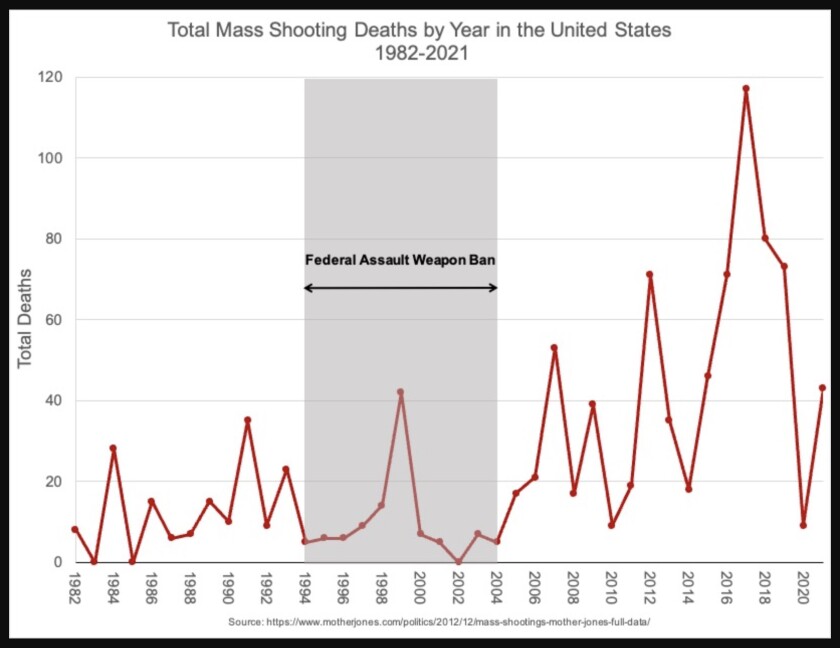
Since the federal ban on assault weapons expired in 2004, mass shootings with those weapons has climbed. An assault weapon was used in the Uvalde massacre of May 24. (Mother Jones)
That changed in 2008, with the Supreme Court’s ruling in the so-called Heller case overturning the District of Columbia’s ban on possession of handguns in the home. Since then, the impression has grown — fostered by the National Rifle Assn. and other elements of the gun lobby — that Heller rendered virtually any gun regulation unconstitutional.
But Justice Antonin Scalia’s 5-4 majority opinion said nothing of the kind. Indeed, Scalia explicitly disavowed such an interpretation. “The right secured by the Second Amendment is not unlimited,” he wrote. The Constitution does not confer “a right to keep and carry any weapon whatsoever in any manner whatsoever and for whatever purpose.”
There was, and is, no constitutional prohibition against laws prohibiting the carrying of concealed weapons, he found. Nothing in his ruling, he wrote, should “cast doubt on longstanding prohibitions on the possession of firearms by felons and the mentally ill, or … the carrying of firearms in sensitive places such as schools and government buildings,” or conditions on gun sales.
The problem with the D.C. law, Scalia wrote, was that it went too far by reaching into the home and covering handguns, which were popular weapons of defense in the home. “The Constitution leaves the District of Columbia a variety of tools” for regulating handguns, as well as other firearms, he wrote.
The federal assault weapons ban, which was enacted in 1994 and expired in 2004, repeatedly came under attack in federal courts, and prevailed in every case. Not a single one of those challenges was based on the 2nd Amendment. Since the expiration of the ban, mass shooting deaths in the United States have climbed steadily.
“Heller has been misused in important policy debates about our nation’s gun laws,” wrote former Supreme Court clerks Kate Shaw and John Bash in a recent op-ed. “Most of the obstacles to gun regulations are political and policy based, not legal.” Shaw and Bash worked on the Heller decision as clerks to Scalia and John Paul Stevens, the author of the leading dissent to the ruling, respectively.
So let’s discard the myth that gun control laws are unconstitutional.
The NRA
By any conventional accounting, the NRA is a shadow of its former self. Its leadership has been racked with internal dissension, its resources have been shrinking and it has faced a serious legal assault by New York state. Attendance at its annual convention last week in Houston drew only a few thousand members, even with former President Trump on hand to speak.
Yet the organization still carries major political weight. To some extent that’s an artifact of its political spending. Even in its straitened circumstances it’s a major political contributor, having handed out more than $29 million in the 2020 election cycle. Some of the politicians taking resolute pro-gun stands are beneficiaries of this largess, mouthing “thoughts and prayers” for the victims of gun massacres while pocketing millions from the NRA.
The NRA also has played a lasting role in blocking funds for research into gun violenceby federal agencies such as the Centers for Disease Control and Prevention, an obstacle that remained in place for some two decades until Congress restored funding in 2019. But the gap in research still hampers gun policymaking. It’s long since time to curb this organization’s blood-soaked influence on our politics.
Debate? What debate?
Part of the knee-jerk news coverage of the aftermath of gun massacres is the notion that the American public is deeply divided over gun regulations. This is a corollary of the traditional claim that American society is “polarized,” which I showed last year to be absolutely false. The truth is that large majorities of Americans favor abortion rights, more COVID-related restrictions and, yes, gun regulations.
More than 80% of Americans favor instituting universal background checks on gun buyers and barring people with mental illness from owning guns, according to a Pew Research Center poll. More than 60% favor banning assault weapons and high-capacity ammo magazines.
The poll was taken last September; it’s a reasonable bet that the majorities would be larger now. To put it another way, the “debate” is over — most Americans want to bring gun sales and ownership under greater control.
Gun regulations work
One claim popular among pro-gun politicians is that gun regulations don’t serve to quell gun violence. (A common version of this trope is that proposed regulations wouldn’t have stopped the latest newsworthy massacre.)
This is a lie, as statistics from the CDC show. States with stricter gun laws have much lower rates of firearm deaths than those with lax laws. The first category includes California (8.4 deaths per 100,000 population) and Massachusetts (3.7). The second group includes Louisiana (26.3) and Texas (14.2, and the highest total gun-related mortality in the country, at 4,164 in 2020).
Texas even loosened its gun regulations just months before the Uvalde massacre. When Missouri repealed its permit regulations for gun ownership in 2007, gun-related homicides jumped by 25% and gun-related suicides by more than 16.1%. When Connecticut enacted a licensing law in 1995, its firearm homicide rate declined by 40% and firearm suicides by 15.4%.
Make them vote
Perhaps the most inexplicable argument justifying congressional inaction over gun laws is that tough laws have no chance of passage, so it’s pointless even to try. Defeatism in the face of urgent need is inexcusable.
The resistance of Republicans to voting for gun laws is precisely the very best reason for bringing those bills to the floor. There’s no reason to give Republican obstructionists a free pass — make them stand up and take a vote.
Make them explain what it is about making Americans safer in schools and workplaces that they find objectionable, and why they think that voting against measures supported by 80% of the public is proper. Bring the fight to them, and show voters the character of the people they’ve placed in high office.
Show the pictures
Americans have become inured to gun violence in part because our culture minimizes its horrors. We’re awash in the most visceral depictions of shootings in movies and television, but at their core those depictions are unthreatening — indeed, in most cases they’re meant for entertainment.
Even our news programs revel in gore — the classic dictum of local news broadcasting has long been “If it bleeds, it leads.”
These conditions have inoculated us against the horror of firearm injuries as they occur in real life — especially those caused by assault weapons such as the AR-15. There’s a big difference between hearing the words “gunshot wound” and learning what actually happens to the organs of victims of AR-15 assaults. They don’t look anything like what we see on TV, and we need to have a true, visceral sense of the difference.
“These weapons are often employed on the battlefield to exact the maximum amount of damage possible with the strike of each bullet,” radiologist Laveil M. Allen wrote last week for the Brookings Institution. “Witnessing their devastating impact on unsuspecting school children, grocery shoppers, and churchgoers is unfathomable. The level of destruction, disfigurement, and disregard for life that a high-powered assault rifle inflicts on the human body cannot be understated. Placed into perspective, many of the tiny Uvalde victims’ bodies were so tattered and dismembered from their ballistic injuries, DNA matching was required for identification because physical/visual identification was not possible.”
You’ll hear the argument that showing photographs of real victims or the scenes of massacres will only be more traumatizing. For some people, including the victims’ families, that may be true. But that only underscores my point — we have not been sufficiently traumatized, and the creation of a truly effective mass movement for gun laws requires that we be traumatized.
Because we experience the horror of gun massacres at a remove, they tend to drift out of public consciousness in a distressingly short time span. Even after the Sandy Hook killings, which took the lives of 20 children ages 6 and 7 less than 10 years ago, there was something distancing about reportage of the event. Photos of some of the murdered children have been made public, but they are photos from life, showing the children smiling at birthday parties or gamboling about the playground.
Let’s face it — few Americans were thinking about the Sandy Hook killings until May 24, when the Uvalde massacre brought them bubbling back to public consciousness. Would our reaction be different had we seen photographs of classrooms slathered in blood, of children’s bodies ripped to pieces by Adam Lanza’s assault rifle?
You bet it would. Those images would not easily be forgotten. Every time a GOP senator or representative stood up to declare that the right to own assault weapons trumped the right of those children to live their lives, someone should have produced one of those photographs and said, “Justify this.”
Our risk is that Uvalde will be just another Sandy Hook. Soon to move off the front burner, or soon buried under the choruses of “We can’t pass this” or “This won’t work” or “This is the path we’ve chosen.” We need to change the terms of discussion, or Uvalde will just be the latest massacre of a long line, not the last massacre of its kind.
This is a letter from Robert Weissman of Public Citizen, an organization that’s trying to fix our broken nation.
There was a time — not that long ago — when America’s gun manufacturers did not advertise assault weapons to the general public.
But for the past 20 years or so, the gun industry has been aggressively marketing military-grade munitions to the American people — with ads specifically invoking race-based fear, twisted notions of masculinity, and distorted ideas about “patriotism.”
This has fed some very bad and deadly trends:
The United States is the only country on the entire planet with more guns (at least 400 million and counting) than people (335 million). No other country has even half as many guns per capita as we do.
The number of guns manufactured in America has nearly tripled over the past two decades, from 3.9 million in 2000 to 11.3 million in 2020. (And it’s not as if guns wear out like light bulbs, refrigerators, or cars.)
We endure more mass shootings than all other developed countries combined. It’s not even close.
The frequency — and body count — of mass shootings has increased as well.
13 of the 20 deadliest mass shootings since 1982 happened in just the past decade.
There were 118 school shootings in 2018, doubling the previous record of 59. Then 119 in 2019. Then 114 in 2020. Then 249 (not a typo) in 2021. And already 137 so far in 2022 (with more than half the year still to go).
The 3 deadliest years for school shootings in the past half-century are 2018, 2021, and 2022 (which, again, isn’t quite halfway over yet).
Guns have become the leading cause of death among children in our country. Not disease. Not malnutrition. Not accidents. (Auto accidents had been the leading cause of death among children for decades until overtaken by guns in 2020.)
And all the while, gun industry profits have exploded.
Look, America’s gun manufacturers may well be beyond listening to reason. There are, after all, more people to scare — and more profits to be made — no matter the carnage.
But let’s make them hear us — our pain, our fury, our disgust — anyway.
As more details emerge, the disaster at Uvalde grows ever more horrifying. The New York Times reported that more than 140 officers of the law converged on Robb Elementary School. They began to arrive only minutes after the killer started shooting children and teachers. Two officers tried to enter the classroom but were struck by gunfire. The school district’s chief of police—who commanded a force of six—decided not to storm the classroom, although the first rule in an active shooter situation is to confront the shooter immediately and disable him. Since Columbine, police training for school shootings emphasizes the importance of rushing the killer and stopping the shooting.
The chief decided that the shooter was barricaded in the classroom and that no one was in danger. He did not have a police radio. He called on a cell phone to ask for reinforcements. Children in the classroom with the killer repeatedly called 911 to plead for help. The police waited outside the door for more than an hour. When a tactical force from the Border Patrol stormed the classroom, the officer in charge told them to stay out. They disobeyed orders and killed the shooter.
The story begins:
UVALDE, Texas — Two minutes after a gunman burst through an unlocked door at Robb Elementary School and began shooting inside a pair of connected classrooms, Pete Arredondo arrived outside, one of the first police officers to reach the scene.
The gunman could still be heard firing repeatedly, and Chief Arredondo, as leader of the small school district police force in Uvalde, took charge.
But there were problems from the start.
Chief Arredondo did not have a police radio with him, according to a law enforcement official familiar with the investigation, which may have impeded his immediate ability to communicate with police dispatchers. As two supervisors from the local police department were grazed by bullets fired by the gunman, he made a decision to fall back, the official said.
Using a cellphone, the chief called a police landline with a message that set the stage for what would prove to be a disastrous delay in interrupting the attack: The gunman has an AR-15, he told them, but he is contained; we need more firepower and we need the building surrounded.
A tactical team led by Border Patrol officers ultimately ignored orders not to breach the classroom, interviews revealed, after a 10-year-old girl inside the classroom warned 911 dispatchers that one of the two teachers in the room was in urgent need of medical attention.
The story is horrifying. It is a story of missed opportunities, unnecessary deaths, fear, miscommunication, ignorance, and perhaps cowardice. The children risked their lives to call 911. Their messages were not relayed to the officer in charge at the scene. 140 police officers on hand, waiting for orders. No orders came other than to evacuate the children who were not in the classroom with the killer. The children in the classroom with the killer were on their own for over an hour while armed police waited for a key and an order.
But now Senator Scott and the rest of the Senate Republicans are opposed to passing similar federal gun control measures.
After a teenage gunman killed 19 fourth-graders and two teachers inside a Texas elementary school Tuesday, Democrats on Capitol Hill quickly lamented Republican lawmakers’ years of intransigence on gun control.
“No matter the cause of violence and no matter the cost on the families,” Senate Majority Leader Charles E. Schumer (D-N.Y.) said Thursday, “nothing seems to move them.”
But that broadside wasn’t entirely accurate: Not long ago, GOP lawmakers bucked ferocious pressure from the National Rifle Association to pass significant new gun restrictions after a deadly school shooting, which were then signed into law by a fiercely conservative Republican.
It just didn’t happen in Washington.
Three weeks after 17 people were gunned down in 2018 inside Marjory Stoneman Douglas High School in Parkland, Fla., then-Florida Gov. Rick Scott (R) signed into law a bill that included provisions banning weapons sales to those younger than 21, imposing a three-day waiting period on most long-gun purchases, and creating a “red flag” law allowing authorities to confiscate weapons from people deemed to constitute a public threat.
The NRA’s powerful leader in the state, Marion P. Hammer, condemned Republicans backing the bill as “betrayers.” But 75 out of 99 GOP lawmakers voted for it anyway, and Scott — who was preparing to seek a U.S. Senate seat — signed it, calling the bill full of “common-sense solutions.” Other provisions of the bill included $400 million for mental health and school security programs, and an initiative, fiercely opposed by Democrats, that would allow teachers and school staff to be trained as armed “guardians…”
Interviews this week with Republican senators revealed little stomach for the sort of sprawling bill that Florida Republicans passed in 2018. None said they are open to a federal waiting period. Some are curious about “red flag” laws but skeptical about their implementation on the federal level. And asked about age limits for rifle purchases, one key GOP negotiator, Sen. Lindsey O. Graham (S.C.) said, “I don’t think that’s on the table.”
Scott himself — who went on to narrowly defeat Sen. Bill Nelson (D-Fla.) in 2018, even after his NRA rating was downgraded from an A-plus to a C — said this week that he does not favor passing a federal version of the Florida law.
“It ought to be done at the state level,” he said. “Every state’s going to be a little bit different. … It worked in Florida, and so they ought to look at that and say, could that work in their states?”
/https://static.texastribune.org/media/files/0b22ff1684446eb4bb16e79b520a32f4/Crosses%20Memorial%20KGB%20TT%2001.jpg)

 Diane Ravitch's blog