Archives for category: Funding


Texas Public Radio reported on the devastating effect that charter expansion is having on the public schools of San Antonio. The city leaders, in their ignorance, decided not to improve the public schools, but to create a parallel private system to compete with them. Both sectors are funded by the public, but the charters choose their students and some do not offer transportation.

The city’s population is growing but enrollment in its public schools is shrinking.

The main reason for the apparent contradiction is an exponential growth in publicly-funded, privately-run charter schools. Charter school enrollment in the San Antonio metro area has grown by more than 200% since 2009, according to a Texas Public Radio analysis of a decade of enrollment records obtained through public information requests. 

In the past two years alone, charter networks in the San Antonio metro area gained nearly 11,000 students. For traditional school districts, that meant a corresponding loss in funding. State funding is based on attendance.

The big charter networks, like IDEA and Great Hearts, have selective enrollment practices. IDEA has received more than $200 million from Betsy DeVos and the federal Charter Schools Program.

Some local parent groups are fighting back, but they are vastly outspent by the charter networks and undercut by state policy, which favors privatization.

Charter favoritism guarantees that the local public schools, which enroll most children, will be underfunded and will serve a disproportionate number of students with the highest needs.

Some parents have organized to fight back:

Standing in the neighborhood next to Oak Meadow Elementary in the North East school district, Cameron Vickrey said her daughters’ school “experienced a kind of mass exodus” a few years ago to go to Great Hearts. Great Hearts is a charter network that uses a classical curriculum similar to private schools.

“When all of those people left there was a volunteer vacuum,” Vickrey said. “That was when I came to the school, and as a new kindergarten mom I was put on the PTA board… because they pretty much had to create a PTA board from scratch.”

Vickrey’s neighborhood is mostly one-story, ranch-style houses a short walk or drive from the elementary school.

Trimmed yards are sprinkled with white signs that say “Proudly RootEd in NEISD.”

Vickrey and a few other Oak Meadow parents started making the yard signs after hearing other parents say that nobody in the neighborhood goes to the traditional public school.
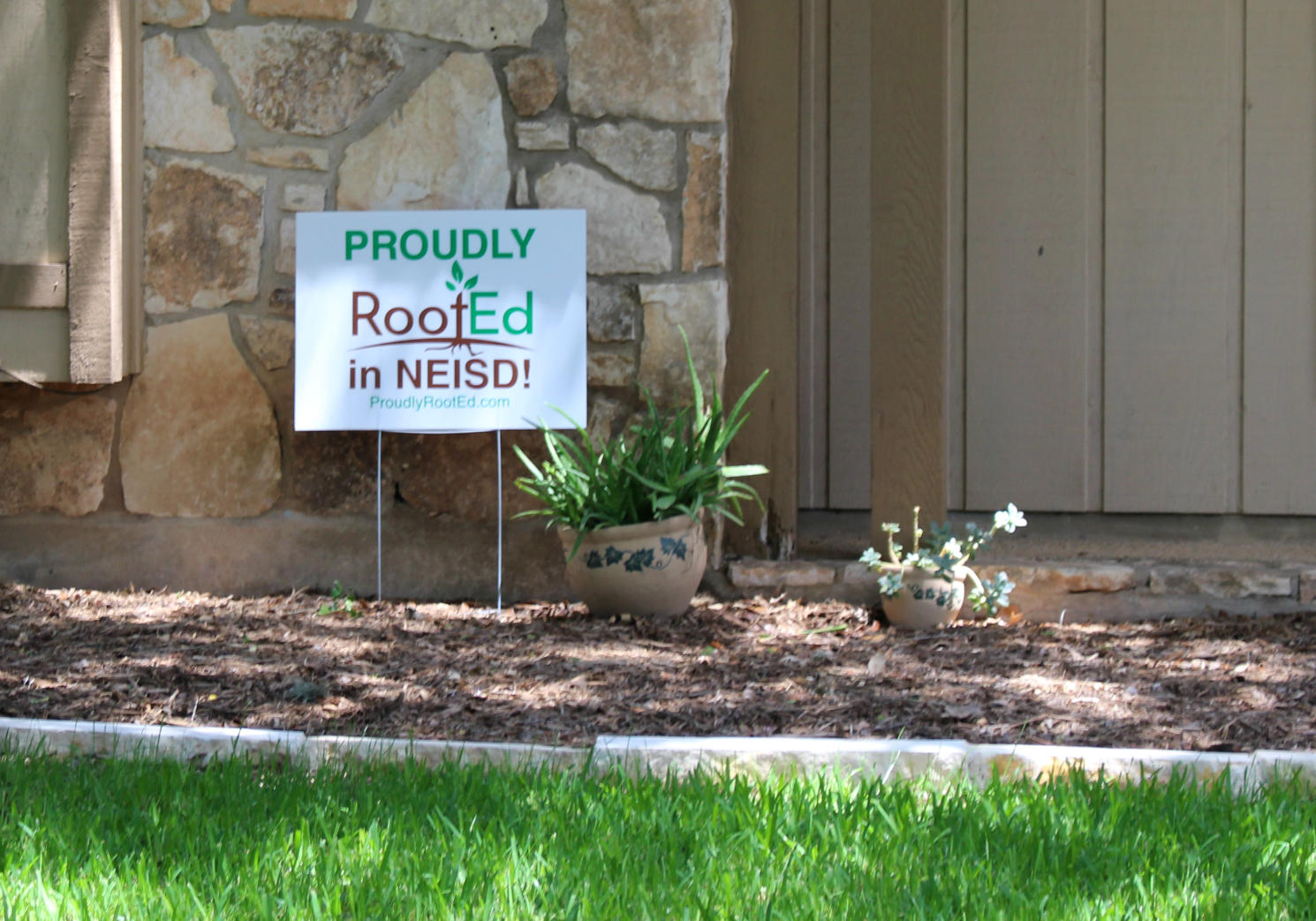
RootEd yard sign in the Oak Meadow neighborhood of North East ISD.
CREDIT CAMILLE PHILLIPS | TEXAS PUBLIC RADIO

And we stopped and thought about it, and we were like, ‘That’s not true! Of course people go to that school.’ They just don’t know those neighbors, right, because maybe they’re not in their clique or whatever.”

From there, RootEd grew into a nonprofit with a mission of spreading positive stories about district schools — both by word of mouth and on social media using the hashtag RootEd.

“RootEd just wants to say, ‘Wait, hang on a second. Remember that these schools are here. And there are awesome things happening in them still,’” Vickrey said. “Make that your first stop, the first thing that you look into and if it doesn’t work for you for whatever reason, nobody’s going to fault you for that. You have a right to do that but we just want to make sure that people don’t discount their public schools.”

Vickrey said she also wants parents to consider the “unintended side effects” of choosing charter schools: less money and volunteers for the traditional public school, and a tendency to choose a school where people look like you.

“Our middle school that we’re zoned for here is a Title I (low-income) school, Jackson Middle School,” Vickrey said. “And it’s fabulous, but so many start choosing their school path for elementary school based on trying to avoid Jackson Middle School.”

Jackson Middle School is 80% Hispanic and 72% economically disadvantaged. San Antonio’s Great Hearts schools are less than 20% low-income and almost 50% white.


According to a study by the watchdog group In the Public Interest, The public schools of the small West Contra School School District in California lose $27.9 million each year due to charter schools, a loss of nearly $1,000 for each student in the public schools. The majority of students suffer budget cuts so a small proportion can attend charter schools that may be no better and may close mid-year.

As of 2016-17, the school year for which the costs in this report were calculated, 28,518 students attended WCCUSD’s traditional public schools, while 4,606 students—14 percent of the total student population—were enrolled in 12 charter schools within the district’s physical boundaries. More recent data indicate an explosion in charter school enrollment. The proportion of WCCUSD students attending charter schools has more than doubled in four years, from 8 percent of the district total in the 2014 -15 school year to 17 percent this year.


The costs of charter schools


When students transfer to charter schools, funding for their education follows—but costs remain. Because charter schools pull students from multiple schools and grade levels, it’s rare that individual traditional public schools can reduce expenses enough to make up for the lost revenue. While WCCUSD schools have 14 percent fewer students to serve, a school cannot adjust expenses by, for example, cutting 14 percent of its principal, heating bill, parking lot paving, internet service, or building maintenance. The district also cannot proportionately cut administrative tasks such as bus route planning, teacher training, grant writing, and budget development. Because these central costs cannot be cut, districts are forced to cut services provided to traditional public school students.


Even if such cuts were possible, districts are legally responsible for serving all students in the community and must maintain adequate facilities to reabsorb students when inherently risky charter schools fail. During the 2016 -17 school year alone, 51 California charter schools either closed or were converted into traditional public schools.3


We have recently heard from political candidates who claim they oppose “for-profit charter schools” but support “non-profit charter schools.”

What they don’t know is that this is a distinction without a difference. Many “non-profit charter schools” are managed by for-profit EMOs (Education Management Organizations). Some are theoretically “non-profit” but pocket big money on their lease agreements (paying exorbitant sums to lease their space from a real estate company who is owned by the charter owner).

Peter Greene explains here how non-profits make a profit. It is legal graft, in which entrepreneurs figure out how to profit from taxpayers’ money intended for students and teachers.

His article originally appeared in Forbes.

He writes:

There is such a thing as a business that specializes in charter schools and real estate. In some states, the government will help finance a real estate development if it’s a charter school, and in general developers have noted an abundance of cash. Though, as one charter real estate loan bond financier told the Wall Street Journal, “There’s a ton of capital coming into the industry. The question is: Does it know what it’s doing?” Many states have found a problem with charters that lease their buildings from their own owners as well.

Why such interest in charter real estate? One reason: the Clinton-eraCommunity Tax Relief Act of 2000 made it possible for funds that invested in charter schools to double their money in seven years. And the finance side can become so convoluted that, as Bruce Baker lays out here, the taxpayers can end up paying for a building twice– and the building still ends up belonging to the charter company.

Management Companies

Once you’ve set up your nonprofit charter school, hire yourself as a for-profit charter management organization. Over the last decade, there have been numerous examples of this arrangement, sometimes called a “sweeps contract,” where the charter school hands as much as 95% of its revenue off to a for-profit management organization. As with real estate, there have been instances where the school’s assets (books, furniture, computers, etc) have been ruled to be the property of the management company— so even if the school tanks, the organizers walk away with assets they can cash in.

 Kansas has a State Supreme Court that pays attention to the State Constitution and cares about the future of the state, which rests on the educational opportunities of its children. Isn’t that novel these days!

EDUCATION LAW CENTER
Find us on FACEBOOK TWITTER
June 24, 2019
HELP SUPPORT ELC
ELC relies on the generous contributions of individuals, corporations and foundations to support our work.
DONATE NOW
RELATED STORIES
KANSAS LEGISLATURE SHORTCHANGES PUBLIC SCHOOLS, ISSUE MOVES TO SUPREME COURT
     

KANSAS HIGH COURT TO STATE: SCHOOL FUNDING FORMULA ADEQUATE, NOW FUND IT

By Wendy Lecker

The Kansas Supreme Court has found the State’s most recent school funding formula to be adequate but will retain jurisdiction to make certain the State fully phases in required funding increases through 2023. The Court’s ruling, issued June 14, is the latest decision in Gannon v. State, Kansas’ long-running lawsuit challenging inadequate public education funding.

The Gannon case was filed in 2010, after the State walked away from implementing a funding remedy ordered by the Supreme Court in an earlier case, Montoy v. State. In a 2005 decision in Montoy, the Court threw out the State’s school finance system and ordered reforms to ensure Kansas school children adequate resources to give them a meaningful opportunity to achieve academic standards. The Montoy case ended in 2006, when the Court ruled that new legislation substantially met constitutional requirements.

In 2008, however, before the State fully implemented the Montoy remedy, it began making significant reductions in school funding. The Gannon lawsuit was filed in response.

The Gannon plaintiffs – parents, students and school districts – are represented by attorneys and Kansans Alan Rupe and John Robb. Alan and John, who also handled the Montoy v. State lawsuit, are among the nation’s most experienced plaintiffs’ lawyers in school funding cases.

In its initial Gannon decisions, the Kansas Supreme Court affirmed a lower court’s rulings that the State’s action’s resulted in inadequate and inequitable funding levels and ordered funding reforms.

The plaintiffs were forced to seek relief from the Supreme Court several times after the Legislature and Governor failed to enact the required reforms. In 2018, the Court ruled that additional funds provided by the State addressed funding equity but did not ensure adequate funding levels.

In its June 14 decision, the Court found the State had finally substantially complied with the constitutional requirement for funding adequacy. The Court noted the plaintiffs’ agreement that a $90 million increase was adequate for 2019-20. The Court also found the State provided good faith estimates for inflation to be phased-in through successive year increases through 2023.

Most important, the Court is retaining jurisdiction over the Gannon lawsuit to ensure the State follows through with the required funding increases. In a ruling similar to the 2009 New Jersey Supreme Court’s decision in Abbott v. Burke, the Kansas Supreme Court pointed to Kansas’ long-term resistance to providing adequate funding and noted its inherent power and responsibility to enforce judicial remedies, especially those relating to constitutional rights.

The Gannon litigation represents a powerful example of the critical role courts can play in advocacy efforts to ensure states fairly fund public education. The Gannon rulings have safeguarded the constitutional right to education against repeated efforts by the legislative and executive branches to severely reduce Kansas’ investment in the education of the state’s children.

No doubt, the Gannon plaintiffs and their experienced counsel will continue their vigilance to make certain lawmakers follow through on the latest court mandate to effectuate the education rights of children across the state.

Wendy Lecker is a Senior Attorney at Education Law Center

Education Law Center Press Contact:

Sharon Krengel

Policy and Outreach Director

skrengel@edlawcenter.org

973-624-1815, x 24


Governor Gretchen Whitmer wrote a letter to the Benton Harbor school board, letting them know that it was up to them to accept the state’s offer, which meant the state would forgive the district’s debts and the district would close its beloved high school.

Excuse me, Governor Whitmer, but why doesn’t the state offer to send support to this impoverished school district, not just forgive its debts. It does not have the tax base to support its schools. Doesn’t the state has a legal obligation to secure equal educational opportunity for every child, regardless of zip code?

Is Governor Whitmer relying on the same education advisors as those who counseled Rick Snyder and John Engler?


Michigan Governor Gretchen Whitmer is poised to close the high school of Benton Harbor instead of giving it the resources and support it needs. Perhaps it is time to review the state’s funding formula, created by a generation of Republican legislator, Gov. Engler, Gov. Snyder, and Betsy DeVos.

In this article, journalist Anna Clark describes what the public schools of St. Joseph, the twin city of Benton Harbor, meant to her.

It begins:

Over on Court Street in St. Joseph, Michigan, one mile from the little bridge to Benton Harbor, my hardworking family struggled to make do. We poured milk over broken Saltines and called it cereal. I tried, in a thousand obnoxious ways, to persuade my parents to buy food they couldn’t afford, not least in a choreographed song-anddance routine with my siblings titled “The There’s-No-Food Blues.”

We had one big advantage: terrific public schools.

For all the separateness between St. Joseph and Benton Harbor – one whiter and richer, the other poorer and mostly African American, with the St. Joseph River curving between them, doomed to be a perpetual metaphor – these are small communities. For many of us, our roots span both sides. I grew up in St. Joseph, but Benton Harbor is where my mother was raised, where relatives live, where our family church is, where I worked part-time jobs in high school and college, and where I run a 5K on Thanksgiving mornings. It, too, is home.

Yet the differences between our so-called “Twin Cities” grow ever more serious. Gov. Gretchen Whitmer has proposed closing Benton Harbor High School for at least a few years, to get the distressed school district out of the death spiral of debt, following a consent agreement that gave the state oversight of the schools for years; it was lifted last November in favor of a financial plan that has, apparently, been scrapped. Benton Harbor’s enrollment may be lower than it used to be, but the prospect of shuttering the community’s single public high school – one that many still take pride in – is a blow.

St. Joe schools gave me the chance to thrive. Besides classes with experienced teachers, I edited a newsmagazine, performed in plays, went out for speech competitions, and failed to make many, many athletic teams. The first time I traveled out of the country was on a class trip for fourth-year Spanish students. I worked constant extra hours to pay the bill, but I got to spend two wide-eyed weeks in Spain.

I didn’t have a conversation with someone my own age from Benton Harbor until I was a freshman at the University of Michigan, leading creative writing workshops at a juvenile detention center. He was in the workshop. We traded joyful memories of the beach at Jean Klock Park and brown bag lunches at Henry’s Hamburgers, while the gulf between us loomed. We had grown up as veritable neighbors, both in working- class families, and here I was, a college student, and there he was, incarcerated.

I began to see how segregation is not only bizarre but sinister. If you grow up on the St. Joe side of the river, even in a family that is poor, you have opportunities your peers in Benton Harbor don’t have.

I’ve often heard people in St. Joe blame Ben- ton Harbor parents for the school system’s woes: “They could have fixed it. They just don’t care,” they say, pointing to empty seats at PTA meetings and sporting events. I understand the value of loving parents, but I had a great public education because my schools were supported by the taxes of people far richer than my family. Until the passage of Proposal A in 1994 (most of my student years), property taxes were the main source of school funding. Unequal schools were a matter of policy.

Even now, in the era of per-pupil funding, schools with a disproportionate number of poor students must meet disproportionate needs, but with few resources.

Michigan ranks 50th for funding growth in public education, with total revenue declining 30% since 2002. Not coincidentally, it also ranks low for math and reading proficiency. But in St. Joseph, millages help. In May, my hometown renewed a millage for support services, technology, transportation and maintenance. The levy only applies to second homes and commercial properties, but it’ll generate $5.8 million.

Poverty is concentrated in Benton Harbor. Second-home millages aren’t an option. It’s a challenge to keep teachers, when salaries are among the lowest in the state. Average annual pay was $34,761 for the 2016-2017 school year, and fell during a statewide teacher shortage. In St. Joseph and nearby Stevensville, average salaries increased to more than $63,000.

I’m proud that I come from a community that prizes public education. But it is outrageously painful that some look across the river and suggest that Benton Harbor’s children don’t have the same advantages because their parents love them less.

It also misses the obvious: Inequality perpetuates itself. It can’t be forgotten that in living memory, segregation was law. Through redlining and racially restrictive deeds, enforced by every level of government and private enterprise, we designed a system where homes owned by African Americans were worth less. Then we tied school funding to property values.

Open the link and read the rest.


As promised, Governor Tom Wolf vetoed legislation to double the funding for vouchers.

In his veto message, he said:

“We have public schools that are structurally deteriorating, contaminated by lead, and staffed by teachers who are not appropriately paid and overstretched in their responsibilities. Tackling these challenges, and others, should be our collective priority,” the governor said in his message.


Our allies the Pastors for Texas Children have repeatedly blocked vouchers in Texas, and they are now celebrating a significant boost in state funding for public schools. They have helped to start similar organizations in other states to protect the separation between church and state.

Dear Friend,

Our nation is wracked by a politics of division, where special interests and big donors set the political agenda for both sides of the aisle. State budgets, which should be reflections of our shared character and moral values, too often reflect the lie of scarcity, promoting an agenda of runaway privatization that harms God’s common good.

More often than not, this agenda involves slashing crucial funding for public education, cutting services to the most vulnerable among us: Texas’ children. 

But Pastors for Texas Children won’t give in to this agenda for one simple reason: we’re a Spirit-driven, people-powered organization, not beholden to any political party or special interest group. During this year’s legislative session, we successfully lobbied for legislative action on the pro-public education priorities that Texans and our legislators hold dear.

We still have a long way to go until we fully recognize robustly funded public schools as the cornerstone of our shared life together, but this was truly a transformative legislative session and a major step on our journey. And we couldn’t do it without you. 

Scripture reminds us that communities flourish when good stewards of God’s grace serve each other with the gifts we have received (1 Peter 4:10). And you have been a steward of PTC’s work and mission in the world. Please consider more ways to steward our work as our legislative witness winds down and our year-round work continues:

  1. Pray for us.Without your prayers and support, we could not do what we do in Texas and around the nation.
  2. Give a gift to sustain our work. A recurring gift of just $5/month helps us sustain our work and our witness.
  3. If you’re part of an organization, business, or church that would be interested in attending next week’s PTC Benefit Luncheon (6/18) at Wilshire Baptist Church in Dallas, email Brandon Grebe today about reserving a spot.

May God bless you, friend.
-Pastors for Texas Children

Copyright © 2019 Pastors for Texas Children, All rights reserved.
You are receiving this email because you have signed up as a partner on our website.Our mailing address is:

Pastors for Texas Children

PO Box 100502

Fort Worth, Tx 76185


Bill Raden of Capitol & Main has a sharp analysis of the recommendations from Superintendent Tony Thurmond’s Charter School Task Force.

Plus, public school advocate David Tokofsky explains why Measure EE—which was supposed to raise $500 million annually for the schoolsof Los Angeles—failed.

With allies like L.A.’s neoliberal supe Beutner running the Yes on EE campaign, who needs enemies? Beutner’s biggest blunder, according to Tokofsky, came last year when he and his pro-charter allies on the board torpedoed the efforts by board members Dr. George McKenna and Scott Schmerelson to get the tax on the November, 2018 midterms ballot, when polling suggested that a larger, more liberal turnout would have made it a shoo-in.

Beutner  compounded that error by not only scheduling EE for June’s low-turnout, single-measure special election but by bunglinga last-minute language change that effectively translated as millions of dollars worth of free publicity for the measure’s opponents — anti-taxers like the Los Angeles Chamber of Commerce and the Howard Jarvis Taxpayers Association

Michael Rice, the new State Superintendent in Michigan, is an experienced educator, not an ideologue or a politician.

His plans are sensible. He wants to steer the state back to responsible policies.

He was most recently Superintendent in Kalamazoo, which has one of the best school systems in the state. Itis terrific not because of its demographics or it’s scores but because of the Kalamazoo Promise, which has brought many students back to the public schools and led to systemwide improvements. The Promise, anonymously funded, guarantees that every high school graduate will receive a full scholarship to college. The longer a student is in the system, the more generous the scholarship.

School reform measures, such as Michigan’s third-grade retention law and the state’s A-F rating system; a statewide push to improve literacy and increase early childhood education; the publication of multiple research papers supporting increased funding for Michigan’s K-12 schools and the precarious future of the teaching profession all have been pushed to the education forefront in the state.

And they are all issues Rice says he is ready to work on.

“I feel differently in 2019,” Rice told The Detroit News in his office in Kalamazoo. “Those issues made me feel it was a moment. A generational moment in the state, and I wanted to contribute to that moment….”

While in Kalamazoo, and with the Kalamazoo Promise in place, Rice started full-day pre-kindergarten, more than doubled the number of students taking Advanced Placement courses and boosted high school graduation rates, school officials said…

Rice becomes superintendent at a critical time for Michigan’s 1.5 million students. Michigan ranks in the bottom third of states for fourth-grade reading, eighth-grade math and college attainment, and it’s 43rd out of 47 in school funding equity.

According to officials at Education Trust-Midwest, Michigan ranks in the bottom third of all states overall in early literacy and among the bottom states for every major group of students: African American, Latino, white, low-income and higher income students. In eighth-grade math, only about 1 in 10 African American students and 2 in 10 Latino students are proficient.

Rice says more spending on public schools is critical, especially to address the chronic underfunding of English language students, poor students and special needs students.

He says he wants to increase pay, benefits and professional development for teachers. New data from the National Education Association found the average salary for Michigan teachers declined last year, continuing the 12% decline over the last decade when adjusted for inflation. Only Indiana, West Virginia and Wisconsin have had worse declines in teacher pay.

Starting teacher salaries in Michigan rank 32nd in the nation, according to the report. Nationwide, 37% of districts have a starting salary of at least $40,000. In Michigan, only 12% of districts meet that threshold, according to the data.

“It is an existential moment for the profession and the profession of public education in the state of Michigan,” Rice said. “As goes the teaching profession so goes public education in the state.”

Rice opposes the “punitive” retention requirements of the state’s third-grade reading laws and the dual accountability system created when state lawmakers passed the A-F grading system during the lame duck session in December. 

There is hope for Michigan.
