Archives for category: Funding


Bracey Harris writes in The Hechinger Report that teacher activism is making the governors’ races in red states competitive. 

This is great news.

Paula Howard teaches in a Republican stronghold in north Mississippi, along the Tennessee border. She usually votes Republican and is closely following the campaign of Jerry Darnell, a Republican educator running to represent Howard’s home district in the state Legislature.

But — while energized about the possibility of sending a conservative colleague to the state Capital — for governor she’s backing the Democrat, Mississippi Attorney General Jim Hood. She likes his calls to dramatically increase funding for education, including raising teacher pay, directing an additional $300 million to school districts, and expanding the state’s public pre-K program.

And, like other teachers around the state, she hasn’t forgiven the GOP’s gubernatorial candidate, Lt. Gov. Tate Reeves, for opposing a 2015 school funding initiative that would have increased money for education.

“It’s not about a ticket,” Howard said. “It’s about what they can do for our children…”

Spending on education is a wedge issue in the other two governor’s races this year, in Louisiana and Kentucky. A teacher sickout roiled the Bluegrass State in February, and the two candidates there have clashed on issues like teacher pensions and charter schools. Mason-Dixon pollster Brad Coker said part of the playbook for Democratic candidates is to stay focused on local and state issues.

Republican candidates have made low taxes their highest priority. But voters seem to recognize that low taxes hurt schools and children.

If Southerners started voting for the best interests of their communities and their state, not for the wily promises of the 1%, it would be a new day for the South.


Wendy Lecker is a civil rights lawyer who specializes in issues related to education and children.

A new Education Week national survey of school districts reveals disturbing gaps between state and federal policy and the reality in American public schools.

The vast majority of districts report major funding problems. Most list rising special education costs and rising levels of needy students as their top challenges. They also doubt they are financially prepared for the next recession.

The most serious funding problem districts report is convincing elected officials to sufficiently fund public schools. They give both state and federal officials poor marks for their ability to understand school spending, and cite state legislators as the biggest obstacle to making spending decisions that best address student needs. Rather than address need, state legislators perpetuate myths about school spending and quality.

Scholars Sally Nuamah, Jamila Michener, and Domingo Morel have found that poor communities, like school district leaders, lose faith in elected officials, and worse, in democratic institutions, when they experience policies that exacerbate rather than respond to their challenges.

Recent research highlights the failure of federal and state leaders to grasp the reality facing public schools. The most pernicious failure is the refusal to recognize the connection between poverty, funding and educational opportunity.

new study of the effect of the 2008 recession, by Kenneth Shores of Penn State University and Matthew Steinberg of George Mason University, found that the economic downturn resulted in cuts in state and local school spending. Those spending cuts were associated with contemporaneous and persistent declines in student test scores.

Moreover, “school districts serving higher concentrations of low-income and minority students experienced greater declines in achievement from school-age exposure to the recession.”

Stanford education researcher Sean Reardon observes that test scores are a reflection of a difference in access to the opportunity to learn, affected by all circumstances in a child’s life, both in and outside of school. They often do not reflect school quality. Two recent analyses, from Ohio and North Carolina, emphasize this truth. Both found the state ratings of public schools, mostly based on test scores, track almost perfectly with school poverty.

Because children do not leave their life experiences at the schoolhouse doors, schools must have the tools to mitigate the effects of poverty in order to provide students with the opportunity to learn. National studies show that increased school spending improves academic and life outcomes — particularly for poor students.

Yet almost half the states still fund schools below recession levels. And a recent Urban Institute paper reveals that federal spending on education has dropped precipitously and is expected to keep dropping, despite rising student need. Since 2010, funding for Title I, the largest federal education program supporting children in poverty, dropped by $7 billion, as did funding for IDEA, the federal program for students with disabilities.

Rather than recognize that high-poverty schools need more tools, and thus more funding, to best serve their students, federal and state leaders mandate intervention strategies that are proven failures: school turnaround, school closures, and state takeovers of school districts.

A report from the National Education Policy Center shows that the poorer and less white a school district is, the more likely a state will aggressively intervene with these failed mandates.

Federal and state policies repeat a toxic cycle of disinvestment, punishment, then further disinvestment. 

Neighborhood and school segregation compounds the inequity. Children of color are five to seven times more likely than white children to be concentrated in high-poverty neighborhoods. African American and Latinx children are also concentrated in high-poverty schools.

No wonder that school districts and poor communities have little faith in their elected officials.

Massachusetts is bucking the trend of denying the connection between investing in public schools and student outcomes. A new Massachusetts school funding bill commits to closing that state’s 1.5 billion dollar school funding gap. In supporting the bill, state Sen. Sonia Chang-Diaz acknowledged that “closing the achievement gap requires two times the investment for our poorest students if we are serious about doing it at scale.”

Connecticut Voices for Children reports that Connecticut’s recovery from the 2008 recession is more unequal than the national recovery, which was among the most unequal in U.S. history. Connecticut’s middle class is smaller and whiter than it was before the recession. Moreover, the census revealed that Connecticut is the only U.S. state where poverty increased in 2018. Our leaders should learn from Massachusetts. Investing in our neediest children, both inside and outside of school, will not only improve their outcomes, it may also restore faith in our elected officials.


Wendy Lecker is a columnist for the Hearst Connecticut Media Group and is senior attorney at the Education Law Center.

 https://www.stamfordadvocate.com/news/article/Wendy-Lecker-opinion-Investing-in-our-neediest-14491762.php

Nancy Flanagan is a retired teacher in Michigan with long experience in the classroom and one of our best education bloggers.

In this post, she wonders why the Democratic candidates are mostly mum about charters. At the last Democratic debate, when the question of charters was raised, Andrew Yang was the only one who openly expressed support for charters. The good news is that Andrew Yang will not be the eventual candidate. Even Cory Booker avoided the subject. Bernie Sanders, whose education policy is sharply critical of charters, did not take the opportunity to express his views. He should have.

Flanagan writes:

I believe charter schools have done untold damage to public education, and I’ve had twenty years to observe the public money/private management ideology establish itself in Michigan. First, a scattering of alternative-idea boutique schools, another ‘choice’ for picky parents. Then they go after the low-hanging fruit, the schools in deep poverty—and then the healthier districts.  There is now agreement with an idea once unthinkable in America: corporations have a “right” to advertise and sell education, using our tax dollarsSo—no, I cannot be agnostic. In the end, I’d like to see charter schools go away, one at a time, forever, because mountains of evidence have proven that they’re ripe for fraud and malpractice, and because there are far better public-school options, in every city and neighborhood. I think that’s preferable to trying to extinguish or ban charter schools outright—although ending all federal financial support for charters is Step One. That will necessitate a new Secretary of Education. The rest will mean changing hearts and minds—a long, slow process.

She adds:

Education is my issue, but charters are a mere slice of a bigger pie. It was gratifying to simply hear candidates talk about education on the stage. Here’s what I would like to hear from a candidate:

Let’s invest more in fully public education—the kind that’s community-based and has elected oversight. Let’s acknowledge the places where it has crumbled and rebuild them, instead of abandoning them. Let’s work toward more economically and ethnically diverse schools, making them places where building an informed citizenry and developing individual talents—not test scores—are our highest goals.

Right on, Nancy!

Let’s keep pushing the candidates and demand them to speak out against privatization.

Real Democrats do not outsource public money to privately managed schools and religious schools.

Now that Tennessee is controlled by Republicans who don’t like public schools, the money needed to operate them is slow to reach the districts.

Andy Spears of Tennessee Education Report reports that Sullivan County is contemplating closing its schools, at least temporarily, because the county commission is holding up necessary funding.

Unfortunately, Tennessee has had two consecutive Republican governors who support vouchers and charters, but not public schools.

Former Governor Haslam is now on the board of Teach for America and was a fervent supporter of privatization.

The new Governor Bill Lee pushed through a voucher program, which has not yet been funded.

Spears writes:

While disputes among school boards (which run schools) and county commissions (which provide funding) are not new, closing schools, even temporarily, is a fairly unusual occurrence.

It’s worth noting that if the state fully-funded the BEP 2.0 formula, Sullivan County would stand to gain some $5 million per year. Unfortunately, former Governor Bill Haslam froze BEP 2.0 and current Governor Bill Lee has chosen to fund a voucher scheme rather than invest significantly in public schools.


Bill Phillis, founder of the Ohio Coalition for Equity and Adequacy of School Funding, warns that privatizers run for local school boards, as they have in Atlanta and other cities. Teach for America has a special outfit called “Leadership for Educational Equity,” which trains its recruits to go into politics and helps to fund their campaigns.

Bill Phillis writes:

Anti-public school advocates run for seats on boards of education to attempt to completely privatize districts

Privatization of the public common schools takes many forms:
·        Charter schools
·        Vouchers
·        Tuition tax credits
·        Education savings accounts
·        Portfolio districts
·        State takeover that can eventually result in turning the district over to private operators
 
The most ruinous privatization tactic is for privatizers to take control of boards of education
 
Michelle Dillingham, with the Cincinnati Educational Justice Coalition, reports that some “fierce” school choice candidates are running for board of education seats in Cincinnati. The Justice Coalition has published a list of “qualities” that voters should look for when choosing a candidate. Topping the list of “qualities” is “a deep commitment to public education.” Public education is the adhesive that has held the American social order together. The education privatization craze has contributed to the fragmentation of our social order.
Phillis links to an article that explains what is happening in Cincinnati, where a TFA alum is running for the school board.
The article by Michelle DillIngham begins:

This November, voters in the Cincinnati Public School District will elect four members to the seven-member Board of Education. One contender, Ben Lindy, the founder and director of the Southwest Ohio Teach for America, has drawn significant controversy among supporters of public schools.

In his recent guest column, “Be proud of schools’ progress, but don’t settle,” (Aug. 31), Lindy’s repeated his use of the term “equity” and a “quality education for every child” are hard to swallow. The controversy surrounding Lindy comes as no surprise to those who follow the influence of Teachers for America and their agenda on public school districts.

TFA is a multi-million-dollar national organization whose main operation is to place non-education major college grads into temporary two-year teaching assignments in urban classrooms with less than two months of preparation. After their two years, the majority of TFA candidates abandon teaching and move on to other fields.

It is not hard to see why professional educators, who have invested in and achieved significant graduate and undergraduate education training, oppose this business strategy for staffing classrooms.

In the last several years, TFA has extracted over $600,000 in “finder’s fees” from our school district. Yet, a majority of TFA recruits do not stay with Cincinnati Public Schools after their two-year contract ends. TFA operates like a temp agency, paying a $5,000 “bounty” per recruit for a two-year commitment. It would make more sense to spend recruitment monies with higher education partners who can refer actual education majors.

School districts in other states have already figured out TFA is not a good return on their investment. Districts in Texas, South Carolina, California and Pennsylvania have all recently ended their contracts with TFA.

The TFA lobby has successfully diverted millions of taxpayer dollars, meant to educate the children of Ohio, to their company. Lindy was not successful in his run for state representative in 2016, but he was able to extract millions of public education tax dollars from the state legislature for TFA.

In April 2019, his joint testimony before the Primary and Secondary Education Subcommittee of the House Finance Committee helped secure another $4 million in the upcoming biennial budget for “support for ongoing development and impact of Teach for America alumni working in Ohio.” I guess he thinks TFA recruits who only spend two years in our urban classrooms now deserve another $4 million for their alumni’s “development.”

TFA is funded by billionaire elites, including the Bill Gates, Eli Broad and Walton Family Foundations. This helps explain Lindy’s confidence that he will be able to raise $250,000 to campaign for a seat whose pay is capped at $5,000 per year. It is well documented that TFA’s most influential alumni are proponents of school district takeovers, high stakes student testing, for-profit charter schools, and anti-union efforts – the most familiar to readers is likely Michelle Rhee (whom Lindy directly worked for), but there are others.

TFA, she writes, is closely tied to the Trump-DeVos privatization agenda.

William J. Gumbert has been writing a series of articles about charter schools in Texas, which are undermining the state’s underfunded public schools and do not perform any better than public schools.

Texas Charter Schools – Perception May Not Be Reality

IDEA Public Schools: Remove the “Rose-Colored Glasses” and Many RED FLAGS Appear

By: William J. Gumbert

IDEA Public Schools (“IDEA”) is the fastest growing privately-operated charter school in Texas and its rapid expansion in local communities is funded and controlled by “special interests” that desire to “privatize” public education. With promotions of a “100% College Acceptance Rate” and students being “Accepted to the College or University of Their Choice”, a full-time staff is employed to advocate for IDEA in local communities and to aggressively recruit “economically-disadvantaged” parents dreaming of a better life for their children.

Ann Landers said: “Rose-colored glasses are never made in bifocals. Nobody wants to read the small print in dreams”. But with the education of children and millions of taxpayer dollars at stake, the small print is vitally important. Part 4 of this 5-part series removes the “rose-colored glasses” that are inherent in the promotions of IDEA Public Schools to provide parents, taxpayers and communities an opportunity to review the potential RED FLAGS that appear when the light is solely focused on the facts of the rapidly expanding, privately-operated charter school.

Overview, Growth, Taxpayer Funding and Financial Benefits: As a privately-operated charter, IDEA has been approved by the State to separately operate in community-based school districts with taxpayer funding. Since opening with 150 students in 2000, IDEA has been consistently focused on expanding its footprint. In this regard, IDEA strategic growth plan states it will serve 100,000 students by 2022 as new campuses are opened in Austin, El Paso, Houston, Midland/Odessa, Rio Grande Valley, San Antonio, Tarrant County, Louisiana and Florida. At 100,000 students, IDEA would be the 31st largest school system in the United States.

With an appointed board in the Rio Grande Valley, the expansion of IDEA is orchestrated without the involvement of local communities and taxpayers. IDEA’s growth is solely controlled by its appointed board, the State and its private donors. With the legislature supporting the expansion of privately-operated charter schools, the State recently approved IDEA to open 21 additional campuses across Texas.

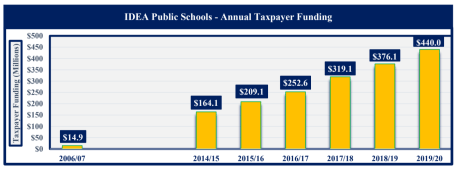
IDEA’s flexibility to expand has resulted in more and more taxpayer funding. Since its first graduating class of 25 students in 2007, IDEA’s taxpayer funding has increased from $14.9 million to approximately $440 million per year. This represents an increase in taxpayer funding of 2,853% in only 13 years.
Screen Shot 2019-09-14 at 10.14.11 PM

IDEA’s growth has also proven to be lucrative for its leadership team. As disclosed on its 2017 IRS Form 990, the Chief Executive Officer and Superintendent collectively received financial benefits totaling $968,208 in year 2017/18. In addition, 8 other IDEA administrators received financial benefits totaling between $219,070 – $466,006. On average, IDEA’s Central Office administrators have a salary of $200,249, while the statewide average salary for Central Office administrators in all Texas public schools is $102,300. 2

Other benefits for IDEA’s leadership team include free travel for family members to IDEA events and the potential use of IDEA’s private airplane secured through a long-term lease. That’s right, a taxpayer-funded “charter” school targeting underserved communities uses a private plane for “charter” flights.

Special Interests are Controlling and Directing IDEA’s Expansion – Not Communities and Taxpayers: As a privately-operated public school, IDEA’s expansion is not subject to the approval of local communities. Rather, IDEA’s expansion is controlled, directed and funded by “special interests” that desire to “privatize” public education. IDEA’s growth strategy proves this: “new regional expansions are the result of community supported education reform groups soliciting and inviting IDEA to open in their region and concurrently offering substantial startup and operational funding…”.

As shown below, IDEA has received financial commitments totaling over $150 million from private donors to expand in various regions of the State. It is important to emphasize that these financial commitments are contingent upon IDEA following the criteria specified by the donor (not parents, communities or taxpayers), which includes the opening of a specified number of new IDEA campuses in each region.

Private Donor

Commitment to IDEA

Expansion Region

Permian Strategic Partners

(Scharbauer and Abell-Hanger Foundations)

$ 55,000,000

Midland/Odessa

Charter School Growth Fund

(Gates and Walton Family Foundations)

$ 23,800,000

Rio Grande Valley

KLE Foundation

$ 23,558,800

Austin

CREEED Foundation (Hunt Family Foundation)

$ 17,000,000

El Paso

Laura and John Arnold Foundation

$ 9,500,000

Houston

Sid W. Richardson Foundation

$ 5,774,000

Tarrant County

Kleinheinz Family Foundation

$ 5,774,000

Tarrant County

Ewing Halsell Foundation

$ 5,500,000

San Antonio

Walton Family Foundation

$ 5,417,800

Tarrant County

Choose to Succeed and City Education Partners

(George W. Brackenridge Foundation)

$ 4,528,351

San Antonio


IDEA Reduces the Funding of Community-Based School Districts by an Estimated $350 Million Per Year: IDEA’s expansions are typically promoted with much publicity and fanfare. But such announcements routinely fail to mention the negative financial impact to local school districts that result from IDEA’s expansion. In this regard, Newton’s Third Law – “for every action, there is an equal and opposite reaction”, applies to education funding. In most cases, there is not any additional funding provided for IDEA to operate in communities as local public education funding is finite. As IDEA enters a community, the available funding must be divided amongst IDEA and the existing community-based school districts. In other words, the funding provided to IDEA will directly reduce the funding and ability of community-based school districts to simultaneously serve students. At this time, it is estimated that IDEA’s expansion in local communities has reduced the funding of community-based school districts by $350 million per year.

IDEA Has Lower Teacher and Principal Experience and Larger Class Sizes: Most parents likely prefer for their child to attend a school that deploys lower “student to teacher” ratios and smaller class sizes. Parents are also likely to prefer teachers and principals with more experience. But IDEA’s “education model” defies these logical preferences. According to Texas Academic Performance Reports (“TAPR”) published by the Texas Education Agency (“TEA”), IDEA’s average class size in the 3rd grade is 28.9 students or 9.9 more students than the statewide average. In addition, while IDEA publicly advertises that it has “Expert Teachers”, the average experience of IDEA’s teachers is only 1.9 years and 90.9% of IDEA’s teachers have 5 years of experience or less. In comparison, the average teacher experience for all Texas public schools is significantly higher at 10.9 years. Teacher turnover has also been historically high at IDEA with 22.1% of teachers leaving each year, which is 33.1% higher than statewide average. 3

Maybe IDEA has figured out how to achieve its promoted results with larger class sizes, lower experienced staff and higher teacher turnover. But if a child was needing to see a doctor, I think most parents would prefer a doctor with 10.9 years of experience, fewer patients and longevity within the community.

COMPARISON OF IDEA PUBLIC SCHOOLS AND STATE AVERAGE – TEXAS PUBLIC SCHOOLS

Teacher and Principal Experience, Class Size and Turnover

State Average – Texas Public Schools

Description

IDEA

Public

Schools

19.0 Students

CLASS SIZE – GRADE 3

28.9 Students

18.7

NUMBER OF STUDENTS PER TEACHER

15.1

10.9 Years

AVERAGE TEACHER EXPERIENCE

1.9 Years

37.3%

TEACHERS WITH 5 YEARS OF EXPERIENCE OR LESS

90.9%

6.3 Years

AVERAGE EXPERIENCE – SCHOOL PRINCIPALS

2.7 Years

16.6%

ANNUAL TEACHER TURNOVER

22.1%


COMPARISON OF IDEA PUBLIC SCHOOLS AND STATE AVERAGE – TEXAS PUBLIC SCHOOLS

Teacher and Principal Experience, Class Size and Turnover

IDEA’s Per Student Expenditures for Instruction and Student Services are Significantly Below Statewide Average: Like a household or a business, the expenditures of a public school can provide insight into the priorities of the school. Once again, IDEA’s unique model defies the norm. In comparison to all Texas public schools, IDEA spends:

  • 17.3% less per student on instruction;
  • 91.2% less per student on career and technical training;
  • 65.5% less per student on extra-curricular activities to supplement the education of students;
  • 43.6% less per student on students with disabilities; and
  • Zero dollars to educate students with a discipline history as such students are excluded from enrolling at IDEA.

However, IDEA does spend 99.7% more per student on “School Leadership/General Administration”. It is interesting to note that in comparison to the statewide per student average, the lower dollar amount that IDEA spends of “Instruction” is essentially equal to the higher dollar that IDEA spends on “School Leadership/General Administration”.

COMPARISON OF IDEA PUBLIC SCHOOLS AND STATE AVERAGE

Per Student Expenditures

State Average – Texas Public Schools

Description

IDEA

Public

Schools

$ 5,492

INSTRUCTION

$ 4,543

62.7%

INSTRUCTION EXPENDITURE RATIO

50.9%

$ 299

EXTRA-CURRICULAR ACTIVITIES

$ 103

$ 296

CAREER AND TECHNICAL TRAINING

$ 26

$ 75

ALTERNATIVE EDUCATION

$ 0

$ 908

SCHOOL LEADERSHIP/GENERAL ADMINISTRATION

$ 1,813

$ 174

SOCIAL WORK, HEALTH AND COMMUNITY SERVICES

$ 62

$ 1,157

STUDENTS WITH DISABILITIES

$ 652


IDEA Serves a Lower Percentage of “At Risk”, “Special Education” and “Disciplinary” Students: It is true that IDEA serves primarily “economically-disadvantaged” students. But every “economically-disadvantaged” student is unique; and some students require more attention and resources. These include students that are categorized by the State as “At Risk” of dropping-out, “Special Education” due to a physical or learning disability and those with a “Disciplinary” history.

While IDEA publicly promotes that it is “Open to All Students”, IDEA’s enrollment eligibility criteria states that it may “exclude” students with a “Disciplinary” history. In 2017/18, IDEA enrolled zero “Disciplinary” students and as such, IDEA is not really open to all students. In addition, data published by TEA demonstrates that IDEA serves a significantly lower percentage of “At Risk” and “Special Education” students than the community-based school districts from which they recruit students. While there could be many reasons for this, it may be that IDEA is designed to only appeal to a certain segment of students in the communities they operate within.

Student Description

Austin ISD

Cypress-Fairbanks

ISD

El Paso ISD

Fort Worth ISD

Ector County ISD

Northside ISD – (San Antonio)

IDEA Public Schools

At Risk

51.3%

44.7%

56.3%

77.8%

57.4%

47.0%

45.9%

Special Education

10.9%

8.0%

10.7%

8.3%

8.4%

11.6%

5.2%

Disciplinary Placement

1,140

1,131

1,049

674

555

1,374

0

IDEA Has a Small Number of Graduates and an Alarming High School Student Attrition Rate: While any high school graduate is to be celebrated, the actual number of IDEA graduates remains relatively small for a charter that has been approved by the State to expand to 83,000 students. Based upon information published by TEA, in years 2015-2017 IDEA only averaged 571 graduates, which is comparable to the number of graduates at Coronado High School in El Paso ISD.

Additionally, the high attrition rates of IDEA high school students indicate that its “educational model” may not be fulfilling the needs of all students. As shown below, 24.8% of students enrolled in an IDEA high school during years 2015-2017 did not make it to graduation. In each year, an average of 202 students left IDEA to attend another Texas public high school. In other words, only 3 of every 4 high school students graduate from IDEA as 1 of every 4 students leaves to enroll at a community-based school district or other Texas public high school.

Graduating

Class

Beginning 9th Graders

No. of Students – Transferring to Another Texas Public School

Actual Graduates

Change – 9th Graders Less Actual Graduates

Percentage Change – 9th Graders Less

Actual Graduates

2015

747

224

539

-208

-27.8%

2016

670

181

500

-170

-25.4%

2017

865

200

675

-190

-22.0%

3-Year Average

761

202

571

-189

-24.8%

IDEA Public Schools and Community-Based School Districts Targeted for Expansion

2017/18 Enollment Demographics

IDEA PUBLIC SCHOOLS

Graduation Summary and High School Student Attrition – Classes of 2015-2017

IDEA’S “100% College Acceptance Rate” is a False and Misleading Promotion: IDEA’s promoted legacy is that “100% of (Students/Seniors/Graduates) are Accepted to College” and they have even promoted in formal documents that “100% of Graduates are Accepted to the College or University of Their Choice”. But based upon the facts listed below, these promotions are simply not true and are “materially misleading” to prospective parents, many of which are “economically-disadvantaged”. 5

  • First, IDEA does not disclose that its college acceptance rate is artificially manipulated by its graduation requirements, which REQUIRES students to be accepted to a 4-year college/university in order to graduate.
  • Second, IDEA fails to disclose its high student attrition rate as 1 of every 4 students enrolled in an IDEA high school transfers to another Texas public high school prior to graduation.
  • Third, IDEA does not disclose that its number of graduates is relatively small, ranging from as few as 25 students to 571 students in 2017, and are not comparable to the community-based school districts it operates within. Statewide, over 300,000 students graduate from Texas high schools each year.
  • Third and most importantly, 125 IDEA graduates applied to a 4-year Texas college/university in years 2012-2016 and were not accepted according to latest data published by “tpeir-Texas Education Reports”,
  • Fourth, the misleading nature of the statement that “students are accepted to the college or university of their choice” speaks for itself and such a statement raises the question of IDEA’s real motivations.

IDEA Graduates Have a Lower College Graduation Rate: In recent years, IDEA has attempted to broaden its appeal by promoting its unique model and curriculum is preparing students for success in college. For example, IDEA’s Student Handbook and IMPACT Magazine that is prepared for students, parents and supporters includes the following statements:

  • “IDEA has focused on raising the achievement levels and expectations of students who are underserved so they have the opportunity to attend and succeed in college”;
  • “Since inception, IDEA has promised countless families that we will get their child to and through college”; and
  • Vision: To ensure the state of Texas reaches its fullest potential, IDEA will become the region’s largest creator of college graduates.

Despite these statements, the college graduation rate of IDEA students is significantly lower than college bound students graduating from community-based school districts in the geographic areas it serves. According to “tpeir – Texas Education Reports”, only 36.9% of IDEA’s 2012 class of 122 students that enrolled in a 4-year Texas college/university had graduated by 2017. In comparison, the college graduation rate for college-bound students in community-based school districts targeted by IDEA for expansion ranged from a minimum of 50.2% to a high of 84.1%.

Description

Austin ISD

Cypress-Fairbanks

ISD

El Paso ISD

Fort Worth ISD

Ector County ISD

Northside ISD (San Antonio)

IDEA Public Schools

Enrolled

872

1,409

1,129

525

190

1,120

122

Graduated

603

1,185

567

323

145

872

45

Graduation Percentage

69.1%

84.1%

50.2%

61.5%

76.3%

77.8%

36.9%

IDEA Public Schools and Community-Based School Districts Targeted for Expansion

Class of 2012 Enrolling and Graduating From 4-Year Texas College/University by 2017

IDEA Graduates Have Lower Success During Initial Year of Attending a 4-Year Texas College/University: There may be many contributing factors for the lower college graduation rate of IDEA students and unfortunately, poverty may be one. However, information published by the Texas Higher Education Coordinating Board indicates poverty is not the only one.

Of the 467 trackable graduates within IDEA’s class of 2018 that enrolled in a 4-year Texas public college/university, 37% had a GPA below 2.0 and an additional 21% had a GPA below 2.5 in their initial year. In other words, despite IDEA’s promoted focus on preparing students to succeed in college, 58% of IDEA’s 2018 graduates had a GPA below 2.49 in their initial year of attending a 4-year Texas public college/university. 6

Closing: As IDEA Public Schools expands in your community at the direction of privately funded “special interests” and your community relinquishes control of certain schools and taxpayer funding to the privately-operated charter, you deserve to know the facts.

To me, the facts do not support IDEA’s self-proclaimed success as many RED FLAGS appear when the “rose-colored glasses” are removed from IDEA’s promotions. In addition, the facts are very similar to the circumstances of previous attempts to “privatize” public services that failed to fulfill their promises. In this regard, the factual similarities include the promotion by “special interests”, lower expenditures to deliver public services, fewer public services, deployment of less experienced staff, higher administrative costs, employment of full-time promotional staffs and misleading advertisements, targeting of prospective customers, high turnover and the denial of service to certain customers.

But these are only my thoughts and with the future of children and communities at stake, I encourage you to do a little homework and form your own conclusions. Afterall, it’s your students, your schools, your tax dollars and your community.

DISCLOSURES: This material solely reflects the opinion of the author and the author has not been compensated in any manner for the preparation of this material. The author is a voluntary advocate for public education. The material is based upon various sources, including but not limited to, the Texas Education Agency, Texas Academic Performance Reports, tpeir-Texas Education Reports, Texas Higher Education Coordinating Board and other publicly available information. While the author believes these sources to be reliable, the author has not independently verified the information. All readers are encouraged to complete their own review of IDEA Public Schools, the material referenced herein and make their own independent conclusions.

Jan Resseger reports here on Stephen Dyer’s astute analysis of Ohio’s state budget. Dyer is a former legislator who is now an Education Policy Fellow at Innovation Ohio.

This is Dyer’s report. Read it and weep. Ohio’s rightwing Republicans care more about campaign contributors than they care about the state’s students or the quality of education.

In looking at the plums for charters and vouchers, please bear in mind that most charter schools in Ohio are low-performing and score far below public schools, even in urban districts. And remember too that a study of Ohio’s voucher program sponsored by the rightwing Thomas B. Fordham Institute concluded that students who used vouchers actually lost ground academically. So, when you see legislators increasing funding for vouchers and reducing oversight of charters, be aware that Ohio is underwriting and rewarding failure.

Resseger writes:

In the 2020-2021 biennial Ohio budget signed into law in July, lawmakers quietly embedded the radical expansion of school privatization. Rewards for charter schools and tuition voucher expansion are written into the budget in a lots of little ways, however, which means that, during the budget debate, few noticed the overall significance of exploding state support for school privatization. A new report released last week by Innovation Ohio, however, connects the dots among several measures which together will undermine oversight of charter schools and at the same time radically expand tuition vouchers. The report includes an examination of the fiscal implications for local public school districts.

The former chair of the Ohio House Education Subcommittee of Finance and now Innovation Ohio’s education policy fellow, Steve Dyer authored the report, which ought to be essential reading for legislators and a broad range of citizens—from experts to people who have not previously tracked the issue. Dyer writes a basic primer and at the same time an analysis sophisticated enough to teach experts something new.

Dyer begins: “When Governor Mike DeWine signed HB166 into law, he approved a budget that lawmakers had packed full of little-noticed gifts to those who seek to erode support for traditional public schools through a proliferation of charter and private school options funded at taxpayer expense.”  Dyer explains that the new Ohio budget:

  • weakens Ohio’s 2015 charter school oversight law that mandated automatic closure for academic failure after two years;
  • weakens standards for Ohio’s already deplorable sector of “dropout recovery” charter schools;
  • weakens Ohio’s oversight of its many charter school authorizers; and
  • increases the transfer of state and even local taxpayer dollars to private—mostly religious—schools.

Read this summary of the state’s preferential treatment of failing charters and see if you can overcome an impulse to gag:

Although in 2015, the state cracked down on academically failing charter schools by mandating their closure after two years of failing test scores, the new budget awards these schools an extra, third year to stay in business. The new budget gives 52 schools which had been preparing to close another year of life. Dyer adds: “Interestingly, of the 52 charters that were scheduled to be closed under the old standard, 34 are run by for-profit charter school operators, including almost 20 percent of the former White Hat schools now being operated by Ron Packard—the founder of K-12 Inc.—the nation’s largest (and most notorious) online charter school operator. Another big operator set to take a hit was J.C. Huizenga’s 10 Ohio-based National Heritage Academies. Six of those were on the chopping block before the legislature offered a legislative reprieve. Huizenga is an acolyte of Betsy DeVos—the controversial U.S. Secretary of Education—and his political connections have kept his schools afloat for years, despite complaints….”

The new state budget also weakens standards at a set of charter schools described by their promoters as providing opportunity for students who have dropped out of school. While the education of school dropouts is a worthy purpose, in Ohio, the state has been providing millions of dollars of support for schools that clearly fail to accomplish that stated goal: “Some graduate less than two percent of their students in four years and less than 10 percent in eight years. The state’s already lax standards only require that dropout recovery schools graduate eight percent of their students in four years.”  Before they can graduate, students in these schools must pass a state-approved test, but the new budget permits these schools, “to adopt another, easier test, and reduces the passing score.” It is predicted that the change in standards will save some of these schools from mandatory closure.

Ohio’s legislature is either bought and paid for by privatization advocates (very likely) or it is dominated by ideologues who want to reward failure regardless of how many children are miseducated.


The federal Charter Schools Program handed out $440 Million this year. Betsy DeVos uses this money as her personal slush fund to reward corporate charter chains like KIPP ($89 million), IDEA (over $200 million in two years), and Success Academy ($10 million). Originally, it was meant to launch start-up charters, but DeVos has turned it into a free-flowing spigot for some of the nation’s richest charter chains.

Last March, the Network for Public Education published its study of the ineptness of the Charter Schools Program, revealing that at least one-third of the charters it funded had either never opened or had closed soon after opening. About one billion dollars was wasted by this federal program.

Despite the program’s manifest incompetence and failure, Betsy DeVos asked Congressional appropriators to increase its funding to $500 million a year, so she could more efficiently undermine public schools across the nation.

House Democrats responded by cutting the Charter Schools Program to $400 Million ($400 million too much), but $100 million less than DeVos asked for.

Senate Republicans want to increase the funding for the destructive Charter Schools Program to $460 million, giving DeVos a boost of $20 million. The Senate Republicans added a special appropriation of $7.5 million for charter schools in rural districts. Is there a need for charter schools in rural districts that may have only one elementary school and one high school?

The best remedy for the federal Charter Schools Program would be to eliminate it altogether.

Charter schools are amply funded by the Walton Family Foundation, the Gates Foundation, Reed Hastings, Eli Broad, Michael Bloomberg, the Koch foundation’s, hedge fund managers, and a bevy of other billionaires on Wall Street and in Silicon Valley.


The Chronicle of Philanthropy published a fascinating story about a  young woman who worked in the development office at MIT when the institution was seeking Jeffrey Epstein’s money. She knew it was wrong, but she was young, a newcomer, and who would care what she thought.

Development support staff are rarely in the limelight, even within their own organizations. But Signe Swenson has had a whirlwind of a week. The former development associate at the MIT Media Lab helped inform New Yorker reporter Ronan Farrow’s exposé about the center’s financial ties with the late Jeffrey Epstein, the financier and convicted sex offender.

In previous interviews, Swenson recalled her and her colleagues’ concern that young women who accompanied Epstein on a campus visit and looked like models may have been victims of trafficking. “We literally had a conversation about how, on the off chance that they’re not there by choice, we could maybe help them,” she told NPR. Employees even checked the trash for any pleas for help scribbled on napkins and discarded. Among the lab’s staff, she told Farrow, “All of us women made it a point to be super nice to them.”

Swenson was in her mid-20s at the time and left the lab in 2016. Now director of marketing and operations at an education nonprofit, she spoke with me about what happened when she initially raised concerns to leaders and why she felt like she was one of the only people who could blow the whistle on Epstein’s relationship with the institution. This transcript has been edited for length and clarity.

What follows is a Q and A. Here is one answer:

I expressed that I was aware of Epstein’s conviction and that I thought working with him was a terrible idea. I remember learning that if I chose to take the job, this was not going to be my choice, or necessarily Peter’s [Peter Cohen, director of development and strategy]. I did say that I guess it would be OK as long as I’m never in a room with Epstein. I sort of was drawing a line in that moment, but it’s interesting looking back. Clearly, I wanted the job very badly and did speak up, but it does feel as if I was just tested to see how confidential I could be. This was five years ago, and I was less confident than I should have been about my beliefs of what was unethical.

When it comes to fund-raising, there are no ethical standards in higher education or in the museum or library sectors. When robber barons or pedophiles have millions to cleanse their reputation, the institutions will take their  money.


Ted Dintersmith was honored by the NEA for his advocacy on behalf of public education.

In this article, which appeared in Forbes, he urges support for a national commitment to investing in education and the future of our society.

He writes:

Education is the single most important issue determining our democracy’s future.  If we continue to get it wrong, we’re headed for collapse.  But if we bring the vision and courage to get it right, we will rescue the American Dream. Now more than ever, we desperately need a compelling blueprint, an Education Imperative.

Education sits in a context. Machine intelligence (computers, software, robotics, artificial intelligence) is advancing at a blistering pace, posing profound career and citizenship challenges for our population. Within a decade or two, machines will outperform humans on almost any physical or cognitive task, eliminating almost all routine white- and blue-collar jobs. To his immense credit, presidential candidate Andrew Yang is sounding alarm bells about this economic tsunami heading our way.  And if economic upheaval isn’t enough, technology-driven social media and deep-fake videos are now weapons with the power to manipulate and disrupt civic engagement, to undermine democratic processes…

In the past, America was at its best when faced with an existential crisis. Hell, we saved the free world during World War II.  We rebuilt Europe.  We put a man on the moon.  What better cause than fighting for our children’s futures by rallying around an aspirational view of what our schools could be, by stepping up to an Education Imperative.

Our Education Imperative should start with our babies and toddlers. There’s no better economic investment, nor higher moral imperative, than ensuring that our youngest children receive high-quality early-childhood care. Too many of America’s kids grow up in desperate circumstances.  Every child, not just every rich child, deserves a decent start in life.  

The vast majority of U.S. kids attend our public K12 schools, one of our country’s most vital resources. These schools need more financial support.  We need to offset the outsized role of local property taxes in funding education, which results shortchanging the kids who need the most. If you’re looking for heroes in America, you’ll find them in our classrooms. Our teachers fight daily for their kids, even risking their lives to protect children from shooters armed with NRA-endorsed assault weapons.  They deserve a fair salary, better professional development support, and trust.

You may not agree with all his prescriptions but in general he is on the right track.

Time for a massive investment in children and teachers and education.

Testing and choice have been a wasteful and harmful distraction.