Archives for category: For-Profit

In a recent issue of The New Yorker, physician Dhruv Khullar writes about what happened to the practice of medicine when private equity began buying up hospitals and group practices. The result of privatization of healthcare was not surprising: the desire for profit became more important that the drive to improve patients’ health. Private equity was very successful in squeezing handsome profits out of community hospitals, but all too often those hospitals went bankrupt, leaving the communities without a hospital. Dr. Khullar says we are now in “the Gilded Age” of medicine, where wealth and corporate power are in charge.

Dr. Khullar is a physician and associate professor of health policy and economics at Weill Cornell Medical College.

Dr. Khullar wrote:

In 2010, a private-equity firm called Cerberus Capital Management, which is named for the three-headed dog that is said to guard the underworld, bought six Catholic hospitals in Massachusetts and christened the chain Steward Health Care. The state’s attorney general blessed the deal on multiple conditions, including that, during a five-year review period, the hospitals stayed open and their workers stayed employed. A few months after the period ended, however, Steward started selling the land on which the hospitals stood. A $1.25-billion-dollar deal, in 2016, helped to finance more acquisitions. Many facilities, asked to pay rent on land they’d previously owned, struggled.

According to a recent report published by Massachusetts Senator Ed Markey’s office, which covers the period between 2017 and 2024, some Steward facilities had to forgo key investments in staffing, surgical equipment, elevator repairs, and even clean linens. Patients increasingly languished in emergency rooms; many left without receiving care; and mortality rates for common conditions climbed sharply. (Steward has argued that its death rates were better than expected, given the underlying health status of the patients it cared for.) A hospital in Florida developed a bat infestation, and another, in Texas, was cited for placing potentially suicidal patients in rooms with materials with which they could hang themselves. Employees at Steward’s Carney Hospital, in Massachusetts, began calling their workplace “Carnage” hospital. (Cerberus’s ownership ended in 2020, and the firm claims that the quality issues at Steward are “overwhelmingly related to the post-Cerberus ownership period.”)

In May, Steward filed for bankruptcy. It has closed two hospitals and plans to sell thirty-one others. Steward’s C.E.O., Ralph de la Torre, who in 2011 purchased a forty-million-dollar superyacht, was subpoenaed by a Senate committee but failed to show up; he was held in contempt of Congress and resigned from his position. (De la Torre, in turn, sued the committee for violating his right against self-incrimination.) Nonetheless, Cerberus realized a profit of seven hundred and ninety million dollars from its investment in Steward. Meanwhile, in some places in the U.S., private-equity firms now own more than half of all medical practices within certain specialties. “We are being picked clean by private equity,” a New Jersey-based radiologist said at a recent meeting of the American Medical Association. “There are people who don’t know where their next paycheck is even going to come from because their groups have been flipped so often.”

2024 was arguably the year that the mortal dangers of corporate medicine finally became undeniable and inescapable. A study published in JAMA found that, after hospitals were acquired by private-equity firms, Medicare patients were more likely to suffer falls and contract bloodstream infections; another study found that if private equity acquired a nursing home its residents became eleven per cent more likely to die. Although private-equity firms often argue that they infuse hospitals with capital, a recent analysis found that hospital assets tend to decrease after acquisition. Yet P.E. now oversees nearly a third of staffing in U.S. emergency departments and owns more than four hundred and fifty hospitals. In some of them, patients were “forced to sleep in hallways, and doctors who spoke out were threatened with termination,” according to Jonathan Jones, a former president of the American Academy of Emergency Medicine.

Erin Fuse Brown, a professor at the Brown University School of Public Health, told me that private-equity firms have learned that they “don’t have to make things better or make them more efficient. You can just change one small thing and make a ton more money.” They are hardly the only corporations to learn this lesson. Increasingly, health insurers, private hospitals, and even nonprofits are behaving as though they aim first to extract revenue, and only second to care for people. Patients often are viewed less as humans in need of care than consumers who generate profit.

In 1873, Mark Twain co-wrote the novel “The Gilded Age: A Tale of Today,” which satirized an era that was marked by inequality, greed, and moral decay but was painted in a veneer of abundance and progress. Industrialists made fortunes in oil, steel, and shipping even as millions suffered poverty and exploitation. Today, health care is where the money is. New technologies and treatments sustain the impression that patients have never been healthier, but corporations and conglomerates wield immense power at the expense of the people they’re meant to serve. Welcome to the Gilded Age of medicine.

In recent years, health-care corporations have embraced an approach that can only be described as gamification. In the U.S., all seniors over sixty-five are entitled to health insurance through Medicare, and, for several decades, private companies have offered plans through programs such as Medicare Advantage. The government pays insurance companies a fixed sum based partly on how sick those patients are. The sicker the patients, the bigger the potential payments. But who’s to say, really, how sick a patient is? Let the games begin.

This year, the health-news site STAT revealed that UnitedHealth, the country’s largest private insurer, had set up dashboards for practices to compete on how many conditions they could diagnose in patients. Doctors who completed the most appointments with seniors in Medicare Advantage were eligible for ten-thousand-dollar bonuses, and patients were offered seventy-five-dollar gift cards for getting checkups at which their medical histories could be recorded. At the height of the covid-19 pandemic, an e-mail sent to one practice told clinicians that documenting chronic illnesses was the “#1 priority.”

Insurance companies have even started to scour medical records for possible diagnoses, and to send nurses to patients’ homes to perform “health-risk assessments.” These strategies rack up so many additional diagnoses that, in 2023 alone, the federal government made $7.5 billion in “overpayments” to insurers, according to the U.S. Office of the Inspector General. Insurers are “pouring tremendous resources into developing the capacity to code patients in a way that nets more money from Medicare,” Donald Berwick, a former head of the Center for Medicare & Medicaid Services, told me. “That’s taxpayer money being siphoned away from people who need it.”

Berwick said that his own physician’s practice had recently been acquired by UnitedHealth. One day, he asked his doctor, “Anything different now?”

“Two things,” the doctor replied. “I have to see more patients each day. And my patients have new diagnoses that I didn’t put there.” Many patients with atrial fibrillation, for example, were now coded as having another condition known as “hypercoagulable state”—which was technically accurate, but didn’t change patients’ care in any way. It did, however, generate higher payments from Medicare. Ask not what your insurer can do for you—ask how much revenue you can generate for your insurer.

The insurance companies in Medicare Advantage tend to argue that they’re simply recording diagnoses, not making them up; that they offer vision and dental benefits that traditional Medicare doesn’t offer; and that they rein in unnecessary care, such as by requiring prior authorization for certain tests and procedures. But according to the Medicare Payment Advisory Commission, a nonpartisan agency that counsels Congress, private Medicare Advantage plans will cost the federal government eighty billion dollars more per year than if those patients had been in the traditional Medicare program. “You might as well flush most of that eighty billion dollars down the toilet,” Berwick told me.

On December 4th, after I drafted this piece, Brian Thompson, the C.E.O. of UnitedHealthcare, was fatally shot in midtown Manhattan. In the days that followed, the public response was not just one of shock but also of frustration and even rage against the health-insurance industry. Someone posted in a subreddit for nurses, “Honestly, I’m not wishing anyone harm, but when you’ve spent so much time and made so much money by increasing the suffering of the humanity around you, it’s hard for me to summon empathy that you died.” The comedian Bill Burr compared C.E.O.s like Thompson to gangsters. “It’s a dirty game,” he said. “Health care—dirty game.” I was saddened by the callousness of these comments. Thompson had become a symbol of a broken system; people who devalued his life, it seemed to me, were engaging in a version of the dehumanizing behavior that they found objectionable within the health-care industry.

Please open the link to finish reading the article.

This article was written by Dr. Cassandra Ulrich, who served as president of the Michigan State Board of Education, and now is a member of the board of the Network for Public Education.

Dr. Casandra Ulbrich is a former Michigan State Board of Education president (2014 – 2023). She is a member of the Network for Public Education Board of Directors Ulbrich has spent most of her career in higher education administration, currently serving as the Vice Chancellor for Institutional Advancement at the University of Michigan-Dearborn. Ulbrich began her career as a press secretary to the former U.S. House Democratic Whip David Bonior, acting as the official spokesperson for the Congressman. She has been recognized as one of Michigan’s 40 under 40 by Crain’s Detroit Business.

At the end of the 2023-2024 session, the House and Senate of Michigan took up bills to increase charter school transparency in a state where 70% of the schools are run by for-profits. Ultimately, the bills did not pass, but the problems persist. Below is the testimony given by Dr. Casandra Ulbrich, the former President of the Michigan Board of Education.

As the former President of the State Board of Education, I would like to commend the State Senate for taking the issue of financial transparency seriously. The bills before you today level the playing field by requiring charter schools, education management companies, and authorizers to demonstrate that they are responsible stewards of public dollars, just as traditional public schools are currently required to do.

Financial transparency is an essential element of accountability for all publicly funded institutions and a necessary component for an engaged citizenry. Absent timely and accurate financial data in a manner that is easily accessible and understood by the public, citizens lack the resources necessary to make informed decisions. Missing or misleading financial information removes a citizen’s ability to adequately determine the value of their public investments. Similarly, a charter school board that is denied this information cannot fulfill its oversight duty and its commitment to the citizens it serves.

This is particularly true for the K-12 public schools that educate approximately 1.3 million students in the State of Michigan, nearly 10 percent of whom attend a charter school. In 2022 – that year will be relevant during my testimony – Michigan Charter schools received roughly $1.4 billion in taxpayer funding. How this money is spent is often hidden from taxpayer view behind a wall of secrecy. One reason is that Michigan law allows charter school boards to contract out all the school’s services to a for-profit education management company that also assumes control of the school’s budget. This arrangement is known as a ‘sweeps’ contract in the charter school sector. Its name comes from the fact that nearly all of the school’s public dollars – anywhere from 95 percent to 100 percent – is ‘swept’ into a charter management company. Once that happens, that money is no longer reportable to the taxpayers who funded those dollars.

While the schools themselves must adhere to Freedom of Information Act(FOIA) laws, private, for-profit management companies themselves are not subject to FOIA. Therefore, when a management company assumes the vast majority, if not all, of the school’s budget, how that money is spent is legally hidden from public view.

For years, the charter lobby has argued that charter schools adhere to all applicable transparency laws. In most cases, they are correct. But, those laws fall far short of allowing taxpayers adequate oversight over the schools for which they fund.

In 2022, the State Board of Education used the Freedom of Information Act to identify and disclose the similarities and differences in financial reporting between traditional and charter school districts.

We sent FOIA requests to all school districts, both traditional and charter, in five Michigan counties. Of those districts, 112 were traditional school districts, representing over 551,000 full-time equivalent (FTE) student counts, and 166 were charter school districts, representing nearly 80,000 FTE student counts. For the charter districts, 117 (71%) used for-profit management companies, 19% used non-profit management companies, and 11% were self-managed. Individual district student counts ranged from a low of 71 to a high of more than 55,000 FTEs.

On January 5, 2022, each district received a FOIA from me as the President of the SBE. A second letter was sent to those who did not respond, and in some cases, a third letter was also sent. The FOIA request included five items:

  • Contracts for rental or lease of facilities.
  • Contracts for food service management or vended meals.
  • Contracts with custodial service vendors.
  • Contracts with lawn and grounds service vendors.
  • Contracts with educational service providers or education management
    companies.

The results demonstrated what we had assumed all along.

Following the third letter, 100% of traditional school districts responded to the FOIA request, while only 93% of charter districts responded. Seven percent of charter school districts didn’t even bother to respond to three Freedom of Information Requests from the State Board of Education.

When it came to facility contracts, Charter school districts were more likelyto submit facility rental or lease contracts. Sixty-eight percent, or 105, of charter districts submitted these contracts. Many charter districts lease their buildings from entities related to the management companies overseeing the schools.

A management company that also subleases its own facilities to the schools they manage raises obvious questions about conflicts of interest. It also allows the management company/facility owner to set lease terms that may be excessive. The State Board of Education FOIA did not address the market rates of each lease, but other states have identified this as an issue. For example, in 2012, the New York State Comptroller issued a report detailing how a Brooklyn charter school managed by National Heritage Academies approved a lease from a “related business” at a rate nearly $800,000 above market value, or $3.96 million more over the term of the five-year lease. The report also indicated that NHA refused to divulge financial records supporting expenses that it charged to the charter school. A 2019 Ohio Auditor report found similar examples in that state.

Another issue is that many charter management contracts also include a provision that allows the management company to own all property in the school, even though that property was most likely funded by taxpayers.

Food Service, Custodial, and Lawn Contracts

Charter school districts, particularly those managed by for-profit companies, were far less likely to share food, custodial or lawn contracts. In fact, these charter districts indicated they were not responsible for these contracts. This reflects the fact that many charter districts engage in “sweeps contracts.” Therefore, a common response among for-profit managed companies was to deny the State Board’s FOIA request related to these three contracts. The FOIA coordinator responded, “Your request for information contained in bullets 2 through 4 is denied because the Academy does not (i) contract for food service management or vended meals, (ii) contract with custodial service vendors, or (iii) contract with lawn and grounds service vendors. Instead, the Academy contracts for the above services through a third-party management company by way of an educational management agreement and, thus, the Academy is not a party to the service contracts.” (S. Wilson, personal communication, January 14, 2022).

Financial Disclosures

One thing that became evident through the FOIA process was the vast differences in detailed financial disclosures. All districts, regardless of charter or traditional, are required by statute to submit annual comprehensive financial data (MCL 388.1618(5) and a financial audit report (MCL 388.1618(4). While the reports tend to be detailed for traditional school districts, this is not the case for charter districts. Most PSAs report most of their current operating expenditures as“purchased services” through their management company. The management companies, themselves, are not required to report detailed information. As a private vendor, there is no statutory requirement for management companies to submit financial reports to the state.

It’s important to note that, with limited exceptions, traditional school districts are not permitted by law to contract for instructional services. On the other hand, many charter school districts contract with a management company for all or most of these services. According to a state board of education resolution, in FY21, 90.4% of charter schools reported that more than 50% of the school’s current operating expenditures were spent on purchased services (totaling $1.3 billion in purchased services), resulting in those expenditures not being reported and audited with the same level of detail provided for expenditures of traditional school districts, and not subject to public disclosure under FOIA” (MI State Board of Education, 2022).

Financial Reporting

Michigan school districts provide financial information to the state via the Financial Information Database (FID). Data submitted to the FID includes financial reports, revenues, and expenditures. However, what is reported looks very different depending on the type of district and their management contracts, leading to greater disparity between traditional and charter school districts. Under current reporting requirements, the costs for services provided to charter districts under a management agreement are often aggregated under “purchased services” and therefore lack any detailed information.

As a result of this method of reporting, it is nearly impossible to make any kind of accurate comparisons of financial spending. And, since management companies are not subject to the same financial reporting and audit requirements as districts, taxpayers have no way of knowing if their investments are being spent appropriately or if those dollars are being spent in an illegal or
inappropriate manner. In my role on the State Board of Education, I have heard many anecdotal examples of this happening, but absent real transparency laws, there is no way of holding bad actors accountable for their actions. Not only is this inappropriate for a public entity, but it also serves as a stain on all charter schools, including those that are acting in good faith and are truly interested in
providing quality education for children.

The bills before you today alleviate many of the concerns that the State Board of Education has been raising over the last twenty years. Specifically, financial information will be available to the Boards that are charged with overseeing these schools, allowing them to do their jobs effectively. Financial
information will also be not only FOIA-able for the public but in many cases available on the school’s website. It will bring to light related party transactions and taxpayer overspending.

If we are truly interested in parents making choices for their children, they should have access to this information, as should taxpayers who are funding these schools.

For these reasons, the Charter School lobby should be the first in line tosupport these financial transparency laws that could demonstrate what they have been saying…that the vast majority of charter school operators are conducting themselves appropriately and to send a message to those who may not be.

Absent that, I would ask yourself, what do they have to hide?


Dr. Casandra Ulbrich is a former Michigan State Board of Education president (2014 – 2023). She is a member of the Network for Public Education Board of Directors Ulbrich has spent most of her career in higher education administration, currently serving as the Vice Chancellor for Institutional Advancement at the University of Michigan-Dearborn. Ulbrich began her career as a press secretary to the former U.S. House Democratic Whip David Bonior, acting as the official spokesperson for the Congressman. She has been recognized as one of Michigan’s 40 under 40 by Crain’s Detroit Business.

Chris McNaighton was an athlete in college and led an active life until tragedy struck: he was diagnosed with a painful, debilitating disease called ulcerative colitis. He was so disabled by its symptoms that he became housebound. After trying many treatments and doctors, he finally went to the Mayo Clinic, where a specialist prescribed a mix of drugs that were very expensive but saved his life.

Chris was covered by his parents’ insurance; they were both faculty members at Penn State. Chris enrolled at Penn State, so he was covered as a student as well.

UnitedHealth did not like paying the cost of Chris’s treatment. It was $2 million a year. It had Chris’s claims reviewed by doctors who denied them and said he could do with a lower dose, which would cost less. The doctor at Mayo responded that lower doses were ineffective.

Chris’s parents sued UnitedHealth.

Chris’s story was told by ProPublica.

It begins:

Christopher McNaughton suffered from a crippling case of ulcerative colitis — an ailment that caused him to develop severe arthritis, debilitating diarrhea, numbing fatigue and life-threatening blood clots. His medical bills were running nearly $2 million a year.

United had flagged McNaughton’s case as a “high dollar account,” and the company was reviewing whether it needed to keep paying for the expensive cocktail of drugs crafted by a Mayo Clinic specialist that had brought McNaughton’s disease under control after he’d been through years of misery.

In the wake of the brutal murder of United Healthcare’s CEO, there has been an outpouring of stories about UnitedHealthcare’s strategy of denying claims to increase profits.

ProPublica wrote about a mother in Louisiana who counted on UHC to pay the cost of behavioral therapy for her autistic son. The therapy offered promise of helping him learn necessary skills. But UHC, which made $16 billion in profits last year, denied the claim.

Thom Hartmann wrote an excellent description of our very expensive and often ineffective healthcare industry. Because we have swallowed the industry propaganda that “Medicare for All” would be “socialist,” that it would be hobbled by bureaucracy, we have allowed for-profit companies to dominate the marketplace.

As a result, we have a very expensive healthcare system, in which people’s claims for coverage are frequently denied. Many people pay through the nose and don’t get the medical care they need because of their insurance companies.

His article is titled: “When Profits Kill: The Deadly Costs of Treating Healthcare as a Business.”

Hartmann wrote:

The recent assassination of the CEO of UnitedHealthcare — the health insurance company with, reportedly, the highest rate of claims rejections (and thus dead, wounded, and furious customers and their relations) — gives us a perfect window to understand the stupidity and danger of the Musk/Trump/Ramaswamy strategy of “cutting government” to “make it more efficient, run it like a corporation.”

Consider health care, which in almost every other developed country in the world is legally part of the commons — the infrastructure of the nation, like our roads, public schools, parks, police, military, libraries, and fire departments — owned by the people collectively and run for the sole purpose of meeting a basic human need.

The entire idea of government — dating all the way back to Gilgamesh and before — is to fulfill that singular purpose of meeting citizens’ needs and keeping the nation strong and healthy. That’s a very different mandate from that of a corporation, which is solely directed (some argue by law) to generate profits.

The Veterans’ Administration healthcare system, for example, is essentially socialist rather than capitalist. The VA owns the land and buildings, pays the salaries of everybody from the surgeons to the janitors, and makes most all decisions about care. Its primary purpose — just like that of the healthcare systems of every other democracy in the world — is to keep and make veterans healthy. Its operation is nearly identical to that of Britain’s beloved socialist National Health Service.

UnitedHealthcare similarly owns its own land and buildings, and its officers and employees behave in a way that’s aligned with the company’s primary purpose, but that purpose is to make a profit. Sure, it writes checks for healthcare that’s then delivered to people, but that’s just the way UnitedHealthcare makes money; writing checks and, most importantly, refusing to write checks.

Think about it. If UnitedHealthcare’s main goal was to keep people healthy, they wouldn’t be rejecting 32 percent of claims presented to them. Like the VA, when people needed help they’d make sure they got it.

Instead, they make damn sure their executives get millions of dollars every year (and investors get billions) because making a massive profit ($23 billion last year, and nearly every penny arguably came from saying “no” to somebody’s healthcare needs) is their real business.

On the other hand, if the VA’s goal was to make or save money by “being run efficiently like a company,” they’d be refusing service to a lot more veterans (which it appears is on the horizon).

This is the essential difference between government and business, between meeting human needs (social) and reaching capitalism’s goal (profit).

It’s why its deeply idiotic to say, as Republicans have been doing since the Reagan Revolution, that “government should be run like a business.” That’s nearly as crackbrained a suggestion as saying that fire departments should make a profit (a doltish notion promoted by some Libertarians). Government should be run like a government, and companies should be run like companies.

Given how obvious this is with even a little bit of thought, where did this imbecilic idea that government should run like a business come from?

Turns out, it’s been driven for most of the past century by morbidly rich businessmen (almost entirely men) who don’t want to pay their taxes. As Jeff Tiedrich notes:

“The scariest sentence in the English language is: ‘I’m a billionaire, and I’m here to help.’”

Rightwing billionaires who don’t want to pay their fair share of the costs of society set up think tanks, policy centers, and built media operations to promote their idea that the commons are really there for them to plunder under the rubric of privatization and efficiency.

They’ve had considerable success. Slightly more than half of Medicare is now privatized, multiple Republican-controlled states are in the process of privatizing their public school systems, and the billionaire-funded Project 2025 and the incoming Trump administration have big plans for privatizing other essential government services.

The area where their success is most visible, though, is the American healthcare system. Because the desire of rightwing billionaires not to pay taxes have prevailed ever since Harry Truman first proposed single-payer healthcare like most of the rest of the world has, Americans spend significantly more on healthcare than other developed countries.

In 2022, citizens of the United States spent an estimated $12,742 per person on healthcare, the highest among wealthy nations. This is nearly twice the average of $6,850 per person for other wealthy OECD countries.

Over the next decade, it is estimated that America will spend between $55 and $60 trillion on healthcare if nothing changes and we continue to cut giant corporations in for a large slice of our healthcare money. 

On the other hand, Senator Bernie Sanders’ single-payer Medicare For All plan would only cost $32 billion over the next 10 years. And it would cover everybody in America, every man woman and child, in every medical aspect including vision, dental, psychological, and hearing. 

Currently 25 million Americans have no health insurance whatsoever.

If we keep our current system, the difference between it and the savings from a single-payer system will end up in the pockets, in large part, of massive insurance giants and their executives and investors. And as campaign contributions for bought off Republicans. This isn’t rocket science.

And you’d think that giving all those extra billions to companies like UnitedHealthcare would result in America having great health outcomes. But, no.

Despite insanely higher spending, the U.S. has a lower life expectancy at birth, higher rates of chronic diseases, higher rates of avoidable or treatable deaths, and higher maternal and infant mortality rates than any of our peer nations.

Compared to single-payer nations like Canada, the U.S. also has a higher incidence of chronic health conditions, Americans see doctors less often and have fewer hospital stays, and the U.S. has fewer hospital beds and physicians per person.

No other country in the world allows a predatory for-profit industry like this to exist as a primary way of providing healthcare. Every other advanced democracy considers healthcare a right of citizenship, rather than an opportunity for a handful of industry executives to hoard a fortune, buy Swiss chalets, and fly around on private jets.

This is one of the most widely shared graphics on social media over the past few days in posts having to do with Thompson’s murder…

Sure, there are lots of health insurance companies in other developed countries, but instead of offering basic healthcare (which is provided by the government) mostly wealthy people subscribe to them to pay for premium services like private hospital rooms, international air ambulance services, and cosmetic surgery. 

Essentially, UnitedHealthcare’s CEO Brian Thompson made decisions that killed Americans for a living, in exchange for $10 million a year. He and his peers in the industry are probably paid as much as they are because there is an actual shortage of people with business training who are willing to oversee decisions that cause or allow others to die in exchange for millions in annual compensation.

That Americans are well aware of this obscenity explains the gleeful response to his murder that’s spread across social media, including the refusal of online sleuths to participate in finding his killer.

It shouldn’t need be said that vigilantism is no way to respond to toxic individuals and companies that cause Americans to die unnecessarily. Hopefully, Thompson’s murder will spark a conversation about the role of government and the commons — and the very real need to end the corrupt privatization of our healthcare system (including the Medicare Advantage scam) that has harmed so many of us and killed or injured so many of the people we love.

For five days, the public was obsessed with the search for the man who murdered the CEO of United Healthcare. For a while, he seemed to be a mastermind, evading the surveillance state that so closely monitored his movements. But then he was caught while eating breakfast at a McDonald’s in Altoona, PA.

There is no excuse for murder. None, unless you are acting in self-defense, which Luigi Mangione was not. He has ended the life of Brian Thompson, the CEO of UHC, and simultaneously destroyed his own life. He is likely to spend the rest of his life in prison. Couldn’t he have thrown a bucket of red paint in protest? Or a cream pie?

The health insurance industry in this country is a mess. Most insurance companies operate for profit, and their actions seem to based on the prospect of profit, not the well-being of their customers. The industry makes obscene profits, based on its frequent denials of reimbursement.

This post was written by Qasid Rashid. When he learned that his child had a deadly disease, he sought help from his insurance company but was repeatedly denied any help. Read the story. It shows how repellent privatized for-profit insurance is. The insurance company was willing to let the child die rather than pay the cost of her desperately needed treatment.

He and his wife wrote:

This article is a deeply personal and vulnerable piece about our daughter Hannah Noor. It is primarily written by my wife Ayesha Noor. We are sharing this not because our daughter’s story is special, but sadly, because her story is all too common. Every year thousands of children and adults suffer incomprehensible pain, suffering, and even death. They suffer not because we lack the means to treat them, but because exploitative insurance companies, incompetent bureaucrats, and apathetic politicians deny them access to the life saving care they need. In light of recent events [See: America’s Violent Health System], we are sharing this story to bear witness to the preventable suffering of so many, the deadly violence imposed upon them, and to give hope that even in the darkest of times things can get better if we demand it. Let’s Address This.

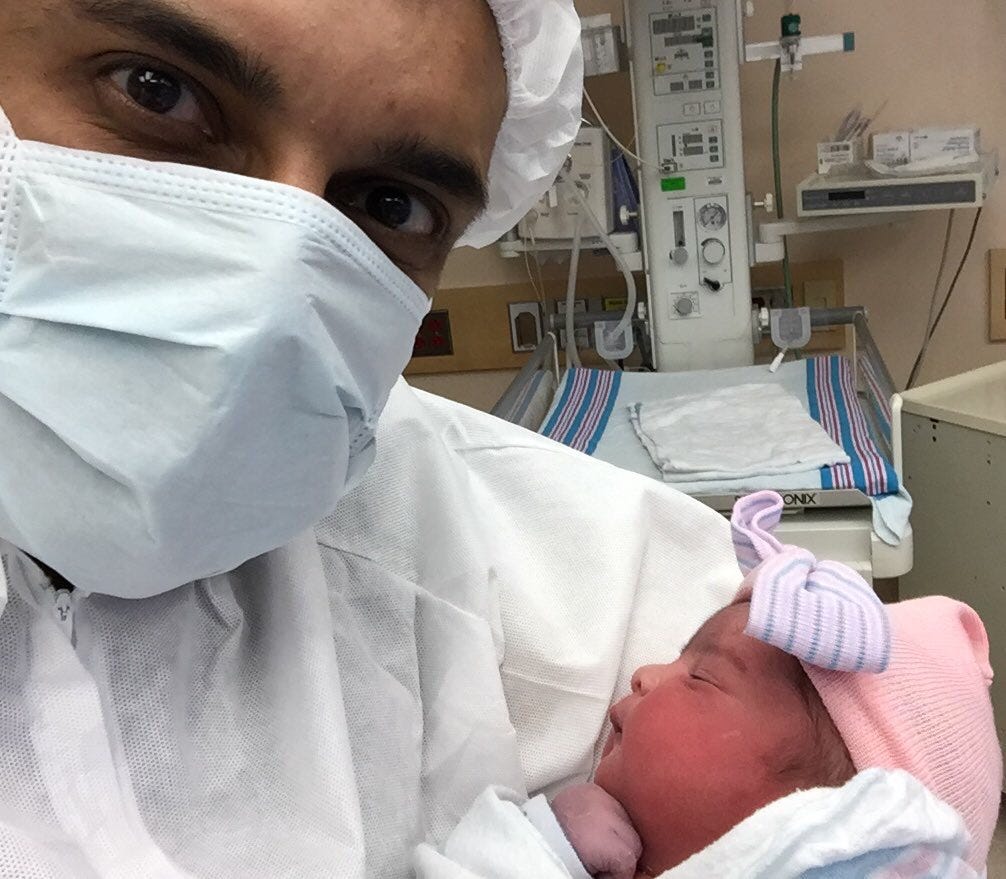
Hannah Noor (Pictured Right) at 5 hours old.

A Scream in the Dark

It was just after her sixth birthday in 2021 when our daughter screamed from her bed in the middle of the night. We rushed to her room to find she had thrown up all over her bed. We cleaned her up, changed her sheets, and blamed the incident on the Oreos she’d eaten after dinner. The next day she complained of a stomach ache and rushed to the bathroom, experiencing diarrhea. Like most parents, we dismissed it as a passing bug—kids get diarrhea now and then. But something felt different this time, even though it was her first experience.

When it happened again just a short time later, the stomach pain was more severe. She screamed, cried, and rushed to the bathroom, but this time there was blood—so much blood. It terrified us. Before we could even make it to urgent care, she had another episode with even more bleeding. We hurried her in, only to be told by the nurse practitioner to “keep her hydrated” and that it was probably a stomach virus. But again, something in our gut told us otherwise.

This was just before Thanksgiving 2021, and I convinced myself she’d recover over the break and be able to return to school. She loved school, as most kindergarteners do. But the bleeding continued. The pain worsened. More urgent care and pediatrician visits followed, but answers did not. By now, our once energetic and chatty daughter was pale, frightened, and visibly losing weight.

Navigating Through the Dark

We reached out to a close friend who happened to be a pediatric gastroenterologist. His questions and careful listening indicated it was not a simple virus, but he didn’t say much directly. He urged us to connect with the GI team at Children’s National Hospital in Washington D.C. Unfortunately, we were met with insurance hurdles and skepticism from her pediatrician. Weeks passed, and her condition deteriorated until, thanks to our friend’s intervention, we finally secured an appointment with a pediatric GI doctor in December.

Hannah Noor, now frail and scared, was put on iron supplements, and an colonoscopy was scheduled for January. She now weighed just 30 pounds—skin and bones, and we feared the worst. Her fear of eating, going to the bathroom, or even moving too much consumed her days. Our winter break became a period of sleepless nights, endless tears, and prayers. We felt like prisoners trying to navigate through treacherous terrain while blindfolded and shackled.

The preparation for the scope was grueling—a 24-hour liquid diet. To make matters worse, a severe snowstorm in early January 2022 left us without power for three days. Despite the chaos, we made it to the hospital. As I held her tiny hand, she bravely went under anesthesia. Hours later, the doctors confirmed what we feared: Hannah had ulcers all over her colon.

Inflammatory Bowel Disease (IBD) was the diagnosis—a chronic, lifelong condition that would require extensive management. Even as the doctor explained, I couldn’t fully grasp the gravity of it. I naively asked, “How long will she need the medication?” The doctor replied—“Do you understand what it means to have IBD? This is for life.”

It shattered me. My world crumbled.

Steroids, with their array of side effects, initially helped stabilize her condition, and she was subsequently started on mesalamine. However, managing IBD is never straightforward. Moving homes and finding a new doctor compatible with our insurance became an uphill battle. Procuring mesalamine was a nightmare, as our insurance kept on requiring prior-authorization—a term we’d never even heard before. Evidently, even though our doctor had prescribed a specific medication to save our daughter’s life, the insurance company required their non-medically trained admins to agree that our board certified physician knew what she was doing in prescribing the medication she prescribed. Spoiler: They disagreed and repeatedly denied the critical medication our daughter needed.

Making matters worse, moving meant we were in between doctors. Desperate to try anything to improve Hannah’s quality of life, we spent hours consulting with a nutritionist to see if dietary changes could make a difference. We invested extensive time and resources into a gluten-free diet, but it did not help at all; in fact, it made her averse to eating. We also tried the FODMAP diet, which was recommended during a flare, but it added to the confusion of what she should or shouldn’t eat. Every day became a battle over something as simple as food—one filled with uncertainty and frustration. Despite our efforts, Hannah’s condition remained unpredictable, with debilitating flares continuing to disrupt her life. By late 2023, we had pursued every imaginable route to find a way to protect our daughter’s health and life, and yet felt exhausted and at a dead end. 

It was clear that only one option remained—she needed a quickly advancing form of therapy known as biological treatment. This would be a direct IV infusion of medication to stabilize the IBD, every six to eight weeks, forever. 

A Dark Dead End

We were at the end of the road. If we couldn’t access biologic treatment, there was nowhere left to go. But what we hoped would finally bring us closure and healing, resulted in yet another emotional roller coaster and painful circus—our insurance corporation blocked us. Turns out, insurance corporations block more than 51% of patients whose doctors prescribe them biologic treatment to save their lives.

The recommended biologic promised not a cure, but a chance at living a healthy life. Our insurance rejected us outright reasoning that we hadn’t tried other medications first—a policy called “step therapy.” Despite our daughter’s life threatening condition, they wanted us to try every other variation of every other possible medication—knowing full well they would likely fail just as much and make our daughter suffer, vomit, bleed, and lose weight. But that did not matter to them, because that was the preferable path to ensure they “maximized shareholder value.” 

Our doctor stepped in and conducted a peer-to-peer direct meeting with the insurance company to show all the data, blood tests, and medical reports to prove that our daughter needed biologics to live. To show without a shadow of a doubt that the yet untried medications they demanded we try were not substantively different than the plethora of medications we had tried and had not worked. Yet, that meeting also went in vain. The insurance company still refused to approve our claim. And Hannah Noor’s condition worsened. She was pale, swollen from steroids, in pain, losing weight, and back to missing school.

We finally contemplated paying for the biologic treatment out of pocket. We knew it would only require six doses a year. How much could one dose be, after all? We checked and our hearts sank once more. Each dosage cost and administration would run into the tens of thousands of dollars. A year’s supply to keep our daughter alive would run into the hundreds of thousands. We certainly did not have that kind of money. We were cornered and desperate.

We contemplated what any parents might. Do we sell the house and cars and move into a small apartment? Do we set up a GoFundMe? Do we borrow money from family and friends? Do we take out a second mortgage?

Do we file for medical bankruptcy, as 500,000 Americans do annually? 

But we soon learned another sinister result of hyper-privatization of health insurance—even if we had the excessive means to pay the hundreds of thousands of dollars out of pocket, the hospital would not accept the funds. Why? The industry is such that not only do insurance companies deny 51% of claims, they have enacted policies forbidding people from paying for the critical medication they need out of pocket, lest the insurance company lose control and revenue. “Either you pay us, or you pay no one,” is a line you’d expect out of a mafia handbook—not out of a health provider. This is not health insurance, this is health exploitation.

A Spark of Light in the Darkness

In that moment of confusion we happened to run into to a fellow parent who, now is a great friend, and learned her children shared a similar medical struggle. She suggested calling the biologic manufacturers directly and applying for their patient assistance program. An idea that seems so obvious now, but something we did not even know was a possibility then.

The application process was tedious, and even then, it was initially rejected. But after weeks of back-and-forth, countless phone calls, and sleepless nights, a miracle happened—we finally secured approval. We let out a cathartic sigh of relief after more than two years of suffocation. And to be sure, the approval was not through our insurance company, who never even bothered to offer such an option, likely because it would cost them money. Rather, the approval was from the drug manufacturer directly. To this day our health insurance company has refused to budge on their cruel and calloused “maximizing shareholder value” decision to deny our daughter the medicine she needs to live.

On March 6, 2024—more than two months after the doctor first prescribed it, a period in which our daughter suffered horrific and unimaginable pain, bleeding, and vomiting—Hannah Noor received her first infusion at Comer Children’s Hospital in Chicago. And since then, everything has changed. Her spark of light returned. Our daughter was back. 

The Light We Create

A process that should have only taken 30-60 days from the night we heard that scream in the dark, took us on a 28 month torturous journey to finally see light again. Hannah Noor’s journey since starting biologic treatment has been a blessing. She’s eating, playing, drawing, and even learning karate (currently a Yellow Belt). The last three years of her life had been a torture for her, but now she is finally thriving as any 9-year-old girl should. Though the fear of flares always looms, we refuse to let it dictate our lives. Herbal and homeopathic treatments complement her medical regimen, and her strength inspires us daily.

As for our insurance company? Those corporate leeches also denied covering the hospital costs as well. Fortunately, despite that high price tag still running into the thousands, we tightened our belts and found a way to pay for that out of pocket, and continue to pay for that out of pocket. (We were shocked there wasn’t some additional insurance rule preventing us from paying our hospital directly). Despite us paying our insurance premiums every single month without exception, our insurance company has not covered a single penny of our daughter’s critical healthcare needs. The care she needs to live. But at least they’re maximizing shareholder value.

This story isn’t just about one child’s struggle with IBD; it’s about the systemic barriers hundreds of millions of families face every single day. From insurance denials to inaccessible care, to step therapy nonsense, to prior authorization red tape, the system fails the most vulnerable. What if we didn’t speak English? What if we couldn’t afford out-of-pocket costs for tests and treatments? What if one of our close friends didn’t just happen to be a national expert on this particular rare disease, and couldn’t leverage his relationships to get us access to a world leading expert? What if we didn’t have a network of supportive friends to recommend new ways to acquire this life saving medicine? 

A Brighter Future Is Possible

We named our daughter Hannah Noor because Hannah was the mother of Mary Mother of Jesus, and Noor means light. We couldn’t think of a more beautiful name for our only daughter, and she has lived up to it every day of her life. 

In these darkest of times, she is the Light of our eyes.

Hannah Noor (now 9) at a recent family vacation in Lahore, Pakistan. Here she is giggling at a cat that wandered over to say meow, which Hannah Noor reminded us means “hello” in cat language.

Hannah Noor’s story highlights a flawed and cruel system that places profits over people. Yet it also underscores the power of advocacy, persistence, and community. To every parent navigating the complexities of chronic illness: stay strong, fight relentlessly for your child, and lean on the resources available, like the Crohn’s and Colitis Foundation, and do not underestimate support groups on Facebook. If I can be of any support, do not hesitate to reach out at ayesha [dot] noor @ gmail.com.

Hannah Noor is living proof that even in the darkest moments, there is hope. She teaches us daily to believe in miracles—and to fight for them when necessary. It is also a reminder that our for profit exploitative health insurance system will always only serve the wealthy elites, the stock market, and whatever private investor who decides to buy and sell these corporations. They will not serve the people. Not our beautiful baby girl, nor the nearly 70,000 Americans who die annually due to lack of care, nor the 500,000 Americans who are forced to file for medical bankruptcy every single year. It is by the sheer grace of the Almighty that we still have our wonderful Light with us today. But for so many parents and families, the end result is not so fortunate.

Perhaps the most frustrating part about all of this is that the medication to save our child’s life existed all along. But because some calloused business person decided her life wasn’t profitable enough and worth saving, it was an acceptable cost to reject her claim and let her die.

It is our responsibility to demand better, not just for our daughter, but for all the daughters, sons, and children out there. We do not suffer from a lack of resources, but from an excess of greed. We can ensure high quality, accessible, and affordable healthcare for all people in this country—but we cannot ensure the satiation of greed for the billionaire corporations, corrupt politicians, and elitists who care more about shareholder value than the survival of innocent children. We have to choose one side. And we choose the children of this great country—we hope you do too.

Carol Burris, executive director of the Betwork for Public Education, describes the devastating advance of privatization in West Virginia. In 2019, the teachers of West Virginia banded together and went on strike, closing down every school in the state.

Burris writes:

West Virginia is closing its public schools. Seven schools will close in the next few years due to declining enrollment. These schools will join the 53 that closed in the past five years, and there are an additional 25 that counties have proposed or approved to close.

These numbers are not small in the context of West Virginia. The National Center for Education Statistics reported only 643 public schools with enrollment in the state in 2023-2024.

West Virginia’s population and student enrollment were in decline. In 2015, there were 277,452 students in West Virginia public schools. By 2020, enrollment was down to 253,930. In 2021, however, the drop seemed to level off—the public schools lost only 1,100 students the next year.

And then school privatization began.

In 2019, the legislature passed a charter law. It was cautious. Three charter schools were allowed to open as pilot schools under the control of districts, but none opened.

And then greed kicked in. The for-profit operators wanted to open schools in the state. In 2021, the legislature expanded the number of charters to ten a year, not including online schools, which they then approved. The authority to approve them was given to a politically appointed state board.

Six charter schools were rapidly approved, five of which are open.

Three of those five are run by for-profit corporations. In 2023-2024, those three for-profit-run charters enrolled 87% of the charter school students in the state. 

Charter schools in West Virginia operate on the “money follows the child” system, depleting school district budgets. That money accounts for a whopping 99% of state per-pupil funding, even though most charter students (70%) attend low-cost, low-quality online schools run by for-profits.

To add insult to injury to the state’s public schools, the U.S. Department of Education, under Secretary Cardona, awarded $12.2 million to the state’s charter board to open new charter schools or expand existing ones in West Virginia.

Over $905,000 was given to open a “classical” academy run by the notorious for-profit ACCEL. ACCEL already operates two of the state’s five charter schools. The new school will be operated on a sweeps contract, violating 2022 CSP regulations. Three of the existing five charter schools would be given funds to expand.

I registered a complaint with the U.S. Department of Education regarding West Virginia’s violation of its own regulations. I have not received a response. 

If that were not enough, this fall, the West Virginia legislature passed a law allowing charter schools to access the state building fund—giving them their own privileged funding stream.

In 2022, the same year that the law to expand charter schools was enacted, the state passed a voucher law called the Hope Scholarship, heralded by Ed Choice as one of the most expansive voucher laws in the country. That law gives vouchers to fund homeschooling, private schooling, tutoring, and “enrichment” activities for students who do not attend a public or charter school.

The scholarship is worth 100% of the average per-pupil state funding. There are no income limits. Beginning in 2026, any student, including a private school student or home-schooled student who has never attended public school, can apply.

In 2023-2024, West Virginians used a voucher. In 2024-2025, the number jumped to 10,000.

Let’s do the math.

During the 2021-2022 school year, there were 252,830 students in public schools. That was the year before charters and the voucher law. In 2023-2024, that number dropped to 243,560. 

Just when West Virginia enrollment had begun to stabilize, 2,277 students were siphoned off along with funding to charter schools, and 6,000 students received vouchers. In West Virginia, privatization through charter schools and vouchers is now the primary source of public school enrollment and funding decline.

As charter schools continue to expand, thanks in part to the federal Charter School Program, and vouchers become accessible to 100% of students in the state, school closings will accelerate. 

For the right-wing Libertarians who run education policy for the Republican Party, this is not a bug; this is the main feature. 

Trump is marketing so many different kinds of merchandise that it’s hard to keep track. Trump sneakers, the Trump Bible, Trump watches, Trump NFT cards, Trump coins, Trump guitars, and now: Trump fragrances. Some say that they are Trump’s own smell, but who would pay for that? Remember that Michael Wolf, his”former lawyer, called him “Mr. Schitzenpants.” You have to be very committed to MAGA to want to pay for his smell!

Blogger Wonkette, aka Robyn Pennacchia, wrote:

Last week, Donald Trump reportedly sold out of Victory, his official fragrance, the male version of which featured a tiny gold replica of his head. 

In response, he’s already released a new fragrance, this one called “FIGHT! FIGHT! FIGHT!” and is selling it online only for $199. That’s certainly a choice just a month after campaigning on the economy being terrible and everything being too expensive…

Of course, the thing that separates Donald Trump’s fragrances from any other fragrance in that price range is that it’s relatively easy to find out what those fragrances smell like — whereas GetTrumpColognes.com has absolutely no description of what the men’s cologne smells like, and barely any description at all of what the women’s perfume smells like. 

Here is how the men’s cologne is described:

Introducing FIGHT FIGHT FIGHT – FOR MEN, the bold new fragrance from Trump Fragrances. For Patriots who never back down, like President Trump. This scent is your rallying cry in a bottle. Featuring Trump’s iconic image and raised fist, this limited-edition cologne embodies strength, power, and victory.

Crafted for those who stand tall, this bold scent delivers rich, robust notes that leave a lasting impression. It’s not just a cologne—it’s a symbol of resilience. Inspired by Trump’s relentless drive, wear it with pride and confidence.

FIGHT FIGHT FIGHT COLOGNE: For men who fight to win and never surrender.

Shipping NOW. Makes the perfect Christmas gift!

What does it smell like? No one knows! But if it smells anything like how those who have been in the near vicinity of Donald Trump describe, it’s not good. Asked by Jimmy Kimmel to describe Trump’s “pungent odor,” Adam Kinzinger responded “So, if you take, like, armpits, ketchup, makeup and a little butt, it’s probably like that, all mixed up” — which sounds bad! MSNBC’s Alex Wagner said, “He smells like cooking oil,” which is slightly better but not much. Former “Apprentice” staffer Noel Casler said that Trump was known to wear a diaper, and occasionally did not change himself often enough and smelled pretty bad because of that.

Open the link to finish reading.

The New Republic writes about how easy it will be to bribe Trump. The emoluments clause in the Constitution has been rendered meaningless–the one that says the President can’t profit from his office. In his first term, nations and lobbyists paid him off by renting luxury suites at the Trump hotel near the White House. Now the possibilities are much greater.

In addition, the U.S. Supreme Court has given Trump absolute immunity for criminal acts he performs while acting as President. So we can expect to see the President selling watches, Bibles, sneakers, NFT trading cards, perfume, and whatever in nightly addresses from the Oval Office.

Imagine a Presidential press conference where Trump has commercial breaks to sell his merch!

Just one more norm to break!

The story begins:

I know what you’re thinking. How can I, a 98-pound weakling, DEREGULATE my industry or win fat GOVERNMENT CONTRACTS? But after last week’s election, there’s NEVER been a better time to BRIBE THE PRESIDENT! As a candidate, Donald Trump said that, if elected, he would put his second term UP FOR SALE! Contribute to my campaign, he told oil and gas industry representatives, and REGULATORY RELIEF IS YOURS! 

But wait, you say. Aren’t there emoluments clauses in the Constitution that FORBID this? Isn’t BRIBERY of public officials AGAINST THE LAW? Not really, thanks to EXCITING NEW OPPORTUNITIES opened up by Supreme Court rulings and the Trump team’s own thrilling CULTURE OF IMPUNITY! 

The Pre-Election Presidential Transition Act requires major-party nominees for president to submit, before the election, a Memo of Understanding to the General Services Administration articulating an ethics policy to avoid conflicts of interest. Trump signed the MOU last time. He hasn’t submitted one this time, even though the deadline was October 1. Until he does, Trump is barred from carrying out certain transition functions. Probably he’ll sign eventually, but once he does the GSA will impose a $5,000 limit on private contributions to his transition and a disclosure requirement, neither of which is really the Trump way. Presumably Trump will tap many of the same donors who gave to him last time, including AT&T, General Electric, Microsoft, Exxon Mobil, and JPMorgan Chase. Meanwhile, no dollar limits inhibit contributions to Trump’s inaugural committee, which last time included $5 millionfrom the late Sheldon Adelson. Adelson’s finances are now in the hands of his widow, Miriam, whom Trump will likely tap again.

Am I saying any of these corporations or individuals extracted promises back in 2016 in exchange for their contributions? I am not. Back then they were deterred by fear of prosecution. But they have much less to fear now, because last June, in the latest of its rulings to render the federal bribery statute completely unenforceable, the Supreme Court ruled that a politician who gets paid off by the beneficiary of some past action is accepting a legal gratuity and not an illegal bribe. Less than one month after this decision (Snyder v. United States) came Trump v. United States, where the court ruled that a president couldn’t be prosecuted for any act performed as part of his official duties. The combined effect is that the highest court in the land is practically inviting you to bribe your president. You might risk offending it if you turn this fabulous offer down! The Supreme Court’s lassitude about bribery, however, bumps up against its lassitude about presidential immunity in an interesting way that I’ll discuss in a bit. 

As for the emoluments clauses (two of which apply to the president; a third is for members of Congress), the Supreme Court long ago made clear it had no intention of enforcing those. In 2020 the high court declined to hear an emoluments case (Blumenthal v. Trump) brought by members of Congress, thereby upholding a lower-court ruling that Congress lacked standing. In 2021 the court dispensed with two other emoluments cases (Citizens for Responsibility and Ethics (CREW) v. Donald J. Trump and the District of Columbia v. Trump), both filed way back in 2017, by delaying action until five days after Joe Biden was inaugurated president and then declaring the lawsuits moot. 

The high court resorted to this evasion because any ruling on the cases’ merits would have had to acknowledge that Trump, serially and flagrantly, violated the emoluments clauses both foreign (“no Person holding any Office of Profit or Trust … shall, without the Consent of the Congress, accept of any present, Emolument, Office, or Title, of any kind whatever, from any King, Prince, or foreign State”) and domestic (“The President shall … not receive … any other Emolument from the United States, or any of them”). 

There’s a rich literature on the many and varied ways Trump made mincemeat of the emoluments clauses during his first term, including tworeports by the Democratic staff of the House Committee on Oversight and Accountability, one on foreign emoluments and one on domestic, and an update to the foreign emoluments report by CREW. According to CREW, Trump’s businesses received $13.6 million in payments from foreign governments during his presidency, including $5.7 million from China (mostly stays at Trump hotels), nearly $4 million from the United Kingdom (tax bailouts for two money-losing Trump golf resorts in Scotland), $1.1 million from Qatar (purchase of four units in Trump World Tower in New York City plus hotel stays at the now-defunct Trump International in Washington), and $885,000 from Saudi Arabia (which since 2001 has owned the 45thfloor of Trump World Tower; the Saudis also logged many stays at the Trump International). This tally excludes a reported $10 million campaign contribution that Trump’s 2016 campaign accepted from Egyptian President Abdel Fatah El-Sisi. Such a contribution, if it was given, would be illegal. A Justice Department investigation of the alleged contribution was shut down by Trump Attorney General William Barr.

On the domestic front, federal and state officials spent, over just an 11-month period, more than $163,000 on rooms at the Trump International, including eight people Trump appointed ambassador and three people Trump appointed to the federal bench. Meanwhile, the Secret Service paid $1.4 million to various Trump properties in the United States so that it might carry out its duties to protect the president and his family from physical harm, at rates as much as 4.5 times the federal per diem. In some instances the Secret Service paid more than Trump charged members of the Qatari royal family. The Secret Service isn’t trying to bribe Trump, of course, but because its stays were paid from the Treasury they violated the domestic emoluments clause, which is triggered by the expenditure of government money.

Since Trump’s first term, opportunities to fill Trump’s pockets have proliferated. Truth Social is a money-losing social-media platform whose stock price is up 180 percent since late September. As I’ve noted before, Trump’s fans are much more interested in buying shares in his social-media platform than in using it, not because they can make money off it but because Trump can. Trump owns a $3.5 billion stake in the company even though he’s never invested in it and can sell that stake any time he wishes. Trump insists he isn’t selling, but more than half of Trump’s net worth of $5.9 billion is tied up in Truth Social, and he’s still burdened by hundreds of millions in debt. The presidency may be the only thing standing between Trump and personal bankruptcy. That reality makes Trump even more susceptible to payoffs of various kinds. “How much Truth Social stock do you own?” could easily become a routine question Trump poses to anybody seeking a political appointment or some other favor. If that’s established to be part of his “official duties,” no prosecutor can touch him. Maybe Trump’s new bestie Elon Musk will buy Truth Social and merge it with Twitter/X. The two platforms aren’t so different, and maybe Trump would agree to stop criticizing EVs in return.

Trump also has a cryptocurrency business, World Liberty Financial (WLF). He doesn’t own it, and neither he nor any family member works for it or sits on its board of directors. As with Truth Social, Trump has not invested in the company. Yet Trump and his family are poised to receive as much as 75 percent of net revenues from the company. When you pay your bribe, don’t forget to make it in WLF tokens!

The Trump International Hotel opened in Washington’s Old Post Office less than two months before the 2016 election, and with Trump’s victory it established the District of Columbia as a latter-day equivalent of Pottersville in It’s A Wonderful Life. Trump paid too much for his lease on this federal building in 2012, lost a fortune on it—and then sold it at a profit in 2022 under mysterious circumstances that I puzzled over two years ago. Some of the mystery cleared up after Forbes reported that Trump lent the new owner $28 million to take it off his hands. By last summer, though, the new owners—of what was now a Waldorf Astoria hotel—had defaulted, and in August the property quietly sold for $100 million at a foreclosure auction. 

Since then, Trump has licensed his name to three developments in Oman, Saudi Arabia, and the United Arab Emirates, including a Trump Tower Dubai and an Intercontinental Hotel, sparing the governments of those countries the inconvenience of traveling to the United States to shovel petrodollars down Trump’s pants. The Saudis’ LIV Golf League has already hosted six tournaments at Trump properties and will doubtless now step up the pace.

At the risk of spoiling the party, I must point out one potential bullkill.  Josh Chafetz, professor of law at Georgetown and author of a forthcoming Yale Journal of Law and the Humanities article about the Supreme Court and political corruption, noted recently to Adam Liptak of The New York Times that the high court’s definitions of what constitute “official acts” lack consitency. In McDonnell v. United States, a 2016 bribery case involving a corrupt wingnut Virginia governor, Chief Justice John Roberts defined an official act narrowly as “a formal exercise of government power,” and on those grounds he vacated the bribery conviction. But in July’s Trump v. the United States, Roberts defined an official act broadly as anything occurring “within the outer perimeter of … official responsibility,” and on those grounds he shielded Trump from prosecution. The only logic these two definitions shared was the chief justice’s motive not to prosecute corrupt Republican politicians.

Please open the link to finish the article.

Jan Resseger read the proposals of the Heritage Foundation’s Project 2025 and the America First Policy Institute to divine the likely shape of Linda McMahon’s plans if she is confirmed as Secretary of Education. McMahon was chair of the board of the America First Policy Institute so its goals are inportant.

It’s not as if these two groups are far apart: they are both closely aligned with Trump and his determination to expand public funding of private schools and sow chaos.

Please open the link, as I am posting only the first half of Jan’s post.

She writes:

Linda McMahon formerly served as an executive of World Wrestling Entertainment; led the Small Business Administration during Trump’s first term; and took a job in 2919 leading the America First Action PAC to support Trump’s candidacy for President. Beginning in 2009, McMahon served part of a term on Connecticut’s state board of education, and once upon a time, after majoring in French in college, the now 76-year-old McMahon secured a teaching certificate in her home state of North Carolina. Currently she chairs the board of the America First Policy Institute, a think tank competitor to the Heritage Foundation and its Project 2025. Both think tanks have been drawing up a policy agenda to drive Trump’s second term.

There is some agreement that McMahon is not as likely to shut down the U.S. Department of Education as many feared Trump’s appointment would be charged to do. The National Education Policy Center’s Kevin Welner believes the complexity of the history and needs served by that federal department would make its closure unlikely: “By the time Congress established the department in 1979, the federal government was already an established player in education policy and funding. For instance, the Higher Education Act of 1965 began the federal student loan program. In 1972, Congress created the basic Educational Opportunity Grant, the predecessor program to today’s Pell Grants. The G.I Bill of 1944, which, among other things, funded higher education for World War II veterans, preceded them both. At the K-12 level, federal involvement in vocational education began with the Smith-Hughes Act of 1917. Federal attention to math, science and foreign language education began in 1958 with the National Defense Education Act. Two laws passed during the Lyndon Johnson administration then gave the federal government its modern foothold in education: the Civil Rights Act of 1964 and the Elementary and Secondary Education Act of 1965. The 1964 law provided antidiscrimination protections enforced by the Education Department’s Office for Civil Rights. The 1965 law… includes Title I, which sends extra funding to schools with high populations of low-income students. In 1975, Congress added the law currently known as the Individuals with Disabilities in Education Act, or IDEA… To dissolve the Education department, both houses of Congress would have to agree, which is unlikely.”

Assuming the U.S. Department of Education will survive a second Trump administration, it is worth comparing the policy agendas both think tanks—the Heritage Foundation with its Project 2025, and the America First Policy Institute (AFPI) where Linda McMahon has been chair of the board—have prepared for the incoming Trump administration’s Department of Education.

The Heritage Foundation’s Project 2025 suggests systematically dismantling or relocating to other departments the institutions that were originally pulled together in 1979 to be managed by one federal agency. According to a concise report in August from the Brookings Brown Center on Education Policy, the Heritage Foundation’s Project 2025 prescribes tearing apart the Department’s structure and functions: “dismantle the U.S. Department of Education; eliminate the Head Start program for young children in poverty; discontinue the Title I program that provides federal funding to schools serving low-income children; rescind federal civil rights protections for LGBTQ+ students; undercut federal capacity to enforce civil rights law; reduce federal funding for students with disabilities and remove guardrails designed to ensure these children are adequately served by schools; promote universal private school choice; and privatize the federal student loan portfolio.”  Project 2025 would, first, end or reduce specific federal funding streams enacted by Congress to serve vulnerable groups of students, and second, disrupt or undermine the specific agency prepared to enforce laws and regulations that protect the civil rights of groups which have experienced discrimination and unequal access to opportunity in the past.

The America First Policy Institute’s agenda is far more focused on what have been called culture war issues, while both think tanks do make universal school choice—the diversion of public dollars for school privatization—a priority.  The agenda of the America First Policy Institute (AFPI) features four pillars, each one described in a two page brief:

First — “Give Parents Control by Allowing Them to Select the School Their Child Attends.” AFPI’s brief on school privatization is piece of classic pro-privatization ideology. Ignoring the fact that two weeks ago in three states, voters rejected ballot measures which would have expanded tuition vouchers for private schools and further, that every single time voters have been presented with voucher initiatives in previous years, voters have flatly rejected school vouchers, the America First Policy Institute (AFPI) tells a lie: “Just 18% of Americans are opposed to school choice. Support for school choice in America has increased from 64% to 72% since April 2020.” And despite Josh Cowen’s research that demonstrates lower academic achievement when students use vouchers at private schools, AFPI declares: “Standardized test scores significantly improve for students who exercised school choice.”  AFPI endorses charter schools and criticizes the Biden administration’s efforts to strengthen regulation of the federal Charter Schools Program, which the Network for Public Education has repeatedly shown suffers from poor oversight.  AFPI writes: “(R)egulations would severely limit the types of schools that could apply for funding and would restrict any potential expansion of charter school programs.”  AFPI concludes mistakenly: “Educational freedom is a tool that has a proven record of putting students and families first, and parents need to be given the power to choose the best educational opportunities for their children.”

Education Week‘s Brooke Shultz directly quotes Linda McMahon in 2016 strongly supporting charter schools : “One of the issues most important to me is the question of school choice.” Shultz also quotes McMahon in 2015: “I don’t believe charter schools take anything away from traditional public schools; rather I think they can be centers for innovation and models for best practices.”

Second —“Give Every Parent the Right to See All Curriculum Materials in Every Class their Child Attends.”  AFPI endorses parents’ individualist right to insulate and shield their children from programs and ideas that the parents consider offensive. However dangerous it may be for a school district to privilege individual parents with the power to set the curriculum according to the biases of the most powerful parents, and however impractical it may be for parents to review and debate each classroom’s lessons in advance, that is the policy AFPI endorses: “The formal authority to approve curriculum for public schools rests with states and local school boards. However, the authority for educating children rests with parents. As such, they should be involved early in the approval process in determining what qualifies as appropriate content for curriculum and lesson plans.”  The bias here is clear: “Many children are being taught to see white supremacy everywhere, indoctrinated to believe America’s foundation was built on racism, talked to about sex and gender identity in developmentally inappropriate ways, and presented with other questionable curriculum…  Officials that have the authority to make and approve curriculum do so as stewards of the public’s trust. The taxpayers and parents who schools ultimately answer to deserve to know what schools are teaching and how tax dollars are being spent.”

Again, please open the link to read this excellent post in full.