Archives for category: For-Profit

One of the most remarkable turnarounds in the nation happened in Ohio. There have been so many charter scandals that the major newspapers have become skeptical, as well they should be. They have noticed the scams, frauds, phantom schools, phantom students. They’ve noticed how many charters get scores lower than the public schools they were supposed to compete with.

They are no longer entranced by the marketing of the charter school industry.

In Ohio, the biggest scandal is the Electronic Classroom of Tomorrow, known as ECOT.

This editorial appeared in the Columbus Dispatch. The editorial board is no longer fooled by the charter industry.

It was founded in 2000. It developed some very bad habits that cheated the public of millions of dollars.

“Alas, the school’s owner, who had no background in education, began to realize that education is really hard. And keeping the attention of at-risk students is really, really hard. The owner began to realize that many students who signed up for his school almost never logged in. Didn’t show up. His virtual classroom was half-empty. But tracking down these students and hounding them to get online and learn something would be time-consuming, expensive and, in many cases, nearly impossible.

“The owner quickly realized something else. Keeping an honest account of how many students were logging in to meet state attendance requirements would reduce the amount he could charge the state — by millions of dollars. Every year. The owner made an unfortunate choice. He decided to charge the state for a full year of instruction for each student signed up, even if a student logged in for only a few minutes each month.

“This is the sad story of ECOT — the Electronic Classroom of Tomorrow, Ohio’s largest online charter school. Since its founding in 2000, the school consistently has billed the state for students whose participation it could not document.

“In November 2001, then-State Auditor Jim Petro determined ECOT received $1.7 million for students not enrolled. Despite these early warnings, ECOT continued to charge Ohio’s taxpayers for phantom students, in increasing numbers.

“State audits from 2000 to 2016 revealed how lucrative this pattern has been for ECOT owner Bill Lager. Although organized as a nonprofit, ECOT contracts with two Lager-owned, for-profit entities for management and software services. From 2000 to 2016, ECOT paid the two businesses a tidy $192.8 million.

“At long last, in 2016 the Department of Education had had enough. It began insisting on honest accounting. After reviewing log-in durations and offline documentation for the 2015-2016 school year, the department concluded ECOT had reported 15,322 full-time students, while only 6,313 could be verified. The State Board of Education required ECOT to repay about $60 million of the $108 million it had received.

“This upset the owner. So he sued the state and its taxpayers, claiming the education department has no right to look under the hood, no right to check whether students actually are logging in. Fortunately, this argument was rejected by both the Franklin County Common Pleas Court and Court of Appeals. The case now is before the Ohio Supreme Court.”

ECOT has the lowest graduation rate in the nation.

How much longer will the taxpayers of Ohio allow this “school” to collect millions for students who never participated in class?
Why did Senator Bob Corker Change his vote?

http://www.ibtimes.com/political-capital/tax-bill-john-cornyn-says-tax-cut-potentially-benefiting-bob-corker-was-part

Why would Republicans pass a tax bill that is wildly unpopular?

Who benefits?

Remember next November.

The Center for Responsible Lending issued this press release about the first stage in the reauthorization of the Higher Education Act. The House Education and the Workforce Committee is chaired by Rep. Virginia Foxx, a far-right extremist from North Carolina.


PROSPER Act Shortchanges Students, Undermines Higher Ed Safeguards

Bill to dismantle higher education opportunity passes committee after late night vote and without bipartisan support

WASHINGTON, D.C. – Today, shortly after midnight, the House Committee on Education and the Workforce passed the PROSPER Act, a bill to eliminate important programs and safeguards that make higher education accessible and affordable for low-income students. The bill was approved without bipartisan support after a daylong debate and markup procedure where Chairwoman Virginia Foxx (R-N.C.) and other sponsors of the legislation summarily denied nearly all 40 amendments submitted by her Democratic colleagues.

The Center for Responsible Lending (CRL) has called on members of the committee and Members of Congress to reject this bill which would: rollback borrower defense and gainful employment rules; eliminate state authority to regulate student loan servicers; use taxpayer dollars to prioritize for-profit colleges over public and non-profit colleges and universities; cut funding for minority-serving institutions, like historically black colleges and universities (HBCUs); and dismantle all student loan forgiveness programs.

CRL counsel Ashley Harrington released the following statement in response to last night’s vote:

“This bill does only one thing—it widens the wealth divide by ensuring that the gap between those who can afford to attend college and those who can’t becomes more difficult to bridge than ever. It increases the ability of predatory for-profit college institutions to access taxpayer dollars and dismisses the call of students who want assistance with the crushing burden of student loan debt.

“In 2008, we saw firsthand what happens when we support industry and businesses at the public’s expense. The student loan debt crisis is on track to decimate our economy and our communities in much the same way the mortgage crisis did. Should this bill become law as written, it will only accelerate that process.

“There are numerous ways to address higher education costs and access—we can create a system that’s more fair and equitable, including increasing our investment in college and career readiness, opening more pathways to loan forgiveness, and working to stem the exponentially rising cost of college. Unfortunately, this bill does nothing to address these concerns. Instead, the PROSPER Act is a war on students and pushes higher education further out of reach for many Americans than ever before.”

###

For more information, or to arrange an interview with a CRL spokesperson on this issue, please contact ricardo.quinto@responsiblelending.org.

ECOT, the Electronic Classroom of Tomorrow, is a virtual charter school that was a ash cow for its owner, William Lager, until the Ohio Department of Education got the novel idea to audit attendance.

It learned that ECOT has inflated enrollments and has charged the state for students who turn on their computer but don’t participate in learning.

ECOT has fought the State I Court and lost repeatedly. Over the past 15 years, ECOT’s founder has given a few million to elected officials and has received about one billion return.

Bill Phillis of theIhio Cpalitionfor Equity and Adequacy has been fighting the squalid charter sector for years.

He reports here onghe latest. Ourtbloss for ECOT:

“Another Court ruling against ECOT

“In a 5-1 decision today the Ohio Supreme Court denied ECOT’s request for an injunction. ECOT was attempting to stop the Ohio Department of Education (ODE) from deducting $2.5 million from its monthly payments in order to collect $60 million it overcharged in 2015-2016.

“ECOT’s claim that ODE erred in its decision to reclaim funds for students not served is still pending before the Ohio Supreme Court. Scheduling of oral arguments in the case has not been announced.

“ECOT has lost all of its many claims before hearing officers and courts thus far. It is interesting; however, that Justice Terrance O’Donnell has always sided with ECOT.”

William L. Phillis | Ohio Coalition for Equity & Adequacy of School Funding | 614.228.6540 | ohioeanda@sbcglobal.net| http://www.ohiocoalition.org

Ohio E & A, 100 S. 3rd Street, Columbus, OH 43215

The AltSchool idea was founded by a Google executive, who decided he could redesign American education. It operates for profit, but it is not making a profit.

Max Ventilla, a Google executive who left the search giant to launch AltSchool in 2013, wooed parents with his vision to bring traditional models of elementary education into the digital age.

AltSchool has raised $175 million from Mark Zuckerberg, Peter Thiel’s Founders Fund, and others, and the startup is closing a Series C round of funding. But now some parents are bailing out of the school because they say AltSchool put its ambitions as a tech company above its responsibility to teach their children.

The startup, which launched in 2013, develops educational software and runs a network of small schools with four locations, in California and New York; two others closed their doors in the past year, and three more will close in the spring of 2018. These schools serve as testing grounds for an in-house team of technologists to work on tools for the modern classroom.

Since August, 12 parents spoke with Business Insider on the condition of anonymity, some because they worried that speaking out against AltSchool could hurt their children’s chances of being enrolled elsewhere. Six parents have withdrawn their children from AltSchool in the past year, and two others said they planned to do so as soon as they found a transfer spot at a different school. AltSchool enrolls between 30 and 100 students at each campus.

“We kind of came to the conclusion that, really, AltSchool as a school was kind of a front for what Max really wants to do, which is develop software that he’s selling,” a parent of a former AltSchool student told Business Insider.

In New York City, where private schools may cost $50,000 or more, the for-profit school sector is growing. BASIS, the high-flying charter chain in Arizona, has opened two private schools in the city, undercutting the traditional private schools with lower tuition costs.

Unlike most of New York’s private schools, these newcomers are all for-profit businesses.

Matt Greenfield, a managing partner of ReThink Education, a venture capital firm focused on education technology, said that this group of new schools seemed to reflect a mix of passion projects, started by parents frustrated with the available options who want to create their dream school, and cold-eyed business ventures.

“Schools are not an inherently bad business,” he said. “New York has a scarily high real estate cost, and other costs are high, too,” but the tuition a school can charge in New York is high, as well, he said. “So I think those are not implausible businesses.”

Not everyone is convinced of the value or long-term viability of the new for-profits:

Some observers are skeptical of the new crop of schools. Amanda Uhry, the founder and owner of Manhattan Private School Advisors, which helps families with the admissions process, said she discourages parents from applying to for-profit schools, because she doesn’t have confidence in the long-term stability of those schools.

“There are people who these schools obviously attract and obviously go there,” she said, but only because they don’t get into the more prestigious nonprofit schools. In her experience, she added, many families “would rather go to public school than go to a privately owned new school that has no history.”

As long as parents don’t expect the state or the federal government to pay for their tuition with vouchers, the choice is theirs to make.

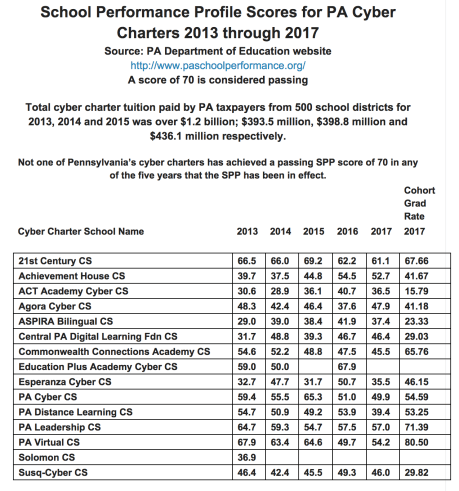
For the fifth year in a row, not one cybercharter in Pennsylvania achieved a passing school performance score of 70. When will these scams be held accountable for their poor performance? When will the State close down these failing schools? These “schools” drain hundreds of millions of dollars away from real schools and get poor results, year after year. Two different cybercharter operators were indicted for stealing millions from state taxpayers. One was convicted, the other was tried but the trial ended in a hung jury.

Screen Shot 2017-11-02 at 9.44.37 PM

A few days ago, the New York Times ran a first-page story about the big push by tech companies to get their software and hardware adopted by public schools. The market is huge, and the vendors are pulling out all the stops to woo District officials by inviting them to conferences, giving them awards, and showering them with attention. The district that was featured by the Times was Baltimore County, which had committed to spend $300 million on high tech, while basic physical needs of the schools were ignored. The BC Superintendent Dallas Dance had recently resigned, and he was replaced on an interim basis by his deputy Verletta White, who shared his passion for going high tech.

The big story was that the district bought equipment that was soon discontinued and that ranked third of four choices in an independent evaluation. No, the big story was how cleverly and insidiously the tech industry sold their stuff to school officials.

But now we learn that Dallas Dance and Verletta White both were paid fees by the tech industry and didn’t report the payments on their income disclosure. In relation to the size of the contracts, the payments were relatively small. Which does not excuse the payments but demonstrates how easy it is to buy influence.

http://www.baltimoresun.com/news/maryland/education/k-12/bs-md-verletta-white-dallas-dance-ethics-20171106-story.html

John Merrow here recounts the sad story of how Baltimore County got snookered by the tech industry, sinking hundreds of millions into a soon-to-be obsolete tech tablet while ignoring the basic needs of the sistrict’s schools.

He writes:

“It’s a breathtaking story of greed, but what’s only hinted at around the edges in the Times story is the harsh truth that this would never happen if educators, politicians and policy makers were not worshipping at the altar of standardized test scores. Tech is selling–and educators are willing buyers–a fantasy: “Buy our fancy software and hardware packages, and your test scores will soar.”

“The reporters use Baltimore County (MD) public schools as their poster child, and surely (now former) Superintendent Darryl Dance has a lot of ‘splaining to do, given the coziness of his relationship with HP and other providers. Under Dance’s leadership, his system signed a $200 MILLION contract with HP in 2014 and was also on the hook for many millions more in related contracts. In the district’s own evaluations, the HP device scored third out of the four devices tested, with only 27 points out of a possible 46, but the County signed with HP anyway.

“(The device, the Elitebook Revolve, has been plagued with problems and has been discontinued by HP, and Superintendent Dance abruptly resigned in April, no reason cited.)

“While the reporters for The Times do not come right out and call the public school people in Baltimore County and elsewhere ‘crooks’ or ‘prostitutes,’ they come pretty close…

“Sadly, this isn’t a new story. Apple sold an expensive bill of goods to Los Angeles County Public Schools years ago, and Joel Klein’s Amplify signed some lucrative contracts, deals that went south when some of the machines burst into flames. I write about those deals and other stupidities in my new book, “Addicted to Reform: A 12-Step Program to Rescue Public Education.” (The New Press, 2017)”

Dallas Dance has moved on. Baltimore County is out nearly $300 Million in total for Dance’s tech deals. The County has obsolete hardware.

Where is the accountability.

The North Carolina State Board of Education unanimously approved the opening of a for-profit charter school that will enroll more than 2,000 students in Cary. The school will be operated by Charter Schools, USA, a Florida corporation owned by Jonathan Hage, a friend of Jeb Bush. Not an educator, Hage has built a very large business by owning for-profit charters.

The State Board of Education unanimously approved Cardinal Charter Academy West Campus, which plans to educate up to 2,180 students in kindergarten through 12th grade. The new school, modeled after the existing Cardinal Charter Academy in Cary, represents the latest effort by charter school operators to target the fast-growing western Wake County area…

Critics say charter schools are targeting the more-affluent families who live in western Wake, where test scores are higher and the percentage of low-income students is lower than the Wake County school district average. Charters are taxpayer-funded public schools that are exempt from some of the regulations that traditional public schools must follow.

But supporters say they’re meeting the need for school choice, citing the long waiting lists for Cardinal Charter and packed parent information sessions.

Cardinal Charter West would be managed by Charter Schools USA, a Florida-based for-profit company that could receive more than $2 million a year from the new school.

Read more here: http://www.newsobserver.com/news/local/education/article182268141.html#storylink=cpy

At the same meeting of the state board, a charter school in rural Bertie County was closed because of its low enrollment and poor academic standing.

Business Insider reports that the latest new thing, AltSchool, is not making it.

Backed by Mark Zuckerberg and tech entrepreneur-Trump acolyte Peter Thiel, started by a former Google executive, AltSchool was lauded lavishly when it opened. It was supposed to revolutionize education.

AltSchool, an educational software developer and network of “micro-schools” with four locations in California and New York, is shuttering another outpost.

The startup’s schoolhouse in Manhattan’s East Village will close its doors at the end of the academic year, according to an email obtained by Business Insider from vice president of schools at AltSchool, Sam Franklin, to parents of AltSchool students on Thursday night.

It’s the second closure that AltSchool has announced in two days, after the buzzy ed-tech startup revealed it’s closing its location in Silicon Valley. AltSchool appears to be refocusing its energy on licensing its educational software to existing schools, rather than creating new ones.

In an email to parents, Franklin apologized to parents who may have learned about the school closures “in the news rather than hearing it from us.”

AltSchool counted the Oxycontin billionaire family, the Sacklers, among its investors. Also Laurene Powell Jobs. All the really smart and very rich folks.

Sad. Very sad. Just a tax write-off.