Archives for category: Failure

Angie Sullivan teaches first- and second-grade students in a Title 1 school in Carson County, Nevada. She sends her email reports to legislators and journalists. She is the conscience of Nevada.

She writes:


Attached is a report I put together in an attempt to review what data I could find on Nevada Connections Academy.

I did include some research on the parent corporation also for background which may or may not give you insight into the Nevada Connections Academy.

Opened in 2007 – Nevada Connections has never been successful.

Ten years later the Nevada Charter Authority is attempting to shut down this charter because of poor graduation rates.

Ten years.

I have been studying this information for months and have yet to see any accountability by Nevada Charters. Claims that they can be closed are not backed by real evidence. Nevada Charters close due to bankruptcy and fraud. They do not close due to severe and consistent academic under-performance.

As you review the data – you will notice that in most years and most grade levels half or more of the students are failing.

Graduation rates have been abysmal.

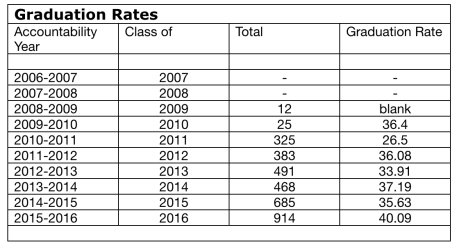
If I am reading the hard to understand reports correctly, in 2016 Nevada most likely paid $6,000 X 2400 = $14,400,000 to Nevada Connections Academy for High School Seniors and 40% or 914 graduated.

Total enrollment in Nevada Connections Academy was report at 2,851. Overall the Nevada Tax Payer spend $17,106,000 for less than half its students to be proficient.

The school also has a swinging door with half its students turning over. Due to lack of regulation and oversight – plus the “missing” students every year at testing time – I have to ask if the Nevada Tax Payer is paying for students not even in the program any longer.

nevada graph

Understandably parents and students do not want their charter school to close.

Parent and students do not want my public school to close either. Yet, I am held accountable. My school can be turned around or taken over by the Achievement School District. This failing charter has been doing poorly for 10 years and what has happened?

Nothing.

Parent and students base their “choice” of school on things other than standardized testing and numbers. I understand this very well. And they will protest if this school is closed. However, I am using this an example which is fairly similar to half of Nevada’s Charters which are on the lowest performing list.

Half of Nevada’s charters are on the lowest performing list. The worst graduation rates in the state are in the State Public Charter School System.

This charter is one of many in Nevada not doing well.

Half of Nevada’s charters are on the lowest performing list.

Parents need access to charter information at the same level public schools are required to give information to parents. In an annual report published on-line. Charters which spend on marketing to produce enrollment numbers need to be giving their data and graduation rate information to student prior to enrollment. No one should have to dig around in the Nevada Report Card for a month to try to determine if a school is academically achieving. If these charters are actually serving students not expected to graduate – if they are alternative schools – they should tell parents up-front the likelihood of graduating from these schools.

Charters need to be audited. Public schools have the SAGE Commission. Charters should have a similiar body which looks at return on investment and other financial measures.

I just attempted to watch an audit or something like an audit on-line from the charter authority.

https://manage.lifesizecloud.com/#/publicvideo/975a6334-1f01-4734-9678-cc6042d30f29?vcpubtoken=2021a45f-3957-40df-97a4-8cc8d9196bdb

Besides cheerleading for charters – I’m not sure the audit produced much information. It certainly did not expose anything I have discovered in the last few months. Watch the video for yourself and ask yourself if the Nevada Charter Authority is able to hold any of Nevada’s Charters accountable with the information presented.

Due process is the reason charters are not closing?

Perhaps there is simply zero political appetite to close a perpetually failing charter?

While charters may protest accountability in the name of freedom and choice. . . this needs to be balanced by accountability to the tax payer who pays the bills.

It is not fair to have a strict accountability system for public systems while charters are allowed to run amuck in the state of Nevada.

The unfairness of a legislated system that turns public schools into charters but does nothing about all the failing charters spending million in tax payer money in the state – is foul.

The Nevada Charter System is a failing school system in the state. That is clear according the data.

If Nevada Connections cannot be closed after 10 years of failure, which charter will ever be held accountable?

Angie

See the whole report here.

David Hornbeck is a veteran education reformer, old-style, meaning he actually has experience running school districts and states. He was superintendent of the Philadelphia schools, state superintendent of Maryland and Kentucky, and led the implementation of KERA (the Kentucky Education Reform Act).

In this post, Hornbeck writes that he once believed that charter schools were “reform,” but he no longer does.

“As Philadelphia’s Superintendent of Schools, I recommended the approval of more than 30 charter schools because I thought it would improve educational opportunity for our 215,000 students. The last 20 years make it clear I was wrong.

“Those advocating change in Maryland’s charter law through proposed legislation are equally committed to educational improvement. They are equally wrong. New policy should not build on current inequities and flawed assumptions, as the proposed charter law changes would do.”

I admire people who are willing to listen, Watch, learn, and change their minds. Why did Hornbeck change his mind?

He paid attention to evidence. Imagine that!

On average, charter schools don’t get better academic results than public schools.

Charter funding negatively affects public schools, creating opportunities for a few but inequities for the many. He writes: “Opportunity for the 13,000 charter school students in Baltimore City is in part funded by the loss of opportunity for the remaining 70,000 students without a commensurate performance improvement by charter school students.”

In addition, charters may harm the credit ratings of urban districts by creating inefficiencies: As Moody’s reported, “charter schools pose the greatest credit challenge to school districts in economically weak urban areas and may even affect their credit ratings.”

Contrary to the claims of charter advocates, “States with “stronger” charter laws are not doing better: Advocates say we need a “stronger” charter law, noting that Maryland ranks near the bottom. Pennsylvania’s law is ranked much higher, yet its charter growth is contributing significantly to a funding crisis that includes draconian cuts to teachers, nurses, arts, music and counselors in Philadelphia.”

The changes proposed in Maryland will make it harder to get and keep the best teachers:

“The proposed “stronger” law undermines collective bargaining that protects teachers from politics and favoritism and has been crucial to improvement in compensation and benefits. It would create a two-tiered system in which charter teachers would have to organize and bargain separately with each charter opting out of the larger system’s contract. Unionization is not the problem. There are no unions in many of the nation’s worst educational performing states. All schools, charter or traditional, must pay competitive salaries and benefits to attract experienced, skilled teachers who can succeed with all children.”

Charters do not serve the children with the greatest needs.

If Maryland passes the proposed charter law, it will make the education system incoherent and inefficient.

This is not reform.

Hornbeck describes what real reform is. His short list does not include charters.

Peter Greene read Betsy DeVos’s speech to CPAC and realized that she totally misunderstood why Obama and Duncan’s reforms failed. It wasn’t because they spent money. It was because they spent money on bad ideas. Now she proposes to spend money on vouchers, which have failed miserably, and on charters, which Obama and Duncan promoted. What is new about her approach? She is candid: she wants to destroy public education. Obama and Duncan either believed or pretended that public education would get better because of high-stakes testing, punishments, and charter schools. They were wrong. DeVos is wrong too. The difference is that we already know she is wrong, but she doesn’t.

Greene writes:

“School improvement grants were like food stamps that could only be spent on baby formula, ostrich eggs, and venison—and it didn’t matter if the families receiving the stamps lived on a farm with fresh milk and chicken eggs, or if they were vegetarians, or if they lived where no store sells ostrich eggs, or if there were no babies in the family. The Department of Education used the grants to dictate strategy and buy compliance with their micro-managing notions about how schools had to be fixed.

“As with many classic reform moves, plenty of folks on the ground level could have told the reformers what was wrong with their plan. But as DeVos’s comments show, the damage of School Improvement Grants is not only in wasted money, it’s also in convicting the wrong suspect and discrediting a whole reform approach.

“DeVos and other conservative reformers are taking the real lesson of the grant program’s failure: “spending money on the wrong thing for schools doesn’t help,” and shortening it to a far more damaging assessment: “spending money on schools doesn’t help.”

“The Obama-Duncan-King program didn’t just fail, they say, but it also helped discredit the whole idea of funding schools at all. Thanks Obama.”

Given the miserable failure of school choice in Michigan and Detroit, you would think DeVos was open to reflecting on the error of her ideas. But don’t make that mistake. Her ideas of school “reform” are based on ideology and theology. They won’t change. They can’t be proved or disproved. They are set in stone. Evidence doesn’t matter.

If allowed to do her wishes, public schools will be defunded (they are “godless”), unions will disappear, for-profit entrepreneurs will cash in, and a million weeds will bloom.

Kevin Carey is the director of education research at the New America Foundation in D.C., a think tank funded by tech magnates.

He writes in the New York Times that researchers are reacting with surprise at the “dismal results” from vouchers.

I am not sure why this is news, because vouchers have been tried out since 1990 in Milwaukee and elsewhere and have been subject to numerous evaluations, almost all of which have reached the same conclusion: vouchers don’t have a significant effect on test scores.

This conclusion has been reported again and again over the past 25 years.

It doesn’t seem to have much effect on the pro-voucher crowd, who have been promising since 1955 (when economist Milton Friedman published his seminal essay about vouchers) that school choice would have dramatic positive effects. Back in 1990, John Chubb and Terry Moe predicted in their book “Politics, Markets, and Schools” that school choice was a “panacea,” and that the problem with schools is that they are democratically controlled. Take away the democratic governance, and all will go well, they said.

Anyone who looks at the many evaluations of the voucher programs in Milwaukee, Cleveland, D.C., Indiana, and Louisiana has to search hard for any positive news.

Still, it is good to see this research consensus publicly acknowledged in the New York Times.

Carey is part of the neoliberal Democratic consensus in the D.C. think tank world that favors charters, but not vouchers. So he takes care to say that charters in Massachusetts produce higher test scores than public schools, although he does not note the vote last November in which the people of Massachusetts voted overwhelmingly not to expand the number of charter schools. (He did mention it in his article in the Times last November, when he assured readers that DeVos could not possibly privatize public schools.) Nor does he make any reference to the numerous financial scandals associated with charters schools, nor to their frequent practice of excluding children with special needs and English language learners, nor to the fiscal burden they impose on public schools by draining away resources from them.

Carey is still trying to salvage the charter idea–which DeVos embraces wholeheartedly–from Trump’s wrecking ball approach to public education. The difficulty is that phony reformers like DeVos can use charters to destroy public education as easily as they can use vouchers. Michigan, after all, is a paradise for school choice, as is Florida, and neither has the sort of voucher program that DeVos prefers. They are hotbeds of rapacious, for-profit charter operators.

Neoliberals are caught on the horns of a dilemma. They think they can advance their kind of school choice (charters) while resisting going “all the way” with vouchers. But once you say that school choice is good, it is very tough to draw a line in the sand against vouchers. It is like being just a little bit pregnant. School choice produces community dissension and segregation. Its true forebears are not Milton Friedman but the racist leaders of the South after the Brown decision.

Full disclosure: Carey wrote an unfriendly article about me in The New Republic (referenced in his Wikipedia listing) in 2011. He sought to belittle my scholarship and credentials, although I had just been awarded the Daniel Patrick Moynihan Award by the American Academy of Political and Social Science for scholarship in the interest of the public good. That was Carey’s way of defending charters at that time, which was then and remains the favorite idea of the neoliberal consensus in DC. The neoliberals are still trying to save charters from their embrace by DeVos and Trump.

All that is past. I forgive him. I look forward to the day that Carey examines the charter scandals in Ohio, Michigan, Arizona, Florida, and Pennsylvania, and considers what they are doing to the public schools that are defunded by charters. The majority of students still go to public schools, not charter schools, and they have fewer resources as a result of a dual system. If deregulation makes schools better, why not deregulate them all?

But all that aside, I am pleased to see him skewer vouchers, which have failed again and again and again. They don’t help poor kids; they are all about diverting taxpayer monies to nonpublic schools. The majority of the public has consistently said that they don’t want their taxes to fund religious schools. Regardless of the religious school, taxpayers say no. Whenever there is a referendum, they vote against vouchers. But that doesn’t stop DeVos or her allies.

Professor Helen Ladd is one of the nation’s most distinguished economists of education; she holds a chair at Duke University.

In this article, she reviews the federal program No Child Left Behind.

The first conclusion one could draw was that the Congress and President committed a fatal flaw by putting the federal government in charge of all educational policy, a function normally left to the states. Whether the Secretary was Rod Paige, Margaret Spellings, Arne Duncan, or John King, their assumption was that they were in charge of education across the nation.

She begins:

No Child Left Behind (NCLB), the 2001 reauthorization of the Federal Elementary and Secondary Education Act, represented a sea change for the federal government’s role in k-12 education, a function reserved by the U.S. Constitution for the states. Prior to that year, the federal government had relied primarily on the equal protection clause of the Constitution to promote educational opportunity for protected groups and disadvantaged students and had done so in part with Title 1 grants to schools serving low-income students. Although it accounted for only 1.5 percent of school budgets in 2000, Title I funding served as the mechanism for the federal government to use NCLB to put pressure on all individual schools throughout the country to raise student achievement. While a state could have avoided the pressure of NCLB by foregoing its share of Title 1 funds, none chose to do so.

Under NCLB, the federal government required all states to test every student annually in Grades 3 through 8 and once in high school in math and reading and to set annual achievement goals so that 100 percent of the students would be on track to achieve proficiency by 2013/2014. Each school was required to make adequate yearly progress (AYP) toward the proficiency goal and was subject to consequences if it failed to do so. This AYP requirement applied not only to the average for all students in the school, but also to subgroups defined by economic, racial, and disability characteristics. Consistent with our federal system, states were to use their own tests and to set their own proficiency standards. The act also required that all teachers of core academic subjects be highly qualified, defined as having a Bachelor’s degree and subject-specific knowledge.

No state met the goal of 100% proficiency.

Her data suggests that NCLB did not improve student test scores and that gains registered after its passage continued pre-existing trends. After reviewing other studies, she concludes:

The overall test score effects of NCLB are clearly disappointing. Moreover, its positive effects on certain subgroups in some grades and subjects were far from sufficient to move the needle much on test score gaps. Such gaps in NAEP scores remained high in 2015.

She notes that NCLB had some positive components, like generating mountains of data and disaggregating scores for different groups.

However:

Despite these positive elements, the law’s use of top-down accountability pressure that was more punitive than constructive represents a flawed approach to school improvement. Three specific flaws deserve attention.

Its Narrow Focus

An initial problem with the test-based accountability of NCLB is that it is based on too narrow a view of schooling. Most people would agree that aspirations for education and schooling should be far broader than teaching children how to do well on multiple-choice tests. A broader view would recognize the role that schools play in developing in children the knowledge and skills that will enable them not merely to succeed in the labor market but to be good citizens, to live rich and fulfilling lives, and to contribute to the flourishing of others (Brighouse et al., 2016).

Research both on NCLB, as well as some of the state-specific accountability programs that preceded it, has shown it has narrowed the curriculum by shifting instruction time toward tested subjects and away from others. A nationally representative survey of 349 school districts between 2001 and 2007 shows that schools raised instructional time (measured in minutes per week) in English and math quite significantly while reducing time for social studies, science, art and music, physical education, and recess (McMurrer, 2007; also see National Surveys by the Center on Education Policy; Byrd-Blake et al., 2010; Dee & Jacob, 2010; Griffith & Scharmann, 2008). This narrowing of the curriculum undermines the potential for schools to promote other valued capacities, such as those for democratic competence or personal fulfillment.

Further, NCLB has led to a narrowing of what happens within the math and reading instructional programs themselves. That occurs in part because of the heavy reliance on multiple-choice tests that are cheaper and quicker to grade than open-ended questions that would better test conceptual understanding and writing skills. In addition, test-based accountability gives teachers incentives to “teach to the test” rather than to the broader domains that the test questions are designed to represent. Evidence of teaching to the test emerges from the differences in student test scores on the specific high stakes tests used by states as part of their accountability systems, and test scores on the NAEP, which is not subject to this problem (see Klein et al., 2000, for a comparison of Texas test scores on NAEP and the Texas high stakes tests).

NCLB also encouraged teachers to narrow the groups of students they attend to. Various studies document, for example, that the incentive for teachers to focus attention on students near the proficiency cut point has led to reductions in the achievement of students in the tails of the ability distribution (Krieg, 2008; Ladd & Lauen, 2010; Neal & Schanzenbach, 2010).
Unrealistic and Counter-Productive Expectations

A second flaw is that NCLB was highly unrealistic and misguided in its expectations. Even if we set aside its 100 percent proficiency goal as aspirational rhetoric, the program imposed counter-productive expectations in a variety of ways.

Recall that one of the goals of NCLB was to raise academic standards throughout the country. Given that the U.S. lodges responsibility for education at the state level, federal policymakers had to permit individual states to set their own proficiency standards. The accountability provisions of the law meant, however, that if a state chose to raise its standards without providing the additional resources and support needed to meet those standards, the result would be greater numbers of failing schools. Hence, it is not surprising that instead of states raising their proficiency standards, some states reduced them. Among the 12 states for which they had data starting in 2002/2003, Cronin et al. (2007) found that seven had lowered their proficiency standards by 2006 and declines were largest in states that had the highest initial proficiency standards. The authors also found a huge amount of variance between states in the difficulty of their proficiency standards.

The program was unrealistic as well in that many schools simply could not meet the requirements of AYP and hence were named and shamed as failures and made subject to sanctions. This requirement differed across schools and states depending on the state’s proficiency standards and the timetable it set out for the schools to meet the goal by 2013/2014. In many cases, states defined the time path so that it would be more feasible to meet in the early years than in the later years. The net effect was a rising failure rate over time. By 2011, close to half of all schools in the country were failing, with the rates well over 50 percent in some (Usher, 2015). Something is clearly amiss when half of the objects of accountability, in this case individual schools, are not in a position to succeed.4

With Congress not able to reach consensus on how to modify or update ESEA between 2007 and 2015, the requirements of NCLB remained in force, leading to the untenable situation in which most schools would eventually be failing. To avoid this situation, the Obama administration intervened in 2011 by offering waivers from certain requirements of NCLB to states that requested them. A key element of the waiver agreements was a shift of focus of accountability away from test score levels to a greater focus on the growth in student test scores or progress in reducing achievement gaps. While this shift represents a sensible change, it did little to counter the narrow focus and top-down nature of NCLB. By 2015, 43 states had received waivers from the most stringent provisions of NCLB (Polikoff et al., 2015). Although the waivers were necessary to stop the rise of school failures, the fact that the Obama administration had to work outside the Congress is another undesirable outcome in that it sets a bad precedent for future policymaking.

A final counterproductive effect of NCLB has been its adverse effect on teacher morale and the harm it could be doing to the teaching profession. Although researchers and policymakers frequently point to teachers as the most important school factor for student achievement, evidence shows that NCLB has reduced the morale of teachers, especially those in high poverty schools (Byde-Blake et al., 2010). Further, clear evidence of cheating by teachers in some large cities, including Atlanta; Chicago; and Washington, DC, even if limited to small numbers of teachers, indicates the magnitude of the pressures facing some teachers under high stakes accountability of the type imposed by NCLB. Low teacher morale matters in part because it may well increase teacher attrition. Although we do not have much direct evidence on how NCLB affects attrition, we do know that the approximately 8 percent attrition rate of teachers in the United States is far higher than that in many other countries (Sutcher, Darling-Hammond, & Carver-Thomas, 2016) and that reducing the rate would substantially mitigate concerns about projected teacher shortages and the costs of teacher turnover.

Perhaps its worst flaw was that it implied pressure but not support. Punishment but not encouragement or help.

Here is a good capsule summary of a valuable analysis:

NCLB relied instead almost exclusively on tough test-based incentives. This approach would only have made sense if the problem of low-performing schools could be attributed primarily to teacher shirking, as some people believed, or to the problem of the “soft bigotry of low expectations” as suggested by President George W. Bush. But in fact low achievement in such schools is far more likely to reflect the limited capacity of such schools to meet the challenges that children from disadvantaged backgrounds bring to the classroom. Because of these challenges, schools serving concentrations of low-income students face greater tasks than those serving middle class students. The NCLB approach of holding schools alone responsible for student test score levels while paying little if any attention to the conditions in which learning takes place is simply not fair either to the schools or the children and was bound to be unsuccessful.

Inform yourself. Read this very readable and important study.

Let’s hope that legislators read it.
Eliot Cohen is a conservative foreign policy expert. He worked on Secretary of State Condoleeza Rice’s staff. During the campaign, he signed a statement opposing Trump, which was co-signed by some 200 others who had worked on foreign policy issues for Republican administrations.

In this post, Cohen says that Trump is even worse than he anticipated and warns his fellow Americans to prepare the worst.

He writes:

“We were right. And friends who urged us to tone it down, to make our peace with him, to stop saying as loudly as we could “this is abnormal,” to accommodate him, to show loyalty to the Republican Party, to think that he and his advisers could be tamed, were wrong. In an epic week beginning with a dark and divisive inaugural speech, extraordinary attacks on a free press, a visit to the CIA that dishonored a monument to anonymous heroes who paid the ultimate price, and now an attempt to ban selected groups of Muslims (including interpreters who served with our forces in Iraq and those with green cards, though not those from countries with Trump hotels, or from really indispensable states like Saudi Arabia), he has lived down to expectations.

“Precisely because the problem is one of temperament and character, it will not get better. It will get worse, as power intoxicates Trump and those around him. It will probably end in calamity—substantial domestic protest and violence, a breakdown of international economic relationships, the collapse of major alliances, or perhaps one or more new wars (even with China) on top of the ones we already have. It will not be surprising in the slightest if his term ends not in four or in eight years, but sooner, with impeachment or removal under the 25th Amendment. The sooner Americans get used to these likelihoods, the better….

“This is one of those clarifying moments in American history, and like most such, it came upon us unawares, although historians in later years will be able to trace the deep and the contingent causes that brought us to this day. There is nothing to fear in this fact; rather, patriots should embrace it. The story of the United States is, as Lincoln put it, a perpetual story of “a rebirth of freedom” and not just its inheritance from the founding generation.

“Some Americans can fight abuses of power and disastrous policies directly—in courts, in congressional offices, in the press. But all can dedicate themselves to restoring the qualities upon which this republic, like all republics depends: on reverence for the truth; on a sober patriotism grounded in duty, moderation, respect for law, commitment to tradition, knowledge of our history, and open-mindedness. These are all the opposites of the qualities exhibited by this president and his advisers. Trump, in one spectacular week, has already shown himself one of the worst of our presidents, who has no regard for the truth (indeed a contempt for it), whose patriotism is a belligerent nationalism, whose prior public service lay in avoiding both the draft and taxes, who does not know the Constitution, does not read and therefore does not understand our history, and who, at his moment of greatest success, obsesses about approval ratings, how many people listened to him on the Mall, and enemies.

“He will do much more damage before he departs the scene, to become a subject of horrified wonder in our grandchildren’s history books. To repair the damage he will have done Americans must give particular care to how they educate their children, not only in love of country but in fair-mindedness; not only in democratic processes but democratic values. Americans, in their own communities, can find common ground with those whom they have been accustomed to think of as political opponents. They can attempt to renew a political culture damaged by their decayed systems of civic education, and by the cynicism of their popular culture.

“There is in this week’s events the foretaste of things to come. We have yet to see what happens when Trump tries to use the Internal Revenue Service or the Federal Bureau of Investigation to destroy his opponents. He thinks he has succeeded in bullying companies, and he has no compunction about bullying individuals, including those with infinitely less power than himself. His advisers are already calling for journalists critical of the administration to be fired: Expect more efforts at personal retribution. He has demonstrated that he intends to govern by executive orders that will replace the laws passed by the people’s representatives.

“In the end, however, he will fail. He will fail because however shrewd his tactics are, his strategy is terrible—The New York Times, the CIA, Mexican Americans, and all the others he has attacked are not going away. With every act he makes new enemies for himself and strengthens their commitment; he has his followers, but he gains no new friends. He will fail because he cannot corrupt the courts, and because even the most timid senator sooner or later will say “enough.” He will fail most of all because at the end of the day most Americans, including most of those who voted for him, are decent people who have no desire to live in an American version of Tayyip Erdogan’s Turkey, or Viktor Orban’s Hungary, or Vladimir Putin’s Russia.

“There was nothing unanticipated in this first disturbing week of the Trump administration. It will not get better. Americans should therefore steel themselves, and hold their representatives to account. Those in a position to take a stand should do so, and those who are not should lay the groundwork for a better day. There is nothing great about the America that Trump thinks he is going to make; but in the end, it is the greatness of America that will stop him.”

Gary Rubinstein, critical friend of Teach for America, reviewed the school rankings recently released by Texas and made a startling discovery. Wendy Kopp’s hometown is Dallas. Wendy Kopp is a huge supporter of charter schools, which hire most of her recruits. KIPP was started by two TFA graduates. KIPP is widely considered to be a purveyor of “high-quality seats.”

The KIPP Destiny Elementary School in Dallas was rated F by the state.

But wait, aren’t these supposed to be the schools that are beacons of excellence in a sea of despair?

Rubinstein says sadly,

So this KIPP school is rated in the bottom 250 schools out of 9,000 schools in Texas which is around the bottom 3%. There’s a reformer mantra, “Zip code is not destiny.” I guess in the case of KIPP Destiny, zip code is, in fact, destiny.

Marc Tucker has more faith in standardized tests than I do, and more faith in the value of  international comparisons based on standardized tests. But despite our disagreements, he has been a thoughtful commentator on the failure of market reforms.


This article explains why “market reforms” don’t work. 


This is a listing of the top ten nations known for outstanding scores.


While we are on the subject of “free markets” and schooling, it is important to be aware of the dismal results in Sweden after it introduced policies like those advocated by the Trump administration.


Here is one description. Swedish education was once the pride of the nation.


Sweden, once regarded as a byword for high-quality education – free preschool, formal school at seven, no fee-paying private schools, no selection – has seen its scores in Programme for International Student Assessment (Pisa) assessments plummet in recent years.


Fridolin [the Swedish education minister] acknowledges the sense of shame and embarrassment felt in Sweden. “The problem is that this embarrassment is carried by the teachers. But this embarrassment should be carried by us politicians. We were the ones who created the system. It’s a political failure,” he says….


Fridolin, who has a degree in teaching, says not only have scores in international tests gone down, inequality in the Swedish system has gone up. “This used to be the great success story of the Swedish system,” he said. “We could offer every child, regardless of their background, a really good education. The parents’ educational background is showing more and more in their grades.


“Instead of breaking up social differences and class differences in the education system, we have a system today that’s creating a wider gap between the ones that have and the ones that have not….”


Sweden’s decline follows a raft of changes in the late 1980s and early 1990s that transformed the educational landscape. A system that had been largely centralised was devolved to municipalities, teacher training was changed, exams and grades changed, and a voucher system was introduced giving parents the power to choose which school to send their child to. Each child was funded by the state, and if the child chose to go do a different school, the money would follow.


Then there is this article from the British New Statesman (which is concerned because its conservative government wants to follow the Swedish path to failure):


We have seen the future in Sweden and it works,” Michael Gove told the Daily Mail in 2008. A few months earlier, Gove and other leading Conservatives had visited schools in Sweden for the first time, a journey that they would repeat in the following years.


“They’ve done something amazing,” he said in a video made for that year’s Tory party conference. “They challenged the conventional wisdom [and] decided that it was parents, not bureaucrats, who should be in charge.”


Sweden’s 800 friskolor make up about a sixth of the country’s state-funded schools. Introduced in 1992, they gave parents the ability to use state spending on education to set up new schools and decide where to send their children. In that decade, friskolor were made easier to set up, with companies given the right to make a profit from running them; other schools were decentralised and a voucher system, allowing parents to choose their children’s school and then awarding funds based on parental demand, was introduced. Tony Blair praised the Swedish model in a 2005 government white paper. For Tories, Sweden’s schools held out a simple message: that competition could transform state education in England.


That message was appealing because it came from “a social-democratic country, far to the left of Britain”, as Gove put it. This was true but only up to a point. The reforms that he enacted after 2010 – notably the introduction of free schools, the speeding up of academisation and changes to the curriculum – owed as much to US “charter schools” as to educational reforms in Sweden.


Even as Gove cited Sweden’s successes in education, its international standing was in decline. Since 2000, standards there have fallen more than in any other country ranked by the Organisation for Economic Co-operation and Development (OECD) using tests known as the Programme for International Student Assessment, or Pisa. Results released in 2013 rated Sweden below Denmark, Finland and Norway by all three measures – reading, maths and science – and worse than the UK. In 2014, 14 per cent of students performed too poorly to qualify for secondary school at 16, a deterioration of 10 per cent on the 2006 level.


Last year, the OECD published a report in which it warned: “Sweden’s school system is in need of urgent change.” Underinvestment is not the problem. The Swedes spend more on education as a percentage of GDP (6.8 per cent) than the OECD average (5.6 per cent). The report describes an education system in chaos, hopelessly fragmented, failing those who need it most. It criticises its “unclear education priorities”, “lack in coherence” and “unreliable data”.


Exactly the path that Trump, DeVos. ALEC, the Friedman Foundation, the Center for Education Reform, the ubiquitous libertarian think tanks, and the “corporate reformers” want to follow. But they can’t or shouldn’t plead ignorance. We know–they should know–that privatization and free markets in schooling produce inequity and lower performance.


A federally-funded evaluation concluded that the $3.5 Billion spent on School Improvement Grants made no difference. SIG grants were highly punitive, requiring the firing of the principal for starters as an “improvement” strategy and eventually culminating in giving the school to a charter operator or coding it down. It failed to help anyone.


This teacher from Utah wrote:


“I could have saved our country all of that money wasted, before it was even spent! But no one asked the teachers at my school.


“We are in our last year of the 3-year SIG money as a turnaround school. From the moment I knew what was going to happen under the grant, I told my colleagues that the whole thing is not going to make a difference, because it wasn’t created under any valid research or by teachers. But on the slim chance it made a difference, it would be because of the sole efforts of expert teachers at my school. We know how to take nothing and turn it into something brilliant.


“For years before we started our grant process, we had been asking, even begging, for help with our students. We have had an increasing population year to year, of immigrant and refugee students enrolled at our school. The affects of the violence they’ve been exposed to since they were born and the obstacles of poverty, has been our nemesis. We have over-crowded classrooms, pennies for a supply budget, and no resources to provide to our students who are in desperate need of interventions. The culture of our school is violent, very low English proficiency rates, and high behavior problems due to PTSD and gang influenced families. But teachers at my school persevered as our pleas fell on deaf ears and blind eyes. As the building representative for my district association (Union), I focused on advocating for our students and teachers. People can’t believe you when you share a snippet of how a normal day goes. The absenteeism rate surpasses what is considered as “chronic”, along with a 50% mobility rate. Over 40 different languages are spoken among our students, while the culture of poverty has control over everything about a student. But yes, the rewards could be great! And teachers were dedicated, stable, cohesive, and always collaborating.


“Year one of the grant timeline, we had a new principal, and about half of the faculty was new; mostly first year teachers. We all know the idea of new teachers coming into classrooms with minimal education and practical experience, would fail. Absolutely! Some of those newbies taught one year, then left the profession completely. The second year, even more of the veterans at my school decided to transfer, and another half of the teachers left as well. Now, in our last year, there are only 4 teachers left, who we consider the veterans of our school. The running joke for us is if you can teach here, you can teach anywhere! Assessment data that shows levels of mastery and benchmarks, shows that about 75% of our students rank in lower levels across the spectrum; we refer to this as our “many shades of red”, because low performing students are color-coded in red, on data spreadsheets.


But the most difficult pill to swallow in this situation, is that the majority of money is spent on the consultant groups. Really? Some expert with a Ph.D. can’t give us ideas or strategies to use with our very unique, and sometimes very volatile students and their disruptive behavior. We have an electronic program to use for documenting behavior, and it shows how much instruction time is lost due to disruptions. It’s shocking to see that the amount of time, in hours and days, is in the double digits. This is outrageous and unacceptable, but still…deaf ears and blind eyes. Despite our efforts inviting administration staff and consultants to come observe our students and see what we deal with, no individual has actually taken up our offer. I think that after they hear about it, they don’t want to see it in real time.


So as the school year is getting closer, we all know what could happen to our school if there wasn’t a high level of proficiency demonstrated among students – state takeover and turned into a charter, or simply closed down all together. Naturally, teachers are worried about what will happen, and at the point, even administration doesn’t really know what is going to happen. I also predicted that in this situation, nothing will happen. We’ll continue doing what we are doing, wondering every year if it’s the last year for our school, before being taken over. No way…no one can honestly say what will happen, but I can surely say that nothing will happen, and our school will stay open as a public K-6 school, for years to come. The building would end up being condemned before becoming a charter school. Whatever….


“One last thing…teaching social studies is not always acceptable in this situation, because only writing, math, and science are tested subjects. I had to convince my principal to allow me to teach social studies. I see what our newer generation lacks in understanding and skill levels. Haven’t we seen those late shows moments when the host asks random civic questions to people on the street, and they do not know a damn thing! That is scary for me!”


I posted the other day that Arne Duncan’s punitive, data-driven, high-stakes “School Improvement Grants” program did not have any impact on test scores, which was its goal. $3.5 Billion blown away, used to fire principals, fire teachers, turn schools over to charters, and close schools. I read on Twitter that the failure of SIG proves that money doesn’t matter. That’s nonsense. Money spent on the wrong things doesn’t matter. If children are misbehaving because they are sick and hungry, they need medical care and food, not belies of consultants and  programs unrelated to their actual needs.


Peter Greene explains here what the failure of SIG shows, aside from a skewed understanding of how to improve schools.


“SIG was like food stamps that could only be spent on baby formula, ostrich eggs, and venison, and it didn’t matter if the families receiving the stamps lived on a farm with fresh milk and chicken eggs, or if they were vegetarians, or if they lived where no store sells ostrich eggs, or if there are no babies in the family. USED used SIG to dictate strategy and buy compliance with their micro-managing notions about how schools had to be fixed.


“The moral of the story is not that money doesn’t make a difference. The moral of the story is that when bureaucrats in DC dictate exactly how money must be spent– and they are wrong about their theory of action and wrong about the strategies that should be used by each school and wrong about how to measure the effectiveness of those strategies– then the money is probably wasted. We’ll see soon enough if anyone left at the Department of Education can identify that lesson.”