Archives for category: Failure


A few years ago, Oregon businessman John Bryan gave hundreds of thousands of dollars in campaign contributions to make sure that the state had a welcome mat for charter schools. He coincidentally opened 17 charter schools across the state, under the aegis of a management corporation called TeamCFA. He also pushed the legislature to create an “Opportunity School District,” modeled on Tennessee’s failed Achievement SchoolDistrict, which would gather the state’s lowest scoring districts and give them to a charter operator. By happenstance or design, Bryan’s TeamCFA received the contract to run the district. Districts fought hard to prevent the state from taking over their schools, and eventually only one school was sucked in. The first evaluation of the OSD showed that its one school did not improve, and the district had a revolving door of superintendents and principals.

TeamCFA runs 17 charters with 11,000 students in North Carolina and another four in Arizona.

When a reporter at the Raleigh News & Observer tried to find out who was in charge, no one answered the phones or returned his messages.

The reporter did reach a board member.

“I want to clear up one misconception,” C. Bradley Miller, a member of TeamCFA’s board of directors, said in an email Friday to The News & Observer. “TeamCFA Foundation is not closing. We remain committed to supporting schools and their students and helping them achieve academic excellence.”

Miller said staff members still work at TeamCFA, but he didn’t provide any details. No one answered the phone at TeamCFA’s headquarters on a recent weekday and a voice mail from The News & Observer wasn’t returned.

The staff directory, email and telephone contact information on TeamCFA’s website was gone Monday afternoon.

Staff members who left and were contacted by The N&O would not say why they left.

Amid the uncertainty, two new schools that opened in August — Bonnie Cone Classical Academy in Huntersville and Community Public Charter School in Stanley — no longer plan to have TeamCFA run their day-to-day operations.

They just picked up and left without so much as a “by your leave.” It’s an innovative way to supply high-quality seats and academic excellence.

Read more here: https://www.newsobserver.com/news/local/education/article235919992.html#storylink=cpy


The State Legislature and Governor in Ohio must be the dumbest in the nation. They responded to low test scores in Youngstown by imposing state control of the district. Needless to say, the state did not have a clue about how to improve the schools, so the state is now replacing the powerless elected local board with mayoral control.

Jan Resseger writes here about this absurd turn of events. 

Officials from the Ohio Department of Education have begun replacing the locally elected school board in Youngstown with a mayoral appointed school board.

This week we learned about one more extension of autocratic state power backloaded in 2015 into the HB 70’s school district takeover of Youngstown. Because at the end of four years of state takeover, the Youngstown school district earned another “F” on the state report card, the state is now imposing a previously unknown provision of the 2015, HB 70, which established state takeover in the first place.

The replacement of the elected school board in Youngstown with a state-approved, mayoral-appointed school board is designed to punish Youngstown for not raising its grade to “C” during four years of state takeover. What is particularly shocking about the new development is that the locally elected school board has had no role to play in the operation of Youngstown’s schools since the time of the state takeover in 2015. The state has been running the district through a state appointed Academic Distress Commission which appointed a CEO to lead the school district.

Krish Mohip, the state-appointed CEO whose term ended on July 31, was never happy in his position, and last spring, several months prior to the end of his term, Mohip took family medical leave. At the time The Youngstown Vindicator‘s Amanda Tonoli reported that Mohip explained: “I’m going to take care of some issues that have accumulated at home, and I’m going to focus my attention there… I don’t see my absence as being a hindrance to all the great work that’s happened and will continue to happen over the next few years.” Mohip left, but he did not resign.  Instead he collected the rest of his $170,000 salary.  Tonoli added: “A longevity provision in Mohip’s contract allows him a $10,000 payout if he completes his full contract.”

Nobody was sorry to see Mohip go. The chair of the Academic Distress Commission explained: “We have to uphold what the contract says… We are following the law and following the contract that was agreed upon with Krish Mohip.” The blatant arrogance of Mohip’s mode of departure was merely the latest example of his abuse of the public trust.  He did not ever move his family to Youngstown, for example.

A new CEO, Justin Jennings, formerly the school superintendent in Saginaw, Michigan, was recently appointed by the state-appointed, Youngstown Academic Distress Commission.

Under HB 70, the residents of the school district have been permitted by the state to elect a local board of education, but its only power has been to decide whether and when to put a property tax levy on the ballot.

Corporate reformers have run out of ideas. They continue to believe that democracy is the problem, that democracy causes low test scores. Everything they try has failed. They fail and fail. They are shameless.


A new movie will be released in a few days, telling the story of the D.C. voucher program.

The movie is called Miss Virginia, and the purpose of the movie is to persuade movie goers to love the idea of vouchers as a way to escape their”failing” public schools.

This is a bit reminiscent of the movie called “Won’t Back Down,” that was supposed to sell the miracle of charter schools. It had two Hollywood stars, it opened in 2,500 movie theaters, and within a month it had disappeared. Gone and forgotten. No one wanted to see it.

Mercedes Schneider doesn’t review the movie. Instead she reviews the dismal failure of the D.C. Opportunity Scholarship Program [sic].

She guesses that  movie won’t mention any of the abysmal evaluations of the D.C. voucher program.

Surely, Miss Virginia thought she was helping her children by encouraging Vouchers. She made the mistake of trusting the rich white men like the Koch brothers, the Waltons, and Milton Friedman.

As Schneider shows, the D.C. voucher program is regularly evaluated, and the results are not pretty.

DC VOUCHERS HAD NO IMPACT ON STUDENT ACADEMIC ACHIEVEMENT

  • There were no statistically significant impacts on either reading or mathematics achievement for students who received vouchers or used vouchers three years after applying to the program.

  • The lack of impact on student academic achievement applied to each of the study’s eight subgroups of students: (1) students attending schools in need of improvement when they applied, (2) students not attending schools in need of improvement when they applied, (3) students entering elementary grades when they applied, (4) students entering secondary grades when they applied, (5) students scoring above the median in reading at the time of application, (6) students below the median in reading at the time of application, (7) students scoring above the median in mathematics at the time of application, and (8) students below the median in mathematics at the time of application.


DC VOUCHERS DO NOT PROVIDE GREATER PARENTAL SATISFACTION

  • The program had no statistically significant impact on parents’ satisfaction with the school their child attended after three years.

  • The program had a statistically significant impact on students’ satisfaction with their school only for one subgroup of students (those with reading scores above the median), and no statistically significant impact for any other subgroup.


DC VOUCHERS DO NOT PROVIDE A GREATER SENSE OF SCHOOL SAFETY FOR PARENTS

  • The program had no statistically significant impact on parents’ perceptions of safety for the school their child attended after three years.


DC VOUCHERS DO NOT INCREASE PARENTAL INVOLVEMENT

  • The program had no statistically significant impact on parents’ involvement with their child’s education at school or at home after three years.


DC VOUCHERS DO NOT PROVIDE MORE CLASSROOM INSTRUCTION TIME OR SCHOOL-WIDE RESOURCES

  • The study found that students who received a voucher on average were provided 1.7 hours less of instruction time a week in both reading and math than students who did not receive vouchers.

  • The study found that students who received a voucher had less access to programming for students with learning disabilities and for students who are English Language Learners than students who did not receive vouchers.

  • The study also found that students who received vouchers had fewer school safety measures in place at their schools than students who did not receive vouchers.


DC VOUCHER SCHOOLS ARE PREDOMINANTLY RELIGIOUS AND THE VAST MAJORITY CHARGE TUITION ABOVE THE VOUCHER AMOUNT

  • The study found that 62% of the schools participating in the voucher program from 2013-2016, were religiously affiliated.

  • The study found that 70% of the schools participating in the voucher program from 2013-2016 had published tuition rates above the maximum amount of the voucher. Among those schools, the average difference between the maximum voucher amount and the tuition was $13,310.


MANY STUDENTS REJECT THE VOUCHER OR LEAVE THE PROGRAM

  • The study found that three years after applying to the voucher program, less than half (49%) of the students who received vouchers used them to attend a private school for the full three years.

  • The study also found that 20% of students stopped using the voucher after one year and returned to public school, and 22% of students who received vouchers did not use them at all.


Mercedes Schneider reports that the deluge of out-of-state money into the election of the state board of education was sufficient to elect a board amenable to the failed strategies of testing and choice. 

No fresh ideas to be expected from Louisiana. Just the same tired nostrums that were written into federal law nearly 20 years ago.

Schneider wonders if the new board will reappoint State Superintendent John White, a former TFA corps member and a graduate of the unaccredited Broad Academy. White was appointed in 2012 and was a cheerleader for charters and vouchers. Under his leadership, Louisiana has not only stagnated on the authoritative national test called NAEP, it has dropped almost to the rock bottom. One thing we have learned about corporate reformers: they are never dissuaded by failure. They fail and fail, but they never change course.

This is a story so nutty that it would be hilarious if there were no children involved. Instead, it is an outrage.

When the fringe rightwingers of the Tea Party won control of the North Carolina legislature in 2010, they promptly passed laws authorizing charters and vouchers and transferring the funding from the state’s successful N.C. Teaching Fellows Program (which prepared career teachers) to the temps in Teach for America.

Then they looked wistfully to Tennessee and realized that what they were missing was a mechanism for state takeover of low-scoring public schools. Tennessee had its very own “Achievement School District,” funded by $100 million of federal Race to the Top money, and North Carolina wanted to do the same thing. The Tennessee ASD  took control of the state’s lowest-performing schools and pledged to catapult them into the top 20% of schools in the state.

By 2016, it was clear that the ASD was a total failure but that did not deter North Carolina lawmakers. Give them credit for a combination of gullibility and ignorance.

To help the state takeover pass, a very wealthy conservative entrepreneur from Oregon named John Bryan funded a campaign for the state takeover legislation. Bryan handed out about $600,000 to Legislative candidates from 2011 to 2016.

The bill passed, and now North Carolina had its very own Innovative School District. The law said the state would take over up to five low-performing schools in its first year, which would be turned into charter schools.

But now the story gets even better! Oregon entrepreneur John Bryan had his very own charter chain, called TeamCFA, which already operated 13 charters in North Carolina.

Why not give the contract for the ISD to TeamCFA?

The only problem was that no public school wanted to be part of the ISD. Each time a school was designated by the state, the parents fought back, contacted their legislator, and avoided the state takeover.

Ultimately, only one school joined the ISD: Southside Ashpole Elementary School in Robeson County. The school was turned into a charter school operated by a new company called Achievement for All Children.

Achievement For All Children is heavily connected to Oregon resident John Bryan, a generous contributor to political campaigns and school-choice causes in North Carolina. He has taken credit for passage of the law creating the Innovative School District.

The board of directors for Achievement for All Children includes former Rep. Rob Bryan, a Republican from Mecklenburg County who introduced the bill creating the new district. John Bryan contributed about $17,000 to Rob Bryan’s campaigns for the state legislature from 2013 to 2016.

Tony Helton is chief executive officer of both Achievement For All Children and TeamCFA, a charter school network founded by John Bryan.

But most of the questions this week focused on the qualifications of AAC, which was formed in February 2017.

An independent third-party evaluation by education consulting firm SchoolWorks said it’s unclear whether AAC “is legally eligible to operate and manage” Southside Ashpole because state law says the company chosen must have a record of results in improving performance for low-performing students or schools.

The company plans to partner with TeamCFA, which has 13 charter schools in North Carolina. But SchoolWorks says TeamCFA’s schools have “a mixed record of student achievement.”

https://www.newsobserver.com/news/local/education/article208006534.html#storylink=cpy

The new Innovative School District had a new principal and its own Superintendent, quite a lot of leadership for one little school.

The State Board of education just got an evaluation of its takeover school.

Test scores, already low, dropped a bit. The new charter got a grade of F.

The school saw high administrative turnover:

Behind the scenes, the report says rifts developed between the principal and some faculty, which were due in part to the significant leadership changes in the district. In the past two years, the program has seen three superintendents, two principals and two different peoplerunning Achievement For All Children.

And despite the experiment’s negative evaluation, the state is supposed to throw more public schools into the “Innovative School District.”

Under state law, four more schools have to be added to the district for the 2020-21 school year. A list of 12 schools being considered for takeover (none in the Triangle) was released in September.

State board members and State Superintendent Mark Johnson met Wednesday with state lawmakers to ask them to approve a delay in selecting any new schools this year.

Expect public schools chosen to enter the failed ISD to fight back.

This is not funny. This is education malpractice.



Gary Rubinstein has followed the failure of the “portfolio model” more closely than anyone in the country. He watched the Tennessee “Achievement School District” as its leaders made bold promises,     then departed for lucrative reformy gigs as the ASD collapsed in failure.

In this post, he describes the failure of Nevada’s copycat ASD. ,which was modeled on Tennessee’s ASD, which was modeled on New Orleans’ low-achieving Recovery School District.

He notes that Michigan’s “Education Achievement Authority” failed and was shuttered.

All of which raises the question, why are Corporate Reformers incapable of learning from experience?


New Orleans is supposed to be the lodestar of the Corporate Reform Movement (or as I call it, the Disruption Movement), but the experiment in privatization is a costly failure, as Tom Ultican demonstrates in this post.

The old, underfunded school system was corrupt and inefficient. The new one is expensive, inefficient, and ethically corrupt because of its incessant boasting about what are actually very poor results.

Comparisons between the old and new “systems” are dubious at best because Hurricane Katrina dramatically reduced the enrollment from 62,000 to 48,000. As Bruce Baker pointed out in reviewing a recent puff study, concentrated poverty was significantly reduced by the exodus of some of the city’s poorest residents, who resettled elsewhere.

Ultican cites Andrea Gabor’s studies of the New Orleans schools to show that the lingering heritage of segregation and disenfranchisement has been preserved in the new all-charter system. The schools that enroll the most white students have selective admissions and high test scores. The majority of schools are highly segregated and have very low test scores.

Be sure to open this link and scroll down to “Individual School Performance,” where you will see that the majority of charter schools in BOLA perform well below the state average.

Do not look to New Orleans for lessons about school reform. But do admire it as a shining example of propaganda and spin paid for by Bill Gates and other billionaires who don’t like public education, democracy, or local school boards.

Rob Levine, a Resistance-to-Privatization blogger in Minneapolis, reports here on the failure of the Bush Foundation’s bold “teacher effectiveness” initiative, which cost $45 million. All wasted.

The foundation set bold goals. It did not meet any of them.

Levine writes:

Ten years ago the St Paul-based Bush Foundation embarked on what was at the time its most expensive and ambitious project ever: a 10-year, $45 million effort called the Teacher Effectiveness Initiative (TEI). The advent of the TEI coincided with the implementation of a new operating model at the foundation. Beginning in 2009 it would mostly would run its own programs, focusing on three main areas: .

  • “developing courageous leaders and engaging communities in solving problems”
  • “…supporting the self-determination of Native nations”
  • “…increasing the educational achievement of all students”

Bush foundation president Peter Hutchinson told a news conference that the initiative would “increase by 50 percent the number of students in Minnesota, North Dakota and South Dakota who go to college.”

The Teacher Effectiveness Initiative was the foundation’s real-world application of its broad educational philosophy. Peter Hutchinson, the foundation’s president at the time, told a news conference announcing the plan that the initiative would “increase by 50 percent the number of students in Minnesota, North Dakota and South Dakota who go to college.” How was this miraculous achievement to be done? By “[enabling] the redesign of teacher-preparation programs” at a range of higher educational institutions where teachers are educated in the three-state area.

The foundation also said that, through “Consistent, effective teaching” it would “close the achievement gap.” It would achieve these goals by “producing 25,000 new, effective teachers by 2018.”

Not only was the Bush Foundation going to do all these things, but they would prove it with metrics. It contracted with an organization called the Value Added Research Center (VARC) to expand its Value Added Model (VAM) to track test scores of students who were taught by teachers graduated from one of its programs. The foundation, which paid VARC more than $2 million for its work, would use those test scores to rate the teachers ‘produced’ – even giving $1,000 bonuses to the programs for each ‘effective’ teacher.

10 years later: Fewer students in college, ‘achievement gap’ unchanged

By just about any measure the Teacher Effectiveness Initiative was a failure. Some of the top-line goals were missed by wide margins. The promise of 50% more college students in the tri-state area over the 10 years of the project? In reality, in Minnesota alone the number of post-secondary students enrolled actually dropped from almost 450,000 in 2009 to 421,000 in 2017 – a decline of about six percent.

Just one more example of the complete and utter failure of the hoax of “reform,” which was always about privatization and union-busting, not improving schools or helping students.


The definition of insanity: funding an experimental education program, discovering that it failed, then funding it some more and expecting different results.

Another definition of insanity: funding a voucher program that depresses student achievement, then demanding more voucher funds so more students can fall behind.

Why fund failure?

Despite Poor Academic Results Groups Sue to Grow Private School Voucher Program

A few weeks ago a pro-school privatization organization, Institute for Justice, announced a lawsuit against the State of Nevada over the impact of AB 458 to private school vouchers recipients, scholarship granting organizations and businesses receiving tax incentives.

Though pro-voucher advocates are framing the suit as “saving vouchers,” in reality, the voucher program did not lose funding. The controversy over some students losing their scholarships is actually the result of a single scholarship granting organization interpreting a law passed this legislative session (AB 458) differently than all other scholarship organizations. Certain families who went through this organization for their voucher funds were the only ones whose funds were not renewed, leaving those students in limbo as the law’s purpose is clarified by the State.

To be clear, AB 458 did NOT cancel funding for the voucher program but only ended the requirement that funding for the controversial program grow by 10% each year. Given that growth in public education funding often struggles just  to keep up with inflation (approximately 2%), automatically growing a voucher program with scant accountability and poor results just doesn’t make sense.

Businesses are also suing on the claim that they would not be able to increase their contributions to vouchers because there is no increase in tax incentives. However ,they could choose to continue supporting private school tuition through donations without having to receive any incentive if it’s a cause that they deem so critical.

Ultimately, the courts will decide if the legal argument holds water, but the policy and evidence behind limiting the program’s growth is sound.

Voucher programs don’t work – both in Nevada and nationwide. The latest results from the Nevada Department of Education showed that more voucher recipient scores decreased than increased year-to-year, mirroring similar trends across the nation. For example, Louisiana has seen consistent abysmal results – with voucher recipients performing worse and numerous private schools fraught with poor school ratings, fraud, and cheating scandals.

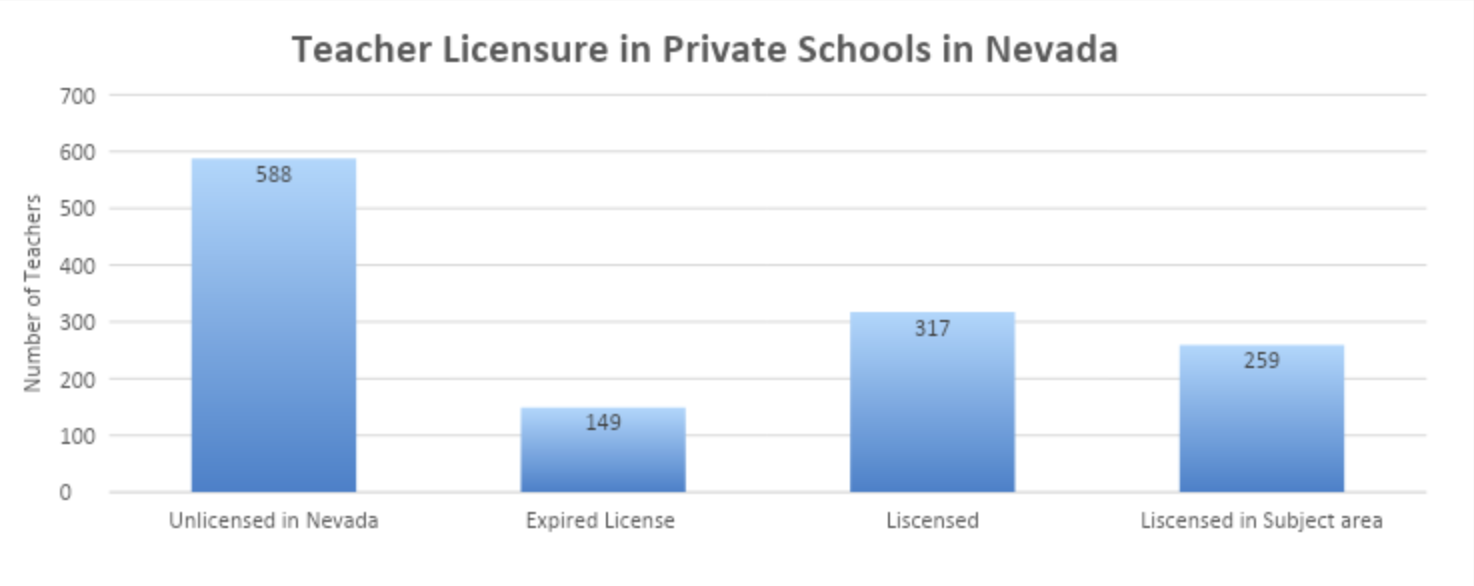
Lack of accountability in voucher programs has continued to raise red flags. Nevada private schools have no requirement that their teachers be licensed. An analysis by ENN found that of the schools that made the information available, less than 50 percent of teachers were ever credentialed in the state of Nevada, while some schools had no staff with Nevada licenses.

A look at the number of teachers who are licensed at private schools that have Opportunity Scholarship students enrolled. **This chart only includes data from schools who make staff information publicly available. Numbers exclude theology teachers and support staff.**

And the overwhelming lack of accountability – uniform testing, treatment of students with unique needs (private schools are less likely to accept students with an IEP), anti-discrimination, and other issues closely monitored in our public schools – means poor outcomes and underqualified staff may only be the tip of the iceberg.  North Carolina, for example, is grappling with testing issues, discrimination against LGBTQ students, and questionable academic content (with one popular textbook claiming the KKK was fighting to protect morality and slaves were treated well by their slave owners). One can argue that teacher quality, curriculum, or treatment of students is the prerogative of these schools because they are private, but if private schools are now operating using public taxpayer dollars, we must demand more.

Ultimately efforts would be better spent advocating for increased dollars for our public schools to ensure all our students have access to a quality education regardless of religion, sexual preference, gender, race or income.


To learn more about national efforts to fight private school vouchers, check out the new Public Funds Public Schools campaign supported by Education Law Center, Southern Poverty Law Center and the SPLC Action Fund.


About Educate Nevada Now
The Rogers Foundation, a Nevada leader in support of public education, joined with local, state and national partners to launch Educate Nevada Now (ENN) in 2015. The organization is committed to school finance reform and improved educational opportunities and outcomes for all Nevada public school children, especially English language learners, gifted and talented students, students with disabilities or other special needs, and low-income students.

More information about ENN can be found at www.educatenevadanow.com
###

Politico Education reports that Secretary Betsy DeVos and her political appointees are fanning out across the country to promote charters, vouchers, and educational “freedom” from public schools. She will be in Indiana and Ohio, which already have vouchers and charters, most of which are low-performing.

Under DeVos, the official  mission of the U.S. Department of Education is to destroy and privatize public schools.


DEVOS HEADS TO INDIANA, OHIO: The Education secretary begins Day 2 of the Trump administration’s “back to school” tour with stops in Indiana and Ohio today.

— DeVos will visit Purdue Polytechnic High School, a public charter school in Indianapolis, in the morning where she’ll meet with students and faculty and tour STEM classes, according to the department. The administration said the school is a good example of an approach to education that breaks down the silos among K-12 and higher education and businesses.

— In the afternoon, DeVos will head to Cleveland. She’ll tour the Great Lakes Science Center and a specialized high school, MC2STEM High School, which is part of the Cleveland Metropolitan School District. DeVos will then visit EDWINS Leadership and Restaurant Institute, “where formerly incarcerated individuals are given the tools they need to transition home, including the opportunity to learn a skilled and in-demand trade in the culinary arts,” the department said.

— Several other top Education Department officials are also fanning out across the country today as part of the administration’s nationwide tour to promote its “rethink school” agenda.

— Deputy Education Secretary Mick Zais will be in Montana. He’ll tour schools and meet with officials in Pryor and Billings along with Montana Superintendent of Public Instruction Elsie Arntzen.

— Johnny Collett, assistant secretary for special education and rehabilitative services, will head to Missouri. He’ll tour an elementary school in Belton and meet with students and faculty at the University of Missouri-Kansas City.

— Scott Stump, the assistant secretary for career, technical, and adult education, will be in New Mexico. He’ll tour a high school in Albuquerque in the morning and Santa Fe Community College in the afternoon.