NORTH CAROLINA — A dead vulture hangs by its feet, tied to a street sign on Chesters Road in Sampson County.
It’s there because locals believe the decomposing scavenger will deter other vultures. Sometimes, especially in the summer, the carrion birds descend like a plague on the Snow Hill area of Sampson County, a predominantly Black community that’s within retching distance of the largest landfill in NC. When it’s hot and humid in the summer, the vultures are so thick that the trees look black.
The birds are the least of locals’ worries.
The 85-acre landfill smells like hell. It gets in your lungs and steals your breath. On a bright, clear day, it can give you a headache and make you nauseous. When it’s hot, humid, or rainy, the smell is overwhelming.
Worse still, the landfill—which ranks second in the nation for emissions of the greenhouse gas methane—is contaminated with PFAS. PFAS are synthetic compounds used in nonstick pans, firefighter foam, cosmetics, and other products. It’s linked to cancers, birth abnormalities, high cholesterol and other ailments, but until this year, the US Environmental Protection Agency was silent on regulating it.
In March, EPA Administrator Michael Regan, who’s from NC, called it “one of the most pressing environmental and public health concerns in the modern world.”
The federal regulations, which wouldn’t go into effect until 2026, are late but not unwelcome. Testing in almost 50 water systems in NC has reportedly found high levels of PFAS over the last five years. That’s the case in about 45% of the nation’s drinking water, according to federal regulators. It attacks your thyroid, your liver, and your kidneys. And it’s an open question what treatment systems are best for filtering out this “forever chemical,” so named because it doesn’t break down in the human body or the environment.
PFAS pollution is just one of the crises here. Sampson County—population 58,000— is beset by environmental nightmares, locals say. There’s the landfill, the poultry and pork farms (including the massive Chinese-owned Smithfield Foods plant), and multiple industrial operations that locals say are noisy, ugly, and making them sick.
There are a few dozen hogs per person. To dispose of the waste, farms have been spraying it onto fields. Neighbors say it’s giving them respiratory problems. There’s science behind it, including studies from 2018 and 2022 that found people living close to animal farming operations are more likely to get sick, sometimes very sick.
A small UNC-Chapel Hill study published in 2020also found PFAS in surface water around the landfill.
The well water that thousands of people here depend on—particularly in the poorer, rural areas—is making them sick too, locals say. But unlike other areas of the county, which have gradually been connected to the county water system, most of the low-income folks have been left to protect themselves against rust, iron, arsenic, and other harmful things that are turning up in their well water.
Michigan has Flint. North Carolina has a lot of Flints, and the biggest might be Sampson County.
‘You can’t win for losing’
“We have a story to tell in Sampson County and nobody’s paying any attention to us,” says Sherri White-Williamson.
White-Williamson is a native of the area, the daughter of two high school teachers—one a World War II veteran who taught her to get involved in her community. She worked for the EPA and other federal offices before returning to Sampson County. Now, she leads a local nonprofit called Environmental Justice Community Action Network (EJCAN). She has her work cut out for her.
EJCAN is helping state officials find locals in the Snow Hill area—not to be confused with the incorporated town of the same name in nearby Greene County—who could benefit from a $1 million grant from President Biden’s administration. The grant’s meant to test the well water and, possibly, help find a solution. If anything, it’s just a start.
Testing in this broad, eastern NC county has been slow. State officials are looking for volunteers. They’ve gone door-to-door. But many don’t trust the scientists and regulators showing up. They also don’t trust what comes out of their taps. If they have the money, which many of them don’t, they rely on bottled water.
The NC Department of Environmental Quality (DEQ) and researchers have confirmed PFAS contamination in the area, although state regulators have not made a final determination on the source. Most are pointing at the privately-operated landfill, which is known to have PFAS in it. For now, the state’s administering bottled water to homeowners with polluted water, although PFAS contaminants aren’t just harmful in drinking water. They can also travel through the air.
Then there are the pigs. Smithfield Foods and other hog farms make up a powerful economic force around here. Pork accounts for more than 6,100 jobsin Sampson County and Smithfield is the largest single employer in the county.
The people who live next to hog farms might be miserable, but the political pull of pork is immense. When locals began winning huge multi-million dollar jury awards from hog farmers working for Chinese-owned Smithfield, Republican state legislators intervened on the farmers’ behalf, rewriting statutes to all but ban such lawsuits.
“You can’t win for losing,” White-Williamson says when talking about the state legislature.
Please open the link and keep reading to finish the post.
The news media keep a set of stock headlines at the ready whenever national or international test scores are posted: SCORES DECLINE! U.S. STUDENTS FAILING! A SPUTNIK MOMENT! OUR SCHOOLS ARE FAILING!
All these cries of “failure” feed the phony narrative of the privatization movement. Organizations funded by rightwing billionaires promote the idea that students will get higher scores in charters or voucher schools (we now know that this claim is not true, that charter schools are no better (and often worse) than public schools, and that vouchers subsidize wealthy families and do not save poor kids.
It is a fact that U.S. students have never performed well on international tests, as I explained in my book REIGN OF ERROR. Since the 1960s, when the first international tests were administered, our scores on these tests were mediocre to awful. Nonetheless, our economy has outperformed nations whose students got higher scores decades ago.
Now for the good news.
The latest international test scores were released a few days ago, and scores went down everywhere due to the pandemic. David Wallace-Wells, an opinion writer for The New York Times, reported that even with dropping scores, U.S. students outperformed the rest of the world!
He writes:
By now, you’ve probably registered the alarm that pandemic learning loss has produced a “lost generation” of American students.
This self-lacerating story has formed the heart of an indictment of American school policies during the pandemic, increasingly cited by critics of the country’s mitigation policies as the clearest example of pandemic overreach.
But we keep getting more data about American student performance over the last few years, and the top lines suggest a pretty modestsetback, even compared to how well the country’s students performed, in recent years, in the absence of any pandemic disruption.
Now, for the first time, we have good international data and can compare American students’ performance with students’ in peer countries that, in many cases, made different choices about whether and when to close schools and whether and when to open them.
This data comes from the Program for International Student Assessment, coordinated by the Organization for Economic Cooperation and Development in almost 80 countries typically every three years — a long-running, unimpeachable, nearly global standardized test measure of student achievement among the world’s 15-year-olds in math, reading and science.
And what it shows is quite eye-opening. American students improved their standing among their international peers in all three areas during the pandemic, the data says. Some countries did better than the United States, and the American results do show some areas of concern. But U.S. school policies do not seem to have pushed American kids into their own academic black hole. In fact, Americans did better in relation to their peers in the aftermath of school closures than they did before the pandemic.
The performance looks even stronger once you get into the weeds a bit. In reading, the average U.S. score dropped just one point from 505 in 2018 to just 504 in 2022. Across the rest of the O.E.C.D., the average loss was 11 times as large. In Germany, which looked early in the pandemic to have mounted an enviable good-government response, the average reading score fell 18 points; in Britain, the country most often compared with the United States, it fell 10 points. In Iceland, which had, by many metrics, the best pandemic performance in Europe, it fell 38 points. In Sweden, the darling of mitigation skeptics, it fell 19 points.
In science, the United States lost three points, about the same decline as the O.E.C.D. average and still above the level Americans reached in 2016 and 2013. On the same test, German students lost 11 points, and British and Swedish students dropped five; performance by students in Iceland fell by 28 points.
In math, the United States had a more significant and worrying drop: 13 points. But across the other nations of the O.E.C.D., the average decline from 2018 to 2022 was still larger: 16 points. And in historical context, even the 13-point American drop is not that remarkable — just two points larger than the drop the country experienced between the 2012 and 2015 math tests, suggesting that longer-term trajectories in math may be more concerning than the short-term pandemic setback. Break the scores out to see the trajectories for higher-performing and lower-performing subgroups, and you can hardly see the impact of the pandemic at all.
Of course, the Program for International Student Assessment is just one test, with all the limitations of any standardized measure. It is not good news, in general, if the world is struggling academically. And none of this is an argument for American educational excellence or never-ending remote learning or a claim there was no impact from closures on American kids or a suggestion that the country’s schools should have stayed closed as long as they did.
It is simply a call to assess the legacy of those closures in the proper context: a pandemic that killed 25 million people globally and more than a million in the United States and brought more than a billion children around the world home from school in 2020. In the 18 months that followed, American schools were not choosing between universal closures and an experience entirely undisturbed by Covid-19. They were choosing different ways of navigating the pandemic landscape, as was every other school system in the world. A good first test of whether the country bungled school closures is probably whether peer countries, in general, did better. The test scores imply that they didn’t.
So why do we keep telling ourselves the self-lacerating story of our pandemic educational failure?
One reason could be that while some state-level testing data shows no correlation between school closures and learning loss, some analysis of district-level data has shown a closer correlation. But this suggests that learning loss is not a national problem but a narrower one, requiring a narrower response.
Another is that testing is blind to other markers of well-being. Chronic absenteeism, for instance, is up significantly since before the pandemic and may prove a far more lasting and concerning legacy of school closure than learning loss. And the American Academy of Pediatrics declared a national mental health emergency — language that has been echoed by the American Medical Association.
But while American teenagers have reported higher levels of emotional distress in several high-profile surveys, here, too, the details yield a subtler picture. In the first year of the pandemic, according to a study supported by the National Institute of Mental Health, 17 percent fewer American teens made mental-health visits to emergency rooms than in the year before; in the second year, they made nearly 7 percent more. According to the Centers for Disease Control and Prevention, the proportion of teenage girls reporting persistent feelings of hopelessness and sadness rose from 47 percent in 2019 to 57 percent in 2021 — a concerning rise, though only slightly larger than the six-point increase from 2017 to 2019. The number of male teens reporting the same barely grew, from 27 percent to 29 percent, having risen much faster from 2017 to 2019.
Each of these data points should probably be understood in the context of mental health surveys of older Americans, such as the General Social Survey, which found that the percentage of American adults describing themselves as “very happy” fell from 31 percent in 2018 to 19 percent in 2021 and those describing themselves as “not too happy” nearly doubled to 24 percent. It is hard to disentangle the effects of school closure here from the experience of simply living through an anxious and disruptive time. To judge by the bleakest standard, youth suicide declined during the period of school closure and returned to prepandemic levels only after schools reopened.
Overall, American adults lost some confidence in the country’s school system in those years, with national approval dropping from 50 percent to 42 percent. But the drop is not from current parents of kids in school, whose approval rose throughout the pandemic, according to Gallup, from 72 percent in 2020 to 73 percent in 2021 to 80 percent in 2022. (Other recent surveys, including ones from Pew and The Times, have found similar postpandemic parental approval, between 77 percent and 90 percent.) Instead, as Matt Barnum suggested on ChalkBeat, the decline has been driven by the perspective of people without kids in those schools today — by childless adults and those who’ve opted out of the public school system for a variety of personal and ideological reasons. [Ed.: bold added]
Could we have done better? Surely. We might have done more to open all American schools in the fall of 2020 and to make doing so safe enough — through frequent pooled and rapid testing, more outdoor learning and better indoor ventilation, among other measures — to reassure parents, 71 percent of whom said that summer that in-person school was a large or moderate risk to their children and a majority of whom said that schools should remain closed until there was no Covid risk at all. We could have provided more educational and emotional support through the darkest troughs of the pandemic and probably been clearer, throughout the pandemic, that the risk of serious illness to individual kids was relatively low.
But we could do better now, too, by sidestepping pandemic blame games that require us both to exaggerate the effect of school closures on educational achievement and the degree to which policymakers, rather than the pandemic, were responsible.
No wonder Jeb Bush wrote an opinion article defending his so-called reforms, especially high-stakes standardized testing.
The Republican-controlled Legislature is moving to dismantle the structure that Bush created when he was governor. Some legislators wanted to cancel recess but the outcry from parents made them drop that idea.
The Florida Senate backed away Tuesday from plans to end the state’s recess requirement after objections from “recess moms” but moved ahead with proposals to scrap key, and controversial, parts of the Republican education agenda.
The Senate’s fiscal policy committee agreed by an 18-0 vote to end policies ushered in by former Gov. Jeb Bush more than 20 years ago. Those include requirements that high school students pass two exams to graduate and that third graders pass a reading test to move on to fourth grade.
Under the bill approved by the GOP-dominated committee, students would no longer have to pass an Algebra 1 and a language arts exam to earn high school diplomas. But the 10th-grade language arts exam would count as 30% of a student’s final grade in 10th-grade English classes, just as the algebra exam already counts as 30% of the final grade in Algebra 1 classes.
The bill also would allow third graders who failed the state reading test to be promoted to fourth grade, if that is what their parents thought was best.
Jeb Bush’s allies objected to the changes and said they would water down standards. It’s not yet clear whether DeSantis will go along. Moms for Liberty also objected.
But Republicans in the Senate have pushed and supported the measures, and two committees have now approved them.
Senate President Senate President Kathleen Passidomo introduced the proposals in a memo she sent to senators last month that was titled “Learn Local – Cutting Red Tape, Supporting Neighborhood Public Schools.”
The idea, she said, was that after the Legislature expanded school choice (HB 1) earlier this year, making many more children eligible for private school scholarships, it should look in its 2024 session to remove regulations on public schools, which serve the bulk of the state’s students.
In the memo, she called the ideas “bold,” “controversial” and, she conceded, ones that might “not make it across the finish line.”
Many of the Senate’s suggestions have broad support from school superintendents, administrators, teachers and parents.
Representatives from the Broward, Orange and Seminole county school districts all showed their support Tuesday, for example.
Simon noted that Florida’s new standardized test, FAST, is a “progress-monitoring” exam given several times a year starting in pre-Kindergarten. “We’re able to find those students much earlier on in the process,” he said, making the current third-grade rule unnecessary.
The Washington Post identifies a serious problem with home schooling: No one is monitoring the well-being of children. In public schools, teachers and staff are designated reporters of children’s physical health; if they see signs of abuse, they are legally bound to report it to authorities. In home schooling, child abuse may be hidden. Read this horrifying story and bear in mind that some states are paying parents to keep their children home instead of sending them to school.
His family had searched, taping hand-drawn “missing” posters to telephone poles and driving the streets calling out the 11-year-olds name. So had many of his neighbors, their flashlights sweeping over the sidewalks as the winter darkness settled on the Sierra Nevada foothills.
The police were searching, too, and nowthey had returned to the place where Roman had gone missing earlier that day: his family’s rented home in Placerville, Calif. Roman’s stepmother, Lindsay Piper, hesitated when officers showed up at her door the night of Jan. 11, 2020, asking to comb the house again. But she had told them that Roman liked to hide in odd places — even the clothes dryer — and agreed to let them in.
Brock Garvin, Roman’s 15-year-old stepbrother, was sitting in the dimly lit basement when police came downstairs shortly after 10:30 p.m. He ignored them, he said later, watching “Supernatural” on television as three officers began inspecting the black-and-yellow Home Depot storage bins stacked along the back wall.
Brock had no idea what had happened to Roman. But he did know something the police did not: Much of what his mother had said to them that day was a lie.
When she reported Roman’s disappearance, Piper told the police she was home schooling the eight kids in her household. This was technically true. It was also a ruse.
Most schoolshave teachers, principals, guidance counselors — professionals trained to recognize the unexplained bruises or erratic behaviors that may point to an abusive parent. Home education was an easy way to avoid the scrutiny of such people. That was the case for Piper, whose children were learning less from her about math and history than they were about violence, cruelty and neglect.
Left to their own devices while she lay in bed watching TV crime procedurals, and her husband, Jordan, worked long hours as a utility lineman, their days and nights passed in a penumbral blur of video games, microwave dinners and fistfights. Almost nothing resembling education took place,her sons said. But there was a shared project in which she diligently led her children: the torture of their stepbrother, Roman.
Roman had been a loving, extroverted 7-year-old who obsessed over dinosaurs when Piper came into his life, a mama’s boy perpetually in search of a mother as Jordan, his father, cycled from one broken relationship to the next.
On the day he was reported missing, he was a sixth-graderwho weighed only 42 pounds. He had been locked in closets, whipped with extension cords and bound with zip ties, according to police reports and interviews with family members who witnessed his treatment. Unwilling to give him even short breaks from his isolation, Piper kept him in diapers.
The Washington Post reconstructed Piper’s torment of her stepson from hundreds of pages of previously undisclosed law enforcement records, as well as interviews with two of her four biological children, other relatives, friends of the family, neighbors and police officers.
Piper, 41, who is in prison, did not respond to two letters requesting comment for this story. Her former public defender did not return calls or emails. Jordan Piper, 38, also in prison, declined a request to comment through his attorney.
Little research exists on the links between home schooling and child abuse. The few studies conducted in recent years have not shown that home-schooled children are at significantly greater risk of mistreatment than those who attend public, private or charter schools.
But the research also suggests that when abuse does occur in home-school families, it can escalate into especially severe forms — and that some parents exploit lax home education laws to avoid contact with social service agencies.
In 2014, a group of pediatricians published a study of more than two dozen tortured children treated at medical centers in Virginia, Texas, Wisconsin, Utah and Washington. Among the 17 victims old enough to attend school, eight were home-schooled.
After a home-schooling mother killed her autistic teenager, government analysts in Connecticut gathered data from six school districts over three years. Their report, released in 2018 by the state’s Office of the Child Advocate, found that 138 of the 380 students withdrawn from public schools for home education during that period lived in households with at least one prior complaint of suspected abuse or neglect.
Child-welfare advocates have long pushed fora minimal level of oversight for home-schooled students — calls that have grown more urgent as home schooling has exploded, becoming the country’s fastest growing form of education.But home-school parents, arguing that serious episodes of abuse are rare, have fiercely resisted. And nowhere have their efforts been more successful than in the state where Roman and his siblings spent most of their lives: Michigan.
Michigan is one of 11 states in which parents are not even required to tell anyone they are home schooling, let alone demonstrate they are teaching their children anything. Its lack of regulation, the result of a 1993 state Supreme Court decision still celebrated by home-school advocates, has repeatedly concealed the actions of abusive parents like Piper.
“She told people we were home-schooled, but we weren’t,” Carson Garvin, one of Roman’s stepbrothers, now 16, later wrote in a victim impact statement. “Now I can see it wasn’t for us that she made this decision. It was to protect herself from the school counselors and staff. I believe that if we had went to school that someone would have had a feeling that something was off and that she would have been reported at some point.”
Despite what Piper told the police, Roman had never really liked hiding. The truth was that he had been hidden. And home schooling is what allowed her to hide him.
As Brock Garvin sat in the basement watching TV on the night of Roman’s disappearance, listening to the police officers banter as they opened the Tough Storage Tote bins, he was in a fog. He had been up all night playing “Dark Souls” on his Xbox, and was upset that he hadn’t been allowed to sleep for most of the day, as he usually did.
He was also jarred by the entrance of unknown grown-ups into the house. The family had moved to California from Michigan just a few months earlier. Long isolated, they were now strangers to everyone around them.
But Brock wasn’t worried about Roman. If his stepbrother had run away, whatever he found could hardly be worse than what he had escaped.
Then the lid on one last bin snapped open, and the officers’ laughter stopped.
Even in his benumbed state Brock felt something strange pass through the room, as if the air pressure had suddenly dropped. It was quiet for a moment, then the police began pulling on latex gloves.
‘I’ll behave’
Romanloved beingalive. It was a strange thing to say about an infant, but that was Jennifer Morasco’s first impression of the sunny 5-month-old boy who would become her stepson when she married Jordan Piper in 2010.
“He’d be teething, but he wouldn’t cry,” recalled Morasco, now 41. “He was just so happy to be in existence, and loved being around people and doing stuff with everyone.”
Roman’s mother, Rochelle Lopez, was a soldier who deployed to Iraq when he was 14 months old. After returning, she struggled with heart problems, anxiety and addiction to pain medication, according to police records. Lopez, who died in 2021 at age 34, fought with Jordan in court for years over custody of Roman.
But none of that seemed to weigh on the boy that Morasco largely raised until he was about 4 years old. Morasco still remembers the lyrics to “Life is a Highway,” a song from Roman’s favorite movie, “Cars,” that he sang over and over. Another favorite was “Rainbow Connection,” the banjo-accompanied Muppet ode to life’s unfulfilled promises.
“He thought he was Kermit the Frog, essentially,” Morasco said.
Even after Morasco left Jordan Piper, she kept in touch with Roman, calling every year on his birthday. But in 2016, Jordan wasn’t picking up his phone, so she tried sending a Facebook message to Roman’s new stepmom, asking her to tell him “he is loved all the way to the moon and back.”
Lindsay Piper reacted harshly, warning Morasco not to contact her again and boasting that Roman “has excelled in ways I can’t begin to explain.”
Piper herself had barely graduated high school, according to her sister, Chanel Campbell. Her interest was never in academics; it was in babies. It wasn’t an unusual fixation for a young girl, but there was something off-kilter about the intensity that Lindsay brought to her aspirations of motherhood, her sister said.
“She carried a baby doll around with her until she was, like, 12,” said Campbell, who was raised with her sister in and around Flint. “She just had this fascination with baby dolls and dressing them up and changing them and putting them in diapers.” This treatment extended to the family’s miniature schnauzer, which Lindsay forced into footed pajamas.
By the time she married Jordan Piper, Lindsay had four children of her own. Their father, Marcus Garvin, was an infantryman in the Army and Army National Guard. He returned from his service in Iraq to years of marital turmoil with Lindsay, who eventually gained full custody of their children. After marrying Jordan, she became the parent of a fifth: her stepson, Roman.
In Piper’s frequent Facebook posts, they were a happily blended family, all beaming smiles and matching flannel shirts. But Campbell knew this image was no more real than the dolls her sister had once carried around. At family gatherings, Piper’s children tended to run wild, and she responded in disturbing ways: pinching them, or biting them on their forearms. When Campbell protested, she said, her sister would storm off.
Reached by phone, Piper’s mother, the guardian of Carson’s twin brother, initially said she would consider speaking to The Post but did not respond to subsequent calls or text messages. Piper’s eldest daughter, now 21, did not respond to repeated requests for comment.
Shortly after her marriage to Jordan, Piper started to complain about her boys’ experience at their elementary school.
“She said, ‘I’m just going to home-school them. I’m tired of the teachers singling them out. I’m tired of everyone picking on them,’” Campbell recalled. “I thought to myself, ‘You’re definitely right. We’ve got a problem here. But home schooling isn’t going to be the answer to it.’”
Between late 2016 and the summer of 2017, Piper withdrew the children from school, Brock and Carson said. With the exception of a few brief interludes when they were sent back for days or weeks, they would not regularly attend school again for the next five years.
At first, they sporadically logged on to an online learning program, Brock and Carson recalled. Then any pretense of education was dropped.
Piper spent the day watching “Criminal Minds” and “Law & Order,” her sons said, and in the evenings, when Jordan returned from work, the couple would sit around drinking Jack Daniels.
By this time, the family had moved to Gaines, a tiny town amid soybean fields about 20 miles southwest of Flint. At midday, the sound of children at recess echoed past their house from the elementary school three blocks away. But for Piper’s kids, the high-pitched laughter and shouting might as well have come from another planet.
“My world got very, very small,” recalled Brock, who was then 12. “I wouldn’t see the sun or moon. I would just be in my room 24/7.” He at least had his Xbox; Carson had his twin brother. Roman had nothing and nobody, because the things thatmade him human were methodically stripped away.
It happened slowly, his stepbrothers said. Early on, when the boys scuffled, Piper blamed Roman, the one to whom she had not given birth, punishing him with lengthy timeouts. Then she began locking the door to his room. Then she began covering his window with a blanket.
“He would sit in the dark on his bed all day. And she would have us, like, scratch on the walls and make creepy noises so he’d think there’s demons trying to kill him,” said Brock, who expressed deep regret about participating. “He’d sit there and scream, like, ‘Stop it, please’ or ‘I’ll behave’ … that was his life.”
Soon there was no disciplinary pretext for the harm inflicted on Roman, Carson and Brock said. It was simply what the family did. Piper ordered her sons to join in when she whipped him with phone charger cords. Roman began trying to escape, so she tied him down. She took away his clothes. Most of her kids were overweight, but Roman was put on something worse than a starvation diet.
“She would feed him oatmeal with huge amounts of salt in it,” Carson said. “He puked it up, so he wouldn’t have to keep eating it. And she would make him eat his puke.”
Campbell suspected there was something badly wrong inside her sister’s house. She said that after seeing bruises on Roman’s face at a Christmas get-together in 2016, she called child protective services.
She made two follow-up calls, she said, but could never determine whether any action was taken. Police later said they found no records of CPS investigations into Piper’s treatment of Roman. A spokesman for the Michigan Department of Health and Human Services — which oversees such investigations — declined to comment, citing the confidentiality of child-welfare cases.
Roman kept appearing in Piper’s Facebook photos, increasingly wraithlike beside his grinning siblings.
“He was just lifeless, just sad. You could just see it in his face, aside from the puffy eyes and the bruising on his forehead,” Campbell said. “The love had been sucked out of him.”
It seemed unimaginable that a child could fall so completely through the safety net because a parent like Piper decided to home-school. But in Michigan, it had happened before.
‘A shield for child abuse’
About two years before Roman was withdrawn from school, an eviction crew entered Mitchelle Blair’s Detroit apartment on March 24, 2015. The 35-year-old mother of four wasn’t home, so they began removing her furniture. But their work came to an abrupt halt when they opened a deep freezer in the living room: inside were the bodies of two children.
Stoni Blair and Stephen Berry — estimated to have been ages 13 and 9 when their mother killed them — had been pulled out of Detroit public schools with their siblings two years earlier. During Blair’s conviction and sentencing to life in prison for first-degree murder, it emerged that she had burned her children with scalding water and beaten them with wooden planks.
She also claimed to be home-schooling them.
Stephanie Chang, then a freshman Democratic state representative whose district included the site of the murders, was horrified by the case. She was also alarmed by what she perceived as a yawning gap in the state’s child protection system.
It wasn’t just Stoni and Stephen. Seven years earlier, there had been Calista Springer, a home-schooled 16-year-old who died in a house fire in Centreville, Mich., unable to free herself from a choke chain her parents used to tie her to her bed. Marsha and Anthony Springer were convicted of torture and child abuse and sentenced to lengthy prison sentences.
Chang understood such cases didn’t represent most children’s home-schooling experiences. But she also believed abusive parents were taking advantage of Michigan’s absence of any notification or monitoring requirements for home educators, with devastating consequences.
“There are so many amazing home-school parents who I have so much respect for. But when people use home schooling as a shield for child abuse, that’s not acceptable,” said Chang, now a state senator. “That lack of a notification requirement creates an environment where parents can basically just do whatever they want.”
It is a concern that extends beyond Michigan, and that pediatricians share with politicians….
A month after Mitchelle Blair’s children were discovered dead in Detroit, Chang introduced a bill requiring that parents notify their local school district of a decision to home-school and that home-schooled children meet at least twice a year with a mandated child abuse reporter, such as a teacher, doctor or psychologist.
“It’s such a common-sense thing, in my view,” Chang said.
The state board of education in Michigan endorsed the legislation. But the possibility of any oversight infuriated home-schoolers, and they organized to defeat Chang’s modest proposal.
The story goes on to explain that Roman died of salt poisoning. He was 11, but weighed the same as a six-year-old.
When the older boys were returned to their biological father in Michigan, who had not seen them for years, he insisted on sending them to public school.
His parents were arrested and jailed in California for second degree murder. The mother has been sentenced to a term of 15 years to life. Roman’s father awaits sentencing.
In the face of such horrifying stories, it is incomprehensible that state officials do not pass laws to regulate home schooling: first, to check in the health of the children, and second, to determine whether they are learning anything. A parent with several children, like the one in this story, could collect almost $60,000 a year from the state in Florida or in other states where vouchers go to unregulated home schooling parents.
Last spring, a television station in Nashville reviewed state data and discovered that 80% of the state’s charter schools are “less successful” than the districts they allegedly serve. In other sectors, when a new idea is tried and fails, it is abandoned. But this is not likely in education, because someone is making money from failure. Among the state’s lowest performing charter schools were those in the “Achievement School District,” which was created with $100 million on Race to the Top funding, promising to taise the state’s lowest performing schools into the top 25% in the state.
NASHVILLE, Tenn. (WTVF) — About 80% of the taxpayer-financed, privately operated charter schools in Tennessee have a lower success rate than the districts where they are located, according to a NewsChannel 5 analysis of state data.
Out of 109 charter schools for which data was available for the 2021-2022 school year, 87 had success rates below the rates reported for other schools in the same geographic district — in many cases, much lower. More than a third of the charter schools, a total of 38, reported success rates of 10% or less; 10 of those had success rates below 5%.
Only 21 charter schools reported higher success rates, while comparisons were difficult for one school because of the way that the state reports the data.
The data also raises questions about how well the privately operated charter schools are meeting the needs of children with disabilities, with two-thirds reporting that they had so few students that they were not required to report success rates for those children.
Tennessee’s Department of Education calculates the one-year success rate based on the percentage of students in grades 3-5 whose scores on state assessments “met expectations or exceeded expectations” for math and English Language Arts.
Success rates are now at the center of Tennessee’s education policy under a new law set to require the retention of third graders who don’t meet ELA expectations.
In the larger debate, the data appears to run counter to some ideological arguments — mainly from the right, but sometimes from the left —that taxpayer-funded charter schools are a critical response to low-performing traditional public schools, with much of the focus often directed at the potential of charter schools to meet the needs of children of color.
Charter school advocates largely focus on metrics regarding “student growth,” a complex calculation used to argue that students in those schools statistically tend to learn more statistically than their peers in traditional public schools.
Brick Church is 70% economically disadvantaged, and more than 95% of students are children of color.
The traditional public school was taken over by the state and converted to a charter school under the Achievement School District in 2012 as part of an ambitious notion that the state could take schools in the bottom 5% and turn them into top performers within five years.
In fact, data shows that Tennessee’s Achievement School District has largely failed in that goal, producing some of the worst results of any district.
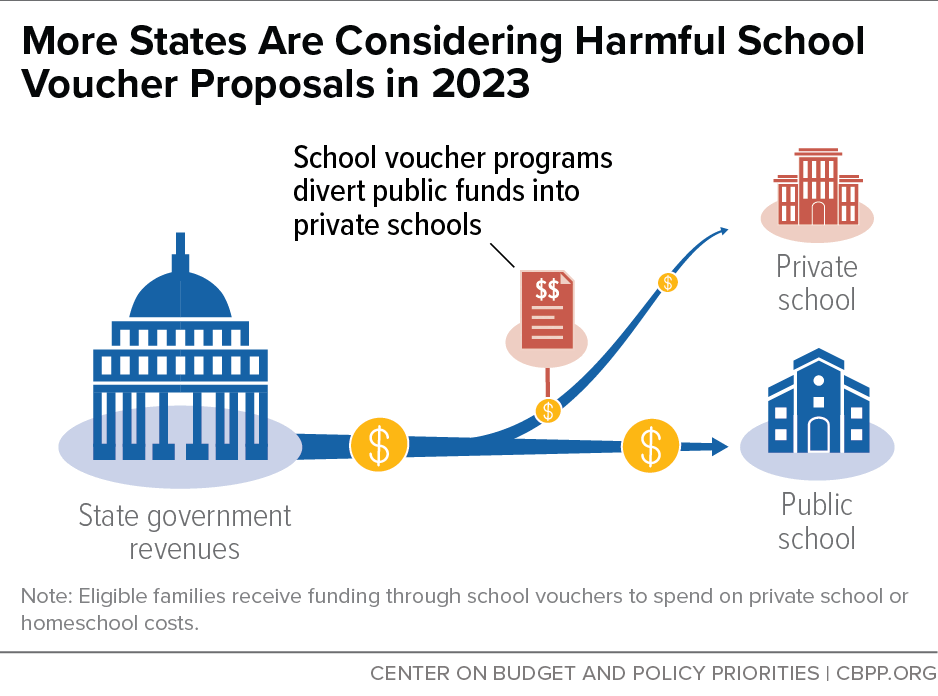
The Center for Budget and Policy Priorities in D.C. issues reports on high-profile issues. This one should be in the hands of every legislator, school board member, and policymaker. It succinctly explains why states should not authorize vouchers.
Iris Hinh and Whitney Tucker wrote this report, which was published in June 2023. One conclusion is clear: vouchers inflict damage on public schools, attended by the vast majority of children, while helping affluent families. .
Hinh and Tucker write:
K-12 school vouchers are typically funded through state revenues and give families a set amount of money per eligible student to cover a portion of private school tuition. These vouchers divert money away from public schools, sometimes by directly re-routing education funding to private schools, and other times indirectly by making it harder to pay teachers, buy new textbooks, and provide quality after-school programming. The support for public schools is high: families overwhelmingly support their schools, and many teachers and other advocates for public education oppose vouchers.[1]
Regardless of whether school vouchers directly or indirectly divert funding from public schools to private education, state K-12 funding formulas depend on some metric of student count to allocate per-pupil funding. Some school districts can absorb some of the cuts with layoffs and reduced spending on textbooks and supplies. But fixed expenses such as air conditioning, school buses, and building maintenance can lead to funding shortfalls and layoffs.
In early 2023, these states created or expanded their school voucher policies:
Nebraska passed the state’s first voucher program, a K-12 tuition tax credit initially capped at $25 million annually, though the cap could rise to $100 million a year depending on demand for tax credits. Individuals and businesses can donate up to half of their taxes owed (with a maximum of $100,000); donations are funneled to scholarship granting organizations (SGOs), which pay private school tuition and other eligible expenses on behalf of students and their families. The tax credits reduce tax liability and thus, decrease the state revenues available for investments in public services, including public schools. Public school advocates are planning to challenge the bill on the 2024 ballot.
Arkansas’ LEARNS Act created, among other harmful policies for public education and teachers, an education savings account (ESA) program, which will phase in universal eligibility by the 2025-2026 school year and provide state-funded vouchers for families to use toward private school tuition and several other allowable expenses (like homeschooling, exam fees, and tutoring).
Florida broadened eligibility requirements to make its existing ESA program available to all students (rather than only students with disabilities or those from low-income families), with an estimated cost of $4 billion in the first year of implementation.
Iowa created an ESA that is initially targeted to families with lower incomes. But it will expand over time to include all students by the 2025-2026 school year and cost over $340 million per year when fully in effect.
South Carolina expanded the state ESA, lifting household income eligibility to 400 percent of the federal poverty level beginning in 2026-2027, but placing a 15,000-student cap on the program.
Utah created an ESA starting in the 2024-2025 school year that is available to all students but gives priority to students based on their household’s income.
Other states should not follow the paths of these states. For one, school vouchers primarily benefit wealthier students, families, and businesses.States with existing voucher programs — Arizona, Missouri, New Hampshire, and Wisconsin — have reported that most families who benefitted were already covering the costs of private schools and homeschooling prior to the voucher becoming available.
Wealthy people and companies also benefit when vouchers take the newer form of K-12 tuition tax credits. People and companies who donate to SGOs are allowed to opt out of paying tax to fund public needs and instead fund tuition scholarships at private K-12 schools. This tax incentive can provide state credits — up to 100 percent of the donation — to families with incomes over $200,000 and even allows businesses to profit from claiming federal expense deductions and avoiding capital gains tax.
Vouchers can also increase the likelihood that students experience discrimination and harm.Private schools are not required to offer the same federal civil rights protections for students as public schools. In fact, many voucher bills explicitly require families to waive students’ protections and rights under the federal Individuals with Disabilities Education Act for educational services that students with disabilities may need to learn.
Further, vouchers do not necessarily expand opportunities for students with the greatest needs. Students from families with low incomes often face barriers to navigating the voucher application and private school admission processes. Smaller, rural areas often rely on their local public schools as community hubs and primary sources of employment. Private schools can more easily push students out without recourse based on how they style their hair, what they wear, test scores, and subjective disciplinary action.
Voucher costs often grow beyond what is projected and thus, reduce overall revenues for other state spending. A recent study of school voucher programsin seven states shows how state voucher spending from 2008 to 2019 increased by hundreds of millions of dollars annually, while K-12 spending for public education declined despite public school enrollment increases. Arizona became the first state to implement a universal voucher program in 2022, and as of mid-March 2023, the ESA program is expected to cost the state at least $345 million more than initial projections for the first year. New Hampshire’s voucher program was estimated to cost $130,000 in 2021 and it now costs $14.7 million. And a few private schools in Iowa are already raising tuition only a few months after the new voucher program passed in January of this year.
Some state lawmakers understood the great cost at the expense of public services and stopped multiple school voucher bills this year. For example, 16 House Republicans broke with their party to defeat Georgia’s universal voucher proposal in the final hours of session. And Idaho Senate Republicans raised concerns about the long-term cost of a universal ESA bill, which also applied to subsequent voucher bills.
As some states continue to debate school vouchers during legislative sessions, state lawmakers should understand that their actions now and in the future will have large fiscal and harmful consequences for public education and student opportunities.
Another state that did NOT pass vouchers was Texas, even though Governor Greg Abbott called four special sessions of the legislature. Rural Republicans refused both bribes and threats and voted against vouchers because they wanted to protect their community schools.
Jeb Bush, a founding father of the corporate reform movement, was governor of Florida from 1999 to 2007. He implemented a regime of high-stakes standardized testing, third grade retention, school report cards, and choice. He vigorously championed charter schools and tried to change the state constitution to allow vouchers for religious schools. Now he is concerned that the legislature might undermine high-stakes testing, so he penned this opinion piece for the Orlando Sentinel bragging about the success of his test-and-punish regime.
Yes, Florida’s fourth-grade NAEP scores are high. But he does not acknowledge that the scores are high because Florida “retains” third-graders who don’t pass the reading test. Holding these kids back artificially inflated the fourth-grade scores. By eighth grade, Florida’s scores are at the national average. Nothing to boast about there. The moral of the story: retention raises test scores by removing from the testing pool the kids who were retained (flunked).
The other curious omission in this article is voucher schools. Jeb is a huge fan of vouchers but voucher schools don’t take any state tests. How does he explain this? He doesn’t.
He wrote:
For more than two decades, Florida has remained committed to educational excellence by ensuring that transparency, accountability and opportunity define our K-12 system. We’ve consistently pushed the envelope, transforming Florida into a national leader. This has not happened by accident.
When I took office, nearly half of Florida’s fourth graders had significant reading deficiencies. Similarly, half of Florida’s fourth graders were significantly below grade level in math. Only half of high school students graduated on time.
In partnership with state lawmakers, we championed the A+ Plan in 1999 based on core principles of high expectations, standardized measurement, a clear and achievable system of accountability, rewards and consequences for performance, effective teaching in the classroom and more choices for families to customize an education for each student.
Today, Florida’s fourth graders rank third in the nation for reading achievement and fourth in the nation for math achievement. Our high school graduation rate is approaching 90%.
This is why it’s concerning that some lawmakers now seem eager to throw out or water down key components of the policies that led our students from the back of the pack to top in the nation.
I understand the goal of the Florida Senate’s recently unveiled deregulation package (Senate bills 7000, 7002and 7004). Cutting red tape and removing outdated regulations is a worthwhile effort.
But this cannot come at the cost of our state and students taking a step backward.
Lawmakers have proposed watering down our third grade literacy policy, removing the backstop of retention and paving the way to reinstate social promotion. Requiring that students objectively demonstrate they are reading successfully before being promoted to fourth grade has been a core part of Florida’s comprehensive early literacy policy — one that research has consistently supported.
This is why it’s concerning that some lawmakers now seem eager to throw out or water down key components of the policies that led our students from the back of the pack to top in the nation.
I understand the goal of the Florida Senate’s recently unveiled deregulation package (Senate bills 7000, 7002and 7004). Cutting red tape and removing outdated regulations is a worthwhile effort.
But this cannot come at the cost of our state and students taking a step backward.
Lawmakers have proposed watering down our third grade literacy policy, removing the backstop of retention and paving the way to reinstate social promotion. Requiring that students objectively demonstrate they are reading successfully before being promoted to fourth grade has been a core part of Florida’s comprehensive early literacy policy — one that research has consistently supported.
Most parents believe their children are reading on grade level even when they are not. Florida’s retention policy raises expectations. We know there are grave later-life outcomes for struggling readers. Lowering expectations by watering down the retention requirement will not help students in third grade or beyond.
Moreover, abandoning the requirement that Florida students pass the tenth grade English Language Arts and Algebra I end-of-course assessments further reduces expectations and hampers Florida’s workforce development efforts. Removing this requirement may aid Florida’s graduation rates, but it will reduce the diploma to nothing more than a participation certificate.
If we expect less, we will get less. This cannot be the future we want for Florida.
Finally, part of the package would turn back recent gains for charter schools to be treated equitably alongside their traditional public school peers. The bill’s proposed changes would make it harder for charter schools to access vacant public school buildings and reduce the share of Title I funds made available to students attending charter schools. This is a step backward.
Maintaining Florida’s system of high expectations, clear accountability and robust choice is as important to our future as anything. We’ve spent two decades establishing, maintaining and building upon these ideals.
Now is not the time for lawmakers to get weak-kneed on policies that have played key roles in contributing to two decades of educational progress.
Jeb Bush was governor of Florida from 1999 to 2007. He is the founder and chair of ExcelinEd, ExcelinEd in Action and the Foundation for Florida’s Future.
The Network for Public Education reposted this excellent review of a book about vouchers. The review and the book summarize the findings about who benefits from vouchers and how they affect the public schools. The place to begin is with recognition of the handsomely funded propaganda campaign on behalf of vouchers. The promise was equity. The reality was inequity, diverting public funds to subsidize students who never attended public schools. Were vouchers intended as a scam or did they unexpectedly turn into one?
Jan Resseger looks at a new book edited by Kevin Weltner of the National Education Policy Center entitled The School Voucher Illusion. Reposted with permission.
The book is a collection of essays edited by Kevin Welner, Director of the Education Policy Center and professor at the University of Colorado; Gary Orfield, Director of the Civil Rights Project and professor at UCLA; and Luis Huerta, professor at Teachers College, Columbia University. Contributors include the editors as well as Derek Black, author of Schoolhouse Burning and professor at the University of South Carolina; Christopher Lubienski, author of The Public School Advantage and professor at Indiana University; Preston Green, professor at the University of Connecticut; and Suzanne Eckes and Julie Mead, professors at the University of Wisconsin, and many other scholars. The list includes academic experts on constitutional law, civil rights, public policy, and the social foundations of education.
In the final chapter, after 270 pages of data and theoretical exploration, Welner, Orfield, and Huerta contrast what the promoters of school privatization promise to the damage caused by the school voucher programs spreading across the states today: “If the real choice is not access to a superior, idealized school with an excellent faculty, but instead to a segregated religious school that is also struggling with concentrated poverty plus a weak and inexperienced teaching force, then vouchers are offering a fundamentally different experience than what’s been advertised.” (p. 276)
What about the diversion of states’ education budgets to private schools?
“What began in Cleveland and Milwaukee as small-scale pilots targeted to ‘save’ students of color from ‘failing public schools’… quickly transformed into a movement to give all students a taxpayer subsidy to incentivize them to leave their public schools and, then, into subsidies for students who were in private schools anyway—simply a transfer of money, usually to families without the financial exigency.” (p. 278)
Through the research reported by contributors to this book, the editors conclude that measuring the fiscal impact of transferring tax dollars to private schools is complicated due to all the ways: “vouchers interact with public budgets… Any measure of the immediate fiscal and educational efficiency of vouchers must… account for significant cost differentials compared to a comprehensive public school system… and must include measures of quality and the amount of services provided to all students. For example, public schools routinely enroll greater numbers of special education, vocational education, and English language learner students, who require more expensive educational services than those that private schools typically provide.” (p. 284)
There is also the problem of fixed costs that do not change when students leave public schools with a voucher: “A reduction in public school enrollments must also be taken into account due to effects on the economies of scale that support public school infrastructure…. When policies move students out of public school systems, the schools often have fixed costs… that cannot be lowered to match declining per-student aid from state governments, leaving less money for educational operations.” (p. 284)
And what about the vouchers taken up by students already in private schools? “Voucher programs only realize financial savings for state governments when the cost of providing vouchers to families is offset by corresponding reductions for students opting out of the public school system… Advocates who claim voucher and neovoucher programs are a savings to taxpayers use very high switcher rates, which can result in a gross overestimate of public-coffer savings.” (p. 284-285)
What have we lost through the erosion of the Constitutional protection of the separation of church and state?
The First Amendment to the U.S. Constitution begins: “Congress shall make no law respecting an establishment of religion, or prohibiting the free exercise thereof.” Although previous U.S. Supreme Courts used to interpret the separation of government and religion under the Establishment Clause, in three recent Supreme Court precedents, today’s justices have relied on the Free Exercise Clause—opining that if a state provides vouchers to private schools, it may not interfere with the free exercise of religion by denying vouchers to private schools that are run by faith communities, even those private schools that explicitly teach religion as part of the curriculum.
Welner, Orfield and Huerta explain how the Supreme Court’s new definition of church/state separation complicates voucher expansion across the states: “A state-established church is, after all, a formalized entanglement between the two institutions. Connected leadership and decision-making, finances and personnel, beliefs and positions…. Each of these is… a type of entanglement, in the sense that a move taken by one of the two institutions is directly felt by the other… We cannot yet know how far the current Supreme Court will take its elevated Free Exercise concerns about bias against religious institutions—perhaps all religiously motivated discrimination will be given heightened legal protection, or perhaps the Court will treat discriminatory practices as beyond the protection of the Free Exercise Clause, or perhaps racial discrimination will trigger greater scrutiny and protection than discrimination based on sexual orientation or gender identity. It is not difficult to see the slippery slope of unregulated funding combined with extreme protection of religious freedom. While religious beliefs are often caring and comforting, some of these beliefs are hostile to outsiders…. (D)iscrimination against members of the LGBTQ+ community is not unusual in private religious schools.” (pp. 280-283)
Are the most vulnerable children the ones who actually receive the vouchers? And what about protecting children’s civil rights?
“Advocates for expanding vouchers argue that students of color and low income students, particularly those with special needs, are otherwise denied the choices available to middle-class families. Vouchers, they say, will provide a large step toward equity of educational opportunity. Yet as described throughout this book, actual voucher policies tend to reach a different set of students. Choice research across the globe finds that unregulated choice creates stratification and disadvantages the disadvantaged.” (p. 286)
I wish the National Education Policy Center, of which Welner is the director, would publish, as a resource brief, the list of 13 questions (pp. 286-287) which advocates, critics, and regulators should ask when voucher programs are proposed. These questions are designed to expose a voucher program’s violations of standards of equity and opportunity. Here are just three examples: “Under what conditions are voucher-receiving schools allowed to reject applicants and expel students?” “Do the voucher-receiving schools have the staff and training to educate successfully and responsively with a community’s diverse population?” “Does the voucher program increase (or diminish) stratification by race and class? For students with special needs and students whose first language is other than English?” (pp. 286-287)
When students bring vouchers to private schools, there are myriad ways their rights are likely to remain unprotected: “State laws should mandate that, with the receipt of public funds, all participating schools become fully responsible to comply with all civil rights laws. For instance, they must agree to comply with the nondiscrimination provisions of the 1964 Civil Rights Act (or a substantially equivalent state civil rights act), including the antidiscrimination policies protecting students and all job discrimination components of staffing. They must also agree to comply with federal laws on special education rights and prohibitions against sex discrimination. Without such policies (which mirror those in many European countries that have voucher-like funding systems), taxpayer dollars are subsidizing open discrimination against some groups.” (p. 288)
The editors conclude The School Voucher Illusion: Exposing the Pretense of Equity with a warning: “As currently structured, voucher policies in the United States are unlikely to help the students they claim to support. Instead, these policies have often served as a facade for the far less popular reality of funding relatively advantaged (and largely White) families, many of whom already attended—or would attend—private schools without subsidies. Although vouchers are presented as helping parents choose schools, often the arrangements permit the private schools to do the choosing… If publicly stated social justice goals are to be anything more than empty and misleading rhetoric, lawmakers will need to address the concerns raised by the authors throughout this volume. Advocacy that began with a focus on equity must not become a justification for increasing inequity. Today’s voucher policies have, by design, created growing financial commitments of taxpayer money to serve a constituency of the relatively advantaged that is redefining their subsidies as rights—often in jurisdictions where neighborhood public schools do not have the resources they need.” (p. 290)You can view the post at this link : https://networkforpubliceducation.org/blog-content/jan-resseger-new-book-contrasts-what-voucher-proponents-promise-to-the-inequitable-results/
Researchers at the esteemed Columbia Journalism Review conducted a study of the election coverage on the front pages of The New York Times and The Washington Post and concluded, despite the protests of editors, that the pre-election coverage in recent years was not objective. Their biggest complaint was that the newspapers reported the Presidential campaign as a horse race instead of informing readers about real policy differences between the candidates. But there was another kind of bias at work: TheNew York Times published ten front-page articles about Hillary Clinton’s emails in the months before the election, which turned out to be a phony issue.
The article begins:
Seven years ago, in the wake of the 2016 presidential election, media analysts rushed to explain Donald Trump’s victory. Misinformation was to blame, the theory went, fueled by Russian agents and carried on social networks. But as researchers, we wondered if fascination and fear over “fake news” had led people to underestimate the influence of traditional journalism outlets. After all, mainstream news organizations remain an important part of the media ecosystem—they’re widely read and watched; they help set the agenda, including on social networks. We decided to look at what had been featured on the printed front page of the New York Times in the three months leading up to Election Day. Of a hundred and fifty articles that discussed the campaign, only a handful mentioned policy; the vast majority covered horse race politics or personal scandals. Most strikingly, the Times ran ten front-page stories about Hillary Clinton’s email server. “If voters had wanted to educate themselves on issues,” we concluded, “they would not have learned much from reading the Times.”
We didn’t suggest that the election coverage in the Times was any worse than what appeared in other major outlets, “so much as it was typical of a broader failure of mainstream journalism.” But we did expect, or at least hope, that in the years that followed, the Times would conduct a critical review of its editorial policies. Was an overwhelming focus on the election as a sporting contest the best way to serve readers? Was obsessive attention to Clinton’s email server really justified in light of the innumerable personal, ethical, and ultimately criminal failings of Trump? It seemed that editors had a responsibility to rethink both the volume of attention paid to certain subjects as well as their framing.
After the 2022 midterms, we checked back in, this time examining the printed front page of the Times and the Washington Post from September 1, 2022, through Election Day that November. As before, we figured the front page mattered disproportionately, in part because articles placed there represent selections that publishers believe are most important to readers—and also because, according to Nielsen data we analyzed, 32 percent of Web-browsing sessions around that period starting at the Times homepage did not lead to other sections or articles; people often stick to what they’re shown first. We added the Post this time around for comparison, to get a sense of whether the Times really was anomalous.
It wasn’t. We found that the Times and the Post shared significant overlap in their domestic politics coverage, offering little insight into policy. Both emphasized the horse race and campaign palace intrigue, stories that functioned more to entertain readers than to educate them on essential differences between political parties. The main point of contrast we found between the two papers was that, while the Postdelved more into topics Democrats generally want to discuss—affirmative action, police reform, LGBTQ rights—the Times tended to focus on subjects important to Republicans—China, immigration, and crime.
By the numbers, of four hundred and eight articles on the front page of the Timesduring the period we analyzed, about half—two hundred nineteen—were about domestic politics. A generous interpretation found that just ten of those stories explained domestic public policy in any detail; only one front-page article in the lead-up to the midterms really leaned into discussion about a policy matter in Congress: Republican efforts to shrink Social Security. Of three hundred and ninety-three front-page articles in the Post, two hundred fifteen were about domestic politics; our research found only four stories that discussed any form of policy. The Post had no front-page stories in the months ahead of the midterms on policies that candidates aimed to bring to the fore or legislation they intended to pursue. Instead, articles speculated about candidates and discussed where voter bases were leaning. (All of the data and analysis supporting this piece can be found here.)
Exit polls indicated that Democrats cared most about abortion and gun policy; crime, inflation, and immigration were top of mind for Republicans. In the Times, Republican-favored topics accounted for thirty-seven articles, while Democratic topics accounted for just seven. In the Post, Republican topics were the focus of twenty articles and Democratic topics accounted for fifteen—a much more balanced showing. In the final days before the election, we noticed that the Times, in particular, hit a drumbeat of fear about the economy—the worries of voters, exploitation by companies, and anxieties related to the Federal Reserve—as well as crime. Data buried within articles occasionally refuted the fear-based premise of a piece. Still, by discussing how much people were concerned about inflation and crime—and reporting in those stories that Republicans benefited from a sense of alarm—the Times suggested that inflation and crime were historically bad (they were not) and that Republicans had solutions to offer (they did not).
I urge you to open the link and read the article. It confirms what many of us suspected: the major media are all too easily sucked into the GOP narrative and parrot it. Expect to see a focus in the lead-up to the 2024 election that emphasizes inflation, crime, fears about Biden’s age, and every verbal slip up he makes, and every other reason either to abstain from voting or to vote for Trump. We will see, as we do already, a drumbeat of articles about why this group or that one will not vote for Biden (so far, I have seen such articles about the youth vote, the Black vote, the Hispanic vote, and the Muslim vote). It would be ironic if Muslims didn’t vote for Biden because of his support for Israel, since Trump tried to ban immigration from Muslim-majority nations and is openly nativist.
Will the major media allow Trump and his enablers again to set their agenda?
I am going to take this opportunity to make a direct plea to journalists, producers, and editors in the news media who read this newsletter. I know you are out there because I hear from you when you feel that I unfairly bash the news media. I occasionally receive mistaken “reply-to-all” or forwarded emails to your colleagues that inadvertently include me. (Don’t worry; I delete them immediately.) (Hint: Do a Google search for “How to remove a name from autofill in an email address field.”)
Let me start with an olive branch. There are exceptional journalists doing great work every day. I cite them every day. They can’t please everyone all the time. They deserve our support and thanks—and forbearance for the occasional mistake. So here it is: Thank you to every journalist who is doing a tough job well in a news environment that is the equivalent of a war zone of disinformation.
Ignore my whining and carping; dismiss me as a crank if you want. But please ask yourselves whether the news reporting and editorial stances at your outlet are rising to this perilous moment in American history. Everyone—including you—knows in their bones that Trump is a unique threat to democracy. He is consciously emulating the worst dictators of the last century. His aides are leaking their plans to undermine democracy. That existential threat must be in every story you write. If you must, report on polls or horse races or political infighting but do so while acknowledging that one candidate seeks to destroy democracy while the other candidate seeks to operate within its confines.
I believe that Americans will prevail against the threat of MAGA extremism with or without the support of a free press rising to the challenge of this moment. But it would be easier—and victory would be more assured—if major media outlets did not treat Trump as just another candidate after his failed coup and incitement to insurrection.
Imagine if Hitler had survived WWII and then ran for re-election as Chancellor of Germany from a prison cell. Would any story be written that merely reported on polls discussing the level of voter support for Hitler versus his opponent? Or would every story include discussion of his fascist takeover of Germany, his war on Europe, and his attempt to exterminate the Jewish people? Why does Trump get a free pass in hundreds of articles a day that treat him as the legitimate political opponent of Joe Biden? How can any story be written that asks, “Is Biden too old,” without asking the more urgent question, “Will Trump end democracy in America.”
I have slipped back into offense when I meant to invite you to reflect on the balance and editorial position of your news organization. Tens of millions of Americans are hoping that you will get it right. You don’t have to defend Democrats or Joe Biden. But defending the Constitution and democracy is not partisan. The future of our democracy is partly in your hands. It should be a part of every story you write.
The Houston Chronicle editorial board advised Governor Abbott to abandon his determined fight for vouchers. Fund the public schools instead. Abbott tried and failed to pass vouchers in the regular session. He then called four special sessions and failed every time to pass vouchers, despite threats and bribes. Abbott refused any increase for public school funding or teachers’ salaries. The Educatuon of the more than 5 million children in public schools meant far less to him than the chance to subsidize the tuition of the tens of thousands of children already enrolled in private and religious schools.
That was Gov. Greg Abbott’s strategy to try to pass school vouchers in the fourth special session so far. He’ll need to find another trick.
Tucked inside an omnibus school spending bill in the House, vouchers made it the farthest yet this year: all the way to a floor debate Friday. Once again, however, a bipartisan alliance stood in Abbott’s way, passing an amendment 84-63 that removed vouchers from the bill.
In the first full House discussion on the issue in decades, voucher advocates repeatedly appealed to the needs of the most disadvantaged students who they claimed would be most impacted by such a program: low-income students, bullied kids, sexual assault victims and students with special education needs. House Bill 1 author Rep. Brad Buckley, R-Killeen, promised the bill would prioritize “the most vulnerable,” including those with learning challenges.
While most private schools say they serve students with some sort of special education need, only 63 across the entire state actually cater to those students, according to testimony from Andrea Chevalier, director of government relations with the Texas Council of Administrators of Special Education.
Those 63 schools, identified by the online database Private School Review, serve approximately 4,510 students in Texas. That’s compared to 700,000 students in the public school system currently enrolled in special education services.
Those private schools are mostly in urban centers, have an average tuition of more than $19,000 and can, of course, reject anyone they want based on their own screening criteria.
“Do you think even 5% of special ed kids that we’re proposing to do the most for would qualify or that there would be a place in a private setting for them?” asked state Rep. Ken King, R-Canadian, during a committee hearing on the bill.
Special education experts know vouchers won’t help the neediest. By now, lawmakers should know better too.
Still, it gets worse. The governor has also held hostage desperately needed increases to public special education budgets until he gets what he wants. As part of an omnibus bill, vouchers were mixed with badly needed boosts to public education funding — fine arts dollars, more per-student funding, new teacher stipends and raises and more.
King asked several witnesses how much sugar might be enough for them to swallow his poison pill?
“There is no dollar amount for us that would justify the long-term damage,” said Chevalier.
In the proposed program’s first wave, some 40,000 students would get $10,500 each at an estimated cost of $461.8 million in fiscal year 2025. But the costs balloon, especially, as many fear will happen, if the Legislature looks to expand the program after getting a foot in the door. Importantly, students currently attending private schools would be eligible for those dollars, betraying the promise made repeatedly Friday that vouchers offered a lifeline to low-income families stuck in their failing zoned school.
We’ve complained — as Abbott has given us ample opportunity to do — about the financial ramifications of vouchers, the lack of accountability and clear, persuasive data showing achievement boosts. But we also oppose vouchers because of the absolute disservice they would do to many students with special needs, students who, even if accepted to a pricey private school, surrender their federal protections against discrimination when they leave public schools.
Friday, Buckley told heart-rending stories of hard-working families struggling on behalf of their special needs students. The government does offer those families not well served by public schools an option: they can challenge their school district in a due process hearing before a state education official, seeking to either force the district to provide appropriate accommodations or to pay for the cost of private schooling. For too many parents, that rare option is still out of reach and requires time and legal savvy to be successful. We’d rather see access to that process strengthened than a sham of a private-school handout.
If Buckley and others really want to help our special education students, they should fully fund our public school system. No poison pill required.


 Diane Ravitch's blog