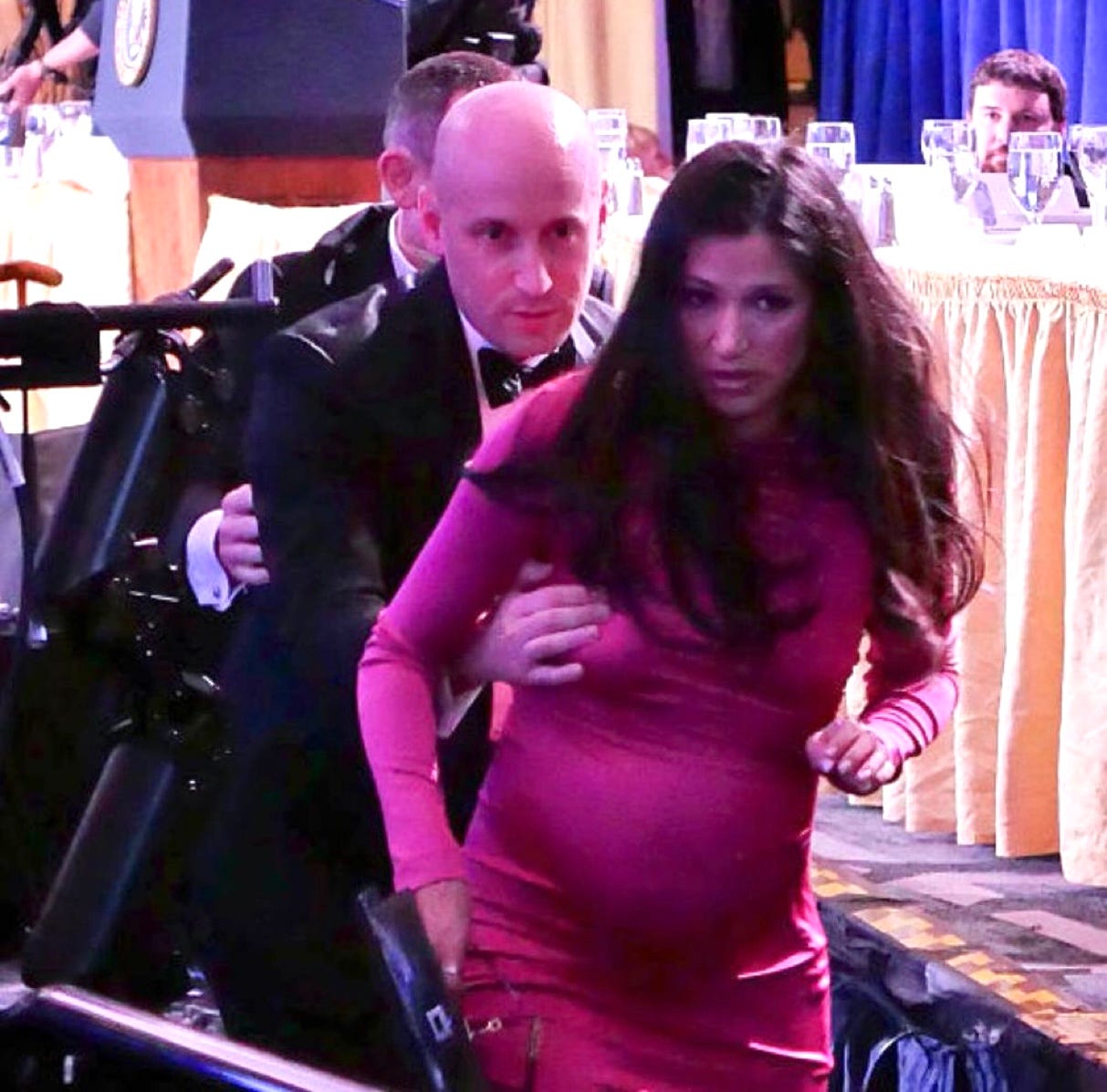
On CNN’s State Of The Union, host Dana Bash interviewed Maryland Democratic Rep. Jamie Raskin. The House Judiciary Committee ranking member was in attendance at the WHCD along with Bash and talked about his firsthand experience.
BASH: And you have, and as many of your fellow Democrats have used some heated rhetoric against the president. And do you think twice about that when something like this happens?
Raskin was diplomatic in his answer, while being perplexed at the idiotic implication.
RASKIN: What rhetoric do you have in mind? I …
Bash then quickly clarified that she was insinuating a correlation by doubling down.
BASH: Well, just talking about some of the fact that he is terrible for this country and so on and so forth. I understand that that’s your democratic right. But, overall…
RASKIN: Right.
BASH: … do you have a responsibility?
Raskin went on to calmly explain the First Amendment and his valid criticisms of Trump.
We, however, are not members of Congress nor beholden to niceties. So with no due respect to Dana Bash, she can f—- off with this bullshit. In fact, if anything, many Democrats are too restrained with their commentary against Trump, too scared of calling a fascist a fascist.
Here are some things Donald Trump has called the Democratic Party and/or just generally people who oppose him, in no particular order:
The Enemy Within
The Enemy of the People
Scum
Terrorists
Vermin
Radical
Lunatics
Demonic
Evil
Fascists
Marxists
Communists
Garbage
Treasonous
Animals
Degenerates
Jew haters
Lowlifes
These kinds of moments expose the insane double standard “liberal media” places on Dems. Trump’s constant, daily violent rhetoric against his enemies is normalized — sanewashed — while Democrats are taken to task for incivility for daring to oppose the king.
The best source of news about politics these days is the Meidas Nerwork. The three Meiselas brothers have created print, video, podcast and every other form of media. With their editor-in-chief Ron Filipowski, they are in the know. This is part of their weekend roundup.
… Trump and Republicans have predictably seized upon the shooting incident at last night’s WHCA dinner to push for suppression of free speech and dismissal of the court case that is temporarily halting some of his beloved ballroom construction.
… AP: “Video showed the suspect running past security barricades as Secret Service agents ran toward him. One officer was shot in a bullet-resistant vest but was recovering. The gunman was tackled to the ground and was not injured, but was being evaluated at a hospital.”
… CBS reporter Jennifer Jacobs: “The shooting happened on the level above the ballroom where the dinner was. I don’t think people hearing about this – or even those of us in the room – realized how far from the president, VP and other guests this incident was. It was on another floor, up some stairs and several sets of security away.”
… Reese Gorman with NOTUS: “I was talking with a GOP lawmaker at the WHCD last night right after the shooting who was appalled at the lack of security entering the Washington Hilton. There were 0 magnetometer or security checkpoints prior to entering the Washington Hilton. All you needed to do to get in was flash a ticket or a screenshot of an email, there was no actual inspection of what you showed anyone.”
… “In my case they didn’t even check my phone or ticket they let me through because I was with someone who had already flashed their ticket. You didn’t reach your first and only security checkpoint until you went down the escalator and were right outside the ballroom. No ID’s were checked. There’s significantly more security at some Trump rallies I’ve been to. And this dinner had the President, VP and Speaker in attendance.”
… Karoline Leavitt on Fox right before the event started: “This speech tonight will be classic Donald J. Trump. There will be some shots fired tonight in the room, so everyone should tune in.”
… Minutes after the shooting, Dep. WH Chief of Staff and former Trump golf caddie Dan Scavinogot up and tried to lead attendees in a “USA! USA!” chant by screaming it out several times. Not one person joined him and he walked out.
… Trump then held a press conference at the event:
“When you’re impactful, they go after you. When you’re not impactful, they leave you alone.”
“This is not a particularly secure building. And I didn’t want to say this, but this is why we have to have all the attributes of what we have planned at the WH. It’s a much larger room and much more secure, it’s got bulletproof glass. That’s why we need the ballroom.
“I lead a pretty normal life, considering, you know, it’s a dangerous life. I think I’m, I think I handle it as well – as well as it can be handled. To be honest with you, I’m not a basket case.”
“We’re not going to cancel things because we can’t do that. We wanted to stay tonight, I will tell you, I, I fought like hell to stay, but it was protocol—they said, please, sir.”
He said he wants the event to be rescheduled because he has a great speech ready: “I was all set to really rip it. I’ll have to save it. I don’t know if I can ever be as rough as I was going to be tonight. I think I’m going to be probably very nice. I’ll be very boring the next time, but we’re going to have a great event.”
… Kash Patel then praised Trump: “Mr. President, you inspire them 24/7, 365 You give them the resources that they need and you know, they know that you have their back, and that is a changing dynamic in this country and that’s why you saw a brave Secret Service agents respond immediately, swiftly, subdue and take down the suspect and safeguard the lives of thousands of individuals at that hotel.”
… Monica Crowley, Chief of Protocol at the WH: “Once again, you witnessed the Hand of God tonight.”
… Franklin Graham posted: “After three assassination attempts, some people say that President Trump is one lucky man. I don’t think luck has anything to do with it – I believe it is the hand of God. What do you think?”
… I think Franklin Graham is a nepo-baby charlatan who weaponizes the Bible to advance his political agenda.
… Immediately after the incident, MAGA supporters received their marching orders and blasted out coordinated propaganda posts on X trying to use it as justification for Trump’s ballroom monstrosity.
… Which also includes Sen. John Fettermanthese days: “We were there front and center. That venue wasn’t built to accommodate an event with the line of succession for the US govt. After witnessing last night, drop the TDS and build the WH ballroom for events exactly like these.”
… Rep. Chip Roy (R-TX) took it a step further and said taxpayers should pay for it: “Any consideration of DHS reconciliation instructions this week and beyond should provide for construction of a secure ballroom on WH grounds.”
… Dep. AG Todd Blanche then sent a letter to the National Trust for Historic Preservationdemanding they dismiss their lawsuit against the ballroom: “You lawsuit puts the lives of the president, his family, and his staff at grave risk. I hope yesterday’s narrow miss will help you finally realize the folly of your lawsuit.”
… Former MAGA influencer and Elon Musk baby-mama Ashley St. Claire: “All of MAGA is paid and they coordinate their messaging in lockstep via groupchats. All of these people came to the conclusion that after what they saw at the WHCD, their first thought was ‘Trump needs his ballroom’? One of the main groupchats in which they coordinate this messaging is literally called ‘Fight, Fight, Fight!’ after the ‘attempt’ on Trump’s life in Butler”
… Rep. Nancy Mace (R-SC) received quite a bit of ridicule after she suggested that actor Ben Stiller may be involved or complicit when he made this 3-word post: “Got it done.” Mace responded: Got what done?” Her reply was hit with this Community Note: “He was rooting for the Knicks to win their game against the Atlanta Hawks. And they did.”
… Journalist David Shuster: “Last night, CNN, TMZ, CBS and others reported the dinner gunman was ‘confirmed dead.’ In fact, he was alive and had not been shot. (Just shot at). At a dinner honoring WH reporting, the rush to be first instead of being accurate was on full display. Speaks volumes.”
… Daily Mail on the shooter: “On LinkedIn, he describes himself as: ‘A mechanical engineer and computer scientist by degree, independent game developer by experience, teacher by birth.’ Allen earned a B.S. in Mechanical Engineering from the CA Institute of Tech and later a M.S. in Computer Science from a CA State Univ. During his time at Caltech, Allen listed his involvement in the Caltech Christian Fellowship.”
… CA-based elections analyst Rob Pyers on shooter: “Registered as a No Party Preference voter in LA County. FEC records show a single $25 contribution via ActBlue to the Kamala Harrispresidential campaign.”
… From the shooter’s manifesto, which he sent to his family minutes before the incident:
“I am no longer willing to permit a pedophile, rapist, and traitor to coat my hands with his crimes. (Well, to be completely honest, I was no longer willing a long time ago, but this is the first real opportunity I’ve had to do something about it.)”
“Administration officials (not including Mr. Patel): they are targets, prioritized from highest-ranking to lowest. In order to minimize casualties I will also be using buckshot rather than slugs (less penetration through walls)”
“I would still go through most everyone here to get to the targets if it were absolutely necessary (on the basis that most people *chose* to attend a speech by a pedophile, rapist, and traitor, and are thus complicit) but I really hope it doesn’t come to that.”
“Turning the other cheek is for when you yourself are oppressed. I’m not the person raped in a detention camp. I’m not the fisherman executed without trial. I’m not a schoolkid blown up or a child starved or a teenage girl abused by the many criminals in this admin. Turning the other cheek when *someone else* is oppressed is not Christian behavior; it is complicity in the oppressor’s crimes.”
… Seems a bit odd that he would exclude Patel from his hit list. Wonder what the reason is for that?
… CBS: “Allen’s brother had notified New London PD (CT) of the alleged manifesto he had sent to his family members prior to the incident. Family members told investigators Allen would regularly go to the shooting range to train with his firearms. The official said Allen was part of a group called ‘The Wide Awakes’ and attended a ‘No Kings’ protest in CA.”
… Trump then posted Sunday morning: “What happened last night is exactly the reason that our great Military, Secret Service, Law Enforcement and, for different reasons, every President for the last 150 years, have been DEMANDING that a large, safe, and secure Ballroom be built ON THE GROUNDS OF THE WHITE HOUSE. This event would never have happened with the Militarily Top Secret Ballroom currently under construction at the WH!”
… Rep. Jamie Raskin (D-MD) was on CNN. Dana Bash: “You and your fellow Democrats have used some heated rhetoric against the president. Do you think twice about that when something like that happens? Raskin: What rhetoric do you have in mind? Bash: That he’s terrible for this country and so on and so forth.”
… Todd Blanche on CBS: Q – “The alleged shooter had multiple weapons. In DC, open carry is not permitted. You just said he traveled from CA across the country by train. How did he do that? Blanche: This isn’t about in my mind changing the law, or making the laws more restrictive around firearms. Host: I’m asking about crossing state lines with firearms. Blanche: I don’t think that’s something we should be focused on.”
… Mehdi Hasan: “They want to use the alleged assassination attempt to build a ballroom (!) and crack down on the left but not touch gun laws, oh no, never that.”
…Peter Doocy on Fox: “We should expect in the coming days to hear about major security improvements – that could include Trump having to wear a bullet-proof vest when he is out in public.”
… When the announcement was made that the dinner was canceled, that started a run on people grabbling bottles of wine and champagne off the tables. Some for takeout later, others decided not to wait.
We make the entire Weekend Bulletin available to everyone who are also able to participate in the comments section below. About the first third of the daily Bulletins during the week are available to free subscribers. If you missed yesterday’s Bulletin, you can find it here.
Gaige Davila of the Texas Observer tells the shocking story of the arrest and detention by ICE of Meena Batru, who worked as a court interpreter for more than 20 years in Texas and other states. She interprets in Hindu, Punjabi, and Urdu. She immigrated from India to the U.S. some thirty-five years ago. She was under the impression that her court-approved work permit assures her legal status. ICE said she is wrong and plans to deport her.
Meena Batra is not a murderer, a rapist, or a burden on society. She is not among “the worst of the worst.” Why is she being deported?
Last month, Meenu Batra, 53, who has lived in the South Texas border colonia of Laguna Heights since 2002, was on her way to Milwaukee, Wisconsin, to work another case. She’s been a court interpreter for over 20 years, the only one licensed in Texas for Hindi, Punjabi, or Urdu. Her language skills are requested nationwide, where she’s contracted to help people making their way through the immigration court system, just as she did for herself 35 years ago when she immigrated from India to New Jersey before settling in Texas.
She planned to meet with her adult children in Austin after the Wisconsin trip, the only difference she foresaw in an otherwise typical trip. Her routine for years included flying from either Harlingen or Brownsville to far-flung parts of the country where South Asian immigrants needed language access. For this trip, the flight was out of Harlingen.
But, around 5 p.m. on March 17, Batra was detained by Immigration and Customs Enforcement (ICE) agents after passing through security at Harlingen International Airport. In a sworn deposition that was filed as part of a petition for habeas corpus—a legal request to be released on the grounds that the detention is unlawful—Batra said the people who arrested her did not have visible badges nor were they wearing uniforms. One of those agents had asked Batra if she knew she was in the country illegally and that she had a deportation order. She replied that her work authorization status, which she applied for regularly after being granted a legal status called withholding of removal by a New Jersey immigration judge decades ago, was good for another four years.
“That doesn’t mean you can be here forever,” the agent replied. Two more plainclothes agents would join the two that detained her, bringing her down the escalator and to the front of the airport.
“Having watched and read enough news, I know that the moment you say something, they accuse you of evading arrest or whatever other things,” Batra told the Texas Observer. “So, being mindful of all that, mindful of the whole line and being embarrassed in front of everybody, I just complied.”
Batra’s attorneys say the agents were targeting her. “This is someone who maybe had one speeding ticket in the last 30 years and [is] being treated like a notorious criminal,” Deepak Ahluwalia, a California and Texas-based immigration attorney representing Batra, told the Observer.
People who are granted withholding of removal are typically immigrants who face persecution in their home countries, like those who receive asylum. Batra, who is Sikh, left India after her parents were murdered during a state pogrom against Sikhs in the 1980s. Batra did apply for asylum but instead received withholding, which, unlike asylum, does not come with a path to a green card.
Though people with Batra’s protection still have deportation orders, they cannot be removed to where they came from. If they are deported, the United States must send them to a “third country” that will accept them. The United States has agreements with at least 27 nations, a list the Trump administration has grown, that it’s paid up to $1 million a person to accept deportees. Many of these deportation flights leave from the Harlingen airport where Batra was detained.
ICE has not said where it plans to send Batra, according to her habeas filing.
After placing her in handcuffs, she said, two of those four agents at the airport drove Batra to ICE’s field office in Harlingen in an unmarked van. She had been there many times over the years to renew her work permit and to help attorneys with translation. Office staff recognized her as she was being processed. Agents posed for photos with her handcuffed, which they said was for “social media,” according to the habeas filing.
Batra was moved through various holding cells for 24 hours without food or water, first in Harlingen then in the El Valle Detention Center outside of Raymondville, in neighboring Willacy County. As of mid-April, she remains there without access to the consistent medical care she needs following surgeries she had in December. Within days of being in the facility, she caught a respiratory illness and lost her voice. She was supposed to see her doctor, in Harlingen, the week she was detained.
“I think it’s a real example of what the administration is doing in terms of its mass deportation plan and who it’s targeting,” Edna Yang, the co-executive director of American Gateways, an Austin-based legal services nonprofit, told the Observer. “It’s not targeting criminals, it’s not targeting dangerous people, it’s targeting individuals who are members of our community, who have a lot to offer and continue to offer a lot of positive things for our entire country and our society.”
Batra’s habeas petition included dozens of letters from people in her community and beyond asking for her to be released from detention. Cameron County Precinct 1 Constable Norman Esquivel, a Republican elected official and fixture in Laguna Madre-area politics, and several judges across the country are among those who authored a letter.
Batra’s attorneys argue that in the decades she’s had her legal protection the U.S. government never told her that it was planning to deport her, and that her detention violated her right to due process. One of Batra’s children recently enlisted in the military and filed a parole application for her. If granted, Batra could remain in the country in one-year increments. Her attorneys have also filed a temporary restraining order seeking to prevent ICE from moving her to another detention center.
In response to an Observer request for comment, a Department of Homeland Security spokesperson noted that Batra had “a final order of removal from an immigration judge in 2000” and said “She will remain in ICE custody pending removal and will receive full due process.”
The spokesperson continued: “Employment authorization does NOT confer any type of legal status in the United States,” adding that the department is encouraging all “illegal aliens” to “self-deport.”
Nationwide, Texas is leading in habeas petitions from people detained by ICE. Most federal judges are siding with detained people, ordering them to be released or to receive a bond hearing before an immigration judge.
Batra, who has spent nearly half her life working in immigration courts, stopped working for the government’s side in immigration proceedings—instead helping only the immigrants seeking status—after seeing the conditions in detention facilities and how detained people were treated. Now, on the other side herself, she’s seeing people at the Raymondville facility who don’t speak English or Spanish, who are without the same knowledge and connections she has after so many years of helping people like them through the same system.
“I am grateful also, because something bad has to happen in life for you to truly appreciate what you have,” Batra said. “But I am getting this experience, and I’m watching the other women and just realizing how much help they need. At least I have awareness. I know my rights.”
DHS has until April 21 to respond to Batra’s habeas petition, according to court filings.
Peter Greene wrote in Forbes about a Democrat-led effort to eliminate the federal voucher program from Trump’s “One Big Ugly Bill,” the one that takes from the poor and gives to the richest. Senator Mark Kelly of Arizona led the opposition to this program. Kelly knows how vouchers have harmed the state budget and public schools in Arizona.
One portion of the President Donald Trump’s “One Big Beautiful Bill” was a federal school voucher program that any state could join. But before that plan can go into effect, a new Senate bill has been proposed that would undo the vouchers entirely.
Senators Mark Kelly (D-AZ), Mazie Hirono (D-HI) and an additional 28 senators have introduced the Keep Public Funds in Public Schools Act. The act would strike IRS Code Section 25, the portion of the IRS code that was inserted to create the federal school voucher program, eliminating that program.
The new voucher program was sold as a tax credit program. It would allow taxpayers to claim a $1,700 tax credit by diverting that payment from the IRS to a scholarship granting organization that would then award at least $1,530 of that donation to a student (the rules governing the program allow SGOs to keep 10% of the donated funds).
Kelly cites his home state of Arizona as a cautionary tale, where taxpayer-funded school vouchers have become costly: “Since 2022, our state’s universal voucher program has diverted and drained money from public schools; last year alone cost Arizona taxpayers nearly $1 billion. Instead of investing in classrooms, special education services, or school safety, lawmakers pushed massive tax giveaways and created a parallel education system that lacks transparency and accountability.”
12News and reporter Craig Harris have run a series of reports showing much of that money has gone to questionable and disallowed purposes, including dirt bikes, custom tires and luxury hotel stays. Choice advocates such as EdChoice have pushed back, but have had difficulty debunking Harris’s results.
“In Arizona, we’ve already seen how universal vouchers are leading to rampant fraud and benefiting people who already had the means to send their kids to private school, while decimating public education for everyone else,” said Kelly.
On X, Secretary of Education Lindas McMahon noted that Kelly surely knows “the Education Freedom Tax Credit does not take a single dollar away from public schools — it brings new, private money into education.”
When Kentucky’s similarly-structured tax credit scholarship program was challenged in court, the state made a similar argument that the program did not use any public taxpayer funds. But when the Kentucky Supreme Court ruled against the program, they rejected that argument. “The money at issue cannot be characterized as simply private funds,” they wrote, “rather it represents the tax liability that the taxpayer would otherwise owe.”
When it comes to granting tax credits, the federal government has one power that states do not. Most states require a balanced budget; the state needs to find a way to cover the money it lost by offering credits rather than collecting on the tax liability. The federal government can just add the uncollected taxes to its deficit tab.
Kelly noted in an interview, “It is a deficit bomb, this federal program.”
The Joint Committee on Taxation, a nonpartisan entity that assists Congress on tax legislation, estimated that the credit could cost $25.9 billion between 2025 and 2034 or around $3 billion to $4 billion a year. That would mean potential income of $300-$400 million for SGOs; several organizations are preparing to launch national SGOs to work with the federal voucher program.
In addition to Kelly and Hirono, the Keep Public Funds in Public Schools Act is cosponsored by Senators Michael Bennet (D-CO), Richard Blumenthal (D-CT), Cory Booker (D-NJ), Lisa Blunt Rochester (D-DE), Chris Coons (D-DE), Tammy Duckworth (D-IL), Dick Durbin (D-IL), John Fetterman (D-PA), Kirsten Gillibrand (D-NY), Martin Heinrich (D-NM), Tim Kaine (D-VA), Andy Kim (D-NJ), Angus King (I-ME), Ben Ray Luján (D-NM), Ed Markey (D-MA), Jeff Merkley (D-OR), Chris Murphy (D-CT), Alex Padilla (D-CA), Jack Reed (D-RI), Bernie Sanders (I-VT), Adam Schiff (D-CA), Chuck Schumer (D-NY), Jeanne Shaheen (D-NH), Tina Smith (D-MN), Chris Van Hollen (D-MD), Elizabeth Warren (D-MA), Peter Welch (D-VT), and Ron Wyden (D-OR).
It’s against the law for the federal government to interfere in curriculum and instruction, but in recent years that has not stopped federal officials from trying. Many people harbor the illusion that there is a way of teaching that is the best, better than any other way. As soon as they think that panacea has been identified, they want to mandate it for everyone.
The Obama administration pressed states to adopt the Common Core curriculum, even when there was no evidence–none at all–that it was better than any other curriculum.
Today’s panacea is called “the science of reading.” The evidence? Reading scores in Mississippi went up after the state adopted SOR. The counter-evidence? Congress funded a $6 billion demonstration project called Reading First, based on the same ideas, as part of No Child Left Behind in 2001. The results: students learned the skills taught, but their comprehension did not improve.
Peter Greene reports that Congressional legislators are so impressed by SOR that they have written federal legislation to ensure that its methods are universally taught. Members of Congress know nothing about teaching reading, but they want to mandate the one best way on everyone.
Check out HR 7890, brought to us by Rep. Erin Houchin of Indiana, along with Rep. John Manion of New York and Rep. Kevin Kiley of California. The bill– The Science of Reading Act– wants to federally mandate Science of Reading stuff. It has the effect of creating a federal definition of SoR that captures the general vagueness of the term:
The term ‘science of reading’ means an interdisciplinary body of evidence-based research about reading and issues related to reading and writing that—
(A) identifies instruction in phonemic awareness, phonics, vocabulary, fluency, comprehension, and writing as essential components to skilled reading;
(B) demonstrates the importance of background knowledge, oral language, the connection between reading and writing, and strong writing instruction;
(C) explains why some students have difficulty with reading and writing; and
(D) does not use a three-cueing model.
Hope that clears it right up for you. If you’re fuzzy on three-cueing, we get a federal definition for that, too. It has to do with A) using context, pictures, or syntax as primary basis for teaching word recognition and B) “teaches visual memory as the primary basis for word recognition.” So, sight words? Sight words are bad now?
Anyway, under the bill, only programs that are aligned with SoR get grant money under the grants to “entities in support of kindergarten through grade 12 literacy,” The bill would add to the directions that states are given for distributing the grants. Which makes me wonder if these GOP Representatives missed the meeting where the regime explained that these kinds of grants were going to be toast anyway.
That’s pretty much the whole bill, other than it’s not allowed to limit any of the protections of students under IDEA or the ADA. The best part is at the very bottom of the page where the bill explicitly says that the bill absolutely does not
authorize any officer or employee of the Federal Government to mandate, direct, or control a State, local educational agency, or school’s specific instructional content, academic standards and assessments, curricula, or program of instruction.
Somebody was wrapping up the bill and remembered that the feds are not allowed to dictate curriculum or instructional programs. Conservatives remembered that really well back when President Obama and Arne Duncan were extorting state compliance with promoting Common Core, but seem to have kind of forgotten now.
So that’s the bill. It directs states to push a particular ill-defined un-supported possibly-nonexistent instructional methodology, and then promises that this bill does not authorize the feds to push a particular instructional methodology. It went to the House Committee on Education and Workforce, where the committee voted 33-0 to report the bill. Should this bill escape its well-deserved death, I expect its major effect will be to influence education grant paperwork, but let’s hope it just sits on the steps up on Capitol Hill and quietly fades away.
Garry Rayno, writer of “The Distant Dome” for inDepthNH, has been covering the legislature for many years. The presence of a large faction of libertarians in the legislature make it difficult to predict what they will do.
In this post, he reviews the likely consequences of passing a voucher bill for which everyone is eligible.
Rayno wrote about what vouchers will accomplish: They will subsidize the well-to-do while diminishing the resources of poor districts.
He wrote:
This week the House will vote on what is perhaps one of the Republicans’ biggest priorities, universal public school open enrollment or Senate Bill 101.
The bill has changed since it left the Senate with a new funding source so one town’s school property tax dollars are no longer sent to another school district following one of its students.
Under the new plan, the district enrolling another district’s student would receive a $9,000 payment from the state’s often tapped Education Trust Fund which was originally established to hold state tax dollars for public education separately to guarantee the state meets its obligation to provide its students an adequate education and to pay for it.
Over the last five years about $130 million dollars has been drawn from the trust fund to largely subsidize the education of children who were not supported by the state dollars because they are in private, or religious schools or homeschooled and their parents were footing the bill.
Despite two superior court rulings the state is not meeting its obligation to pay for an adequate education for its students, lawmakers have not seen fit to increase state aid to public schools which receive about $4,200 per pupil in state aid, along with differentiated aid for poverty, English language learners and special education making the average per pupil aid around $5,000 per student.
If this bill passes, and it probably will, even more money will be drawn from the Education Trust Fund to pay for students moving from one public school to another.
The State Department of Education declined to predict how many students might take advantage of the new open enrollment policy, so just how much of a hit the trust fund will take is not known.
The trust fund is not the only entity that will experience financial loss with the new policy.
The school district losing the student will lose his or her state aid which ranges from $4,200 on the low end to about $8,000 on the high side.
Chances are the districts losing students will be in property poor communities that can ill afford to lose any state aid for their schools without impacting property taxes. Even if they reduce staff if enough students leave, many costs like buildings, electricity, heating and transportation will remain the same.
The district receiving the students will receive the $9,000 per student state aid but its average per pupil cost is likely to be higher than the state average of about $23,000 per student.
That means the receiving district will have to pick up the difference in theory although adding a few students is not likely to change overall costs much.
And the big issue still hanging over the open enrollment bill is who pays for a student’s special education costs who transfers.
The sending district is responsible for those costs, so some — and it may actually be many — school districts will be sending the receiving districts substantial checks to cover special education services which have been growing steadily more expensive with the state and federal governments not living up to their obligations to pay those bills.
That means local property taxpayers in a sending district will continue to pay the majority of the special education costs for their student if he or she transfers out of the district.
Under the bill, parents are responsible for their student’s transportation to the new school although they can make arrangements with the receiving districts to drop their student at a convenient bus stop, but that is not guaranteed.
Looking at the bigger picture, who will be able to participate in the new open enrollment scheme? Probably not a single parent — most likely a mother — who has to work one or two or three jobs to support her children, or poor families with both parents working.
The largest group served by the open enrollment plan will be children of well-to-do parents who have the time and money to drive their children the 10 or 50 or 100 miles to the school of their choice be it for academics, the theater, music, art or athletic program, or even the special education services, to schools in property wealthy school districts.
Once again it is the reverse Robin Hood concept where the property wealthy districts and wealthy families receive the greatest benefit while the property poor districts and their families will see less state aid and dwindling educational resources for their children.
Much like the state’s voucher program, while it was originally touted as a way for low-income parents to access the best educational environment for their children, the greatest benefit is to those families wealthy enough to send their children to private or religious schools or to homeschool their children.
There is a lot of rhetoric about open enrollment providing the best educational experience for children, but that is only true if you can afford to and have the time to transport their children to another school district.
Since the supporters of the voucher program or Education Freedom Accounts, were able to open the program to any eligible parent in New Hampshire last year regardless of income this year, they have proposed several other ways to expand it beyond the legal cap of 10,000 students this year and 12,500 this coming school year by opening it up to military families and allowing EFA students to take classes at their local public schools at no cost.
When the program originally passed, EFA students were not allowed to go back to their former school for a class or two, there was a bold black line.
Now supporters of the program want to blur the line which is fine for the student and his or her parents but not the school districts which lost the state aid associated with those students.
The proposed changes do not help those low-income parents who were used to finally get the program passed by including it in the budget package during the 2021 session, but are now seldom mentioned. The program did not have the votes to pass on its own five years ago.
If the voucher program were truly helping kids who do not do well in the public school environment from low-income families, there would be a lot less opposition.
Those kids are a small minority and do not receive the vast majority of the benefits.
Those who benefit from the new open enrollment program are the same people who benefit from the voucher program, those wealthy enough to send their children to private and public institutions and homeschool, not those leaving public schools, who are few and far between and a declining percentage.
The greatest beneficiaries of this “school choice” push are not the ones who need government’s help. They can do quite well on their own.
And all of these changes to public education do nothing to reform it or fund it adequately, but do make it more difficult to provide for the educational needs of 90 percent of the state’s children who attend public schools.
And that is the bigger picture too many people fail to see.
Vengeance against all those who have dared to investigate him for his role in the insurrection of January 6, vengeance against those who dared to investigate him for taking classified documents to Mar-a-Lago, vengeance against those who dared to criticize him, vengeance against those who prosecuted him for paying off Stormy Daniels….the list is long. His grievances are many.
Every FBI agent who participed in these investigations was fired. But that’s not enough.
At last, he has found the perfect vehicle, a prosecution to snare his enemies. They will be charged with participating in a Grand Conspiracy to smear him.
The federal judge is Aileen Cannon, who killed Special Prosecutor Jack Smith’s case against Trump. The jury will be drawn in Fort Pierce, Florida, a deep-red jurisdiction, even for matters that occurred in Washington, D.C. The prosecutor will be an 81-year-old Trump ally, not a career prosecutor.
The trial and verdict are rigged. That’s the way Trump likes it.
U.S. Installs a Trump Loyalist to Lead ‘Grand Conspiracy’ Case Into Trump Foes
A former lawyer for President Trump’s campaign, Joseph diGenova, is said to be planning to split time between Miami and Fort Pierce, where a grand jury overseen by a Trump-favored judge sits.
Robert Hubbell is a well-informed and insightful blogger with a large following.
In this post, he sorts through the claims and counterclaims of the past 24 hours.
He writes:
In a famous thought experiment posed by physicist Erwin Schrödinger, the life-or-death fate of a cat in a box is determined by the random radioactive decay of a particle. Schrödinger argued that the rules of quantum mechanics implied that as the cat awaited its fate, it was simultaneously alive and dead (i.e., in superposition) until the moment the random radioactive decay occurred, at which time the cat’s fate became fixed—it was either alive or dead, but not both.
Friday, Trump and Iran operationalized the “Schrödinger’s Cat” thought experiment using the Strait of Hormuz instead of a cat in a box. Early Friday, Trump said that the Strait of Hormuz was open but that the US blockade against Iran would continue, while Iran said the Strait is open but will remain closed so long as the Trump blockade remains in effect. To further complicate matters, Iran said that when the Strait opens, permission to pass through the Strait must be granted by Iran’s Revolutionary Guard.
If the above paragraph makes your head hurt, then you understand the situation perfectly—because it makes no sense. Indeed, that was the point of Schrödinger’s thought experiment; he was mocking the seemingly nonsensical idea of a cat being simultaneously dead and alive. That is exactly where we are with the Strait of Hormuz: It is both open and closed, blockaded by the US for now, with future transit subject to the whim of the Iranian Revolutionary Guard.
We are in this state of quantum indeterminacy because Trump is making announcements that do not appear to be connected to reality. In other words, Trump is lying. He has every incentive to pretend that the conflict with Iran is over. Nearly every announcement Trump made on Friday was quickly contradicted or denied by Iran. See, e.g., Jerusalem Post, Iran denies claim that US will retrieve enriched uranium.
As reported in the Jerusalem Post, the Iranian Parliament Speaker Ghalibaf posted a statement on Twitter accusing Trump of making multiple false claims:
“The President of the United States made seven claims in one hour, all seven of which were false,” Ghalibaf wrote. “They did not win the war with these lies, and they will certainly not get anywhere in negotiations either.”
Ghalibaf urged all to “read the real and accurate news of the negotiations in the recent interview of the Foreign Ministry spokesman,” in which a Foreign Ministry spokesman claimed that Iran will not transfer its enriched uranium anywhere, contrary to earlier Trump claims that Iran had agreed to do so.
Iran and the US appear to be negotiating a three-page term sheet that includes the release of $20 billion in frozen Iranian assets. Axios has published a detailed outline of the term sheet, although both Iran and Trump have denied reporting on the purported terms. See Axios, U.S. considers $20 billion Iran cash-for-uranium deal.
The Axios article provides a good summary of the state of play in a rapidly evolving situation. My recommendation is to wait until the US and Iran make a joint announcement before trying to parse the terms. Until then, much of the reporting is market manipulation disguised as leaks from “administration officials.” See Reuters, Traders place $760 million bet on falling oil ahead of Hormuz announcement.
Per Reuters,
Investors placed a bet worth about $760 million on a falling oil price around 20 minutes before Iran’s foreign minister announced on Friday that the Strait of Hormuz was open, another sizeable wager on the world’s most traded commodity ahead of major announcements in the course of the Middle East war.
But whatever the outcome, it does not appear that Trump will be able to replicate the advantageous terms of the Joint Comprehensive Plan of Action (JCPOA) negotiated by President Obama. And Iran’s Revolutionary Guard will regulate traffic through the Strait of Hormuz—an unimaginable situation before Trump’s ill-advised and unconstitutional decision to start a war against Iran without consulting Congress or the American people.
We should hope that peace negotiations succeed quickly. But we should not forget that the war was a debacle that cost thousands of lives and billions of dollars, alienated US allies, increased prices in the US, and shifted the balance of power in the Middle East toward Iran, which will retain its stockpile of enriched uranium.
Trump is in the process of surrendering, and no amount of lying can change reality. We must not let Trump and his apologists distort or bury the truth of what happened over the last six weeks. It was an unmitigated disaster, full stop. Trump and all Republicans must be held to account in November…
Hubbell has two other stories in this post that you should know about.
The first is explosive investigative reporting about Kash Patel by Sally Kirkpatrick in The Atlantic. She reports that she interviewed many FBI employees and learned that Patel is a heavy drinker. He is, she writes, a security risk. Patel and his law firm announced on Twitter that he was suing her and the magazine.
Another item describes the Trump administration’s efforts to send former CIA Director John Brennan to prison. One prosecutor, unwilling to go along, resigned. Brennan had the bad luck to land in the courtroom of Judge Aileen Cannon in South Florida. Hubbell feels sure that Brennan will be cleared of whatever charges they cobble together against him.
Federal Judge Richard Leon again halted work on Trump’s super-sized ballroom, which can hold as many as 1,000 people and would be twice as large as the White House. It’s a giant golden sore thumb looming over the White House.
Trump said that under the ballroom would be a major security site and that continuing the construction of the ballroom was a matter of national security. A federal appeals lifted Judge Leon’s stay and asked him to clarify what part of the structure he was stopping.
A federal judge set new limits on President Donald Trump’s planned White House ballroom, saying construction could proceed only on an underground portion of the project deemed necessary by the military, and not on the 90,000-square-foot aboveground addition that Trump has eyed to entertain VIP guests.
“National security is not a blank check to proceed with otherwise unlawful activity,” U.S. District Judge Richard Leon wrote Thursday. He said the Trump administration could also take steps to secure the construction site to make it safe for people on the White House grounds.
Leon, an appointee of President George W. Bush, last month ordered a halt to Trump’s planned $400 million project, ruling that it could not continue until the president obtains approval from Congress. But Leon permitted further construction to ensure “the safety and security of the White House” after Trump officials said work on an underground emergency bunker was necessary to protect the president, his family and his staff….
The National Trust for Historic Preservation, the organization that sued to block the ballroom construction last year, disputed Trump’s interpretation and asked Leon to explicitly bar any aboveground construction on the ballroom until it received authorization from federal panels and Congress. It also questioned the Trump administration’s claim that pausing the project puts the president at risk.
“No matter how much the Defendants insist otherwise, the lack of a massive ballroom on the White House grounds is not a national-security emergency,” lawyers for the National Trust wrote in a filing Tuesday. They noted that Trump continues to live at the White House and entertain foreign dignitaries, despite the administration’s claim that the current situation poses a security risk.
The National Trust’s lawyers also called attention to the Justice Department’s shifting arguments over the project’s scope. The Trump administration initially maintained that the underground work was separate from the aboveground ballroom, an argument that Leon considered when he declined to pause the project last year and allowed the underground work to continue.