Education Week reported the results of a poll that showed that half of Americans don’t want children to learn about racism today. How will they understand the events of the day? What will they make of the national protests after the murder of George Floyd? How do they sense of hate crimes? How do they make sense of persistent segregation and inequality?
Madeline Will writes:
The public is divided on whether schools have a responsibility to ensure that all students learn about the ongoing effects of slavery and racism, a new national survey shows.
And as debates over how children learn about sensitive subjects bubble up across the country, Americans are also split on whether parents or teachers should have “a great deal of” influence over what is taught in schools, the survey shows. Republicans tend to defer to parents of schoolchildren, while Democrats tend to think teachers should get to decide how to teach about certain issues.
“These results suggest that not only are we divided about what’s the best curriculum, but we’re also divided about who gets to figure that out and who gets to decide,” said Eric Plutzer, a professor of political science and sociology at Pennsylvania State University who co-authored the report. “That makes it hard to solve a problem if we can’t even agree on the process, and it suggests that these kinds of issues are going to continue to come up at the local level, and we won’t be able to solve by consensus.”
The nationally representative survey of 1,200 U.S. adults, conducted in early December, was designed by the McCourtney Institute for Democracy at Penn State and analyzed by the American Public Media Research Lab. The goal was to understand how Americans think three controversial subjects should be taught in school: slavery and race, evolution, and sexual education.
While most Americans think schools have a responsibility to teach about slavery, only about half think schools should teach about the ongoing effects of racism. However, responses differed when separated by race: 79 percent of Black Americans think that students should learn about the ongoing impacts of slavery and racism, while 48 percent of white Americans think schools should teach about historical slavery but not contemporary race relations.
The survey also found that 10 percent of Americans don’t think that schools have a responsibility to ensure that all students learn about the history of slavery and racism in the United States.
As Orwell wrote, “ignorance is strength,” and in this day and age, it’s growing by leaps and bounds.
Dale C. Farran was one of the lead researchers in a study of the effects of an academic pre-kindergarten program in Tennessee. The study concluded that the children who participated in the program eventually fell behind those in the control group who were not in the program.
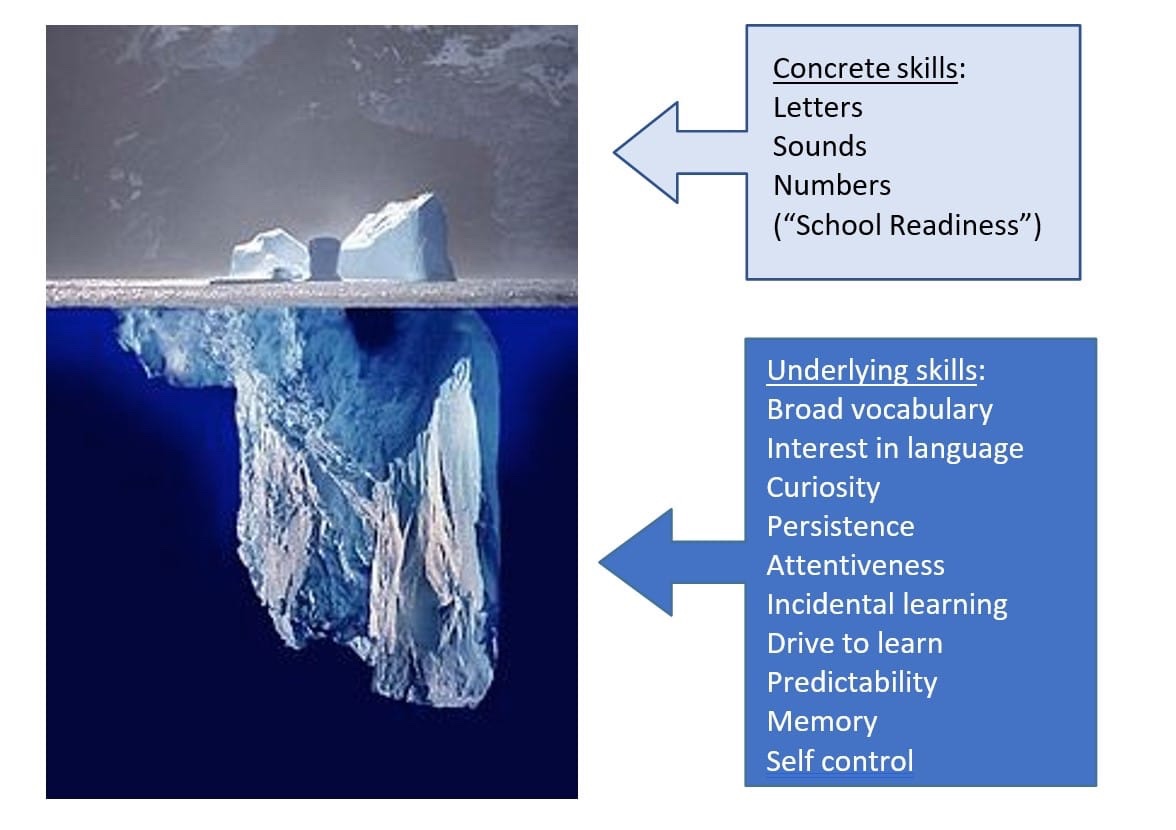
In an article on the blog of DEY (Defending the Early Years), Farran expressed her views about child development. She used the metaphor of an iceberg.
She wrote:
Years ago, few teachers believed that children should be taught to read in kindergarten; a more recent survey shows that 80% of kindergarten teachers now think children should know how to read before leaving the grade.
As recently as 1993 the great majority of kindergarten teachers did not believe an academic focus in preschool was important for children’s school success.
However, concern for the “fade out” of pre-kindergarten effects has led several researchers and policy makers to argue for a stronger academic focus in those classrooms, including the use of an intentional scripted, academically focused curriculum.
Not only do effects from pre-k classrooms fade, but also results from one study of the longitudinal effects of pre-k attendance conducted by my colleagues and me demonstrated that in the long run the effects turned negative.
A greater focus on academics for three- and four- year-olds is not the solution.
As an author of the recent paper on long term effects and as a primary investigator on the only randomized control trial of a statewide pre-k program with longitudinal data, and, finally, as a developmental psychologist whose career focused on young children’s development, I have thought extensively about what the causes of these unexpected effects might be.
I AM PROPOSING AN “ICEBERG MODEL OF EARLY DEVELOPMENTAL COMPETENCIES.”
The tip of the iceberg, the section floating above the surface, is composed of things that are easily measured.
These types of skills have recently been characterized as “constrained” skills meaning they are finite and definable.
All standard school readiness assessments focus on these types of skills.
But they do so because assessors believe that the skills represent deeper competencies.
They measure these skills somewhat like taking a finger-prick for evidence of the information the assessments provide into other more important characteristics of children.
BOTH THE FOCUS OF CURRENT PRE-K PROGRAMS AND THE PEDAGOGICAL STRATEGIES EMPLOYED FOCUS ALMOST EXCLUSIVELY ON THE TIP OF THE ICEBERG SKILLS.
Many who have been in early childhood for a long time testify to the changes in classrooms.
I believe these changes are accelerated by the process of subsuming preschool into the K-12 system.
In many states the department of education administers the pre-kindergarten program, and the program behaves like an additional grade level below kindergarten – the classrooms are open for the school day (5-6 hours a day) and the school calendar (9 months a year).
The classrooms are most often in elementary schools, where the push down from the K- 12 system is almost impossible to avoid.
Many of the elementary schools are older and unsuitable for younger children – no bathroom connected to the classroom, the requirement to have meals in the large cafeteria, and no appropriate playground.
These physical features mean that children spend a lot of time transitioning from the classroom, necessitating a high level of teacher control as children walk through the halls and endure long wait times.
Descriptions from a number of large studies of the instructional strategies used in current pre-k classrooms show them to be dominated by whole group instruction focused on basic skills (the tip of the iceberg).
TEACHERS TALK AT CHILDREN A MAJORITY OF THE TIME, SELDOM LISTENING TO CHILDREN, AND MULTI-TURN CONVERSATIONS ARE A RARE OCCURRENCE.
Learning opportunities that involve other than right-answer questions are almost never observed, and a high level of negative control from teachers characterizes many classrooms.
This content focus and the teaching strategies, I argue result in a detachment of the tip of the iceberg from the deeper skills under the surface.
Thus, children can score well on school readiness skills at the end of pre-k – especially on those related to literacy – but not maintain any advantage by the end of kindergarten when all children attain these skills with or without pre-k experience.
The tip of the iceberg skills no longer symbolizes those under the surface.
They are no longer the visible and measurable aspects of more important competencies.
Only when the deeper skills are enhanced should we expect continued progress based on early experiences.
A very different set of experiences likely facilitates the development of those deeper skills.
We have known for many years that the developmental period between four and six years is a critical one.
Neuroscience confirmed the importance of this period for the development of the pre-frontal cortex.
The pre-frontal cortex is involved in many of the skills described in the model as being below the surface.
Research does not provide good evidence for which experiences facilitate the development of important skills like curiosity, persistence, or working memory.
But research has demonstrated the importance of these kinds of skills for long term development.
For instance, some argue that early attention skills are more important than early academic skills as predictors of long-term school success including the likelihood of attending college.
In a large longitudinal study, researchers identified the importance of the development of internal self-control during the ages of four to six.
Some children with initially low self- control developed self-control during early childhood and had subsequent better outcomes via what the researchers called a “natural history change.”
Whether an intervention-induced change would yield the same positive outcomes is an open question.
So far, no early childhood curriculum has been able to bring about sustained changes in self-control or any of the below- the-surface skills listed above.
WHAT IS CLEAR IS THAT CHILDREN FROM MORE AFFLUENT HOMES ENTER KINDERGARTEN SCORING HIGHER ON SCHOOL READINESS SKILLS.
Moreover, they maintain that advantage across the school years.
But they did not learn those “readiness” skills from a didactic pre-k experience.
While these children may have had magnetic alphabet letters to play with, for example, parents did not sit them down in front of the refrigerator and force them to learn the letters.
Most of those tip-of-the-iceberg skills were learned through a variety of experiences and the opportunity to learn through interactions with adults and friends.
For these children, measuring the tip does provide information about the beneath the surface competencies that are so important.
Guidance may come from comparing the developmental contexts of families who are economically secure to the pre-k classroom context.
Children of economically secure families are more likely to succeed in school, more likely to matriculate in a two or four year college and more likely to graduate when they enter….
GOVERNMENTS IN MOST HIGHLY DEVELOPED COUNTRIES HEAVILY SUBSIDIZE THE CARE FOR YOUNG CHILDREN PRIOR TO SCHOOL AGE.
Nordic countries all provide a child supplement to parents, which most parents use to offset the modest cost of the government-subsidized group care, care that looks nothing like U.S. pre-k programs.
These programs stress different sorts of competencies in young children, capabilities like “participation” or the ability to be a functioning member of a group (not sitting “criss-cross applesauce” for 20-40 minutes during large group instruction).
The programs stress self-reliance and independence, the ability to make good decisions and to be responsible for one’s actions.
Most of these countries delay formal instruction in academic skills until children are six or seven. Their children do quite well in international comparisons in the later grades.
Concerns about the accelerating academic focus in early childcare education are being voiced by many.
I hope this “iceberg” model will provide a useful visual depiction of the danger of concentrating on basic skills instruction in pre-k.
I hope also that it will help people understand why getting early childhood right is so important and the imperative need to fix the childcare situation in the U.S. for families of poor children – in fact for all our children.
Pre-k is not the magic bullet policy makers hoped it would be. Quite the contrary. The reason it is not may lie with the unavoidable focus of the program when it becomes part of the K-12 system.
Denisha Jones is a lawyer, an early childhood educator, and a member of the board of DEY (Defending the Early Years). She writes here about the necessity of protecting young children from the resurgence of bad ideas. The worst of these bad ideas is standardized testing.
She writes:
As protectors of childhood, we have a duty to resist bad ideas, policies, and laws and be as vocal in our resistance as the proponents are in their insistence.
Though the effects of standardized testing have permeated certain aspects of childhood, young children typically are immune to mandated standardized testing.
When the testing accountability era began with No Child Left Behind, children below third grade escaped the yearly testing requirement.
This does not mean young children are not subject to many assessments as many schools give practice tests to first graders, but children in grades K-2 rarely take national standardized tests.
Five days into the new year, a proponent of standardized testing argues for beginning the NAEP (National Assessment of Education Progress) tests in kindergarten.
He argues that since advances in technology make it feasible to mass test young children on iPads and computers, we should collect more data in the early years.
Though many feel that NAEP is a good standardized test because it only tests a sample of students, even if this bad idea became the norm, it would only impact a sample of young children.
A THREAT TO SOME CHILDREN’S CHILDHOOD IS A THREAT TO ALL CHILDREN’S CHILDHOOD.
Testing children in kindergarten is a bad idea, period.
We do not need more tests to know what young children learn in school.
More tests lead to more scripted curriculums, teacher-led instruction, and less time to play, explore, and discover.
Nancy MacLean is an esteemed historian at Duke University, where she is the William H. Chafe Professor of History and Public Policy. She specializes in the study of race, gender, labor history and social movements in the United States. Her book Democracy in Chains: The Deep History ofthe Radical Right’s Stealth Plan for America is must reading. In this important paper, she examines the role of economist Milton Friedman in promoting school choice, segregation, and privatization. The abstract:
This paper traces the origins of today’s campaigns for school vouchers and other modes of public funding for private education to efforts by Milton Friedman beginning in 1955. It reveals that the endgame of the “school choice” enterprise for libertarians was not then— and is not now–to enhance education for all children; it was a strategy, ultimately, to offload the full cost of schooling onto parents as part of a larger quest to privatize public services and resources. Based on extensive original archival research, this paper shows how Friedman’s case for vouchers to promote “educational freedom” buttressed the case of Southern advocates of the policy of massive resistance to Brown v. Board of Education. His approach—supported by many other Mont Pelerin Society members and leading libertarians of the day –taught white supremacists a more sophisticated, and for more than a decade, court-proof way to preserve Jim Crow. All they had to do was cease overt focus on race and instead deploy a neoliberal language of personal liberty, government failure and the need for market competition in the provision of public education.
She describes the spread of ”school choice” legislation and writes:
A well-funded, laser-focused and integrated long game helped achieve these legislative triumphs. Indeed, it is difficult to find an institution on the American right that has not advocated “school choice.” Think tanks such as the Cato Institute and the Heritage Foundation, along with affiliates of the State Policy Network, make the case for it. Engines of legal and judicial change such as the Federalist Society and the Institute for Justice workshop the constitutional issues and litigate for it. The American Legislative Exchange Council (ALEC) produces templates of “model laws” for its overwhelmingly Republican members to introduce it in state legislatures. Fox News broadcasts the talking points. Organizing efforts including Americans for Prosperity drive calls and letters to elected officials. Deep-pocketed donors underwrite the work. The campaigners employ a common language of personal liberty and anti-government, pro-market catch phrases. They tout the benefits of parents gaining the “freedom to choose” to send their children to private schools. And they claim that breaking up the “government monopoly” will promote “competition” that will improve the overall quality of education.2
“School choice” sounds like it offers options. But as I will show, the whole concept, as first implemented in the U.S. South in the mid-1950s, aimed to deny the choice of equal, integrated education to Black families. Further, Milton Friedman, soon to become the best-known neoliberal economist in the world, abetted the push for private schooling that southern states used to evade the reach of Brown v. Board of Education, the Supreme Court’s unanimous 1954 ruling that the segregation of public education violated the constitutional right of Black children to equal protection of the laws. So, too, did other libertarians of the day, among them leading pioneers of the cause that today avidly pushes private schooling.3 Perhaps most tellingly, though, the ultimate purpose was not really to benefit parents and children, even the white ones who patronized the new segregation academies. For Friedman and the libertarians, school choice was and is a strategy to ultimately offload the burden of paying for education onto parents, thus harming the educational prospects of most youth. As we will see, Friedman himself hoped it would discourage low-income parents from having children in a form of economic social engineering reminiscent of eugenics. He predicted that once they had to pay the entire cost of schooling from their own earnings, they would make different reproductive decisions.4
Please read this thoughtful, well-researched and alarming study to understand the dark history of “school choice.” This is a case where history illuminates the future.
I am pleased to report that I was selected as ”Global Guru #1” by an organization that selects “global gurus” in different fields. I am happy to see my friends Deborah Meier, Andy Hargreaves, and Pasi Sahlberg on the same list. I’m honored to be in the company of such distinguished educators. In case you read the bio, there are two updates. I retired from active service at New York University on September 1, 2020. And the blog has received more than 39 million page views (not 32) since it started in 2012.
Whitney Kimball Coe, director of national programs for the Center for Rural Strategies, advises those who are outraged about the removal of MAUS from the eighth grade curriculum by the McMinn County School Board to support those in the South and rural areas who agree with them, instead of showering them with contempt and condescension. She was invited to appear on CNN to talk about the decision, and she had a sleepless night trying to find the right way to condemn the decision without condemning her neighbors.
Do they think we’re not outraged, too, here in East Tennessee? Do they think we can’t speak up and respond for ourselves? Because let me tell you, I lay awake the night before the CNN interview indulging my own outrage and constructing a commentary that would eviscerate all book ban supporters and signal to the rest of the world that I, too, am pissed off. It would feel good to give into the outrage, the indignation, the snark.
But I let the outrage pass over and through me because I live here. We live here. These are our people, our schools, our kids. We spend our days relying on the trust and goodwill of our neighbors to make a life here. Neil Gaiman doesn’t shop at the Food City downtown. Trevor Noah doesn’t volunteer with the local United Way. CNN isn’t interested in solutions journalism and outrage is where relationships go to die.
There’s no cure for opportunism. With each op-ed from another coastal publication, Tennessee becomes more alienated, and our public officials dig their heels in deeper. And those of us dissenting locally are left to bridge the gap, trying to figure out how to protect our hometown and organize for change.
As I lay awake, I remembered that the only side I’m on is the one that keeps the door open to a relationship, and one day, community transformation. When the rest of the world tires of tweeting, expounding and publishing op-eds about this ban, I’ll still be here: raising a family, living, working, organizing, and praying in a community that has my heart. I’ve got to be on the side of holding that together.…
The American Library Association says the number of attempts to ban school library books was 67% higher in September 2021 than in September 2020, fueled in large part by conservative activists organizing at a national level with an eye toward influencing local politics. This isn’t a McMinn County problem or a rural problem. We aren’t a novelty. We sure as hell shouldn’t be the scapegoats for deeper rifts in our national and global fabric.
If you must write about us, at least give a damn about us. Outrage is the quick and easy response if you’re not committed to the sum of us; that is, if you’re only committed to signaling which side you’re on and don’t really care about communities outside your bubble.
If you want to signal to the world that you’re on the side of solutions and repair, then write or tweet as a repairer of the breach.
Write about the donations that have poured into our local library these last days, both monetary and in the form of copies of the books! Look at the people who have been inspired to run for the school board. Talk about how one local parish is hosting a community-wide book discussion and conversation about the history of anti-Semitism in the Christian church. Celebrate Maus flying off bookshelves and selling out on Amazon. Find opportunities to deliver copies to kids in our community and around the world.
After reading her article, I went to the library website. I saw that every copy of MAUS had been checked out and had a hold on it when it was returned. I made a donation to the library. You could too.
Anya Kamenetz of National Public Radio reported a new study of pre-K that reached surprising results. Most policymakers who support the expansion of early childhood education expect that it gives young children an early start with academics and leads later to narrowing of the achievement gap between different groups of children. But that’s not what this study found.
Kamenetz wrote:
Dale Farran has been studying early childhood education for half a century. Yet her most recent scientific publication has made her question everything she thought she knew.
“It really has required a lot of soul-searching, a lot of reading of the literature to try to think of what were plausible reasons that might account for this.”
And by “this,” she means the outcome of a study that lasted more than a decade. It included 2,990 low-income children in Tennessee who applied to free, public prekindergarten programs. Some were admitted by lottery, and the others were rejected, creating the closest thing you can get in the real world to a randomized, controlled trial — the gold standard in showing causality in science.
Farran and her co-authors at Vanderbilt University followed both groups of children all the way through sixth grade. At the end of their first year, the kids who went to pre-K scored higher on school readiness — as expected.
But after third grade, they were doing worse than the control group.And at the end of sixth grade, they were doing even worse. They had lower test scores, were more likely to be in special education, and were more likely to get into trouble in school, including serious trouble like suspensions.
“Whereas in third grade we saw negative effects on one of the three state achievement tests, in sixth grade we saw it on all three — math, science and reading,” says Farran. “In third grade, where we had seen effects on one type of suspension, which is minor violations, by sixth grade we’re seeing it on both types of suspensions, both major and minor.”
Farran is rethinking her own preconceptions about what constitutes high quality pre-K.
Low-income children get programs that are regimented and prescriptive, highly disciplined and controlled. Affluent children, however, are usually in play-based schools, where they learn socialization skills, art, music, and make decisions. For poor kids, school is drill and practice. For their affluent peers, it’s fun. Farran says that pre-K is not a magic bullet thatproduces miraculous results. She concludes:
We might actually get better results, she says, from simply letting little children play.
Katherine Stewart has been writing for years about Christian nationalism and its pernicious influence on American society, especially public schools. Her latest book is The Power Worshippers: Inside the Dangerous World of Religious Nationalists.
She wrote this article about the January 6 insurrection for The New York Times:
The most serious attempt to overthrow the American constitutional system since the Civil War would not have been feasible without the influence of America’s Christian nationalist movement. One year later, the movement seems to have learned a lesson: If it tries harder next time, it may well succeed in making the promise of American democracy a relic of the past.
Christian nationalist symbolism was all over the events of Jan. 6, as observers have pointed out. But the movement’s contribution to the effort to overturn the 2020 election and install an unelected president goes much deeper than the activities of a few of its representatives on the day that marks the unsuccessful end (or at least a temporary setback) of an attempted coup.
A critical precondition for Donald Trump’s attempt to retain the presidency against the will of the people was the cultivation of a substantial population of voters prepared to believe his fraudulent claim that the election was stolen — a line of argument Mr. Trump began preparing well before the election, at the first presidential debate.
The role of social and right-wing media in priming the base for the claim that the election was fraudulent is by now well understood. The role of the faith-based messaging sphere is less well appreciated. Pastors, congregations and the religious media are among the most trusted sources of information for many voters. Christian nationalist leaders have established richly funded national organizations and initiatives to exploit this fact. The repeated message that they sought to deliver through these channels is that outside sources of information are simply not credible. The creation of an information bubble, impervious to correction, was the first prerequisite of Mr. Trump’s claim.
The coup attempt also would not have been possible without the unshakable sense of persecution that movement leaders have cultivated among the same base of voters. Christian nationalism today begins with the conviction that conservative Christians are the most oppressed group in American society. Among leaders of the movement, it is a matter of routine to hear talk that they are engaged in a “battle against tyranny,” and that the Bible may soon be outlawed.
A final precondition for the coup attempt was the belief, among the target population, that the legitimacy of the United States government derives from its commitment to a particular religious and cultural heritage, and not from its democratic form. It is astonishing to many that the leaders of the Jan. 6 attack on the constitutional electoral process styled themselves as “patriots.” But it makes a glimmer of sense once you understand that their allegiance is to a belief in blood, earth and religion, rather than to the mere idea of a government “of the people, by the people, for the people.”
Given the movement’s role in laying the groundwork for the coup attempt, its leaders faced a quandary when Mr. Trump began to push his repeatedly disproven claims — and that quandary turned into a test of character on Jan. 6. Would they go along with an attempt to overthrow America’s democratic system?
Some attempted to rewrite the facts about Jan. 6. The former Republican Representative Michele Bachmann suggested the riot was the work of “paid rabble rousers,” while the activist and author Lance Wallnau, who has praised Mr. Trump as “God’s chaos candidate,” blamed “the local antifa mob.” Many leaders, like Charlie Kirk, appeared to endorse Mr. Trump’s claims about a fraudulent election. Others, like Michael Farris, president and chief executive of the religious right legal advocacy group Alliance Defending Freedom, provided indirect but no less valuable support by concern-trolling about supposed “constitutional irregularities” in battleground states.
None appeared willing to condemn Mr. Trump for organizing an attempt to prevent the peaceful transfer of power to President-elect Joe Biden. On the contrary, the Rev. Franklin Graham, writing on Facebook, condemned “these ten” from Mr. Trump’s “own party” who voted to impeach him and mused, “It makes you wonder what the thirty pieces of silver were that Speaker Pelosi promised for this betrayal.”
At Christian nationalist conferences I have been reporting on, I have heard speakers go out of their way to defend and even lionize the Jan. 6 insurrectionists. At the Road to Majority conference, which was held in Central Florida in June 2021, the author and radio host Eric Metaxas said, “The reason I think we are being so persecuted, why the Jan. 6 folks are being persecuted, when you’re over the target like that, oh my.” At that same conference, the political commentator Dinesh D’Souza, in conversation with the religious right strategist Ralph Reed, said, “The people who are really getting shafted right now are the Jan. 6 protesters,” before adding, “We won’t defend our guys even when they’re good guys.” Mr. Reed nodded in response and replied, “I think Donald Trump taught our movement a lot.”
Movement leaders now appear to be working to prime the base for the next attempt to subvert the electoral process. At dozens of conservative churches in swing states this past year, groups of pastors were treated to presentations by an initiative called Faith Wins. Featuring speakers like David Barton, a key figure in the fabrication of Christian nationalist myths about history, and led by Chad Connelly, a Republican political veteran, Faith Wins serves up elections skepticism while demanding that pastors mobilize their flocks to vote “biblical” values. “Every pastor you know needs to make sure 100 percent of the people in their pews are voting, and voting biblical values,” Mr. Connelly told the assembled pastors at a Faith Wins event in Chantilly, Va. in September.
“The church is not a cruise ship, the church is a battleship,” added Byron Foxx, an evangelist touring with Faith Wins. The Faith Wins team also had at its side Hogan Gidley, a deputy press secretary in the Trump White House, who now runs the Center for Election Integrity, an initiative of the America First Policy Institute, a group led in part by former members of the Trump administration. Mr. Gidley informed the gathering that his group is “nonpartisan” — and then went on to mention that in the last election cycle there were “A lot of rogue secretaries of state, a lot of rogue governors.”
He was presumably referring to Brad Raffensperger, the Republican secretary of state of Georgia who earned the ire of Trumpists by rebuffing the former president’s request to find him an additional 11,780 votes. “You saw the stuff in Arizona, you’re going to see more stuff in Wisconsin, these are significant issues, and we can’t be dismissed out of hand anymore, the facts are too glaring,” Mr. Gidley said. In fact, the Republican-backed audit of votes in Arizona’s largest county confirmed that President Biden won Arizona by more votes than previously thought. But the persecution narrative is too politically useful to discard simply because it’s not true.
Even as movement leaders are preparing for a possible restoration of a Trumpist regime — a period they continue to regard as a golden age in retrospect — they are advancing in parallel on closely related fronts. Among the most important of these has to do with public education.
In the panic arising out of the claim that America’s schools are indoctrinating young children in critical race theory, or C.R.T., it isn’t hard to detect the ritualized workings of the same information bubble, persecution complex and sense of entitlement that powered the coup attempt. Whatever you make of the new efforts in state legislatures to impose new “anti-C.R.T.” restrictions on speech and teaching in public schools, the more important consequence is to extend the religious right’s longstanding program to undermine confidence in public education, an effort that religious right leaders see as essential both for the movement’s long-term funding prospects and for its antidemocratic agenda.
Opposition to public education is part of the DNA of America’s religious right. The movement came together in the 1970s not solely around abortion politics, as later mythmakers would have it, but around the outrage of the I.R.S. threatening to take away the tax-exempt status of church-led “segregation academies.” In 1979, Jerry Falwell said he hoped to see the day when there wouldn’t be “any public schools — the churches will have taken them over again and Christians will be running them.”
Today, movement leaders have their eye on the approximately $700 billion that federal, state, and local governments spend yearly on education. The case of Carson v. Makin, which is before the Supreme Court this term and involves a challenge, in Maine, to prohibitions on using state tuition aid to attend religious schools, could force taxpayers to fund sectarian schools no matter how discriminatory their policies or fanatical their teachings. The endgame is to get a chunk of this money with the help either of state legislatures or the Supreme Court, which in its current configuration might well be convinced that religious schools have a right to taxpayer funds.
This longstanding anti-public school agenda is the driving force behind the movement’s effort to orchestrate the anti-C.R.T. campaign. The small explosions of hate detonating in public school boards across the nation are not entirely coming from the grass roots up. The Family Research Council, a Washington, D.C.-based Christian right policy group, recently held an online School Board Boot Camp, a four-hour training session providing instruction on how to run for school boards and against C.R.T. and to recruit others to do so. The Bradley Foundation, Heritage Action for America, and The Manhattan Institute are among those providing support for groups on the forefront of the latest public school culture wars.
A decade ago, the radical aims at the ideological core of the Christian nationalist movement were there to see for anybody who looked. Not many bothered to look, and those who did were often dismissed as alarmist. More important, most Republican Party leaders at the time distanced themselves from theocratic extremists. They avoided the rhetoric of Seven Mountains dominionism, an ideology that calls explicitly for the domination of the seven “peaks” of modern civilization (including government and education) by Christians of the correct, supposedly biblical variety.
What a difference a decade makes. National organizations like the Faith & Freedom Coalition and the Ziklag Group, which bring together prominent Republican leaders with donors and religious right activists, feature “Seven Mountains” workshops and panels at their gatherings. Nationalist leaders and their political dependents in the Republican Party now state quite openly what before they whispered to one another over their prayer breakfasts. Whether the public will take notice remains to be seen.
Rachel Levy is a public school parent and teacher in Virginia. She wrote this article as part of the series created by the Network for Public Education called “Public Voices for Public Schools.” Rachel recently ran for a seat in the Virginia House of Delegates. She learned about politics at the ground-level. And she saw how much the public appreciates its public schools.
She wrote:
I was proud to tell voters that I was a teacher. I am proud to be part of a profession of smart, resourceful, responsible, and caring people who do socially useful, meaningful, and intellectual work. Unfortunately, that same sense of ease people felt when I told them I was a teacher, the same sense that I am a responsible and reliable member of the community may be tied to the sense right now in this pandemic that teachers are expected to take care of everyone else and put the health and lives of others above our own and our own family members. It may tie into the practice of not allowing teachers and educators input into the policies, practices, and working conditions that determine the quality of our working lives and the quality of education we’re able to provide.
My message to voters was that our public school teachers are not expendable, replaceable or disposable.To value our public schools is to value our teachers. To value our public schools is to value democracy.
Just as the January 6th insurrectionists came for our democracy, there are people coming for our teachers and for our public schools. I don’t believe that teachers and education alone can solve poverty or build democracy. But our public schools are a building block of our democracy, and we need them and our teachers to be strong in order to weather the current fascist storm.
From the response I got on the doors campaigning, I’m confident that the public agrees.
COLUMBIA — Republican legislators are on track to create a private school choice program in South Carolina after years of failed attempts, driven by parental complaints about closed classrooms and virtual-only non-learning amid the pandemic.
Legislation providing parents up to $5,000 yearly toward private tuition costs will likely advance to the House floor Feb. 9, a day after it easily cleared a Ways and Means subcommittee.
“The unique circumstances of educating a child during the pandemic has taught us lessons,” Rep. Murrell Smith, chairman of the budget-writing committee and the main sponsor, said to open the one-hour meeting.
“The two things I think are very distinct and loud that we’ve heard is that parents want a voice in their children’s education, and they want a choice as to their children’s education,” the Sumter Republican said. “The time has come for those parents to have a choice right now. Kids who need the most help are victims of their economic circumstances as well as their geography.”
His proposal would set aside $75 million of the state’s surplus to create a three-year pilot program for up to 5,000 students annually in kindergarten through sixth grades. All children who qualify for Medicaid would be eligible for the tuition voucher, which in South Carolina means their parents earn at or below 200 percent of the federal poverty level, or $46,000 for a family of three.
Up to 500 students who are children of active-duty military service members would also qualify.
If applications exceed the 5,000-student cap, the tuition aid would be doled out through a lottery…
This is not a silver bullet for education or for choice in education,” Murrell said. “This is a first step.”
The pilot is limited to elementary-age students, he said, since they’ve been most harmed by school closures.
The subcommittee’s vote brought applause from an audience filled with fifth- through eighth-grade students from a Catholic school in Florence.
GOP senators are working on their own voucher proposal, though more slowly. A Senate Education subcommittee could advance its version Feb. 9 after weeks of meetings.
As introduced, that proposal would provide parents roughly $7,000 yearly for private K-12 education through a phased-in program open to 5,000 students initially and expanding to all Medicaid-eligible students, potentially costing hundreds of millions of tax dollars. But senators have been working on amendments to limit the possible cost.

 Diane Ravitch's blog