Several years ago, I endowed a lecture series at my alma mater, Wellesley College, focused on education issues. This year’s lecture will be live-streamed on April 12, and the speaker is Helen Ladd, an emeritus professor at Duke University and one of the nation’s leading economists. I hope you will tune in to the livestream. I will introduce Professor Ladd.
Speaker: Helen F. Ladd ’67, Susan B. King Professor Emerita of Public Policy and Economics at Duke University
Ladd will draw on her many years of education research and discuss the four central requirements of good education policy in the U.S., and how charter schools, as currently designed and operated, typically do far more to interfere with, rather than to promote, good education policy in the U.S.
Bill will safeguard grades PreK-2nd from state testing
Young children will be protected from any current or future plans to expand state standardized testing into prekindergarten through second grade if Governor Pritzker signs a new Too Young To Test law passed by the Illinois General Assembly this session.
The Too Young To Test bill, SB 3986, received broad and bipartisan support from legislators and a coalition of Illinois parents, educators, researchers, and advocacy orgs concerned about the possible encroachment of the state testing system into PreK-2. The Too Young To Test bill prevents the state from requiring or paying for any non-diagnostic standardized testing of children before third grade.
“Too Young To Test seeks to safeguard the early years by ensuring that the Illinois State Board of Education does not spend finite resources or require standardized assessments in K-2 that have been proven to be developmentally inappropriate during such a fluid time of child development.” said State Senator Cristina Pacione-Zayas (D-Chicago), the bill’s chief sponsor in the Senate. “Instead, the state should invest in research-based practices that support whole child development such as play-based learning, social-emotional skill building, and teacher coaching. Especially after the unprecedented disruptions of these last two years, we cannot forget that the same part of the brain that registers stress and trauma is also responsible for memory and learning.”
“Our decisions about state standardized testing should reflect evidence-based research and provide reliable data,” chief House sponsor of SB 3986 State Representative Lindsey LaPointe (D-Chicago) said. “Encouraging schools to focus on unreliable standardized tests for children too young will change the focus of classroom instruction and create further inequity. We need to direct our education resources and energy toward proven strategies that enrich the classroom experience for our youngest learners.”
Assessment experts, teachers, and early childhood researchers all agree that test scores from children below age eight are not statistically reliable or valid measures of what children know and can do and should not be used to assess academic achievement or school performance.
Despite this, the Illinois State Board of Education has been considering a proposal to add optional, state-funded K-2 testing in Illinois to the existing 3-8th grade tests. That proposal has been unpopular with parents and teachers. A petition from grassroots public ed advocacy group Illinois Families for Public Schools calling on ISBE to drop the plan garnered over 1300 signatures from parents and community members in over 150 towns and cities across Illinois.
Too Young To Test wouldn’t restrict the ability of districts, schools, and teachers to use or develop assessments paid for with local funding dollars. It also does not stop the state from creating or funding tests or evaluations used for screening or diagnostic purposes.
Since the passage of the federal No Child Left Behind Act in 2001, overtesting has become a significant problem in early elementary school because younger students are being prepped for high-stakes tests in later grades. “We are relieved and encouraged by the General Assembly’s action to set clear criteria for what types of assessment the state can develop, fund and require before third grade.” said Cassie Creswell, director of Illinois Families for Public Schools.
“Before age eight, and even after, kids should be learning via play, exploration and inquiry, and the way teachers assess what they’ve learned should reflect that. What parents want for their children is small classes with teachers who use meaningful assessment methods, not more contracts with commercial test vendors,” added Creswell. “Governor Pritzker has said he’s committed to Illinois becoming the best state in the nation for families raising young children, and we think the Too Young To Test bill is an important part of fulfilling that. We hope we can count on him to sign this bill into law as soon as it gets to his desk.”
Illinois Families for Public Schools (IL-FPS) is a grassroots advocacy group that represents the interests of families who want to defend and improve Illinois public schools. Founded in 2016, IL-FPS’ efforts are key to giving public ed parents and families a real voice in Springfield on issues like standardized testing, student data privacy, school funding and more. IL-FPS reaches families and public school supporters in more than 100 IL House districts. More at ilfps.org.
Tom Ultican, retired teacher of physics and advanced mathematics, lives in California. He has attended every annual conference of the Network for Public Education, except for the first one in Austin, Texas. He met many of the people whose work he admired, and he left fired up to do his part in the struggle to save public schools from the privatizers. Now he has become one of the bloggers that everyone wants to meet! Join us in Philadelphia and share the enthusiasm!
Tom writes:
In 2014, the first Network for Public Education (NPE) Conference was held at Austin, Texas. My first conference was the following year in Chicago. That was the year after the late Karen Lewis and the Chicago teachers union decided enough is enough and stood strong against a host of privatizers and education profiteers. Their powerful teachers’ union victory sent ripples of hope to educators across America. That year, Diane Ravitch, Anthony Cody, Mercedes Schneider, Peter Greene, Jennifer Berkshire, Jose Vilson, Jan Resseger and many other pro-public education activists dominated social media.
NPE Chicago was held in the fabulous historic Drake hotel just up the street from Lake Michigan. When walking into the lobby, I was greeted by Anthony Cody the co-founder of NPE. Steve Singer from Pennsylvania and T.C. Weber from Tennessee arrived just after I did. During the conference, it seemed I met all of the leading education activists in America.
Particularly memorable was lunch the following day. I met Annie Tan in the hallway heading to lunch and she said let’s get a seat near the stage. So, I followed her to an upfront table. Turned out our table mates included Adell Cothorne the Noyes Elementary school principal famous for exposing Michelle Rhee’s DC test cheating. Jenifer Berkshire who had unmasked herself as the Edu-Shyster was also at the table. The Curmugducator, Peter Greene, and his wife were there as was well known education blogger and author Jose Vilson.
It strangely turned out that Greene, his wife, Vilson and I were all trombone players. Of course, everyone knows that trombone players are the coolest members of the band.
A highlight of NPE 2015 was the entertaining hour long presentation by Yong Zhao. He is the internationally decorated professor of education who had just published Who’s Afraid of the Big Bad Dragon.
Zhao’s presentation focused on the harm caused by standards and testing. He also made fun of the concept of being college ready and the recently broached kindergarten readiness was a new abomination making the rounds. Zhou made the logical observation that it was schools that needed to ready for the children. He also shared that what he wanted for his children was “out of my basement readiness.” Zhao claimed that on a recent trip to Los Angeles that he met Kim Kardashian in an elevator. He observed that she clearly had “out of my basement readiness.”
NPE 2016 in Raleigh, North Carolina
We met in the spring for the 3rd NPE conference. There was some thought about cancelling in the wake of North Carolina passing anti-transgender bathroom legislation. I am glad we didn’t. Many disrespected North Carolina teachers came to our hotel in the large downtown convention center complex to report and be encouraged. It was a great venue and I met more amazing people who taught me a lot.
The Reverend William Barber’s “poor people campaign” was leading the fight against the kind of cruel legislation emanating from the capital building an easy walk up the street. Barber might be America’s most inspirational speaker. His keynote address fired up the conference.
A major highlight for me was meeting Andrea Gabor. She is a former staff writer and editor for both Businessweek and U.S. News ξ World Report and is currently the Bloomberg chair of business journalism at Baruch College. Gabor is also one America’s leading experts on W. Edward Deming’s management theories which are credited with the rise of Toyota among other successes. She was there leading a workshop based on the research she did in New Orleans which eventually led to her 2018 book “After the Education Wars; How Smart Schools Upend the Business of Reform.”
Gabor was an agnostic concerning charter schools when she went to New Orleans. Her experience there gave her insight into how damaging the privatization agenda had become. A New Orleans parent accompanying Gabor described how during her eighth-grade year she was in a class with 55-students. Their room was not air-conditioned and they were restricted to running the fan 10-minutes each hour to save on electrical costs. With the promise of never before seen large scale spending on schools in black communities, residents did not care about the governance structure. It was the first significant spending on education in their neighborhoods in living memory. Now, they have no public schools left and choice is turning out to mean the schools chose which students they want.
NPE 2017 in Oakland, California
In early fall, we gathered at the Marriot hotel in the Oakland flats. The first evening, smoke from the big Napa fire made being outside uncomfortable. That night, KPFA radio hosted an event at a local high school featuring Diane Ravitch in conversation with Journey for Justice (J4J) leader, Jitu Brown. Two years earlier, Brown led the successful 34-day hunger strike to save Dyett High School from being shuttered by Chicago Mayor Rahm Emanuel. J4J, Bats, NEA, Black Lives Matter at School, AFT, Parents Across America and many other organizations had representative both attending and presenting.
When leaving the inspiring session with Jitu and Diane, I ran into San Diego Superintendent of Schools, Cindy Marten. A San Diego teacher carpooling with me had what appeared to be a heated exchange with Marten. However, when Marten was appointed Deputy Secretary of Education by Joe Biden, that same teacher lauded her saying “don’t worry my Superintendent will take care of us.”
We were one of two conventions that weekend at the Marriott. The other was sponsored by the nascent California marijuana industry. When returning to my room in the evenings, the sweet smell of pot wafted down the hallways but as far as I know there were no free samples.
In the main hall, a Seattle kindergarten teacher, Susan DeFresne, put up a series of posters that covered all of one very long wall. Her artwork depicted the history of institutional racism in U.S. schools. Six months later Garn Press published this art in the book The History of Institutional Racism in U.S. Public Schools.
In Oakland, I saw a new younger leadership appearing. It is also where I met activists, board members and researchers from Oakland who would become invaluable sources for my articles about the public schools they are fighting desperately to save.
One of our keynote speakers was a recipient of the 2017 MacArthur Genius award, Nicolle Hanna-Jones. Today everyone knows about her because of the 1619 Project.
NPE 2018 in Indianapolis, Indiana
Indianapolis was a trip into Mind Trust madness and home of the second most privatized public education system in America. Diane Ravitch jubilantly opened the conference declaring, “We are the resistance and we are winning!”
Famed Finnish educator, Pasi Sahlberg, was one the first featured speakers. He labeled the business centric education privatization agenda the Global Education Reform Movement (GERM) and buttressed Ravitch’s declaration stating,
“You are making progress. The global situation is getting better.”
One of the most visible people at NPE 2018 was founding board member Phyllis Bush. She was dealing with the ravages of cancer and seemed determined not to let it slow her in the least. She had always shown me great consideration so the news of her demise not long after the conference was sad, but in the last years of her life she helped build NPE into a great force for protecting public education.
Last year, I was also saddened to learn that the woman with the walker, Laura Chapman, had died. Her research into the forces attacking Cincinnati’s public schools and the spending nationally to privatize public schools made her a treasure. I really enjoyed our breakfast together in Indianapolis and will miss her.
There were many outstanding small group presentations at NPE 2018. One that I found personally helpful was put on by Darcie Cimarusti, Mercedes Schneider and Andrea Gabor. Darcie did significant research for the NPE report, Hijacked by Billionaires: How the Super Rich Buy Elections to Undermine Public Schools. In her presentation she demonstrated LittleSis a program she used for her research. It is a free database and orthographic mapping facility. LittleSis is viewed as the antidote to “Big Brother.” Gabor and Schneider shared how they search for non-profit tax forms and explained the differences between an IRS form 990 and form 990 PF, the forms non-profits must file.
Jitu Brown and the Journey for Justice (J4J) came to Indianapolis with a message:
“We are not fooled by the ‘illusion of school choice.’ The policies of the last twenty years, driven more by private interests than by concern for our children’s education, are devastating our neighborhoods and our democratic rights. Only by organizing locally and coming together nationally will we build the power we need to change local, state, and federal policy and win back our public schools.”
J4J introduced their #WeChoose campaign consisting of seven pillars:
A moratorium on school privatization.
The creation of 10,000 community schools.
End zero tolerance policies in public schools now. (Supports restorative justice)
Conduct a national equity assessment.
Stop the attack on black teachers. (In 9 major cities impacted by school privatization there has been a rapid decline in the number of black teachers.)
End state takeovers, appointed school boards and mayoral control.
Eliminate the over-reliance on standardized tests in public schools.
Jitu Brown introduced Sunday morning’s keynote speaker, Jesse Hagopian, as “a freedom fighter who happens to be a teacher.”
In his address, Hagopian listed three demands: (1) End zero tolerance discipline and replace it with restorative justice; (2) Hire more black teachers (he noted there are 26,000 less black teachers since 2010) and (3) Teach ethnic studies including black history.
For me personally, I had the opportunity to cultivate deeper friendships with the many wonderful individuals who I first met at NPE Chicago. That included once again speaking with my personal heroine and friend, Diane Ravitch.
#NPE2022PHILLY
I am excited to see everyone in Philadelphia to ignite a new wave or resistance to billionaire financed efforts aimed at destroying public education.
COVID-19 interrupted our 2020 plan to meet in Philadelphia and again interrupted us twice in 2021. This year we will finally have what promises to be a joyful rejuvenation for the resistance.
I do not think it is too late to be part of it. Go to https://npeaction.org/2022-conference/ and sign up for the conference. It will be the weekend of April 30 – May 1.
As the ultra-conservative Supreme Court nears a decision that may erode or reverse Roe v. Wade, the landmark 1973 decision that allowed abortion until fetal viability (23 weeks), Red states are moving swiftly to enact ever more punitive laws to punish women who get an abortion, as well as doctors or nurses who provide them.
Some thought that abortion pills that are easily available on the Internet would provide access to abortion for women in Red states that had banned it. But according to a recent article in the New York Times, 19 states have adopted new laws barring the use of abortion pills obtained by mail, and another 9 are considering similar legislation.
States such as Missouri are attempting to reach beyond their borders to stop their residents from going elsewhere to get an abortion, by pill or by surgery. Connecticut and California, meanwhile, are rushing to protect their citizens who might be penalized for helping women in restrictive states obtain the medication. One pill manufacturer has sued to stop a Mississippi law that requires the pills to be picked up and swallowed in a doctor’s office.…
In Texas, S.B. 8, which bans abortion after about six weeks, requires civilian enforcement, incentivizing citizens with bounties of at least $10,000 to sue anyone who helps a woman get an abortion. S.B. 4, the subsequent law against medication abortion, establishes a criminal violation for delivering the pills, making it a state felony punishable by $10,000 and up to two years in prison. A bill in Iowa would ban the distribution of the pills entirely, with punishments of $10,000 and up to 10 years in prison.
Only days ago, Oklahoma enacted an almost total ban on abortions, with the sole exception of saving the pregnant woman’s life. A rapist faces a possible prison term of up to five years, but if the woman he raped tries to get an abortion, she may be jailed for up to ten years. What is the logic behind the disparate treatment?
The bill, Senate Bill 612, would make performing an abortion or attempting to perform the procedure a felony punishable by a maximum fine of $100,000 or maximum 10 years in state prison, or both.
The legislation, which first passed the state Senate last year, passed the state Republican-led House on Tuesday by 70-14, without debate or questions on the floor. The legislation now heads to Republican Gov. Kevin Stitt, who previously promised to sign every bill limiting abortion that came across his desk.
Such a law would have been unthinkable before Donald Trump appointed three ultraconservative justices and Senator Mitch McConnell rushed through their confirmations.
Women in Red states who are affluent will find a way to get an abortion, by traveling to another state where it is legal (although some states are trying to criminalize that too). Women who are poor, most of whom are people of color, will have more babies. Ironically, this will hasten the changing demographics in Red states.
My personal view of abortion is that it is a decision to be made between a woman and her doctor. My views should not compel anyone else to do what I believe. Women who are opposed to abortion should not have one. Women who, for whatever reason, want an abortion should have access to abortion services that are safe and legal.
Javier Montańez has been acting superintendent of the Providence public schools all year, while State Superintendent Angelica Infante-Green searched and searched and finally decided to make him the real superintendent of the troubled school district.
Providence finally has a chance to have genuine experienced leadership at the helm, if Infante-Green allows him to run the district, writes Boston Globe columnist Dan MacGowan.
Providence has been under state control for two years, with nothing happening, in part due to the COVID.
But let’s face it, the maximum leader Infante-Green has less experience than the new superintendent. She was a TFA teacher for two years, then moved into the New York State Education Department bureaucracy. She has never been a principal or a superintendent. Montańez has been both.
Kids don’t look up to superintendents the way they do to sports stars like LeBron James or Steph Curry, but Montañez is a true role model. As a teenager, Montañez was homeless and sleeping under a tree in Roger Williams Park, and now he’s running a district filled with thousands of students facing similar obstacles to those he overcame in his life.
Teachers don’t usually look up to superintendents, either. But in Montañez, they’ve got someone who truly understands what they’re going through. He has both taught and been a principal in Providence, so he has the ability to connect with the city’s 2,000 educators in a way no school chief has in many years.
Now comes the hard part.
Montañez has a life’s worth of credibility and a career’s worth of goodwill to be the transformational figure that Providence schools desperately need, especially when we’re more than two years into a state takeover that hasn’t produced any significant results up to this point...
For the past year, he’s been the ideal cheerleader for the district while also proving that he can run the operations of a large school system. He has excelled at both. He’s in his element when he’s talking to students about their future or joking around with them in the hallways, and he’s proven that he can make sure the buses run fine, the buildings aren’t in complete disarray, and the students are safe.
His challenge now is to begin articulating and then executing a vision for getting Providence schools to a place where the majority of kids are proficient in math and English. It’s a tall task. As it stands now, only 6.8 percent of students in Grades 3 through 8 were proficient in math and 14.1 percent were proficient in reading.
Is it worth mentioning at this point that “proficient” is not the right benchmark? “Proficient” does not mean “grade level” or “above grade level” or “passing.” It means “excelling.” I am not sure what percent of Providence students should be excellent, but editorialists should use “basic” as “grade level,” not “proficient.”
The biggest problem the new superintendent will have is that the Governor and the State Superintendent are used to micromanaging the district, and neither of them has the experience that the superintendent has. Also, they are both big fans of privatization, and he will have to protect the public schools.
He will have to use his credibility to insist on his leadership.
The nonprofit, nonpartisan group “In the Public Interest” explains the need to regulate the $440 million federal Charter Schools Program, which is awash in waste, fraud, and abuse.
Did you know that the federal government spends $440 million every year to help start privately run charter schools?
Some even goes to charter schools with a history of worsening racial segregation and others that exclude, by policy or practice, students with disabilities and students who are English Language Learners.
That’s why it’s a big deal that Department of Education just proposed new rules to reform its funding program.
And why YOU, as an individual and/or an organization, need to send a comment in support of the department’s proposed changes.
Make sure you write that you support the proposed changes. Try to personalize it as much as you can. Talk about how charter schools are impacting your school district or how they might if they started opening and taking away public school dollars. (Here’s a post from education historian Diane Ravitch with more on what to write.)
If you’re short on time, just say who you are and that you support the changes.
Here are the most important proposed reforms:
A proposed charter school would need to divulge how it will impact the local school district, including finances, demographics, and educational needs.
A proposed charter school would need to demonstrate how it would serve the local community.
Charter schools operated by for-profit organizations would no longer be eligible for funding.
The charter school industry is fighting the new regulations with all they’ve got. Opinionpieces are echoing across right-wing media.
Tom Ultican, chronicler of the Destroy Public Education movement and retired teacher of physics and advanced mathematics, investigated a strange occurrence in the District of Columbia: Two respected, experienced black educators were fired for refusing to adopt the practices of the so-called Relay “Graduate School” of Education. Relay is not a real graduate school. It has no campus, no research, no graduate programs. It was created by charter schools and recognized by their allies so that charter teachers could teach the tricks of raising test scores to other charter teachers and enable them to get a “master’s degree” from people who had never earned doctorate degrees. Relay’s textbook is Doug Lemov’s “Teach Like a Champion.” Relay does not offer the wide range of courses offered in real graduate schools.
He begins:
School leaders and teachers in Washington DC’s wards 7 and 8 are being forced into training given by Relay Graduate School of Education (RSGE). West of the Anacostia River in the wealthier whiter communities public school leader are not forced. When ward 7 and 8 administrators spoke out against the policy, they were fired. Two of them Dr. Carolyn Jackson-King and Marlon Ray, formerly of Boone Elementary School are suing DC Public Schools (DCPS) for violating the Whistleblower Protection Act and the DC Human Rights Act.
Jackson-King and Ray are emblematic of the talented black educators with deep experience that are being driven out of the Washington DC public school system. They are respected leaders in the schools and the community. When it was learned Jackson-King was let go the community protested loudly and created a web site publishing her accomplishments.
In 2014, Jackson-King arrived at the Lawrence E. Boone Elementary school when it was still named Orr Elementary. The school had been plagued by violence and gone through two principals the previous year. Teacher Diane Johnson recalled carrying a bleeding student who had been punched to the nurse’s office. She remembered fighting being a daily occurrence before Jackson-King took over.
In 2018, Orr Elementary went through a $46 million dollar renovation. The community and school board agreed that the name should be changed before the building reopened. Orr was originally named in honor of Benjamin Grayson Orr, a D.C. mayor in the 19th century and slave owner. The new name honors Lawrence Boone a Black educator who was Orr Elementary’s principal from 1973 to 1996.
Jackson-King successfully navigated the campus violence and new construction. By 2019, Boon Elementary was demonstrating solid education progress as monitored by the district’s star ratings. Boone Elementary is in a poor minority neighborhood. It went from a 1-star out of 5 rating when Jackson-King arrived to a 3-star rating her last year there….
Marlon Ray was Boone’s director of strategy and logistics. He worked there for 13-years including the last six under Principal Jackson-King. Despite his long history in the district, Ray was apparently targeted after filing a whistleblower complaint over Relay Graduate School. Ray questioned RGSE’s relationship with DCPS, the Executive Office of the Mayor and the Office of the State Superintendent of Education. He implicated Mary Ann Stinson, the DCPS Cluster II instructional superintendent who wrote Jackson-King’s district Impact review that paved the way for her termination. In the lawsuit, Ray alleges that DCPS leadership responded by requiring him to work in person five days a week in the early months of the pandemic while most of his colleagues, including Jackson-King’s replacement Kimberly Douglas, worked remotely. This continued well into the spring of 2021.
In October of 2020, Ray joined with about 30 Washington Teacher’s Union members, parents and students to rally against opening school before it was safe. Ray reported that he received a tongue lashing from a DCPS administrator for being there and then 2-hours later receive a telephoned death threat. He reports the caller saying, “This is Marcus from DCPS; you’re done, you’re through, you’re finished, you’re dead.”
In Washington DC, the mayor has almost dictatorial power over public education. Therefore, when the mayor becomes convinced of the illusion that public schools are failing, there are few safeguards available to stop the policy led destruction.
In the chart above, notice that all of the key employees she chose to lead DC K-12 education have a strong connection to organizations practicing what Cornell Professor Noliwe Rooks labeled “segrenomics.” In her book Cutting School (Page 2), she describes it as the businesses of taking advantage of separate, segregated, and unequal forms of education to make a profit selling school. Bowser’s first Deputy Mayor for Education, Jennifer Niles, was a charter school founder. Her second Deputy Mayor, Paul Kihn, attended the infamous school privatization centric Broad Academy. She inherited Kaya Henderson as DCPS Chancellor and kept her for five years. Kaya Henderson, a Teach For America alum, was the infamous Michelle Rhee’s heir apparent. The other two Chancellors that Bowser chose, Antwan Wilson and Lewis Ferebee, also attended the Broad Academy and both are members of Jeb Bush’s Chiefs for Change….
The State Superintendent of Education who awarded $7.5 million in public education dollars to five private companies was Hanseul Kang. Before Bowser appointed her to the position Kang was a member of the Broad Residency class of 2012-2014. At that time, she was serving as Chief of Staff for the Tennessee Department of Education while her fellow Broadie, Chris Barbic, was setting up the doomed to fail Tennessee Achievement School District. In 2021, Bowser had to replace Kang because she became the inaugural Executive Director of the new Broad Center at Yale. Bowser chose Christina Grant yet another Broad trained education privatization enthusiast to replace Kang.
Bowser and her team are in many ways impressive, high achieving and admirable people. However, their deluded view of public education and its value is dangerous; dangerous for K-12 education and dangerous for democracy.
“Teach like it is 1885”
The root of the push back against Relay training by ward 7 and 8 educators is found in the authoritarian approach being propagated. NPR listed feedback from dismayed teachers bothered by instructions such as:
“Students must pick up their pens within three seconds of starting a writing assignment.
“Students must walk silently, in a straight line, hands behind their backs, when they are outside the classroom.
“Teachers must stand still, speak in a ‘formal register’ and square their shoulders toward students when they give directions.”
Dr. Jackson-King noted, “Kids have to sit a certain way, they have to look a certain way. They cannot be who they are. Those are all the ways they teach you in prison — you have to walk in a straight line, hands behind your back, eyes forward.”
RSGE does not focus on education philosophy or guidance from the world’s foremost educators. Rather its fundamental text is Teach Like a Champion which is a guidebook for no excuses charter schools.
No excuses charter school founders established RGSE. In the post “Teach Like its 1885.” published by Jenifer Berkshire, Layla Treuhaft-Ali wrote, “Placed in their proper racial context, the Teach Like A Champion techniques can read like a modern-day version of the *Hampton Idea,* where children of color are taught not to challenge authority under the supervision of a wealthy, white elite….”
‘“Ultimately no-excuses charters schools are a failed solution to a much larger social problem,’ education scholar Maury Nation has argued. ‘How does a society address systemic marginalization and related economic inequalities? How do schools mitigate the effects of a system of White supremacy within which schools themselves are embedded?’ Without attending to these problems, we will not solve the problems of educational inequality. ‘As with so many school reforms,’ Nation argues, ‘no-excuses discipline is an attempt to address the complexities of these problems, with a cheap, simplistic, mass-producible, ‘market-based’ solution.’” (Page 174)
Legitimate education professionals routinely heap scorn on RSGE. Relay practices the pedagogy of poverty and as Martin Haberman says,
“In reality, the pedagogy of poverty is not a professional methodology at all. It is not supported by research, by theory, or by the best practice of superior urban teachers. It is actually certain ritualistic acts that, much like the ceremonies performed by religious functionaries, have come to be conducted for their intrinsic value rather than to foster learning.”
So these two courageous black professionals were fired for refusing to accept the harsh “no excuses” pedagogy designed for black children, designed to make them servile and obedient.
Their jobs should be promptly restored. Mayor Bowser has been captured by the forces of privatization and conformity. She should wake up. Some of the “no excuses” charter schools have recognized the harm they do to black children by treating them as clay to be molded, instead of human beings with vitality and interests who need to discover their talents and the joy of learning.
The following post was written by Jill Barshay and reposted by Larry Cuban on his blog. It is a response to the claim by various economists that teachers don’t improve after three to five years. This claim has been used to promote Teach for America, despite their inexperience and lack of substantive teacher education. It has also been used, as the previous post about North Carolina shows, to claim that teachers should not be paid based on their experience. It’s a pernicious idea, and I thank Larry Cuban for featuring this debunking of the conventional but wrong “wisdom.”
Jill Barshay writes:
The idea that teachers stop getting better after their first few years on the job has become widely accepted by both policymakers and the public. Philanthropist and former Microsoft CEO Bill Gates popularized the notion in a 2009 TED Talk when he said “once somebody has taught for three years, their teaching quality does not change thereafter.” He argued that teacher effectiveness should be measured and good teachers rewarded.
That teachers stop improving after three years was, perhaps, an overly simplistic exaggeration but it was based on sound research at the time. In a 2004 paper, economist Jonah Rockoff, now at Columbia Business School, tracked how teachers improved over their careers and noticed that teachers were getting better at their jobs by leaps and bounds at first, as measured by their ability to raise their students’ achievement test scores. But then, their effectiveness or productivity plateaued after three to 10 years on the job. For example, student achievement in their classrooms might increase by the same 50 points every year. The annual jump in their students’ test scores didn’t grow larger. Other researchers, including Stanford University’s Eric Hanushek, found the same.
But now, a new nonprofit organization that seeks to improve teaching, the Research Partnership for Professional Learning, says the conventional wisdom that veteran teachers stop getting better is one of several myths about teaching. The organization says that several groups of researchers have since found that teachers continue to improve, albeit at a slower rate, well into their mid careers.
“It’s not true that teachers stop improving,” said John Papay, an associate professor of education and economics at Brown University. “The science has evolved.”
Papay cited his own 2015 study with Matt Kraft, along with a 2017 study of middle school teachers in North Carolina and a 2011 study of elementary and middle school teachers. These analyses all found that teachers continue to improve beyond their first five years. Papay and Kraft calculated that teachers increased student performance by about half as much between their 5th and 15th year on the job as they did during the first five years of their career. The data are unclear after year 15.
Using test scores to measure teacher quality can be controversial. Papay also looked atother measures of how well teachers teach, such as ratings of their ability to ask probing questions, generate vibrant classroom discussions and handle students’ mistakes and confusion. Again, Papay found that more seasoned teachers were continuing to improve at their profession beyond the first five years of their career. Old dogs do appear to learn new tricks.
The debate over whether teachers get better with experience has had big implications. It has prompted the public to question union pay schedules. Why pay teachers more who’ve been on the job longer if they’re no better than a third-year teacher? It has encouraged school systems to fire “bad” teachers because ineffective teachers were thought to be unlikely to improve. It has also been a way of justifying high turnover in the field. If there’s no added value to veteran teachers, why bother to hang on to them, or invest more in them? Maybe it’s okay if thousands of teachers leave the profession every year if we can replace them with loads of new ones who learn the job fast.
So, how is it that highly regarded quantitative researchers could be coming to such different conclusions when they add up the numbers?
It turns out that it’s really complicated to calculate how much teachers improve every year. It’s simple enough to look up their students’ test scores and see how much they’ve gone up. But it’s unclear how much of the test score gain we can attribute to a teacher. Imagine a teacher who had a classroom of struggling students one year followed by a classroom of high achievers the next year. The bright, motivated students might learn more no matter who their teacher was; it would be misleading to say this teacher had improved.
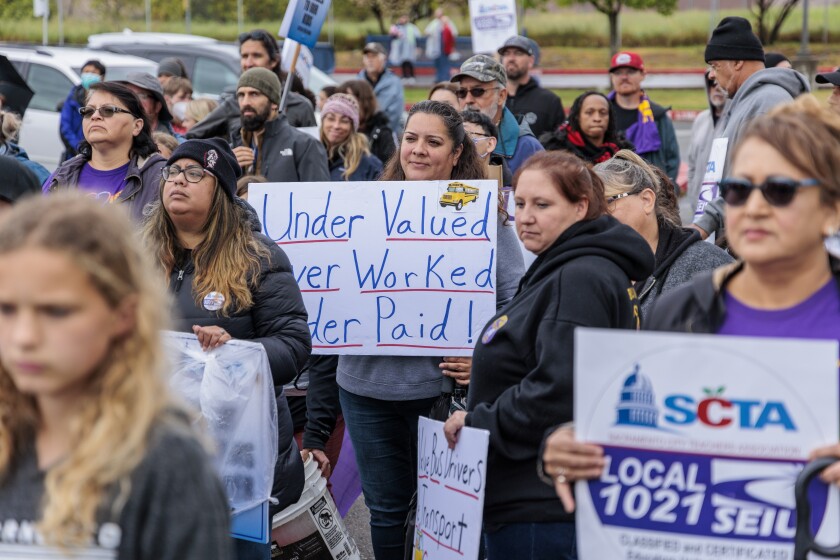
Sacramento City Unified School District teachers, school staff and supporters take part in a rally at Rosemont High School on March 28 as they have been gone on strike due to the staffing crisis in the district . All SCUSD schools shut down and will remain closed for the duration of the strike.
I have read many articles about the shortage of teachers and school staff. I have read many that were laden with statistics. This is one of the best. It appeared in the Los Angeles Times.
A few weeks ago, Sacramento teacher Kacie Go had 56 kids for second period.
That day, there were 109 students at her eighth- through 12th-grade school who were without an instructor because of staff shortages. So she crammed the students into her room and made it work, but “it’s not sustainable,” she said.
No kidding.
Go told me the story standing with hundreds of other teachers and support staff Tuesday morning in the parking lot of an empty high school, as “We’re Not Gonna Take It” blared from speakers and the mostly female workers gathered for day five of a strike that has closed down schools in the Capitol City.
Like Go, these teachers, cafeteria workers, bus drivers and instructional aides are fed up with being asked to do more with less. It’s a problem that goes beyond the Sacramento City Unified School District, with 48,000 students in 81 schools. Frustration among teachers and school workers is rampant across California — pushed to a breaking point by the pandemic and a shortage of more than 11,000 credentialed teachers and thousands of support staff as the state tries to expand pre-kindergarten and bring 10,000 mental health counselors on campuses.
From school closure protests in Oakland to Sacramento’s all-in strike, those who work in our schools are telling us they cannot do this job under the conditions we are imposing. These include mediocre pay, sometimes vicious political blowback from COVID-19 safety measures, a witch-hunt-like scrutiny around hot-button topics, a mental health crisis, the reality of too few people doing the work, and the general disrespect of a society that swears it loves teachers and values education but does little to invest in it. Worrying about school shooters, once an urgent concern of educators and parents, doesn’t even make the top three problems anymore.
It’s the same story playing out in hundreds of other districts not just in California but across the country. Minneapolis teachers just ended a 14-day strike that shared some of the same issues of pay and support, underscored by the same teacher chagrin that we talk a good game about supporting public education but don’t always come through with actions. Minneapolis Federation of Teachers Chapter President Greta Callahan summed it up, sounding like she could be standing in Sacramento.
“We shouldn’t have had to [have] gone on strike to win any of these things, any of these critical supports for our students, but we did,” she said.
Go, who has been a teacher for 20 years and earned a master’s degree along the way — bringing her to the top of the district’s salary scale at just more than $100,000 a year — estimates she’s losing about $500 a day during the walkout.
But she’s more worried about support staff such as Katie Santora, a cafeteria worker who was also on the picket line.
Santora is the lead nutrition services worker at a high school, expected to churn out 1,500 meals a day between breakfast and lunch — with a staff of nine people (though they started the year with only five). Most are part-timers because the district doesn’t want to pay them benefits, and they make about minimum wage.
Santora, with 13 years at the district, makes $18.98 an hour for what is essentially a management role. She’s in charge of ordering, planning, receiving and keeping the joint running.
On the last day before the strike, that included making popcorn chicken bowls for lunch. What does that look like? Five 30-pound cases of chicken, oven-baked, 22 bags of potatoes, boiled and mashed, corn and gravy — all assembled after her staff finished making steak breakfast burritos and scrambled egg bowls. Did I mention every student is required to take a piece of fruit, which means washing somewhere along the lines of 1,700 apples?
Santora says high schoolers are the “most misunderstood” people on the planet, teetering between child and adult. Their well-being, she says, depends on being fed so “their bellies aren’t rumbling in class” and seeing a friendly face when they walk in her cafeteria. She loves delivering both.
“When they come through the line, I like to say, ‘Thank you for having lunch with me,’” she says.
But the money isn’t enough to pay her bills. Four or five nights a week, she gets about an hour at home before she heads to her second job loading grocery bags for delivery drivers at Whole Foods. She’s working two jobs just to pay for the privilege of doing the one she likes.
Go, the teacher, feels the hardships in other ways. One of her twin daughters recently had a “pretty severe concussion,” she said, but Go felt like she couldn’t stay home with her. If she did, one of her co-workers would likely be stuck with a jampacked classroom — and all the other unofficial jobs she has to do on a daily basis, from fill-in parent to police officer to relationship advisor when her teenage students’ hormones go into overdrive. Substitutes are hard to come by, she thinks, because the pay — $224 a day — isn’t competitive compared with other jobs with less stress.
“Subs don’t have an easy life,” Go said. “Why would you want to do that when you could go to In-N-Out and worry about if it’s animal-style or not for the same amount of money?”
The unions involved in the Sacramento strike contend that there are hundreds of open positions in the district in virtually every job. Nikki Milevsky, a school psychologist and vice president of the teachers union, puts it at 250 vacancies for teachers and 400 for classified staff — in a district with 2,069 teachers and 1,656 classified staff. That classified staff and teachers walked out together shows the depth of problems in Sacramento — it’s unusual for both to strike at the same time, and it has forced schools to shut down because there was no one left but administrators to watch kids.
Chris McCarthy, a first grade teacher in the Sacramento Unified School District, joined other teachers, parents, students and supporters, in the rain at a rally in support of their strike against the school district at Rosemont High School in Sacramento.
The teachers union says that 10,000 students lack a permanent instructor, and on some days, up to 3,000 don’t even have a substitute. About 547 kids who signed up for independent study haven’t been given a teacher yet, meaning they are learning nothing.
The district says it’s down 127 certificated staff and 293 classified positions. Take the difference as you will, but the district doesn’t dispute it’s in a staffing crisis.
Sacramento teachers want a pay raise to make the district more competitive in hiring. Right now, some surrounding districts pay more but have lesser benefit packages. (Please don’t make me tell you that healthcare is a right, not a privilege.) The teachers want the district to back off of a proposal to make current and retired teachers pay hundreds more to keep a non-HMO health plan. The district says it has made an offer of a pay increase and recruitment bonus and a one-year stipend to offset the health plan issue.
From there it turns contentious. Teachers reject the district’s offer as lowball and assert there is money available to do better, just not the will to invest it in staff. The district says the teachers need to compromise because it can’t afford all of their asks.
For days, there were no negotiations. State Supt. of Public Instruction Tony Thurmond tried to bring everyone to the table, only to be rebuffed by the district. Back home again instead of in the classroom, my eighth grader, a student in Sacramento schools, ate lots of chocolate chip pancakes and watched “Turning Red” on repeat.
There is no end in sight. Though negotiations with both unions have resumed, the shutdown is another blow to parents and families already anxious and stressed out. The last time my daughter had a normal school year, she was in fifth grade. So I understand the frustration, and even anger, of parents that schools are once again closed — and the resentment of parents across the state who are sick and tired of problems with schools, many of which predate the pandemic.
But I went to the strike line three times and I can tell you this — it’s not about the money for these teachers. You can roll your eyes at the unions all you want, but these teachers and support staff want their schools to work, for their students, for themselves, and for our collective future. Because democracy depends on an educated populace and education is a right. And because they are educators, and they’re invested in our kids.
Go doesn’t want to do anything else but teach, even if it means 56 kids sometimes. Even if it means losing $500 a day and striking. Even if it means making some people mad to make schools better.
With so many laws passed forbidding the teaching of “critical race theory,” Kevin Welner has come up with an ingenious solution. Teach the law itself! Kevin is a lawyer who teaches education policy at the University of Colorado in Boulder. He is also director of the National Education Policy Center. He means this as an April Fool’s joke, but like all satires, there is more than a kernel of truth here:
In high-school classrooms throughout Texas, Oklahoma, Idaho, and other states that have passed laws apparently intended to prohibit the teaching of Critical Race Theory (CRT), a new type of elective course is popping up. Students in the classes read the state legislation and explore its meaning and impact.
One such course offered in Houston, Texas is called, “Get to Know SB 3”, which is a reference to that state’s bill passed in late-2021. Courses in other states and school districts have a variety of names, but what holds them together is an attempt to help students gain a deep understanding of their state’s law and what it accomplishes.
Kim Bell, who teaches the SB 3 course at Ladson-Billings High School in Houston, explained that the course was originally proposed by the school’s students. “None of them had heard of CRT until a couple years ago, but then everyone started talking about it and, more recently, about the law we thought would stop us from teaching it. The students turned to us because they wanted to know more, but at first we told them we were afraid to answer their questions about CRT. We thought that maybe the law stops us from even talking with them about it, so instead we told them about the law.”
Not surprisingly, the students then wanted to know even more about SB 3. “The more we told them, the more questions they asked. So we created this course. It’s not specifically about CRT, but we explain the theory because of its relevance to the legislature’s debates and intentions.”
Among the provisions in the Texas law is a prohibition against “inculcat[ing]” in students, “with respect to their relationship to American values, [that] slavery and racism are anything other than deviations from, betrayals of, or failures to live up to the authentic founding principles of the United States, which include liberty and equality.” As Bell’s students learn, this provision is a push-back against the generally accepted view of historians and other scholars, including those who use a CRT lens, who point to themany ways in which racism has been institutionalized in American laws and society.
The students also read the arguments used by proponents of the state laws. Texas Senator Ted Cruz, for example, charged that CRT is “every bit as racist as a Klansmen in white sheets.” Rhode Island State Representative Patricia Morgan complained that she had lost a black friend to CRT – “I am sure I didn’t do anything to her, except be white.”
This teaching hasn’t gone unnoticed by proponents of laws. “Using things we say – that’s just sneaky and divisive!” protested Rep. Leon Alabaster.
The classes, however, are moving forward. “It seems like the legislature wanted SB 3 to stop us from teaching about the reality of structural racism. Fine. Most students reach that conclusion on their own,” said Bell. “If the legislature prohibited our science teachers from telling students that gravity is real, they’d still reach that conclusion after seeing the objective evidence.”
Bell and other teachers we spoke with pointed out that, by the end of the course, their students often observe that the laws designed to stop them from learning about institutionalized racism are themselves institutionalized racism. Also, these laws that are designed to stop students from learning about CRT have instead resulted in their learning about CRT.
Bell’s students even started a CRT club at the school. These students told us that it’s the CRT lens that really helps them understand the institutionalized racism underlying the anti-CRT laws.
“We’re thinking about creating another elective called, Using SB 3 to Explore Irony,” said Bell.



 Diane Ravitch's blog