Archives for category: Education Reform

Send us your thoughts on best/worst events for our schools in 2022 & your hopes for 2023 so @danielalicea & I can share them on @WBAI Sat. at 1 PM EST on #TalkoutofSchool w/special guest @dianeravitch! Instructions here; or DM me. nycpublicschoolparents.blogspot.com/2022/12/for-ou… Deadline: Fri at noon.

You can send your thoughts on the best and worst things that happened to schools this past year by writing a tweet @leoniehaimson

Or writing her directly at “leoniehaimson@gmail.com”

Heather Long is a member of the Washington Post editorial board. She pinpoints the reasons for the national teacher shortage: low pay, but also pandemic stresses, and the ongoing political attacks on the teaching profession by extremists who want to prevent any teaching about racism or sexuality.

Message: pay teachers as professionals and let them teach as professionals, without censorship or interference by busybodies.

Long writes:

The U.S. economy hit a milestone this year: All 22 million jobs lost during the coronavirus pandemic were fully recovered. But that doesn’t mean workers went back to the same jobs. One of the sectors struggling the most to rebound is K-12 public education, which is still down more than 270,000 employees.


There is an educator shortage in the United States, but it is crucial to understand the details. First, this is about more than teachers. That 270,000 figure includes a lot fewer bus drivers, custodians and other support staff. Second, education isn’t simply about getting enough warm bodies into classrooms; it’s about having effective and qualified teachers and staff. The best analysis of the situation this fall, from the Annenberg Institute at Brown University, indicates a teacher shortage of nearly 2 percent, but more than 5 percent of positions are currently held by under-qualified teachers. Third, the shortage isn’t nationwide. It’s much worse in some schools and in some subjects.

In October, nearly half of public schools were still struggling to fill at least one teacher vacancy, according to a recently released Education Department survey. But schools in high-poverty neighborhoods were significantly more likely to have unfilled positions. Similarly, school districts report having an especially hard time finding special education, computer science and foreign language teachers, and bus drivers and custodial staff.

This isn’t a new phenomenon, but many signs indicate it worsened during the pandemic. Teachers experienced extreme levels of burnout from Zoom classes and safety concerns during the early days of the pandemic. Then came the culture wars that put teachers and staff under constant scrutiny over any conversations involving history, racism and sexuality. Throw in the Great Resignation, a tight labor market and rapidly rising pay in other professions, and the net result has been some teachers and staff retiring early. Others have quit and gone to work in different professions. And some recent graduates have decided not to enter education at all.

The single most notable achievement of Mayor Bill DeBlaio’s eight years as Mayor of New York City was the creation of a free, universal pre-k program.

Marina Toure of Politico reports that new Mayor Eric Adams is cancelling the expansion of the program to include all three-year-olds.

The immensely popular universal prekindergarten program was the brainchild of former Mayor Bill de Blasio in 2014. Three years later, he began expanding it to 3-year-olds. The pioneering education policy remains the single biggest achievement from de Blasio’s two terms in office. It was so successful that it became a national model for other major cities like Seattle and Washington.

Six years ago, New York City hosted leaders from a dozen cities across the U.S. to share lessons learned from its free early childhood education program for over 70,000 4-year-olds.

And yet, in a wildly expensive city where monthly child care costs top $3,500, a staggering 30 percent of free pre-K and “3K” seats were unfilled as of November.

Mayor Eric Adams, who took office in January, is canceling de Blasio’s plan for universal 3K, citing mismanagement of the program that led to the empty seats and budget cuts. Enrollment declines caused by the Covid-19 pandemic combined with a lack of education and outreach led to a striking imbalance where the lowest-income neighborhoods had the greatest number of empty seats and the wealthiest ones had long wait lists.

The result means children whose families are struggling the most will be deprived of a lifeline — a chance at the kind of free, quality education that’s been shown to improve performance in high school mathematics. It could also be a deterrent to other cities looking to replicate New York’s model after President Joe Biden repeatedly failed to get funding for early childhood education in spending bills.

Adams blames DeBlasio for the program’s shortcomings.

Leonie Haimson chimed in on the New York City parents’ blog to say that the program was “horribly implemented.” (Note: CBO=Community Based Organization.)

She wrote:

De Blasio’s preK program was horribly implemented and incredibly wasteful. Under Josh Wallach, the DOE insisted on putting as many kids as possible into elementary schools, including those that were already overcrowded and had waitlists for Kindergarten, contributing to worse overcrowding for about 236,000 students.

Meanwhile CBOs that had been in the preK program for years were starved for students, putting many of them at risk of closing down. There were MANY empty seats in CBOs, who directors begged for more students, to no avail. – despite the fact that their quality is rated more highly in many respects than the preKs in elementary school and provide services till 5 or 6 PM.

The Politico article mentions this [the botched implementation] in passing: “Finally, an application process controlled by the DOE — as opposed to parents being able to enroll their children directly with community providers — has led to access issues.” The CBOs had countless meetings with Wallach where he stubbornly refused to fix these problems

DOE also spent hundreds of millions of dollars in building stand-alone preK centers that stood half empty. The spending included renovating a leased space that previously housed a Dunkin Donuts shop in the basement of a parking garage in Brooklyn, costing six million dollars to create a preK classroom with a capacity of only 18 students, at a cost of $333,000 per student.

I wrote about this in our preK report ; press release here: https://classsizematters.org/the-impact-of-prek-on-school-overcrowding-in-nyc-lack-of-planning-lack-of-space/;

Our full report here. https://3zn338.a2cdn1.secureserver.net/wp-content/uploads/2018/12/PreK-report-12.17.18-final-final.pdf

Here is an excerpt: “In recent testimony before the New York City Council, Lisa Caswell, a senior policy analyst with
the Day Care Council of New York, a federation of 91 non-profits which run child care programs,
addressed the fact that DOE had diverted students not only from DOE pre-K centers but also
from CBO centers to public schools. She testified that in previous years, the DOE had been
engaged in the “recruitment of children directly from our [CBO] settings to fill UPK seats,” which
added to public school pre-K enrollment while leaving seats empty in CBOs, causing these
centers loss of students.”

This is an example of the danger of mayoral control. The mayor makes decisions that promote his standing in the polls. A program run by professionals would have been better implemented.

John Merrow shares his wisdom and makes a list of worthy recipients of your holiday giving. I’m happy to note that he included the Network for Public Education.

I hope you will consider making a donation to the Network for Public Education—either a one-time gift or a monthly gift.

NPE is working on behalf of students, families, teachers, public schools, and communities every day.

We have a small but mighty staff. We don’t waste money on a physical office. We produce reports, letters to legislators, and work with journalists to spread the good news about our public schools and their incredible teachers and students.

We need your help!


From Carol Burris, executive director of NPE:

December Newsletter: A new “Conversation with Diane Ravitch” and more

Can you spare just $5.00 a month to save public education?

Your monthly gift provides a dependable source of funding, enabling our team to put out Action Alerts, newsletters, seminars, and reports that inform the public, the press, and policymakers about the war on public schools.

Please commit today to a monthly amount of $5, $10, $15, or even $20. For NPE, monthly donations add up to make a big difference.

The stakes are getting higher all of the time. Just this week, the outgoing Oklahoma attorney general declared that it is unconstitutional to prohibit religious charter schools.

Betsy DeVos’s American Federation for Children and the Oklahoma governor applauded.

A Catholic online charter chain is ready to put in its application. The time is now to act to save public education.

Please sign up to make a monthly donation today.

DONATE NOW

Stephen Dyer is a very insightful and reliable analyst of school issues in Ohio. He used to be a legislator. He reads bills and budgets. He keeps everyone informed about the intellectual fraud that perpetuates the diversion of public funds to failing charters and voucher schools. In this post, he dissects a recent paper by the Fordham Institute, which is an outspoken advocate of school privatization. Fordham, writes Dyer, said the quiet part out loud. A few years ago, Fordham funded a study by David Figlio on vouchers in Ohio that showed their negative effects, but they try to ignore their own study.

Dyer writes:

There’s been some news coverage today of Fordham’s latest foray into fantasy — a study they claim proves EdChoice vouchers are perfectly fine and dandy for kids and taxpayers.

However, tucked away in one of their “findings” is a kind of startling admission — that EdChoice forces local school districts to rely more on property taxes to pay for educating the students in public schools.

“Combined with the decrease in enrollments, this dynamic led to a 10-15 percent increase in local revenue per pupil.”

I’m sure the study’s author(s) had no idea what they had just done. But those of us who have been saying the same thing for years sure did. This is an admission that EdChoice means that students not taking EdChoice vouchers have to rely more on local, voter approved property taxes to pay for their educations — the exact thing that the Ohio Supreme Court ruled four different times made Ohio’s school funding system unconstitutional.

“The overreliance on local property taxes is the fatal flaw that until rectified will stand in the way of constitutional compliance,” ruled Justice Alice Robie Resnick in the 4th and final DeRolph decision in 2002.

So it was nice of Fordham to admit this. However, the report went on to spend a lot of time trying to minimize the potentially existential lawsuit Ohio’s voucher program faces, as well as mocking me and others as “Chicken Littles” (because those with a winning argument always use ad hominem attacks to strengthen their position).

The study blows minimal to zero impacts on student success into enormous justification for increasing taxpayer subsidies for private school tuitions. As Michigan State’s Josh Cowen put it: “First and most important: the study presents a ton of zero impacts and tiny effects. Mostly this is a #schoolvouchers report about statistical noise, packaged as a win.”

Exactly.

Take the information on segregation. The study compares the racial makeup of voucher students with the statewide racial makeup of Ohio students. The study’s author, Stephane Lavertu of Ohio State University (who taxpayers paid $132,968 in 2019 to educate students) was very careful to only compare the racial makeup of EdChoice recipients with public school students “statewide”.

Because he knows that EdChoice voucher students don’t come from every district. They come from majority-minority districts.

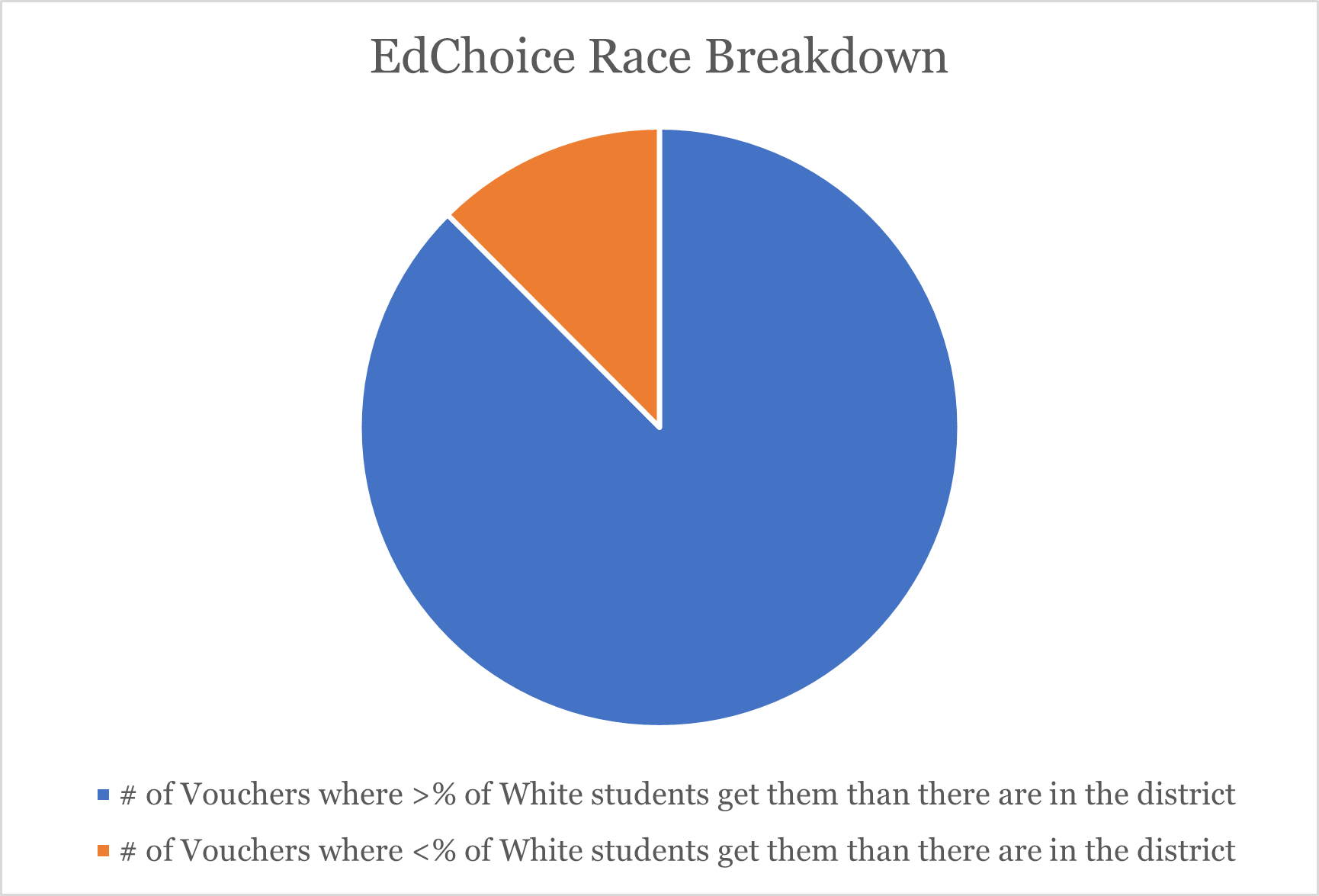
There are 95 districts that lose 10 students or more to EdChoice. In 76 of those districts, accounting for 87% of all vouchers given through the program, a higher percentage of white students take vouchers than there are in that district.

The average difference between white students taking vouchers and white students in those 76 districts was 76.2%. That means that in the districts where 87% of voucher students come from, voucher recipients are 76.2% more likely to be white than their public school counterparts.

My friends, that’s White Flight. Like, obvious White Flight.

Dear reader, do these data suggest — as Huffman wants you to think — that these segregation issues are “isolated examples”?

If 87% of voucher recipients are more likely to be white than the districts they come from, is that really “isolated”? Or is it “systemic”?

I mean in Huffman’s own district of Lima, Temple Christian takes 100% white voucher students. From a district that’s 35% white….

The vouchers worsen segregation. The students in voucher schools do worse on state tests than the public schools they left. What is more, “voucher students do worse on state tests the longer they take the voucher.”

A lose-lose, for students, for public schools, and for the state.

Nonetheless, despite failure, the state Teoublican legislature wants more vouchers and more failure!

Please open the link and keep reading this important post.

Donna Mace recently died, unexpectedly, and the public schools of the United States and Florida lost a dear friend.

Sandy Stenoff wrote this tribute to Donna, who taught elementary school students for 35 years, then became an outspoken activist for public schools and against the overuse of standardized testing. Of course, she was a BAT.

She concluded:

Donna Mace made the world a better place by being a force for good. She was a class act, approaching life’s challenges with courage, grace, humility, humor, and optimism, We all benefited from Donna’s wisdom, gained from her experience as a lifelong educator and a life well lived. She really was the best of us.

To the Mace family: Our thoughts are with you now and we send you love, gratitude, and a wish that your fondest memories will bring you peace and comfort.

I am sadened that we have lost Donna Mace. Many were inspired by her and will follow in her footsteps, never abandoning the struggle to do what is right for children. I hereby add her name to the honor roll, a list of distinguished fighters for public schools and children.

David Berliner and Carl Hermanns edited a book about the value and importance of public schools in a democratic society. Its title is Public Education: Defending a Cornerstone of American Democracy, and it was published by Teachers College Press. I was one of the contributors, along with other well-known figures in the field.

The book would be a terrific Christmas gift for an educator.

This review will give you a good look at the contents.

Public Education is a 346-page book containing 29 chapters penned by some of America’s most eminent scholars, including Diane Ravitch, Jennie Oakes, Sonia Nieto, H. Richard Milner, Deborah Meier, Ken Zeichner, Gloria Ladson-Billings, Michael Apple, William Ayers, and of course, co-editor David Berliner. The late Mike Rose has a chapter in the book as does Edward Fiske, the longtime New York Times education reporter and author of the ubiquitous Fiske Guide to Colleges.

While the themes of the book are quite varied, all the contributors to the book seem to agree that a child’s prospects in life, the quality of America’s public schools, and the country’s future as a democracy are all intimately intertwined. The importance of high-quality public education has been covered by Berliner previously in co-authored books such as The Manufactured Crisis (with Bruce Biddle, 1996) and 50 Myths and Lies that Threaten America’s Public Schools (with Gene Glass, 2014), and in well over a hundred articles.

However, in comparison with Berliner’s earlier works, this book has a stronger sense of urgency and a more dispiriting sense of disappointment in the ways in which federal and state governments have undermined, underfunded, and underappreciated the singular accomplishments of public education. In Berliner’s chapter on charter and voucher schools, for example, he uses the word scandalous over thirty times.

The very first sentence of the book’s introduction states, “The belief in the vital importance and central role of public education in the development of our country and the sustenance of our democracy runs deep.” When discussing the history and future of American public education, the specter of Horace Mann is always difficult to ignore. Indeed, more than half of the contributors explicitly discuss Mann’s ideas concerning the importance of a free education, sometimes in great detail. Even when he goes unnamed, Mann runs like a powerful current throughout these pages.
To offer a sense of the content and variety of the chapters, citations from four contributors follow.

Mark Weber
“Reform has become the core of the resistance to meaningful and sustained investment in schools. Education reformers are providing cover for those who fear that the United States might take its obligation to fund schools more seriously—starting with raising taxes on the wealthiest of its citizens.” (p. 205)
“A 2017 meta-analysis of merit pay experiments found ‘a modest, statistically significant, positive effect on student test scores (.053 standard deviations).’ This is the equivalent of moving a student at the 50th percentile in test scores to the 52nd percentile.” (p. 207)

Gloria Ladson-Billings
“Currently most major cities do not have enough white students attending their schools to adequately desegregate them.” (p. 227)
“The number of the most intensively segregated schools—with more than 90% of low-income students and students of color—more than doubled [from 2001 to 2014].” (p. 229)
“Beyond the crudeness of the per pupil expenditure measure is also the way ‘average daily attendance’ is derived. In Wisconsin, ADA is calculated on ONE day per year–September 15.” (p. 230)


Diane Ravitch

“After the Civil War, no state was admitted to the Union without an education clause in its constitution.” (p. 21)

“For many years, the term ‘school choice’ was stigmatized because of its association with advocacy for school segregation.” (p. 23)


Carol Burris

“The term public school is generally not viewed as a pejorative, which is why those who oppose public schools are so anxious to either exclude the term from the discourse, blur the definition, or hijack it for privatized systems.” (p. 236)

“We need to mind our words, being cognizant of how language has been used to shift the perception of privatized choice. Terms like privately-run charter schools and neighborhood public schools should replace public charter and traditional.” (p. 240)

As with any edited book, one chapter may seem nondescript while another may seem absolutely indispensable. For example, James Harvey’s chapter, “Education is our only political safety,” (pp. 214–225), a clearly written, tour-de-force about how education in the U.S. is funded, would be a perfect fit for an undergraduate foundations of education course.


Some of the book’s chapters are quite short and informal; others are fully realized, in-depth academic papers, replete with conclusions and recommendations. Most authors use APA bibliographic style, but a few use Chicago, and some chapters include no list of references at all. The chapters are divided into six “interrelated” parts that are so interrelated as to be indistinguishable from one another. Sections are identified not by titles but by Roman numerals, I–VI.

The divider pages indicating a transition to a “new part” often feature historical photos and text. For example, on p. 233, the divider page for Part V shows a picture of 16 very young child- employees of an oyster plant in a small town in Mississippi located on the Gulf of Mexico. The children depicted in the photo look to be between the ages of 5 and 8, and one of the 8-year-olds is struggling to hold another child-worker who appears to be around 2. The caption reads:

Before America had child labor laws and school attendance requirements….all [these children] worked from before daybreak until 5 p.m. for extremely low wages.”

Child Labor laws in the United States were ratified less than a century ago, in 1938. When children were liberated from the chains of illiteracy and the drudgery of working long hours for near-starvation pay, public schools emerged as welcoming, empowering institutions that offered the possibility of a better life. Rather than submit to a permanent sentence of indentured servitude, an American child—every American child—was suddenly given the opportunity to be treated as an equal among peers, regardless of race, religion, wealth, or family connections.

One can argue about the extent to which America has fallen short of its promises. But, powerful forces at work in the United States today are working to obliterate public schools and debunk the idea that every child deserves a fair chance. As noted repeatedly by the contributors to Public Education, if our public schools go down, our democracy seems likely to follow.


Author Biography
LAWRENCE BAINES, Ph.D., writes on educational policy and multisensory learning. He is the author of 13 books, including What’s a Parent to Do? How to Give your Child the Best Education (2022, Rowman & Littlefield). His homepage is http://www.lawrencebaines.com.
Roger Taney was the Supreme Court justice who wrote the Dred Scott decision, one of the worst decisions in the history of the Court. Its ruling upheld slavery. Taney’s bust will be replaced by a bust of Thurgood Marshall.

NPR wrote:

The House gave final passage to legislation to replace the bust of Roger Taney, the Supreme Court justice who wrote the Dred Scott decision, in the Capitol with one of Thurgood Marshall, the first Black person to serve on the high court.

The notorious 1857 Dred Scott decision upheld slavery and established that Black people were not U.S. citizens. The legislation, which passed Wednesday and now heads to President Biden’s desk, says the bust is “unsuitable for the honor of display to the many visitors to the Capitol.”

The statue of Taney sits at the entrance of the Old Supreme Court Chamber in the Capitol where the Supreme Court met from 1810 to 1860. Taney, the fifth chief justice, led the court from 1836 to 1864.

“While the removal of Chief Justice Roger Brooke Taney’s bust from the Capitol does not relieve the Congress of the historical wrongs it committed to protect the institution of slavery, it expresses Congress’s recognition of one of the most notorious wrongs to have ever taken place in one of its rooms, that of Chief Justice Roger Brooke Taney’s Dred Scott v. Sandford decision,” the legislation says.

“Taney’s ruling denied Black Americans citizenship, upheld slavery, and contributed, frankly, to the outbreak of the Civil War,” Rep. Steny Hoyer, D-Md., said on the U.S. House floor on Wednesday. “That’s why I and so many others advocated for his statue’s removal from the Maryland State House.”

Jeannie Kaplan is a former elected board member of the Denver Public Schools and a supporter of public schools. Alan Gottllieb is a journalist and a supporter of school choice.

They write:

A piece co-authored by the two of us will undoubtedly shock many people in the Denver education community because we frequently fall on opposite sides of the local education debate.

For example, Jeannie believes that the proliferation of charter schools is directly responsible for many of the challenges facing Denver Public Schools today. Alan sees charter schools as a net benefit to Denver’s families and students. Jeannie believes former superintendents Michael Bennet and Tom Boasberg did deep and permanent damage to DPS, with growing achievement gaps and too much emphasis placed on high-stakes testing. Alan counters that the district improved steadily, across all student groups, during their regimes.

But we, as Denver grandparents, are putting our differences aside for now because we agree on one key issue: DPS is seriously adrift, and it is time for the school board and the administration to get their acts together.

It’s irrelevant at this point to argue over which individual board members or district leaders are to blame for the current mess. The indisputable fact is that until the board can begin acting professionally, which includes providing clear direction to the superintendent, DPS will continue being a national embarrassment that gives the city as a whole a black eye.

No city in this country can hope to grow and thrive without at least a functioning public education system. Denver faces a host of challenges, to be sure, ranging from its failure to deal with the explosion in the number of people experiencing homelessness to crime to economic inequality.

But we believe that no issue is of greater consequence at this moment than the unraveling of DPS. To be sure, educators across the city are performing heroically on a daily basis. But given persistent dysfunction at the top, those educators are succeeding in spite of rather than because of district leadership.

Who could blame anyone a year after the current Denver school board took office for saying they’ve seen enough to have concluded the situation is hopeless with the current cast of characters in place?

There have been multiple instances of dysfunction, incompetence, and unseemly infighting. The board more often than not has proved unable to perform its core functions.

Combine this mess with the inept moves and general tone-deafness of Superintendent Alex Marrero and his team and what you’ve got is a school district in crisis, and distracted from addressing its most glaring issues.

But hope springs eternal. So, rather than despairing, we are going to suggest some ways out of the current morass.

One glimmer of hope is that we have a school board election coming up next November, in which three seats are up. Elections have a way of focusing incumbents’ attention. It gives them an opportunity to reflect upon, if not their shortcomings (that’s probably wishful thinking), at least their electoral vulnerabilities.

The public at large, as well as influential advocacy groups, need to make it crystal clear to the board that any incumbent who continues to feed the dysfunction without offering constructive solutions to the board and district’s issues will not be reelected.

They need to deliver those messages in stark terms beginning right now.

Next, individuals and groups on both sides of the Denver education ideological divide need to join forces, as we are doing here, to deliver a clear message to all board members, including those not up for reelection.

It’s a simple message:  Your behavior is unacceptable. You are not  serving our children. You are embarrassing yourselves and us. Get to work on what matters.

Surely there are enough shared interests that people passionate about public education can bridge their differences to deliver this message. It’s no exaggeration to say the future of the city hinges on its public education system improving, not spiraling into deep and permanent dysfunction.

Finally, Marrero needs to step forward and lead. This includes meeting one-on-one with his bosses, the seven board members, to tell them their behavior is making it all but impossible for him to get anything done.

Marrero has some public apologizing of his own to do as well. His mishandling of the school closure conversation last month left the district with no plan for addressing declining enrollment and related budget challenges. While some schools undoubtedly will have to close, it’s unclear how this will happen or when the decisions will be made. This uncertainty puts enormous stress on potentially affected communities.

Pressure on the district and board members over the lack of community closure conversations led six of seven board members to vote down Marrero’s ever-dwindling number of closure recommendations.

This provides a blueprint for how the citizens of Denver could force the board and the district to change course. Withering criticism from a diverse collection of voices could eventually prove too much for DPS to withstand.

People need to keep up the unrelenting pressure strategy across a host of issues. It is clear the board and the district aren’t going to fix themselves.

We’re going to have to show them the way. Or show them the door.