Archives for category: Education Reform


Linda Lyon is the president of the Arizona School Boards Association. She is a retired officer in the U.S. Air Force. She served her country in the military and continues to serve it by her participation in defense of public schools.

Colonel Lyon made this stirring video about democracy and public education. It is short and powerful. Please watch and share with your friends via Twitter, Facebook, and other social media. Show it to your PTA, the school board, the town council, the League of Women Voters, and every other group committed to strengthening the common good.

This video was sponsored by the Network for Public Education and produced, directed, and edited by Michael Elliott, a professional cinematigher

DONT BE HOAXED BY PRIVATIZERS AND PROFITEERS!


January 21-27 is School Choice Week, a multi-million dollar campaign funded by right-wing groups like the Koch Brothers, The American Federation for Children, ALEC and the Walton Foundation. The endgame is to replace public education with privatized systems of schooling. Read what the Center for Media and Democracy had to say here about School Choice Week.

We need YOU to help us tell the public the truth about so-called School Choice. And so we created a powerful campaign for you to use and share here.

Right Now
1. Send a letter to your Governor telling him or her that you support public education, not privatized education with vouchers, voucher-like tax credit schemes, charters and online schools. In just a few seconds you can send that letter by clicking here.

2. Go here to put a PRO-PUBLIC SCHOOL frame on your Facebook profile picture for the week. Just move your cursor down on the image and click “use frame.”

3. Watch and share this wonderful video of Arizona School Board President, Linda Lyon, unmasking what school choice has done in her state. Please share it on Facebook and go to the NPE twitter account (NetworkforPublicEd) and tweet it out. It is pinned to the top.

4. Join the Thunderclap sponsored by the #WeChoose campaign for public schools. Click here.

5.Go here to find a toolbox of resources to share all week. We will continue to post new material to share. Every day this week we ask you to go to the site and take action. Each action is designed to tell the truth about School Choice Week and its supporters.

On Friday you will receive another email from us asking you to send a letter to your legislators asking them to stop a backdoor voucher triggered by the recent tax reforms. More on that to come.

Here is the real choice we face.

Either we support public schools governed by our elected neighbors or we let state governments dole out tax dollars to parents to shop for schools.
We can’t have both.

Please do your part and get the message out this week. Thanks for all you do.

Share this link

#StoptheSchoolChoiceScam Week of Action


on social media and by email. Go back every day for new actions. Let’s let our friends and neighbors know that the right choice is public schools.

Carol Burris

The Network for Public Education is a 501 (c)(3) organization. You can make a tax deductible donation here.

  1. You can follow us on twitter and like us on Facebook.

This post was originally posted on December 21, 2016.

It is a review of my decision to oppose the Common Core standards. A few days ago, I met a high school teacher who told me she had quit her job as a teacher because her supervisor told her she could not teach poetry anymore, due to the Common Core standards. Defenders of the standards will say that the supervisor misinterpreted the standards. Unfortunately, many others are following the same guidelines: Put away poetry and classic literature; teach students to read informational text so the nation can be globally competitive. If I told you there was no evidence for this claim, would you believe me? Do you know that students can learn to read critically and thoughtfully whether they are reading literature or factual information? Every kind of text requires interpretation and understanding.


I oppose the mandated use of the Common Core standards. If teachers like them and want to use them, they should. I have no problem with that. It should be up to the teachers, not to a committee that was funded by Bill Gates, promoted by Arne Duncan, and marketed as a “state-led initiative,” which it was not.


I did not reach this view frivolously or for political reasons. I first read the standards in draft form in 2009. I read them when they were published in 2010. I was invited to the White House in 2010 to meet with the President’s top advisors–Melody Barnes, the head of the Domestic Policy Council; Rahm Emanuel, then the President’s chief of staff; and Ricardo Rodriguez, the President’s education advisor. They asked what I thought of the CCSS. I said that until standards are implemented, until they are tried and tested in classrooms with real teachers and real students, it is impossible to know how they will work. However good they might look on paper, the real test happens in real classrooms, where they must be tried and reviewed. I urged them to give grants to three-to-five states to implement the standards, listen to teachers, work out the bugs, and learn what effects they will have. Will they raise achievement? Will they narrow or lower the achievement gaps among different groups? We can’t know without running trials and revising what needs to be fixed. They flatly rejected my suggestion and said there was no time for that. I realized then that their goal was to have the standards in place in time for the next presidential election in 2012, whereas my goal was to figure out how to make sure the standards were valid and useful for students.


In 2013, after watching the fiasco of the rushed implementation of the standards in New York, I came out in opposition to them, in part because of the process, and in part because of the failure to implement them appropriately and create any mechanism for fixing them.


I also strongly oppose the arbitrary imposition of quotas for literature and informational texts. Those quotas have no basis in research or evidence. The quotas reflected the NAEP (National Assessment of Educational Progress) guidelines for assessment developers. As students get older, the tests have more questions that are informational. But the National Assessment Governing Board, which oversees NAEP, had no intention of telling teachers what they should teach or how much time to devote to literature or informational text. (I know this for a fact because I served as a member of NAGB for seven years.) One could read literature for twelve years and still be able to read informational text. The decision about how much time to spend on fiction or nonfiction belongs to teachers, not to national committees.


My bottom line is that teachers who like the Common Core standards should use them; teachers should be free to use any part of them; and teachers should be free to ignore them if they wish. Since they were  never field-tested, never validated, there is no reason to mandate them.


So here are some of the posts from the past that I hope will inform you about the CCSS and why I oppose them:


This was my first post, written in early 2013, explaining why I could not support the standards.


A post where I explained my views to the Modern Language Association.


This post in 2014 explains why the CC failed the test of standard setting.


No One Opposes Reading Non-Fiction

A post about the battle between fiction and nonfiction.


An explanation of why fiction matters, written by someone else.


Tom Loveless on the decline in teaching fiction.


Johann Neem on the danger of Common Core to the teaching of history:

Research say fiction matters.


That is a small sampling from scores of posts about Common Core.


I had long been a proponent of national standards. The flawed development and rushed implementation of the Common Core undermined my belief. As the results from the tests appeared, it became obvious that national standards do not raise achievement, do not narrow achievement gaps, and do not produce better education or equity. The Common Core taught me that national standards are not a solution to the problems of poverty, lack of appropriate funding, and neglect of education as a primary responsibility of the public. College-and-career readiness are not the purpose of education. Full development of every child’s capacities is. Preparation for citizenship is. Ethics and a sense of responsibility for oneself and to the community are. What matters most can’t be measured. Wisdom. Kindness. Character. Integrity. A love of learning. A sense of justice. Concern for others. Courage.


As time goes by, it seems clear that the biggest beneficiaries of the Common Core standards are the testing companies and the vendors of technology, not students or teachers.

Edward Johnson is an advocate for high quality public schools for all children. He lives in Atlanta. He has studied the works of G. Edwards Deming, who understood that you don’t blame frontline workers for problems with the system. If things go wrong, fix the system.

He wrote the following letter to Rev. Diane Daugherty about the absurdity of “choice” as a fix for the system (see her letter after his). In fact, “choice” is an abdication of responsibility by those who have the power to fix the system. They turn problems over to the market and hope for the best, ignoring the well-documented fact that the market deepens pre-existing inequities.

Of course, anyone who thinks that the Walton family, the DeVos family, Trump, ALEC, and other plutocrats are committed to civil rights and equity is either hopelessly naive or on their payroll.

He writes:


Rev. Diane Daugherty,

Thank you for lending your voice to the matter. Interestingly, one may take your understanding as a key aspect of the law research paper Opt-Out Education: School Choice as Racial Subordination, by Osamudia R. James, currently Vice Dean, University of Miami School of Law.

Atlanta superintendent Meria Carstarphen, Atlanta school board members, and BOOK, including especially its supporters UNCF and Andrew Young Foundation, would do well to learn from Vice Dean James’ paper.

But it may be unreasonable to expect any of them would. For example, this AJC article makes clear the superintendent, arguably Atlanta school choice proponents’ leader, holds an unshakable mindset fixated on commercializing public education in Atlanta by transforming it from a systemic public good into disparate private consumer goods, à la KIPP and others. So transformed, and unlikely to have resulted in improved schools, parents as consumers may then choose a school for their child just as they would choose a McDonald’s Happy Meal for the child. So goes the superintendent’s reasoning.

The pushback that arose in response to the superintendent’s profane conflation of consumerism and public education prompted school choice advocate Robert Holland to rise in her defense, with an attempt to say what the superintendent really meant to say. Holland, at the conservative and libertarian public policy think tank The Heartland Institute, blogged “The School Choice Generation Wants a Full Educational Menu.”

The Atlanta superintendent, school board, and BOOK would also do well to take from their partner and supporter, Walton Family Foundation, a lesson about how consumerism’s choice really works. Last week, the AJC and other media reported that, “based on a number of factors, including financial performance,” the Waltons made the decision to close their Lithonia Sam’s Club at Stonecrest. Was the store’s consumer community consulted or otherwise involved beforehand? Nope. Did the store’s consumer community have a choice? Nope. Now that once consumer community fears the Waltons have put upon it more problematic, if not new, food desert they did not “choose.”

The lesson, then, is who, in consumerism’s commercialized world, truly has choice and who truly does not.

Diane Ravitch offers an excerpt from Vice Dean James’ paper that amplifies the lesson (my emphases):

“James advocates for limitations on school choice ‘to prevent the disastrous social consequences–the abandonment of the public school system, to particularly deleterious consequence for poor and minority schoolchildren and their families–that occur as the collective result of individual, albeit rational, decisions. I also advocate for limitations on school choice in an attempt to encourage individuals to consider their obligations to children not their own, but part of their community all the same….The actual impact of school choice cannot be ignored. Given the radicalized realities of the current education system, choice is not ultimately used to broaden options or agency for minority parents. Rather, school choice is used to sanitize inequality in the school system; given sufficient choices, the state and its residents are exempted from addressing the sources of unequal educational opportunities for poor and minority students. States promote agency even as the subjects supposedly exercising that agency are disabled. Experience makes clear that school choice simply should not form an integral or foundational aspect of education reform policy. Rather, the focus should be on improving public schooling for all students such that all members of society can exercise genuine agency, initially facilitated by quality primary and secondary education. Ultimately, improving public education begins with preventing its abandonment.’”


This is Dr. Daugherty’s letter to the Atlanta Board of Education:


From: Diane Dougherty [mailto:doughertyadd@gmail.com]
Sent: Wednesday, January 17, 2018 8:01 PM
To: EdJohnsonAfQPE <edwjohnson@aol.com>
Cc: AfQPE@aol.com; bamos@atlantapublicschools.us; cbriscoe_brown@atlanta.k12.ga.us; epcollins@atlantapublicschools.us; jesteves@atlantapublicschools.us; lgrant@atlantapublicschools.us; nmeister@atlantapublicschools.us; pierre.gaither@atlanta.k12.ga.us; mjcarstarphen@atlanta.k12.ga.us; annwcramer@gmail.com; Erika Y. Mitchell <eymitchell@gmail.com>; Kandis Wood <kandiswood@gmail.com>; Michelle Olympiadis <michelle.olympiadis@gmail.com>; education@naacpatlanta.org; president@naacpatlanta.org; info@bookatl.org; david.mitchell@bookatl.org; Naomi.Shelton@uncf.org; sekou.biddle@uncf.org; cmeadows@morehouse.edu; mbinderman@geears.org
Subject: Re: BOOK and newly installed Atlanta Board of Education Members

BOOK seems to promote better outcomes outside any effort to make existing public education better. Their methodology seems to create parallel academic structures diminishing schools that need an infusion of structures and funds. To me their short term efforts will not evolve into a sustainable plan 30 years from now. Without any data that supports their perceived “Better Outcomes, BOOK’S emphasis on School Choice has proven a poor strategy in decimated African American schools in Tennessee, Michigan and Louisiana….in spite of billions spent…why would there be improved outcomes here if it has not worked there? Rev. Diane Dougherty

Diane Dougherty, ARCWP

Avondale Estates, GA 30002

678-918-1945

doughertyadd@gmail.com
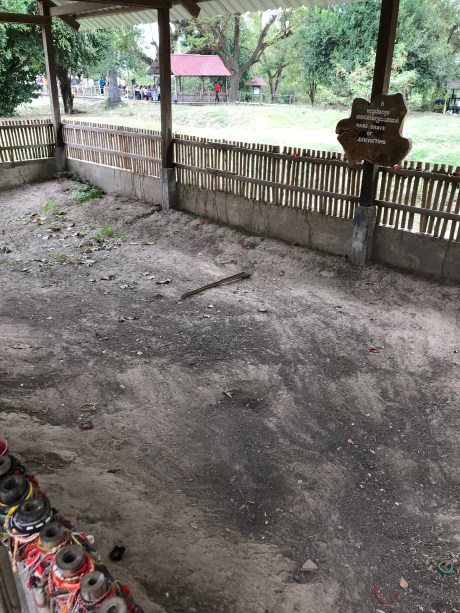


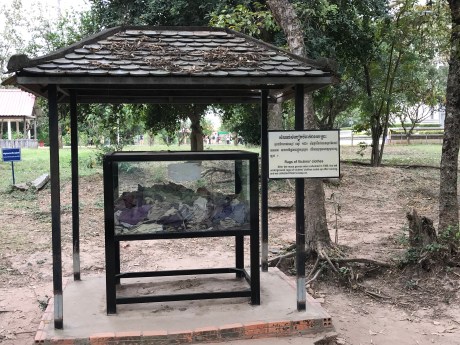
A few days ago, our group was brought to one of the mass graves where thousands of Cambodians were slaughtered by Pol Pot’s troops. They had committed no crime. They were teachers, doctors, engineers, mothers, children, people who wore glasses, people with metal in their teeth, people whose hands had no calluses..
What follows are some of the photos I took there.
A mass grave for 450 people.
IMG_1168
Another mass grave
IMG_1172
Rags of victims clothes
IMG_1174
Rags exposed by torrential rains in 2011
IMG_1175
A mass grave of women and children
IMG_1177
A tree where small children were killed by their heads being bashed against the tree. Mourners left mementoes on the tree.
IMG_1180
This tree had a loudspeaker to drown out sounds of suffering
IMG_1184


The Michigan House passed a bill to let the charter sector—including for-profit charters and cyber charters—share in millage revenues. Voters no doubt think they are underwriting their local community public schools, but they will be paying for the privately managed charters if the State Senate agrees.

https://www.freep.com/story/news/education/2018/01/18/michigan-legislation-millage-charter-schools/1045504001/

Michigan charters are unusual in that they operate with little accountability. Some 80% of the state’s charters operate for profit.

In recent years, with the spread of charters, Michigan’s ranking on NAEP has fallen from the middle of the national rankings to near the bottom.

Michigan believes in investing in failure. Results don’t matter.


We learned recently that the Electronic Classroom of Tomorrow was losing its authorizer, which had made 3% on every student who enrolled. Will ECOT die? Is it really finished? Maybe some other authorizer will step in to claim the commission for running one of the lowest performing schools in the nation. Obviously, no one in state government was willing to close ECOT down.

Meanwhile, give the devil his due. Someone has profited, even if kids have not.

Stephen Dyer writes about the profits extracted by ECOT’s sponsor. More money goes to the profiteer investor than to the teachers.

https://10thperiod.blogspot.com/2018/01/ecot-in-receivership-ecot-paid-more-to.html

How do you spell S-C-A-M?

In Ohio, it seems, if you take care of politicians, they take care of you.

The kids don’t pay the legislators.


Roxana Marachi writes about two proposals before the California State Board of Education today. Maybe the decision has already been made.

Question: Is it true that “anyone can open a charter school in California?”

Does it matter if the proposal comes from an organization that has previously failed?

Does it matter that no one knows who will actually run the school?

Do California taxpayers care how their money is spent?

Does the State Board of Educatuon have any quality standards?

Can convicted felons open charters?

Can maniacal parents home school their children and chain them to their beds?

Does California have any standards?

Or is it Betsy DeVos’ Dream State?


Although the owner of the so-called Electronic Classroom of Tomorrow has collected over $1 billion in the 15 years he has owned the low-performing School, the State has demanded that he repay $60 million for inflated enrollment.

William Lager fought the judgment and lost in court.

Now the authorizer is cancelling its contract with ECOT.

We can call it the Electronic Classroom of Yesterday.

I posted this law review article in 2015. It remains one of my favorites. Her argument is straightforward. Abandoning the public school system is an assault on the rights of most children, especially the most vulnerable.

I wrote when I posted it nearly three years ago:

Osamudia R. James is a law professor at the University of Miami School of Law. She is a scholar of race and equity. She has written a scholarly article that was published in the Iowa Law Review titled “Opt-Out Education: School Choice as Racial Subordination.” I hope that readers of this blog will take the time to read it. It is an important legal analysis of the social inequities caused by school choice.

As more children are induced to leave the public school system, the public schools are less able to provide a decent education for those who remain behind. Many of those who leave will attend charter schools and voucher schools that are no better and possibly worse than the public school they abandoned. The harm done to children by this strategy is powerful, and the harm done to society is incalculable.

James advocates for limitations on school choice “to prevent the disastrous social consequences–the abandonment of the public school system, to particularly deleterious consequence for poor and minority schoolchildren and their families–that occur as the collective result of individual, albeit rational, decisions. I also advocate for limitations on school choice in an attempt to encourage individuals to consider their obligations to children not their own, but part of their community all the same….The actual impact of school choice cannot be ignored. Given the radicalized realities of the current education system, choice is not ultimately used to broaden options or agency for minority parents. Rather, school choice is used to sanitize inequality in the school system; given sufficient choices, the state and its residents are exempted from addressing the sources of unequal educational opportunities for poor and minority students. States promote agency even as the subjects supposedly exercising that agency are disabled. Experience makes clear that school choice simply should not form an integral or foundational aspect of education reform policy. Rather, the focus should be on improving public schooling for all students such that all members of society can exercise genuine agency, initially facilitated by quality primary and secondary education. Ultimately, improving public education begins with preventing its abandonment.