I can’t tell you how angry this post made me. I felt outraged and frustrated. It is not just about privatization. It is about the purchase of an entire state by one family. How can anyone teach civics in Arkansas when one family owns everything?
This post will make your head spin. Public schools in communities of color are taken over by the state, and charter schools open. One high-powered chain. spreads it’s tentacles across the state, scooping up the best students. A rotating cast of characters plays musical chairs at the state board, the state education department, and superintendencies.
The schools targeted for closure and privatization are schools that enroll mostly children of color. Everyone feels powerless to stop the Walton train.
Behind it all: ALEC, the Koch brothers, and the Walton Family. The Walton Family owns everything and every body.
Schools? Education? An afterthought.
This saga reads like a gangster tale. The mob always wins.
I was contacted by a minister in Little Rock who asked, what can we do? My advice: civil disobedience. Mass protests. Marches. Demonstrations. Chain yourselves to the schoolhouse doors. Nothing else will work. The greatest enemy is complacency, apathy, hopelessness. Faced with the unlimited power of a family that owns the state government, it is easy to feel hopelessness. But resistance is the only path. The other way, the status quo, is servitude.
Basketball Star Kevin Johnson was Mayor of Sacramento. He married Michele Rhee, ex-face of the privatization movement. Before their marriage, Johnson founded St. Hope Academy charter schools in Sacramento.
What has St.Hope got to do with Tony Thurmond’s Task Force on the fiscal impact of charters?
One member of the task force, Margaret Fortune, was the superintendent of St. Hope Academy. A graduate of Berkeley, she has stellar academic credentials. Nothing on her resume, however, refers to experience as a teacher or a principal. She is now board chair of the California Charter Schools Association, the powerful lobby for charter schools.
Another member of the task force is Ed Manansala, who is Superintendent of the El Dorado County Office, which runs a SELPA, providing special education services for students in charter schools. El Dorado County’s SELPA offers low prices and competes for students with disabilities in districts hundreds of miles away. How they are able to provide services to students in distant and far-flung districts is not clear.
A reader sent this additional information.
“Ed Manansala used to work at Sac Charter HS as a Principal of one of the small schools (School of Business), when Margaret Fortune was Superintendent of St. HOPE public schools. When she resigned to take over The Fortune School (her Dad’s teacher prep program), Ed became Superintendent of St. HOPE before moving back into the public sector as El Dorado County Superintendent. “
I googled and indeed Ed Manansala was principal and superintendent of Kevin Johnson’s St. Hope Academy Charter High School in Sacramento before he became County Superintendent in El Dorado.
So, yes, indeed, a majority of the members of the task force that is supposed to scrutinize the fiscal impact of charters on public schools have direct connections to the charter industry.
The membership of the task force does not inspire confidence in its judgment or independence.
The question remains: Why did Tony Thurmond and Gavin Newsom give a majority of the seats on this task force to people directly connected to the charter industry, which enrolls only 10% of the students in the state? This is especially curious since the same charter industry spent many millions trying to defeat both Thurmond and Newsom.
Another Question: Did they think no one would notice?
Craig Harris of the Arizona Republic is part of the Polk Award-winning team that investigated charter school frauds, scams, and abuses.
This is the second part of an article in which he describes the mistreatment of students and the state’s failure to investigate complaints.
He writes:
“Charter and district schools are both publicly funded schools, but they are vastly different in how they’re governed.
“School districts have boards elected by local voters. Those boards hire superintendents who are responsible for personnel and policies. Board meetings are typically held at least monthly and are open to the public.
“Charter schools boards, meanwhile, are appointed by the charter owner, who in some cases is also on the board. Some Arizona charter schools have only two board meetings a year, each lasting 10 minutes. In some cases, a charter owner determines who is allowed to address the board.
“A Brown University study from 2014 found charter schools, in general, because of their autonomy face less scrutiny of their finances, and the lack of oversight has led to numerous cases of fraud across the country.
“Anabel Aportela, a research director for the Arizona School Boards Association who had a similar role with the Arizona Charter Schools Association, said members of district school boards are “accountable to their communities and voters in their districts,” but charter school board members are not.
“The proposed changes would not necessarily help a situation like the Georges’ because the bill does not guarantee parents access to a charter school’s board of directors. It also does not prevent a charter owner from stacking a board with friends and relatives.
“The bill has passed the Senate Education Committee and is working its way through that chamber.
“In Arizona, with minimal access to a local charter board to air complaints, typically the public’s only recourse is to appeal to the state Charter Board, an 11-member body mostly appointed by the governor.
“The Charter Board, with just 11 employees, is tasked with monitoring more than 500 Arizona charter schools. That means only a small fraction of complaints are investigated, The Republic has found.
“An analysis of 89 public complaints to the Charter Board from the past four years released to The Republicunder the state’s Public Records Law, showed only 12 percent were investigated. The rest were closed after the charter operator responded in writing, often denying the allegations.
“Among the cases that went without investigation were complaints of bullying, refusal to provide student transcripts, a 5-year-old boy leaving campus unsupervised, violations of the Open Meetings Law, failure to provide special education services, classroom temperatures being too cold, and a teacher cutting a girl’s hair without parents’ permission.
“In some instances, schools changed course following a complaint to the Charter Board. The student who was unable to get his transcripts from Arizona Call-a-Teen Center for Excellence obtained them after he filed a complaint.
“The state’s Charter Board not only investigates few cases, it also lets parents see little information about the complaints themselves. The Charter Board does not make public on its website the number of complaints against a charter school, nor does it post them online even though complaints are public record.
“Gov. Doug Ducey — following a yearlong investigation by The Republic that found widespread financial abuses, profiteering, and insider deals at charter schools — has proposed adding 10 additional regulators to the Charter Board. The additional staff could result in more complaints being investigated.
“Ducey’s office estimates the new Charter Board staff will more than quadruple the number of visits to schools to investigate fraud. Currently, just 15 percent of Arizona’s charter schools receive a site inspection each year to make sure a school is accurately reporting its finances and enrollment to the state.
The kinds of cases the Charter Board doesn’t investigate
“After a 5-year-old boy wandered away from Mesa Arts Academy on Aug. 15, 2016, while on “time out” his parents complained to the Charter Board.
“In its response to the August 2016 complaint, Mesa Arts Academy confirmed the child had left campus, and that police had been called before a staff member found the child. The school added it had since installed security cameras.
“The Charter Board elected not to investigate further.
“The Charter Board also took a pass when a 15-year-old girl at Heritage Academy Gateway said a male classmate put his hand under her shirt and groped her.
“The girl told her parents about the alleged incident in early September, and the parents notified the school. School officials, in turn, reported the incident to the Maricopa County Sheriff’s Office.
“The Republic typically does not disclose the identity of alleged victims of sexual abuse.
“The day after the incident was reported, the boy transferred from Heritage Academy to another charter school.
“The girl’s family said that allowed the boy, whose mother is a Heritage administrator and member of its board, to avoid discipline.
“According to the girl’s parents, the boy continues to visit the Heritage Academy Gateway campus every afternoon.
“Calls to Heritage for comment were not returned.
“The girl said the incident has caused her to see a therapist for anxiety.
“I don’t like seeing him on campus,” she told The Republic. “It’s kind of scary to see him in that situation.”
“Her father said the family asked Jared Taylor, Heritage Academy’s charter holder, CEO and board chairman, to keep the boy off campus.
“It’s pretty little what we have asked for,” the father said in an interview.
“Records the school provided to the Charter Board in response to the complaint indicate Heritage Academy denied their request.”
The Arizona Republic recently won a Polk Award for its outstanding coverage of charter corruption.
Craig Harris, a member of the investigative team, writes here about how charters ignore parents’ complaints.
When a student is mistreated, there is no re ourse. The boarddoesnt care. It protects the school,not the student.
Students in charter schools have no rights. The parents of the student in the incident described herewithdrew him from the school.
Harris writes:
“Evan George had finished his classes for the day and was hanging out with friends at American Leadership Academy’s Queen Creek campus, when two staff members approached and accused him of vaping.
“Evan, 16, says he was doing a trick with his mouth thatproduces a plume of moist air that resembles vapor from an electronic cigarette.
“His explanation didn’t convince the charter school’s staffers.
“Evan was ordered to the administration office, where Athletic Director Rich Edwards took him into a room and searched him, looking for a vape pen, which would have been a violation of school policy.
“He told me to take my pants down, and he put his fingers in my underwear,” said Evan, who is a junior. “I felt scared.”
“The search didn’t turn up a vaping device, according to records the school provided to the Arizona State Board for Charter Schools.
“ALA still suspended Evan from school for eight days.
“His parents, Chris and Kimberlie George, said both the Dec. 11 search and the suspension were wrong.
“The athletic director inappropriately touched their son, they said. And the school suspended Evan without proof he’d had been vaping, even though their son’s only prior disciplinary issues were for wearing torn jeans and chewing gum, they said.
“But when the Georges sought an independent review of Evan’s suspension, they found they had nowhere to turn.
“Arizona’s charter schools are primarily run by private companies. They must have a governing board, but school owners get to pick who’s on the board, so many are stocked with relatives, friends and even the charter’s owner. In some instances, boards have just one member — the charter operator.
“American Leadership Academy Queen Creek student says he was strip searched over vape trick
16-year-old Evan George says he was strip searched in December 2018 after performing a trick that made it appear vapor was coming from his mouth.
“Beyond the school, parents can only turn to the state Charter Board. And regulators there, because of limited resources and limited authority, rarely investigate such complaints against schools, an Arizona Republic investigation shows.
“The result is a lack of independent oversight that leaves students and families at some charter schools, in disagreements big and small, with no recourse to challenge school officials’ actions — even if they think those moves inhibit their students’ academic progress or personal safety.
“ALA Queen Creek officials denied the Georges’ request for an appeal hearing before ALA’s Board of Directors, which is composed of friends of ALA founder Glenn Way.
“Evan was never afforded due process,” Chris George said. “He wasn’t able to speak to his accusers, and the dismissal hearing was a farce. There was no interest in what the truth was.”
The Arizona Republic has previously written about Glenn Way, the founder of this charter chain.
On July 11, 2018, the Arizona Republic described how Way has made millions of dollars through hischarter chain.
“When Glenn Way moved to the East Valley at the end of the Great Recession, he might have been looking for a fresh start.
“The charter school operator was deep in debt to the IRS, had sought bankruptcy protection, and recently resigned from the Utah Legislature after his wife filed a protective order against him, public records show.
“Arizona offered other opportunities for someone in his line of work: A more lightly regulated charter school industry that’s well-funded.
“At his American Leadership Academy, which he launched in June 2009, he promised students would find “the best educational experience … in a moral and wholesome environment.”
“Thanks partly to Arizona’s favorable charter school laws and lucrative no-bid contracts with ALA, Way would find new wealth.
“The schools, which have made patriotism central to their brand, including red, white or blue student apparel, have been a hit in the conservative East Valley. American Leadership — which bears the same name as a charter school Way and his wife, Shelina, operated in Spanish Fork, Utah — has over nine yearsgrown to a dozen campuses with 8,354 students in Florence, Gilbert, Mesa, Queen Creek and San Tan Valley.
“Way’s own development and finance companies bought the land and then built most of the school buildings. Then, they sold or leased them to American Leadership Academy, where Way, until last year, was board chairman.
“An Arizona Republic review of property records shows that during ALA’s nine-year expansion, businesses owned by or tied to Way made about $37 million on real estate deals associated with the schools — funded largely by the Arizona tax dollars allocated to his charter schools.
“Way disputes the profit figure, saying undisclosed capital costs tied to the campuses, such as street improvements, trimmed profits to $18.4 million. He did not provide documents to show a lower profit.
“But building and selling the schools weren’t the only ways he has profited. Another one of Way’s firms is paid at least $6 million a year to operate them under a contract with American Leadership, records show.
“An Arizona charter schools watchdog said regardless of the precise size of the multimillion-dollar profit, it’s clear that Way has profited handsomely — like other charter operators — using Arizona’s loose charter school laws.
“Meanwhile, the Arizona State Board for Charter Schools is investigating allegations of financial mismanagement at ALA.
“Way said there has been no wrongdoing.
“Charter schools were not designed for people to make a profit,” said Chuck Essigs, government relations director of the Arizona School Association of Business Officials.
“Way disagrees.
“The (charter school) law is silent on the question of profit, and for good reason. Arizona families will only benefit if more operators of quality charter schools are enticed to expand their offerings in our state,” said Way, who is building a home in Queen Creek valued at nearly $1 million.”
It must be the height of patriotism to get rich from public funding intended for schools.
More than 200,000 people have died because of opioid addiction.
Governor Raimondo of Rhode Island is not returning contributions from Jonathan Sackler, although other elected officials have done so.
The Sackler family is worth about $14 billion based on the success of their addictive drug. Jonathan Sackler is a major donor to charter schools. He founded ConnCAN and is a board member of 50CAN and other charter-promoting organizations.
I have often wondered whether their grand mansions are haunted by the ghosts of those killed by OxyContin.
A report on Monday by Reuters said that embattled OxyContin manufacturer Purdue Pharma is considering bankruptcy to shield itself from more than 1,600 lawsuits, including by the State of Rhode Island and by multiple Rhode Island cities and towns.
“The potential move shows how Purdue and its wealthy owners, the Sackler family, are under pressure to respond to mounting litigation accusing the company of misleading doctors and patients about risks associated with prolonged use of its prescription opioids,” reported Reuters.
The Sacklers rank as the 19th richest family in the United States according to Business Insider.
Jonathan Sackler, who has been a board member of Purdue Pharma, and his wife Mary Corson, are significant donors to Governor Gina Raimondo. Raimondo, who has said in the past she supports the Rhode Island lawsuit against Purdue Pharma, has refused to donate or return the donations from the Sacklers.
In contrast, Lt Governor Dan McKee donated campaign donations from Sackler and Corson to Rhode Island agencies that treat substance abuse.
I posted earlier that there are no teachers on the task force appointed by Governor Gavin Newsom and State Superintendent Tony Thurmond to study charter law in California, but that’s not quite right. The task force is meeting regularly and it would likely be impossible for a working teacher to leave her or his classroom on a weekly basis to attend task force meetings.
However, there are at least two members of the task force who were active teachers: Erika Jones of the California Teachers Association and Cindy Marten, superintendent of the San Diego Unified School District.
I don’t understand why the task force has so many representatives of the charter industry on a committee to study charter law, when only 10 percent of students in California schools are enrolled in charters. The charter industry is infamous for protecting its turf and fighting any regulation or accountability. This is like asking representatives of Big Tobacco to participate in a discussion of whether to regulate cigarette sales.
Charter law in the state is notoriously lax. A district with a tiny enrollment can open a charter in a district 500 miles away and collect a commission on the students who enroll. If a charter asks a district for permission to open or for a renewal, and the district rejects the application, the charter can appeal to the county board. If the county board says that its application or its record is deficient, the charter can appeal to the state board. Under Governor Jerry Brown, the state board rubberstamped applications despite rejections from the affected district and county. Under current law, the state need not consider the fiscal impact of charters on nearby public schools, a factor which has severely damaged Oakland, Inglewood, and other districts. Under current law, charters are parasites on the districts that are forced to host them, draining away students and resources and leaving “stranded costs” (fixed costs).
California has had a large number of scandals in the charter sector. The most recent occurred when the CEO of the Celerity Charter chain pled guilty to using the schools’ credit card to charge luxury items, including designer clothing, fancy hotels, haute cuisine and limousine service, as well as to fund her Ohio charter school.
These are issues the task force will consider. Will the large bloc of charter supporters on the task force acknowledge the fiscal problems caused by charters for the public schools that enroll most students? Or will they fight stubbornly to maintain the charters’ freedom from accountability? Why did the California Charter School Association get two members of the task force but the California Teachers Association get only one? If charter schools undermine public schools, it is a net loss for the children of the state. If failing charters are allowed to be renewed again and again, it is a disgrace.
Here is the complete task force:
The task force members are:
Cristina de Jesus, president and chief executive officer, Green Dot Public Schools California (charter chain);
Dolores Duran, California School Employees Association;
Margaret Fortune, California Charter Schools Association board chair; Fortune School of Education, president & CEO;
Lester Garcia, political director, SEIU Local 99 (Local 99 took $100,000 from Eli Broad to oppose Jackie Goldberg);
Alia Griffing, political director, American Federation of State, County and Municipal Employees (AFSCME) Council 57;
Beth Hunkapiller, educator and administrator, Aspire Public Schools (charter chain);
Erika Jones, board of directors, California Teachers Association;
Ed Manansala, superintendent, El Dorado County; board president, California County Superintendents Educational Services Association;
Cindy Marten, superintendent, San Diego Unified School District;
Gina Plate, vice president of special education, California Charter Schools Association (charter lobby);
Edgar Zazueta, senior director, policy & governmental relations, Association of California School Administrators (ACSA endorsed Marshall Tuck against Tony Thurmond).
Last November, there was a bitter contest for the position of Superintendent of Public Instruction in California.
The charter lobby pumped millions of dollars into the campaign of Marshall Tuck, former CEO of Green Dot charter schools. The charters spent twice as much as the California Teachers Association, which backed Tony Thurmond.
In a tight race, Thurmond won.
In two recent teachers’ strikes, in Los Angeles and Oakland, teachers demanded a moratorium on new charters until the fiscal impact of charters on public schools was thoroughly studied.
In response, Governor Gavin Newsom asked State Superintendent Tony Thurmond to set up a task force to examine the issues that charters raise and consider any needed revisions in the law.
Thurmond appointed an 11-member panel. Not a single one of the 11 is a teacher, even though teachers raised the questions in their strikes.
Worse, a possible majority of the panel represent the charter lobby that fought so hard to defeat Thurmond, smeared him with negative ads, and lost.
Here are some of the members:
Cristina de Jesus, president and chief executive officer, Green Dot Public Schools California;
Margaret Fortune, California Charter Schools Association board chair; Fortune School of Education, president & CEO;
Lester Garcia, political director, SEIU Local 99; (Charter against Jackie 100K Broad IE)
Beth Hunkapiller, educator and administrator, Aspire Public Schools
Ed Manansala, superintendent, El Dorado County; board president, California County Superintendents Educational Services Association; (El Dorado Charter Officers. President. Marcy Guthrie … Ed Manansala, Ed.D., County Superintendent El Dorado Co. Office of Education
Rite of Passage Charter High School – El Dorado County Office of Education …
Gina Plate, vice president of special education, California Charter Schools Association;
Edgar Zazueta, senior director, policy & governmental relations, Association of California School Administrators. (LED Endorsement of Marshall Tuck)
It appears that seven of the 11 task force members are in the tank for charter schools.
This is by no means a balanced or open-minded committee.
How likely are they to propose tighter regulation of charter schools?
How likely are they to propose that districts should not be allowed to open charter schools in other districts, a policy that has led to financial abuses?
How likely are they to curb the waste, fraud, and abuse that allow fly-by-night charter schools to open in strip malls, collect money, then disappear?
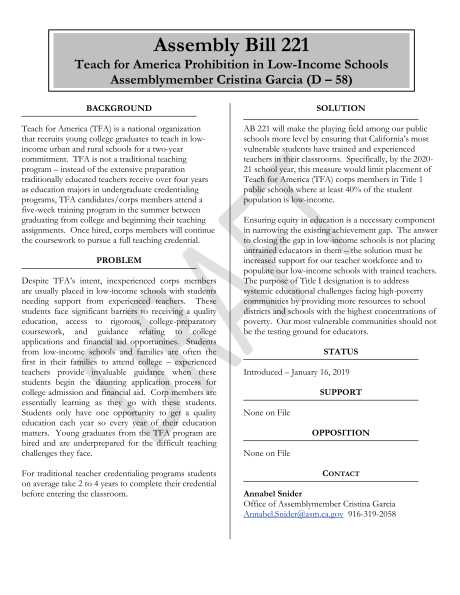
In this brief radio interview, Professor Julian Vasquez Heilig of California State University in Sacramento explains the rationale behind Assembly Bill 221, which would ban TFA teachers from teaching in schools with high numbers of impoverished students. He says that the neediest students need well-prepared, experienced teachers, not novices.
Four members of the task force are part of the charter industry.
Thurmond is amazingly evenhanded. In the race for the office last fall, the charter industry outspent him 2-1 and smeared him with negative advertising.
Ten percent of the state’s students are in charter schools.
The task force should be sure to read University of Oregon Professor Gordon Lafer’s Study of the fiscal impact of charters on three districts, called “Breaking Point.”
In the two recent teachers’ strikes, in Los Angeles and Oakland, teachers called for a moratorium on new charters until such a study was completed. Governor Newsom has been noncommittal on that demand.
The charter sector has operated with minimal or no oversight. To see how bad things are, read “Charters and Consequences.” There are storefront charters where students meet their teacher only once every three weeks. There are charters with graduation rates under 10%. Charters are allowed to open wherever they want. Charters can appeal a district rejection to the county, then appeal the county rejection to the state, where they usually got a rubber stamp. Charters may be run like chain stores, without oversight, just to make money. Until Newsom signed a bill recently, there were no laws profiting conflicts of interest or nepotism. The charter industry vigorously opposed any regulation or accountability.
One charter executive called the ban on conflicts and nepotism a “scorched earth policy.”
Lisa Haver, a pro-public school activist in Philadelphia wrote to tell me that “It’s a new day in Philadelphia!”
The old School Reform Commission, appointed by the governor and mayor, routinely approved charter school applications, no matter what the charter operator’s performance or record.
Last week, the new school board turned down three charter applications.
She wrote:
Hi Diane,
The new Board, which replaced the state-imposed School Reform Commission last year, voted last night to deny all three of this year’s charter applications.
The decisions, with the exception of a few abstentions due to conflicts, were unanimous.
There was not a single yes vote for any of the three applicants.
Board members gave several reasons why they rejected the applications.
The SRC would approve applications for clearly inadequate applicants, mostly for political reasons.
These schools would have cost the District over $161 million over 5 years, including stranded costs. Now we can use that money to hire more support staff and fix our older buildings.
“In a series of historic votes, Philadelphia’s Board of Education denied all three new charter school applications at its meeting Thursday, amid calls for a full moratorium on charters. After protest from charter advocates and a group of students, the votes reversed the dominant reasoning of the former School Reform Commission, which the board seemed to uphold in December when it voted to renew the charter of Richard Allen Preparatory Charter School in an attempt to avoid legal fees that could result from a lengthy appeals process.
“This time, board members denied the three applications to expand the operators’ charter school networks, citing struggling academics at the applicants’ other schools and a difficulty serving diverse and vulnerable students. Members also mentioned that applicants have other charter schools that are operating under expired charters, without signing the conditions offered by the board, which would require the schools to meet various standards.
“City Councilwoman Blondell Reynolds Brown spoke in favor of String Theory’s proposed new charter school, the Joan Myers Brown Academy, named after the founder of the Philadelphia Dance Company. It was envisioned as a performance arts charter school in West Philadelphia with a focus on dance.
“The vote took place after outraged testimony from Joseph Corosanite, the co-founder of String Theory Schools.
“It’s challenging for me to see an evaluation of us that is deeply flawed and biased,” Corosanite said, referring to the evaluation of String Theory’s application by the District’s Charter Schools Office. “I understand that there still may be some question, but there is not part of our application that can’t be worked through if you choose to approve us.”
Corosanite said the school should be approved because the neighborhood schools in West Philadelphia are “some of the worst in the city from an academic standpoint, as well as from a facilities standpoint.
“People don’t know how we do this because they’ve never done it before.”
“Board members explained their thoughts after the votes were taken.
“I did not come to the board with the perspective that all schools were bad. I certainly did not come with the perspective that charters are better,” said member Leticia Egea Hinton. “I’m sometimes confused by the perspective that charters, no matter how low-performing, are better and that public schools, no matter how great, are still bad.
“Our challenge is: How do we create a system that provides a quality education for all, that reflects high standards and expectations for all children, no matter where they live and who they are?”
Chris McGinley, who was also a member of the former School Reform Commission, thought back to the 1990s, when charters first appeared in Philadelphia.
“During the charter school movement in Philadelphia, it was an era where schools were supposed to become more like businesses … a quick fix, mostly for urban school districts,” he said. “We all know that promise has not been realized.”
“ said he would vote to approve only the highest-quality charter schools, “with consistency towards a Pennsylvania charter school law that is big on promise and low on accountability.”
“He added: “Even if we accept the premise that school districts should operate more like businesses, there were valid reasons not to approve. We have unsigned contracts with three of the applicants. No business would accept new bids or new work with providers who refuse to sign current contracts.”
”City Councilwoman Helen Gym, who helped found a charter school when she was a community organizer but became a critic of the state’s charter law, celebrated the votes as a victory for local control — referring to the nearly 20-year struggle of organizers and advocates to abolish the state-controlled SRC, which Mayor Kenney replaced with an appointed school board last summer.
“For years, a state takeover body sold the idea that our public schools’ most basic needs and rights had to be sacrificed in favor or reckless and massive charter expansion — no matter the quality of the charter or the impact on the school district,” Gym said in a statement after the vote. “The needs of our public schools are dire. We need immediate investments to address staffing and curricular vacancies that are robbing our children of their right to a ‘thorough and efficient’ education.” She was referring to a phrase in Pennsylvania’s constitution.
“We need meaningful investments in our school facilities so that they don’t fall apart or continue to put the health of children and school staff at risk,” Gym’s statement continued.”