I read the following commentary by Bill Phillis of Ohio Coalition for Adequacy and Equity, and it gave me an idea:
The HB 70-triggered chaos continues in Lorain City School District
While state officials fiddle with the potential of repeal of HB 70, Lorain City School District continues to burn.
The HB 70 CEO claimed and then retracted that school employees would not be paid; the Board of Education filed a lawsuit; Representative Joe Miller asked for public records regarding contracts and expenditures; HB 70 CEO makes a request for mediation to the Ohio Supreme Court’s Government Conflict Resolution Services; etc. The chaos is ever present.
State takeover of school districts do not resolve the problem of low grades on the state report card. Poverty is the problem. The delivery of public education programming and services is a function of local communities via elected boards of education. State takeover of school districts would be akin to a federally-appointed commission replacing the functions of state government. That would not sit well with elected state officials or Ohioans.
State officials should repeal HB 70. JUST DO IT!
What if the federal government announced a Race to the Top for all 50 states and territories?
Suppose the feds established certain goals that every state had to meet (percent of population that votes, that has a budget surplus, that is healthy, that pays its taxes on time, that has a postsecondary degree, etc.).
The states with the highest scores win a bonus. The states with the lowest scores are subject to takeover by the federal government and will be run by a federally appointed czar, with all the powers of a dictator.
This may sound far-fetched, but Michigan has done something along these lines when it created state takeovers of financially strapped districts and appointed an emergency manager to supersede all elected officials.
One of our readers asserted that it was unfair to raise taxes on billionaires and alluded to the famous saying by Lutheran pastor Martin Niemöller. Only he put it this way:
First they came for the billionaires. Then they came for the millionaires. Then they came for those with $100,000 a year. Then they came for you. And private property was no longer permitted. That’s what socialists want. No private property for anyone. That used to be called slavery, to the state this time.
Thus, we must object to taxing the billionaires, because taxation inevitably leads to socialism! Never mind that taxation pays for the military, the police, highways, bridges, tunnels, parks, schools, medical and scientific research, and other public functions.
So…
This is what Pastor Niemöller actually wrote:
First they came for the socialists, and I did not speak out—because I was not a socialist.
Then they came for the trade unionists, and I did not speak out— because I was not a trade unionist.
Then they came for the Jews, and I did not speak out—because I was not a Jew.
Then they came for me—and there was no one left to speak for me.
The reader, a contrarian, is neither a socialist, nor a trade unionist, nor a Jew. He typically defends Trump and all his actions.
Our blog poet, SomeDAM Poet, responded with this poem:
First they came for Gates
First they came for Gates And I did not speak out About the taxing rates Cuz Gates was just a lout
Then they came for those Who have a hundred mill And I did not oppose Cuz they were simply swill
Then they came for those Who have 100k And I did not impose No chance, no how, no way
Then they came for me Who hasn’t got a cent And I was glad, you see Cuz jail means food and rent
The teachers at Passages Charter School, who belong to the Chicago Teachers Union, won their demands.
Victory at Passages Charter School
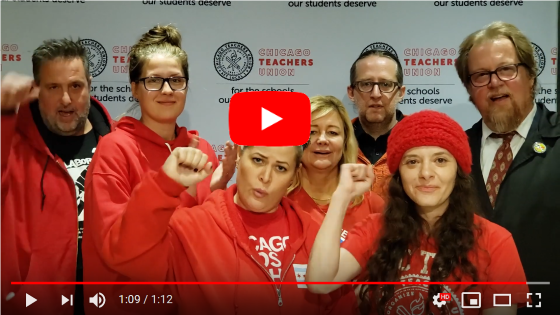
Educators at Passages Charter School won a tentative agreement today that enshrines in the contract key provisions that are still not settled in bargaining for educators at district-run schools. Among those are big wins on paraprofessional pay and rights as well as grievable protections for special education minutes and support. Bold action made these wins possible. When Passages educators learned that the charter operator was holding a fundraising gala Thursday, they threatened to confront donors with conditions in the school, forcing management to cancel the high-ticket gala. That direct action got the goods. Watch their video message to all their CTU family on YouTube.
Bargaining Update
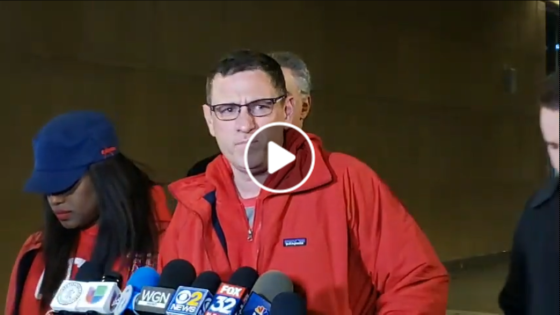
As usual, the officers held an evening press availability to talk about bargaining. As President Sharkey related, our bargaining with the Board has gotten past aspects of the contract that were somewhat easier to bargain. We are now negotiating on the toughest parts, where we have the biggest disagreements. Talks were cordial, but there were no breakthroughs on questions like class size, staffing, prep time or PSRP wages—all of which members have told the bargaining team are critical.
For Jesse’s comments to the press, watch the video above. However, the most frank and open discussion of the state of bargaining has been in member spaces. First, our office posted a point-by-point summary of positions on the biggest issues in our contract. Check it out on the MemberLink Portal. After that, we held a TeleTown Hall with district members. If you weren’t able to join the call, we’ll provide a recording in MemberLink as soon it’s available. As Vice President Stacy Davis Gates pointed out during the call, we’ve now won a range of tentative agreements on issues that management had simply refused to bargain over before our union hit the picket lines. On the big outstanding issues, it will take our ongoing strength on the lines and in the streets to turn the tide and land an agreement.
Our bargaining team returns to the table Saturday, and negotiations will continue all weekend. Our strategy in the press, on the picket line and in the streets is designed to encourage the Board to compromise on these essential issues.
As a celebration, a show of solidarity and a general pick-me-up from the exhilarating, but exhausting, work of bargaining and striking, the Chicago Federation of Labor has organized a day at Union Park. You’ll hear from the victorious Passages bargaining team at the rally This will be a family-friendly event for CTU, SEIU, Chicago Labor and all of Chicago!
Getting Information
Our members want to get as much information as possible, as soon as possible. Those include questions about the potential need for strike loans, health care and more. The CTU has a Strike FAQ page to provide some answers and links to other resources.
In addition, the union has set up a structure to pass information along and get speedy responses to questions. Members should always ask their delegate first. Delegates have access to Strike Captains, who can rely on their Field Organizers. This chain of information is a good way to get quick answers without going directly to CTU staff who have a lot on their plate coordinating activities on a citywide basis for 25,000 people. Staff will always do their best to provide you with information as quickly as possible, but asking up the chain may actually be a more efficient way to find out what you need to know.
Scammon steps it up
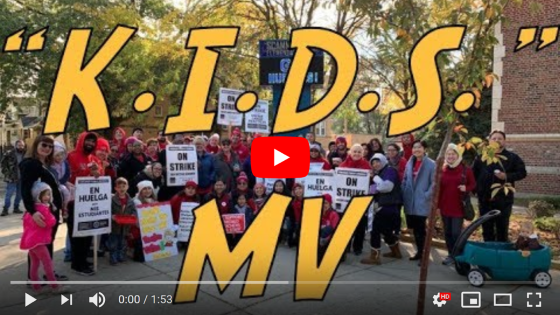
We have so loved all the videos of dance routines, cheers and songs to keep our picket lines up and exciting. The picket team at Scammon Elementary and their videographer, Mr. Lee, has upped the ante, so to speak, on these videos. We hope everyone enjoys tonight’s from-the-line video, “We do it for the K-I-D-S” as you kick off your weekend.
Not many (or any) of those who work at TBF or CAP have been career teachers.
Anthony Cody offers his advice:
I worked in the public schools of Oakland, CA, for 24 years, 18 of them as a middle school teacher of science and Math. I have witnessed firsthand the destructive effect of previous philanthropic efforts in education. There must be a radical change in approach.
The key to successful investment in this arena is leveraging a relatively small amount of money to create a ripple effect that delivers further deeper investment — and not just of funds, but of public trust and engagement.
A coalition of philanthropists would heed the convincing evidence from Anand Giridharadas that their prior efforts have had the effect of suppressing investment and engagement in common public schools. They would reverse course, and instead of seeking to undermine public schools under control of democratically elected school boards, create a campaign to support such schools. They would create a process to empower a democratically elected leadership team composed of students, teachers and parents.
The project would work to:
1. Support efforts to reduce income inequality, since there is a direct connection between educational and economic well-being.
2. Overturn Citizen’s United, since this absurd notion has allowed for legalized bribery.
3. Recognize the destructive effects of high stakes tests and work to end them at all levels.
4. Reaffirm the value of racial and economic desegregation, so all children have equal access to high quality schools, and the chance to learn together.
5. Significantly reduce class sizes across the nation, setting a cap of 20 on grades k to 3, and 25 on grades 4 to 12. This would allow for genuine personalization of education.
6. Make “virtual schools” ineligible for public funds.
7. Minimize screen time and eliminate farcical descriptions of this as “personalization.”
8. Create democratically elected teams of teachers, parents and students to participate in decision-making at every level of the education system.
This is a significant departure from previous philanthropic efforts in education. But given that prior work has been so devastating to our schools, it is time for such a correction.
THIS SHOULD BE THE PLATFORM OF THE DEMOCRATIC CANDIDATE FOR PRESIDENT.
American Leadership Academy, an East Valley charter school chain, paid this past fiscal year at least $46.8 million to companies owned or co-owned by founder Glenn Way or his relatives, newly released financial records show.
The payouts include more than $30 million to the management company that employs the schools’ teachers and staff, millions to another firm for operational services, and almost half a million to an apparel firm for school or athletic uniforms. Way or one of his relatives is a co-owner in all of those businesses.
In total, the payments to so-called related parties made up more than half of ALA’s annual $79 million budget.
Arizona is fortunate to have the Arizona Republic looking out for frauds and corruption because the state doesn’t care.
Arizona also has Curtis Cardine of the Grand Canyon Institute, a former superintendent of both public and charter schools. Cardine became so incensed about endemic corruption that he has studied the finances of every charter school in the state (except those that keep their book secret). He reported in a book called Carpetbagging America’s Public Schools that nearly 3/4 of the state’s charter schools do business with “related” companies, companies connected or owned by the charter owner.
The hard-right Governor Doug Ducey is a stand-in for the Koch Foundation. His elections were funded by the Koch brothers, the DeVos family, and other billionaires who hope to eliminate public education.
Parents and teachers managed to defeat their last attempt to expand vouchers by fighting for a referendum, in which vouchers were overwhelmingly rejected by voters.
Someone needs to demand accountability and transparency for charters.
Arizona is the only state that openly endorses for-profit charters. The other states ban for-profits, but allow for-profit management companies to operate nonprofit charters, which is a shell game.
The Education Department’s Rip-Off Schemes Radicalize Its Own Staff
Billionaire daughter-in-law to the Amway fortune Betsy DeVos probably contracts with the U.S. Mint to exclusively reissue $100,000 bank notes so she can light them on fire to light candles in her office. But she’ll have exactly one less, after a federal judge in San Francisco fined her exactly that amount, because the Education Department continues to collect on fraudulent loans issued to students of shady for-profit college network Corinthian Colleges.
Around 16,000 students have been affected by DeVos collecting on illegal loans, so that’s $6.25 each. Nevertheless, seeing any personal liability at all for an Education Department that not only failed to stop Corinthian from lying to students and saddling them with debt for worthless diplomas, but then kept trying to squeeze those students for unlawful payments, must offer at least a little solace. The Education Department resisted compensating Corinthian students at all, until they went on a debt strike. Under Arne Duncan, students ripped off by for-profit colleges were allowed to assert “defense to repayment” to get the loans canceled.
That process moved at turtle-like speed, with only one-fifth of Corinthian students made whole by the time DeVos took over. She instituted hurdles to prevent loan forgiveness, which Judge Sallie Kim ruled unlawful. This ruling is stayed pending appeal, but DeVos’s department kept trying to collect loan payments anyway, despite the dispute. Three thousand borrowers made these payments. The Education Department even garnished wages on 1,800 students, which it had no right to acquire.
Essentially nobody abused by Corinthian has had loans canceled during DeVos’s tenure. However, she has created momentum for mass loan forgiveness—inside her own department. A. Wayne Johnson, whom DeVos appointed as chief operating officer for the Office of Federal Student Aid, resigned this week, calling the system “fundamentally broken.” He’s now running for Senate (as a Republican) in Georgia, endorsing the cancellation of $50,000 in student-loan debt for every borrower, while adding a $50,000 tax credit for everyone who had already repaid their loans. This is a more robust student debt cancellation proposal than Elizabeth Warren’s (because it includes no means testing), from a Republican DeVos appointee who’s actually seen the student debt crisis up close. That’s how radicalizing it is. The way we finance higher education cannot sustain itself, and everyone to the left of Betsy Hundred Thousand DeVos ought to demand a reset.
Tom Ultican has been writing a series of brilliant studies of cities where the Destroy Public Education Movement is busily undermining and privatizing its public schools, usually because of an unwarranted admiration for the efficiency of market forces. In their unalloyed love of the market, the DPE forces ignore the fact that markets never create equality; instead, they have a few winners and a lot of losers. They forget that the American education ideal is equality of educational opportunity, not a vast sorting machine that leaves most children behind.
In this post, he analyzes the city of Dallas, where business leaders, in league with the city’s leading newspaper, are determined to privatize public schools.
The business leaders think they are innovative, but in fact they echo the same stale cliches as corporate reformers in other cities. The slogan of the moment is that Dallas (and apparently all of Texas) wants “a system of great schools,” not “a great school system.” When I came across this chestnut in Ultican’s article, I nearly spit out my coffee because I had heard the same words uttered by Joel Klein in New York City in 2003. Is there a Corporate Reformer hymnal where they learn all the same phrases, then pretend they made them up themselves?
Ultican’s history of Dallas education in the crosshairs of the Privatization Movement is richly detailed, too much to summarize briefly. It involves the brief tenure of a Broadie who arrived with great fanfare, then departed without having accomplished any of his grand goals.
It is safe to predict that nothing positive will come of the money lavished by elites to privatize the schools. It hasn’t succeeded anywhere else, and it won’t succeed in Dallas. When they finish playing with the lives of Other People’s Children, they should all be horsewhipped, an old Texas tradition. That would be real Accountability.
My daughter had bad news for me yesterday at dinner.
She turned to me with all the seriousness her 10-year-old self could muster and said, “Daddy, I know you love Bernie but I’m voting for Elizabeth.”
“Elizabeth Warren?” I said choking back a laugh.
Her pronouncement had come out of nowhere. We had just been discussing how disgusting the pierogies were in the cafeteria for lunch.
And she nodded with the kind of earnestness you can only have in middle school.
So I tried to match the sobriety on her face and remarked, “That’s okay, Honey. You support whomever you want. You could certainly do worse than Elizabeth Warren.”
Jennifer Berkshire writes in the New Republic that Betsy DeVos is deeply unpopular in swing-state Michigan. Voters in Detroit can see a district disrupted by a generation of failed reforms. Suburban voters like their public schools and don’t want charters or vouchers. Berkshire notes that the Democrats are picking up unlikely victories in districts where education is a big issue.
In 2016, Darrin Camilleri was 24 and teaching at a Detroit charter school 20 miles from where he grew up, when Michigan lawmakers took up a measure to implement more rigorous oversight of the city’s charter schools. Seemingly anyone could open a charter in Detroit, and the schools closed just as suddenly as they opened. From his classroom on the city’s southwest side, Camilleri watched the reform effort fail. “Watching that play out really showed me the downside of deregulation,” he told me. “No one is holding anyone accountable.” That year, he decided to run for state representative in southern Wayne County, a largely blue-collar area that shades rural at its edges. Rather than hewing to standard Democratic talking points—health care, for instance, or Donald Trump’s erratic comments—Camilleri made charter school oversight and school funding his central issues, and in 2016, he became the only Democrat to flip a Republican state house seat in Michigan.
In the three years since Trump turned Michigan red, education has emerged as a potent political issue in the state, thanks to a steady stream of grim studies and embarrassing news stories. Between 2003 and 2015, the state ranked last out of all 50 for improvement in math and reading. According to a recent study, Michigan now spends less on its schools than it did in 1994. Republicans have slashed funding to give tax cuts to big businesses. And the number of people who choose to become teachers has fallen dramatically….
Consider the political climate in Michigan’s suburban districts. In 2018, when Padma Kuppa challenged a Republican state representative, she homed in on the GOP’s role in undermining public education and won, claiming a seat in Troy, an affluent suburban district north of Detroit that Democrats had never held before. Suburban districts like the one in Troy regularly top “best schools in Michigan” lists, with high test scores and graduation rates, and loads of AP offerings. “People here like their public schools, regardless of what party they belong to,” Kuppa said. The GOP’s steady expansion of a largely unregulated charter school sector has very little to offer voters in communities like hers.
Matt Koleszar, a high school social studies and English teacher, won his race for state representative in suburban Plymouth with a message of what he describes as “tenacious support for public schools.” His call for adequate school funding resonated in this “purple” district, he told me, but so did tying his opponent, Jeff Noble, to Betsy DeVos. Noble had scored an endorsement from the education advocacy group DeVos founded, and raised thousands from her extended family. In 2018, he even backed a controversial law to give charter schools a cut of any property tax increases at the county level. “When I went door to door, explaining to people that this meant that their taxes were going to some for-profit charter school headquarters that’s not even in the district, they were outraged,” Koleszar said….
That relationship could backfire on Trump not only in Michigan’s suburbs, but also in rural areas, where the GOP’s education policies have even less to offer voters. There, the local schools are foundational community institutions, and the conservative push to privatize public services has transferred bus drivers, janitors, cafeteria workers, and even some coaches on to the payroll of private contractors that pay less than the state does while providing fewer benefits. “When you’ve gutted all of the insurance for these jobs, they’re not that attractive,” said Keith Smith, the superintendent of schools in rural Kingsley, Michigan. Cuts have forced school districts like his to ax “extras,” such as music, counseling, and the vocational programs that prepare students to work in skilled trades….
The success of candidates who yoked their opponents to DeVos in 2018 should provide valuable lessons for the eventual Democratic nominee, not only in Michigan but also in Wisconsin, Pennsylvania, and Florida, where the GOP has embraced her agenda. For Democrats who have spent much of the last decade teaming up with the GOP to expand charter schools, a new strategy could prove fruitful. Trump, after all, may have trouble distancing himself from DeVos’s legacy: He announced his reelection bid at Orlando’s Amway Center, named for the multilevel marketing company that has so enriched her family.