Archives for category: Education Reform

Morgan Ames is a techie. She majored in computer science at Berkeley and now works at the Center for Science, Technology, Medicine, and Society. She wants to convince you that techies know computer science, but we should not look to them for advice about child-rearing, education, or other social issues. Their range of expertise is narrow. It may make them very rich. But it does not make them wise in every field of endeavor.

in particular, she is critical of the media narrative that techies shield their children from early use of technology.

She writes:

“These articles assume that techies have access to secret wisdom about the harmful effects of technology on children. Based on two decades of living among, working with, and researching Silicon Valley technology employees, I can confidently assert that this secret knowledge does not exist.

”To be sure, techies may know more than most people do about the technical details of the systems they build, but that’s a far cry from having expertise in child development or the broader social implications of technologies. Indeed, most are beholden to the same myths and media narratives about the supposed evils of screen time as the rest of us, just as they can be susceptible to the same myths about, say, vaccines or fad diets. Nothing in their training, in other words, makes them uniquely able to understand arenas of knowledge or practice far from their own.”

Whoa. I disagree with Ames. Monitoring children’s screen time and allowing them time to read and play is one of the most important jobs of parents today.

I think Ames would have been on safer grounds had she criticized techies’ entrance into politics or other realms about which they are clueless, where they think their financial success makes them superior to everyone else and encourages them to scoff at democracy. Or where they think that their financial success gives them the right to “reinvent” education and scoff at democracy. Think Zuckerberg, Gates, and Mrs. Jobs.

For Immediate Release
October 31, 2019
Contact:
Ori Korin
okorin@aft.org
American Federation of Teachers President Randi Weingarten Congratulates Chicago Teachers Union
WASHINGTON—AFT President Randi Weingarten issued the following statement in response to the news that the Chicago Teachers Union, AFT Local 1, reached a return-to-work agreement with Chicago Mayor Lori Lightfoot and will return to classes tomorrow:


“More than 20 years ago, in 1995, educators in Chicago were stripped of their right to bargain, and with that, they lost their voice to influence their students’ learning conditions and their own teaching conditions. As a result, Chicago’s students—particularly students of color and students with special needs—lost out on so many things they needed in schools, including losing many of the neighborhood public schools themselves. This contract is the culmination of a generational struggle to make up those losses. The members and leaders of the Chicago Teachers Union have taken on these inequities and fought for the conditions our kids need and the respect our educators deserve. With this agreement, if ratified, they’re one giant step closer.


“This historic fight for what students deserve—nurses and counselors in every school, librarians, class-size caps, and additional investments in special education—represents a paradigm shift: It wasn’t simply a fight to mitigate the damage of austerity, it was a fight to create the conditions that both students and educators need. This strike, like so many other fights to fund our future, is about building the political will to strengthen our public schools so all kids have their shot at success.


“We thank the Chicago community for standing with us and are glad Mayor Lightfoot heard us. We congratulate CTU’s leadership, its bargaining team and every member it represents for the work they did and continue to do. I saw their commitment to this fight and their students at every picket line and rally I joined. I want to thank CTU President Jesse Sharkey and Vice President Stacy Davis-Gates for their incredible leadership.


“Together with SEIU Local 73 and every parent, student and ally who stood with CTU Local 1—including our state affiliate, the Illinois Federation of Teachers—we know this: We have helped make Chicago’s public schools safe, welcoming sanctuaries of learning, and we have shown an entire nation that when we fight together, we win.”    


Follow AFT President Randi Weingarten: http://twitter.com/rweingarten

The American Federation of Teachers is a union of 1.7 million professionals that champions fairness; democracy; economic opportunity; and high-quality public education, healthcare and public services for our students, their families and our communities. We are committed to advancing these principles through community engagement, organizing, collective bargaining and political activism, and especially through the work our members do.

Randi Weingarten                                                    Lorretta Johnson                                                                     Evelyn DeJesus
PRESIDENT                                                SECRETARY-TREASURER                                                        EXECUTIVE VICE PRESIDENT

American Federation of Teachers, AFL-CIO
Communications Department • 555 New Jersey Ave. N.W. • Washington, DC 20001 • T: 202-879-4458 • F: 202-879-4580  •  www.aft.org

AFT Teachers     •     AFT PSRP     •     AFT Higher Education     •     AFT Public Employees     •     AFT Nurses and Health Professionals


If you would rather not receive future communications from AFT, let us know by clicking here.
AFT, 555 New Jersey Ave NW, Washington, DC 20001 United States

Nancy Bailey writes here about a zombie policy launched by Jeb Bush called third grade retention. Students who can’t pass a third grade reading test are flunked and held back. Nineteen states have adopted this practice despite a large body of research showing that it hurts kids and leads to future failure, even dropping out.

Children who are held back feel humiliated.

There is one big benefit to this policy, however. Holding back the kids who have not yet mastered reading does wonders for the state’s fourth grade reading scores on national tests like NAEP.

Bailey offers specific ways to help third graders instead of humiliating them.


Remember Pennsylvania Speaker of the House Mike Turzai, who denounced public schools as a “monopoly, and expressed his contempt for public school teachers as a “special interest group”?

He will have a Democratic challenger in the next election. Emily Skopov is the daughter of a public school teacher and an activist. Read her biography and learn about her project called “No Crayon Left Behind.”

Emily Skopov will challenge Pa. House Speaker Mike Turzai again in 2020

PITTSBURGH POST-GAZETTE localnews@post-gazette.com AUG 1, 2019

After losing by almost 9 percentage points in 2018, Marshall Democrat Emily Skopov said today that she will again challenge Pennsylvania State House Speaker Mike Turzai for the 28th Legislative District seat. Mr. Turzai, a Republican, has held the seat since 2001 and been the House speaker since 2015. Democrats have challenged him six times, but Ms. Skopov, riding a wave of Democratic energy following President Donald Trump’s election in 2016, was the first to get within 10 points. The 28th District is located entirely within Allegheny County, and includes Pine, Bradford Woods, McCandless, Franklin Park and Marshall. In a press release announcing her run, Ms. Skopov argued she could win because of “demographic and ideological shifts” in the district. “This district is one of the few in Pennsylvania to be currently experiencing unprecedented growth. Mr. Turzai has demonstrated an inability to recognize, let alone understand, these changes and the changing needs and priorities of the residents that he purports to represent,” she said.

https://www.post-gazette.com/news/politics-local/2019/08/01/Emily-Skopov-mike-turzai-pennsylvania-house-2020-election/stories/201908010125

Everyone who loves their public schools and respects teachers as dedicated professionals should support Emily Skopov. Every parent of public school children in the 28th District should support her. Turzai will be funded by Betsy DeVos. Emily Skopov needs our help.

District 28 needs a leader, not a DeVos puppet.


Tentative Agreement

Tonight’s Vote to Conditionally Suspend the Strike

CTU’s House of Delegates met tonight to consider a new tentative agreement. The terms of the tentative agreement can be downloaded from the MemberLink Portal. Delegates voted 364 to 242, with four abstentions, to accept the revised tentative agreement on the condition that Mayor Lightfoot agree to make up the days lost in the strike. The text of the resolution reads:

Be it resolved, that the Chicago Teachers Union House of Delegates will suspend the strike against the Chcago Public Schools immediately upon a CPS agreement with the CTU to restore with pay student instructional days lost during the strike. Per the CTU Constitution and By-laws, a referendum by the CTU’s entire CPS membership on contract ratification will be held within ten (10) days of suspending the strike.

So far, the mayor still insists that she will not schedule makeup days for students to regain class time and for us to recoup our lost workdays. Her hypocrisy, though, is clear to see. She and her bargaining team fanatically insisted that elementary teachers couldn’t have a 30-minute morning prep because it would “reduce instructional time.” Yet, now they have the opportunity to make up days of instruction. What reason, other than sheer vindictiveness, would they have for passing up this opportunity? That’s why we’ll still be on strike Thursday and until the mayor and CPS come to their senses and close this deal.

Tentative Agreement Highlights

Some major elements of the Tentative Agreement include:

  • A nurse in every school community every day.
  • A social worker in every school community every day.
  • Staffing Pipeline: $2.5 million in recruitment and training programs for clinicians, $2 million in tuition and licensure for nurses, increased investments in “grow your own” teacher pipeline programs and 50 percent tuition reimbursement for English Language and bilingual endorsement programs.
  • $35 million annually to reduce oversized K-12 classrooms across the district, prioritizing schools serving the most vulnerable students.
  • Unprecedented enforcement mechanisms for class size relief.
  • Sports Committee with an annual budget of $5 million (33 percent increase in annual funding) for increases to coaching stipends and new equipment/resources.
  • January 2019 0.8 percent increase in health care contribution rate rescinded as of 7/1/19; no plan changes to health insurance benefits and reductions in co-pays for mental health services and physical therapy.
  • Bank of sick days earned after July 1, 2012, increased from 40 to 244 days.
  • Development of special education Individual Education Plans (IEP) made solely by the IEP team; principals required to use substitutes or release time to provide adequate time for special education duties to the extent possible; common preparation periods with general education teachers where possible; special ed teachers last to be called to cover classes; $2.5 million annual fund to reduce workload.

Clarification on class size language

Many members have read the new language in Article 28 on Class Size and found the table and language confusing. We want to clarify how the new language improves on the class size language in our recently expired 2015-19 contract.

In that last contract, there were advisory class size limits for different grade levels. However, to relieve oversized classes only $6 million per year was allotted for the entire district. When a class was over the limit, the teacher would have to file for relief, a weak joint committee came and investigated. If there was money, and if there was will, the class might get a remedy.

In the tentative agreement, that protection still remains, but is strengthened. The same class size guidelines are maintained andthe pool of money to remedy oversized classes is increased more than five times, from $6 million to $35 million. The committee also has more power to award remedies.

The truly new part, however, is the automatically triggered hard cap on class sizes. Those classes that are over the limit by a set amount (differing based on grade level) will be immediately and automatically referred to the committee and relief for the those classes is mandated in the contract. There will be no need for a teacher to report their class and ask for help, the committee will automatically come out to relieve the problem.

Some have mistakenly read the higher numbers as eliminating the previous class size guidelines and raising them to allow even larger classes. That isn’t so. This language keeps the previous numbers and improves the enforcement mechanism quite a bit. Once the automatically triggered classes have been relieved, there is still a larger pool of money to relieve classes that may be over the existing guideline, but under the automatic trigger mark. Those classes will need to request relief, but will still have the stronger committee come to their aid and there will be more money available to solve their problems.

Day 11, Thursday

10:00am at City Hall

At 10:00 a.m. all members should meet at City Hall to demand Mayor Lightfoot agree to make up the strike days. Costumes are encouraged, especially if they’re red (no costume weaponry, though, please). We will not have pickets at school, but schools are encouraged to arrange breakfast or lunch meetings or conference calls to discuss the tentative agreement and our next steps as a union.

Day 10 Recap

Wednesday’s Actions

Our members maintained picket lines at every school today. At noon, in the cold and pouring rain, hundreds of CTU members met to protest “The 78” luxury real estate development. Like Lincoln Yards, The 78 got a huge TIF giveaway to develop already valuable land. The $700 million that Rahm and Lori gave them would have made a huge difference for our schools. We won’t stop reminding the public and the politicians that Chicago isn’t broke, the City’s priorities are.

New support from Springfield

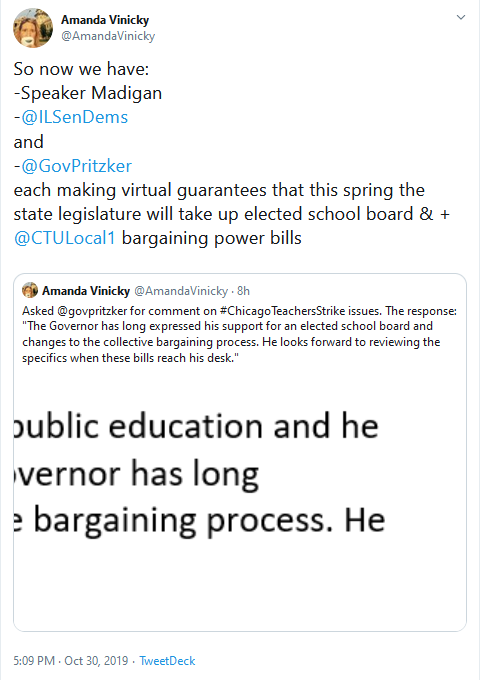
As the bargaining team finalized the deal, new information emerged from Springfield.

Tweet by Amanda Vinicky about Madigan and Cullerton pledging support to repeal IELRA Sec. 4.5

Looking ahead and building power

As you talk about the tentative agreement, it’s worth thinking about the conditions at your school. Whether or not this TA is ratified, we will eventually have a contract. It’s important that everyone build on the solidarity and momentum you’ve developed together on the picket line to enforce it. If the fight for good working and learning conditions were a war, the strike would be the “air war.” It can win a lot, but what ultimately determines day-to-day conditions is the “ground war”—the back-and-forth between administrators and staff in each school and workplace.

Read the TA (and the existing contract, for that matter) with an eye to the changes you want in your school. Try to come up with one change—big or small—that CTU members, together, want to see in your work environment. Then you can use our Campaign Planning Worksheet to brainstorm your campaign for when we return to work. When members at your school have agreed on a rough plan, check in with your organizer and/or field rep to talk through the details of putting it into action.

Union staff will continue to work hard in support of your rights. In your campaigns, they’ll help you refine your strategy and back you up. And they’ll always stand up for your rights in grievances and arbitration. If you organize well, you can make change without the long process of a grievance and help build your school’s solidarity and power.

Sent via ActionNetwork.org. To update your email address, change your name or address, or to stop receiving emails from Chicago Teachers Union, please click here.

In recent years, I have posted several times about the issues raised by the efforts of for-profit Bridge International Academies to supply low-cost schools in Africa. These schools are staffed by teachers equipped with iPads reading a script written in Boston or someplace similar. Most African families can’t afford the cost. BIA aims to disrupt and replace African nations’ underfunded, ill-equipped public schools. African nations should be building a universal, free public school system with qualified teachers. The entry of BIA, despite good intentions, disrupts thoughtful long-term planning. BIA is supported by Bill Gates, Mark Zuckerberg, the World Bank, and other wealthy donors.

The World Bank’s ombudsman recently expressed concern about BIA.

A major development in the World Bank Compliance Advisor Ombudsman (CAO) complaint against the International Finance Corporation’s investment in Bridge International Academies was just announced.
The East African Centre for Human Rights announced the World Bank’s accountability body report, which raised ‘substantial concerns’ regarding the investment in Bridge International Academies.
In a report published Friday, the CAO found ‘substantial concerns’ regarding the issues brought against the company. An investigation into the International Financial Corporation’s (IFC) investment in Bridge International Academies will now be launched.

The investigation will look at whether the IFC took reasonable steps to ensure Bridge complied with national law and standards, labour rights, and IFC policy requirements for transparency, community participation, and health and safety standards.

The East African Centre for Human Rights (EACHRights) on behalf of the complainants, welcomed the report on Friday, urging the World Bank and IFC to commit to the provision of free, quality public education for all.

In solidarity with EACHRights, and the learners, parents, teachers and community members affected, we support this significant development and call for the World Bank and other major investors to ensure the right to education is fulfilled in line with the Abidjan Principles.

The full press release is available below.

Kind regards,
Sarah

Campaigner, Global Initiative for Economic, Social and Cultural Rights
+1 613-203-8093 | sarah@gi-escr.org
www.gi-escr.org

NAIROBI, 25TH OCTOBER 2019. The World Bank’s independent recourse and accountability mechanism, Compliance Advisor Ombudsman (CAO), published a report yesterday raising “substantial concerns” regarding Bridge International Academies (BIA) and announcing their intention to conduct a compliance investigation into the International Finance Corporation’s (IFC) investment in the company.

This decision comes after a comprehensive appraisal of a complaint filed in April 2018 by ten Kenyan citizens, with support from The East African Centre for Human Rights (EACHRights,) which outlined alleged contravention of IFC performance standards and abuses of human rights law as committed by the IFC client, BIA. The complaint was filed following a long list of concerns raised by various independent sources, academics, rights holders, civil society organisations and journalists since 2016.

In order to decide whether a compliance investigation is required, the CAO first conducts a compliance appraisal. Through this appraisal, the CAO determined that BIA’s operations raise “substantial concerns” regarding: “(a) the specific allegations of adverse impacts to teachers, parents and students raised in the complaints; (b) the Environmental and Social risk profile of the schools in light of their number, locations and concerns regarding their construction methods; and (c) the registration status of the schools and adherence to relevant health and safety requirements.”

The CAO raised concerns regarding the adequacy of the IFCs supervision and due diligence regarding its investment in BIA. The investigation by the CAO will also look into the IFC’s supervision of BIA’s compliance with national laws, and its capacity and commitment to implement IFC performance standards including those relating to labour practices and the environment, health and safety aspects of its schools. In the course of the investigation, IFC may also consider whether IFC’s policy framework provides an appropriate level of protection for workers, the environment and affected communities in a context of providing low-cost services in informal settlements.

Dr Judith Oloo the Chief Executive Officer at the East African Centre for Human Rights commented: ‘It has been a long wait for the complainants involved in this case. In making this decision, the CAO has taken into account the scale of BIA’s operations in Kenya, the number of communities potentially impacted and also considered the vulnerable status of children and families that are the target market for Bridge schools. We look forward to a rigorous and thorough investigation, and call on all investors to start taking action to avoid further harm.’

Sylvain Aubry, from the Global Initiative for Economic, Social and Cultural Rights, stated: “The CAO report confirms the concerns and many issues that parents, teachers, and civil society organisations have been raising for years about the harmful practices of Bridge International Academies. It’s now time for the World Bank and other major investors such as Mark Zuckerberg, Bill Gates, the Omidyar Network, and the UK Government to take immediate action to remedy the situation and comply with the right to education.”

Tony Baker from RESULTS Educational Fund added “This investigation comes at a critical time when donors like the Global Partnership for Education and others are exploring their own private sector engagement strategies. Such investment decisions must be evidence-based, and a thorough and honest look at the concerns around for-profit private schools like Bridge is needed to ensure that such approaches truly support national efforts to achieve free, quality education for all.”

It is anticipated that the compliance investigation will be completed by September 2020. More information on the investigation can be found here.

The complainants trust that the investigation will confirm what existing evidence already shows and that actions will be taken by the World Bank and IFC to ensure that the findings are adequately addressed in fairness to the thousands of children, parents and teachers who are daily affected by these violations.

Background
Bridge International Academies is a for-profit, multinational commercial chain of low cost private schools running over 500 institutions in Kenya, Uganda, Nigeria, Liberia and India. The company’s operations have raised concerns over the threat they pose to the right to education. The IFCs total equity investment in Bridge International Academies as of June 2019 is US $13.5 million.

Contacts
The East African Centre for Human Rights (EACHRights): Linda Oduor-Noah, linda@eachrights.or.ke, +254 7 01 67 00 90

Documents

The CTU reached a tentative agreement with Chicago Public Schools. The CTU House of Delegates voted 364-242 to suspend the strike pending resolution of final issues. The settlement, which meets most of the CTU demands, will be voted on by the full membership within 10 days.

But the strike is not yet over. The sides are very close but the union wants an assurance that there will be no loss of instructional time for the students. They want to make up the instructional time, possibly by extending the school year. Thus far, Mayor Lightfoot says no.

The union made no concessions. For the first time ever, they have won enforceable guarantees about class sizes, though the agreed-upon limits are still too large: no more than 32 students in K-3. No more than 35 in upper grades. $35 million has been pledged for class size reductions, which will be lowered as funding permits. The agreement commits the city not to authorize any new charters, nor add to the current enrollment of students in charter schools.

No school tomorrow while the bargaining continues.

The settlement contains not only caps on class sizes, but guarantees about school nurses, and other important staffing issues. It also offers significant salary increases, which was not a contentious issue. The union really did fight for better conditions for their students. .

The Big Three—Governor Pritzker, the Democrats in the Legislature and House Speaker Madigan— have agreed to restore a democratically elected board to replace mayoral control and to restore full collective bargaining rights so Chicago is on the same footing as other districts in Illinois.

Now we wait to see how long it will take to assure that the students do not lose instructional time.


This is a strong statement by Randi Weingarten. Please note that 10% of New York City’s public school students are homeless; students in many other districts suffer trauma, including homelessness, lack of access to medical care and basic nutrition, and inadequate housing. These figures should be appended to NAEP reports in the future.


AFT President Randi Weingarten’s Statement on NAEP Report Card
 

WASHINGTON—American Federation of Teachers President Randi Weingarten issued the following statement in response to the National Assessment of Educational Progress (NAEP) Report Card:


“What we see in this data snapshot, while disappointing, is not surprising: Our students are still bearing the brunt of two decades of austerity, competition and test-based fixation that have failed to prioritize the needs of students, including the 90 percent of kids who attend public schools. Twenty-one states still spend less on public education than before the Great Recession, and during this decade of disinvestment there has been little to no change in either the math or reading performance of our highest-risk students.


“What the survey data doesn’t tell us in detail is why. Almost half of America’s kids have trauma, and they’re going to school in classrooms without nurses and counselors. For years, we’ve been advocating that children need comprehensive social and emotional supports so they’re able to engage in meaningful learning in safe and welcoming environments. It’s vital to meet kids where they are and to do what evidence shows works for improving student well-being and achievement.


“Since the enactment of the Every Student Succeeds Act just four years ago, some states and districts have started stepping up to the plate to use evidence-based strategies that are tailored to their communities, and we’re already seeing incremental gains in high school graduation rates. So why stop now, when our work is just starting to pay off? Secretary of Education Betsy DeVos ignores the real issues that plague our classrooms and student achievement, presumably because they disrupt her political agenda to siphon public money into private hands and expand private school vouchers and for-profit school ventures. But the evidence on achievement in voucher programs has not found statistically positive gains for students using vouchers, and most large-scale studies have found that students actually saw relative learning losses. DeVos has been putting her thumb on the scale against public schools and public education since Day One—cutting the very programs that help kids the most.


“So, our answer to the question of how we help students succeed shouldn’t be to go back to the competition-and-austerity era, or to pull the rug from the strategies that we know are starting to work and have potential to grow. We have to push forward and continue fighting for the investments that prioritize children’s well-being; provide wider access to high-quality instruction and learning experiences; and engage parents, communities, educators and students in making our public schools safe, welcoming environments where teachers want to teach, parents want to send their kids, and students want to learn.”

Teresa Hanafin writes Fast Forward for the Boston Globe:

Today’s witnesses giving depositions to the three House committees conducting the impeachment inquiry are two State Department diplomats who are experts on Ukraine: Catherine Croft and Christopher Anderson. They both worked as deputies to Kurt Volker, the former special envoy to Ukraine.

Both were considered stars in the department, deeply familiar with Ukraine and “steeped in the policy issues,” as one department official put it. Both have served under Republican and Democratic administrations.

In her opening statement, Croft says that when she was the Ukraine director on the National Security Council, she got several calls from a lobbyist, Robert Livingston,pushing for the firing of Marie Yovanovitch, the US ambassador to Ukraine at the time. Croft says she wasn’t sure on whose behalf Livingston was advocating: A Ukraine politician he used to represent, or Rudy Giuliani, Trump’s personal lawyer with whom Livingston also had contacts. (Remember, Giuliani was trying to get rid of Yovanovitch because she wouldn’t go along with his off-the-books, rogue operation to dirty up the Bidens.)

Croft also says that she was on the July 18 video conference call in which a budget official announced that acting chief of staff Mick Mulvaney had put an “informal hold” on critical Ukraine military assistance at Trump’s direction — a statement that astonished William Taylor, another Ukraine envoy who also was on that call.

Anderson will tell lawmakers of another astonishing episode: That Trump blocked a State Department statement last November condemning Russian aggression against Ukraine after Russia had seized three Ukrainian navy ships in the Sea of Azov and detained 24 Ukrainian sailors. We don’t want to upset Putie!


Steven Wilson, founder and CEO of the Brooklyn-based Ascend Charter Schools, was fired by the board of directors after a petition on Change.org, apparently started by students at one of the charter schools, complained that an essay he had written was racist and exemplifed “white supremacy.”

Two charter-school advocates, one employed by the Walton Family Foundation, the other from the IDEA charter chain, defended Wilson and demanded that the board reinstate him. Their letter to the board was published in the rightwing EdNext.

The essay is a lengthy complaint about American public schools, asserting that they are deeply anti-intellectual and that children have been deprived of “intellectual joy” since the very inception of public education.

He argues that all children without exception should participate in “intellectual joy,” which would seem to me to be an unassailable position.

However, the critics of his essay say that it is an assertion of “white supremacy.” The board fired Wilson.

Now about that essay.

As a historian, I find much that is troubling in his depiction of the history of public education. It is true that public schools were not temples of academic learning in the 19th century. Most children left school when they were old enough to work. It was a mark of accomplishment to finish the eighth grade. Parents wanted their children to have just enough education to do what was necessary in daily life. The McGuffey’s Readers were almost universal. The McGuffey Readers contained excerpts of essays and poems that most students probably didn’t understand but memorized for recitation. The typical stuff of grades 1-8 was not deeply intellectual, that’s for sure. Most teachers were barely high school graduates. College attendance was still rare, limited only to the children of wealthy families, and they did not become teachers, which was a position of low esteem and low pay. High schools were rare until late in the 19th century, and they too leaned heavily on memorization and recitation. Most taught Latin and Greek, which no doubt gladdens Wilson’s heart. History textbooks were mainly recitations of wars, battles, and big events in the life of the U.S. or Europe. There was little about other nations or cultures. Private schools were not great temples of academic joy either.

It is fair to say that Steven Wilson would have been disappointed in the intellectual quality of most schools in the 19th century, whether public or private.

In the 20th century, the big urban centers of the nation were swamped with one of the biggest migrations of history, the transit of Europeans to the U.S. Most were illiterate or didn’t speak English or both. The big city classrooms typically had a poorly educated teacher trying her best to school some 80-100 children in her classroom, usually sitting two at the same desk. Not too much intellectual joy there.

I wrote a book about anti-intellectualism in American education. It is called Left Back: A Century of Battles Over School Reform.

I tried to disentangle the strands of the progressive movement. Some progressives were concerned about the health and well-being of children and worked together with settlement house workers to better the lives of poor urban children. Some were interested in political activism and wanted the school to be the instrument to remake society (a hopeless endeavor). Some wanted the schools to be child-centered and to focus on the needs and interests of children. Others, including some of the child-centered progressives, were openly disdainful of the academic curriculum. Be it noted that there was good reason to be disdainful of the academic curriculum as it was then construed. Students spent endless hours memorizing words from textbooks or readers, then reciting them to the satisfaction of their teachers. Memorization played a big role–too big a role in the academic program. Even the Committee of Ten, the illustrious education leaders who called for a revamping of the academic curriculum in 1893, urged the use of active learning and projects to enliven instruction in history. Given the low standards and rock-bottom salaries for teachers, it was hard to imagine that the typical public school would ever be a beacon of intellectual enlightenment.

I was hyper-critical of anti-intellectualism, but unlike Wilson, I never smeared all of public education as an intellectual desert, openly hostile to ideas and determined to belittle the pursuit of knowledge for its own sake. If you don’t see schooling in its historical and cultural context, it is easy to dismiss them as scornful of academic learning.

I am a graduate of the Houston public schools. My public schools were typical of the 1950s. What mattered most was sports, clothes, pop music (Elvis!), pop culture (James Dean!), and popularity. San Jacinto High School had good teachers and mediocre teachers. I had abysmal instruction in U.S. history, but a stellar teacher of English and American literature who left her classes longing for more, and whose door at “sign-up time” always had a long line of students eager to learn from her. No gifted classes, no AP courses, no test prep. Yet somehow I managed to get admitted to Wellesley College, one of the nation’s best colleges. And somehow I managed to hold my own in a class where at least half the students had gone to the nation’s best private schools. And all I had was a public school education!

Wilson’s jeremiad about public schools is insulting to public schools and their dedicated teachers, for sure. What’s more, he blames John Dewey for the dissolution of the curriculum, repudiating liberal education, and denigrating academic teaching. But anyone who read the first-hand accounts of the Dewey School at the University of Chicago would know that Wilson is dealing in second-hand stereotypes. I wrote about it in Left Back:

Teachers at the Dewey School created projects and activities to enliven the studies that were taught by rote in more traditional schools. They wanted to show that the traditional subjects, so often taught without any imagination, could be turned into exciting learning experiences. Far from being hostile to subject matter, they continually experimented with different ways of involving their young students in learning about primitive life in the Bronze Age; Phoenician civilization; early Greek civilization; the voyages and adventures of Marco Polo, Prince Henry of Portugal, Columbus, and other explorers; English village life in the tenth century, the story of William the Conqueror and his conquest of England, and the Crusades; American colonial history; the European background of the colonies; Shakespeare’s plays; science; mathematics; algebra and geometry; English, French, even Latin. (Left Back, p. 171).

If there were a Dewey School today, the curriculum would be multicultural and would reflect the cultures and interests of the students, it would explore the crimes of colonialism and imperialism, but one thing is certain: it was NOT anti-intellectual. In fact, it would be accurate to say that the teachers at the Dewey School were trying to find ways to ignite the love of learning and to connect history to their students’ lives and interests.

Wilson was also in error in setting the “Life Adjustment Movement” in the 1920s. It was a post-World War II craze.

Wilson defends the Common Core and asserts that it demands “intellectual performance” of a high quality. I find this bizarre, since the Common Core is lacking in any curricular coherence; even E.D. Hirsch Jr. has abandoned it because of its vacuousness. “Regrettably,” Wilson writes, “in many states, governors capitulated to anti-testing forces and retreated from the Core.” There is more that is wrong with the Core than the testing—with its absurd passing marks—that accompanies it.

But the students (or teachers) who wrote the petition against his essay were insulted for other reasons. They thought his essay was racist. They accused him of “equating a liberal education to whiteness,” thereby displaying a sense of “white supremacy.”

The petition says:

The underlying message here is that a liberal education is whiteness, whiteness is therefore intellectual, and any challenge to a liberal education is a challenge to whiteness, so any challenge to whiteness is anti-intellectual. The article later reinforces the importance of this liberal education by stating such an education “empowers them to escape poverty and dependency.”

Perhaps it was these sentences that troubled them:

“Just as schools are organizing to overcome these challenges [e.g, overtesting], they face a new threat to intellectual engagement. As schools strive to become more diverse, equitable, and inclusive and to ensure cultural responsive teaching, there is the growing risk that these imperatives will be shamefully exploited to justify reduced intellectual expectations of students. One document widely used in diversity workshops, including in the training of all New York City administrators and principals identifies 13 ‘damaging characteristics of white supremacy culture.’ One is ‘objectivity,’ which is manifested as ‘the belief that there is such a thing as being objective’ and ‘requiring people to think in a linear way.” Anti-intellectualism often takes the position that there are only subjective perspectives. Another is the ‘worship of the written word,” where ‘those with strong documentation and writing skills are more highly valued’…But how tragic it would be if any child was taught that a reverence for the written word was a white characteristic. What would they make of Frederic [sic] Douglass’s Fourth of July speech, Martin Luther King’s Letter from a Birmingham Jail, or James Baldwin’s letter to his nephew, “My Dungeon Shook’ in The Fire Next Time? As writers, they were deeply learned and dazzling stylists. Their words explode on the page, inspiring millions in the urgent work of racial justice. It’s hard to imagine a more destructive message to teachers and their students. This too will surely come to be seen as another wrong turn on the way to equal educational opportunity.”

He then goes on to discuss a closed door conversation in which he refers to the word intellectual, and someone in the group says that the word “has a connotation. Intellectual speaks to colonized and oppressed.” The group prefers the word rigor.

But, he says, when the session is over, the members of the group tell him to ignore the discussion.

Clearly the students (if they were students) who reacted strongly to his paper did not ignore it. They thought his paper was patronizing and racist and that it reeks of white supremacy.

They see his crusade for intellectualism as elitist and condescending.

His defenders from the charter sector accused the board of succumbing to “racialist bullying.”

Clearly there is a failure to communicate.

On all sides.

Since I am a historian by training, not a teacher, I can’t weigh in on how to teach “intellectual joy.” I know that being an intellectual won’t make one a good teacher; I have seen very well educated people give up as teachers because they were unable to connect to their students. Clearly something in Steven’s tone sent a message that he did not intend. The critics of the essay had antennae that he did not understand.

I asked my friend Anthony Cody, who is an experienced teacher who taught science in the Oakland public schools, about engaging students’ love of learning, and he offered this advice:

When I think of how we go about igniting passion for learning in students, it has more to do with connecting to their experiences and building on them — stretching them to consider new approaches that still relate to their realities. The conception of “intellect” in this essay seems to me a rather abstract one, which would struggle to inspire most of the teachers I have worked with over the past decade. 
For me, one of the most valuable things we could do for students would be to get their teachers actively engaged in a lively intellectual process of questioning what, why and how they are teaching. When that lively process is taking place within a school, it will infect every classroom and provide students with a variety of models of inquiry, experimentation and reflection, all of which are the basic processes of intellectual growth. That is why packaged curriculum and prescriptive standards and timelines are the death of real thought in our schools.