Archives for category: Education Reform

The principal of the Discovery Creemos Charter School pled guilty to inflating enrollment and stealing $2.5 million from the state and federal governments. 

The former principal of the shuttered Discovery Creemos Academy pleaded guilty Friday to participating in a $2.5 million scheme to inflate enrollment at the defunct charter school.

Harold Cadiz, 55, faces up to 12 ½ years in prison after pleading guilty in Maricopa County Superior Court to two counts of felony theft during the 2016-17 and 2017-18 school years. He’s scheduled to be sentenced March 27.

Cadiz is the second administrator from the Goodyear charter school, also known as the Bradley Academy of Excellence, to admit to participating in the scheme to defraud the state and federal governments by inflating the school’s enrollment by hundreds of students.

Cadiz’s plea calls for a prison sentence of 3 to 12 ½ years and up to 7 years of probation.

Arizona public schools are funded based on the number of students, meaning each additional student a school reports to the state brings more tax dollars.

Daniel K. Hughes, president and CEO of Discovery Creemos, was the first executive at the school to cut a plea bargain with the Arizona Attorney General’s Office, admitting to theft and conspiracy in November 2018. He faces a presumptive prison sentence of five years.

The school closed January 2018, just after the 100th day of the school year, ensuring it would receive as much state money as possible before it closed.

A few months before Discovery Creemos Academy closed, Hughes had assured the Charter Board that he would turn around the financially and academically failing charter school. Reviews by the Charter Board for the 2013-14, 2014-15 and 2015-16 school years found the school did not meet its financial performance recommendations.

Hughes has admitted that during the 2017-18 school year, his school reported an enrollment of 528 students, but 453 of them were fraudulent. In 2016-17, the school reported it had 652 students, but 191 were fraudulent.


The munificently-funded Thomas B. Fordham Institute, based in D.C., controls Educatuon Policy, graduation requirements, curriculum, and testing in Ohio. Mr. Fordham, for whom the institute is named, had no known interest in education, but his namesake is part of the rightwing ALEC nexus, where contempt for public schools, hatred for unions, contempt for gun control and environmental regulation are reflexive.

Laura Chapman, who lives in Ohio, writes:


This numbers game is routinely pushed by the Ohio arm of Thomas B. Fordham Institute/Foundation. Oped’s written by employees at criticize the Fordham routinely criticize teacher unions for pointing out the debilitating affects of poverty on students. In a typical rhetorical move, the Fordham “expert” will find one exceptional school with an “A” rating of the state report card rigged to ensure few schools are rated A. Then when you read in detail, you will see that the most exceptional thing about this school is really rare. The same principal has been there for 18 years, lives in the community, and has an uncommon level of trust from her community, the teachers, and students. Test scores were a byproduct of that not the aim of her work as an educator.

In Ohio, the writer most responsible for this misleading journalism and “research” is Aaron Churchill, the Institute’s Ohio Research Director. The Institute says this: Since 2012, Aaron has worked on “strengthening” Ohio policy on standardized testing and accountability, school evaluation, school funding, educational markets, human-resource policies and charter school sponsorship. He writes for the Fordham’s blog, the Ohio Gadfly Daily and contributes op-eds to the Columbus Dispatch, Cleveland Plain-Dealer, Dayton Daily News, and Cincinnati Enquirer. Aaron previously worked for Junior Achievement.”

He has not an ounce of documented experience in teaching or studies of education as an undergraduate or graduate student. He gets a free pass on almost everything he submits to the Columbus Dispatch, Cleveland Plain-Dealer, Dayton Daily News, and Cincinnati Enquirer. These local newspapers are shrinking and have few if any staff available for questioning this “throughput” of misleading but ready to post news.

When I spoke at Town Hall in Seattle, I was introduced by Garfield High School teacher Jesse Garfield. Jess is one of the heroes in SLAYING GOLIATH. Here is the conversation..

Steve Hinnefeld writes about education in Indiana.

In this post, he explains the deep corruption in the virtual charter industry and how the frauds were facilitated by generous gifts to key politicians.

He writes:

We’ve known something fishy was going on with virtual charter schools since 2017, when a Chalkbeat Indiana investigation exposed shady business practices and lousy test scores and graduation rates at Indiana Virtual School and its sister school, Indiana Virtual Pathways Academy.

A blockbuster report this week from the State Board of Accounts shows just how bad it was – and it was worse than we’d imagined. The report charged that the schools overbilled the state by $68 million by vastly inflating the number of students who were enrolled in and attending classes online.

It also found schools made $85.7 million in questionable payments to vendors in which school officials or family members had an interest. Much of the taxpayer money that the schools received, the report shows, went to a network of for-profit businesses tied to school founder Thomas Stoughton and his associates.

The state investigatory report suggests officials at the virtual schools were “focused on maximizing profits and revenues,” not on serving students.

How did they get away with it? For one thing, they appealed to the dominant ideology in the Republican-controlled state government, which holds that choice and competition in the educational marketplace are an inherent good. For another, they played the game of politics.

Businesses that were associated with and benefited from Indiana Virtual School and Indiana Virtual Pathways Academy gave over $140,000 since 2016 to the campaigns of

Republican legislators and Gov. Eric Holcomb. The schools also paid over $300,000 to a high-end lobbying firm, according to the report.

That’s in addition to similar amounts paid by other online education providers – e.g., K-12 Inc. and, for a time, Connections Academies – to promote an environment conducive to virtual schools.

Political connections

Indiana Virtual School and its initial operator, the Indiana nonprofit Business Consulting Inc., worked with politicians from the get-go. In July 2011, just a month after the school got its first charter, its board approved a contract with the consulting firm of state Sen. Travis Holdman, R-Markle.

Holdman said in a statement that the schools paid him a monthly retainer from 2011 to mid-2019 to be “available for general business consulting on legal and personnel matters, contract interpretation, the relationship with the school’s authorizing entity and strategic planning.” He said he had no day-to-day involvement with the schools and terminated the

contract once news media reported “alleged malfeasance” by school officials.

Early board members of Indiana Virtual School included Sue Richardson, a former member of the State Board of Education, and Linda Chezem, an influential retired state appeals court judge.

Daleville Community Schools, a small, rural school district near Muncie, approved the charters for Indiana Virtual School and Indiana Virtual Pathways Academy and was supposed to monitor their performance. That’s an unusual situation. Most charter schools in Indiana are authorized by Ball State University, the mayor of Indianapolis or the Indiana Charter School Board.

But Daleville, by serving as authorizer, was able to collect 3% of all money the two virtual schools received from the state. As enrollment ballooned, so did Daleville’s revenues. In a sense, the authorizer was another “related party” with a financial stake in the schools’ growth.

It gets worse. Money, politics, education. Why not steal from the children? Why not sacrifice their futures to make a profit?

Do taxpayers in Indiana care? How do they feel about their tax money going into the pockets of the entrepreneurs?


This is an extraordinary story, which I hope you will read to the end. It was published by Chalkbeat.

A group of concerned leaders in Detroit, including some retired educators, decided to open a charter school.  They won the endorsement of the city’s leading philanthropies. They won a federal grant from the Charter Schools Program.

The school struggled from the beginning. It struggled initially to attract students, because it was competing with so many other charters for the same students. It took in students from a closing charter, who were far behind. It searched for an educational management company, which drew off a large share of its income.

It housed its students in a closed elementary school, where there was far more space than the charter could use.

There was no shortage of potential authorizers. The sponsors were turned down by one, then found another.

Efforts to regulate charter schools in Michigan have run into fierce political headwinds, in large part because of DeVos and her family, who have used their considerable fortune to support a free market education system that allows charter schools to open wherever they believe they’ll succeed.

DeVos and her allies have been so successful in blocking efforts to regulate charter schools in Michigan that when the founders of Delta Prep began looking for permission to open back in 2012, they had no shortage of options. They could pick from roughly eight colleges and school districts that were empowered to authorize charter schools, some of which would provide more oversight than others. When it finally opened in 2014, Delta Prep was one of more than a dozen schools that opened in Detroit and began competing for the same students.

The problems multiplied. Low enrollment. Discipline problems. A rotating cast of principals, year after year.

Delta officials had promised that “90 percent of students will attend every class, on time, every day.” But in the school’s third year, just 20 percent of students came to class with any regularity.

Officials said they would boost student achievement by borrowing from the playbook of a New York-based education nonprofit. Their goal: “85% of students will demonstrate competency in all core subjects via exit tests.”

But within three years, not a single Delta Prep 11th-grader was deemed proficient in math, compared with 13.2 percent in Detroit’s troubled main district. Just 10 percent of 11th-graders posted passing scores in SAT English, compared with 37 percent in the district.

Delta Prep had promised that “100% of graduates will be accepted to college.” But in 2016, the only year the state recorded graduate data for Delta Prep, just over half of the school’s graduates enrolled in college. Just six students — 10 percent of that first graduating class — went on to complete a year’s worth of college credits within a year of graduating.

If the data was concerning, the situation inside the school was even more dire. When Brandi North was hired as principal in 2017, the first thing she did was hire security. The sprawling school was built during an era when Detroit couldn’t find enough classroom space for all of its students, but now it sat mostly unused, and students tended to disappear into vacant classrooms. Teacher-student relations were antagonistic. North said her assistant principal’s hand was broken during an encounter with a student, and that she regularly contacted the police about student behavior.

The year before she arrived — and the year after the influx of students from recently closed schools — Delta Prep had slapped more than half of its students with out-of-school suspensions, resulting in nearly 1,000 missed days of school.

“In 15 years of education, it was the most stressful position I’ve ever had,” North said. “I worked in south central Los Angeles, and Delta was still my most stressful situation.”

North started at the school in March 2017, after the previous principal resigned and an interim principal decided not to take the job. She says she found tutors for students, brought consistency to a patchwork curriculum, even drove to students’ houses on test day to make sure they took Michigan’s standardized exam. But she left that June following disagreement with the management company that she declined to discuss.

She was not the only administrator unable to cut it at the school. Within a few years of its hopeful start, Delta Prep had become another Detroit school desperate to find the rare principal capable of quarterbacking a long-shot school turnaround. It had five principals in less than five years of operation…

In Detroit’s crowded education landscape, Delta Prep kept falling short of its 400-student target, creating a financial situation so bleak that students lacked textbooks and other basic supplies.

When officials from Ferris State came to check in on the school, they noted that only one-third of its budget was spent on instruction, while far too much went to the management company and other operating costs. Delta Prep’s reserve fund, set aside to protect the school against unforeseen problems, dipped to $217 in 2017-18.

Twenty-two days after the start of school in the fall of 2018, Delta Prep closed its doors, to the shock of students and parents, who suddenly had to find a new school.

In the business world, closings are not uncommon. In the charter world, school closings are not uncommon. Anyone who thinks it is easy to run and manage a school should read this story and think again.

Customers can find another place to shop when a store goes out of business. When a school closes, children, parents, teachers, and families are disrupted.


Jersey Jazzman notes that charters in his state are on the horns of a dilemma: on one hand, public school advocates are suing to block charter expansion, because they drain away public school funding: on the other hand, charters want to join a lawsuit that would allow them to share in a settlement intended to provide equity for public schools in impoverished districts. JJ is a very smart guy but he doesn’t seem to understand that what matters most is not consistency but being in the right place when the money spigot is turned on. Charters are public when that’s where the money is; charters are not public when it suits them to avoid mandates.

He writes:

This was a long time coming: the Christie administration happily encouraged the expansion of charter schools without seriously thinking about appropriate oversight, regulation, and funding of the sector. Now the state has to contend with a system that imposes fiscal burdens on school districts that host charter schools, even as those districts have no meaningful say on charter school proliferation.

The fact – which I have validated empirically – is that charter school expansion is not a revenue-neutral policy. As school districts lose students to charters, they are unable to adjust immediately to enrollment declines, because districts have fixed costs like buildings and personnel that can’t be quickly scaled back. 


But charter operators appear to be unconcerned with this reality; repeatedly, they have demanded they get everything they think they are owed, even when school districts are facing serious financial pressures. During Christie’s time, this meant charter budgets weren’t touched
, even as host districts’ were slashed…

As Bruce Baker and Gary Miron pointed out years ago, charter school regulations like New Jersey’s lead to an absurd situation: the public pays for school buildings that many times used to be owned by a school district – in other words, the public – but wind up in private hands. Sometimes those hands are nonprofits aligned with the charter school; sometimes they are for-profit companies, paying off their mortgages with funds the charters receive in per pupil payments from hosting school districts.

In either case, the public is paying for a building that the public will never own. And in most cases, these are buildings that are paid for, at least in part, with local funds, even though the state is the entity that gets to decide whether charters will be granted or renewed.

This lunacy is at the heart of the serious conflicts of interest, lack of transparency, and just generally bad policymaking that surrounds New Jersey’s charter school facilities…

The legal status of charter schools has always been open to debate, but it’s clear at this point that they are not government actors. As such, they can claim immunity from oversight regulations that other governmental entities, such as school boards, must abide by. Why, then, should the taxpayers simply turn over revenues for charter facilities when they won’t even know who, if anyone, is profiting off of this system?

There are a lot of aspects of charter school policy we can debate, but this one if clear: If the public pays for a school building — including a charter school building — the public should own the building. If New Jersey’s charter schools want more funding for their facilities, the price to be paid is that those facilities stay in public hands, with public oversight and complete transparency.

If you think I’m wrong, I’d love to hear your argument. But it seems clear to me that New Jersey’s charter schools can’t have it both ways: if you want public funding, you can’t have privately owned buildings.

Teresa Hanafin writes the Fast Forward feature for the Boston Globe, interpreting the big events of the day and referring to the Old Farmer’s Almanac, the weather, and sports in Boston.

She writes today about the Department of Fake Outrage:

I am so sick and tired of this week that I was tempted to make this a TFF. But too much happened yesterday to ignore. Nonetheless, in honor of it being the Friday leading into a long weekend, I’ll try to be brief. (Ha!)

Before we get to AG William Barr’s neat political theater, let’s consider that Trump appears to have threatened to continue to ban New Yorkers from the federal Trusted Traveler programs unless NY prosecutors stopped investigating him and dropped their lawsuits against him. That guy just loves his quid pro quos!

That’s the interpretation by Walter Shaub, the former director of the Office of Government Ethics who resigned in 2017 because he was too ethical for the new administration.

The Trumpian tweet at issue: “I’m seeing Governor Cuomo today at The White House. He must understand that National Security far exceeds politics. New York must stop all of its unnecessary lawsuits & harrassment [sic], start cleaning itself up, and lowering taxes.”

Shaub was so alarmed by the tweet that he has been posting his concern on Twitter every half-hour, frantically waving his arms to try to break through the Trump fog machine. At one point he wrote in frustration, “here’s my hot take on Barr, airplane chairs, nicknames, insults, primaries, nominees, Bolton, campaign ads, comets or your lumpy oatmeal: Fresh on the heels of his acquittal and weaponizing the Justice Department, the president attempted quid pro quo extortion on Twitter.”

He did get the attention of a handful of congressional Democrats and some other ethics types, but most of the media has been focusing on Barr’s performance.


Speaking of which, here’s the background: Barr faced a revolt from career prosecutors in the Justice Department over his decision to take the extremely rare step of changing a sentencing recommendation in a case in which the defendant just happened to be a friend of Trump’s.

He didn’t insert himself into any of the thousands of federal cases that occur nationwide; he jumped into the one that involves Trump’s buddy, political adviser Roger Stone.

He also received a sharp rebuke from the New York City Bar Association, and was the subject of accusations that he was allowing Trump to compromise the integrity of the judicial system by trying to use it to help Trump’s friends and punish his many, many, many, many, many perceived enemies.

Finally, Barr was certainly aware of the rumblings that some prosecutors across the country were discussing resigning en masse in protest of Barr carrying water for Trump — an internal insurrection that would be stunning. He also realized that history may hold him responsible for the erosion of the judicial system’s historic — and vital — reputation for independence from politics.

So to salvage the situation, he quickly gave an interview to ABC News in which he said he wouldn’t be bullied by anybody, and complained that Trump’s tweets about court cases and attacking judges were making his job “impossible.” Of course, Trump’s been doing that during Barr’s entire tenure, but who’s counting.

(If the situation is so “impossible,” will he resign when Trump does it again?)

The reaction was swift: Wow! Barr is bucking the president! He’s criticizing Trump publicly! Anyone who has ever done that has either been eviscerated by Trump or fired! What is Trump going to do?

Um, nothing.

Remarkably, Trump — the guy who turns dark orange with rage whenever somebody so much as looks at him cross-eyed, let alone criticizes him publicly — just shrugged his shoulders and said that what Barr said was fine. It was almost as though … he knew it was coming.

From The New York Times: “The attorney general had let the president know some of what he planned to say and is remaining in his job, a person familiar with the events said.” Huh.

Democrats and other critics scoffed at Barr’s supposed rebellion. “The tell here will be how Trump reacts,” said Joe Lockhart, Bill Clinton’s press secretary. “If he lashes out, those who argue Barr is being genuine may be right. If he’s muted, the opposite.”

Oh, and Barr did not explain why, of all the gin joints court cases in all the towns in all the world, he walked into this one.


By the way, Trump finally admitted that he sent Rudy Giuliani to Ukraine to dig up dirt on Joe Biden after months of lying about it. Just to clarify.


Outrage and anger continue to grow today over the homophobic comment about Pete Buttigieg by radio host Rush Limbaughimplying that Buttigieg is not a real man, or not masculine, because he’s gay, and that Trump could “have fun with that” on the debate stage.

“A gay guy, 37 years old, loves kissing his husband on debate stages. Can you see Trump have fun with that? They’re looking at Mayor Pete, 37-year-old gay guy, mayor of South Bend, loves to kiss his husband on the debate stage. And they’re saying, OK, how’s this going to look, 37-year-old gay guy kissing his husband on stage next to Mister Man Donald Trump?”

Mister Man? That sounds like the stage name for a porn actor in a Stormy Daniels video.

I’m not sure if Limbaugh was wearing his Trump-bestowed Presidential Medal of Freedom at the time of these remarks, but let’s remember that Buttigieg has had one spouse; Limbaugh is on his fourth. (And Buttigieg is 38, not 37.)

And this notion that only heterosexual men are masculine is rather odd. As CNN’s Jim Sciutto said, “What’s more manly: volunteering for military service, as Pete Buttigieg did, or avoiding it?”

Pete Buttigieg went to Afghanistan. Where did Trump go? Oh, yeah, bone spurs.
Charter advocates have reacted with astonishment and outrage at the Trump-DeVos decision to fold the federal Charter Schools Program into a block grant to the states, along with 29 other programs. The Trump administration’s goal is to shift federal funding to states and let them decide how to spend the money.

Matt Barnum of Chalkbeat writes the story here, detailing the administration’s rationale and charter advocates’ reaction. 

Jim Blew, formerly of the Walton Family Foundation, which claims to have launched one of every four charters in the nation, brushed off the charter lobbyists: 

“The federal lobbyists for charter schools sound a lot like the lobbyists for all of the other competitive grant programs,” Assistant Secretary Jim Blew told Chalkbeat in a statement. “In their desperate communications, they have exaggerated the importance of CSP — just like other lobbyists,” he added, referring to the Charter Schools Program.

It’s not clear that the program is in real jeopardy, since Congress has previously disregarded the Trump administration’s proposed budgets. But the budget proposal and combative rhetoric suggest that charter advocates do not have as staunch an ally in the administration as they previously believed.

“We are saddened and puzzled by the Department of Education’s comments,” said Nina Rees, president of the National Alliance for Public Charter Schools, which has receivedfederal charter dollars. “We advocate for the federal Charter Schools Program because we believe it is a lifeline for students.”

Rees formerly was education advisor to Vice President Dick Cheney and to entrepreneur MIchael Milken, who engaged in education philanthropy after serving a term in prison for financial crimes.

Strangely, Barnum refers to Democrats for Education Reform (DFER) as “left of center,” which is laughable since they were founded by and funded by hedge fund managers, some of whom are billionaires and may not even be Democrats. DFER’s funding has gone to supporters of school choice, and their beneficiaries show no interest in funding, class size, teachers’ salaries, integration or other issues that matter to progressive Democrats.

It is ironic that the Republican-dominated charter industry will now have to count on Democrats in the House to save the federal Charter Schools Program, which DeVos has used to fatten avaricious corporate charter chains.

The federal CSP has funded a large proportion of the nation’s charter schools, acting like “the Small Business Administration” for charters entrepreneurs, as NPE executive director Carol Burris said recently on Twitter.

Barnum wrote:

A recent presentation from the Department showed the figure was slightly higher: as of 2016, more than 3,100 existing charter had received such a grant, with the program helping to fund close to 45% of all operating charters. (Morabito, the spokesperson, acknowledged the error when asked about it by Chalkbeat.)

For charters that opened between 2006 and 2016, the share was even higher — 60% had received a federal grant.

Studies of the federal Charter Schools Program by the Network for Public Education found that it was riddled with waste, fraud, and abuse. More than 1/3 of the federally funded charters either never opened or closed soon after opening. This is a program that should be eliminated.

What will the Democrats do?


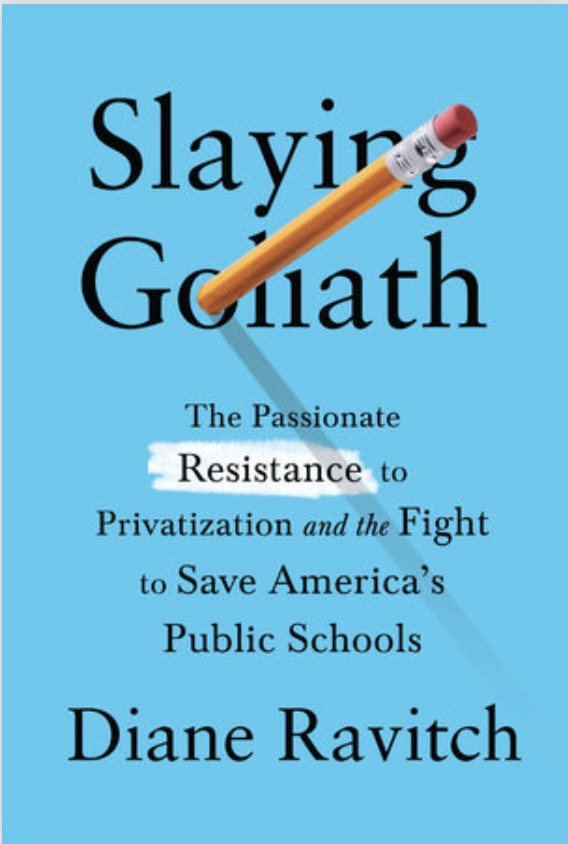
John Thompson, historian and retired teacher in Oklahoma, reviews SLAYING GOLIATH. This is the second part of his review.

This is an excerpt of a long and thoughtful review.

This second post will focus on Ravitch’s analysis of the research which predicted the defeat of accountability-driven, charter-driven policies. Perhaps the most striking pattern documented in Slaying Goliath is how they failed in the way that scholars and practitioners anticipated.

Decades of Disruption-driven reform began with the false claim “that American education was failing and the only way to fix it was with standards, tests, competition, and accountability.” As Arne Duncan’s public relations officer and Walton-funded reformer Peter Cunningham said, “We measure what we treasure.”

Ravitch’s response was, “I was taken aback because I could not imagine how to measure what I treasure: my family, my friends, my pets, my colleagues, my work, the art and books I have collected.” And that foreshadows the victory of the Resistance over Goliath. Most educators, patrons, and students agree that children are more than a test score.

No Child Left Behind and the Race to the Top set impossible test score targets. They were based in large part on the weird idea that “no-excuses” behaviorist pedagogies could be quickly “scaled up,” providing poor children of color a ladder to economic equality. Drawing on the tradition of Edward Thorndike and B.F. Skinner, reformers “rigidly prescribed conditioning via punishments and rewards.” Previewing their fatal flaw, Ravitch observes, “Behaviorists, and the Disrupters who mimic them today, lack appreciation for the value of divergent thinking, and the creative potential of variety. And they emphatically discount mere ‘feelings.’”

When educators resisted, corporate reformers became livid and doubled down on the punitive. Perhaps their worst debacle was using value-added teacher evaluations to hold each individual educator accountable for test score growth. It combined inappropriate test outputs with an unreliable and invalid algorithm, the VAM, as a club to enforce compliance. In the short run, it forced educators, who had previously tried to keep their heads down and “monkey wrench” testing mandates to join patrons and students in the Resistance. By 2018, however, pent up anger exploded as teacher strikes spread across the nation.

Today, many or most of Goliath’s coalition have become disenchanted with standardized testing, but their Disruption model can’t function without it. Few have gone as far as Paymon Rouhanifard, the former Camden superintendent who abolished report cards after listening to complaints, and denounced standardized testing as he left the job.

The more common path is to spin their punitive tests as “personalized” learning, and their incentives and disincentives as the “portfolio model.” As Ravitch explains, “A portfolio district is one where the local board (or some entity operating in its stead) acts like a stockbrokerage, holding onto winners (schools with high test scores) and getting rid of losers (schools with low test scores).”

As was also predicted by Campbell’s Law, test-driven accountability (made more intimidating by the dual threat of test-driven competition with charters) led to corruption. The cheating was far greater than just the scandals where adults erased and changed bubble-in answers. Graduation rates were easy to manipulate. For instance, NPR reported a “heartwarming story” in 2017 about a school with 100% graduation rate. A subsequent FBI investigation and a district audit found 1/3rd of the school’s graduates lacked credits and only 42% were on track to graduation.

And that leads to the corruption associated with school choice. Today’s Disrupters seem to be doubling down on charters to drive transformative change. As explained in a previous post, in 1988 Al Shanker saw charters as a path towards innovation. Within two years, however, the promise of win-win experimentation started to be undermined when conservative reformers Terry Moe and John Chubb claimed “choice is a panacea.”

In this case, it was choice-advocate Paul Peterson who predicted the political future. Charters didn’t take off because of the balanced approach of Shanker, but because reformers “radicalized” the concept. And, of course, there was plenty of big bucks available for pushing their radical but false narrative.

Within a decade, a shocking number of non-educators had been convinced by Goliath’s spinsters that the KIPP’s behaviorist model could be scaled up. As Slaying Goliath explains, “The biggest innovation in the charter sector was the invention of ‘no-excuses’ schools.” It took nearly another decade for policy makers to accept the fact that charters get average results except for those with high attrition.” And it took nearly as long to reveal the much greater down sides of charters…

Regardless of whether we’re discussing high-stakes testing, charter expansion, or the other pet theories, we should all heed Ravitch’s most important lesson of the past few decades is that “Reform doesn’t mean reform. It means mass demoralization, chaos, and turmoil. Disruption does not produce better education.”

Slaying Goliath celebrates a great victory for public education and democracy. However, Ravitch reminds us that the Disrupters are still threatening. She compares today’s danger to that which faced a man who decapitated a rattlesnake but who nearly died after being bitten by the detached head.

So, we can’t lower our guard until the principles that inspired the Resistance are safe in our schools.


Jeff Bryant has written a powerful story that reveals the growing dominance of corporations in schools.

In the expanding effort to privatize the nation’s public education system, an ominous, less-understood strain of the movement is the corporate influence in Career and Technical Education (CTE) that is shaping the K-12 curriculum in local communities.

An apt case study of the growing corporate influence behind CTE is in Virginia, where many parents, teachers and local officials are worried that major corporations including Amazon, Ford and Cisco—rather than educators and local, democratic governance—are deciding what students learn in local schools.

CTE is a rebranding of what has been traditionally called vocational education or voc-ed, the practice of teaching career and workplace skills in an academic setting. While years ago, that may have included courses in woodworking, auto mechanics, or cosmetology, the new, improved version of CTE has greatly expanded course offerings to many more “high-demand” careers, especially in fields that require knowledge of science, technology, engineering, and math (STEM).

Education policy advocates across the political spectrum, from Education Secretary Betsy DeVos to former First Lady Michelle Obama, have praised expansions of CTE programs in schools. Fast-tracking federal funds for CTE programs in schools has become the new bipartisan darling of education policy. CTE lobbyists and advocates have successfully pressed for expanded funding of their programs at federal and state levels. And a 2019 study by the American Enterprise Institute, a right-wing advocacy group based in Washington, D.C., found that since 2004, mentions of CTE in U.S. media outlets “have grown over tenfold, and they have doubled since 2012.”

According to a September 2019 analysis from Brookings, “more than 7 million secondary school students and nearly 4 million postsecondary students were enrolled in CTE programming.” And a 2018 review of CTE programs by the federal government’s National Center for Education Statistics found 73 percent of school districts offered CTE courses that give students both high school and postsecondary credit, a potential benefit for students and parents who want to reduce the cost of college.

What has folks in Chesterfield County, Virginia, concerned is the particular brand of CTE that has come to their district. At a September 2019 community event, middle school teacher Emma Clark and others mentioned the district’s collaboration with Ford Next Generation Learning (NGL), an offshoot of the Ford Motor Company that claims, according to its website, that it “mobilizes educators, employers, and community leaders to create a new generation of young people who will graduate from high school both college- and career-ready.”

Chesterfield parents I spoke with also pointed to the district’s collaboration with the Cisco Networking Academy, an offshoot of the computer networking giant that has its own branded course offering in the Chesterfield CTE curriculum.

In a phone conversation, Clark described the district’s collaborations with these companies as “new layers” of school privatization. First, corporations like these can use the rush to CTE to flood schools with new course offerings that require technology the schools have to buy. And another layer is the CTE programs businesses help to create provide them with free job training.

The concern Chesterfield teachers and parents have about corporate influence in K-12 public school curricula is magnified enormously due to the entrance of Amazon into the equation.

The “centerpiece” of Virginia’s successful effort to lure Amazon to build a new headquarters in the state, according to state-based news outlets and state-issued reports, was a commitment to more than double Virginia’s tech-talent pipeline, beginning in K-12 schools.

“Virginia’s ultimate proposal was centered around an effort to provide Amazon—or any other tech firm that wanted to come—with all the educated workers it needed,” according to a report in the Washingtonian, and the state sealed the deal with a pledge “to plow $1.1 billion into tech schooling.” The state’s commitment to developing a tech-talent pipeline providing workers for Amazon and other companies was key to inking the deal, says an Amazon spokesperson in the Cincinnati Business Courier.

“We’re being hijacked in Virginia,” Kathryn Flinn explained to me. Flinn is a 20-year resident of Chesterfield and mother of two children, one a special-needs child, who both have attended Chesterfield County Public Schools.