The Select Sub-Committee on the Coronavirus Crisis (House of Representatives) released a devastating report on the Trump administration’s efforts to hide the seriousness of the pandemic from the public.
Archives for category: Education Reform
James Hohmann of the Washington Post explains Trump’s refusal to face reality:
Self-help guru Norman Vincent Peale’s 1952 book, “The Power of Positive Thinking,” influenced Donald Trump’s worldview more than anything else he ever read, according to biographers. “Stamp indelibly on your mind a mental picture of yourself as succeeding,” Peale wrote. “Hold this picture tenaciously. Never permit it to fade.” The book includes chapters with titles like “Expect the Best and Get It” and “I Don’t Believe in Defeat.” Peale, who was also a favorite of the president’s father, even officiated the first of Trump’s three weddings.
The Trump presidency has presented scores of painful lessons on the limitations of the power of positive thinking. Climate change continues to make fires, floods and hurricanes worse, even if Trump denies it and his political appointees seek to erase mentions of it from government reports. Russia interfered in the 2016 election and the intelligence community agrees the Kremlin is trying once again to influence the 2020 campaign, but Trump struggles to accept that reality because, current and former aides say, he believes that acknowledging the Kremlin’s support for his campaign would undermine his legitimacy. And so on.
But nothing captures the hubris of trying to spin the primal forces of nature into submission more than the president’s response to the novel coronavirus.
Trump said in January that the coronavirus was “totally under control” and that there would be only a few U.S. cases before the number would “go down to zero.” On Feb. 28, Trump said: “It’s going to disappear. One day it’s like a miracle, it will disappear.” In March, Trump said people would be able to celebrate vanquishing the coronavirus by going to church on Easter.
That was more than six months ago. Trump downplayed the dangers of the contagion not just at the country’s peril – but his own. Watching these clips with the benefit of hindsight makes the president sound like Baghdad Bob as U.S. forces closed in on the Iraqi capital in March 2003.
White House press secretary Kayleigh McEnany became the latest member of Trump’s inner circle to test positive. She announced in a statement on Monday that she has no symptoms and will continue to work – but from home.
Apparently, denialism can be infectious, as well. The White House’s lead physician, Sean Conley, acknowledged at a news conference on Sunday that he intentionally withheld information about Trump’s blood-oxygen levels plummeting in order to put a positive spin on the president’s condition. “I was trying to reflect the upbeat attitude that the team, the president, that his course of illness, has had,” Conley said. “I didn’t want to give any information that might steer the course of illness in another direction. And in doing so, you know, it came off that we were trying to hide something, which wasn’t necessarily true.”
A virus does not care what a doctor says at a news conference. White House communications director Alyssa Farah told reporters that Conley was trying to project positive for Trump’s sake during his public remarks on Saturday. “When you’re treating a patient, you want to project confidence, you want to lift their spirits, and that was the intent,” she said.
Positive thinking has certainly gotten Trump far in life, and it can be very helpful for a patient fighting a disease. Everyone wishes the president well and hopes he recovers as speedily as possible and with no long-term damage. But Conley was not speaking to Trump during his Saturday news conference. He was addressing the American people.
Since being hospitalized on Friday at Walter Reed National Military Medical Center in Bethesda, the president has been treated with the steroid dexamethasone, the antiviral drug remdesivir and a cocktail of monoclonal antibodies that has not yet been approved by the Food and Drug Administration. Outside doctors think Trump may be the first coronavirus patient ever given all three of these strong treatments simultaneously, along with a handful of supplements and over-the-counter drugs. Medical experts we checked with called it a kitchen-sink approach that suggests the president is in worse shape than the White House is claiming.
Trump, who ostensibly remains highly contagious, appears to still be in denial about the risks he poses to others by trying to return to the White House before doctors would advise him to do so – and by going for a ride in his motorcade at Walter Reed on Sunday afternoon to see well-wishers outside the gates. Current and former Secret Service agents and medical professionals were aghast about Trump’s car ride outside the hospital, saying the president endangered those inside his SUV for a publicity stunt, Josh Dawsey, Carol Leonnig and Hannah Knowles report. “As the backlash grew, multiple aides who spoke on the condition of anonymity to describe internal deliberations also called Trump’s evening outing an unnecessary risk — but said it was not surprising. Trump had said he was bored in the hospital, advisers said. He wanted to show strength after his chief of staff offered a grimmer assessment of his health than doctors.”
- “He’s not even pretending to care now,” one current Secret Service agent said after the president’s jaunt outside Walter Reed.
- “Where are the adults?” said a former member of the Secret Service.
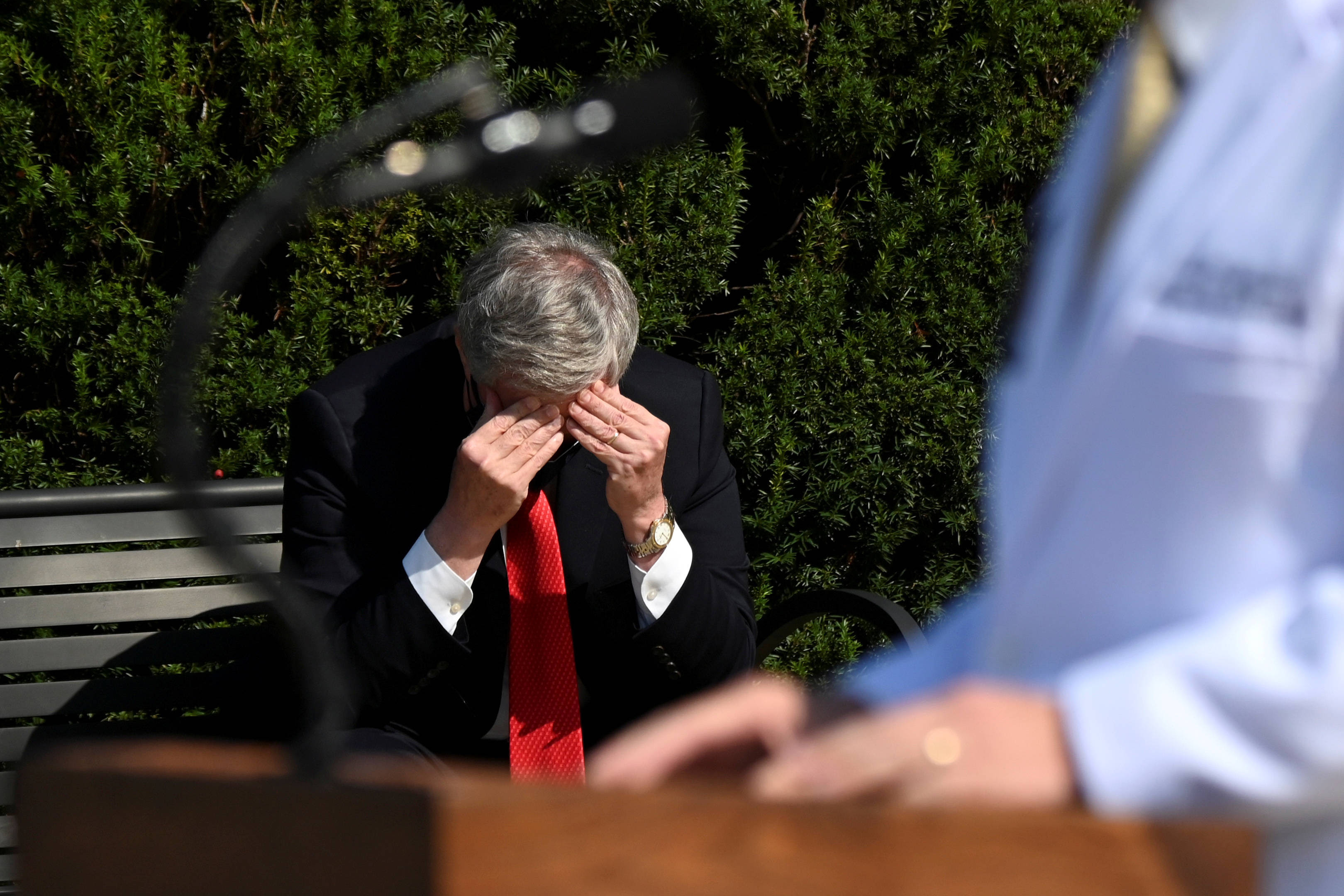 White House chief of staff Mark Meadows listens as Sean Conley speaks to the media on Sunday at Walter Reed. (Erin Scott/Reuters) White House chief of staff Mark Meadows listens as Sean Conley speaks to the media on Sunday at Walter Reed. (Erin Scott/Reuters) |
As the virus spread among the people closest to him last week,Trump asked an adviser not to disclose results of their own positive test. “Don’t tell anyone,” Trump said, according to the Wall Street Journal.
We found out that Trump himself tested positive on a rapid test that he took Thursday and was awaiting the results of a second, more reliable, test when he called into Sean Hannity’s show that night. He did not reveal the news to the Fox News host. Former counselor to the president Kellyanne Conway’s teen daughter, Claudia, broke the news on Friday, via her social media platforms, that her mom was infected. Claudia Conway says she, too, has now tested positive for the virus.
There are other indications that the president’s attempted coverup continues. “Farah told reporters Sunday that the White House would be more forthcoming going forward, and would release information about the number of aides who have tested positive for the virus. Later Sunday, [McEnany] indicated that such information would not be released, citing privacy considerations. Several White House officials are still waiting to learn if they will be infected,” Toluse Olorunnipa, Dawsey and Amy Goldstein report. “Nick Luna, Trump’s personal assistant, has tested positive for the coronavirus, according to a senior administration official. … Meanwhile, at least two White House residence staffers contracted the virus some weeks ago and were sent home. Administration officials do not believe those staffers directly gave the virus to the president, given the passage of time since their cases.” Neither of those cases were disclosed to the public. The White House did not acknowledge that senior adviser Hope Hicks had tested positive until a reporter for Bloomberg News broke the story.
There is a lot the White House still will not say. Conley declined to answer when asked how Trump’s lungs have been affected by the virus, whether he has pneumonia and what his exact temperature has been. The White House refuses to say when Trump last tested negative for the coronavirus. That is a critical piece of information to determine how long the president may have been contagious — and how many people he may have put at risk by traveling to Ohio, Minnesota and New Jersey.
And Trump continues to put a positive spin on his experience. In a video he posted to Twitter on Sunday evening, Trump said he’s “learned a lot” about covid-19. “I learned it by really going to school,” the president said from his hospital suite. “This is the real school; this isn’t the let’s-read-the-books school. And I get it. And I understand it. And it’s a very interesting thing. And I’m going to be letting you know about it.”
The American people do not approve of Trump’s denialism. An ABC News-Ipsos poll conducted in the two days after Trump announced his diagnosis found that 72 percent said both that the president did not take the “risk of contracting the virus seriously enough” and that he did not take “the appropriate precautions when it came to his personal health.” The poll, released Sunday, found that 43 percent of Republicans shared the negative sentiments about Trump’s mind-set and preventative actions regarding the coronavirus. Overall approval for the president’s handling of the pandemic held steady at 35 percent, where it has been since early July.
David Dayen writes a daily report for The American Prospect on the pandemic called “Unsanitized.” In this entry, he comments on Trump’s selfishness in spreading the coronavirus.
He writes:
| The President Is a Sick Man |
| What happens when one of the worst people America has produced contracts the coronavirus? Well, he tries to hide it, first of all. He attends a series of fundraisers and rallies without disclosure, potentially exposing hundreds if not thousands of people. When he has to roll to the hospital because his condition is deteriorating, he shows fake photos of himself “at work,” even as most of the public knows he doesn’t work even in normal times. His physician, it is leaked, withholds details of his medical condition to lift his spirits and “convey confidence.” But it’s also noted that he’s taking a cocktail of medications that are really only reserved for very sick people. To top this off, he demands to be taken on a car parade around the Walter Reed Medical Center to wave at well-wishers, while Secret Service agents are forced to sit in the car with his contagious personage. So whether he’s leaving the hospital today or not, I think we can say that Donald Trump is handling this disease almost exactly as you would expect it. All presidents lie, and most of them lie about their health: here’s a rundown, but I note that Gover Cleveland, known in his day for the slogan “Tell the truth,” snuck out of Washington onto a boat and had half of his cancerous jaw removed, in secret, in the 1890s when removing half your jaw was, you know, a treacherous thing, and when a reporter found out about it and leaked the information Cleveland’s White House ruined his life. There’s a great little book about this called The President Is a Sick Man by Matthew Algeo. Point being, the default setting in White Houses is obfuscation about a president’s medical condition. Even when accounting for that, however, Trump’s… Trumpiness is exhausting and sad. The selfishness, the lies, the moral blindness is fully on display. “The President is a sick man” takes on new meaning. |
Andrea Gabor, a former editor at Business Week and U.S. News & World Report, is the Bloomberg chair of business journalism at Baruch College of the City University of New York and the author of “After the Education Wars: How Smart Schools Upend the Business of Reform.” It appeared behind a paywall at Bloomberg News. After she wrote this article, Governor Gavin Newsom vetoed the proposal to mandate a course in ethnic studies as a requirement for high school graduation. The original proposal would have included the experiences of African Americans,Latino Americans, Native Americans and Indigenous peoples, and Asian Americans. The governor received complaints from other ethnic groups complaining that they should have been included. First Jewish groups complained, then Arab Americans, then Iranian Americans, then Kurdish Americans, and on and on.
In his veto message, Newsom said he values the role of ethnic studies in helping students understand the experiences of marginalized communities and that he supports schools and districts offering such courses. But, he said, there was too much uncertainty about the content of the model curriculum and he wanted to be sure it “achieves balance, fairness and is inclusive of all communities.”This contretemps reminded me of my exposure to California culture wars in the mid-1980s when I was invited by Bill Honig, then State Superintendent of Public Instruction, to join a committee to rewrite the state’s history and social-science framework. I spent three days each month in California for nearly two years, and eventually became the lead writer. Our committee produced a groundbreaking, history-based, multicultural K-12 curriculum. When it came time for public hearings all over the state, we were pounded by every racial, ethnic, and religious group in the state for not giving enough attention to them. We made changes wherever possible to give each group its due, but some were never satisfied. We ended up writing a Human Rights curriculum that added extensive attention to the Armenian Genocide (the Armenian community was especially aggrieved, and the Governor was of Armenian descent).
Gabor wrote:
Trust California to plunge deeper into the culture wars, even at the risk of undermining its own worthy objectives.Under a bill headed for signature by Governor Gavin Newsom, the state would become the first to require that all high-school students pass an ethnic-studies course before graduating. The new mandate follows passage in August of a similar university-level requirement that is set to take effect in the 2021-2022 academic year.
As if on cue, President Donald Trump charged last week that U.S. schools are “indoctrinating children,” and vowed to bring back “patriotic education.” (My Bloomberg Opinion colleagues shared some thoughts this week on how that should go.)
California has the right idea. It’s past time for educators to confront long-standing gaps that have made it too easy for Americans to ignore the dark side of their own history. That’s been a recent goal of some journalists, scholars and the Black Lives Matter movement. Last year, a Pulitzer Prize-winning New York Times series sought to reframe U.S. history by arguing that “the start of this nation’s story” was not 1776 or 1787 but rather 1619, the year the first slaves arrived in Jamestown, Virginia. The series has since been integrated into history curricula nationwide. A year earlier, a book by the Harvard University historian Jill Lepore, “These Truths,” won prizes for a nuanced look at America’s founding ideals and the extent to which the nation has lived up to them.
A small but growing number of states agree that schools need to bring a wider lens to U.S. history and integrate the perspectives and contributions of minorities, as well as the losses of indigenous communities. In addition to correcting the historical record, proponents argue that such courses also boost attendance and performance among students otherwise at risk of failing or dropping out. But California’s unfunded mandate to create a separate ethnic-studies course is a flawed approach that risks draining money and attention from history and civics curricula. A better path is being blazed by Oregon, which aims to teach a broader narrative of U.S. history by deepening existing social studies and civics standards.
Under California’s high-school mandate, every district must offer ethnic-studies courses in the 2025-2026 school year, at a time when the state will probably be recovering from pandemic- and fire-induced financial devastation. Under state law, additional funding for the mandated course could take several years to approve. Even then, depending on the state’s fiscal health, the legislature could pay for it by draining some funding from other educational programs, according to Edgar Cabral, an analyst in California’s Legislative Analyst’s Office. (California is already anticipating future budget cuts; it took a decade to restore school funding following cuts made during the recession of 2008.)
California’s approach does offer districts some flexibility to modify existing courses rather than follow an ethnic-studies curriculum now being developed by the state that focuses on African Americans, Latinos, Asian Americans and Native Americans. However, for modified courses, ethnic studies must constitute the “primary content.”
By contrast, Oregon is establishing new statewide standards that broadly define what students should learn in existing courses rather than imposing new-course mandates. The revised Oregon standards, adopted in 2018, aim to “create teaching and learning opportunities for students to examine identity, race, ethnicity, community, religion, nationality and culture in the United States.” Thus, a discussion of the nation’s westward expansion and manifest destiny would include a focus not just on settlers, but also on the people who had lived in what is now Oregon since time immemorial, as well as the contributions of European and Asian immigrants.Some states, including Vermont and Washington, where curriculum is set at the local level, also are focused on developing new ethnic-studies standards and course materials that local districts can choose to adopt, or not, as they see fit.
Making the courses optional, however, undermines a goal of public education: to create one culture out of many. Ethnic studies have been controversial since they were first conceived in the 1960s. The Cornell University literature professor Noliwe Rooks has noted that the Ford Foundation backed early university Black-studies programs at least in part to keep students from being “lured into more radical politics like that of the Black Panther Party.” In the 1970s and 1980s, budgetary crises weakened funding for ethnic-studies programs.
In extreme cases — notably in Arizona — a backlash against ethnic studies at the high-school level provoked a ban, later reversed, on any public-school courses that “promote resentment toward a race or class of people, are designed primarily for pupils of one ethnic group, or advocate ethnic solidarity.”
Today, historians are pushing to correct distortions and omissions of America’s historical record. That’s a worthy goal for educators, but it could fail if it heightens social tensions. It’s also dangerous to drain funding and focus from civics instruction, which has declined over the last two decades as standardized testing regimens focused on math, science and English.
By contrast, developing standards that include a broader ethnic and racial perspective in American history and civics courses could serve to deepen education for everyone.
To contact the author of this story:Andrea Gabor at Andrea.Gabor@baruch.cuny.edu
Jan Resseger writes here about the Republicans who refuse to fund teachers’ salaries have placed budget-cutting above education and the needs of the future. The Republicans’ disregard for teachers has been displayed over the past 20 years, as state legislatures and governors have attacked teachers’ rights, their salaries, and whatever they could to discourage teachers. The supply of young people entering education has precipitously declined, in response to the devaluing of the profession.
Among the lingering effects of state budget reductions during the 2008 Great Recession have been widespread drops in teachers’ overall compensation. Although some states and local school districts do their part to pay their teachers fairly, and some provide the fringe benefits such professionals should expect, overall according to a new report from the Economic Policy Institute, “teachers are paid less (in wages and compensation) than other college-educated workers with similar experience.” And, “(T)his financial penalty discourages college students from entering the teaching profession.”
Our economy has now entered another recession due to layoffs and business closures during COVID-19, and without further federal relief to states, teachers are likely once again to be the victims.
All summer and through September, U.S. Senate Republicans have refused to negotiate with House Democrats, who passed their bid for a second coronavirus relief bill, the HEROES Act, on May 15. Until this past weekend, it looked as though Congress would recess until after the election without the Senate’s agreeing even to take up the bill for consideration.
House Speaker Nancy Pelosi and White House negotiator Steve Mnuchin returned to discussions last week, but until the President became ill with COVID-19 over the weekend, it looked as though progress had broken down. The President’s infection by COVID-19 and indications that the economy will continue to lag have, apparently, brought Pelosi and Mnuchin back to the table over the weekend, and have also made Senate Majority Leader Mitch McConnell and his caucus more amenable to further federal investment. A relief package is needed to help the unemployed, to strengthen SNAP (food stamps) and Medicaid, and to help states avoid catastrophic budget cuts like those that have continued to depress school funding more than a decade after the 2008 recession.
William J. Gumbert has studied the performance of charter schools in Texas and has consistently documented that they are inferior to public schools. Their promoters have sold the Legislature a Bill of goods, meaning that their results are nowhere as impressive as their promises. In this post, he shows that charter graduates are poorly prepared for higher education.
Privately Managed, College Preparatory Charter Schools:
A Common Approach and a Common Result – Graduates Underperform in College
By: William J. Gumbert
Without any notices or disclosures, the Texas Legislature has been experimenting with students in public education for 25 years. The experiment allows a separate system of taxpayer funded, privately managed charter schools (“State Charters”) to recruit students from locally governed school districts. In this regard, the State provides approximately $10,000 for each student that a State Charter recruits from local school districts. In total, the State has diverted over $25 billion of taxpayer funding from local school districts to fund its separate system of privately managed State Charters.
With State Charters receiving taxpayer funding for recruiting students to attend a low-performing school and with the flexibility to relocate underperforming schools to another community, it is not surprising that State Charters are rapidly expanding. It is also not surprising that many State Charters are targeting the enrollment of low-income, minority students. In low-income communities across the State of Texas, the “sales pitch” is the same and it goes like this:
“Because school districts offer limited high-quality educational options, privately managed charters were created to provide a tuition free, college preparatory education to close the achievement gap for low-income and minority families. As highlighted in our recruiting brochures, our schools are nationally recognized and 100% of the graduates are accepted to college every year. We are a non-profit organization with a mission to ensure that all students get in and through college. With limited seats, please contact our full-time staff of student recruiters to assist with the submission of an application”.
However, these promotions are disingenuous and “very economical with the truth” as the facts document that school district graduates, from Dallas to Houston to the Rio Grande Valley, outperform State Charter graduates upon enrolling in college.
Results in First Year of College Indicates Probability of Graduation: Many studies have indicated that students with a low-grade point average (“GPA”) in their first-year college are less likely to persist in college and graduate. According to the published article: “First Semester GPA a Better Predictor of College Success than ACT Score” by the University of Illinois at Urbana-Champaign, students with a first semester GPA below 2.33 were half as likely to graduate from college in comparison to higher performing students. For low-income students, a GPA below 2.0 (a “D” average or below) has the potential added consequence of losing their student loans or financial scholarships/grants that make college an option. The consequences of a failing GPA for low-income students are a reminder that college acceptance is one thing and succeeding in college is another. As such, prior to college enrollment it is vital for students to be academically, emotionally, and socially prepared to succeed. If not, students are being set-up to fail.
State Charters and School District Graduates – Comparison of College GPAs: Given the relationship between first year GPA’s and college graduation, the Texas Higher Education Coordinating Board (“THECB”) tracks the first year GPA’s of Texas students that enroll at a 4-year public university. The table below compares the GPA’s of State Charter and school district graduates within the Class of 2018 that enrolled in a 4-year public university in 2019. As shown, almost 30.3% of State Charter graduates had a failing GPA versus 17.5% of school district graduates. In addition, the percentage of State Charter graduates achieving a GPA or 3.0 or above lagged school district graduates by 15.4%.

College Preparatory State Charters Targeting Low-Income, Minority Families: There are 4 primary State Charters in Texas that target the recruitment of low-income, minority students with the allure of a “college preparatory” education (referred to as the “CP Charters” herein). As shown in the table below, the enrollment at CP Charters is 115,791 students (which is approximately 33% of the enrollment in all State Charters) and over $1.0 billion of taxpayer funding will be provided in the current year. It is noteworthy that after 20 years, CP Charters produced 3,338 high school graduates in 2018. In comparison, Humble ISD with an enrollment of 43,441 produced a comparable number of high school graduates and it will receive $403 million of taxpayer funding this year.
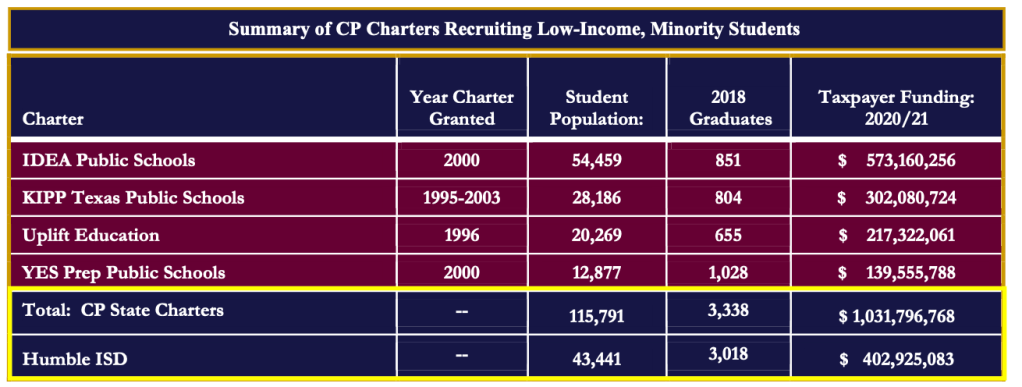
CP Charter Graduates Underperform in College: Although touted as “tuition-free” college preparatory schools, 39.0% of CP Charter graduates had a GPA below 2.0 upon enrolling in a 4-year public university in 2019. In comparison, only 17.5% of school district graduates had a similarly low GPA. In addition, 27.0% of CP Charter graduates excelled with a GPA of 3.0 or above, which is about half of the 53.0% of school district graduates with a GPA of 3.0 or above.
While this general comparison of college GPA’s does not account for the difference in the student populations that are enrolled at CP Charters and school districts, it does indicate that CP Charters are not successfully closing the “achievement gap” for the low-income, minority students that are actively recruited.

Comparison of College GPA’s – IDEA Public Schools, Brownsville ISD and Edinburg CISD: To compare the postsecondary success of CP Charter and school district graduates that serve similar student populations, a comparison of IDEA Public Schools (“IDEA”), Brownsville ISD (“BISD”) and Edinburg CISD (“ECISD”) is included below. IDEA Public Schools currently enrolls 7,972 students within BISD and ECISD and each school system had a similar percentage of economically disadvantaged graduates within the Class of 2018. For purposes of comparison, we will ignore that both BISD and ECISD had a higher number of graduates and a higher percentage of “At Risk” and “Special Education” graduates.
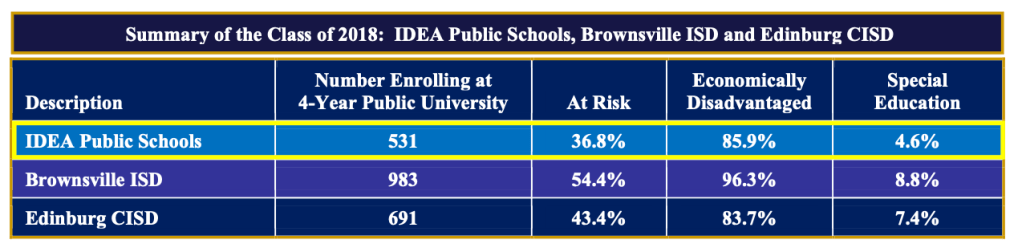
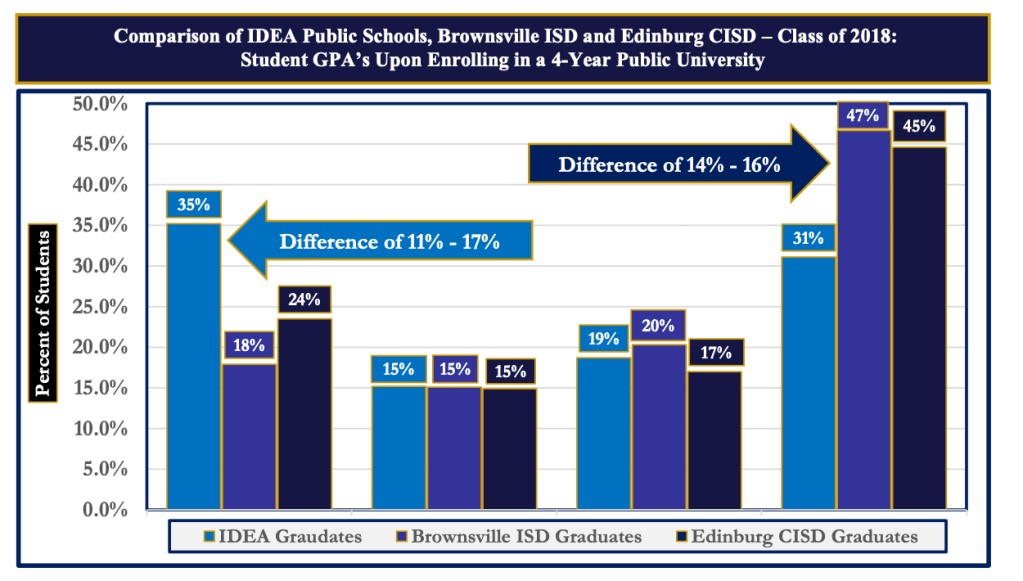
As highlighted in the graph below, the college GPA’s of BISD and ECISD graduates are similar. But despite serving a comparable student population, the GPA’s of IDEA graduates are well below BISD and ECISD graduates. For instance, 35% of IDEA graduates had a GPA below 2.0 versus only 18% of BISD graduates. In addition, the percentage of IDEA graduates that earned a GPA of 3.0 or above was 14% – 16% lower than ECISD and BISD graduates.
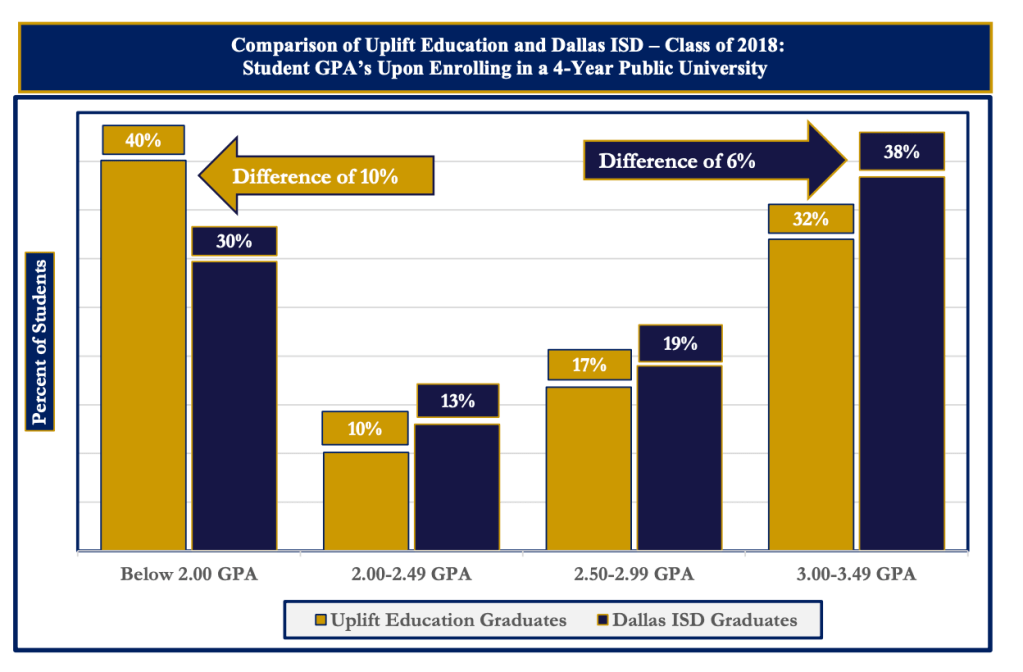
Comparison of GPA’s — KIPP Texas, YES Prep and Uplift Education: To further compare the GPA’s of CP Charter graduates to school district graduates with similar student populations, the GPA’s of KIPP Texas and YES Prep graduates are compared to Houston ISD graduates on the following page. KIPP Texas and YES Prep collectively enroll 20,957 students within Houston ISD. In addition, a comparison of the GPA’s of Uplift Education graduates and Dallas ISD graduates is included. Uplift Education currently enrolls 9,549 students within Dallas ISD.
The results of these comparisons are consistent with previous GPA comparisons, as a significantly higher percentage of KIPP Texas, YES Prep and Uplift Education graduates had a GPA below 2.0 as compared to Houston ISD/Dallas ISD graduates that enrolled in a 4- year public university. In fact, at least 40% of KIPP Texas, YES Prep and Uplift Education graduates had a GPA below 2.0 upon enrolling in a 4-year public university in 2019. Furthermore, the percentage of KIPP Texas and YES Prep graduates that earned a GPA of 3.0 or higher was equal to about half of the Houston ISD graduates that obtained a comparable GPA.

Common Attributes of CP Charters: With the strikingly similar low postsecondary performance of CP Charter graduates relative to school district graduates, there are numerous other commonalities among CP Charters that may be contributing to these results as discussed below.
Funded and Directed by Special Interests:
Every CP Charter has received millions of dollars from private foundations to expand in local communities. A few of the private foundations that are financially supporting CP Charters is included below. To maintain ongoing influence on public education in local communities and to oversee their financial investments, it is common for trustees of private foundations to be appointed to the governing boards of CP Charters. For example, Ms. Victoria Rico, Chairwomen of the George W. Brackenridge Foundation, has served on the Board of IDEA Public Schools and Ms. Carrie Walton Penner, a Board member of The Walton Family Foundation, serves on the Board of KIPP.
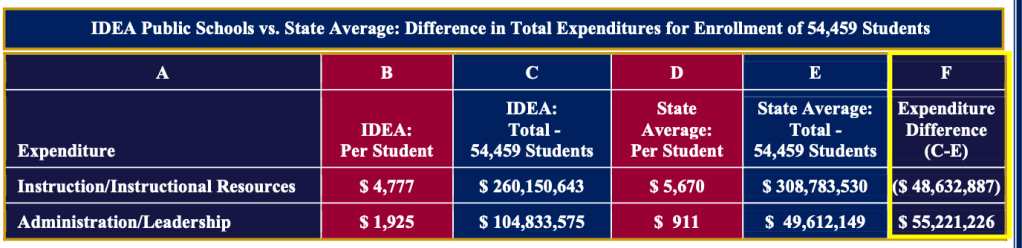
Expenditure Model: Prior studies have indicated that higher funding for student educational programs improves student outcomes. But each CP Charter deploys a conflicting “expenditure model” that devotes fewer dollars for student programs/services. In comparison to the state average of all public schools, CP Charters allocate up to $928 less per student for student “Instruction/Instructional Resources”, while allocating as much as $1,014 more per student for “Administration/Leadership” costs as summarized in the table below.

To illustrate the magnitude of the difference in the expenditures that CP Charters deploy to serve primarily low-income and minority families, the table below compares the “Instruction/Instructional Resources” and “Administration/Leadership” expenditures of IDEA Public Schools to the state average. Based upon the enrollment of 54,459 students, IDEA annually devotes $48.6 million less for student “Instruction/Instructional Resources” than the average public school in Texas and $55.2 million more for “Administration/Leadership”. To put it another way, if the 54,459 IDEA students were enrolled in a school district, an additional $48.6 million would be annually directed to support the instructional needs of students from low-income homes and $55.2 million fewer taxpayer dollars would be siphoned to pay the administrative costs of the private organizations within the State’s separate system of State Charters.
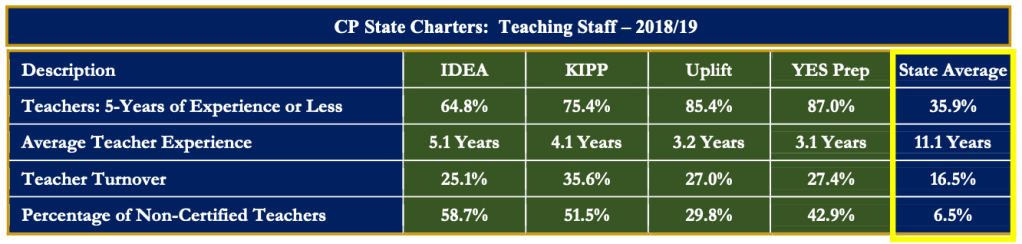
Teacher Staffing Model: There have been multiple studies concluding that teachers with more experience and lower teacher turnover improve student achievement. This includes information published by “tpier-Texas Education Reports” that is co-managed by the Texas Education Agency (“TEA”). According to “tpeir-Texas Education Reports”, teachers with 1-3 years of experience have 6% fewer students that pass the State of Texas Assessment of Academic Readiness” (“STAAR”) test than teachers with 10 years of experience. Despite these findings, CP Charters impose an unorthodox approach that does not value teacher experience, teacher certifications, or teacher persistence. As demonstrated in the table below, as much as 87% of the teaching staffs at CP Charters have fewer than 5 years of experience, and in some cases, almost 60% of teachers are “non-certified”. In addition, with an annual teacher turnover rate of over 25% – 35%, the ability of CP Charters to implement consistent instructional practices and develop long-term, nurturing relationships with students is diminished relative to school districts.
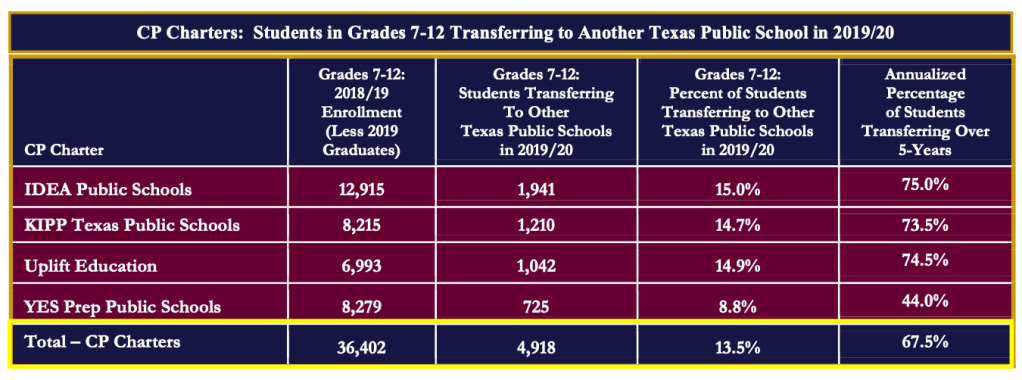
Families Transfer from CP Charters to Another Texas Public School at High Rates: CP Charters recruit new families by marketing the perception that students will be enrolled in a prestigious and nationally acclaimed, tuition-free private school. But upon acceptance and witnessing the educational experience offered by CP Charters, 13.5% of the student enrolled in CP Charters in grades 7-12 transferred to another Texas public school in 2019/20. Comparatively, the student transfer rate at Brownsville ISD and Edinburg CISD that have been bombarded with the expansion of State Charters is 6.1% and 5.8%, respectively. This revolving door means that up to 75% of the students enrolled at a CP Charter in grade 7 are not enrolled in grade 12. This high transfer rate is concerning given the growing evidence that academic outcomes can be negatively impacted as students change schools.
If a restaurant or local business were required to replace 75% of its customers every 5-years, it would likely indicate a flawed business model and the restaurant or local business would be forced to close. But the business model of CP Charters anticipates the loss of students. Which is why CP Charters devote millions of dollars each year to develop a “wait list” of new families to replace those that transfer to another Texas public school each year.
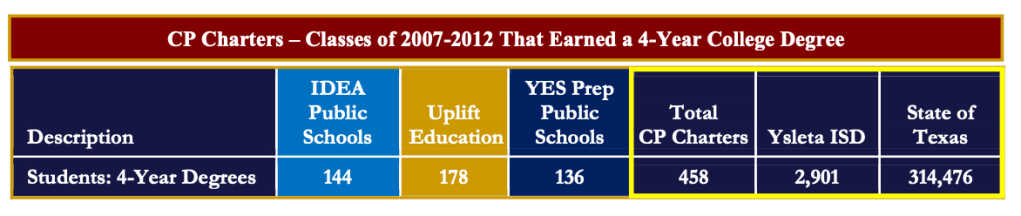
Limited CP Charter Graduates Have Earned a 4-Year College Degree: While each CP Charter has been operating in Texas for at least 20-years, the number of graduates that have earned a 4-year college degree remains very limited. According to “tpeir – Texas Education Reports”, the table below summarizes the number of graduates from the Classes of 2007-2012 at IDEA Public Schools, Uplift Education, and YES Prep Public Schools that earned a 4-year college degree by 2018 (i.e. 6 or more years after high school graduation). It is noted that KIPP Texas was excluded from the table as only 13 graduates were shown to have earned a 4-year college degree and that appeared to be potentially misleading. From the 6 graduating classes in years 2007 – 2012, a total of 458 CP Charter graduates earned a 4-year college degree. For perspective, the number of CP Charter college graduates represents 0.0014% of the total graduates within the State of Texas that earned a 4-year college degree during this time and the number of CP Charter college graduates is 6.3X lower than Ysleta ISD in El Paso.
The point is not to criticize the number of CP Charter graduates that have earned 4-year college degrees. Rather, it is to highlight that the State continues to permit CP Charters to rapidly expand and recruit additional low-income families, despite the limited evidence that CP Charters are adequately preparing students to be successful in college.
Conclusion: In our public schools, students are taught to use the “scientific method” to analyze and answer questions. In this regard, students perform extensive research, formulate a hypothesis, conduct an experiment to test the hypothesis, analyze the data, and draw an evidence-based conclusion.
However, to establish public education policies the Texas Legislature does not rely upon research to form its hypothesis that privately managed State Charters will produce better student outcomes than locally governed school districts. For the last 25 years, the State has conducted a $25 billion taxpayer funded experiment to test its hypothesis about State Charters. The data produced by the State’s experiment documents that State Charters have consistently produced lower student outcomes than school districts as measured by the State’s own academic metrics. These metrics include results of the STAAR test, district and campus academic ratings, graduation rates, financial standards, etc. The difference in the postsecondary outcomes of State Charter and school district graduates referenced herein is further evidence.
So why does the State ignore the facts of its privatization experiment and continue to support the rapid expansion of State Charters in local communities? To answer that question, I conducted my research, formed a hypothesis, analyzed the facts of the experiment, and formed an evidence-based conclusion that the State’s separate system of privately managed State Charters is not about improving student outcomes for low-income and minority students. Rather, the State’s separate system of privately managed State Charters is to please the billionaire, political donors that desire to transfer the governance and taxpayer funding of public education to private organizations.
With fewer resources and a limited political profile, the initial recruitment of low-income and minority families provided the path of least resistance to establish the State’s separate system of privately managed State Charters. With the State approving more and more State Charter expansions in suburban school districts such as, Conroe ISD, Frisco ISD, Hays CISD, New Braunfels ISD, Prosper ISD, Round Rock ISD, Sherman ISD, and Whitewright ISD to name a few, the next phase of the State’s efforts to privatize public education is well underway.
It is your students, your children, your grandchildren, your tax dollars, and your community. It is time for the State to serve students with the basic principles that our taught in our public schools: honesty, integrity, morality, equality, and the scientific method.
DISCLOSURES: This material solely reflects the opinions of the author and the author has not been compensated in any manner for the preparation of this material. The author is a voluntary advocate for public education. The material herein is based upon various sources, including but not limited to, the Texas Education Agency, Texas Academic Performance Reports, Public Education Information Management System, tpeir-Texas Education Reports, The Texas Higher Education Coordinating Board, and other publicly available information. While the author believes these sources to be reliable, the author has not independently verified the information. All readers are encouraged to complete their own review of the State’s separate system of privately managed charter schools in Texas, including the material referenced herein and make their own independent conclusions.
Today is World Teachers Day. It’s a day we honor teachers around the world and thank them for their dedication and hard work, building our future.
Andy Hargreaves poses a thought experiment: Imagine a world without teachers!
He begins:
Never has there been a more important time than this moment, right now, to think about and appreciate what great teachers have done for our children and also for us. We have seen what the world looks like when its teachers are taken away from our children. We have witnessed online how teachers have struggled mightily to master complex digital platforms and to try and make virtual class interactions with children as enriching as possible. Plunged into virtual learning at very short notice, our own grandchild’s teacher has posted materials as early as 4am. We have also learned about all the teachers who delivered curriculum materials, workbooks, pens and paper to poor working class homes when many children were unable to access online learning. We’ve been experiencing a world without teachers. So it’s time to reflect on why teachers truly matter.
Andy remembers a teacher who changed his life, Mrs. Waring.
This is what so many teachers do. They inspire our children with new interests, develop their curiosity about learning, give them the chance to undertake protracted projects that enable them to explore their interests, and, to some extent, themselves in depth. And they engage with the totality of their children’s development as human beings. Even when you’re not perfect and have let yourself down, teachers like this still stand by you and help put you back on the right path again.
So it’s a disgrace and a shame that for more than 20 years, in many countries, politicians thought they could lower the cost of government spending by disinvesting in public education, and by demeaning and discouraging its teachers. They thought they could privatize schools and deregulate teaching so that teachers would be less qualified, less unionized, and less well supported, and therefore move on quickly before their salaries started to climb. And they thought and still sometimes think that teachers were expendable and could be substituted with digital devices. They claimed that education could take place anytime, anywhere, with teachers or without them. And they believed that impersonal algorithms could replace teachers’ professional judgments. Government leaders, media and business critics, and more than a few thought leaders, promulgated crude stereotypes of bad teaching that was allegedly ruining children’s lives. In-person teaching was portrayed as being teaching from the front, in the boring classes of factory age schools. These portrayals, as fictitious as the US voter ballots allegedly dumped into unnamed rivers, have then been used to try and replace teachers with online learning.
Then, all of a sudden, the biggest natural educational experiment in human history – taking nearly 2 billion children out of school – has made everyone think again. What is a world like without teachers?
It’s a place without an economy because parents can’t go to work if their children aren’t in school.
It’s a place where teenagers can’t be with their peers, developing their senses of identity and responsibility away from their parents.
It’s a place that can’t protect young people from being bullied, or prevent many others from turning into bullies.
It’s a place that builds no sense of community or of how to participate in society.
It’s a place where teachers can’t be the high water mark that separates order from chaos, where they can’t intervene calmly when there’s trouble, and where there’s no-one to help children focus, when they are otherwise easily distracted.
A world without teachers is also a place where children have no way to learn how to express their own ideas and listen to others, to take their turn, and to value differences.
Teachers ignite new interests, show you the difference between your first effort and your best effort, and help you achieve things you never would have thought possible if you had been left to yourself.
Teachers help young people learn about racism, prejudice, climate change and the Holocaust, even and especially when youngsters’ parents don’t.
A world without teachers is a world deprived of learning and with a lot less love. Appreciate your children’s teachers, and reflect back on the teachers who made a difference for you.
It’s time to bring our teachers back, not just physically in our schools, but also morally, at the very center of our societies. Please celebrate World Teachers Day.
Ruth Marcus, a writer for the Washington Post, writes that Amy Coney Barrett says she holds the same judicial philosophy as her mentor Justice Antonin Scalia. In this column, she explores Scalia’s legacy.
The best way to predict how Supreme Court nominee Amy Coney Barrett would behave as a justice is to listen to her — and take her words seriously. She hasn’t been mysterious about it: Speaking in the Rose Garden after President Trump announced his selection, Barrett invoked the “incalculable influence” of her “mentor,” Justice Antonin Scalia, adding: “His judicial philosophy is mine, too — a judge must apply the law as written.”
We can, and should, examine Barrett’s record, on the bench and in academia. So Barrett’s decision to sign a newspaper advertisement in 2006 that decried the “barbaric legacy” of Roe v. Wade is instructive — if any more were needed to deduce her inclinations on that case. “You don’t know her view on Roe v. Wade,” Trump lectured Democratic nominee Joe Biden at Tuesday’s debate. “You don’t know her view.”
Oh, please. This from someone who vowed, during a debate with Hillary Clinton four years ago, that overturning Roe “will happen automatically, in my opinion, because I am putting pro-life justices on the court.”
But let’s imagine there’s still some uncertainty here. One way to examine how a Justice Barrett will rule is to examine the jurisprudence of Scalia, for whom she clerked in 1998 and 1999. The late justice repeatedly — and scathingly — made clear that he did not believe in any constitutional protection for abortion rights, and that the court was being cowardly by refusing to fix its error.
In 1989, when Justice Sandra Day O’Connor argued that “a fundamental rule of judicial restraint” required the court to avoid reconsidering Roe, Scalia was dismissive: That position, he said, “cannot be taken seriously.” Three years later, in 1992’s Planned Parenthood v. Casey, when O’Connor and a court plurality reaffirmed the essence of Roe, Scalia said the issue “is not whether the power of a woman to abort her unborn child is a ‘liberty’ in the absolute sense; or even whether it is a liberty of great importance to many women. Of course, it is both. The issue is whether it is a liberty protected by the Constitution of the United States. I am sure it is not.”
It is fair, given Barrett’s comments, to ask the nominee: Would a Justice Barrett agree? Is she sure, too?
Barrett’s alignment with Scalia has implications far beyond Roe.
Start with gay rights. Scalia issued a ferocious dissent in Lawrence v. Texas in 2003, when the court overruled its 1986 holding that states could criminalize homosexual conduct. “The Texas statute undeniably seeks to further the belief of its citizens that certain forms of sexual behavior are immoral and unacceptable . . . the same interest furthered by criminal laws against fornication, bigamy, adultery, adult incest, bestiality, and obscenity,” Scalia wrote.
He lambasted the ruling as “the product of a Court, which is the product of a law-profession culture, that has largely signed on to the so-called homosexual agenda, by which I mean the agenda promoted by some homosexual activists directed at eliminating the moral opprobrium that has traditionally attached to homosexual conduct.”
A dozen years later, in Obergefell v. Hodges, when the court majority took the step that Scalia had forecast and ruled that the Constitution protects the rights of gays and lesbians to marry, Scalia was even more dismissive. “I write separately,” he observed, “to call attention to this court’s threat to American democracy.” He termed the ruling “a naked judicial claim to legislative — indeed, super-legislative — power; a claim fundamentally at odds with our system of government,” adding, “A system of government that makes the People subordinate to a committee of nine unelected lawyers does not deserve to be called a democracy.”
Would a Justice Barrett agree? Do states have an interest in making homosexual conduct criminal? Was Obergefell a threat to democracy?
Then there’s Scalia on gender discrimination. When the court in 1996 ruled that Virginia Military Institute’s male-only admission policy violated the constitutional guarantee of equal protection, Scalia was the sole dissenter from Ruth Bader Ginsburg’s opinion for the majority. The court, Scalia wrote, “enshrines the notion that no substantial educational value is to be served by an all men’s military academy — so that the decision by the people of Virginia to maintain such an institution denies equal protection to women who cannot attend that institution but can attend others. Since it is entirely clear that the Constitution of the United States — the old one — takes no sides in this educational debate, I dissent.”
Would a Justice Barrett agree? Does the constitutional guarantee of equal protection not apply here? Or Scalia on affirmative action in higher education. In 2003’s Grutter v. Bollinger, when the court narrowly upheld the University of Michigan Law School’s policy that used race as a factor in admissions, Scalia, dissenting, called the approach “a sham to cover a scheme of racially proportionate admissions” — one not permitted by the Constitution. In a 2014 case, he criticized the court’s “sorry line of race-based admissions decisions.”
Would a Justice Barrett agree? Is this impermissible race discrimination? One thing that’s striking about all four of these areas is that Scalia was in dissent. One thing senators should explore — and that the public should weigh — is what could happen now, when the court’s conservative composition means that his former clerk could translate his angry dissents into controlling law.
A well-educated citizenry is essential to democracy. The Education Law Center reports good news for the schools and students of Illinois:
On September 30, the Illinois Supreme Court agreed to hear an appeal in Cahokia Unit School District No. 187 v. Pritzker, a case challenging inadequate and inequitable school funding that could potentially alter the landscape of school funding jurisprudence in the state.
The plaintiffs in the Cahokia lawsuit are twenty-two, low-wealth school districts across the state. They filed their lawsuit in 2018, charging that the State of Illinois has persistently underfunded their schools, depriving their students of their right to a high quality education under the Education Clause of the Illinois constitution.
The plaintiffs are represented by Thomas Geoghegan of the law firm Despres, Schwartz & Geoghegan, Ltd. in Chicago.
In 1996, in Committee for Educational Rights v. Edgar, the Illinois Supreme Court ruled that the Education Clause was a non-justiciable political question because the “quality of education” was not “capable of or properly subject to measurement by the courts.” The Court held that defining the quality of education was a matter for the State Legislature.
In the ensuing years, the Legislature took up that mantle, adopting the Illinois Learning Standards, which detail the specific educational experience to which all students in Illinois are entitled. The State also adopted tests to measure students’ progress on the Learning Standards.
In 2017, in response to intense political pressure, the Legislature enacted the Funding Act of 2017, designed to provide the resources essential for all students to achieve the State’s Learning Standards. In 2018, the State Board of Education determined, pursuant to the Funding Act’s criteria, that an additional $7.2 billion was required to provide adequate and equitable resources for all students. The Funding Act established a deadline of 2027 for full funding of the adequacy amount.
However, even in the first year of the Act’s decade-long phase-in to full funding, the state failed to provide the requisite installment of state school aid. This failure lies as the heart of the Cahokia lawsuit, in which the plaintiffs contend that the State is already so far behind on funding the new formula that full funding will not be achieved even by 2047.
The Cahokia plaintiffs presented data establishing a correlation between inadequate State and local per-pupil funding and failure rates on state assessments. The plaintiffs also demonstrated a wide disparity in passing rates on state assessments between students in low-wealth districts, which are inadequately funded, and in affluent districts.
In July 2018, the State defendants moved to dismiss the lawsuit, contending that the case was beyond the reach of the courts, or “not justiciable,” based on the Supreme Court’s 1996 Edgar ruling. The trial court agreed and dismissed the complaint. In April 2020, in a split decision, the Appellate Court of Illinois affirmed the dismissal, noting that the Legislature’s enactment of the Illinois Learning Standards did call into question the holding in Edgar. However, the appeals court also ruled that overturning this precedent is the exclusive province of the Illinois Supreme Court.
Appellate Court Justice Milton S. Wharton filed a vigorous dissent, asserting that the court has a duty to address the issues in the case “instead of ignoring or postponing this critical issue of utmost urgency and importance to our citizens and our State with an overly broad application of Edgar ‘s holding.” Justice Wharton concluded that since Edgar, the Legislature has “determined the education students must receive” and, as a result, “courts no longer need to make that determination in order to resolve claims that students in under-resourced districts are not receiving the high quality education mandated by our State constitution.”
The Cahokia plaintiffs filed a petition for leave to appeal in the Illinois Supreme Court in July. The Supreme Court’s decision to accept the case provides the opportunity to revisit its decision in Edgar in light of the Legislature’s actions since 1996 that have defined the substantive contours of a quality education for Illinois public school students.
In 2017, in a case very similar to Cahokia, the Pennsylvania Supreme Court reconsidered its previous ruling that constitutional education adequacy claims were non justiciable. In William Penn School District, et al., v. Pennsylvania Department of Education, et al., the Pennsylvania Supreme Court held that the plaintiffs (a coalition of school districts, parents, children and advocacy groups) were entitled to proceed to trial on their school funding claims. The Court declined to follow its earlier decision, now holding that it was possible to devise a judicially enforceable standard of educational adequacy. The Court further held that failure to adjudicate school funding claims would make a “hollow mockery of judicial review.”
A similar decision by the Illinois Supreme Court would allow the plaintiffs to proceed to trial to prove their case and would finally provide, as Justice Wharton declared, “an avenue [for] under-resourced school districts like the plaintiffs to insist on funding that is adequate to serve their students” in the manner to which they are entitled under the Illinois constitution.
Education Law Center is providing assistance to the Cahokia plaintiffs’ attorneys and working with the Chicago Lawyers Committee for Civil Rights Under Law on an amicus brief before the Illinois Supreme Court.
Press Contact:
Sharon Krengel
Policy and Outreach Director
Education Law Center
60 Park Place, Suite 300
Newark, NJ 07102
973-624-1815, ext. 24
skrengel@edlawcenter.org
The Oklahoma State Auditor released a partial audit of Epic Charter Schools that reveals irregular expenditures.
A partial investigative audit of Epic Charter Schools has revealed millions of dollars in questionable expenditures that will be referred to the FBI, state attorney general and other authorities for further action, state Auditor Cindy Byrd announced Thursday.
“I have seen a lot of fraud in my 23 years, and this situation is deeply concerning,” Byrd said at a news conference. “Our audit is around 120 pages long — so it would take hours to explain all the violations we discovered.”
Epic spent $203,000 from Oklahoma Learning funds to expand its brand into California, Byrd said.
“Worse yet, Epic founders used Oklahoma school employees to run the California school,” Byrd said. “They used $210,000 of the Oklahoma resources to develop their project in California. And they only paid the money back after our office discovered what had happened.”
Epic Charter Schools also spent nearly $3 million advertising for new students over a three-month period, she said.
“To put that in perspective, the $3 million Epic spent on advertising in just three months was enough money to buy 1.2 million school lunches for low-income students, buy 15,000 new Chromebooks, or buy a half-million new textbooks.”
The story offers more details.
Here is a link to the audit.

 Diane Ravitch's blog