Archives for category: Education Industry

Peter Dreier, a professor at Occidental College and fervent advocate for public education, asks why public education continues to lavish so much favorable attention in the leaders of the privatization movement while disregarding dissenting voices or–worse–treating our nation’s public schools shabbily.

He suggests that the Republican attack of public funding of PBS may have made the network dependent on the billionaires who favor privatization and view public schools with contempt.

With the sole exception of Bill Moyers, who has run programs about ALEC’s efforts to destroy every public service, and who recently interviewed me about the profit motive in the privatization movement, PBS has made no effort to investigate the assault on public education across the nation.

Dreier contrasts the lavish attention devoted to the privatization propaganda film “Waiting for ‘Superman,'” with the absence of attention to a remarkable new film celebrating the daily struggles of public schools in Pasadena, California. This film, “Go Public,” tells the true story of life in a public school. Will it appear on public television? That’s up to you.

The same might be said of “Rise Above the Mark,” another well-produced film that tells the story of real life in schools today and the insidious efforts to destroy public education by the powerful and complicit politicians.

David Sirota recently compelled PBS to return $3.5 million to billionaire John Arnold, who had underwritten a series on the “pension crisis,” an issue dear to him as a critic of defined benefit pensions.

Maybe Dreier’s critique will encourage PBS to give equal time to our nation’s public schools, not just their critics.

PS: I mistakenly attributed the article to another wonderful Paul–Paul Horton. Wrong! My bad!

Paul Rosenberg writes on Salon about the well-honed Fox-News style tactic of “crying wolf,” “the sky is falling,” we are in an “unprecedented crisis” to achieve political ends, in the present case, the privatization and monetization of public education. In urban districts, the privatization is gobbling up public schools and turning them over to private corporations–both for-profit and non-profit. In suburban districts, which are not prepared to relinquish their community public schools to charter chains, the gold rush is on to panic these districts into buying edu-schlock and paying consultants to train teachers to meet the federal government’s latest mandate.

What Rosenberg describes is what I earlier called the deliberate use of FUD–fear, uncertainty, and doubt–by the well-paid PR machine of the Status Quo privatizers.

Here is a small sample of Rosenberg’s comprehensive review of scare tactics and whom they benefit:

“In September 2012, for example, economist Jeff Faux, principal founder of the Economic Policy Institute, wrote an article, “Education Profiteering; Wall Street’s Next Big Thing?” which first noted, “It is well known, although rarely acknowledged in the press, that the [education] reform movement has been financed and led by the corporate class,” but then went on to note a crucial change:

In recent years, hedge fund operators, leverage-buy-out artists and investment bankers have joined the crusade. They finance schools, sit on the boards of their associations and the management companies that run them, and — most important — have made support of charter schools one of the criteria for campaign giving in the post-Citizens United era. Since most Republicans are already on board for privatization, the political pressure has been mostly directed at Democrats….

“What’s more, Faux noted, there was less money for Wall Street to play with from the sources they had burned, but the money-making opportunities in education were proliferating like never before:

“You start to see entire ecosystems of investment opportunity lining up,” Rob Lytle, a business consultant, earlier this year told a meeting of private equity investors interested in for-profit education companies….

“This is the context in which Andrew Cuomo hooked up with Wall Street, as the New York Times reported in May 2010. Cuomo’s ticket to Wall Street came courtesy of Joe Williams, executive director of Democrats for Education Reform, a PAC that “advances what has become a favorite cause of many of the wealthy founders of New York hedge funds: charter schools.” Members who met with Cuomo included “the founders of funds like Anchorage Capital Partners, with $8 billion under management; Greenlight Capital, with $6.8 billion; and Pershing Square Capital Management, with $5.5 billion.” But in retrospect, 2010 was nothing. As already noted, Cuomo has raised $800,000 from Wall Street charter school supporters — roughly half that total from Moskowitz supporters alone.

“The Philanthropic Dimension

“Money may be all the motivation Wall Street needs, but there’s more. Philanthropy has always been a means for the wealthy to extend their influence over society beyond the marketplace, to serve a multitude of functions. Northern philanthropists spent an enormous amount of money bringing education to Southern blacks after the Civil War, for example. This brought them into prolonged and complex conflicts with both Southern elites, who resisted virtually all education efforts, and with blacks who resisted the Northern philanthropists’ focus on industrial education (epitomized by the Tuskegee model), as well as their broader pattern of trying to appease Southern white racism. (See, for example,”The Education of Blacks in the South, 1860-1935.”) Although highly conflicted and complicated, these efforts eventually synergized with blacks’ own broader civil rights struggles to bring about the integration of public education in the South — at which time, Southerners’ first response was the policy of massive resistance, including the creation of private academies, and the closing of public schools.

“Amazingly, three decades later, the education panic reform movement began the process of recycling the racist Southern resistance strategies as general solutions for the purported failure of public education. Another three decades further on, those very same anti-civil rights strategies are now being touted as the key to civil rights. The reasons are at least partly psychological. After the financial crises decimated the economy, Wall Street elites and their 1 percenter allies were profoundly defensive, as seen most shockingly in remarks comparing their critics to Nazi Germany. But the “productive” manifestation of this same acute status anxiety was arguably much more destructive — that is, the intense desire to re-create themselves as moral leaders, not lepers, by recasting public education as a locus of evil, and portraying its destruction as “the civil rights struggle of our time” — which they, of course, would be only too happy to lead.”

The corporate style reformers–the cheerleaders for charters, vouchers-and high-stakes testing–like to claim that they are leading the civil rights movement of their day. They imagine themselves locked arm-in-arm with Martin Luther King, Jr., in their efforts to end collective bargaining rights, to eliminate teacher due process rights, and to privatize public education.


I am not sure if they actually believe this or if they think they can pull the wool over the eyes of the media and the public.


In this fascinating interview, Josh Eidelson of Salon puts the question to Linda Darling-Hammond: Would you agree or disagree that the Vergara case–which would end teachers’ job protections–is an extension of the civll rights movement, as its proponents claim?


My guess is that Linda either fell off her chair laughing, or was momentarily dumbstruck by the absurdity of the idea.


She responded:


“I can’t understand why anyone would agree. To me, it’s completely unrelated to the agenda from Brown, which was about getting equal access to educational opportunities for students — you know, initially through desegregation, but the heritage of Brown is also a large number of school finance reform lawsuits that have been trying to advocate for equitable resource distribution between districts and schools. And Vergara has nothing to do with that …


“Even if you got rid of teachers’ due process rights for evaluation, you would do nothing to remedy the inequalities in funding and access that students have. And in fact you might exacerbate the problem.”


See, Linda remembers that the Brown decision was about equity, equitable resources for schools, and desegregation, and today’s self-proclaimed reformers avoid discussing things like that. They say that poverty is an excuse for bad teachers. Martin Luther King Jr. would never have said that. They certainly don’t care about desegregation. As the UCLA Civil Rights Project and as researcher Iris Rotberg have documented, charter schools exacerbate segregation. Indeed. the so-called reformers like to boast about all-black schools that get high test scores; segregation just is not an issue for them. They don’t see any reason to reduce class size–Bill Gates and Michael Bloomberg think it should be increased. If pressed, they say that we are spending too much on education already. Things like desegregation, equitable resources, and class size are not on their agenda.


Eidelson asks whether the plaintiffs are right in saying that it should be easier to fire bad teachers, and Linda responds:


First of all, just to be clear: It is extremely easy to get rid of teachers. You can dismiss a teacher for no reason at all in the first two years of their employment. And so there is no reason for a district ever to tenure a “grossly ineffective” teacher — as the language of the lawsuit goes — because you know if a teacher is grossly ineffective pretty quickly, and it’s negligence on the part of the school district if they continue to employ somebody who falls into that classification when they have no barriers to [firing them]. And districts that are well-run, and have good teacher evaluation systems in place, can get rid of veteran teachers that don’t meet a standard and [don’t] improve after that point.


But in fact, the ability to keep teachers and develop them into excellent teachers is the more important goal and strategy for getting a high-quality teaching force. Because if what you’re really running is a churn factory, where you’re just bringing people in and, you know, firing them, good people don’t want to work in a place like that. So it’s going to be hard for you to recruit. Second of all, you’re likely not paying enough attention to developing good teachers into great teachers, and reasonable teachers into good teachers.


That’s not to say you shouldn’t get rid of a bad teacher if you get one. But you ought to be very careful about hiring and development – that makes that a rare occurrence.


When Eidelson asks Linda what should be done to fulfill the promise of the Brown decision, she responds:


First of all, we have a dramatically unequal allocation of wealth in the society, which is getting much worse … We need another War on Poverty … Because we have a quarter of our kids in the country, and more than half in the public schools of California, living in poverty.


And so that’s No. 1: We need to do what other developed nations do, which is ensure that kids have healthcare, housing and a context in which they can grow up healthy – in communities which still have the kinds of recreation facilities, public libraries and other supports, [including] early childhood education, that would continue to allow children to come to school ready to learn.


Then we need schools that are equitably funded, with more money going to the students who have the greatest needs. I’m proud to say that in California, we’ve just passed a school funding law that is probably the most progressive in the nation, and that will actually, over the next years, allocate more money to each child that is living in poverty, is an English learner, or is in foster care than to other children. And we will begin to redress some of the profound inequalities that exist today … Cities in California typically are spending much less right now – before this kicks in — than affluent districts. That’s the real thing — if we were litigating the successes of Brown — that’s the real thing that would be first on the agenda to correct.


And then beyond that, I think we have to be sure that the state builds a high-quality teaching force, well-prepared for all candidates. If we were a highly developed nation that is high-achieving, we would be offering free teacher education to everyone that wants to teach, in high-quality [preparatory programs] … and getting rid of the [programs] that can’t meet the bar, so that everyone comes in ready and competent.


Wait a minute, that’s not what Bill Gates, Arne Duncan, Michelle Rhee, and other leaders of the Status Quo want!

Sherm Koons left this comment. Check out Sherm’s blog, Tales from the Classroom. He is a veteran high school English teacher in Ohio.


Down the Rabbit Hole with PARCC.

It’s taken me a while to begin to wrap my head around what’s really going on with PARCC and what makes it so absolutely wrong, but standing in the hall after school today talking to some fellow teachers I think got a glimpse. As we discussed the inappropriateness of the exams for our students, it occurred to me that actually it all makes perfect sense if your goal is to generate the most data that you possibly can. If you believe that, given enough data, you can predict human behavior, environmental, societal and other factors, and all the infinite variables of existence to a degree that mimics reality, of course you would want the most data that you could get. And you become obsessed with data. And eventually you lose track of what you initially were hoping to measure. It becomes data for data’s sake. And soon it has absolutely nothing to do with education, students, or anything human. And as you disappear further and further down the rabbit hole, you can’t understand why nobody gets it but you. The reason we don’t “get it” is that IT MAKES NO SENSE. You have become lost in your never-ending quest for data. You are delusional. And you must be stopped.

Last week, Governor Andrew Cuomo and the State  Legislature passed a budget bill that allows charters to have free space inside public schools, even though the charters are private corporations. Not only that, the charters that are already located inside public schools may expand as much as they want, pushing public school children out of their buildings. In some cases, the charters will push out programs for students with profound disabilities to make way for a larger, highly privileged charter school.  If the charters rent private space, the city is obliged to pay their rent. All this, despite the fact that many charters have billionaires on their private boards of directors. Today, leaders of New York City parent organizations and community councils rallied on the steps of the New York Public Library, then marched to the office of Governor Cuomo.


The Governor should remember–this being an election year–that there are 1.1 million children in New York City who attend public schools. There are 60,000 children who attend charter schools. Parents will remember in August what Governor Cuomo did in April.


For immediate release
April 10, 2014

Noah E. Gotbaum: 917-658-3213; noah@gotbaum.com
Rashidah White: 646-229-1610; white.rashidah@gmail.com
Electeds and Parent Leaders Representing 1.5M NYC Public School Parents Say “All NYC Kids Matter”
Rally Against the Governor’s Giveaway of Public Space To Hedge-fund Backed Charters
This afternoon, in an unprecedented show of unity, elected officials, including State Senators Liz Krueger and Brad Hoylman of Manhattan and Council Member Danny Dromm, chair of the Council Education Committee, Hazel Dukes, President of the NAACP NY State Conference, and hundreds of parents and children from across the five boroughs filled the steps of the New York Public Library to say that all kids matter, and that the privileged few who attend charter schools should not be allowed to hijack space in our already overcrowded public schools. Then they marched to Governor Cuomo’s office where children present his representative with a large signed post-card, with counterfeit dollar bills attached, to symbolize how he has enabled his wealthy contributors in the charter lobby to engineer a hostile takeover of our public schools, over the needs of NYC’s 1.1 million public school children.

 
Said Gale Brewer, Manhattan Borough President, “It would be a mistake for Albany to force the City to provide public space for all charters or else require the DOE to pay charter rent for private space. Our City doesn’t benefit from Albany’s meddling; it can only breed resentment and the vast majority of New Yorkers will not stand for it. If Albany truly wanted to be helpful, it would make funding available to alleviate overcrowding and support class size reduction. In too many Manhattan school districts, pre-k seats have been eliminated to make room for kindergarten seats; and, year after year, class sizes continue to rise. New York City must have the ability to determine best uses for our public school buildings without intervention from Albany.”

 
“Governor Cuomo’s education budget is unfair to New York City schools,” said NYC Council Education Chairperson Daniel Dromm (D-Jackson Heights, Elmhurst). “Giving privately operated charter school students preference for space and more per pupil public funding than public school students if the city is forced to pay their rent is totally unjust. Forcing co-locations in favor of privately run charter schools and forcing out public schools creates a logistical nightmare that begs the question about where will our public school students go. We stand united against gubernatorial control of our schools.”
“Despite school leaders’ best efforts and the best intentions of the Department of Education, a co-location disadvantages students from both schools by forcing them to share already-overburdened resources,” said Assemblymember Aravella Simotas of Queens. “I applaud the dedicated efforts of community parents, teachers, and students in working towards a vision that will benefit every New York student with fair and equal access to a quality education.”

 
John Fielder of Community Education Council in District 7 in the Bronx said, “The new charter law is absolutely disgraceful. Our public schools are losing classrooms and programs right and left because of co-locations. PS 162 in District 7 had one of the best music programs in the Bronx; now with the charter school being forced into the building it may lose that program. I say, let charters pay for their own buildings because they can afford it, instead of hurting the education of our public school kids.’

 
According to Lisa Donlan, President of the Community Education Council in District 1 in Manhattan, “Parents, educators, students and community members are coming together to send a strong message to Governor Cuomo: these are our public schools , and we will not allow the Governor to bully us and hijack them to satisfy private interests. The Governor needs to improve opportunities for ALL students, not for the small number who are already protected by wealthy special interests. He could start by addressing the fact that makes our state’s schools the most segregated in the country, with NYC charter schools the most segregated of all.”

 
“Perhaps we should thank Gov. Cuomo for finally uniting 1.1 million families across all five boroughs. To minimize co-locations in New York City’s public schools, we stand as many…we stand as one,” said Deborah Alexander, a member of Community Education Council in District 30 in Queens.

 
Miriam Aristy-Farer, President of Community Education Council 6 in Upper Manhattan said, “To ignore what the state owes the public school children from the Campaign for Fiscal Equity lawsuit was wrong. To further fuel the divide in our city by giving more funding and power to charters was not only short sighted but foolish. To then allow these same charter lobbyists to flood parents’ mailboxes with propaganda, saying we should thank the Governor, is particularly outrageous.”

 
“Traditional public schools will now suffer even greater financial strains, thanks to the NY legislature and Governor Cuomo mandating NYC pay rent for all charter schools. I appreciate charter schools and the competition they create for better schools. I just wish we had more safeguards in place to ensure charters retain all students, especially those with disabilities. Far too many charters counsel students out of the school. The charters “cream” the high performing and less costly students while the local zoned public schools absorb the costs of providing services to the students with the most needs,” pointed out Mike Reilly, Community Education Council member from District 31 on Staten Island.

 
Noah E. Gotbaum, Vice President of Community Education Council District 3 in Harlem and the Upper West side said, “12,000 New York City public school students have traded classrooms for rat-infested trailers, almost half a million of our children sit in schools above capacity, and all 1.1 million face class sizes at levels not seen in decades. So why have Governor Cuomo and the Senate Coalition leadership given unregulated expansion rights to all new and existing charters, and handed over control of our public school buildings to the charter school lobby, while defunding the 94% of kids in public schools? Because the hedge fund-driven charter lobby told them to.”

 
“During the Bloomberg years, our communities had a difficult time communicating the educational needs of our schools to the disconnected educrats in Tweed. Now the people making decisions are in Albany and even more removed from direct input from the stakeholders. What does a state charter school authorizer know about my Brooklyn neighborhood!? NOTHING! And now these folks are in charge! Is this any way to run a school system? As we say in Brooklyn, you bet it ain’t!” said David Goldsmith, President of the Community Education Council 13 in Brooklyn.

 
Andy Lachman of Parent Leaders of the Upper East Side said: “For the majority of NYC public school children this budget spells D-O-O-M. It dooms public education and puts control of education in the hands of private citizens and corporations. It will mean less funding for public schools and larger class sizes in an already overcrowded system. It will mean fewer essential services, and less space for art and physical education, already lacking in too many schools.”

 
Rashidah White of Community Education Council in District 5 in Central Harlem said, “In the national competition to “Race to the Top”, Albany legislatures have not only neglected to provide standard state regulated learning environments for some of our country’s most needy public school children, but their decision last week leaves them ill equipped to even enter the race at all. The parceling off of NY State’s constitutional obligation to provide equitable education to all students and the funneling off of public resources to corporate backed charters is wholly unconstitutional and must be reexamined.”

 
Kemala Karmen of the group NYCpublic said, “The voters of New York City gave Bill de Blasio an overwhelming mandate to charge charter schools rent. Now Andrew Cuomo, who seems to take his marching orders from the wealthy hedge-funders who donate to his campaign, has reversed that popular mandate to make the city pay charter rent. This is outrageous and undemocratic. Every single public school child in New York City is a potential victim of this budget. Lock up your teachers and your guidance counselors, because the city may have to lay them off to pay for the leases of well-financed charters.”

 
Ellen McHugh, member of the Citywide Council on Special Education said, “Please Governor Cuomo, be a Governor for every child. If you want to be a champion of education, see to it that the Campaign for Fiscal Equity settlement is implemented. Don’t abandon the most vulnerable 109 students with special needs at PS 811, who will be evicted by the charter school for the sake of a favored few. Where will these students go? To a Success Academy, which refuses to enroll disabled children? I don’t think so.”

 
Leonie Haimson, Executive Director of Class Size Matters said, “ While the Governor claims he is the ‘students lobbyist’ his new budget favors the pet charter schools of his contributors while cheating 1.1 million public school children out of space and resources, at a time when our schools are already hugely overcrowded and our class sizes the largest in fifteen years. Kudos to our elected officials and the parents elected to serve on Community Education Councils, for speaking out against this unfair and damaging mandate, and insisting that all NYC kids matter, not just a privileged few.”
###

When Mayor Bill de Blasio was being hammered by $5 million of emotional attack ads accusing him of “evicting” 194children from one of Eva Moskowitz’s Success Academy schools in Harlem, the Mayor called Paul Tudor Jones to plead for a truce.

Paul Tudor Jones is a billionaire hedge fund manager who is heavily invested in privately-managed charter schools. He manages $13 billion in his business. Being so very rich and successful, he decided to fix poverty. He created the RobinHood Foundation to raise money from his rich buddies, and it has done some good work. It raises $80 million in a single night at its nnual dinner.

Jones now has a big goal. He wants to save public education.

Never having been a teacher nor a public school parent (not clear if he ever attended a public school), he nonetheless feels fully qualified to redesign American education based on the same principles he learned as a successful hedge fund manager.

The money of Jones and his friends is now used to destroy a basic democratic institution, which they don’t like. Their money supports schools that cherry-pick students who are winners, just as they manage their investments. The idea of equal opportunity has no role in his world.

That may be why the negative TV commercials about de Blasio never explained that no students were being evicted from charter schools; they wanted more space to grow a middle school in PS 149 in Harlem, which meant the actual eviction of students with severe disabilities.

But in the world of Paul Tudor Jones, students with disabilities don’t count. They are not winners. They must be evicted to make more room for kids with high scores.

Aren’t we lucky to have Paul Tudor Jones to redesign American education? To tell us how to train teachers?

A few years ago, Michigan governor Rick Snyder decided that the best way to fix the financial problems of districts in deficit was to put them under the control of an emergency manager to straighten out their finances. Some districts, however, are so poor that they don’t have enough money to educate their children. It is the state’s duty to help them.

In 2011, an emergency manager decided to give the Muskegon Heights school district to a for-profit charter chain, called Mosaica. It has not been profitable, and the district’s deficit continues.

Mosaica just received an emergency bailout from the state because it couldn’t meet its payroll. The corporation ended its first year in deficit because of the cost of repairs.

Years of deferred maintenance required expenditures of $750,000 to bring the buildings up to code. Meanwhile revenues have shrunk as enrollment dropped from 1400 to 920.

Lingering question: why did the state allow this impoverished, largely African American school district to fall into such shabby condition? Will for-profits be more cautious in the future about taking over neglected districts? Or will they have a commitment from the state for subsidies that were not available to the school district when it had an elected board?

Amanda Potterton of Arizona State University presented this paper at the recent annual meeting of the American Educational Research Association. Now that these charter chains are going national, it is a good time to review them.

Potterton writes:

Last November, I wrote a commentary published in Teachers College Record about two “highly performing” charter school management organizations (CMOs) in Arizona, BASIS and Great Hearts Academies; I summarize the findings below. These top-ranked schools rarely serve all students. When the demographics of these schools are compared to demographics of all public school students in the state, it is clear that disadvantaged students are vastly underserved by these schools. This is a critical issue that should be considered alongside enthusiastic calls for increasing the numbers of charter schools.

I compared the demographics of these schools using the most recent data available(2010-11) in Common Core of Data (CCD) (U.S. Department of Education, 2013). The BASIS schools I examined did not serve any students who received free or reduced lunches (a common indicator of family poverty), or who were English Language Learners. In comparison, 45% of Arizona’s public school students received free or reduced lunchand 7% were English Language Learners. Few students who had Individualized Education Plans (IEPs) attended BASIS schools, compared to 12% of Arizona’s total student population. Similarly, the Great Hearts Academy schools provided little to no service to students with special needs and to those who were English Language Learners. Five English Language Learners attended Great Hearts schools, four of whom attended Teleos Preparatory Academy. With the exception of Teleos Preparatory Academy, which serves a diverse population of students, all of these top-ranked schools served between 53% and 86% white students. In comparison, 43% of Arizona’s public school students are white. On the other hand, American Indian students, Hispanic students and Black students were underrepresented at these schools compared to state averages (except for Teleos Preparatory Academy, whose majority percentage of students were Black/ non-Hispanic). Among the schools noted above, Teleos serves the greatest number of poor and minority students. According to state accountability data, student achievement at Teleos is lower than student performance at the other Great Hearts Academy schools (Arizona Department of Education, 2013). Producing high test scores with low income minority children is apparently as hard for charter schools to do as it is for regular public schools.

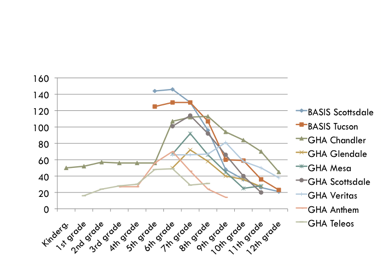
I also highlighted some recent reports about BASIS schools that document questionable methods for enrollment procedures, high attrition rates, and methods including “counseling out” of students who might negatively affect average school performance rankings (Safier, 2013; see also Welner, 2013). The figures above suggest that “highly-ranked” BASIS schools serve a privileged demographic; Safier’s story suggests that they likely select even further amongst that privileged group. Visually striking declines in student enrollment at Arizona’s BASIS and Great Hearts schools in 2010-2011 are evident in the figure below:

Enrollment Declines: Arizona’s BASIS and Great Hearts Schools
enrollment

Other researchers have highlighted declining enrollment numbers in the years nearing graduation at BASIS schools (see, for example, Casanova, 2012). BASIS school representatives responded (BASIS_Communications, 2012) by challenging interpretations of the low numbers shown in the data, albeit without adequately addressing Casanova’s main concern about the “enrollment drop across grades.” Casanova’s analysis highlights the low numbers of enrolled students in the upper grades. The graph displayed above raises a question of basic comparability: is it even fair to include these schools in a comparison with Arizona’s public schools, since they are not drawing a representative population of Arizona’s public school students?

Finally, Ann Ryman (2012) documented business practices within BASIS and Great Hearts Academy schools that reveal potential conflicts of interest between board members and owners (see, also, these comments from Gene V Glass, 2012, here and here). These charter school organizations make large profits at the expense of the government and community members, through fees, book purchases, and building contracts. Other investigators have highlighted questionable practices that provide considerable access to policy makers who influence Arizona’s lawmakers. For example, Mercedes Schneider (2013) created a map of Great Hearts political connections, highlighting significant access between CMO executives and policy makers who influence laws, including members at the Goldwater Institute and the American Legislative Exchange Council (ALEC).

The connections between executives of CMOs and policy leaders who influence lawmakers further complicate the problems of educational inequality and appear to provide charter schools with unfair competitive advantages. Children and taxpayers are the losers when public education dollars are at stake.

Citation:

Potterton, A. U. (2013). A citizen’s response to the President’s charter school education proclamation: With a profile of two “Highly Performing” charter school organizations in Arizona. Teachers College Record. Retrieved from http://www.tcrecord.org/Content.asp?ContentID=17309

References:

Arizona Department of Education (2013). Teleos Preparatory Academy > Great Hearts Academies- Teleos Prep. Retrieved from http://www10.ade.az.gov/ReportCard/SchoolSummary.aspx?id=90143&ReportLevel=1

BASIS_Communications. (2012, April 13). Re: The newest problem with graduation rates. [online forum comment]. Retrieved from http://www.washingtonpost.com/blogs/answer-sheet/post/the-newest-problem-with-graduation-rates/2012/04/12/gIQAwsH2DT_blog.html

Casanova, U. (2012, April 13). The newest problem with graduation rates. Retrieved from http://www.washingtonpost.com/blogs/answer-sheet/post/the-newest-problem-with-graduation-rates/2012/04/12/gIQAwsH2DT_blog.html

Glass, G. V. (2012, November 18). May I have the envelope please. And the Pulitzer for education reporting goes…. Retrieved from http://ed2worlds.blogspot.com/2012/11/may-i-have-envelope-please-and-pulitzer.html

Glass, G. V. (2012, December 2). “Judge us by our results”. Retrieved from http://ed2worlds.blogspot.com/2012/12/judge-us-by-our-results.html

Ryman, A. (2012, October 12). Insiders benefiting in charter deals. Retrieved from http://www.azcentral.com/news/articles/20121016insiders-benefiting-charter-deals.html

Safier, D. (2013, April 17). BASIS charter’s education model: Success by attrition. Retrieved from http://blogforarizona.net/?p=645

Schneider, M. (2013, March 25). Arizona education: A pocket-lining, “conflict of interest” mecca. Retrieved from http://deutsch29.wordpress.com/2013/03/25/arizona-education-a-pocket-lining-conflict-of-interest-mecca/

U.S. Department of Education. Institute of Education Sciences, National Center for Education Statistics. (2013). Search for schools, colleges, and libraries. Retrieved from http://nces.ed.gov/globallocator/

Welner, K. G. (2013, April). The dirty dozen: How charter schools influence student enrollment. Teachers College Record. Retrieved from http://nepc.colorado.edu/publication/TCR-Dirty-Dozen

In recent years, Indiana has gone overboard for charter schools, believing that they held the secret to raising the test scores of low-income students.

But blogger Steve Hinnefeld analyzed the passing rates by income levels and discovered that public schools outperform charter schools in Indiana.

He wrote:

“I merged Department of Education spreadsheets with data on free and reduced-price lunch counts and ISTEP-Plus passing rates. Then I sorted by free-and-reduced-lunch rates and focused on schools where 80 percent or more students qualified for lunch assistance. Results include:

“For charter schools: Average passing rate for both E/LA and math, 48 percent; passing rate for E/LA, 62.3 percent; passing rate for math, 62.5 percent.

“For conventional public schools: Average passing rate for both E/LA and math, 57.2 percent; passing rate for E/LA, 64.1 percent; passing rate for math, 68.1 percent.

“The data set includes only schools that enroll students in grades 3-8, who take ISTEP exams; it excludes high schools and many primary-grade schools. I also tried to screen out nonstandard schools such as juvenile detention centers and dropout recovery schools.”

He also reported that fewer charter schools get high grades from the state than public schools.

Not what you would call a high-performing sector, despite the boasting and promises.

The mainstream press in Ohio is starting to take a closer look at charter schools, many of which are money pits for big donors to Governor John Kasich and the legislature.

The Akron Beacon-Journal published a remarkable, three-part series on charters, looking closely at the peculiar financial operation of the for-profit White Hat management company.

In this article, the reporter discovered that most charters won’t tell anyone who is in charge.

Journalists learned that most charter schools will not provide basic information. They are neither transparent nor accountable.

“The calls were made as part of a school-choice project by the Akron Beacon Journal and the News­Outlet, a consortium of journalism programs at Youngstown State University, the University of Akron and Cuyahoga Community College.

“In a phone-call blitz that began in early January, students in the journalism lab called 294 of Ohio’s 393 charter schools in operation at the time, seeking basic information:

“• Who runs the building?
• Who is that person’s supervisor?
• Who is the management company in charge?
• How does one contact the school board?
• When does the board meet?

“Public accountability was difficult. Of the 294 called, the results by March 26 were:

“• 114 — more than a third — did not return messages seeking information.
• Eight refused to answer.
• Seven said they would call back but did not.
• 73 provided some of the information.
• 80, or about 1 in 4, provided the information requested.

“By law, Ohio charter schools “must follow health and safety, ethics, public records and privacy laws; and comply with open meetings laws,” states a 2014 position statement by the Ohio Alliance for Public Charter Schools. Citizens are not required to provide reasons for the requests.”

In the second article in the series, a reporter finds that board members of White Hat charters has no idea where the millions of taxpayer dollars go.

“As a board member of four publicly funded charter schools in Akron and Cleveland, Charlotte Burrell will watch this year as $5.3 million in taxpayer money passes through her financial reports.

“She knows most of it will go to White Hat Management ­— a private, for-profit Akron-based company that runs 32 charter schools in Ohio. But unlike an elected school board member who can obtain intimate details about spending, her hands are tied. What White Hat does with the money, she said, is beyond her control.

“She does, however, control “unrestricted net assets.”
She pointed to the line item on a budget at a joint board meeting in February for two of the charter schools — University and Brown Street academies. Of $2.1 million in expected yearly funds, unrestricted dollars for both schools totaled roughly $1,500, or less than 0.1 percent.

“That’s what we concern ourselves with the majority of the time,” she said.
She’s satisfied, so long as a school treasurer — employed by White Hat — says the money spent by White Hat adds up.

“So, who is in charge of the nonprofit, publicly funded Ohio charter schools that 20 years ago did not exist? This school year, more than $900 million in state and local tax dollars — some of it approved by local voters — will be transferred from local schools to charters.

“In Ohio, charter schools are required to satisfy strict federal guidelines as nonprofit organizations under Section 501(c)3 of the Internal Revenue Code, including board autonomy. If the board is not independent of the company, the IRS is supposed to throw up a red flag.
But state law allows private companies to throw out nonprofit boards that challenge them.

“At many White Hat-operated schools, this already has happened. Last summer, boards in Akron and Cleveland expressed dissatisfaction with White Hat, so White Hat forced them out and new boards were formed.
The three unpaid board members who attended the February meeting said they were recruited by White Hat to serve. They turn over 95.5 percent of funding to White Hat, which then hires the staff, pays the bills and gives rent to its for-profit affiliates that own the tax-exempt school properties.”

.

“The IRS’ checklist to qualify for federal tax-exempt status draws a bright line between the charter-school governing board and the management company hired to run the school. The company should not create the board or recruit the members, and any evidence of boilerplate contracts from one school to the next suggests the company may be in control.

“Richard Schmalbeck, a Duke University professor of law and a former tax law attorney, said the description of relationships between private companies and Ohio charter schools may be problematic.

“The charter schools appear to be run by a for-profit organization,” he said.
Because the private company creates and owns the nonprofit school, then recruits a governing board that would give a favorable contract to the private company, “There may be a private benefit problem. Charities are supposed to operate exclusively for charitable purposes, and not for the purpose of advancing for-profit business ventures.”

“Schmalbeck is disappointed but not surprised that the IRS, buried in applications, might carelessly grant tax-exempt status to a nonprofit created or controlled by a private company. “If these facts are accurate and fully disclosed to the IRS, I think the IRS should withhold 501(c)(3) status,” he said.

“Ohio law requires schools to obtain 501(c)(3) status. The federal government allows 27 months to apply. Some charter schools are created and disappear in less than two years.
University and Brown Street were created by a White Hat attorney in September 2011, or 28 months ago. The board for each school, represented by the same attorney, had yet to file as of mid-March.

“Last year, the Ohio Department of Education (ODE) barred the creation of four White Hat schools when the state determined that boilerplate contracts would strip too much power from the boards.

“So directors who owe their position and continued appointment to White Hat are voting a lucrative operator contract to White Hat. Since a community school is a public entity, ODE feels this is not permissible,” ODE’s Mark Michael wrote in an email rejecting White Hat’s applications.
This was a rare event, though, because the legislature has shifted direct regulation of charter schools from the state to school-choice friendly groups known as sponsors — such as Buckeye Community Hope Foundation, a two-time sponsor of the school at 107 S. Arlington St.

“Initially sponsored by ODE and known as Hope Academy University Campus, the state handed over control after State Rep. John Husted — now secretary of state and a recipient of at least $139,033 in campaign contributions from the Brennans — sponsored legislation that effectively stripped ODE oversight.

“Buckeye Community Hope then took over. Peggy Young, director of the group’s Education Division, takes the position that the boards have ultimate authority.

“We’ve seen boards fire management companies, so in that sense they have ultimate control of the school,” Young said.

“However, when 10 school boards attempted to fire White Hat, it didn’t work out so well. Because White Hat had trademarked school names and bought up real estate through affiliate companies, the renegade boards couldn’t force White Hat out of the building.

“All but one has since contracted with another private company, this one a Delaware-based affiliate of a Florida company founded by a former White Hat employee.

Young saw that as the board maintaining control.

“I’ve had boards do that. They move next door. They have the students. The records,” Young said.

The old buildings didn’t stay empty. They have students and teachers, and board members who say they were recruited by White Hat.

And their attorney, Amy Goodson, whose name is on incorporation papers for several White Hat-managed schools, said it’s “pretty typical” that lack of wherewithal forces boards to enter contracts with big name companies.

“What happens is, I can’t say broadly, but in the case of University and Brown Street, those were education models that White Hat creates,” said Goodson, who is paid by the board. “It’s kind of a chicken and an egg thing because you have to have someone start this.”

Burrell is unaware of her predecessors’ disapproval of White Hat. To the contrary, it’s been “fabulous” working with White Hat, she said.

When asked if she could provide some of the financial information that prior boards continue to seek in court, she replied: “That comes under the management company, not the board. So you would have to interview those persons at White Hat.”

A third article describes IRS rules supposedly governing the tax exempt status of charter schools.

Doug Livingston can be reached at 330-996-3792 or dlivingston@thebeaconjournal.com. Contributing to this story were NewsOutlet reporters Matt Hawout and Sara Rodino.

TheNewsOutlet.org is a collaborative effort among the Youngstown State University journalism program, the University of Akron, Cuyahoga Community College and professional media outlets including, WYSU (88.5-FM) and The (Youngstown) Vindicator, The Akron Beacon Journal and Rubber City Radio (Akron).

http://www.ohio.com/news/local/irs-sets-rules-on-how-charter-schools-qualify-for-tax-exempt-status-1.477137

Lets hope that journalists keep asking questions. The public has a right to know who and what they are funding, and where the money goes.