Archives for category: Education Industry

Two officials of the Philadelphia school system wrote an opinion piece warning that proposals for “charter reform” are actually a blank check for unlimited charter expansion with no regulation at all.

Dr. William R. Hite is superintendent of the Philadelphia public schools. Joyce Wilkerson is president of the Philadelphia school board.

They point out that the State Auditor said that Pennsylvania’s charter law is the worst in the nation.

Current proposals to benefit charter schools would make it even worse.

They write:

Legislation pending in the General Assembly pushes the charter law in the wrong direction. House Bills 356 and 357 create more risk for students, local districts, and taxpayers. We vehemently oppose these bills.

The legislation would allow all charter schools, even the poorest performers, to expand without the authorizing district’s knowledge or approval. These unpredictable expenses would not only create short-term fiscal challenges for the district but make it impossible to reasonably utilize multiyear budgeting — the very approach to budgeting that has allowed the district to make the strategic, sustainable investments that are resulting in improved academic performance across our schools. These bills undermine the fiscal-stability promise of local control.

Newly proposed charter legislation also frees charters from oversight that is necessary to ensure they are meeting academic standards. They make it harder to close underperforming charters and allow unfettered expansion of charters — even those with failing performance — without regard for their ability to successfully operate. The proposed standard charter application form lacks information on an applicant’s’ experience, finances, past performance, and operational ability, all of which are necessary to meaningfully assess whether the applicant can sustain a school that meets the needs of the very students it aspires to serve.

The original vision for charter schools was teacher-driven laboratories of innovation that would develop promising practices to inform and advance all public schools. Charters have not lived up to that promise. In fact, charter schools are only 6 percent of public schools in Pennsylvania but are 25 percent of the lowest-performing schools under new state standards. Is this the future we want for the commonwealth’s public education system? Is this the future our students and families deserve?

As usually, the charter lobbyists are advocating for no accountability, no supervision, and more money.

Disgraceful.


Whenever there is a battle over the expansion of charter schools, we read in the papers that “charter parents” prevailed and the teachers’ union lost.

Why don’t the stories say “charter lobbyists prevail,” and public schools and their students lost?

Why do reporters always assume that only the unions oppose charter expansion.

Why are “charter parents” seeking more charter schools?

Don’t their children already attend a charter school?

Here is the conundrum.

Who benefits when legislators allow unlimited expansion of new charter schools?

Not the parents. Their children are already in a charter school.

How many charter schools does one child need?

This unrestricted expansion is solely for the benefit of the charter operators and their lobbyists.

As we have seen again and again, charter operators use the children and the parents as pawns to expand their empire of privately managed schools and enrich themselves.

Unlimited expansion of new charters does not benefit any charter school parent.

It sucks money away from existing public schools, the schools that 90% of the nation’s are enrolled in.

The California Legislature failed to take action on bills to impose a moratorium on new charter schools, and charter lobbyists were exultant.

Despite the ongoing scandals in the charter industry, the Legislature was unable to act.

Only this week, eleven charter leaders were indicted for misappropriating millions of dollars that ended up in their personal bank accounts.

Only last week, the founder of a charter chain was sentenced to thirty months in prison for theft of millions of dollars.

The California Charter School Association, funded by billionaires such as Reed Hastings and Eli Broad, want predators to go unsupervised and unregulated. They want no limits on charter growth, public schools be damned.

If it is not there already, I place the CCSA on this blog’s Wall of Shame.

Let’s see what happens to AB 1505, which enables districts to have some say over whether charters can open in their space, which would curb the rapacious appetite of sleazy operators who are able to get a charter in Rural District Z and open the school in an urban district that doesn’t want them.

Ten percent of the students in California are enrolled in privately managed charter schools; 90% are enrolled in public schools. Why undermine and deprive the 90% for the (possible) benefit of the 10%? Only one group benefits from the legislators’ inaction: the charter industry. This is insane. And corrupt.

Erika Jones is an experienced teacher in California. In this post, she responds forcefully to the claim by charter advocates that privately managed charter schools “save” children of color.

They don’t.

I urge all charter advocacy groups and individuals to read her eloquent article and consider her words carefully.

She begins:

As a public-school educator who is African-American, I am keenly aware of what it means to be a student of color within the public school system and the role institutional racism has played.

We have faced decades of funding and resource inequities, which have left our current public schools in marginalized communities unable to fully serve their students. Historically, acknowledging these inequities can lead to strategies to combat institutional racism in our schools and across the country.

The last 20 years of exploding charter school growth in communities of color also make it clear that many proposed solutions can have serious negative consequences for the overwhelming majority of public school students. The time is now for our elected leaders in Sacramento to pass laws to support students by curtailing the worst parts of this broken, decades-long experiment.

Often within the conversation of supporting communities of color, school choice and specifically charter schools frequently are presented as the answer. When looking at institutional racism within public education, instead of being the panacea for children of color, more often than not the charter school industry actually leads to worsening conditions for a majority of students of color. This is because many school districts in California, whose students are overwhelmingly students of color, are in crisis mode: seeing upwards of a 200 percent growth in charter schools, lacking facilities and averaging hundreds of millions of dollars in fiscal impact directly attributed to this growth.

Yet the achievement gap for students of color has continued to widen. We see a select group of children of color leaving the traditional public school setting to attend charter schools, while the majority of children of color remain in the traditional setting.

I taught both 3rd grade and kindergarten in South Los Angeles at Angeles Mesa Elementary and during the years I was there multiple new charter schools popped up surrounding my school. I saw firsthand how our families of color were lured away by the promise of free tablets for their kids, nicer uniforms and so-called college readiness. I hugged parents as they brought their children back to my school, feeling devastated that their child had been kicked out of one of the charters or their children found themselves in schools with higher class sizes and less student support. Some of my families had even been misled to believe that the new charter school was their new home school.

The original intent of charter schools was to be educator-driven incubators of change where innovations that lead to student success could be shared with all schools within the public school system. Here we are 20 years later and instead of sharing methods, many traditional public schools in communities of color find themselves competing for resources, having disproportionate numbers of students with high needs and having larger populations of English learners. All this while for the most part charters are performing about the same as traditional public schools.

Erika Jones answers all the questions with facts and evidence. Please read the rest of her article.

Finance experts in Pennsylvania warned that the costs of charter schools and cyber charters threaten to bankrupt as many as 500 school districts. 

Finance experts with the Pennsylvania Association of School Business Officials (PASBO) said lawmakers must change the way charter costs are assessed to local school districts or accept that some school districts are not going to be able to continue to bear the cost of paying hundreds of thousands, and in some cases millions, of dollars in charter school tuition.

The call for change comes as the General Assembly weighs a variety of bills aimed at altering the way the state regulates and finances charter and cyber charter schools that now enroll about 140,000 students in kindergarten through 12th grade.

Hannah Barrick, of the Pennsylvania Association of School Business Officers, said charter school costs, which are borne almost entirely by local school districts, totaled $1.8 billion last year and accounted for 37 cents of every new dollar raised in local property taxes.

In some school districts, the costs are even higher.

Enrollment in Pennsylvania’s charter schools grew dramatically over the last decade, increasing from about 78,000 students in 2009-10 to 140,000 this year.

Along with that growth, school districts have seen the bill for charter school tuition grow by double digits five out of the past eight years.

Charter schools, promoted as a free option for public school students whose families wish to look outside their districts, are funded by the students’ local school districts. Tuition is calculated using a complex formula that requires each district to pay charter school fees based on the local district’s cost per student per year. Across the state, those figures ranged from $7,600 to $18,500 per mainstream student to $15,100 to $48,000 per special education student.

Pennsylvania has about 1.7 million students. Supplying choices for 140,000 students (8%) in schools that are of mixed quality threatens to bankrupt the state’s school finance system.

Has it occurred to the lawmakers in Pennsylvania that running a dual school system, both publicly funded, is an insane idea?


The California Legislature is considering four bills to reform the state’s massive charter school industry (1,300 schools, mostly unregulated and unsupervised). One of the bills would prohibit school districts from authorizing charters in other districts. The following story is a classic example of rural school districts authorizing online charters in San Diego and Los Angeles, solely to get the commission attached to each student. In this case, the online charters were cash cows for their owners. [A personal aside: Last February, I was in Newport Beach, California, having breakfast at a hotel. The man at the next table was loudly discussing his schools with someone who was selling athletic services, $5 a student. When he got up to leave, I asked him if he was “in the charter school business.” He said, “Yes,” and said he owned 40 schools under six different corporate names. I asked him his name. He said, “Sean McManus.” I should have asked him to join us. He is one of the key figures in the following article.]

The San Diego Union-Tribune reports that eleven people connected to online charter schools have been indicted for “criminal charges of conspiracy, personal use of public money without legal authority, grand theft and financial conflict of interest.“

The online charters operate in San Diego and Los Angeles, but were authorized by other districts that get a slice of the revenues. This is one of the corrupt practices that have been rampant in California, where lax state law allows sharp operators to get public money and cheat students with no consequences. The Legislature is currently debating a proposal to stop allowing District A to authorize a charter in District B, a practice that is mercenary and predatory. Until now, the powerful California Charter Schools Association—enriched by billionaires like Reed Hastings and Eli Broad—has fought all accountability for charter schools.

At the center of the allegations are leaders of the charter school management corporation A3 Education, a Newport Beach corporation whose leaders control 13 charter schools across California, according to an indictment filed May 17.

A3’s chairman, Sean McManus, and president, Jason Schrock, essentially owned and operated the charter schools throughout California at the same time that A3 contracted with those schools, according to the indictment.

McManus and Schrock operated multiple businesses that charged their own charter schools millions of dollars for services. Then they channeled money from those businesses into their own charitable trust and personal bank accounts, according to the indictment.

A3 Education and the businesses affiliated with McManus and Schrock together have invoiced at least $83.3 million from the 13 charter schools, according to the indictment.

From the affiliated businesses, at least $8.18 million went into personal bank accounts, some in Australia, and into charitable trust accounts for McManus, Schrock and their wives, and $500,000 went to a family member of McManus, according to the indictment.

McManus and Schrock also used $1.6 million of A3 Education’s funds to buy a private residence for McManus in San Juan Capistrano, the indictment states.

Also according to the indictment, six people, including McManus and Schrock, conspired to collect state money for students who were listed as being enrolled in Valiant Charter Schools but were not receiving services.

The two Valiant schools will close permanently on June 30. Several thousand students will need to find new schools. The San Diego online charter was authorized by the Dehesa School District, and the one in Los Angeles was authorized by the Acton-Agua Dulce Unified School District.

The children were not assigned to teachers who have state-required professional certificates, the indictment said. The students were not in contact with the schools or provided with educational services during the summer months, as some of the co-conspirators claimed, according to the indictment…

Also indicted is Nancy Hauer, who is superintendent of Dehesa School District, which authorized several charter schools, including Valiant Academy of Southern California. The Dehesa district office did not immediately provide a comment Tuesday.

Also among the indicted is Steve Van Zant, a former Mountain Empire Unified superintendent who three years ago pleaded guilty to violating conflict-of-interest laws, after he brokered deals with charter schools to operate in other school districts, prosecutors said at the time.

Valiant Academy had 43 students two years ago, 726 last year, and 2,250 this year. It’s academic performance was so poor that even the California Charter School Association recommended that it be closed.

Betsy DeVos says that parents always know what’s best. Why were they enrolling their children in these failing “schools.”?


I am very excited!

My new book was just announced!

The title is: SLAYING GOLIATH: The Impassioned Fight to Defeat the Privatization Movement and to Save America’s Public Schools. 

It will be published on January 14, 2020, by Knopf, the most prestigious publisher in America. The editor is the brilliant Victoria Wilson, who is also an author, having written the definitive biography of Barbara Stanwyck.

In Slaying Goliath, you will read about the heroes of the Resistance, those who stood up to Big Money and defeated disruption in their schools, their communities, their cities, their states.

It is a book of inspiration and hope.

It shows how determined citizens—parents, students, teachers, everyone—can stand up for democracy, can stand up to the billionaires, and win.

Please consider pre-ordering your copy so you can be sure to get the first edition.


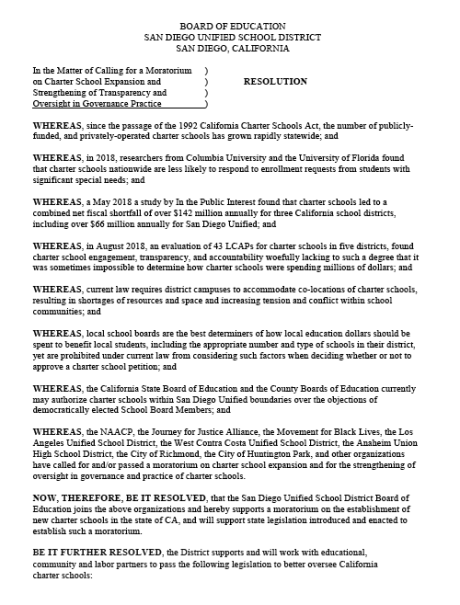
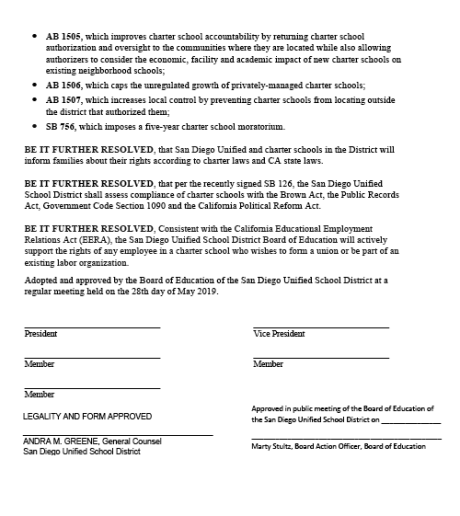
Last night, the elected Board of Education of the San Diego Unified School District passed a strong resolution endorsing four bills in the State Legislature that would impose discipline on the Wild West unregulated charter industry. The bills are described in the resolution. They would impose a moratorium on charter school expansion, revive local control, and increase oversight of charters. This resolution demonstrates that the board is willing to stand up to the rapacious charter industry.

Screen Shot 2019-05-28 at 5.40.05 PMScreen Shot 2019-05-28 at 5.40.16 PM


Former Vice President Joe Biden released his education plan yesterday. 

He pledges a dramatic increase in federal funding for education.

The plan is notable for what it does not say.

It does not say anything about the failed strategies of Race to the Top.

It does not say anything about charter schools, which was a major focus for the Obama-Duncan program. Will he repeal the failed federal Charter Schools Program or will he give his approval to continue funding corporate charter chains like KIPP, IDEA, and Success Academy?

It does not say anything about testing, nor does it say anything about revising the federal “Every Student Succeeds Act,” which mandates annual testing. Will Biden support the continuation of the ESSA law?

It does not say anything about evaluating teachers by the test scores of their students, which was a favorite Duncan policy. States bidding for Race to the Top billions changed their laws to adopt this punitive and wrong-headed policy. Will he oppose this practice or let it slide?

It makes no reference to the Common Core, which had the enthusiastic support of the Obama administration, which was legally prohibited from funding it, but which supplied $360 million to create two Common Core testing programs, PARCC and Smarter Balanced Assessment Consortium. Is Biden for or against it.

In sum, I like everything he said. But I wonder about what he didn’t say. He ducked all the tough issues, most of which are the legacy of the Bush-Obama era, of which he was a part.

Biden clearly prefers to duck the contentious issues. I hope that they will be posed to him in town halls.

We need to know where he stands on all the issues that matter to students, parents, teachers, and schools.


Steven Singer doesn’t research or data to describe what is happening to his school district. He sees it. It is being gobbled up outsiders intent on turning public schools into charter schools and voucher schools. 

The state auditor of Pennsylvania said a few years ago that the Pennsylvania charter law is”the worst in the nation.”

Singer shows why.


Our middle school-high school complex is located at the top of a hill. At the bottom of the hill in our most impoverished neighborhood sits one of the Propel network of charter schools.

Our district is so poor we can’t even afford to bus our kids to school. So Propel tempts kids who don’t feel like making the long walk to our door.

Institutions like Propel are publicly funded but privately operated. That means they take our tax dollars but don’t have to be as accountable, transparent or sensible in how they spend them.

And like McDonalds, KFC or Walmart, they take in a lot of money.

Just three years ago, the Propel franchise siphoned away $3.5 million from our district annually. This year, they took $5 million, and next year they’re projected to get away with $6 million. That’s about 16% of our entire $37 million yearly budget.

Do we have a mass exodus of children from Steel Valley to the neighboring charter schools?

No.

Enrollment at Propel has stayed constant at about 260-270 students a year since 2015-16. It’s only the amount of money that we have to pay them that has increased.


The state funding formula is a mess. It gives charter schools almost the same amount per regular education student that my district spends but doesn’t require that all of that money actually be used to educate these children.

If you’re a charter school operator and you want to increase your salary, you can do that. Just make sure to cut student services an equal amount.

Want to buy a piece of property and pay yourself to lease it? Fine. Just take another slice of student funding.

Want to grab a handful of cash and put it in your briefcase, stuff it down your pants, hide it in your shoes? Go right ahead! It’s not like anyone’s actually looking over your shoulder. It’s not like your documents are routinely audited or you have to explain yourself at monthly school board meetings – all of which authentic public schools like mine have to do or else.

Furthermore, for every student we lose to charters, we do not lose any of the costs of overhead. The costs of running our buildings, electricity, water, maintenance, etc. are the same. We just have less money with which to pay them.

Read his post in full. You will understand.