Archives for category: Economy

Robert Hubbell was outraged by the editorial in The Washington Post attacking Kamala Harris’s economic plan. The editorial said, basically, that her plans to help the middle class made no sense. Consider the source, he says. In one post, he listed and praised Harris’s economic priorities, then went into detail, explaining how they would benefit the average American.

This is the heart of her economic plan:

  • Increase the child tax credit.
  • Increase the earned income tax credit for wage earners without children.
  • Prohibit price gouging in food supplies.
  • Subsidize down payments for first-time [home] buyers.
  • Decrease the cost of prescription drugs.

Then he followed up by attacking the Washington Post editorial belittling her plan.

He writes:

Apologies for taking a second-bite at the apple, but Jeff Bezos just gave Kamala Harris a gift that cannot be ignored. The Bezos-owned Washington Post just issued an Editorial by the Editorial Board that was titled, “Opinion The times demand serious economic ideas. Harris supplies gimmicks.”

Oh, thank you, Jeff Bezos, owner of Amazon Fresh, Whole Foods, and one of the largest home delivery grocery services on the planet, thank you!

Here is what Kamala Harris should do at the convention: Put up that headline on big screen, and give a speech that contains these elements:

The Washington Post Editorial Board, which works for billionaire Jeff Bezos, thinks it’s a “gimmick” to give families with newborns a tax credit in the first year of the newborn’s life.

Billionaire Jeff Bezos thinks it’s a “gimmick” to expand the child-tax credit, the single most effective measure for lifting children out of poverty in three generations.

Billionaire Bezos, who has a super-yacht to ferry passengers to his mega-yacht, thinks it’s a “gimmick” to give low-income working Americans a $1,500 tax credit.

Billionaire Bezos, whose company, Amazon, is trying to take over the pharmacy business in America, thinks it’s a gimmick to limit out of cost prescription drug prices to $2,000 for ALL Americans, not just seniors.

Billionaire Bezos, who just bought his THIRD mansion on an island in Florida, thinks it’s a gimmick to give first time home buyers a $25,000 subsidy for a starter home.

Billionaire Bezos says that we shouldn’t prohibit “price gouging” because grocery stores are aggressively reducing prices. Let me hear from you: Is your grocery bill going down now that inflation is under control?

Billionaire Bezos is free to have his personal newspaper criticize my plan all he wants. This is America and billionaires are entitled to free speech, even if they get to buy an Editorial Board to promote their opinions.

But fair is fair. Donald Trump held a press conference last week to reiterate his plan for the economy, which has only two elements: Extending tax cuts that favor billionaires and imposing an economy killing 10% tariff on all imports.

Here is what Jeff Bezos’s editorial board had to say about Donald Trump’s insane plan that just happens to be good for billionaires like Jeff Bezos: Nothing. Nada. Zip. Zero. 

That’s right, in the face of an economic plan that favors Jeff Bezos but would destroy the economy for hundreds of millions of Americans, the Washington Post Editorial Board was silent–but roused itself to say that my plan aimed at helping the working poor and middle class is–according to Bezos–a bunch of gimmicks.

Now, Jeff Bezos and his employees on the Editorial Board will tell you that Bezos doesn’t weigh in the editorial stance of the Washington Post. If you believe that the panicked voice of Jeff Bezos wasn’t in the ear of every editor who did his bidding by writing that editorial–while ignoring Trump’s plan–I’ve got a bridge in Brooklyn I would like to sell you.

I have promised a new way forward for all Americans, one that does not involve a handful of billionaires telling us what is good for the working poor and middle class in America. I suggest that Jeff Bezos leave his private island in Florida, sell his super-yacht AND mega yacht, and spend some time with people like you–the people who built America before Amazon arrived on the scene and who will sustain it long after Amazon is gone. You are America. You are the new way forward. Don’t let anyone tell you otherwise.

Umair Haque is an economist. In this post, he takes aim at journalists who have taken potshots at Kamala Harris’s economic proposals. He explains why they are, as he puts it, “brilliant.”

He writes:

It took nanoseconds. Kamala announced her economic policies. Wham! The press pounced. All in unison. Without taking even a second to think. Bad! Terrible! Awful! The Washington Post went so far as to legitimize Trump calling her a communist.

Welcome to the crackpot level of American media, and nowhere is it worse than its commentary on economics.

My friends, I’m here to tell you something. Kamala’s economic policies are brilliant. Absolutely stellar. They are the economic state of the art, reflecting not just the latest thinking, but also aimed directly at solving America’s biggest problems. Price gouging. Housing. Having a family. This is stuff that should be celebrated. America is becoming a leader again through such policies.

I know that for a fact. I’ve been the chief economist of one of the world’s largest corporations. I keep up with the literature. I’ve written peer-reviewed books about the economy. This is why so many of you follow me. I know precisely what I’m talking about.

They don’t. Journalism’s criticism of Kamala’s econ policies isn’t criticism at all. It’s a disgrace. They are just making it all up. I’m going to explain that to you, as well, because I feel that our econ journalists are an embarrassment. They lash out at Kamala—and yet they appear not to know the current state of the field at all. They’re regurgitating tired, obsolete far-right talking points from decades ago. Which have all been discredited in the real world. I’m going to explain that to you, in this dense essay, and it’s dense because I want to do justice to Kamala’s policies, and rebut some of the sheer nonsense coming from these crackpots by teaching you a thing or two about econ.

If you feel like something’s off here, it is. They’re trying to get Kamala. Just like they got Biden. This sort of thing is the equivalent of character assassination, and our media should be doing better. What do I mean?


How to Raise a Society’s (Falling) Standard of Living

The Washington Post minced no words. Instantaneously, their editorial board called Kamala’s trio of policies “gimmicks,” while their columnists savaged them, too. Fair? Spectacularly foolish.

Kamala’s first policy is to offer families a $6K tax break for having a first child. A gimmick? Give me a break. America’s median family income is about $70K. Before taxes. That’s about 10% of median income. Would you like a 10% raise? That’s what you’ll get. I think at this juncture, most Americans would be grateful for 10% more income. Half of families—that’s what “median” means—make less than that, of course. So up to half of American families could get a lift more than 10% of their incomes. 

In this day and age? We’re savaged by a “cost of living crisis.” I put that in quotes to emphasize that I don’t make it up: even the world’s most pre-eminent, and most conservative, financial institutions, like the IMF, call it that. During an historic cost of living crisis, giving people more than a 10% lift in incomes? That’s a Very Big Deal

Sound like a “gimmick” to you? The media didn’t even bother doing this basic math. It takes five secondsBut they appear not to even know these fundamental facts about the economy—median incomes, cost of living crisis, etcetera. Like I said: this isn’t criticism. They’re just making stuff up. The IMF itself—one of the world’s, again, most conservative institutions—has recommended governments find ways to help people address the cost of living crisis. Ways just like this.

It’s shocking to me that the editorial board of the Washington Post and their columnists wouldn’t know this. But maybe it shouldn’t be. They seem more focused on gotcha journalism these days than facts. And facts are what I’m trying to teach you. Facts enlighten us, and now you know whyKamala’s first policy is brilliant.

Many readers pointed out to me that the Post is now run by a former Murdoch editor? Does that play a role here? 

Let’s come to the second policy, which is building three million new homes. Targeted directly at the middle and working class, not to be sold to investors, aka private equity funds. Is that a…gimmick?

Three million homes. They will house three million families. That’s twelve million people. Twelve million people is 4% of America’s populationIn other words, Kamala’s proposing enough housing for a sizable share of the population. If you’re one of those twelve million, is that a gimmick? Having a new, affordable home to live in? A “gimmick,” if we’re fair, is something that doesn’t really count—maybe it affects .001% of the population. But 4%? That’s very real. Far from a gimmick—that’s a policy with real, and tremendous impact. If it’s repeated in a second term, we’re talking housing for 10% of a society’s population, roughly. A gimmick? You must be kidding.

Let’s think harder about it. To build each of those homes, perhaps 10 people will be employed. Probably more, but let’s stick with ten. That’s 30 million jobs. What do 30 million new jobs do? They raise demand in the economy. What are we currently struggling with? A situation of slow demand, which the IMF—let me say it yet again, the world’s most authoritative financial institution—has called weak and sluggish and a threat to financial stability. Creating 30 million jobs right about now is an incredibly smart move, because it restores health, demand, and growth, the good kind, to the economy, when things are risky and uncertain and difficult.

Again, how hard is this to understand? I’ve explained it to you simply, and yet, media didn’t want to think any of this through for even the few seconds it took me to explain it to you. That’s disgraceful. If a media can’t do that, what purpose does it serve?

Let’s keep going. What do those 30 million jobs do, in turn? They create growth, because now, of course, more demand is flowing through the economy, more money is in people’s pockets, and they can go out and spend and invest it. As they do that, new businesses can roar, and more than that, the magical thing called certainty and confidence return. That in turn sparks a virtuous cycle of investment, which is the key to raising living standards.

And that’s really what all this is about. Raising living standards. That’s the point of an economy, after all. And yet our media, pundits, journalists, editorial boards—they seem deliberately unwilling to engage with that point and fact, instead, just regurgitating discredited talking points. All the above is “communism!” My God. Can you even imagine? If any time we talk about raising living standards, it’s “communism,” then of course, we’re not having a sane conversation anymore. We’re just trying to reason with crackpots, which is what America’s media has become, sadly.


Why American Living Standards Have Fallen

I’ll come back to that. First, let’s tackle the third proposal from Kamala, which is the one that really set the media’s hair on fire.

Price gouging. They went nuts. Price gouging?! Where? Where’s the evidence? The Post’s economics columnist went so far as to equate taking on price gouging to “price controls,” and say that was communist. So there’s the Post, calling Kamala a communist.

Let’s pause there. The Post’s columnist literally made this up. Kamala’s proposal pointedly doesn’t mention price controls. And in fact, there are already price controls in the economy. Here’s one Big One. The…minimum wage. Does it make America a “communist” society because it has a minimum wage? You see how ridiculous this is. And you also see how illiterate economics commentators are not to understand this elementary level of stuff.

Why do we want to stop price gouging, anyways? Far from being “communism,”, because that’s how we restore capitalism to good health. Price gouging is already illegal in most states, and every other developed country besides America. Why? Because it’s usually evidence of, and propelled by, “anti-competitive behaviour.” Anti-competitive behaviour means basically building monopolies. America’s economy is the most highly concentrated on earth—just a handful of gigantic companies control nearly every industry. What we want, if we’re interested in the health of capitalism, is competition.

Competition between market players, which ends up in price competition. Why do we want price competition? Because prices are “signals” in economics. The integrity of the “price signal” is paramount in economics, because it allows economies to allocate resources efficiently. But if prices are out of whack, if they’re bad signals, then an economy can’t do that. And that is why we want no price gouging—not for moral reasons, or because we’re “communists,” but because we want capitalism to be healthy, and for prices to be reliable, meaningful signals.

Again, it’s utterly shocking to me that media wouldn’t know this, or worse, not be able to tell you this. The Washington Post literally legitimized Trump calling Kamala a communist, and people went into an uproar, rightly so. But on an even deeper level, it’s worse than it seems, because, no, it’s not “communism,” we’re actually trying to defend capitalism, by making prices work the way they should.

Whew, it makes my head sort of explode, but let me return to the issue.

How do we know if there’s price gouging or not? The wrong way to do it is the way pundits tried to—revealing, again, that they don’t know what they’re doing. They looked at “longitudinal” data, aka, prices over time, in a narrow way. The correct way to do it is to look at comparative data.

Let me explain, and here’s a brief tutorial in social science, by the way.

Think about any major category of expenditure in America. Let’s take for example healthcare. Healthcare costs in America have exploded by thousands of percent over the last few decades. So has, for example, sending a kid to college. That’s also true for food, and of course housing. 

Now. In most of these categories, the same hasn’t been true in many other countries. In France, my favorite example is that the Sorbonne is free, while sending a kid to Harvard will cost $100K a year or whatnot. Healthcare’s affordable, even if it’s private, in most of the rest of the rich world. Why is that? And what does it tell us?

It tells us that something went badly wrong in America. Americans pay astronomical prices for most basic categories of goods and services compared to most if not many of their peer countries. And that’s clear evidence of price gouging.

And Americans know that by now. We all know that when you get some kind of bill, for example, from an HMO, it’s literally mostly made up. And if you call up and make a fuss, you can get them to drop some of the “charges,” because they’re fictional to begin with. 

One thing that strikes most Americans who’ve lived overseas is how much cheaper food is. It comes as a shock. Fruit, dairy, meat, even snacks—half the price or less. That, too, isn’t just evidence of price problems in America, it’s because Europe’s laws on food have been carefully designed to keep it relatively affordable for people.

Is there price gouging in America? Media and pundits have gone hysterical asking this question, and then tried to answer it in naive and unsophisticated ways. They end up missing the forest for the trees. There’s a much simpler, and yet more sophisticated way, to think about the question. If there’s not price gouging in America, how come life in peer countries is so much more affordable? 

This is all why America’s standard of living has been falling. According to the most authoritative index on the subject.

That’s a fact. Another one that those writing about economics should know. If there’s not price gouging happening, then why are living standards falling? America’s hardly out of money, housing, or jobs, after all. The reason must be that people are having a harder and harder affording the standard of living their parents and grandparents once enjoyed.


How (Not) to Think About Economics

You see my point, perhaps. Let me make it really, really clear though. There’s a lot of crackpot “research” that comes from “think tanks” in America, which is just right wing propaganda, basically. But the last really good paper on all this? By an eminent and internationally respected economist? Here’s what it found:

I review the causes and consequences of rising concentration of market shares that is occurring in most U.S. industries. While concentration is not necessarily harmful to the economy, my assessment of the available evidence leads me to conclude that Increased barriers to entry have resulted in lower investment, higher prices, and lower productivity growth. I estimate that the associated decline in competition has likely decreased aggregate labor income in the United States by more than $1 trillion between 2000 and 2019.

Now connect that to the evidence on falling living standards.

And there are literally tons of papers like that, because this is what the field has found. Its a consensus now in mainstream economics that, yes, this is a problem, monopolies, raising prices, leading to lower investment and growth. But—again—the editorial boards and journalists we’re dealing with don’t appear to actually read, know, or grasp modern economics at all, and so they don’t know this. But then what business do they have teaching you rank disinformation?

All of that’s abysmal and shocking to me. Let me sum up where we are.

Kamala’s policies aren’t gimmicks. They’re brilliant. Because they hold to transform the American economy, by raising living standards again. 

Kamala’s policies aren’t “communism.” They’re designed to keep capitalism healthy. Those are polar opposites, and that journalists and editorial boards have fallen for the former tell us what level their thinking is at—nonfunctional.

Kamala’s policies aren’t some kind of radical leftism. In fact, they are precisely the directions that the cutting edge of the field of economics, the best economists, already suggest. But because journalists and editorial boards don’t read that stuff, they don’t know that, and that’s actually disgraceful, because they’re just making stuff up, and miseducating you. The truth is that 99% of the world’s better economists would nod their heads at Kamala’s plans, and approve whole-heartedly. (And if crackpots from American thinktanks disagree, so much the better.)

We should celebrate policies this smart, innovative, and ferocious. To reflect the cutting edge of economics, to transform living standards, to lay a foundation for growth—these are brave and wise and good things. For media and journalists to paint them as the opposite is, like I’ve said, disgraceful. It betrays that they literally appear to have no idea about the very issues they’re pretending to be authorities opining on, that they hope you listen to. You shouldn’t. Their ignorance is one thing, but when ignorance joins hands with itself, it’s called folly, and nobody should make that mistake.


America Deserves Better

America deserves better than the charade media is playing out with policy. If you don’t understand the first thing about economics, as I’ve proven here, then…keep your mouth shut and go read and learn instead. It’s shocking and alarming that a major American paper, as we discussed above, would call keeping capitalism healthy “communism,” and play right into Trump’s hands, repeating his smear. Just crazy—but irresponsible, too, and egregiously outside the boundaries of good journalism. This is some of the lowest quality writing and thinking I believe I’ve ever seen—I’d flunk it out of a college class—and America deserves better.

Tomorrow, I’ll write some more about this—this is too long already. Take some time with it. This was dense, and I packed a lot of lessons and example into this essay. Let me end on this note.

I’m here to tell it to you like it is. If Kamala’s policies sucked, I’d tell you. If they were pie-in-the-sky, I’d say it. If they were fantastical or brain-dead, you’d hear it from me. The fact is that they are brilliant. Remarkable. Smart. I don’t say that lightly. Don’t let those who don’t know the first thing about economics, don’t read papers or books, and still think the wealth is going to trickle down, or right-wing thinktanks are credible—don’t let them convince you otherwise. Don’t join them in their folly. This moment is too crucial for that.

❤️ Don’t forget…

📣  Share The Issue on your TwitterFacebook, or LinkedIn.

💵 If you like our newsletter, drop some love in our tip jar.

📫  Forward this to a friend and tell them all all about it.

Dean Baker published a terrific article in The New Republic, called “The Biggest Success Story the Country Doesn’t Know About.” Baker is a  macroeconomist who co-founded the Center for Economic and Policy Research(CEPR) with Mark Weisbrot.

He wrote:

Over the last few weeks, an extraordinary series of events has altered the course of an election that previously seemed to have few surprises in store. Eight days after Donald Trump survived an assassination attempt, President Joe Biden announced his historic decision to withdraw from the presidential race and cast his support for Vice President Kamala Harris to run in his stead. It will be some time before we know all the political ramifications of these events, but whatever they may be, they will not change the past.

What can the past tell us about what’s to come? Perhaps the most critical element of a candidate’s platform is their approach to the economy. In assessing Harris as a presidential candidate, people will want to look at the economic track record of the Biden-Harris administration. As always, the president takes the lead role in setting the economic course for the administration, but throughout Biden’s term in office, Harris was standing alongside him. The Republicans will surely blame her for everything that went wrong and many things that didn’t. On the other hand, Harris can take credit for what went right, and there is much here to boast about. Indeed, she can (and should) run on the outstanding—and criminally underappreciated—economic record of the Biden administration.

Under Biden, the United States made a remarkable recovery from the pandemic recession. We have seenthe longest run of below 4.0 percent unemployment in more than 70 years, even surpassing the long stretch during the 1960s boom. This period of low unemployment has led to rapid real wage growth at the lower end of the wage distribution, reversing much of the rise in wage inequality we have seen in the last four decades. It has been especially beneficial to the most disadvantaged groups in the labor market.

The burst of inflation that accompanied this growth was mostly an outcome of the pandemic and the invasion of Ukraine. All other wealthy countries saw comparable rises in inflation. As of summer 2024, the rate of inflation in the United States has fallen back almost to the Fed’s 2.0 percent target. Meanwhile, our growth has far surpassed that of our peers.

Furthermore, the Biden administration really does deserve credit for this extraordinary boom. Much of what happens under a president’s watch is beyond their control. However, the economic turnaround following the pandemic can be directly traced to Biden’s recovery package, along with his infrastructure bill, the CHIPS Act, and the Inflation Reduction Act, all of which have sustained growtheven as the impact of the initial recovery package faded. While the CARES Act, pushed through when Trump was in office, provided essential support during the shutdown period, it was not sufficient to push through the recovery.

Finally, the negative assessment that voters routinely give the Biden administration on the economy seems more based on what they hear from the media or elsewhere. They generally rate their own financial situation positively and say that the economy in their city or state is doing well. It is only the national economy, of which they have no direct knowledge, that they rate poorly.


Let the Good Times Roll!

Before going through what is positive about the Biden economy, I’ll just state the obvious. Tens of millions of people are struggling to get by, or not getting by at all. This is a horrible situation, which we should be trying to change every way we can. However, this has always been the case. We have a badly underdeveloped system of social supports, so that people cannot count on getting the foodhealth care, and shelter they need.

It’s also the case that the spurt of inflation in 2021 and 2022 was a shock after a long period of low inflation. People found themselves paying considerably more for foodgasshelter, and other essentials, and in many cases their pay did not keep up, especially at the time these prices were soaring.

But the Biden administration has taken important steps to directly improve the situation for low- and moderate-income people, notably by making the subsidies in the exchanges created by the Affordable Care Act, or ACA, more generous and expanding the Child Tax Credit, or CTC. He increased the benefitsin the Supplemental Nutrition Assistance Program, or SNAP, by 21 percent. Unfortunately, the expansion of the CTC, which was included in the initial recovery package, was only temporary. It expired at the end of 2021, and Biden has been unable to get the support needed in Congress to extend it.

While we should always recognize the enormous work left to be done, we need as well to acknowledge when we are making progress, and we have made an enormous amount of progress in improving living standards during Biden’s presidency. Also, the suffering of tens of millions of people at the lower end of the income distribution can’t possibly be the explanation for negative views of the economy. People at the bottom were suffering at least as much in 2019, when most people gave the economy high marks.

Thom Hartmann encourages readers to beware of political scams right before the elections. The economy is cooling off. Why isn’t the Federal Reserve lowering interest rates? Is it because the chair of the Federal Reserve is a Republican? Did you know about Trump’s increase in wealth during his presidency? I don’t agree that Trump wants to get elected to make money; I think he wants to stay out of jail. But we may both be right.

He writes:

—  Is the Fed Chair “trying to get Donald Trump elected” by keeping rates high? The anti-corruption watchdog group Revolving Door Project is claiming that lifetime Republican and former commercial banker Jerome Powell, now the Chairman of the Federal Reserve, is “trying to get Donald Trump elected.” Fully two months ago, Powell noted that “this is no longer an overheated economy” and “the labor market appears to be fully back in balance.” Yesterday’s jobs numbers — lower than expected new jobs (144,000) and a jump in unemployment to 4.3% — suggest the economy is on the verge of tipping into recession, an event that Trump yesterday pointed out and proclaimed is happening because of “Kamalanomics.” The Project’s Executive Director Jeff Hauser was explicit: “That Powell’s Fed still refuses to lower interest rates—after Trump said that rates shouldn’t be lowered before the election—raises questions about the central bank’s independence. Whether the Fed keeps rates high or brings them down, one of two presidential candidates will benefit. While lower rates would provide much-needed economic relief to the American people, Powell has instead chosen to stick it to the people and give an electoral boost to Trump.” Senator Elizabeth Warren yesterday called on the Fed chair to “cancel his summer vacation” and “lower interest rates now.” The warnings signs are flashing bright red — with worldwide declines in stock market indexes — and if Powell and the Fed don’t lower interest rates at least a half point within the next few weeks, it’ll be safe to conclude that Hauser is exactly right in his diagnosis of this situation. 

— Did Egypt give a $10 million bribe to Trump? The Washington Post published a blockbuster report yesterday, detailing how the Egyptian government pulled together $10 million in cash in 2016 right after Donald Trump sought out Egyptian dictator El-Sisi and promised him a presidential visit (which he fulfilled) right after his inauguration. The Department of Justice found out about it in 2019 and the FBI began an investigation, but Attorney General Bill Barr — one of the most publicly corrupt senior government officials in modern history — put the kibosh on the investigation. As a result, nobody knows if or how the money was delivered to Trump, although right around the time it would have been delivered Trump took the unusual step of putting exactly $10 million of his own money into his campaign. Saudis and Russians own large parts of Trump Tower and multiple nations funneled millions to Trump by booking blocks of rooms in his DC hotel and then just leaving them empty. Forbes estimates that Trump’s businesses brought in $2.4 billion during his four years as president; hundreds of millions of that came from foreign governments and from his charging the Secret Service and our US government a small fortune for their stays at Trump properties around the world. His entire presidency, it turns out, was a giant grift; no wonder he wants back into office. 

— Senate Republicans tell us who they are. President Biden’s American Rescue Plan increased child tax credits in a way that lifted an estimated 30 million children out of poverty, cutting the US child poverty rate in half. They expired last year, and legislation to reinstate them passed the House with roughly equal votes from both Democrats and Republicans. Iowa Senate Republican Chuck Grassley famously opposes help to poor families, saying “passing a tax bill that makes the president look good mailing out checks before the election, means he could be reelected and then we won’t extend the 2017 tax cuts.” Senate Republicans got the message and killed the bill on Thursday afternoon, keeping child poverty in America at a higher level than any other developed nation in the world.

Republicans say that the child tax credits are an effort by Democrats to buy votes. Maybe they are but when they were in effect, they cut child poverty rates in half. That’s reason enough for both parties to support them.

Every so often, someone writes in to say that immigrants are hurting the economy, and in particular, they are taking jobs away from native-born workers. Sometimes they quote economist Paul Krugman, who writes a regular column for The New York Times, to make their point. See, they say, even Paul Krugman agrees with me.

But not so fast. Krugman recently wrote this column, where he takes the opposite view.

He wrote:

On the eve of the 2020 election Donald Trump, in a post on the platform formerly known as Twitter, told voters that “This election is a choice between a TRUMP RECOVERY or a BIDEN DEPRESSION.” Not quite. Since President Biden took office, the United States has gained 15.7 million jobs.

Trump, however, has been dismissing the good news on employment, claiming that all the job gains are going to illegal immigrants. In my most recent column I addressed his further claim that immigration has had a devastating effect on Black workers. (It hasn’t.)

What is true, however, is that a lot of recent employment growth has involved immigrants. But have their job gains come at the expense of the native-born?

No. But how do we know that? And how should we think about the effect of recent immigration on jobs?

Before I present numbers, there are three qualifications to consider.

First, while we have monthly estimates for employment that distinguish between native-born and foreign-born workers (although they don’t separate out the undocumented), these numbers aren’t adjusted for seasonal variation. Rather than try to roll my own seasonal adjustment, I’ll just use 12-month averages, which are good enough for current purposes.

Second, many experts believe that the standard numbers, based on the Current Population Survey, underestimate the recent surge in immigration. I’ll note where this makes a difference, but it doesn’t change the overall picture.

Finally, when you’re looking at recent job growth, it matters what you choose as your starting point. Biden inherited an economy still depressed by the effects of Covid-19, and some of the job growth on his watch reflected a recovery from that depressed state. It arguably makes more sense to compare the current economy with the economy on the eve of Covid. I’ll do it both ways, looking at both job growth since 2020 and job growth from the prepandemic year 2019.

OK, here we go. First, let’s compare average employment in the 12 months ending in June 2024 with employment in 2019 and employment in the pandemic year 2020.

Since 2020 there have been large increases in employment of both native- and foreign-born workers, but much of that reflected recovery from the pandemic slump. Compared with the prepandemic economy, job gains have been much smaller, especially for the native-born. So immigrants have accounted for most job growth — perhaps more than the chart says, if immigration has been understated — although not all of it.

The question, however, is whether the jobs immigrants have taken would have gone to native-born workers if immigration had been lower.

Well, if immigrants were stealing our jobs, we’d expect to see a sharp rise in unemployment among the native-born. We don’t. The unemployment rate among native-born workers is near a historic low.

But some anti-immigrant crusaders argue that unemployment is only low because immigrants have driven native-born Americans entirely out of the labor force; you’re only counted as unemployed if you’re actively seeking a job.

Indeed, the share of native-born adults in the labor force — employed or unemployed — has fallen slightly since 2019.

But this was both predictable and predicted, not because of immigration but as a result of the aging of the native-born population. Congressional Budget Office projections published in January 2020 — when nobody knew that either the pandemic or the immigration surge were coming — had already forecast a decline in the labor force participation rate as baby boomers retired.

So the near stagnation of native-born employment isn’t a demand-side issue, in which people aren’t working because they can’t find jobs. It is instead a supply-side issue, in which people aren’t working because they’ve reached retirement age. We’ve been able to achieve large increases in overall employment only because working-age immigrants have been coming to America. If we didn’t have the immigrants, we wouldn’t have the jobs.

What about the impact of immigration on wages? A few decades ago many economists, myself included, believed that immigrants with low levels of formal education were in effect competing with native-born workers who also lacked degrees. But most labor economists now believe that immigrants don’t do much head-to-head competition with native-born workers; they bring different skills and take different jobs. And the past few years, with elevated immigration, have also been an era of exceptional growth in wages for the worst paid.

So none of these negative claims about the effects of immigration hold up. But are there important positive effects? (Aside from the benefits to the immigrants themselves, which can be really large — I am very glad, for multiple reasons, that my grandparents left the Russian Empire.)

There’s a good although not ironclad case that immigration has helped limit inflation in recent years. Normally, as Jerome Powell, chair of the Federal Reserve, recently noted, immigration is more or less neutral in its effects on inflation: Immigrants expand supply, but they also contribute to demand. In the aftermath of the pandemic, however, the huge sums spent on aid pumped up demand; this burst of demand was easier to accommodate without sustained inflation because immigration made it possible to achieve rapid growth in employment.

In the longer run, the big story is fiscal. Adult immigrants tend to be working age, which means that they will spend years paying taxes before they become eligible for Medicare and Social Security, which constitute a large part of federal spending. And while this point is a bit brutal, undocumented immigrants are especially good for the budget, because they pay payroll taxes (which are collected by employers) without being eligible for future benefits.

So, no, immigrants aren’t taking our jobs. Everything that happens in the economy hurts someone: There are no doubt some places where immigrants have driven up housing costs, or where native-born Americans or legal immigrants have faced increased job competition. But the scare stories don’t match the facts.

To see Krugman’s nifty graphics, taken from the Buteau of Labor Statistics, please open the link.

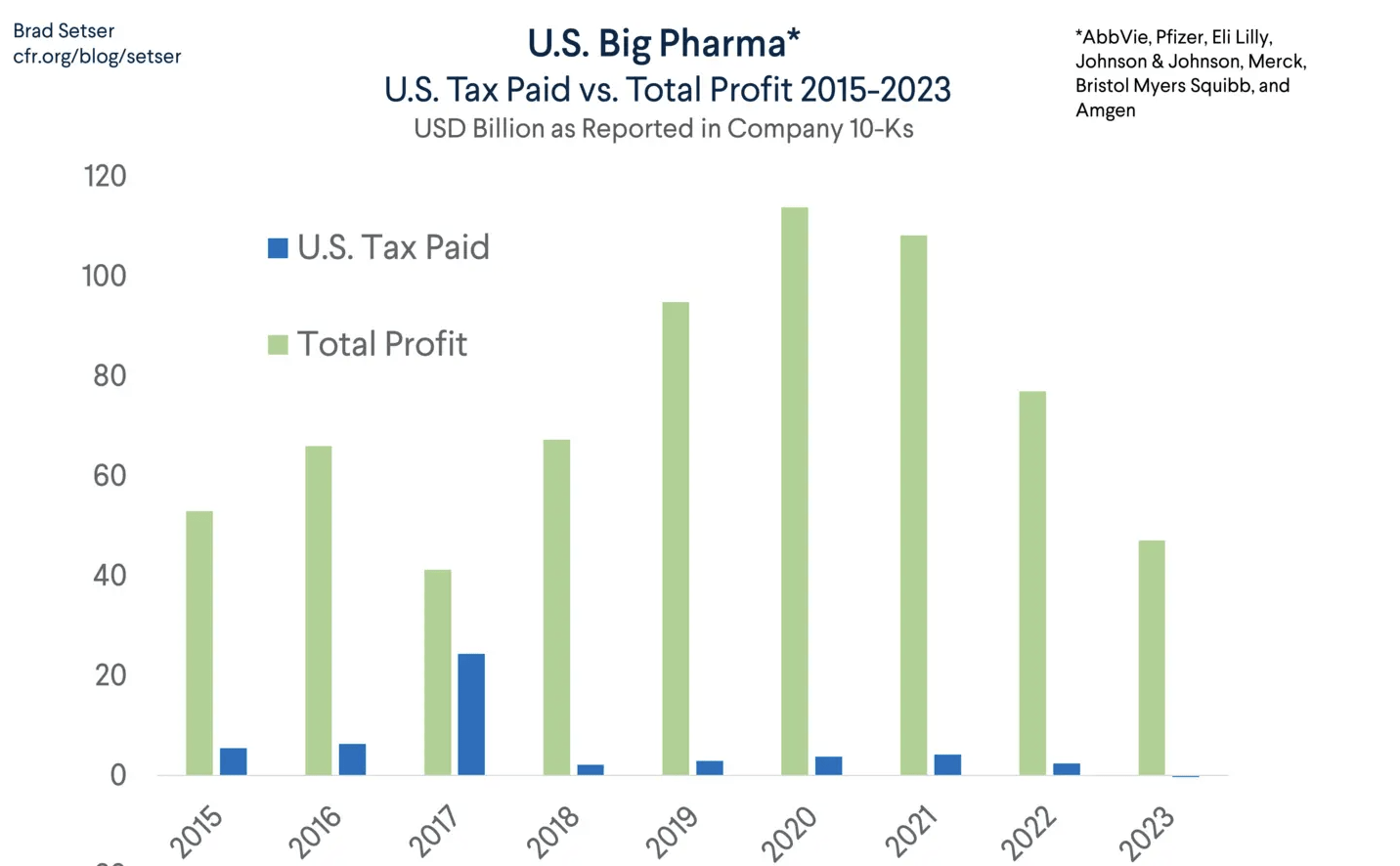
Big Pharma makes big profits in the U.S., but has mastered the accounting trick of paying little or no taxes. Thanks to Trump’s big corporate tax cut in 2017, most of these corporations are able to transfer their profits to other countries where the tax rates are lower.

Although they receive the bulk of revenue from sales in the U.S. and report large overall profits, most large U.S.-based pharmaceutical companies don’t pay any taxes in the country.

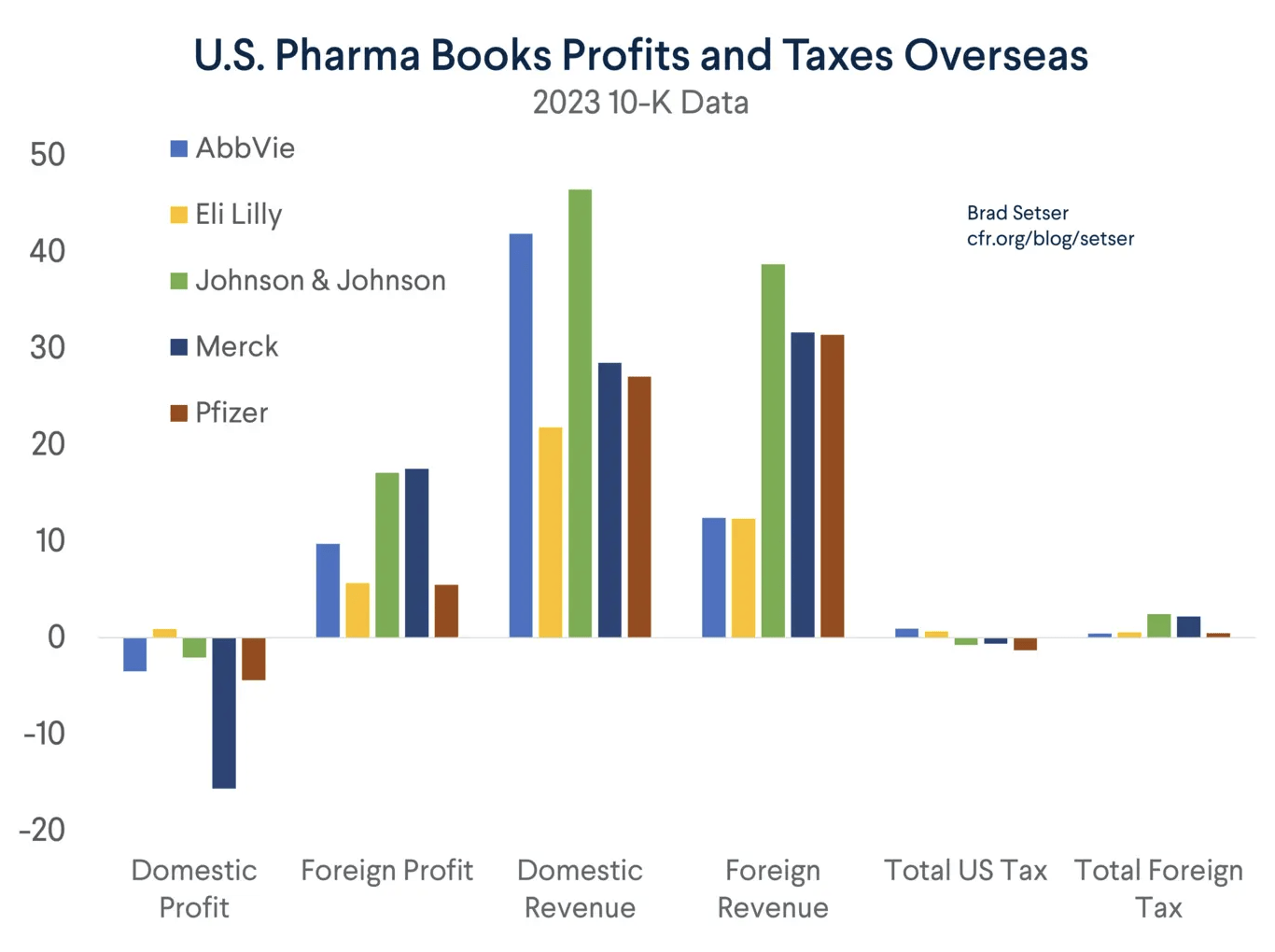
A new analysis of corporate taxes paid by the largest U.S. pharma companies by the Council on Foreign Relations found that in 2023, the top seven based on revenue had a combined U.S. tax obligation of (-)$250M.

The duo also noted that, based on 10-K filings, many pharmas reported losses in the U.S. in 2023. Among them: Pfizer, $4.4B; AbbVie, $3.5B; Merck, $15.6B; and Johnson & Johnson $2B.

However, Setser and Weilandt estimated that Eli Lilly (LLY) reported a $0.9B U.S. profit.

Gilead Sciences (GILD) is an outlier among large biopharmas. It is the eighth largest U.S. biopharma by revenue, yet reported paying $3B in U.S. taxes in 2023.

Setser and Weilandt explain how pharmas can book U.S. profits overseas to save on paying U.S. taxes. The first reason is the Tax Cuts and Jobs Act of 2017, which the pair say provided for lower taxes on foreign profits than U.S. profits, providing an incentive for companies to book more profits overseas.

Second, since many drugs sold in the U.S. market are actually made abroad, pharma companies decide to book those profits in the country of manufacture.

Finally, many pharmas have moved their intellectual property to wholly owned subsidiaries in locations with more favorable tax rates than the U.S.

Open the link to read the rest of the article.

Sarah Jaffe wrote in The American Prospect about the latest way to extract profit from consumers: surge pricing. It’s not only Uber and Lyft. It’s spreading into every corner of business.

She writes:

The internet nearly exploded this February when Wendy’s CEO Kirk Tanner announced that the fast-food chain intended to embrace “surge pricing,” raising the prices of a burger and a Frosty in line with customer demand.

The company had included a mention of “dynamic pricing” in its fourth-quarter earnings presentation, but clarified after the kerfuffle that the announcement of its new digital menu displays had been “misconstrued in some media reports as an intent to raise prices when demand is highest,” and said that it had “no plans to do that.” Instead, the new system would merely allow Wendy’s to “offer discounts and value offers to our customers more easily.”

The snark, which included Sen. Elizabeth Warren (D-MA), ranged from pure outrage to questions of whether the company would also offer “surge pay” to its low-wage workforce. But it’s not like Wendy’s invented price-gouging. A quarter-century earlier, Coca-Cola’s CEO mused about equipping its vending machines with thermometers, and triggering them to raise the price of a soda on a hot day. People hated that too; we just didn’t have social media then.

Wendy’s and Coke aside, surge pricing is spreading. Since deregulation in the late 1970s, airlines have used a form of it, with flights costing more at short notice or at high-demand times of year. Now, the practice has crept into golf courses, hotel rooms, gyms, pubs, and concert venues. Amazon alters its prices every ten minutes. Like Wendy’s, brick-and-mortar retailers are moving to digital price tags, allowing them to surge at will. Consulting firms like Sauce Pricing promise automatic surge pricing at restaurants to boost revenues. A chain bowling alley called Bowlero charged $418.90for two lanes one day last year. Surge pricing “will eventually be everywhere,” the Financial Times, that chronicler of modern capitalism, said last September.

Customers tend to want to know in advance how much something will cost, and though we’re used to the cost of a gallon of gas, or even a quart of milk or a can of Coke, changing over time, those things tend not to fluctuate rapidly over the course of a day or even an hour. People make a distinction between things you need right away and things you could wait for; between luxury items, like market-price lobster at the hottest restaurant in town, and something we all know is cheap and easy, like a Wendy’s cheeseburger.

As companies gather more data available on consumer preferences, the process of algorithmically adjusting prices rapidly based on supply and demand will get easier, affecting all sorts of goods and services we’ve grown to count on. And there’s a case study in how this affects not only consumers but the workers who serve them. You encounter it every time you hit up your phone to find a way home.

IN RECENT YEARS, “SURGE PRICING” has been mostly associated with rideshare companies like Uber and Lyft. It was one of Uber’s earliest sources of bad press, even back when the tech press mostly penned breathless paeans to genius founder-disruptors. Uber took advantage of dysfunctional taxi systems in cities like Washington, D.C., to win goodwill, according to Kafui Attoh, associate professor of urban studies at the City University of New York’s School of Labor and Urban Studies and co-author of Disrupting D.C.: The Rise of Uber and the Fall of the City.

The pricing system was justified as a way to encourage drivers to come out at peak times by offering them more money, something that a regulated taxi system could not offer. It worked, ostensibly, by some combination of three incentives: reducing demand for rides because fewer people could afford the higher price; offering drivers a higher rate if they hit the road; and getting already-working drivers to head to the high-rate zone.

But regulated taxi systems at least offered a steady price that users could count on, whereas Uber’s sudden price spikes turned a short ride home into a luxury good. Uber spokespeople would suggest that riders simply wait for prices to fall again, but anyone who’s ever been stranded at closing time or missed the last subway knows that waiting sometimes isn’t an option.

Please keep reading by opening the link.

Dan Rather is gobsmacked by the short memories of the delegates at the RNC. How could they have wiped their memories of the insurrection of January 6? How could they take pride in nominating a convicted felon? How could they opine for the Trump economy when Biden’s economy has been so successful? How could they endorse a man who still insists that he won in 2020 without a scintilla of evidence? Sore loser.

He writes:

At their convention in Milwaukee, Republicans see themselves as celebrating what they are convinced is going to be not only a win in November, but an overwhelming one. Among delegates and others on the convention floor and around the hall, there is much chatter about an “avalanche” building. 

This, as they have nominated for president a man who tried to overthrow our government.

Their hope is that a majority of voters will simply forget all Donald Trump has done to help himself and hurt this country. That strikes many Americans as falling in the narrow space between revolting and appalling. 

And my goodness, the lies are flying fast and furious at the Republican fantasy convention. This glitzed-up affair is full of speeches that don’t even come close to the truth. Here’s how bad it is: Some major news organizations (although unfortunately not all) are fact-checking the speeches live, calling out the lies in real time. 

But it’s more than that. Republicans must believe Americans are in a mood to forgive and forget. To forgive the insurrection of January 6 and forget the fact that the former president kept top-secret documents strewn about Mar-a-Lago like last month’s junk mail, among many other indiscretions.

How much airtime and how many column inches will be devoted this week to what the previous president has done to harm our democracy? My guess is almost none. Instead there will be a celebration, one devoid of context. It will be an anointing without proper perspective and analysis. And there will be misleading speech after misleading speech. 

Tip of the Stetson to The Washington Post and The New York Times, whose fact-checkers are calling out a myriad of false claims. MSNBC is doing the same in real time. CNN is airing a fact-checking segment after the convention coverage. Unsurprisingly, Fox “News” is airing live speeches unchallenged and unchecked.

So far, the speeches have been riddled with stunning yet emphatically stated lies. Trump, the liar-in-chief, is getting a run for his money in the telling of tales. Over two days, the Post’s fact-checkers have found that convention speakers have made false claims about border crossings, gas prices, fentanyl, tax cuts, Vice President Kamala Harris, peace during Trump’s presidency, voting by migrants, energy independence, the relative wealth of young Americans, and Easter Sunday.

The lies and misinformation are meant to rile and to scare. Texas Senator Ted Cruz actually said this out loud from the convention podium: “Americans are dying, murdered, assaulted, raped by illegal immigrants that the Democrats have released.”

And then there’s the old chestnut, election denialism. According to the Post, 62 convention speakers have previously questioned President Biden’s 2020 election win. 

Nikki Haley and Ron DeSantis have capitulated, forgiving Trump for his miserable and untruthful treatment of them when they were running against him. They both gave speeches endorsing him on Tuesday night.

And don’t forget House Speaker Mike Johnson’s claim that the Republican Party is “the law and order team,” as it nominates a convicted felon.

It is no secret that the political nominating conventions lost their significance decades ago. Today, they are nothing more than hour upon hour of campaign advertising, which makes them a great place to court undecided voters. This MAGA convention will be hard-pressed to appeal to middle-of-the-roaders. Republicans can no longer claim to be the party of Lincoln or even of Reagan. It is wholly the party of Trump and his MAGA extremist followers. Their newly anointed vice presidential candidate, JD Vance, is even more extreme on issues like gun control and abortion than Trump.

Vance and the convention speakers are talking some about America’s need for unity, and that’s good, if they actually mean it. But after only two days, they seem to have abandoned the calls for unity and reverted back to the MAGA talking points. Against the backdrop of Republicans celebrating in Milwaukee, let’s hope that most of the rest of the country gives itself a gut check on Trump’s record and the reality of what his victory in November would mean.

Watch President Biden’s Detroit rally tonight. Biden spoke for about 30-40 minutes, and he was outstanding. He touted the economic record of his administration, and he described his agenda for his first 100 days in his second administration.

He also described the dangerous agenda of Trump’s Project 2025. He said “Trump is a loser!”

Number #1 on his agenda would be signing legislation to make Roe v. Wade the law of the land. He promised to promote good union jobs. He pledged to protect healthcare, Medicare, and Social Security. He said he would revive the Child Tax Credit, which cut child poverty in half before Republicans blocked its renewal. There was more.

He made clear that his goal was to strengthen the middle class.

President Biden was vigorous, passionate, and articulate. The crowd was fired up.

Biden is in it to win it.

John Thompson, retired teacher in Oklahoma, writes here about the environmental crisis in his state, propelled by greed.

He writes:

Oklahoma City is again in the national news. On one hand, it was ranked 16th in the nation in the U.S. News & World Report’s “Best Places to Live” in 2024-2025. On the other hand, The International Classification of Functioning, Disability and Health’s, (ICF) Climate Center just projected how Oklahoma City’s “temperature will change by mid-century under a moderate warming scenario.” 

From 1981 to 2010, the average annual days in Oklahoma City where heat put a strain on electric transformers was 10. This was due to “blistering daytime highs along with sultry nighttime lows, depriving electrical equipment of a chance to cool down.” By the midcentury (2036 to 2065) it is projected to reach 45 days. Also, Tulsa is expected to reach 44 days and Altus 65 days of heat waves. 

It also estimated that Phoenix, which is in the news for its current heat wave, “will endure an estimated 126 days each year with heat that reduces transformers’ performance, the analysis found. A power outage during a heat wave would kill thousands of people in the city, according to a peer-reviewed study published last year.”

Of course, the stress that heat waves dump on transformers is just an indicator of the predicted effects of a 350% increase in heat waves in Oklahoma City, and worse increases across the world. The distress imposed on infrastructure should be seen as a symptom of the devastation that humans, and other living beings will face.

The national press has also reported on possible ways that Oklahoma (and other places) could respond to global warming. In an editorial in the Tulsa WorldPhilip-Michael Weiner explained, “If we want to have a more stable climate in the future, we need to remove a lot of the carbon already in the air.” He adds, “Our elected representatives must not miss the chance to help Oklahoma become a global leader in carbon removal.”

Weiner explains that Oklahoma is “well-situated to become a global leader in carbon removal and reap meaningful economic benefits for our state.” He cites “Oklahoma’s geo-workers, technology, and resources, [and] vast geologic capacity, subsurface geology, needed for carbon storage.” And Weiner adds that, “Exxon Mobil Corp. estimates there will be a $4 trillion market by 2050 for capturing carbon dioxide and storing it underground.”

But that leads to another concern. Yes, given our failure to adequately tackle the proven threat of climate change, we must invest heavily in a range of efforts to decarbonize our atmosphere. And that will require major commitments from corporations, especially oil and gas companies, as well as government programs. But, we wouldn’t be facing such an existential threat if oil and gas companies, especially Exxon, had not hid their research which confirmed the findings of scientists who nearly convinced the H.W. Bush administration that carbon dioxide emissions needed to be quickly and massively cut. As the Guardian noted, their study:

Made clear that Exxon’s scientists were uncannily accurate in their projections from the 1970s onwards, predicting an upward curve of global temperatures and carbon dioxide emissions that is close to matching what actually occurred as the world heated up at a pace not seen in millions of years.

But they borrowed the tactics of the tobacco industry, which knowingly lied about the deadly dangers of their product. And then Exxon “continued its disinformation campaign for another half century.”

Yes, there has been reporting on Oklahomans seeking to apply technologies developed for fracking in order to cut greenhouses gases. But the bigger stories have focused on Oklahoma oil billionaire Harold Hamm, who pledges, “We’re going to be on oil and gas for the next hundred years,” It was Hamm who organized the “energy round table” at former President Trump’s private club where he promised “to eliminate Mr. Biden’s new climate rules intended to accelerate the nation’s transition to electric vehicles, and to push a ‘drill, baby, drill’ agenda aimed at opening up more public lands to oil and gas exploration.”

The New York Times reported that sources:

Asked not to be identified in order to discuss the private event.  Attendees included executives from ExxonMobil, EQT Corporation and the American Petroleum Institute, which lobbies for the oil industry.

One would think that the new predictions regarding global warming in Oklahoma City, and elsewhere, would convince the Chamber of Commerce and political leaders to immediately make de-carbonization a #1 priority. And it should be clear that the Hamm/Trump agenda – pushed by oil industry lobbyists – would devastate our planet. Somehow, we have to come together and hope businessmen will value stakeholders as well a shareholders, and place mankind over short-term corporate profits for a very few.  

By the way, as I was about to complete this post, United Nation’s World Meteorological Organization (WMO) said:

There is now an 80% chance that at least one of the next five years will mark the first calendar year with an average temperature that temporarily exceeds 1.5C above pre-industrial levels – up from a 66% chance last year.

As Reuters reports, “scientists warn of more extreme and irreversible impacts” if the 1.5C threshold is passed. So, “U.N. Secretary-General António Guterres called for urgent action to avert ‘climate hell.”” And I would add, Oklahomans and other Americans must double down on our abilities to fight global warming. But it is too late to make a difference in saving our planet if we don’t resist Exxon, Harold Hamm, Donald Trump, and others who are promoting the economics of destruction.