Archives for category: Cruelty

Trump says he will deport 11 million illegal immigrants. He says his deportation program will be unlike anything the nation has ever seen. He is right.

Trump says that Franklin D. Roosevelt deported over one million Mexican immigrants. Not literally true. His aide Stephen Miller must have told him that; Miller will probably be put in charge of the program if Trump wins the election. He hates immigrants.

Actually, the deportations were started in 1930 and reached a peak in 1931, before FDR was elected. Estimates for the numbers of those deported ranged from 300,000-2 million, about half of whom were American citizens. President Herbert Hoover approved the deportation program on the belief that Mexicans were taking jobs from white people. Most of the deportation was implemented by local and state governments.

What would it look like to deport 11 million people?

First, they would have to be rounded up in massive raids. Imagine the terror as federal agents arrived at the homes of immigrants and raided them, carrying away families–men, women and children.

Where to put 11 million people?

Then, the federal government would have to build thousands, tens of thousands of detention camps. Every state would have detention centers. This would be a massive undertaking, because the camps would need to be constructed and supplied with beds, food, personnel, doctors and nurses.

Trump has suggested that the deportees would each have a serial number. Would it be tattooed on their arms?

Inevitably, families would be torn apart, people would die, women would give birth in the camps.

The images sent around the world of detention camps for millions of people would humiliate our country as a cruel, heartless place.

Someone should drape a hood over the Statue of Liberty, so that she does not see what is happening as she lifts her lamp “beside the golden door.”

On the base of the Statue of Liberty, “The New Collosus,” by Emma Lazarus.

Give me your tired, your poor, Your huddled masses yearning to breathe free, The wretched refuse of your teeming shore. Send these, the homeless, tempest-tossed to me, I lift my lamp beside the golden door! 

No more. Stay home. We are full. No more room. Not at this inn.

Billy Townsend writes a blog where he exposes public corruption in Florida. In this post, he tries to understand why his friends and neighbors will vote for Trump.

He begins:

Choosing — yet again — to inflict a deteriorating, revenge-obsessed, 78-year-old Capitol lynch mob inciting felon sex abuser and his horde of MAGA freaks on your friends, loved ones, neighbors, fellow citizens, and communities means inflicting — yet again — a deteriorating, revenge-obsessed, 78-year-old Capitol lynch mob inciting felon sex abuser and his horde of MAGA freaks on your friends, loved ones, neighbors, fellow citizens, and communities. 

I am surrounded in Lakeland, Florida these days by folks who have made this choice multiple times already, who pretend they’re in downcast denial about the self-evident facts of making that choice yet again, especially post January 6th. They’re pretending to believe that choosing to make a MAGA dictatorship and give it the nuclear codes and Department of Justice does not meanmaking a MAGA dictatorship and giving it the nuclear codes and Department of Justice….

What I most value about elections is that they force clear, unambiguous choices. The MAGA Freak dictatorship choice before us is the clearest and most obviously one-sided choice in the history of American self-government. Everyone knows this. The fact that the vote will be close on something so obvious says more about Americans than it does about the choice we face. MAGA doesn’t even have a fake economic or border argument to make. 

I mean, at the most elemental level, I would be proud to call Kamala Harris friend, aunt, wife, mother, boss, co-worker Kiwanis Club president, mayor, minister. I would be disgusted and embarrassed to call the deteriorating 78-year-old MAGA dictator friend, uncle, husband, father, boss, Kiwanis Club president, mayor, minister. 

Mark Robinson, currently the Lt. Governor of North Carolina, is running for Governor. He has a long record of making inflammatory, extremist statements. He was endorsed by Trump and is true-MAGA. Recently his personal life has caught up with his extreme rightwing views. North Carolina is a crucial “battleground state” in the Presidential race.

After learning that Lt. Gov. Robinson had a history of frequenting porn stores, CNN discovered his Internet activity on porn sites.

CNN) — Mark Robinson, the controversial and socially conservative Republican nominee for governor of North Carolina, made a series of inflammatory comments on a pornography website’s message board more than a decade ago, in which he referred to himself as a “black NAZI!” and expressed support for reinstating slavery, a CNN KFile investigation found.

Despite a recent history of anti-transgender rhetoric, Robinson said he enjoyed watching transgender pornography, a review of archived messages found in which he also referred to himself as a “perv.”

The comments, which Robinson denies making, predate his entry into politics and current stint as North Carolina’s lieutenant governor. They were made under a username that CNN was able to identify as Robinson by matching a litany of biographical details and a shared email address between the two.

Many of Robinson’s comments were gratuitously sexual and lewd in nature. They were made between 2008 and 2012 on “Nude Africa,” a pornographic website that includes a message board. The comments were made under the username minisoldr, a moniker Robinson used frequently online.

Robinson listed his full name on his profile for Nude Africa, as well as an email address he used on numerous websites across the internet for decades.

CNN is reporting only a small portion of Robinson’s comments on the website given their graphic nature.

Many of Robinson’s comments on Nude Africa stand in contrast to his public stances on issues such as abortion and transgender rights.

Publicly, Robinson has fiercely argued that people should use bathrooms only that correspond to the gender they were assigned at birth. He’s also said transgender women should be arrested for using women’s restrooms.

“If you’re a man on Friday night, and all the sudden Saturday, you feel like a woman, and you want to go in the women’s bathroom in the mall, you will be arrested, or whatever we gotta do to you,” Robinson said at a campaign rally in February 2024. “We’re going to protect our women.”

Yet privately under the username minisoldr on Nude Africa, Robinson graphically described his own sexual arousal as an adult from the memory of secretly “peeping” on women in public gym showers as a 14-year-old. Robinson recounted the story as a memory he said he still fantasized about.

“I came to a spot that was a dead end but had two big vent covers over it! It just so happened it overlooked the showers! I sat there for about an hour and watched as several girls came in and showered,” Robinson wrote on Nude Africa.

CNN is not publishing the graphic sexual details of Robinson’s story.

“I went peeping again the next morning,” Robinson wrote. “but after that I went back the ladder was locked! So those two times where [sic] the only times I got to do it! Ahhhhh memories!!!!”

In other comments on Nude Africa, Robinson discussed his affinity for transgender pornography.

“I like watching tranny on girl porn! That’s f*cking hot! It takes the man out while leaving the man in!” Robinson wrote. “And yeah I’m a ‘perv’ too!”

In an interview with CNN on Thursday, Robinson repeatedly denied that he made the comments on Nude Africa.

“This is not us. These are not our words. And this is not anything that is characteristic of me,” Robinson said. Presented with the litany of evidence connecting him with the minisoldr user name on Nude Africa, Robinson said, “I’m not going to get into the minutia of how somebody manufactured this, these salacious tabloid lies…”

A history of controversial statements

Campaigning for lieutenant governor in 2020, Robinson advocated for a complete abortion ban without exceptions. He later expressed regret in 2022 for paying for his now-wife to have an abortion in the 1980s.

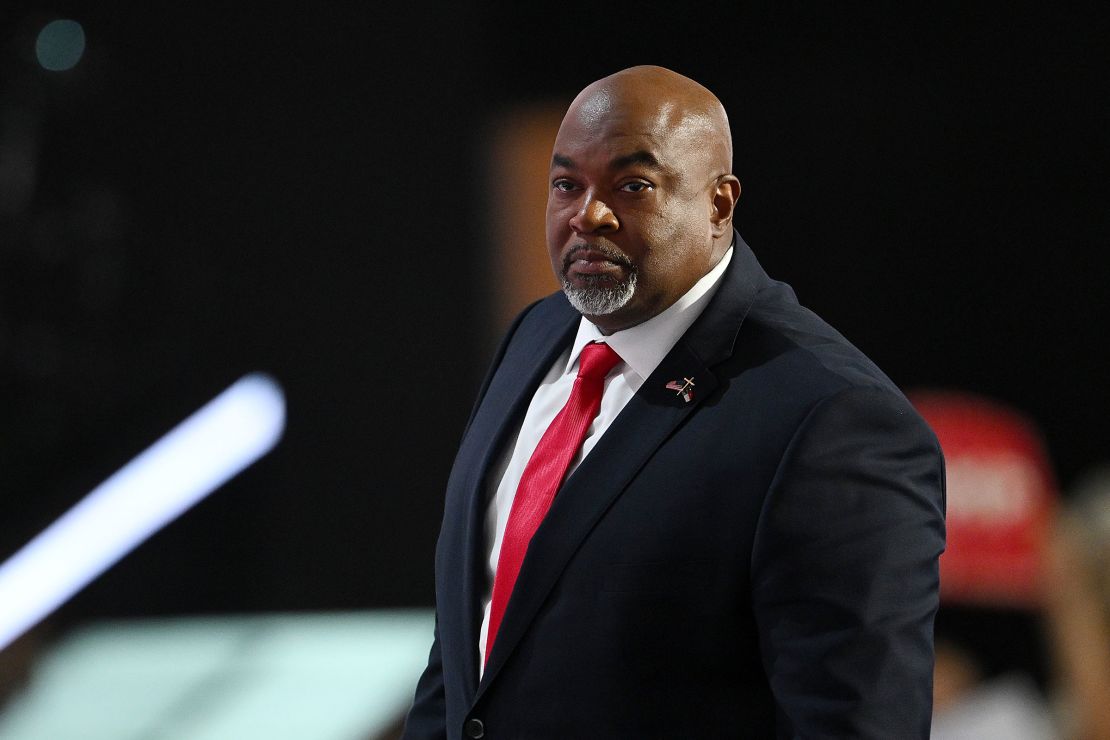
North Carolina Lt. Gov. Mark Robinson speaks on stage on the first day of the Republican National Convention at the Fiserv Forum on July 15, 2024, in Milwaukee.

North Carolina Lt. Gov. Mark Robinson speaks on stage on the first day of the Republican National Convention at the Fiserv Forum on July 15, 2024, in Milwaukee. Leon Neal/Getty Images

Now campaigning for governor, he says he supports a so-called “heartbeat” bill that would ban abortion when a heartbeat is detected – approximately six weeks – with exceptions for rape, incest and health of the mother…

In another thread, commenters considered whether to believe the story of a woman who said she was raped by her taxi driver while intoxicated. In response, Robinson wrote, “and the moral of this story….. Don’t f**k a white b*tch!”

Robinson, who would become North Carolina’s first Black governor if elected, also repeatedly maligned civil rights leader Martin Luther King Jr., attacking him in such intense terms that a user accused him of being a white supremacist.

“Get that f*cking commie bastard off the National Mall!,” Robinson wrote about the dedication of the memorial to King in Washington, DC, by then-President Barack Obama.

“I’m not in the KKK. They don’t let blacks join. If I was in the KKK I would have called him Martin Lucifer Koon!” Robinson responded.

CNN’s reporting on Robinson’s comments comes a few weeks after The Assembly, a North Carolina digital publication, reported that Robinson frequented local video pornography shops in the 1990s and 2000s. The story cited six people who interacted and saw him frequent the stores in Greensboro, North Carolina. A spokesperson for Robinson called the story false and a “complete fiction.”

Open the link to see CNN’s extensive documentation.

Alex Shepherd of The New Republic wrote an outstanding article about the linkage between Trump and violence. He threatens it, he encourages it, he revels in his threats. He likes to play the role of the tough guy. I recall a clip from one of his campaigns where he was portrayed at a wrestling match beating up a cartoon figure labeled CNN. I recall him at one of his rallies encouraging the crowd to beat up any infiltrators and he would pay the court costs. I remember the cruel taunts that he directed at others, including Paul Pelosi. He is a bully and he wants to be feared.

Yet when yet another gunman was captured before shooting at him, Trump was quick to blame Harris and Walz, who have repeatedly called for unity.

Shepherd writes:

Three hours before a would-be assassin was spotted hiding in the bushes of his golf course in West Palm Beach, Donald Trump posted, in all caps, “I HATE TAYLOR SWIFT” on Truth Social, his wildly unprofitable social network. At roughly the same time, his running mate, Ohio Senator J.D. Vance, was touring the Sunday shows to proudly admit that he and Trump were knowingly spreading racist lies about Haitian immigrants eating pets, in service of an even bigger lie—that immigrants pose an existential threat to the country itself.

It was a banner day for the Trump campaign: a feud with the country’s most popular pop star, a vile lie about a vulnerable population, yet another close call with an attempted assassin. But it also felt oddly familiar, bordering on routine—especially given how the former president and his allies reacted to the golf course scare. There were no fleeting calls for “unity” or hollow promises to turn down the temperature; instead, they were quick to blame their political opponents.

In a speech on Monday, Vance noted that the two attempts on Trump’s life were “pretty strong evidence that the left needs to tone down the rhetoric or somebody is going to get hurt.” He further argued on X that the captured suspect, Ryan Routh, was inspired by the Harris campaign’s insistence that Trump is a threat to democracy. Trump, meanwhile, said his opponents’ inflammatory rhetoric was endangering him, and that “these are people who want to destroy this country.”

“It is called the enemy from within,” Trump continued. “They are the real threat.” If that wasn’t subtle enough, his campaign then released a lengthy list of people it blamed, without evidence, for inspiring Routh, including Harris and her running mate, Governor Tim Walz, as well as Representative Nancy Pelosi, Representative Adam Schiff, and even Walz’s wife, Gwen.

It would be foolish to blame any politician for either assassination attempt; both Routh and Thomas Crooks, the deceased Pennsylvania shooter, were mentally troubled and politically confused. But it’s important to acknowledge a simple and obvious truth: No one in this country has done more to sow division, create chaos, and, yes, encourage violence over the past decade than Trump. It was only a matter of time before that boomeranged on him.

Criticisms of Trump that rightfully note that he is a threat to the future of American democracy are hardly incitement to violence. They are recognition of the fact that Trump has used and will continue to use any means at his disposal to gain and hold onto power. His own paranoia and deluded ravings about his political enemies, meanwhile, have created a combustible climate—one made more dangerous by the lax gun laws that Trump and his allies have embraced.

These are people who egg on violence against their enemies at every turn. As The New York Times’ Peter Baker put it on Monday, Trump has “long favored the language of violence in his political discourse, encouraging supporters to beat up hecklers, threatening to shoot looters and undocumented migrants, mocking a near-fatal attack on the husband of the Democratic House speaker and suggesting that a general he deemed disloyal be executed.” Let’s not forget that he also directed his supporters to attack the U.S. Capitol and allegedly expressed support for hanging his vice president, Mike Pence.

And then, Trump cries victim when he finds himself in the crosshairs. But increasingly, it seems, Americans aren’t buying it. For the last two months, the Trump campaign has whined incessantly about the fact that the country quickly moved on following the first attempt on his life, in mid-July. They’re right about that; his near-death experience was out of the news within a few days, and Trump received no noticeable bump in the polls. The incident is now an afterthought in the election—it’s almost as if it never happened at all. The second assassination plot, meanwhile, barely registered on NFL Sunday.

The country has moved on because it has grown accustomed to the chaos that Trump effortlessly generates. It has moved on because Trump himself moved on almost immediately. The Trump that stood onstage at the Republican National Convention, rambling about his grievances for almost two hours, was not changed by his recent brush with death in the slightest. He was, if anything, even morederanged and vengeful. And since then, he has said that Kamala Harris is a “fascist,” Walz wants to force young children to have gender reassignment surgeries, and that Haitian immigrants who are in the country legally are pet-eating criminals intent on murdering downtrodden Rust Belt whites.

Years before Trump’s political career began, the British photographer Platon found himself shooting Trump in the boardroom where he fired people on The Apprentice, the show where he played an idealized version of himself—wealthy, important, competent. Platon tried to connect with his subject. “Let’s be human together,” he said to Trump. “There’s always an air of tension and controversy about the things you say and do in public. I’m sure it’s intentional on your part but it feels to me like you’re in the middle of an emotional storm. I can’t live with that anxiety all the time. As a fellow human being, I’d like to know how you weather the storm.”

Trump calmly looked back at him and responded: “I am the storm.”

Trump is one of the least self-aware people in American political history—maybe in history, period. But this was an eerily prophetic statement. For eight years, Trump has been the storm. He unleashed dark forces in our society—making America more violent, more menacing, more chaotic—and rode them to the height of power. Now, he’s trying to do it all over again. But that’s the thing about storms, no matter their origin. Sometimes there’s no escaping them.

Timothy Snyder is the Richard C. Levin Professor of History at Yale University. He specializes in the history of Central and Eastern Europe, the Soviet Union, and the Holocaust.

He wrote this as he was flying from Europe to the U.S. Since the Russian invasion of Ukraine, Snyder has been an outspoken champion of that beleaguered nation. He has used his deep knowledge of history to debunk Putin’s justifications for invading his neighbor. He has even raised money to buy defense weapons for Ukraine when the Republican Congress dithered for months before passing an aid package.

Snyder writes:

Words make their way through the world with us, changing their senses as we change our lives.  Think for example of the word “launch.”

Today and in days to come I will “launch” my book On Freedom, in the sense of the word all of my publishing friends like to use.  They want to book to “launch,” to soar, to do well.  In this spirit I talked to Tom Sutcliffe of the BBC in London this morning, and I am hoping to speak to Rachel Maddow of MSNBC tonight.  And no doubt throughout this long day, which begins in Europe and ends in the United States, I will say “launch” several times myself.

I am returning from Ukraine. My first true conversation about On Freedom this month was a week ago in Kharkiv, a major city in northeastern Ukraine, close to the Russian border and to the front.  The Literary Museum there had invited me for a presentation at an underground site.  It was a lovely place, with a bar that made me the coffee that I needed after a long trip, and a crowd of people invited to talk about freedom (we could not announce the event for safety reasons, which I regret). In a sense, this Kharkiv discussion was the real launch of the book.

We were underground, though, because of another kind of launch, the unmetaphorical kind, not the literary launch but the literal launch — of Russian missiles.

Kharkiv, Budynok “Slovo”.

The Russians seemed close to taking Kharkiv at the beginning of the war.  There was intense combat in Saltivka, a district of the city home to about 600,000 people.  Major buildings in the city center of Kharkiv are still in ruins. The Ukrainians held the Russians back, but Russia itself remains close.  A missile fired from Russia can reach Kharkiv before people have a chance to get underground.  That, in Kharkiv, is what a “launch” too often means.

The difference in the sense of a word can help us to catch the difference in reality.  In Kharkiv, the drones and the bombs and the missiles are a normal part of the day.  People want to talk about books, they want to go to restaurants and movies, they want to live their lives, and they do, despite it all.

Those of us beyond war zones catch all of this, if at all, indirectly, through media.  We do not hear the sirens and we do not have to go underground.  We do not have to check social media to see if friends and family are alive. The word “launch” retains a kind of innocence.

This is not about countries being different, but about situations being difference.  Kharkiv in normal times is a major literary city. In the 2020s, before the Russian full-scale invasion, Kharkiv was a center of Ukrainian book production.  Before February 2022 there were plenty of launches, in the literary sense, in Kharkiv. And there are still some now!

Genocide is not only about killing people, but about eliminating a culture, making it untenable by destroying the institutions that transmit it.  Thus Russia burns books, steals museum artifacts, and bombs archives, libraries, and publishing houses.  Russia deliberately destroyed the publishing houses in Kharkiv, including where one of my own books was being printed.  One sort of launch would seem to obliterate the other.  But, to the Ukrainians’ credit, only for a time.  The book publishing industry, like a number of others, picked up in other places. The public book culture in Ukraine, expressed in new stores and cafes, is defiant.

I was thinking of “launches” in Kyiv, a couple of days after the Kharkiv visit, as I pretaped an interview about the book.  For me it was the end of a long day, spent beginning (“launching”) a big history project.  The first conference had gone well, and we had a press conference complete with a Viking sword, a Byzantine cross, and Scythian and Trypillian vessels kindly loaned by the national museum.  Ukrainian colleagues on the stage had spoken of the importance of cooperation and listening in our grand cooperative project.  I was in a good mood when I went to a side room to tape the interview.

At around the time the interview began, a missile was launched from Russia, aimed at Kyiv.   The air raid sirens began outside the window.  An air raid siren can mean different forms of attack, some more rapid and some less so.  Drones can cause terrible damage and kill large numbers of people, but they are not very fast.  If a missile is in the air, on the other hand, you have to move right away.  Since there was in fact a missile bearing down on Kyiv, I explained this to the interviewer and hastened to the stairs.  I learned that Ukrainian air defense had destroyed the missile as I reached the staircase.

This was all completely normal.  The Russians launched a number of very large strikes last week with missiles and drones.  Ukrainian air defense is excellent — when the Ukrainians are given the tools, they protect their people extremely well, and Kyiv is where their limited equipment is concentrated.  We picked up the interview as soon as I could re-establish the connection.

One sort of “launch” had been briefly interrupted by another, my literary book launch by a literal missile launch.  This was an infinitesimally tiny taste of the interruption tens of millions of Ukrainians face all the time from Russia’s senseless war, which changes the shapes of lives even when it does not end them.  Russia launches these attacks on civilians all the time, almost every day.  The point is not only to kill people and destroy civilian architecture but to instill a certain view of life.  Nothing good ever happens. Be afraid at all times.  Undertake nothing new yourselves.  Give up.

But people do start new projects in Ukraine.  Ukrainian writers have been productive during this war, including writers serving in the armed forces. Serhiy Zhadan, an extraordinary Kharkiv poet and novelist, has just published a book. I was able to have three discussions with him in two cities. One day there will be a collection of Ukrainian war poetry in translation, and it will be astounding. Ukrainians launch cultural projects one after the other, even if the word seems odd just now.  I took part in two such launches in just one week: the big history project in Kyiv, called Ukrainian History Global Initiative; and a new cultural institution in Lviv, INDEX, which is based around recording war experience from multiple methods and multiple perspectives.  The Literary Museum in Kharkiv has an interesting new (partly interactive) exhibition by K. Zorkin.

When we can meet, we can gather the senses of words from the settings.  I am grateful to all my friends and colleagues and hosts in Ukraine.  Without the time in Ukraine On Freedom would be a different and poorer book. And so, much as I am happy to be speaking about the book today in the UK and the US, it seems right that there was something like a launch in Kharkiv first. 

When we cannot meet, we still have the words.  We can follow the senses of the word “launch,” from the rougher to the gentler and back, along an arc that perhaps leads to some understanding.

TS, 16 September 2024

In Kharkiv, September 2024, in conversation with Volodymyr Yermolenko

Over recent years, we have heard again and again that parents always know what’s best for their child. And so we have vouchers and home-schooling because “parents always know what’s best for their child.”

No, they don’t.

Read this story and ask yourself whether this parent knew what was best for her child.

I wish I had saved the many stories of this kind that I have read over the past decade. Thank God, they don’t happen every day but they do happen.

Whenever I write about abusive parents like the one in this horrific story, I get inundated by angry letters from advocates for parents’ rights, especially homeschoolers. Let ’em write.

The state should have had someone to look after this boy. They should have had the authority to take the child away from his mother, who hated him, to save his life.

If you can stand listening to and watching Trump, this is the speech that Heather Cox Richardson wrote about this morning.

Ron DeSantis is second only to Trump as the most toxic politician in the U.S. He is cruel. He is mean. He is anti-science. He is anti-intellectual. He is a prude. He signed one of the worst abortion bans in the nation. He banned accurate sex education. He demonized anything related to LGBT issues. He tried to suppress drag queens, but they are performers and are irrepressible.

DeSantis has exercised near-total control over the state because both houses of the legislature are Republican-dominated. Whatever DeSantis wanted, the legislature gave him, including a militia under his command. DeSantis personally drew the map to redistrict the state for Congressional seats; he managed to get rid of one of the state’s majority Black dustricts

Taking personal control of education in Florida has been one of his biggest goals. He has focused on redirecting the curriculum of public schools and colleges. He pushed through legislation that banned honest teaching about race and gender in the schools, including a law known as “Don’t say gay,” which restricted teaching about race, gender, and homosexuality. He demanded a revision of the AP course on African American history to delete ideas and authors he didn’t like. His state education department rejected textbooks that were too honest about climate change.

He encouraged book banning, although he publicly denied it; PEN America, however, identified Florida as the state that banned the most books. He has worked closely with the prudes at Moms for Liberty, aka Moms for Censorship. He packed the State Board of Education with his cronies. He eliminated tenure in higher education.

Friends of DeSantis were selected by the state board of education to be president of public colleges; the top job at the University of Florida was given to a retired politician, who lasted one year, gave hefty salaries to his former staff in DC to work remotely, and stepped down with a salary of $1 million yearly until 2028.

DeSantis destroyed the only progressive public college in the state, New Colmege. He packed the board with right wingers, who hired a politician to be its president, eliminated programs that offended them and recruited athletes to replace the free-thinkers who used to be drawn to the school. His aim: to turn progressive New College into the Hillsdale of the South.

In his zeal to redesign K-12 schooling, DeSantis expanded the state’s voucher programs so that every student in the state, regardless of need, was eligible for a public subsidy. This coming year the state will spend about $4 billion on vouchers for private schools, most of which are religious. Most of the students who use vouchers never attended public schools; sought voucher program is subsidizing the tuition of students who were already attending elite private schools or religious schools.

The voucher schools, by the way, are not required to take state tests. They have no accountability to the state taxpayers who fund them.

He appointed a doctor as the state’s “surgeon general” who was critical of vaccines and masking.

DeSantis was looking unstoppable. He seemed to be in line to inherit Trump’s mantle, as leader of the forces of bigotry, anti-science, and anti-intellectualism. But then Trump jumped into the 2024 race and crushed DeSantis in the primaries.

DeSantis is term-limited. He cannot run again in 2026. Competitors are already measuring the drapes in the Governors’ landing.

And DeSantis is starting to see rebuffs that would have been unimaginable before this year.

Two years ago, DeSantis endorsed school board candidates who shared his extreme rightwing views about race and gender. Of the 30 candidates he endorsed, more than 80% won their seat. DeSantis boasted that Florida was the state where “woke goes to die.” But in recent school board elections, only about half the candidates supported by DeSantis and his allies “Moms for Liberty” were elected.

DeSantis was also embarrassed by a sex scandal involving one of his favorite power couples, Bridget Ziegler–a co-founder of Moms for Liberty and a school board member in Sarasota–and Christian Ziegler–chair of the state Republican Party. The Zieglers got caught in a messy threesome, which led to Christian’s resignation from his position and Bridget’s refusal to resign from the school board. Read Bridget’s Wikipedia entry for the sordid details. Moms for Liberty, which crusades against gay sex, dropped Bridget’s name as a co-founder and pretended she didn’t exist.

Then came the latest fiasco: the DeSantis administration planned to put a major development into one of the state’s most important parks, the Jonathan Dickinson State Park. The proposed development included a 350-room hotel and a golf course. The park is near Hobe Sound. It consists of 11,500 acres. Development was planned for other state parks too.

The uproar from people of all political persuasions was instantaneous and loud. “Hands off our park!”

DeSantis dropped the plan.

On August 28, the Washington Post reported:

Florida Gov. Ron DeSantis on Wednesday pulled the plug on a proposal that would have paved over native habitats and protected beaches in state parks to build golf courses, pickleball courts and large hotels.

The Republican governor backed away from the controversial plan announced by his administration last week after even members of his own party protested. Hundreds demonstrated at the nine parks targeted for development.

“So this is something that was leaked,” DeSantis said at a news conference Wednesday in Winter Haven when he was asked about the plan. “It was not approved by me. I never saw that. They’re going back to the drawing board.”

It was the first time DeSantis has spoken publicly about the issue. The “Great Outdoors Initiative” was announced last week by the Florida Department of Environmental Protection and called for building three golf courses at Jonathan Dickinson State Park, a stretch of undeveloped land north of Palm Beach popular for its trails and birding.

The plan also proposed building new lodges with space for hundreds of guests at Anastasia State Park near St. Augustine and Topsail Hill Preserve in the Panhandle. The latter has sand dunes that the state park service describes as “especially remarkable because they are untouched by development.”

Scott Maxwell of the Orlando Sentinel wondered who paid whom and who was profiting:

Plans by the Ron DeSantis administration to put golf courses and a hotel into one of Florida’s state parks appear to have suffered a fast and fatal blow.

It wasn’t just that Democrats objected. Virtually everyone did. In fact, Florida Republicans tripped over each other to trash the idea.

Absolutely ridiculous” was how Rick Scott and Marco Rubio described the way DeSantis’ Department of Environmental Protection wanted to fast-track the controversial development. GOP Congressman Brian Mast called it “bullsh*t.”

It didn’t stop there. Everyone from the Florida Senate president to the state’s Republican CFO said it was nuts to allow a development company to plow 45 holes of golf and a hotel into South Florida’s Jonathan Dickinson State Park, a preserve known for its expansive scrub-jay habitat.

The outcry was so overwhelming that the out-of-state group planning the golf course announced Sunday it was pulling out.

But that only raised more questions. Chief among them: How on earth could one particular development group claim it was abandoning plans for a development opportunity that had never before been publicly advertised?

A key question I had all along: Who’s going to profit? In fact, last week I asked state environmental officials only one question: How will these development companies be chosen?

The answer should’ve been swift and simple: Of course we will open this up to a competitive bidding process. That’s how ethical government works.

Instead, a spokeswoman acknowledged my question, but then never answered it. That was supremely suspicious.

To put an even stinkier cherry on top of this stench sundae, the Palm Beach Post reported that the company had a former Florida secretary of the environment on its payroll as a lobbyist. Because what could be more Florida than one of the state’s top former environmental officials trying to literally pave the way to environmental destruction?

The whole plan reeks of secretive, inside dealing.

Still, inside dealing — specifically no-bid contracts where political pals and cronies cash in on public assets — isn’t new. In fact, it’s been a sordid hallmark of the DeSantis administration, whether it’s a  $100,000 campaign donor that scored $46 million worth of no-bid COVID contracts or no-bid deals at the state’s new Disney governmental services district.

Most Florida Republicans didn’t seem to mind these no-bid deals … until now.

So what changed? Well, two things:

1) This deal was exceptionally bad. Floridians tolerate a lot of rotten behavior. But plans to desecrate land that taxpayers spent millions to protect was just too much.

2) Also, DeSantis’ political clout is seriously diminished. For most of the past six years, Florida’s governor had total control over this state. His fellow Republicans would do anything he asked. But DeSantis’ star has dimmed. His presidential campaign collapsed. His local endorsements fell flat in last week’s primary elections. Once touted as the heir apparent to the MAGA throne, DeSantis has been shoved aside by the JD Vances and Matt Gaetzes of the world. He’s now a lame-duck governor with much glummer prospects.

It’s not clear whether development plans for the other state parks are dead, but it’s hard to believe they will go forward.

As we watch Ron DeSantis’ star fade away, we can all breathe a sigh of relief and hope there’s not a return appearance.

Soldiers of the Israeli Defense Force discovered the bodies of six young hostages while searching the vast tunnel infrastructure under Gaza. All six had been captured on October 7, 2023 They were young people, and each had been shot in the head within 24-48 hours of being found. This event provoked massive protests in Israel, with hundreds of thousands of people in the streets, demanding both a ceasefire and a release of all the hostages. The national labor federation called a general strike in support of these demands. Sadly, while the public wants an end to the war, the leaders on both sides do not.

The following article by Amir Tibon appeared yesterday in Ha’aretz, a liberal Israeli news site.

It seems like a lifetime ago, but just two weeks ago, U.S. Secretary of State Antony Blinken was in Israel, and ended his visit to the country with a surprising statement. The Israeli government led by Prime Minister Benjamin Netanyahu, he said, had accepted the latest bridging proposal put forward by the United States and the other mediators in the talks for a hostage release and cease-fire deal.

Blinken’s intention was good: He wanted to increase the pressure on Hamas leader Yahya Sinwar, who has been stalling and refusing to compromise for months now, sticking to maximalist positions and doing everything he can to avoid negotiating in good faith. Almost 11 months into the war that Sinwar initiated with the October 7 massacre, Gaza is in ruins, tens of thousands are dead, but the man who brought this calamity on his people is hiding in a tunnel and haggling for time.

The problem with Blinken’s statement is that on the other side of the negotiating table is a cynical and ruthless politician who feels even less urgency to reach a deal than Sinwar. Netanyahu pulled on Blinken the same trick he has been pulling on American diplomats for his entire career: Doublespeak. One message in English, the opposite in Hebrew.

And so, after a lengthy conversation in which Netanyahu promised the secretary that he will accept the bridging documentput forward by the mediators, Blinken gave his statement – and the Israeli prime minister, having “pocketed” the achievement, moved on to his next move.

In the two weeks that have passed since the visit, Netanyahu has done everything humanly possible to turn Blinken’s statement into a total joke. He imposed new conditions for any future agreement, stated that Israel will “never” evacuate its forces from the Philadelphi corridor along the Gaza-Egypt border, and pushed Israel’s security cabinet to pass a decision that prohibits any withdrawal from there. His own defense minister warned the cabinet members during a heated discussion on Friday morning that Netanyahu’s desired decision is a de facto death sentence for the dozens of living hostages still held in Gaza. Netanyahu ignored him.

It’s too late to save the six hostages who were murdered last week by Hamas, after surviving 11 months in the tunnels of Gaza. The time to save them was in June and July, when a deal was in hand, and Netanyahu again added new, last-minute obstacles.

At the end of the day, the Biden administration – which seems much more eager than the Israeli government and Hamas to reach a deal – is facing an impossible situation. Sinwar is an ultrareligious fanatic with a murderous zeal and a messianic world view. Netanyahu is an egotistic, selfish man who values the survival of his own coalition over the survival of the hostages. It’s not clear if the administration can truly get a deal under these circumstances. But if it can’t, it owes one thing to the families of the hostages, especially the American ones: to tell the truth, and stop allowing either side to use political tricks and manipulations.

Paul Krugman, the economist who writes a regular column for the New York Times, recently explored why Republicans oppose free lunch for students. The simple answer is that it’s just plain weird. The more complex answer is that they don’t want to create an “entitlement” for children. The irony that he does not explore is why Republicans are unwilling to pay for free lunches, yet eager to pay the tuition of students who attend religious or other private schools, regardless of their family’s income.

He writes:

You could say that Tim Walz became the Democratic vice-presidential nominee with one weird trick — that is, by using that word to describe Donald Trump and JD Vance, a categorization that went viral. In his maiden campaign speech he upgraded it a bit further to “creepy and weird as hell.” (If you think that’s over the top, have you seen Trump’s bizarre rant speculating about whether Joe Biden is going to seize back his party’s presidential nomination?)

But Walz is more than a meme-maker. He has also been an activist governor of Minnesota with a strong progressive agenda. And I’d like to focus on one key element of that agenda: requiring that public and charter schools provide free breakfasts and lunches to all students.

Perhaps not incidentally, child care has long been a signature issue for Kamala Harris, and Walz’s policies may have played a role in his selection as her running mate.

In any case, free school meals are a big deal in pure policy terms. They have also met fierce Republican opposition. And the partisan divide over feeding students tells you a lot about the difference between the parties, and why you really, really shouldn’t describe the MAGA movement as “populist.”

Now, even many conservatives generally support, or at least claim to support, the idea of cheap or free lunches for poor schoolchildren. The National School Lunch Program goes all the way back to 1946, when it passed with bipartisan support and President Harry Truman signed it into law.

Why should the government help feed kids? Part of the answer is social justice: Children don’t choose to be born into families that can’t or won’t feed them adequately, and it seems unfair that they should suffer. Part of the answer is pragmatic: Children who don’t receive adequate nutrition will grow up to be less healthy and less productive adults than those who do, hurting society as a whole. So spending on child nutrition is arguably as much an investment in the future as building roads and bridges.

There’s a strong case that in general child nutrition programs more than pay for themselves by creating a healthier, higher-earning future work force. In other words, this is one area where there really is a free lunch.

Schools, then, should feed students who might otherwise not get enough to eat. But why make free meals available to all children, rather than only to children from low-income households? There are multiple reasons, all familiar to anyone who has looked into the problems of antipoverty policy in general.

First, trying to save money by limiting which children you feed turns out to be expensive and cumbersome; it requires that school districts deal with reams of paperwork as they try to determine which children are eligible. It also imposes a burden on parents, requiring that they demonstrate their neediness.

Additionally, restricting free meals to children whose parents can prove their poverty creates a stigma that can deter students from getting aid even when they’re entitled to receive it. I know about this effect from family history: My mother, who grew up in the Depression, used to talk about her shame at not being able to afford new shoes because her parents, although just as poor as her classmates’ parents, couldn’t bring themselves to apply for government assistance.

And it’s not as if feeding children is prohibitively expensive. So if you want to make sure that children get enough to eat, having schools offer free meals to all their students, without an income test, would seem to be simple common sense.

But Republicans in general aren’t on board. The Minnesota law that Walz signed passed essentially along party lines. The people behind Project 2025, in particular, don’t approve. (Yes, despite denials, Project 2025 is a very good guide to what a second Trump administration might do.) The project’s magnum opus, “Mandate for Leadership,” whose 900 pages lays out a detailed policy agenda, singles out feeding students as something that should be reined in. “Federal school meals increasingly resemble entitlement programs,” it warns, as if this is self-evidently a bad thing. A bit farther down, it reads, “The U.S.D.A. should not provide meals to students during the summer unless students are taking summer-school classes.” I guess being hungry isn’t a problem when school is out.

Stories like this are why my hackles rise whenever people call MAGA a populist movement. The people who will almost certainly make policy if Trump wins are as committed as ever to a right-wing economic agenda of cutting taxes on the wealthy while slashing programs that help Americans in need — including programs that help children.

In addition to being cruel, this agenda tends to be unpopular. Most Americans support providing all students with meals, regardless of their income, just as most Americans now support the Affordable Care Act, which Trump will very likely again try to destroy if returned to office.

But the American right lives in an echo chamber that normalizes views on both economic and social policy that are very much at odds with what a majority of voters want. Those extreme views often fly under the radar. But sometimes they do attract attention. And when they do, many people find them … weird.