Archives for category: Corporate Reformers

Dan Drmacich was principal of Rochester’s School Without Walls. He is now head of that city’s Coalition for Justice in Education. He read an opinion piece in the local paper by Xerox CEO Ursula Burns touting the virtues of the Common Core and decided he needed to respond. He concluded she had no idea what she was talking about.

He argued that her essay demonstrated why corporate executives like Bill Gates, Eli Broad, and Burns should stop telling educators what to do.

One by one, he took apart her flawed claims.

And he concluded by saying:

“To adequately implement any major education change, meaningful practitioner involvement must be a major part of the change process (in this case, teachers, curriculum experts and motivation researchers), along with field-testing and fine-tuning the processes, before it is fully implemented. I am sure Burns would not initiate any organizational change as complex as Common Core at Xerox without first using research-based processes.”

The most popular guessing game in New York City these days is Who Will The New Mayor Choose as Chancellor?

Many names have been floated, including some who currently work in the Bloomberg DOE. Seems unlikely.

Some have suggested J.C. Brizard, who was disliked by teachers in Rochester and booted out by Rahm Emanuel in Chicago. Unlikely.

Another name floated is former Baltimore superintendent Andres Alonso. Here the New York City Parent blog reviews the good and the bad about his record. He seems too close to the Klein ideology to survive scrutiny.

The guessing game goes on.

This is a comment by an educator in New Mexico:


My name is Tine Hayes. I have been teaching high school in Gallup NM for 14 years. I am dual certified in Fine Arts and Social Studies, and I am level three and National Board certified. This year more than ever in the past I am disheartened and distressed by the actions of the PED [state education department] and the attitude toward students and teachers offered by this department. Students are tested into total submission and teachers are disregarded and disrespected at every turn.

Our current educational climate in New Mexico is predicated on assumptions held by our governor and our secretary of education.

First, the success of a school and its students can be summed up by test scores. Second, a Value Added Model of teacher evaluation meaningfully provides a measure of teacher effectiveness.
I take issue with both of these assumptions. The issue of assessment has been at the core of the public education policy since the advent of NCLB. This law requires the use of decontextualized assessments to evaluate school performance. This test based evaluation system was and is a windfall for the test developers and resulted in massive bureaucracies whose job it is to evaluate, analyze and regurgitate test results.

Each year more and more focus has been given to testing, and each year less focus is given to the child being tested. I have sincere doubts about the value of high stakes testing, but I could see how it might provide some meaningful information.

Under Skandera the PED attaches value only to test scores. Although some other areas are given lip service in the school grading system, it is clear the PED only cares about the test scores. The PED claims to be interested in student success, but what they really mean is they want better test scores.

An examination of the Value Added Model indicates that it is a justification of test scores as the sole expression of the quality of teacher student interaction. Hopefully we live in a world where the success of a child is more multifaceted than a test score and the human experience of teaching is about more than performance on the NMSBA.
The data from test scores is specious. Millions of dollars every year are spent on the test itself, and then thousands of man hours are spent interacting with the data. New Mexico has changed tests and test vendors many times since the establishment of NCLB. The State assessment is modified and reworked almost every year since its inception, making it nearly impossible to gather meaningful data.

Next year it will again change to the PARCC assessment. At my high school it has been very difficult to collect and compare relevant data due to both these changes, and the limited number of students who are tested. With the new budget restraints placed on states and districts resulting from the economic downturn these costs are an increasing burden.

For example, the NMSBA now is 80% multiple choice and 20% writing. The reason is not pedagogical. It is financial. It costs too much to grade writing. At this juncture in GMCS only selected grades are given the NMSBA, because it is too expensive to test everyone. While financial restraints have made the tests questionably meaningful the PED continues to double down on the importance of the scores.

Meanwhile budgets get smaller every year, and students have to raise money to go on field trips or participate in extracurricular activities. We do not have the money to pay for gas to go on field trips or to offer vocational programs, but The PED signs contracts with private companies in the name of improving the tax payer’s return on investment in education.

Testing has, despite its questionable effectiveness, become the holy grail of our educational system, at the expense of student experience. This hypocritical misuse of tax payer dollars is intolerable. Students in my wife’s third grade class have to sell pickles and candy to pay for the gas and the bus driver to go on their field trips, yet the PED signed a two year contract with Teachscape, a California based company, for 3.6 million dollars.

Is sending millions of New Mexico dollars to private contractors out of state putting student’s first? How are New Mexico tax payers getting a good return on their investment?

The Value Added Model and the new system for teacher evaluation misses the point. Let me first say I believe the quality of the teacher is the main indicator of the quality of the student’s school experience. I am also keenly aware teacher quality needs to be improved. But once again the myopic PED turns to test scores.

Even the portion of the teacher evaluation based on the principles observation is really based on test scores. The principle is judged on how well their evaluations match the teacher’s scores. The value added model is essentially an academic justification for using test scores to judge the quality of a teacher. It tells us nothing we did not already know. Good teachers impact student’s lives. Good teachers improve test scores.

What the Value Added Model does not tell us is what makes a teacher good. And what it does not allow for is that good teachers were having a positive impact on student’s lives long before NCLB. The PED has embraced this model because it justifies their investment in test scores. The problem for them is that not all subjects are tested. Because they insist on using test scores to evaluate teachers the PED has to come up with tests in each content area.

Thus in order to judge the quality of a Physical Education teacher or an Art teacher, for example, the PED has developed a high stakes assessments in those content areas. The PED is wasting time and energy on a way of thinking disconnected from the student’s experience. I wonder how these tests make the experience of a student in Art or PE more meaningful.

At my school we do not have funds to support sending chorus to regional competition, but the state has the funds to develop an End of Course Exam for chorus. The decision to develop EoCs in electives is not student centered. It is anti-teacher. Skandera will tell you she is dedicated to giving teachers and principals the tools to improve. The tool she provides is apparently Teachscape. This tool serves no function except as a data warehouse for the teacher evaluation system. New Mexico just bought a 3.6 million dollar filing cabinet.

Law suits are being brought against the PED with regard to overstepping its authority, but legal arguments are narrow and specific in focus, and my concern is general. Skandera’s vision of Education in New Mexico is disassociated from the children. Data is currently more important than children and that is wrong and must change.

Please use your position in the New Mexico legislature to return the focus of education to students. Stand up for the children of this state and demand that decisions made by the PED reflect a truly student first approach.

Marc Epstein is a veteran New York City teacher who holds a Ph.D. in Japanese naval history. He was dean of students at Jamaica High School, now closed and replaced by multiple small schools. Epstein has written extensively for Huffington Post and other outlets. Here he shares his reflections on the past dozen years of changes under Mayor Bloomberg and the changes that face the new Mayor Bill de Blasio.

Epstein writes:

Cleaning The Stables: Why New York’s Next Mayor Faces A Herculean Task


During the first years of Bloomberg’s mayoralty I recall a conversation I had with Andrew Wolf about the direction the public schools had taken under Joel Klein’s stewardship, and voiced my deep misgivings about the future of public education in New York City.


Wolf, whose regular column in the New York Sun, provided the most trenchant reporting on the schools, replied, “Look, If Bloomberg were Frederick The Great we wouldn’t be having this conversation.”


So an enlightened mayor politically beholden to nobody owing to his great personal wealth acquired through his business expertise seemed like the perfect fit for exercising the enormous powers granted to him by the state legislature in order to turn things around in much the same way Frederick the Great reformed Prussia.


The idea of mayoral control had widespread bi-partisan support because after decades of reconfigurations of the school system that were impelled by political pressures and the exigencies of the turbulent 60s and 70s, the time seemed ripe for a radical reorganization of the schools.


But instead, a series of substantive public policy blunders, many of which lie below the surface and hence out of the public’s consciousness, will be the legacy Mayor Bloomberg bequeaths to the new mayor.


Should the new mayor do nothing, a million plus children will attend school each day, and a bureaucracy staffed by over 100,000 will show up for work. Yet there is more to just having the store filled with customers.  If the city is to thrive, an accountable, rational bureaucracy most be restored.


That’s because after 12 years of multiple reorganizations and increased expenditures that run to over $100 billion dollars, Bloomberg has nothing to show for it but a decline in academic progress, a thoroughly demoralized workforce, and a massive bureaucratic structure that no longer has its indispensible institutional memory.  


As American democracy and public participation in everyday affairs expanded, the schoolhouse emerged as one of the cornerstones of American society. 


The expansion of free compulsory education was one component, but some might argue that democratic governance of the schools was equally important.  There are 700 school boards In New York State alone with over 5,000 members serving on those boards.  Their communities elect these boards annually.


The elimination of the Board of Education in favor of total mayoral control allowed Mayor Bloomberg to cleanse all vestiges of democratic parental input into the running of the schools. Instead, a rump committee known as the Panel For Educational Policy and controlled by the mayor’s appointees, voted according to his wishes in lockstep, making the opposition of non-Bloomberg appointees an exercise in futility.


If the next mayor contents himself with some minor repairs to the tattered relationship between city hall and the badly demoralized teaching cohort and support staff, the death spiral of the New York City public school system will continue until it is completely unsalvageable.


A Modest Proposal: Restore the neighborhood high school and end Academic Apartheid


The systematic policy of closing “failed” schools is unsustainable and hurts the students it ostensibly claims the reforms were designed to help. For the past decade Bloomberg has seen to it that over a hundred schools have closed.


When, as Governor Cuomo recently said, “If the school fails it deserves to die,” what exactly did he have in mind?  Unless a schoolhouse is infected with mold or needs asbestos abatement what does closing a school entail?


The ‘School Closers’ assumption is that the school failed because the faculty has failed.  The students’ socio-economic or psychological background have no relevance for them.  Market forces will solve their problems since they are free to choose the school they attend and only the good schools will survive as the bad ones die off, at least according to the reformers.


But, usually, low performing children in the worst schools are the most disadvantaged and have personal domestic problems that often interfere with or makes learning an insurmountable task for them.


Instead of providing a combination of alternative educational paths and necessary social services the Department of Education cynically steers these kids to “failing” schools that they want to close as part of their agenda.


City Hall claims that since hundreds of new choices are available to parents shopping for schools, market forces results in the survival of fittest schools and the need to improve “failing” schools evaporates.


The reality is something quite different. The parents of these children, many of whom are single parents or new arrivals with limited English language facility, are the least likely to overcome the barriers the Department of Education has erected for them when it comes to choosing a school or being involved with their child’s education.


They are the working poor of New York, and now have to travel long distances on public transportation to attend their child’s school or address their educational needs. Not only isn’t this a consideration for those running our schools, it actually achieves the atomization of the parent body that they long for.


A recent Annenberg Foundation study documented the practice of funneling the lowest performers into the worst schools, as a perpetual motion school failure-closing machine is cynically stocked to justify school closings and openings ad infinitum.


The result is the triumph of Academic Apartheid with the strivers and middle class navigating the system to ensure acceptance in the boutique schools that either screen students or administer entrance exams. These apartheid schools have proliferated during the Bloomberg years for good reason. By providing the most articulate and economically advantaged safe havens for their children, you silence them.


Mayor Bloomberg boasts that hundreds of small schools with names like “preparatory” and “academy” were created under his stewardship, but at what cost?  They are mostly located in the defunct high schools on a hunch by Bill Gates that low achieving students wouldn’t fall through the cracks in a more intimate setting.


While Gates admitted the idea hasn’t worked, and abandoned his philanthropic support of small schools, New York has stubbornly clung to this misguided “experiment.”  That’s because killing off the neighborhood school is a central component of Bloomberg’s “creative destruction,” and the small school initiative was the perfect device for carrying out the task.


 As a parting gesture the Department of Education announced that it wanted to eliminate all geographically zoned schools.


What are the fruits of this misguided exercise in social engineering?


1. Since most classes are at capacity, the desired intimacy of the small school has never been achieved.  I attended large schools and I also attended a small private school, and can vouch for the benefits of the small school.


But my classes never had more than 15 students.  We were located in our own building instead of sharing the gym, the auditorium and the athletic fields with three other schools. If Bloomberg truly wanted small schools to succeed he would have built small schools.


2. Administrative costs have exploded since a building that was once run by one principal and one administrative staff has quadrupled to 4 principals and their individual staffs.


3. After-school student participation involving the arts and athletics has suffered too. The once great Jamaica High School was renamed Jamaica Campus, and the varsity coaches are faced with the task of putting their teams together by recruiting from the four small schools in the building, and the running of the teams must be in sync with the four schools. It’s much more difficult to get those students who have a long commute to stay after school.


4. Discipline problems have increased since it’s impossible to have a handle on the entire student body when four schools of about 500 each share one space. 


5. In the name of open enrollment and choice, hundreds of thousands of students now use mass transportation to get to school placing even more of a burden and costs on the transit system.  The result is increased tardiness and absences whenever the weather or transit glitches occur.


For a mayor who was obsessively concerned about the environment and personal health, it’s ironic that a “have your child walk to school” initiative was never part of his agenda.


“There are eight million stories in the naked city,” and it’s the mayor’s job to make the vast humanity feel that they are somehow part of a living community and civil society.  The schools are a central component in this equation. When you destroy their role in the life of the community you do it at great peril. 
The latest NAEP reports on reading and math have been heralded as evidence for the success of the “reforms” that involve test prep, testing, punishing teachers if scores don’t go up, rewarding them if they do, closing schools, and other versions of the carrot and stick method of school reform.

Here is my one-word comment: Balderdash!

There are just as many states using the same misguided strategies who made few or no gains as there were reformy states making big gains.

If test-and-punish strategies work, why don’t they work everywhere?

D.C., Tennessee, and Indiana raised test scores, but the gains in other reformy states were small or negligible.

Below the national average were hard-driving reformy. States including Colorado, Delaware, Louisiana, Rhode Island, Ohio, Connecticut, and. North Carolina.

That highly reformy state Wisconsin made no gains at all.

Michigan, New Jersey, and Massachusetts actually lost ground.

It is impossible to conclude, as some leaders have, that D.C., Tennessee, and Indiana have the right formula because so many states with exactly the same formula made no progress at all. Some of the states that were unlucky enough to win Race to the Top mandates made little or no gains or lost ground.

As a former member of the NAEP board, let me say that I find this statistical horse race utterly stupid. Are students in D.C. getting a better education than those in Massachusetts? Highly unlikely.

Are the students in the states with the biggest gains getting better education or more test prep?

Let me say it as bluntly as I know how: these state comparisons are stupid and say nothing about the quality of education available in different states. Anyone who takes them seriously is either a sports writer covering education or someone who thinks that education can be reduced to the scores on standardized tests.

Will families rush to enroll their children in the schools of D.C. or Tennessee because of these scores? Don’t be ridiculous.

At any previous time in American history, I can’t imagine writing a column with this title. Almost every American understood that public education is one of the most important democratic institutions in our society. There were a few curmudgeons here and there who didn’t want to pay to educate other people’s children, but their numbers were always small, and their complaints were dismissed as idle grumbling.

Now there is a full-bore attack on the very existence of public education. Billionaires and their paid minions wage war on the concept of public education. They push vouchers, charters, homeschooling, online schooling, for-profit schooling, and most anything they can think of that will starve public schools into submission or obsolescence. They lack any sense of civic obligation.

Yet here is Marilou Johanek, a columnist for the Toledo Blade, saying what used to be simple common sense, and today it sounds like a revelation. We ALL have an obligation to provide a strong public school system for all our children.

Johanek gives the spotlight to a grassroots group that has formed to tight Governor John Kasich’s privatization steamroller.

She notes the tsunami of bad ideas that have suddenly descended on the public schools, once seen as the bastion of our democracy:

Public schools are buffeted by all sorts of competing agendas that seek to influence policy on charter schools, vouchers, value-added measures, unfunded mandates, high-stakes tests, and Common Core. Who wants a piece of the public school action?

Those who work in local schools are as frustrated as those on the outside, trying to make sense of the upheaval. Educators are exasperated with cyclical attempts at school reform that are hastily embraced and poorly developed.

Administrators are tired of begging for money. Property owners are sick of school levies. Parents are dismayed with eliminated programs, laid-off faculty and staff, and pay-to-play sports.

Students are numb and joyless about learning. They’re guinea pigs for revised expectations, exams, and for-profit education.

Public education is at a crossroads. It needs advocates to sustain it as an indispensable public service. Fortunately, a grass-roots campaign is forming to raise awareness of what’s at stake in public education.

The good news is that citizens are mobilizing to save public education.

She writes:

Groups of stakeholders, calling themselves Friends of Public Education, are mobilizing in several states, including Ohio, Michigan, Indiana, and Illinois. Their mission is to become informed activists in defense of public schools.

Dan Greenberg, an English teacher at Southview High School in Sylvania, was instrumental in starting Northwest Ohio Friends of Public Education. “I just can’t sit by and wring my hands and say, oh, I hope it [the public education crisis] goes away,” he said.

“If we don’t stand up and do something in the public schools in our community, they could be gone, changed to private entities,” Mr. Greenberg said. “I don’t think you can help but get mad or get upset and want to take action if you know the injustices that are being heaped on public education.”

The times, they are a-changing. The tide is turning. The billionaires are in for a big surprise.

Today, voters in Douglas County, Colorado, will decide the future of public education for the children of their county. In response to an earlier post about the election battle for control of the schools in Douglas County, where the school board is eager to privatize the schools, this reader made the following comment:

We should be courageous and move in the opposite direction from the so-called corporate reformers, the for-profit charter schoolmasters, and the naysayers of American public education. Administrators, teachers, staff, parents, students and concerned citizens should follow what is happening to American education. It is a violent, destructive force against public education.

The landscape is changing; on the horizon, we do not see public schools or parish schools. We see a disproportionate number of for-profit charter schools and schools serving segregated populations. The closure of neighborhood public and parochial schools widen the gaps, decreasing opportunities to grow and prosper. The demise of neighborhood schools adversely impacts the community life and spirit.

We see the end of public school funding and with that, the end of the significant role public schools play in democratizing our young citizens. In this model, the for-profit schools control the market place and the market values.

According to the Providence Journal, Rhode Island won plaudits from the National Council on Teacher Quality. The newspaper, which is notorious for its inattention to background, describes NCTQ as a “nonprofit, nonpartisan research and policy group.”

This is not accurate. As I have described on this blog in detail, NCTQ was created in 2000 by the rightwing Thomas B. Fordham Foundation at a time when I was a member of the board. It was created specifically to harass teacher-education institutions and to advance an agenda in which untrained teachers could win certification by passing a test.

As I explained in this post, NCTQ floundered about, seeking a strategy and was rescued in 2001 when George W. Bush’s secretary of education Rod Paige gave NCTQ an unrestricted grant of $5 million to keep it alive. The teacher test it created, called the American Board for Certification of Teacher Excellence, eventually was turned over to another company that sells online certification for only $1995.00. Is that a high-quality way to prepare teachers for the nation’s children?

The board of NCTQ is dominated by corporate reformers. It may have members from both parties, but it is certainly NOT non-partisan. It is hostile to teacher education and infatuated with the idea that test scores are both the measure and the outcome of education.

Mercedes Schneider analyzed the board and the political agenda of NCTQ at great length on her blog; her posts have been widely reposted.

Its recent, widely heralded report on the nation’s schools of education–which found all but four to be inadequate–was based on a review of their reading lists and syllabi, not on actual visits to the campuses. This was supposed to show the power of “Big Data,” that is, making judgments without any personal interactions, but it really demonstrated that the NCTQ review was a hit job on teacher education. I always have been a tough critic of teacher education, but I also believe that you can’t grade an institution without ever setting foot in its buildings or interviewing its professors and students.

The Providence Journal should have done a few minutes of research on the Internet before lauding the findings of the NCTQ report on Rhode Island. What they have done here is journalism by press release. That’s not journalism. That’s lazy.

Anthony Cody wrote a post in which he reviews how the newspapers have reacted to important issues.

First, there was the great editorial in a Vermont newspaper, patiently explaining that public schools belong to the public, “not hedge fund managers and entrepreneurs,” and they serve public purposes.

Then he points to the Lap Dog editorial in the Los Angeles Times, which defended embattled superintendent John Deasy, whose decisions may be costly and harmful, but who must ultimately prevail over those who were elected by the public to be Deasy’s employer. The L.A. Times, in other words, voices the anti-democratic views of its owner, who obviously cares very little for democratic niceties like elections. John Deasy is the darling of Eli Broad and Bill Gates, so his wrong-headed decisions must be defended, free from any judgment by no matter the elected board. In the eyes of this newspaper, Deasy is the boss and the elected board works for him.

And then there is the kid-glove treatment of New Jersey’s bully governor, whose sneering response to a teacher was not worthy of a mention. Luckily, his remarks as well as his sneer were recorded by others, and they are going viral even now.

I have always been a supporter of a free press, but at times like these, one misses the freedom of the press. The press should comfort the afflicted, and afflict the comfortable. But that’s hard to do when the comfortable own the press.


The Bloomberg years have been good for New York City in some ways; for example, smoking has been extinguished in all public and even many private places. The mayor’s dedication to public health is highly commendable.

But other things have been disastrous. The mayor has succeeded in making Manhattan a playground for international tourism and the uber-rich, but the explosion of new residential construction has added apartments that sell for millions of dollars. The New York Times, when it endorsed Bill de Blasio for mayor on October 27, noted in passing that 46% of the populace is New York City lives below the poverty line. In a city as expensive as New York City, nearly half the population is poor. That is a sad record, and it is reflected in the continuing struggles of the schools, which must educate the children of those who are homeless, hungry, and in need of intensive supports of all kinds.

At the outset of his administration, some dozen years ago, Mayor Bloomberg decided that the reform of the education system would be his greatest legacy. He said it again and again in his campaign. He was convinced that the only thing missing was management skills, of which he had plenty. He actually claimed that he could get better “results” with the same amount of money (then $12 billion). The spending has more than doubled, but the better results remain elusive. Unfortunately, the mayor decided that testing and accountability and choice would be the strategies that he would rely on to transform the system. In doing so, he mirrored George W. Bush’s No Child Left Behind. That was the zeitgeist of 2002, when Bush signed NCLB and Bloomberg took office and gained complete control of the school system.

Some observers, especially those who live thousands of miles away, are impressed with the Bloomberg record. Certainly the mayor has expanded the public relations staff devoted to selling the story of his “success.” In the years before Bloomberg, there were three people in the press office, whose job was to get information for reporters. Under Bloomberg, the PR staff ballooned, not only at the Department of Education itself, but grew to include the mayor’s own PR staff, so it is difficult to say exactly how many people were paid to “sell” the mayor’s story of success. Some thought it was a staff of at least 20, but it may have been even more.

Sadly, what was lost was any possibility of getting accurate information from the Department of Education. The PR staff existed to “sell the story” and spin results, not to candidly assess what was happening and how initiatives were working. That work was left to independent groups, which found it very difficult to raise money since the mayor used his considerable influence to affect decisions at the city’s major foundations. Anyone who questioned the administration’s claims had a difficult time finding any funding at all.

In pursuit of his elusive goal of 100% success, the mayor went through several iterations. He had three chancellors: Joel Klein, a lawyer, who lasted eight years and reorganized the schools at least three, perhaps four, times; Cathie Black, a publisher, who lasted 90 days and was a disaster, almost singlehandedly wrecking the mayor’s reputation as a reliable judge of management capability and displaying his disdain for anyone who had any experience in education; then Dennis Walcott, who had once headed the Urban League, but was better known for his long and acquiescent service to Bloomberg as an education advisor.

Over the course of this past dozen years, many schools have closed, many schools have opened. Many new schools also closed after they too posted low scores. The mayor never rethought his strategy of closing schools and opening schools, of using test scores and letter grades as measures of school quality. The graduation rate went up, but the remediation rate at local colleges remained staggeringly high.

What the city needs most today is an administration committed to telling the unvarnished truth about what is happening to the students, the teachers, and the school. If it is possible in our society today, the new administration must be prepared to be honest about successes and failures, and devote the resources necessary to have a high-quality internal department of evaluation and research. Much more is needed, but a good place to start is with a firm commitment to tell the truth without spin or hype.

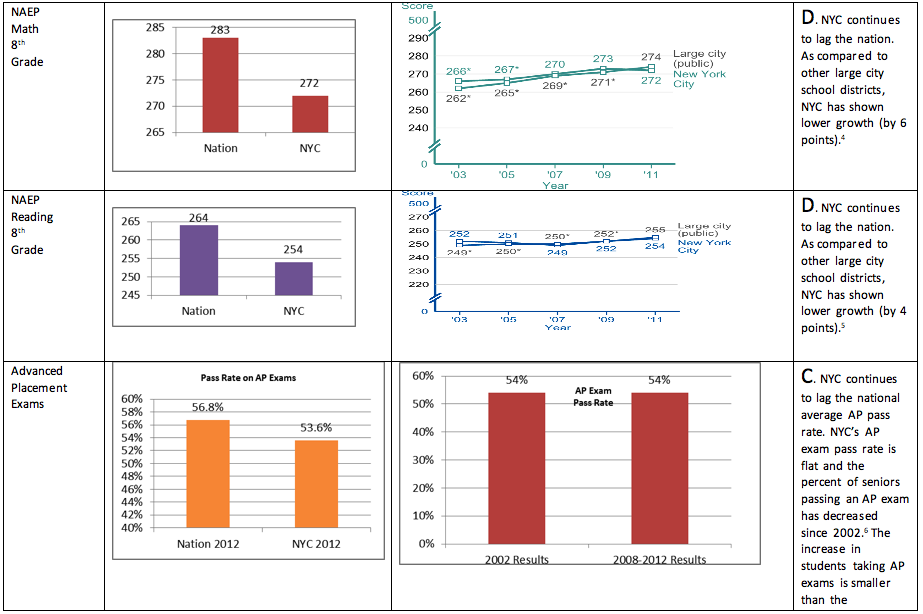
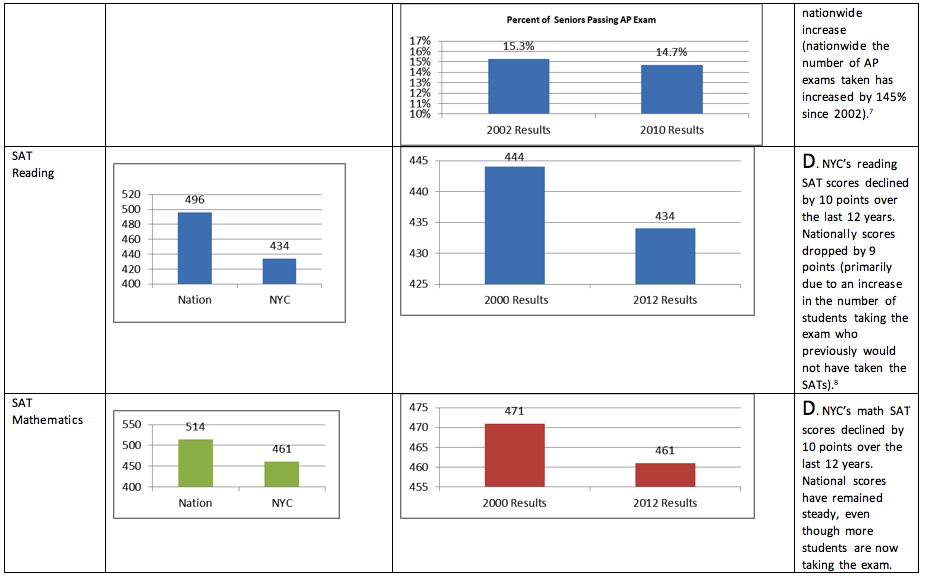
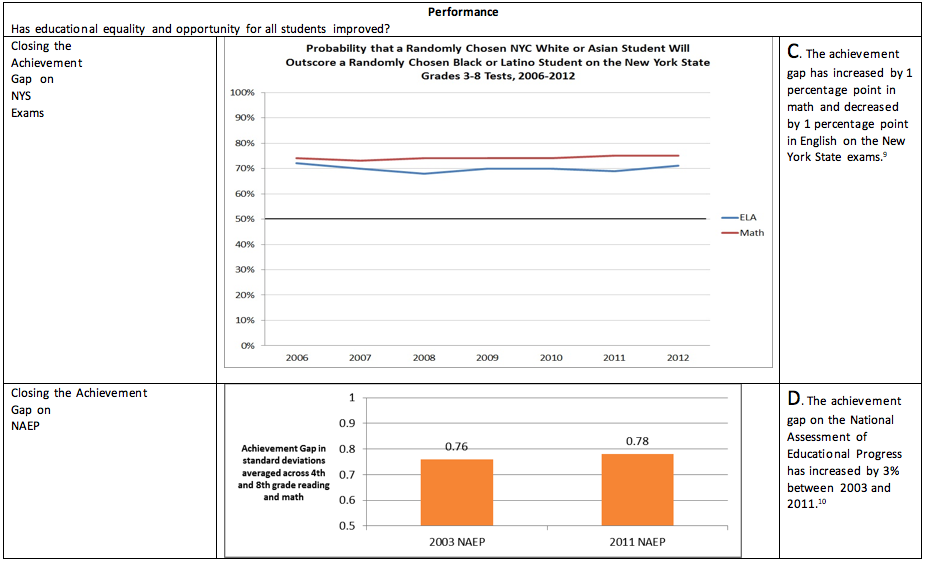
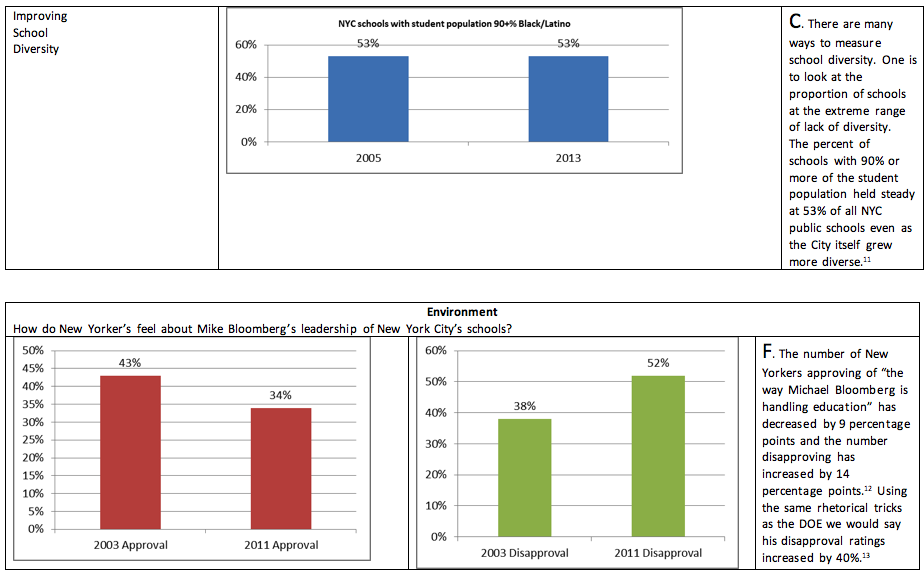
Here is an analysis of the Bloomberg record, written by an insider at the Department of Education.

Click on the images to enlarge them.

Grading A Dozen Years of Education Policy in the Big Apple: A Report Card

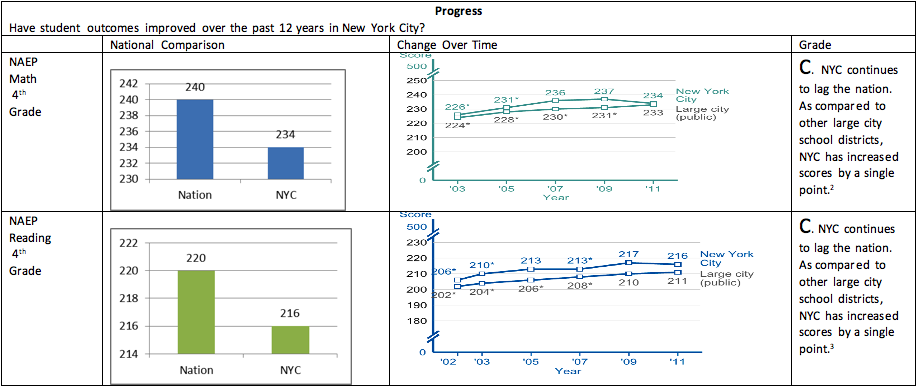
As we come to the end of a dozen years of Michael Bloomberg’s control of New York City’s schools, it is an appropriate time to take stock of the results. Using actual data from New York City schools, what do we learn about results of the specific policies implemented over the past 12 years? [1] Is the education of our students better after many changes and new policies? Has the focus on testing students, using test scores and formulas to grade (and punish) teachers and schools, closing schools, opening schools (and closing those schools too), co-locating and championing charter schools and new schools, and the multiple re-organizations of the bureaucracy helped students?

Screen shot 2013-10-23 at 10.43.38 PM Screen shot 2013-10-23 at 10.43.54 PM Screen shot 2013-10-23 at 10.44.11 PM Screen shot 2013-10-23 at 10.44.26 PM Screen shot 2013-10-23 at 10.44.40 PM
FINAL GRADE= D[14].Some readers may have questions or doubts about the data presented above. We do our best to answer them in the section below.

Have you cherry-picked data? These are the real numbers and we have sourced all the data. In fact, some data that were not included show even greater under-performance in New York City schools over the past 12 years. For example, the NAEP results in science show New York City lags behind the national average by 14 points in 4th grade and by 20 points in 8th grade. [15] However, since the most recent data are from 2009 and over 4 years old we did not include them.

Why do some of the metrics have different years of data cited? Because the New York City Department of Education refuses to publicly release complete data sets (and often denies data requests of researchers), we had to use the data we could identify by scouring the web and academic publications. The DOE’s secretive approach to sharing data with researchers, even with all identifying student information removed, is ironic given that they share private student information with corporations. [16]

Is it fair to compare New York City to the national average? The New York City Department of Education uses a similar measure by evaluating individual school in comparison to the performance of all city schools. This means that a school with primarily high needs students is evaluated against screened specialized schools. However, we are fairer than the NYC DOE and do not use the national comparison in the actual scoring. In this context it is worth noting that the formula New York State created and that New York City has implemented to evaluate teachers based on students test scores penalizes teachers who teach significant numbers of disadvantaged students. [17]

Why do you use test scores as your evaluative criteria? Because these are the very criteria that the education policies in New York were based on. As it turns out, even on their own terms, the policies have shown very poor outcomes. Even with the deck stacked in favor of Bloomberg’s policies the data still show that the policies have not been successful. If we were to add other criteria such as quality arts programs things are even worse. Data self-reported by schools shows that since 2006 elementary school students have at least 5% fewer opportunities to take visual arts, dance, theater and music classes taught by arts teachers. This is clearly an underestimate of the loss of arts options for students as an independent audit has demonstrated. [18]

How do you explain the increase in graduation rate in New York City? An independent study based on full access to DOE records and internal emails would help answer this question. A couple of points are in order.

A) The New York State Regents exams were made significantly easier over the past dozen years especially in terms of the grading scale applied to the exams. Math is an illustrative example. The Sequential Math 1 exam required the test taker to earn 65 percent of the available points to receive a passing score. The Math A exam, which replaced Sequential 1 in June 2002, required the test taker to earn 43 percent of the available points to receive a passing score. The Integrated Algebra exam, which replaced the Math A exam in 2009, requires the test taker to earn only 34.5 percent of the available points to receive a passing score. [19] Additionally the Biology exam was replaced by the Living Environment exam in 2001 and the Global Studies exam by the Global History exam in 2000. In each case the newer version was less content driven. [20]An academic study looking at changes in scoring and in difficulty of the Regents exams over the past 15 or so years would fill a gaping hole in our ability to make sense of test trends.

B) Schools were graded on the number of students earning credit. This led to some schools having jumps of 30-55+ percentage points in the number of students passing 10 or more classes. [21]In the space of 4 years the overall level of credit accumulation by students increased by 16 percentage points. [22]This can only be explained as being due to a citywide lowering of the bar on the expectations for earning credit, leading to a higher graduation rate, presumably at the cost of the actual quality of the diploma/college readiness of the student. [23]

C) The demographics of school age children in New York City changed dramatically since 2000, with white and Asian children becoming an increasingly larger proportion of the population. [24]As is well-known those demographic groups have significantly more educational success than Black and Latino children. Closing this achievement gap is one of the core missions of public education.

D) How can the increase in graduation rate reflect true increases in student learning when the grades 3-8 test scores have been mostly flat over the past dozen years? [25]Did students miraculously begin to learn more only when they hit 12th grade? The 8th grade Math/ELA scores on the NAEP increased by less 1.5% between 2003 and 2009, significantly less than the increase of other large urban school districts. How does that translate into an increase in graduation rates 4 years later unless the quality of a high school diploma and the bar for earning one was significantly lowered during that time?

E) The New York City Department of Education likes to compare its numbers to those of the “Big 5” cities (NYC, Buffalo, Rochester, Syracuse and Yonkers) in New York State. This is a deliberately misleading comparison as only 1 of these cities, Yonkers, is demographically similar to New York City. [26] NYC has significantly underperformed when compared to Yonkers. In fact, since 2008 the graduation rate in NYC has barely budged (the percent of students graduating by August after 4 years having gone from 62.7% to 64.7%). Yonkers, on the other hand, has seen its graduation rate increase by over 9 percentage points (from 62.9% to 72.1%). [27] Yonkers has outperformed New York City while serving a similar student population.

Bottom line: The data used here is comparable across years. It is more reliable than graduation rate which is a social construct having no set criteria or meaning. New York City underperforms on graduation rate when compared to comparable districts in New York State.

What does this all mean for the future of education in New York City? It means that we have our work cut out for us, as does the next mayor. With each mistake made over the last dozen years we have learned how we can do better. What have we learned?

  • We need to ensure that every single school has as diverse a student body as possible. Whether G&T programs, screened or specialized high schools, all schools must have a student body that reflects the diversity of New York City. The Office of Enrollment must improve their systems so that diversity is a crucial element of the process.
  • We need to provide schools with expert support and guidance in curriculum. We cannot take a sink or swim approach to teaching and learning, with every school left to their own devices. The Office of Teaching and Learning must be re-opened after having been shuttered under Bloomberg. Truly expert teachers must be identified at each grade level and subject area, their lessons videoed, their materials copied, and all of such resources must be shared with teachers throughout the city.
  • We need to develop rich early intervention and support services for students. This includes vastly increasing the number of speech teachers and math and reading intervention specialists in elementary schools. We cannot pretend that merely increasing the demands we make on students with the Common Core can take the place of our responsibility to support students in the critical early years to ensure they do not fall behind. This will also require developing a citywide early warning system and specialized curriculum to identify and provide quality remedial opportunities to students who are falling behind.
  • We need to provide support to schools that are struggling. It is wrong to continue to close schools just because they serve a high-needs student population. [28]Teams of experts must be formed to work directly with such schools in the areas of programming, data, and instructional cohesion. Each team must be assigned to one school to ensure quality support. This will also require changing Fair Student Funding so that all schools are funded equitably. [29]
  • We need to reform the DOE central office so that they take ownership of, are responsible for, and are held accountable for the success of every school (and student) in New York City. They must do the hard work of helping all schools and students improve. [30]They can no longer be allowed to take the easy way out. [31] The enormous support for a small percentage of charter schools, with no clear improvement in performance, makes no sense. The significant resources and PR devoted to the charter sector must end, while ensuring that the 6% of NYC’s children in charter schools receive a quality education. [32]Instead of destroying existing schools in order to create new schools we must add new and 21st century aligned academic and CTE programs to the schools we already have to ensure their success and that students have genuine choices and opportunities. [33]
  • We need to create an independent research office to evaluate educational initiatives so that the metrics are uniform across schools and can’t be gamed. [34]This office should report to the Panel for Educational Policy whose members should be selected to time- limited terms of office. The panel will then collaborate with the mayor in ensuring that community voice is heard.
  • We need to reorganize the bureaucracy so that schools are evaluated and coached on instructional techniques and youth development approaches by geographically based personnel with knowledge of the school and community. Other functions such as budgeting, HR and the like should be run out of regional offices. Web-based platforms will allow schools to form non-geographic affinity groups so that similar schools can share ideas no matter how far apart they are in the city.
  • We need to think creatively about ways to provide students with the additional quality learning time they need to succeed. The school year should be extended with a shorter summer break in the month of July and the new school year beginning again at the start of August. Summer learning loss is a huge factor in diminished student outcomes and we must address it system-wide.
  • Finally, we need to develop better ways to communicate with parents and communities to present an accurate picture of school performance. The current system penalizes schools and teachers who work with high-needs students. These are the precise parents and families who need the most help. Transparency about these factors must be improved.

[1] There have been some earlier attempts to answer this question https://dianeravitch.net/2012/10/02/after-a-decade-bloomberg-reforms-still-failing/. Our grading policy is as follows: significant improvement (by 10+%) over the past dozen or so years=A, improvement (2-9%) over the past dozen or so years=B, flatlining (-1,0,+1) over the past dozen or so years=C, decline (-2- -9%) over the past dozen or so years=D, significant decline (-10+%) over the past dozen years=F. This is, of course, a rather charitable grading policy as it assumes that no improvement even after a dozen years earns a gentleman’s C and not a F. We will weigh the 3 sections using the same weights as the School Report Cards implemented under Mike Bloomberg for New York City schools. Progress=60% of the final grade, Performance=25% of the final grade and Environment=15% of the final grade.

[2] http://nces.ed.gov/nationsreportcard/pdf/dst2011/2012453XN4.pdf

[3] http://nces.ed.gov/nationsreportcard/pdf/dst2011/2012456XN4.pdf

[4] http://nces.ed.gov/nationsreportcard/pdf/dst2011/2012453XN8.pdf

[5] http://nces.ed.gov/nationsreportcard/pdf/dst2011/2012456XN8.pdf

[6] http://cityroom.blogs.nytimes.com/2011/02/09/15-of-high-school-seniors-passed-an-a-p-test-last-year/ and http://nypost.com/2010/02/11/ny-schoolkids-do-a-ok-on-ap-tests/

[7] http://media.collegeboard.com/digitalServices/pdf/ap/rtn/9th-annual/9th-annual-ap-report-appendix-b.pdf nationwide AP results

[8] http://www.manhattan-institute.org/html/cr_26.htm NYC’s 2000 SAT results. http://nces.ed.gov/fastfacts/display.asp?id=171 nationwide SAT results through 2011. http://professionals.collegeboard.com/testing/sat-reasoning/scores/averages 2012 SAT results.

[9] http://eyeoned.org/content/closing-the-achievement-gap-have-we-flat-lined_379/

[10] http://eyeoned.org/content/the-emperors-new-close_313/

[11] http://schools.nyc.gov/NR/rdonlyres/B54A0720-E4EE-432D-A322-940346CCE61B/0/2013DemographicSnapshotPUBLIC.xlsx and http://www.nytimes.com/interactive/2012/05/11/nyregion/segregation-in-new-york-city-public-schools.html?_r=0 showing that “Black isolation in schools has persisted even as residential segregation has declined.” https://dianeravitch.net/2013/09/08/insider-at-bloomberg-doe-spills-the-beans-about-failed-policies/ has data on the extreme inequities in school outcomes where only a small handful of NYC produce outcomes at the national average. Finally, the Independent Budget Office has shown that from 2002-2011 school integration has remained flat http://www.ibo.nyc.ny.us/iboreports/printnycbtn11.pdf

[12] http://www.nytimes.com/interactive/2011/09/07/nyregion/20110907-nyc-schools-poll.html?ref=education

[13] The DOE, when reporting numbers, often uses percent increase rather than the actual number of percentage points. This makes small gains looks much larger than they otherwise would.

[14] Following the formula outlined in the first footnote the calculation is as follows: Progress x 60% + Performance x 25% + Environment x 15%= Final Grade. Replacing the letter grades with numbers A=1, B=2, C=3, D=4, F=5. The scores of each component were averaged and plugged into the formula as follows: (4.1667 x .6) + (3.3333 x .25) + (5 x .15) = 4.08=D.

[15] http://nces.ed.gov/nationsreportcard/pdf/dst2007/2008471XN8.pdf

[16] http://www.nytimes.com/2013/10/06/business/deciding-who-sees-students-data.html.

[17] http://www.lhcss.org/positionpapers/nysgrowthmodel.pdf

[18] http://schools.nyc.gov/offices/teachlearn/arts/ArtsCount/ArtsReport/2011-12/Final2012ArtsInSchools.pdf

[19] http://nycpublicschoolparents.blogspot.com/2008/01/ny-state-math-regents-exams-soft.html and http://atfss.wordpress.com/nys-regents/. Note that these numbers vary slightly with each exam.

[20] http://www.city-journal.org/2009/eon0731me.html

[21] http://blogs.edweek.org/edweek/eduwonkette/2008/11/the_nyc_high_school_progress_r_1.html

[22] http://www.edwize.org/credit-accumulation-soars-in-nyc-but-students-remain-behind

[23] Note that this may be very good public policy. Lowering the bar for a high school diploma so that more young adults have the opportunities for college education and job training where there is more flexibility around pursuing one’s interests is intuitively smart policy. However, when the bar is lowered policy-makers can’t claim that the graduation rate is comparable to earlier rates.

[24] “The fact is, the number of children in New York decreased by almost 9 percent between 2000 and 2010. According to the Department of City Planning, the black population under 18 decreased especially dramatically during those ten years, by 22.4 percent, while the population of white children decreased by only 3.8 percent. In the city’s richest borough, Manhattan, the number of white kids actually grew—by nearly 23 percent—and in rapidly gentrifying Brooklyn, the number of white kids increased by 7 percent. (The displacement of blacks and Latinos in some neighborhoods is painfully pronounced: In Brooklyn’s District 6, which encompasses Park Slope, the South Slope, Cobble Hill, Carroll Gardens, and Red Hook, the number of white kids grew by 28.5 percent while the number of black and Hispanic kids each dropped by 36 percent.) Asians are the one ethnic group whose number of children increased overall during the decade.” http://nymag.com/news/features/childhood/modern-childhood-2013-4/index3.html

[25] http://gothamschools.org/2010/07/28/test-scores-down-sharply-biggest-decline-for-needy-students/ data showing flat scores after New York State stopped lowering the bar for proficiency on the grades 3-8 exams.

[26] http://assembly.state.ny.us/member_files/044/20090319/report.pdf

[27] http://www.p12.nysed.gov/irs/pressRelease/20130617/GradRateSlides.ppt

[28] http://annenberginstitute.org/sites/default/files/SchoolTransformationReport_0.pdf https://dianeravitch.net/2012/08/25/nycs-schools-for-poorest-faring-poorly/ and https://dianeravitch.net/2012/08/09/after-ten-years-of-reform-in-new-york-city/

[29] https://dianeravitch.net/2012/09/05/how-new-york-city-stiffs-the-neediest-students/ https://dianeravitch.net/2012/08/12/in-nyc-fair-student-funding-is-unfair/ and https://dianeravitch.net/2012/08/30/who-is-putting-children-first/

[30] https://dianeravitch.net/2012/10/17/if-teachers-ran-their-classes-like-nyc-runs-schools-then/

[31] https://dianeravitch.net/2013/10/22/a-report-from-the-sinking-ship-at-nycs-doe-headquarters/

[32] https://dianeravitch.net/2013/10/15/the-charter-school-bubble-in-new-york-city/ on spending for charter schools. https://dianeravitch.net/2013/02/26/an-inside-the-doe-view-of-the-nyc-credo-study/ on the performance of charter schools. https://dianeravitch.net/2012/12/20/inflated-claims-of-charter-success-in-nyc/ and https://dianeravitch.net/2012/12/03/reader-calls-out-ny-daily-news-for-charter-spin-2/ on the exaggerated PR on behalf of charter schools.

[33] https://dianeravitch.net/2013/03/01/why-nyc-closes-high-schools/ on the coddling of new schools at the expense of existing ones.

[34] https://dianeravitch.net/2013/09/19/nyc-whistle-blower-how-the-doe-is-like-enron/