In this insightful and somewhat frightening article, Peter Greene draws a straight line from the Amazon model of production and sales to the “reform” vision for education.
Archives for category: Corporate Reform
Nancy Bailey has assembled a devastating review of a three-decades long effort to destroy the teaching profession and replace it with models derived from the corporate sector.
She begins:
The pandemic has been rough on teachers, but there has for years been an organized effort to end a professional teaching workforce by politicians and big businesses.
In 1992, The Nation’s cover story by Margaret Spillane and Bruce Shapiro described the meeting of President H. W. Bush and a roomful of Fortune 500 CEOs who planned to launch a bold new industrial venture to save the nation’s schoolchildren.
The report titled, “A small circle of friends: Bush’s new American schools. (New American Schools Development Corp.),” also called NASDC, didn’t discuss saving public schools or teachers. They viewed schools as failed experiments, an idea promoted by the Reagan administration’s A Nation at Risk, frightening Americans into believing schools were to blame for the country’s problems.
The circle believed their ideas would break the mold and mark the emergence of corporate America as the savior of the nation’s schoolchildren.
The organization fell apart, but the ideas are still in play, and corporations with deep pockets will not quit until they get the kind of profitable education they want, for which they benefit.
They have gone far in destroying public education and the teaching profession throughout the years, not to mention programs for children, like special education.
Here are the ideas from that early meeting, extracted from The Nation’s report, with my comments. Many will look eerily familiar.
. . . “monolithic top-down education philosophy,” which disrespected teachers, parents and communities alike.
NCLB, Race to the Top, Every Student Succeeds Act, and Common Core State Standards disregarded teachers’ expertise and degraded them based on high-stakes test scores.
These policies also left parents and communities feeling disengaged in their schools.
Please open the link and read the rest of this perceptive post.
Michael Bloomberg, former mayor of New York City, announced yesterday that Bloomberg Philanthropies will spend $750 million to expand the charter school sector. Declaring that “the American public education system is tragically broken,” Bloomberg pledged to add 150,000 seats in “high-quality charter schools” over five years, with the intention of “closing the achievement gap.”
As mayor, Bloomberg had total control of the New York City public school system, which he reorganized and disrupted repeatedly. His first pick for chancellor of the schools was antitrust corporate lawyer Joel Klein, who distrusted experienced educators and turned to McKinsey and Goldman Sachs for advice. Bloomberg’s second pick for chancellor was a magazine publisher with no experience in education; she lasted just 90 days.
Bloomberg apparently decided that he couldn’t achieve sweeping change in the public schools, so he became a champion for outsourcing students to privately managed charter schools. As his press release shows, he continues to believe his own puffery. The NYC public schools continue to be plagued with crowded classrooms, while charter schools enjoy privileged status, such as co-locations inside public schools, depriving them of facilities, and rent in private spaces paid by the city.
Although the press release claims that Bloomberg’s decision is based on “evidence,” it completely ignores the large number of charter schools that close every year, the high attrition rates of charter students and teachers, and the multiple studies showing that charter schools are outperformed by public schools, except when the charters curate their enrollment to exclude students who are unlikely to succeed or conform.
One of the richest men in the world, Bloomberg loves market solutions to public problems. In his 12 years as mayor, he did not transform the public school system that he controlled. Evidently he has learned nothing about education in the eight years since he left office.
How does it help the 85-90% of students in public schools to invest in a privately run sector that, contrary to his claims, has not demonstrated success in closing the achievement gap and that poaches students and resources from public schools?
How will it “close the achievement gap” to spend $750 million to add 150,000 seats to the charter sector?
Education Week reported that a decade of “reforms” focused on tougher teacher evaluations produced no improvement in student test scores.
More than a decade ago, policymakers made a multi-billion-dollar bet that strengthening teacher evaluation would lead to better teaching, which in turn would boost student achievement. But new research shows that, overall, those efforts failed: Nationally, teacher evaluation reforms over the past decade had no impact on student test scores or educational attainment.
The research is the latest indictment of a massive push between 2009 and 2017, spurred by federal incentives, philanthropic investments, and a nationwide drive for accountability in K-12 education, to implement high-stakes teacher evaluation systems in nearly every state.
Prior to the reforms, nearly all teachers received satisfactory ratings in their evaluations. So policymakers from both political parties introduced more-robust classroom observations and student-growth measures—including standardized test scores—into teachers’ ratings, and then linked the performance ratings to personnel decisions and compensation.
“There was a tremendous amount of time and billions of dollars invested in putting these systems into place, and they didn’t have the positive effects reformers were hoping for,” said Joshua Bleiberg, an author of the study and a postdoctoral research associate at the Annenberg Institute for School Reform at Brown University. “There’s not a null effect in every place where teacher evaluation [reform] happened. … [But] on average, [the effect on student achievement] is pretty close to zero.”
The evaluation reforms were largely unpopular among teachers and their unions, who argued that incorporating certain metrics, like student test scores, was unfair and would drive good educators out of the profession. Yet proponents—including the Obama administration—argued that tougher evaluations could identify, and potentially weed out, the weakest teachers while elevating the strongest ones…
A team of researchers from several universities analyzed the data, starting when states adopted the new teacher evaluations incorporating student test scores. They looked not only at changes in scores but high school graduation rates and college enrollment rates.
Tougher teacher-evaluation systems can work, Petrilli said—but there was no political will to act on the results at the time of the reforms. Teachers’ unions resisted firing teachers who received poor results, and districts were unwilling or unable to pay great teachers more, he said.
At a time of acute teacher shortages, what school district is eager to fire teachers based on their students’ test scores?
The failed reforms were in large part a response to the demands of the Obama administration’s Race to the Top, which required states to adopt test-based evaluation to be eligible for a share of $4.35 billion in federal money. Secretary of Education Arne Duncan praised such teacher evaluations loudly and frequently.
As I wrote in my 2020 book SLAYING GOLIATH, test-based teacher evaluation was never tried before it was imposed on almost every state in the nation. It had no evidence to support its use. Many scholars and professional groups warned against it, but Duncan plunged forward, belittling anyone who dared to disparage his Big Reform.
Obama and Duncan found support in a 2011 study led by Harvard economist Raj Chetty, but his glowing predictions about the benefits of test-based evaluation didn’t pan out. His paper on value-added teacher assessment won him a front page story in the New York Times, a story on the PBS Newshour, and a laudatory mention in President Obama’s 2012 State of the Union address. Chetty et al concluded that better teachers caused students to get higher test scores, to graduate more frequently, to earn more income over their lifetimes, and—for girls, to be less likely to have out-of-wedlock births. As one of the authors told the New York Times, the message of our study is that bad teachers should be fired sooner rather than later.
But despite the cheerleading of Arne Duncan and the seemingly definitive conclusions of Chetty, Friedman, and Rockoff, value-added teacher evaluations failed.
How many good and great teachers left their profession because of this ill-fated “reform”?
Peter Greene realized that supporters of public education have been lacking the very thing that catches the attention of the public and the media: reports backed by data. Especially reports that rank states as “the worst” and “the best.”
Greene’s Curmudgation Institute constructed rubrics to rate the states and developed the Public Education Hostility Index. He has created a website where he defines his methodogy and goes into detail about the rankings.
The #1 ranking, as the state most hostile to public education, is Florida.
The state least hostile to public education is Massachusetts.
Where does your state rank? Open the link and find out.
Jennifer Berkshire, education journalist and co-author of A Wolf at the Schoolhouse Door (with Jack Schneider) explains in The Nation the real reason why Terry McAuliffe lost the governorship in Virginia.
McAuliffe, she says, could have turned the education issue in his favor, but he doesn’t have a clue what public schools are for. He is a corporate reformer. He couldn’t defend the public schools because he sees them as job training sites that feed workers into big corporations. To those parents who care about their public schools, he was as unable to articulate a vision for them as his opponent, Glenn Youngkin.
She wrote:
Four years ago, McAuliffe was en route to southwest Virginia in a state helicopter when he heard about Amazon’s HQ 2 competition—the search by the corporate behemoth for a second headquarters outside of Seattle. The contest would come to be derided as at best a sham, at worst a bait and switch, but for McAuliffe it represented an opportunity to cement his legacy. “We’ve got to win this!” McAuliffe recalled in an interview with the Richmond Times-Dispatch. “Literally, it would finish what we started in diversifying and building a new economy.”
While other states shoveled taxpayer cash and gimmicky incentives in an effort to lure Amazon, Virginia promised something more meaningful to the company: its schools. At the center of Virginia’s sales pitch was a pledge to invest more than $1 billion into tech education, beginning in kindergarten, through high school and into college. Come to northern Virginia, beckoned McAuliffe and his economic development team, and a K-12 tech talent pipeline awaits. “In Virginia, we put corporate partners first,” wrote McAuliffe in a letter to Amazon.
Virginia won the competition, and so did McAuliffe.
He’d taken office in 2013 with a pledge to make the state “the best place to do business,” and followed a blueprint, furnished by the Virginia Chamber of Commerce, to get there. Realigning Virginia’s public schools to better fit the needs of employers—or in Chamber speak, “strengthen[ing] the linkages between the classroom and the workplace at all levels”—was central to realizing his goal….
As a Times-Dispatch reporter noted, Youngkin and McAuliffe were virtually indistinguishable on the goal of tethering education ever more tightly to the needs of Virginia’s industries. In an election in which education was a central and divisive issue, the candidates were in lockstep on the belief that the function of schools is to train Amazon workers.
He was unable to articulate the role of the public schools as the foundation of a democratic society. He doesn’t get it.
Berkshire concludes:
When McAuliffe ran for governor in 2013, the political arm of the Chamber of Commerce representing the northern part of the state, the aptly named NOVABizPAC, backed the Democrat over his GOP challenger, right-wing firebrand Ken Cuccinelli. McAuliffe was their kind of guy, explained the group’s chief. His policies and priorities—especially his vow to keep Virginia a right-to-work state—neatly aligned with those of the business community. This year the group declined to back McAuliffe or Youngkin. Choosing between two such worthy candidates had proven impossible, said the group in a statement. Either would do.
You may remember IDEA as a free-spending charter chain in Texas. A few years ago, IDEA got negative publicity when its board of directors decided to lease a private jet at a cost of $x million per year. Then we learned that the schools had paid for box seats for the San Antonio Spurs basketball games. When the CEO departed, he received a $1 million golden parachute. These are not customary expenditures for a “public” school. These are the actions of a private corporation. Betsy DeVos dropped more than $200 million in federal funds on the IDEA chain, to enable it to expand.
William Gumbert, an independent researcher in Texas, took a deep dive into the metrics of the IDEA chain. After you read his report, you will wonder why the state of Texas and the federal government encouraged the chain to expand.
Gumbert writes:
Introduction: Federal and state elected officials, privately funded public policy organizations, and private foundations are financially supporting education reforms to undermine locally governed, community-based school districts. With promises of a “college preparatory” or “classical” education, the expansion of taxpayer-funded charter schools in local communities is the primary reform vehicle. IDEA Public Schools (“IDEA”) is the fastest growing and most prominent charter school network in Texas. National and regional promotions claim IDEA’s “Tuition-Free,” “No Excuses,” college-preparatory education model is revolutionizing education for low-income students and eliminating the opportunity gap. IDEA’s co- founder agrees by saying: “But no matter your zip code, you have access to a tuition-free public school, and I believe that will be the solution to every problem in America.”
With promotions of expert teachers and more of them, IDEA promises to prepare low-income students for success to and through college. As evidence, IDEA promotes that “100% of Graduates Have Been Accepted to their College of Choice for 15 Consecutive Years.” For education reformers, IDEA is validation that “when the adults in the system get it right, students can do remarkable things.”
Unfortunately, recent findings reveal a story that is not representative of serving low-income families. IDEA’s story consists of private jets, chauffeured cars, a luxury Bed & Breakfast resort, misuse of public funds, high-priced advertising, misrepresentations, low instructional expenditures, low teacher experience, high “Student to Teacher Ratios,” and without offering career or technical training, IDEA graduates underperform in college. IDEA’s story is validation that locally governed school districts continue to provide higher quality educational attributes and better prepare students for success. IDEA’s story is also validation that TEA lacks the institutional controls to oversee charters and serves as another example of what happens when the state and private interests dictate the public education system in local communities.
Ernest Hemingway said, “The best way to find out if you can trust somebody is to trust them.” Elected officials, education reformers, and families trusted IDEA Public Schools. Regrettably, IDEA has run amuck and “No Excuses” exist for the unyielding support of the state and private interests. It’s your schools, children, families, tax dollars, and communities!
The Promotion and Growth of IDEA – Private Foundations: After three years of classroom experience with Teach for America and at the age of 24, Tom Torkelson and JoAnn Gama founded the IDEA Public Schools charter network to revolutionize the education for low-income families. Since its founding, IDEA’s education model was propelled by private interests, including the Walton Family Foundation, Bill and Melinda Gates Foundation, Ewing Halsell Foundation, KLE Foundation, and the George Brackenridge Foundation. Collectively, these organizations give contingent donations to open campuses in targeted communities, implement specific curriculum, and expand enrollment. Although IDEA no longer specifies the details of its donors, prior communications reveal that IDEA was the beneficiary of over $150 million of private donations to expand in various regions of Texas.
.
Private Financial Support to Expand IDEA “Public” Schools

In 2008, IDEA had produced 56 high school graduates and no graduate had earned a college degree. But that did not prevent private foundations from strategically publicizing IDEA’s education model to further the charter movement. In 2009, Wendy Kopp, the founder of Teach for America (“TFA”), named Torkelson as “100 of the most influential global citizens” in TIME magazine. Coincidentally, TFA receives funding from the Walton Family Foundation, which has donated over $160 million, and other private foundations supporting charter expansion. Torkelson also received the Peter Jennings Award for Civic Leadership in 2009, another award annually provided by TFA. In 2016, IDEA was named the top charter school system in the country by the Eli and Edythe Broad Foundation and the National Alliance for Public Charter Schools, also funded by the Walton Family Foundation and other private foundations. In 2018, IDEA’s Torkelson and Gama were inducted into the National Charter School Hall of Fame.
State: At the state level, the appointed Commissioner of Education supports IDEA’s education reform model by unilaterally approving the opening of over 90 new campuses in the last decade to increase IDEA’s enrollment by 889%. To support the construction of new campuses, the state is guaranteeing the repayment of IDEA’s $988 million long-term, non-voter approved bonds through the Texas Permanent School Fund Bond Guarantee Program. The Texas legislature contributions include providing IDEA with $693 million of taxpayer funding in the current year and total taxpayer funding of $3.5 billion since 2010/11. With funding for public education limited, IDEA’s taxpayer funding is at the expense of locally governed school districts.
IDEA Public Schools: It should not be a surprise that IDEA is also its biggest advocate, thanks to an annual $7.3 million Advertising Budget. To build a perception as an education pioneer, IDEA’s full-time promotional staff is directed to: “work with public relation partners to produce positive news stories, promote school leaders as subject matter experts, and build relationships with elected officials.” IDEA also runs prime-time commercials during the Super Bowl and World Series to promote its image and maximize its exposure.
IDEA Public Schools – Historical Enrollment
IDEA Public Schools Has Run Amuck and No Excuses Exist for the State’s Unyielding Support (November 3, 2021) (3)Download
Download the pdf here.
This article by Ed Montini in the Arizona Republic explains the childish behavior of Republican leaders, who engage in taunts instead of reasoned discourse about their agenda. They don’t want to expand Medicare. They don’t want universal pre-K. They don’t support efforts to combat climate change. They oppose paid family leave for families in need after surgery or childhood. They are against a federal guarantee of two years tuition-free community college. They oppose higher taxes on billionaires. They don’t care about voting rights. They don’t want to expand opportunity. They don’t want to reduce inequality. They don’t invest in the future.
What are they for? Tax breaks for the rich.
Since they have no agenda, their goal is to make sure Biden can’t succeed. After blocking everything he proposes (with the help of Senator Manchin of West Virginia and Senator Krysten Sinema), they have nothing to offer other than the schoolyard chant.
Ed Mancini was walking his dog early one morning, and he saw two other dog owners engage in conversation, a man and a woman. As they part ways, the man says to the woman, “Let’s go, Brandon!” then turning away.
The woman is puzzled and asks Montini if he knows what that phrase means.
So, first thing in the morning I am called upon to explain this recent cultural phenomenon to one of the few American grown-ups who has managed to remain a fully functioning adult, while most of the rest of us have been transformed by social media into crude, smart-alecky 8-year-olds.
There’s that Southwest Airlines pilot
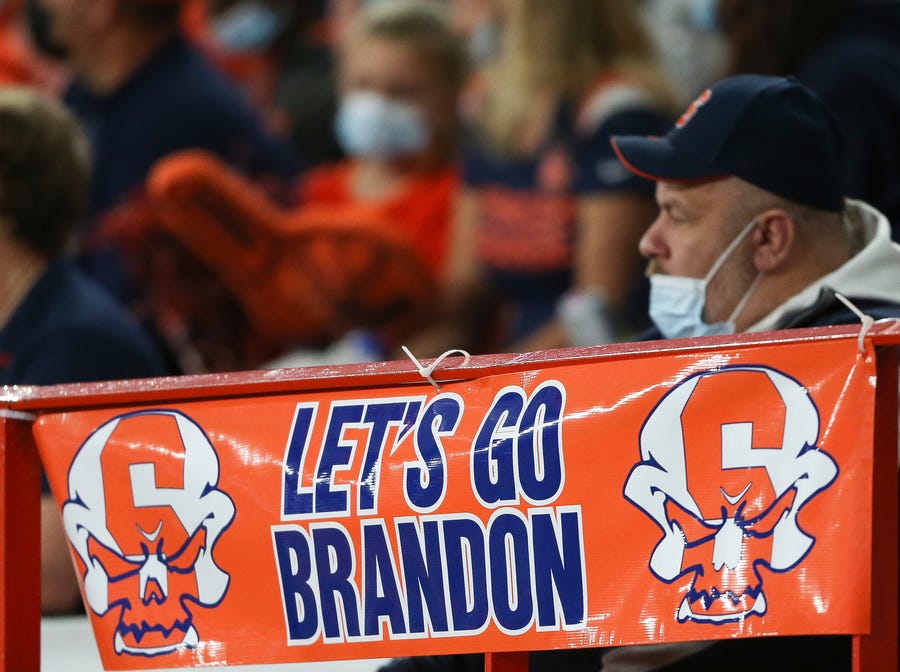 This particular sign was a the Boston College-Syracuse football game Oct. 30. A fan’s juvenile jab at President Joe Biden.Joshua Bessex
For instance, the woman had not heard about the Southwest Airlines pilot who recently signed off on a flight, telling passengers, “Let’s go, Brandon.”
Or about how the whole thing began when a race car driver named Brandon Brown won a NASCAR race and, while being interviewed on TV, the crowd started chanting, “F–k Joe Biden.” The flummoxed interviewer suggested they might be saying, “Let’s go, Brandon.”
After that, the phrase became a way for grown-up 8-year-olds to say the f-word about Biden without actually using it.
Really.
Elected Republican politicians in Washington, D.C., started using the phrase.
Donald Trump began selling “Let’s go Brandon” T-shirts through his Save America PAC for $45, and grown-up 8-year-olds in America actually purchased them.
$45.
There are adults who channel their 8-year-old selves by bringing signs saying, “Let’s go, Brandon” to public events, as well as some who scribble the message in paint on the rear window of their automobiles….
How to answer someone who says such a thing
Of course, we all learned as children that infantile behavior tends to draw some type of backlash….
After I explain the whole “Let’s go, Brandon” thing to the woman who’d been walking her dog she says, “That seems incredibly childish. How are you supposed to answer someone who says such a thing?”
I tell her that, as a grown-up, she would be best served simply ignoring it.
As for the rest of us, suffering as we do from social-media-induced age regression, I’d respond, “I’m rubber and you’re glue …”
Reach Montini at ed.montini@arizonarepublic.com.
Problem viewing email? View in browser
Veteran journalist Jennifer Berkshire speculated on Twitter about why Democrats failed to defend public schools against extremists. The answer is that they swerved into the politics of neoliberalism 25 years ago and promoted privately-run charter schools. They allied with reactionary forces like the Waltons in their fruitless quest for “innovative” schools. Her handle is @@BisforBerkshire.
She wrote with crystal clarity:
Lots of takes on the Dem’s public education problem. But party’s utter inability to articulate why public education matters may be the biggest.
The Democrats’ favorite policy shop in D.C. is the Center for American Progress, which has been the party’s leading advocate of charter schools. The question that CAP can’t answer is: Why does public education matter?
Nancy Bailey addressed the same problem on her blog. She said bluntly that Democrats are not the education party, as they want the public to believe. They abandoned public schools and teachers by their promotion of school choice and evaluating teachers by their students’ test scores.
The eight years of Obama’s Race to the Too was a nightmare for teachers, who were constantly scapegoated. Arne Duncan fell in love with Common Core and Teach for America and used every opportunities to bash teachers and real public schools.
Democrats cannot be the education party when they support charter schools, Common Core, and fast-track teachers like Teach for America. They haven’t stood up for public education despite all the teacher union hoopla.
Where have they been on the discussion of special education? They’ve worked along with Republicans to deny children individualization, smaller class sizes.
Democrats can become the “education party” again when they walk away from the billionaires like Bill Gates, who likes to play with other people’s lives.
On September 22, the National Alliance for Public Charter Schools put out a press release boasting of unprecedented enrollment growth during the pandemic. The report asserted that charter school enrollment increased during the pandemic in at least 39 states, with a 7 percent overall increase. The charter lobby said that this growth “is likely” to be “the largest rate of increase in student enrollment increase in half a decade,” as charter schools added nearly a quarter million students.
Carol Burris, executive director of the Network for Public Education, conducted a state-by-state analysis of their claim and discovered that it was a half-truth at best. Maybe a quarter truth. Maybe less.
What she discovered was that most of the enrollment gains occurred at the worst-performing segment of the charter industry: virtual charter schools. Many brick-and-mortar charter schools actually lost enrollment.
Writing on Valerie Strauss’s “Answer Sheet” blog at the Washington Post, Burris documented the hollowness of the charter lobby claim.
She began:
The National Alliance for Public Charter Schools (NAPCS) has been broadcasting a 7 percent surge in charter school enrollment during the 2020-2021 pandemic school year. Parents are “voting with their feet,” according to its new report, preferring charters to their local public schools. What the authors of the report avoid telling readers is that much of the increase — and likely most of it — was in virtual charter schools, the worst-performing in the charter sector. This occurred even at the expense of brick-and-mortar charters.
The report says this:
“Although a school-level analysis was not conducted as a part of this paper, in some states (e.g., Oklahoma, Pennsylvania, and Utah), charter school enrollment increases were primarily driven by enrollment in virtual charter schools. This explains some but not all of the enrollment increases experienced by the charter school sector nationwide last year.”
What exactly does “primarily” mean? How bad is the problem? To find out, the Network for Public Education did a school-by-school analysis of virtual charter growth in the states with the largest proportional enrollment increases.
We began with the three mentioned states. In Oklahoma, the virtual charter-school sector more than doubled enrollment. Ninety-seven percent of the more than 35,000 new students in charters enrolled in virtual schools — most in the for-profit EPIC, which has been repeatedly under investigation for misreporting costs to state officials, improper financial transfers and more.
In Pennsylvania, 99.7 percent of the charter enrollment growth occurred in virtual charter schools. Enrollment in the Commonwealth’s traditional brick-and-mortar charter schools increased by a mere 78 students.
Cyber charters accounted for over 131 percent of the growth in Utah, with enrollment in traditional charters declining.
We expanded our analysis to see if this trend occurred in other states. We began with Michigan, a state whose auditor general had recently released an audit finding that cyber charters could not document participation in at least a single course in more than half of the inspected student records.
The enrollment surge in that state’s cyber charters accounted for 237 percent of the increase. Cyber charters enrollment increased by 5,071 students, while traditional charter enrollment dropped by nearly 3,000.
We then looked at Arizona, a state where families have been bombarded with cyber charter ads and billboards. Over 94 percent of the charter enrollment growth in that state was in the cyber charter sector.
Burris then includes a graph of every state that experienced at least a 10% increase in charter enrollments; there were 13. The graph shows how many students switched to online charters and how many to brick-and-mortar charters. In sum, 95.5% of the enrollment growth was virtual charters. Some brick-and-mortar charters lost enrollments.
Why does this matter? The virtual charter schools have a record of low academic achievement, high attrition, and low graduation rates. In addition, the sector has experienced massive scandals, like the A3 chain in California, whose founders pleaded guilty to phantom enrollments and are repaying the state hundreds of millions of dollars. Like ECOT (Electronic Classroom of Tomorrow) in Ohio, which collected $1 billion over 20 years, gave generously to politicians, then declared bankruptcy rather than comply with a court order to repay $67 million to the state for padded enrollments.
Seeing this increase in schools with abysmal performance is cause for alarm. A study of virtual schools by CREDO in 2015 concluded that students who attend these schools lose ground. While findings vary for each student, the results in CREDO’s report show that the majority of online charter students had far weaker academic growth in both math and reading compared to their traditional public school peers. To conceptualize this shortfall, it would equate to a student losing 72 days of learning in reading and 180 days of learning in math, based on a 180-day school year. This pattern of weaker growth remained consistent across racial-ethnic subpopulations and students in poverty.
Students may have”voted with their feet” to enroll in virtual schools during the pandemic, but we have to wait for the evidence to find out if they stayed or returned to public schools. If they decide to stay in virtual schools, we should be alarmed.


