Archives for category: Common Core

I am happy to see that our friend Peter Greene, recently retired from teaching, just published an article in Forbes. This makes me hopeful that business folk might learn from his wisdom.

In this article, he explains the conundrum of the Common Core. It was supposed to save the world, lift education to new heights, and achieve other miracles but it suddenly became so toxic that states started claiming they had dropped it—even when they hadn’t.

As usual, what matters most are the tests, not the standards. In a time-honored, inevitable practice, teachers have revised them to fit their own classrooms.

But, lo, the Thomas B. Fordham Institute discovered a huge difference that everyone but TBF attributes to Common Core. Teachers are dropping classic literature. For one thing, the CORE prioritizes non-fiction Over fiction. For another, students are expected to do close reading, which prepares them for the snippets of text on a standardized test.

TBF says “teachers should take another look at their ELA curriculum to make sure they aren’t overlooking classic works of literature. Although it’s encouraging that ELA teachers are assigning more informational texts and literary nonfiction, as the CCSS expect, it’s concerning that they seem to be doing so at the expense of “classic works of literature.””

TBF received millions of dollars from the Gates Foundation to advocate for the adoption of the Common Core, even in states where the English curriculum was far superior to the Common Core, with Massachusetts as the prime example.

They are hardly in a position now to disown the consequences of the Core, which many English teachers predicted.

Jamie Gass at the conservative Pioneer Institute bemoans what Common Core has done to the teaching of classic literature, which used to be the Crown Jewels of the Massachusetts English language arts curriculum. (FYI, I totally detest the Pioneer Institute on charter schools, but like to read Jamie Gass on literature.)

Gass refers to “The Count of Monte Christo” as a novel that belongs in the curriculum but has been banished by the fetishes of the Common Core.

He writes:

“Since 2005, Massachusetts, with K-12 English standards that were rich in classical literature, has outperformed every other state on the reading portion of the National Assessment of Educational Progress (NAEP), “the nation’s report card.” Reading books like “The Count of Monte Cristo” helped students achieve this distinction.

“The author’s father, Thomas-Alexandre (Alex) Dumas, son of a scoundrel French marquis and a black slave woman, is the subject of Tom Reiss’s 2013 Pulitzer Prize-winning biography, “The Black Count.” Alex’s life was something beyond improbable: ascending from slavery in the Caribbean sugar colony of Saint-Domingue (now Haiti) to command 50,000 men in the French Revolutionary and Napoleonic armies. General Dumas was the heroic inspiration for his son’s adventure novels.

“Alexandre Dumas’s intriguing plots elevate our understanding of history, geography and culture. Few authors can use swashbuckling action to ignite students’ imaginations, while simultaneously teaching about the glory and treachery within human nature.

“Sadly, in 2010 the Bay State abandoned its literature-rich English standards for inferior national ones, the Common Core, which slashed fiction by 60 percent and stagnated NAEP reading scores. Marginalizing great books deprives schoolchildren of legendary stories that can transform young lives.

“The Count of Monte Cristo” is Dumas’s most thought-provoking novel. This revenge thriller features an innocent, uneducated French sailor, Edmond Dantes. His naiveté allows him to be manipulated by scheming Machiavels, who unjustly imprison him for 14 years in the notorious dungeon fortress, Chateau d’If.

“While incarcerated, Edmund is befriended by a wise, aging inmate, Abbe Faria, who teaches him to understand timeless writings, dissect conspiracies, and become a skillful swordsman. Abbe also reveals to Edmund the whereabouts of a buried treasure. Once Edmund escapes, wealth and knowledge transform his identity into the calculating Count of Monte Cristo, who shrewdly exacts his revenge on the malicious villains.

“Dumas’s enduring lessons also apply to K-12 education policy: Wily and self-serving adults would sooner consign unschooled young people to futures of intellectual solitary confinement than teach them the classic texts and ideas that might ensure their survival in the world.

“How is it that little children are so intelligent and men so stupid?” Dumas asked prophetically. “It must be education that does it.”

“Decades of research report that “boredom,” which another writer called “the shriek of unused capacity,” is the major reason one million students annually drop out of high school. Eighty percent of America’s minority-majority prison population are dropouts. Education bereft of great stories like Dumas’s will only exacerbate this crisis.”

Mike Petrilli, meet Jamie Gass.

Don’t tell teachers to teach classic literature when you pushed standards that diminished their value.

The Common Core killed classic literature, except for those daring teachers that defy the district and state mandates of the Common Core standards.
Mike Petrilli, president of the Thomas B. Fordham Institute, one of the leading advocacy groups in the Corporate Reform Movement, offers advice and consolation to fellow Reformers.

“After two decades of mostly-forward movement and many big wins, the last few years have been a tough patch for education reform. The populist right has attacked standards, testing, and accountability, with particular emphasis on the Common Core, as well as testing itself. The election of Donald Trump and appointment of Betsy DeVos, meanwhile, have made school choice and charter schools toxic on much of the progressive left. And the 2017 results from the National Assessment of Educational Progress indicate a “lost decade” of academic achievement. All of these trends have left policymakers and philanthropists feeling glum about reform, given the growing narrative that, like so many efforts before it, the modern wave hasn’t worked or delivered the goods, yet has produced much friction, fractiousness, and furor.”

Take heart, he says. The children of America need us to privatize their schools, bust teachers’ unions, and Judge their teachers by student test scores. Remember when they all laughed at NCLB, but now “we” know that it was a great success?

It’s true that NAEP scores have been flat for a decade. It’s true that charters close almost as often as they open. It’s true that the charter industry is riddled with fraud, waste, and abuse.

But stick with proven leaders like the hedge fund managers, Bill Gates, and DeVos.

Sorry to be snarky, Mike, but I couldn’t resist.

This is a thoughtful and important article by Mark Weber (aka Jersey Jazzman), who teaches in public school in New Jersey and is earning his doctorate in statistics at Rutgers.

He notes that both the New Jersey Star-Ledger and the New York Post were outraged–outraged!–that NJ Governor Phil Murphy plans to abandon the PARCC exam, which is aligned with the Common Core. They accuse Murphy of kowtowing to the lousy teachers’ unions and trying to dumb down the test.

But he points out that PARCC and NJ’s previous standardized test (NJASK) produced the same results.

This is worth your while to read as you will learn a lot about standardized testing and its limitations.

Kate Raymond of the University of Oklahoma challenges the claim by Mate Weirdl of the University of Tennessee that the Common Core is deeply flawed in the early grades.


As a mathematics educator, I was disturbed by recent comments made by Dr. Mate Wierdl on your blog site and felt the need to contact you to respond, educator to educator.

It is interesting to me that Dr. Wierdl ended this comment by saying he is not an expert on ELA; implying that he is an expert on the teaching and learning of mathematics. While Dr. Wierdl is a mathematics Ph.D., nowhere could I find any reference to education he has received or research he has done on teaching and learning.

Perhaps if he had such an education, he might have avoided some elementary mistakes he made in his critique of the common core. While I am by no means a proponent of, or an expert in, common core mathematics, the baseless and inaccurate assumptions Dr. Wierdl only serves to muddy the waters when it comes to a discussion of standards, curriculum and assessment in mathematics education. In large part, this is because Dr. Wierdl fails to distinguish between standards (which can generally be thought of as goals), curriculum (the experiences of students) and assessment (a measure of students’ understandings). Most fundamentally, Dr. Wierdl has conflated Common Core Standards with the standardized tests referred to in the article that compares Finland and the US. The tests referred to in that article were not written by the creators of common core, and the literature in mathematics education already documents that they are not well aligned with the intentions or the content of common core; the article itself references this problem when it speaks to the fact that Pearson, a for profit company, developed both textbooks series and standardized tests for the state of New York. So to critique the common core based on these tests is simply illegitimate.

More disturbing however, Dr. Wierdl makes several assumptions that, had he had an education in teaching and learning, he might have avoided. For example, he states that young children can intuitively understand the difference between 12 and 21. While I am sure this was intuitive for him as a young student, research shows that for the vast majority of students, this is not at all intuitive. Young children often see the difference between these two numbers as akin to something like * # verses # *.

Would you necessarily see these two as fundamentally differently? Would you intuitively know that one is larger than the other? As the article that Dr. Wierdl points out, students are just learning to read in grade one; that includes learning to read numbers. Many mathematics standards, including Finland’s, as it turns out, place an emphasis on “properties of numbers” and “the use of manipulatives to break down and assemble numbers” (language I quote from a description of the Finnish mathematics standards, see http://timssandpirls.bc.edu/timss2015/encyclopedia/countries/finland/the-mathematics-curriculum-in-primary-and-lower-secondary-grades/) in order to help students build a schema for understanding numbers. While many (but not all) students may be able to successfully add relatively small numbers without such a schema, those who do not begin to have difficulty in adding and/or multiplying large numbers. For example, if asked to add 3472 and 1248, students without such schema struggle to remember when to “carry” (or “borrow”, for subtraction), because they have not build the concept that 2 and 8 make one whole ten (so that they can carry a one to the tens place) or that that carried ten, the 70 in the first number and the 40 in the second number combine to be one whole hundred and two extra tens, so that a 2 should be placed in the tens column while a 1 is carried to the hundreds column.

The difficulties become even more pronounced when students are asked to multiply 54 times 19. I would imagine Dr. Wierdl, like many mathematicians, is fluent enough to understand that he can multiply this in a number of ways, including multiplying 54 by 20 (which is a much more simple problem due to the round number) and subtract 54 to get 1080-54= 1026, rather than a long step by step procedure which often makes very little sense to young children. I imagine that Dr. Wierdl finds such flexibility with numbers intuitive, but research shows most students do not. However, students’ ability to be flexible with numbers can be greatly improved if they learn to communicate mathematical thinking. Vygotsky’s social constructivist theories of learning have been proven time and again in mathematics education research; students learn by reflecting on their own thinking and the mathematical thinking of others. This is reflected in Common Core and other standards by emphasizing the development of students abilities to communicate mathematically, a skill by which Dr. Wierdl makes a living. However, contrary to Dr. Wierdl’s assertion, I challenge anyone to find a set of standards that requires students to “explain the difference every time they see it”.

Given all of that, I do agree that “fake” real life questions are a significant problem in US mathematics instruction. However, while standards promote application of mathematics to real problems, nowhere do the standards promote the use of contrived “fake” real life scenarios. Those scenarios are largely the result of textbooks (which are generally not developed by writers of standards) and teachers who do not have the educational background or mathematical strength to apply mathematics in more authentic and interesting ways. This is again a problem with the curriculum, not the standards, and one that is being addressed by many leading experts in mathematics education (see https://www.ted.com/talks/dan_meyer_math_curriculum_makeover, for example).

While I have a Master’s degree in mathematics, I would not presume to present myself as an expert in the field of mathematics. Since Dr. Wierdl has no background in education, I would respectfully ask that he do the same and that the community at large be wary of opinions put forth by ‘experts’ who have no background in teaching and learning.
Sincerely,
Dr. Kate Raymond

Kate Raymond, PhD
Department of Instructional Leadership and Academic Curriculum
Mathematics Education
University of Oklahoma
Jeannine Rainbolt College of Education
820 Van Vleet Oval, ECH 114
Norman, OK, 73071
kate.m.raymond@ou.edu

Mate Wierdl is a professor of mathematics in Tennessee and a reader of the blog. He posted this comment:


I think the problems with CC is perfectly described in this blog post which compares a Finnish and a US first grade tests.

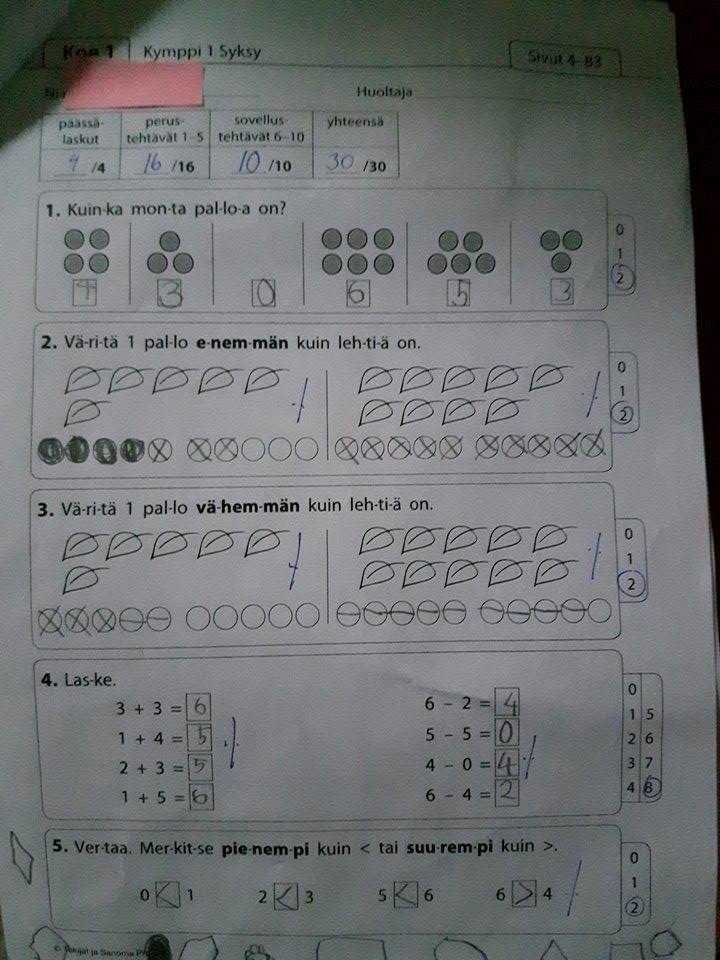
First Grade Math Tests in American and Finnish Classrooms

Simply looking at the two tests is enough: you can easily understand the Finnish test without knowing Finnish, while you may have to reread some questions in the US one.

Finnish

US

Click to access the-math-test.pdf

The US early emphasis on word problems to connect math with (fake) real life is one of the basic issues with CC. This corresponds to the close reading nonsense. The other basic issue is insisting on kids’ giving logical , detailed explanations for concepts they can easily understand intuitively (such as, they have no problem understanding the difference between 12 and 21, but CC wants kids to explain the difference every time they see it). This corresponds to poem analysis until the poem is dead—as you guys mentioned it before.

If I had to give a single sentence to describe the problem with the CC math: it wants to take art out of math and replace it with logic.

Probably, the same could be said about ELA, but I am not an expert on that.

Marin Levine writes in NonProfit Quarterly about Bill Gates’ determination to reshape the nation’s schools. He has gone from failure to failure without changing course. The only time he admitted he was wrong was when he gave up his small schools initiative. Small schools are not a bad idea, but they can’t be stamped out in a cookie cutter fashion. Gates never understood that to succeed, they need to have a guiding spirit. Smallness all alone is not Reform.

On to charter schools, the Common Core and teacher evaluation. Failures. None delivered the Revolution he sought.

Now he is “helping” states with their ESSA plans, which means he is telling them what to do.

If only he could find a new idea, a new toy, a new hobby.

Give it up, Bill! You don’t know how to redesign American education. You never will, unless you made it your mission to give every child the same education you and your children had at Lakeside Academy.

Otherwise, he and Melinda are rich dilettantes playing with the lives of other people’s children.

Matt Barnum, writing in Chalkbeat, describes the mixed reactions of high school students to Common Core math.

Some hated it.

Some liked it.

Some found it confusing.

The Common Core standards were supposed to get students to understand math more deeply. For some California high school students, it didn’t work out that way.

“I like working in the old books, because they actually explain it to me,” one said. “Do you want me to learn it? Or do you want me to stare at the problem?”

That’s one response from a survey of students who experienced the shift to the new standards in their math and English classes. The study is quite limited, emerging from interviews from just 54 high-achieving seniors. But it gets at something often overlooked in the political controversy that would eventually surround the standards, which most states adopted in 2010: what it felt like for students to see their classrooms change.

Some of the student’s responses, published last month in a peer-reviewed academic journal, may be surprising. Many blamed the Common Core for encouraging more group work — something they almost universally disliked. In some schools, though, the students appreciated what they perceived as a move away from teacher-led instruction.

The Associated Press reviewed the Gates Foundation’s education spending and found that Bill Gates is now engaged in “helping” shape the ESSA plans of the states. He just can’t stop telling everyone how to run their public schools even though everything he has tried until now has been a failure.

Does he care that teachers in several states have walked out due to underfunding? Is he trying to persuade governors and legislators to tax billionaires to raise school funding? Don’t hold your breath.

Presumably he wants to make sure they are sticking with high-stakes testing, Common Core, and charters, his three favorite reforms to which he never subjected his own children or their school. If it is not good enough for Lakeside Academy in Seattle, why must it be mandatory for the rest of the nation?


Mercedes Schneider takes apart Bill Gates and his monumental hypocrisy and arrogance. 

She documents his predilection for experimenting on other people’s  children, as he did with the Commin Core, and his penchant for carelessly destroying other people’s  lives, as he did with the ineffective teacher evaluations.

She notes that he recently announced an initiative to fix poverty, but is not investing much money, as compared to the billions he wasted on education forays.

Bill Gates has funded studies to belittle class size reduction, though in his own schooling and in that of his children, small classes were crucial.

He has given advice lately, sharing advice about how to raise children. He says you should love them unconditionally and pay no mind to their grades or test scores. Nice for his children, whose elite schools would never follow Gates’ education ideas. But what about the teachers who got fired because their students didn’t try or their parents didn’t care?

And last, to really see how out of touch he is, read about the “modest” bequests he plans to leave them.


Lisa Haver and Deborah Grill pose this question in an incisive article in the Philadelphia Inquirer. 

There was a national media flap when billionaire investor Stephen Schwarzman offered his alma mater in Abington, Pennsylvania, $25 million in exchange for renaming the school, putting his name over six entrances, and changing the curriculum to meet his demands. Ultimately, the board refused some but not all of his requirements.

Haver and Grill worked in the Philadelphia public schools. They say, “Welcome to our world,” where the Uber-rich have owned the public schools for years and run them into the ground.

”In November 2011, the state-imposed School Reform Commission (SRC), absent any public deliberation, approved a multimillion-dollar grant from the Bill and Melinda Gates Foundation. In return, the SRC agreed to several conditions, including yearly charter expansion, implementation of Common Core standards, more school “choice” and testing, and permanent school closures. No one elected Bill Gates, typically portrayed in the media as just a very generous rich guy, to make decisions about Philadelphia’s public schools. But his mandates have had devastating and lasting effects on the district, much more than renaming one school.”

No one elected Bill Gates. An unelected board outsourced control of the Philadelphia public schools to an unaccountable billionaire. Why? Money. No evidence. No research. No wisdom. Just money. Goal: Privatization. Means: Silence the public.

“Here in Philadelphia, the Gates Compact conferred authority upon the Philadelphia School Partnership (PSP) “to provide funding …to low-performing or developing schools.” PSP has since raised tens of millions from a stable of wealthy donors; most has gone to charter schools, in keeping with Gates’ pro-privatization ideology. PSP’s influence has grown in the last seven years: the group now funds and operates teacher and principal training programs, oversees a website rating all Philadelphia schools, and holds the district’s yearly high school fair. PSP’s money, like Schwarzman’s, always comes with strings attached, whether that means changing a school’s curriculum or a complete overhaul of faculty and staff, as its 2014 grant to two North Philadelphia schools mandated.”

The PSP meetings are closed to the public. Its board members are wealthy suburbanites.

There is something to be said for democracy. Why has Philadelphia prevented its citizens from having any role in the o ersight of the public schools? Could those who have a genuine stake in them do worse than the rich dilettantes who control them now?