Archives for category: Closing schools

Mayor Rahm Emanuel likes to close schools in African American communities. He claims underenrillment but then opens new charter schools to replace the public schools he closed. Is there a master plan? Is this strategy about real estate and gentrification? Large numbers of black families have left Chicago. The Chicago Teachers Union has valiantly resisted School closings, but Mayor Emanuel will not be deterred. Some community activists charge that the school-closing strategy has contributed to the city’s high levels of youth violence. Stable communities support stable schools. School closings disrupt communities and studebts’ lives.

Screen Shot 2018-01-02 at 6.01.21 PM

Stop Destructive School Actions

Closingsviolence_660x440

PLEDGE TO ATTEND

CPS’ dishonest “choice model” — which sets up a limited number of well-resourced magnet schools, a large number of charter schools and defunds other schools using “Student Based Budgeting” — has destabilized Black & Latino neighborhoods, driven families from Chicago, and left many neighborhood schools struggling to offer students a quality curriculum, starved of even the most basic resources.

CPS proposes to close all four neighborhood high schools in Englewood: Hope High School, Robeson High School, Harper High School, and TEAM Englewood Community Academy High School. To the Mayor, their students just don’t matter enough to have the same rights, access or education as his children or neighbors.

CPS proposes to phase out National Teachers Elementary Academy because they want to give their building to another community.

The unelected School Board voted to co-locate a clout-heavy charter school whose charter operator is linked to scandal-ridden SUPES into Hirsch Metropolitan High School, a move that would destroy Hirsch to start a new privatized school.

As CTU members, there are ways to fight back. We urge all CTU members to support the educators and families at these schools as they defend their schools and communities. Here are some of the ways you can help:

  • Attend closings hearings starting on January 9th. Plan to testify to talk about how student based budgeting and privatization are affecting your school and community.

  • Attend actions being planned by the students, parents and educators at these schools. They need our support at these protests to keep the public informed and keep the pressure on Rahm.

  • Plan to attend the next Board of Education meeting on Wednesday, January 24.

Click here for more information.


One thing that Mayor Rahm Emanuel’s massive school closings did: They hastened the exodus of African American families from Chicago.

“Chicago was once a major destination for African-Americans during the Great Migration, but experts say today the city is pushing out poor black families. In less than two decades, Chicago lost one-quarter of its black population, or more than 250,000 people.

“In the past decade, Chicago’s public schools lost more than 52,000 black students. Now, the school district, which was majority black for half a century, is on pace to become majority Latino. Black neighborhoods like Austin have experienced some of the steepest student declines and most of the school closures and budget cuts.

“A common refrain is that Chicago’s black families are “reverse migrating” to Southern cities with greater opportunities, like Atlanta and Dallas. But many of the families fleeing the poorest pockets of Chicago venture no farther than the south suburbs or northwest Indiana. And their children end up in cash-strapped segregated schools like the ones they left behind, a Chicago Reporter investigation found.”


Leonie Haimson has long insisted that the single most effective intervention for children who are struggling in school is reduced class size. She has assembled an impressive body of research showing that class size gives teachers the time that they need for each child.

She has long been a critic of Mayor de Blasio’s Renewal Schools. The Mayor wanted to show that he could create a model of school improvement that differed sharply from the Bloomberg administration’s policy of closing schools in large numbers without any effort to help them.

Following the announcement that the city is closing or merging 15 of the Renewal schools, in addition to the 18 already closed, Haimson has written a scorching critique of the city’s refusal to reduce class size.

“Chancellor Fariña announced yesterday that the closure or merger of 15 more Renewal schools, to add to the 18 that were previously closed or merged.

“This means 33 Renewal schools of the original 94 have failed to improve sufficiently since the program began in 2014. Forty six of the Renewal schools will remain in the program for another year. The list of schools, including an additional five to be closed that were never in the Renewal program, is here.

“This record of failure is no surprise to many of us who have criticized the DOE’s plans for the Renewal schools since the program began in 2014. Despite the city’s promise to the state to focus their efforts on reducing class size in these struggling schools, only three of the Renewal schools capped class sizes last year at the appropriate levels designated in the city’s original Contract for Excellence plan — no more than 20 students per class in grades K-3, 23 in grades 4-8 and 25 in high school.

“Moreover, 70 percent of the Renewal schools continued to have maximum class sizes of 30 or more, and about half did not reduce class size by even one student per class. The DOE’s failure to take any demonstrable steps to reduce class sizes in the Renewal schools was cited in our class size complaint filed in July with the State Education Department, demanding that the CFE law be enforced…

“Instead of capping class sizes in these schools, the DOE spent about $40 million per year on consultants and bureaucrats to oversee the Renewal program, many of them with records marked by scandal and incompetence, as well as millions more on wrap-around services to create “community schools.” Though perhaps of value in themselves, these services do little to improve students’ opportunity to learn or teachers ability to teach…

“The contrast with an earlier NYC school reform effort is stark. When Rudy Crew headed DOE, he created a special program called the Chancellor’s district for the city’s lowest-performing schools. He consulted the research and used common sense by capping class sizes in these schools at no more than 20 students per class in K-3 and 25 in the higher grades, as well as taking other measures. The program was widely hailed as a success, but when Joel Klein took over as Chancellor, he disbanded the district. Lessons learned? Apparently none to this day– to the tragic detriment of NYC children.”

What is laughingly called “Reform” is actually an interrelated group of education policies that have failed repeatedly. Reformers are never discouraged by failure. They ignore evidence. They like to fund any effort that will demoralize teachers and lead to privatization of public schools.

Laura Chapman reviews some of the current crop of reform efforts built on guess, conjecture, and ideology.

She writes:

“The Ewing Marion Kauffman Foundation is trying to dominate policy in Kansas City. It has a parallel in Indianapolis called the Mind Trust.

“The Kauffman Foundation is part of the Education Cities network promoting “new” and “great” schools, but it is not just a member. It is a major contributor to that network, along with the Broad, Walton Family, Bill and Melinda Gates, Michael and Susan Dell foundations. Education Cities is part of a large network of “reform” organizations.

“Empower Schools.org, for example, is an adjunct to Education Cities. Empower Schools says: “We work with policymakers and education system leaders to adopt “Third Way” policies, structures, and strategies that allow for schools of all types, including both traditional district schools and schools led by proven and promising independent leaders. We capture and share the most promising Third Way practices to inform and shape the national conversation on education reform.”

“In other words, Empower Schools is far more than a starter of a “conversations.” The network connects 18 programs/organizations, among these the New Teacher Project, Relay Graduate School of Education, Teach for America, and others intent on de-professionalizing education.

Click to access An-introduction-to-the-Third-Way.pdf

“The Ewing Marion Kauffman Foundation also funds the “Education Innovation Cluster” initiative, part of a USDE funded Digital Promise program (Obama era) and intended to bring together in one mega network people and groups identified as entrepreneurs, funders, researchers, educators, and other community stakeholders (families, local government, non-profits) to “design, launch, iterate on, and disseminate breakthrough learning practices and tools.”

“Breakthrough learning practices and tools” really refers the expanded use of on-line learning, competency-based awards such as badges and certificates for students and teacher education, learning enabled with mobile devices and so on. USDE appears to have outsourced this program http://nextgenlearning.org/blog/education-innovation-clusters-help-way

“The Kauffman Foundation has also been praised as a reason for Kansas City to be included in The U.S. Education Innovation Index: Prototype and Report, a rating system for cities released in September 2016 by Bellwether Education and the Digital Promise Innovation Clusters.

“This index measures “innovation activities “and conditions of urban schools along 42 indicators in nine categories: Innovation Culture (e.g., mayor control, Gates compact); Need for Academic Improvement ( e.g., scores of schools on state tests), Collaboration and Coordination Mechanisms (e.g., OneApp), Talent Supply and Quality (TFA a plus), Innovation-Supporting Institutions (e.g., the Kauffman Foundation in Kansas City, the Mind Trust in Indianapolis).
Innovation-Friendly Policies ( e.g., tax incentives) , Innovation Investment (venture capital flowing to education startups), District Deviation (a measure of how public schools budget money across eight categories compared to other similar school districts in the state), and Dynamism (a fancy word referring to the opening and closing of schools, market churn for schools). More detail on the rating system is outlined in Table A2: “Indicator Scoring Method.”

“This “innovation index” project from Bellwether was inspired by a similar effort on an international scale and funded by the Organization for Economic Cooperation and Development (OECD) http://www.oecd.org/unitedstates/Measuring-Innovation-in-Education-USA.pdf.

“Bellwether’s index was also influenced by another index, published in 2013: Alive in the SwAmp 3. Assessing DigitAl innovAtions in eDucAtion.” That quirky typeface is in the title. The title is also prescient.

“Alive in the Swamp was published with support from Pearson, NewSchools (venture philanthropy), and the Bill and Melinda Gates Foundation. It features colorful charts to show the potential influence of technology on learning and color-coded rating scheme for digital innovation in education.

“One of the authors of the digital index is Michael Fullan, a distinguished Canadian scholar in education whose ideas have been used to develop a “School Quality Improvement Index for California’s “CORE” distracts. The second author, Katelyn Donnelly, is an economist and director of Pearson’s venture fund for low-cost schools in the developing world. The examples of innovation cited in the report include Rocketship Education, School of One, Kahn Academy, and Learn Zillion, each of these rated for likelihood of producing “transformative outcomes.” These examples certainly tell us about inhabitants and supporters of the swamp-lands in education. See especially, page 13 and Appendix A.”

Click to access alive_in_the_swamp.pdf

John Thompson is a teacher and historian in Oklahoma. He writes often about education policy. In this post, he recounts the recurring failure of “the portfolio model,” a reformer favorite.


Matt Barnum’s three-part series on the national corporate reform campaign to expand the “portfolio” corporate school reform model provides a balanced appraisal of the movement which is very different than the alt-facts presented by reformers seeking privatization and union-busting.

Barnum’s first post starts with Indiana’s Mind Trust which “has called for dramatic changes to schools; recruited outside advocacy, teacher training, and charter groups; and spent millions to help launch new charter and district schools.” He then warns, “A Mind Trust–style organization may be coming to a city near you.” Barnum further describes “their idealized vision,” known as the “portfolio model,” with an enrollment system which helps families choose schools, and where the local district’s role shrinks to holding schools accountable, often (mostly?) by closing ones that supposedly don’t measure up.
https://www.chalkbeat.org/posts/us/2017/12/06/a-portfolio-of-schools-how-a-nationwide-effort-to-disrupt-urban-school-districts-is-gaining-traction/

The Mind Trust and other portfolio advocates have assembled teams of “quarterbacks” to contribute money to initiate the portfolio approach and recruit the same privatization team players – Teach for America, Relay Graduate School of Education, TNTP, and Stand For Children.

Barnum writes that it is unclear how much money has been invested in promoting portfolios. He notes that 1/3rd of the $77 million raised by the Mind Trust since 2006 came from national groups, but it is clear that “prominent philanthropies, including some that have also spent millions in recent years funding charter schools nationwide, are investing heavily.” In particular, he cites the Walton, Arnold, and Broad foundations. He points out the role of David Osborne’s book tour, funded by Walton, Arnold, and Broad, where Osborne “recently compared teachers unions’ opposition to charter school expansion in Massachusetts to George Wallace’s promotion of mandated school segregation.”

The thing that jumps out to me with Barnum’s first two posts is that the record of these political campaigns is mixed. And organizing an attack on unions and school boards is much, much easier than actually improving schools. This ambiguity is an even more important theme of his third piece, as well as the sources he footnotes. National reformers may believe that they can come into localities that they know nothing about and push through their privatization schemes. They may have tons of money to gamble on risky social engineering experiments, but they have little or no evidence that the tumult that they instigate would benefit students, and remain oblivious to the damage down by failed experiments.
https://chalkbeat.org/posts/us/2017/12/08/advocates-of-the-portfolio-model-for-improving-schools-say-it-works-are-they-right/

Barnum cites conservative reformers and research from a range of scholars to puncture the public relations spin of big-bucks portfolio advocates. Even the cornerstone of the experiment, a common enrollment system, has prompted pushback by conservatives who note the way that it would promote more teach-to-the-test malpractice and by patrons who were confused by the systems. Even one of the most highly praised centralized enrollment system, in Denver, did not increase access of special education students to charters or have a statistically significant effect on the number of low-income students in charters.

Advice to the Arnold Foundation

Denver Study Shows Simplifying Enrollment Drove More Disadvantaged Students to Sign Up for Charter Schools

Something similar applies to school closures which is the silver bullet being promised by portfolio advocates. Those who trust the increase in test scores in New Orleans attribute much of the gains to closing schools that were low-performing. As Barnum acknowledges, that only works when there are better schools available, and I would say that it would take more than a portfolio of silver bullets to create them in our most challenging districts. Barnum also links to his compilation of research which showed gains for students in closed schools in only 1/4th of the studies. He showed no examples of closures where displaced students benefitted but the outcomes in receiving schools didn’t decline.

Research Shows Students Can Benefit When a School Closes — but Only If There Are Better Ones to Attend

And the question of costs versus benefits brings us to New Orleans, which is typically cited as the proof of the concept of portfolios. It is the only serious gripe that I have with Barnum’s wording. While he acknowledged that test score growth is a flawed metric, Barnum doesn’t mention why it is so much more problematic in evaluating NOLA and other experiments that focus unflinchingly on bubble-in accountability. Test score growth might or might not mean more learning, and as I hope any teacher would understand, it often means the learning of destructive habits. Personally, I can’t see any scenario where test score growth in a place that stressed such growth as much as the NOLA portfolio can stand by itself as evidence of meaningful learning that beneficial to students.

Regardless, Barnum cites a “national analysis [which] also found that New Orleans students made large academic gains between 2009 and 2015.” I wish he’d been more precise in noting that NOLA only had three years when the growth rate exceeded that of the old failing system. However, Barnum notes that the gains occurred when New Orleans was most generously funded, and was free to suspend or push out large numbers of students. He mentions the lack of clear evidence that gains can be sustained without those tactics, and that “more recent test scores in the city have suggested that schools are backsliding somewhat.” Corporate reformer Peter Cook called the decline “The Great NOLA Train Wreck.”
https://peterccook.com/2017/11/08/great-nola-train-wreck/

Barnum also notes “another concern: expansion of charters in New Orleans coincided with a decline in the number of schools offering prekindergarten.” And regarding NOLA, Newark, and elsewhere, he addresses the conflicts between outside reformers and communities.

Portfolio advocates should also explain the disappointing results of Memphis and Newark. Barnum writes, “A Vanderbilt analysis found that a state takeover effort known as the Achievement School District failed to raise test scores, even as it was dubbed a “national exemplar” in implementing the portfolio model.” I wish he’d also reported that Memphis became #1 as New Orleans became #3 in “disconnected youth,” or students out of school without a job.
http://www.speno2014.com/oydataguide/

Barnum notes a recent, revisionist (and I would say flawed) study which indicates the $200 million Zuckerberg reform investment in Newark was a “mixed success.” In a longer analysis he writes:

Journalist Dale Russakoff wrote a largely critical account of changes that focused on how a large share of the Zuckerberg money went to high-paid consultants. Since, media reports have largely suggested that the approach failed and that the money was wasted.

Given the thorough research by Russakoff, and the work of other excellent journalists, it’s hard for me to take seriously the special pleading by reformers who deny that Newark was a failure. It’s especially hard to fathom how social scientists would get away with spinning the conclusion that Newark portfolio might have worked because it might lead to future gains, but without offering evidence that the happy ending might occur, and “eventually alter system-wide productivity for future cohorts.”

Click to access newark_ed_reform_nber_w23922_suggested_changes.pdf

Finally, Barnum writes, “There is little or no rigorous research comparing gains in Denver, Indianapolis, and Washington D.C. to similar districts that have gone in a different direction.”

Denver was identified as having the largest achievement gap in the nation, indicating that like D.C. the gains may be due to economic growth and/or gentrification. And a recent scandal shows that D.C. still hasn’t shown the ability to curtail the cheating that portfolios would invariably encourage. And as far as Indianapolis, recent research can help estimate the gains that occurred when the Mind Trust and other corporate reformers invested in the city. Median income in Indianapolis is $10,000 or 1/3rd greater than that of the resource-starved Oklahoma City schools and 3rd grade scores are much higher. During the next five years, however, student performance grows at the same rate in both cities, 4.4 years.
https://www.chalkbeat.org/posts/co/2015/10/07/report-denver-ranks-last-among-50-cities-on-income-based-achievement-gaps/
https://www.chalkbeat.org/posts/co/2016/09/21/dps-students-of-color-not-making-as-much-progress-on-state-tests-as-white-peers/
https://www.chalkbeat.org/posts/in/2017/10/04/indianapolis-public-schools-sees-little-a-f-change-but-innovation-schools-got-top-grades/
https://www.washingtonpost.com/local/education/ballou-high-principal-reassigned-following-report-questioning-school-standards/2017/12/04/54bbcdfe-d947-11e7-b1a8-62589434a581_story.html?utm_term=.ce1c2339b34d

Now that the claims of gains for portfolios have been largely debunked in Newark, D.C., Tennessee, and Indianapolis, and the extreme exaggerations regarding Denver and New Orleans cut down to size, what are the prospects for the new portfolio public relations campaign? We educators have seen this dog and pony show repeatedly. We need to keep reminding political leaders of the Billionaires Boys Club’s sorry record in education policy.

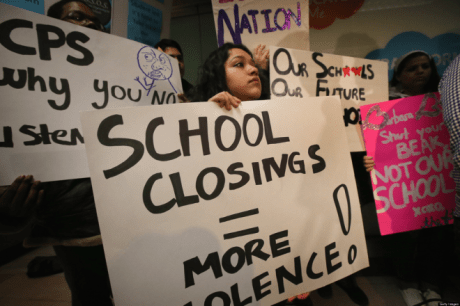
Michelle Gunderson, veteran teacher in Chicago, explains here what Mayor Rahm Emanuel is doing to the city’s schools and the damage he is inflicting on communities of color:

On December 1, the Board of Education of the Chicago Public Schools announced its plan to shutter Harper, Hope, Robeson, and Team Englewood High Schools. All of these high schools are located in the predominantly African American Englewood neighborhood. With their planned closing there will be no neighborhood open enrollment public high schools left in this community of 30,000 people.

Schools are the cornerstones of neighborhoods, the place where a community comes together and relationships are built. Once a neighborhood school is closed it is like giving the community a black eye. The message is clear – this part of the city is not deserving of a public school and its children can be educated elsewhere.

You will hear about a beautiful, new high school planned for Englewood. While this sounds good, it does nothing for the current students of these Englewood high schools. NONE of the current high school students at Harper, Hope, Robeson, and Team Englewood will be allowed to attend. The school will start with a freshman class in 2019 and build a new class each year.

In the meantime, current students are set adrift and told to search out another school in an adjoining neighborhood. This brings up both academic questions and serious safety issues for these youth. In essence, Englewood students will be shipped to other schools, and the end of their high school careers sacrificed for a “fresh start” for the new school.

There is only one word for pushing African American children outside of their community in order to make room for a future student population – apartheid.

If CPS sincerely cares for the children of Englewood the current high schools would stay open until the new one was built and there would be a plan for integrating their students into the new school. To ‘start clean’ with only freshmen is to deny the value and humanity of the current youth in this neighborhood.

The narrative around the school closings is that the schools are under-enrolled and that they are not meeting the needs of the students. Janice Jackson, chief education officer of Chicago Public Schools said, “When I look at Englewood, at the experience some kids are getting, I can’t make the case they’re getting a good high school experience.” On this, she is right. The high schools in Englewood have been starved of the resources needed for high quality school programming for years. They have been intentionally run into the ground so that their closings would be inevitable.

The Chicago Teachers Union (CTU) has been fighting for fair funding of schools for many years. The union’s underlying analysis is that the Chicago Public Schools purposefully defunded schools, claimed them as failures, and then proceeded to close them. The city is in fact “broke on purpose” so that these neighborhoods can be taken over and gentrified. What are the values of our society when children’s lives are sacrificed to the real estate ‘gods of gentrification’?

There will be readers who ask, why would a city government plan the demise of the high schools in an entire section of town? The answer is clear – real estate. Englewood sits in prime territory just south of Chicago’s Loop and with ready access to expressways and transportation. This is a real estate grab.

In Chicago’s rush to close public schools, one neighborhood will have no high school at all.

Wendy Katten of Raise Your Hand, a public education activist, interviews a parent who describes how the voices of parents were ignored in the latest round of school closings.

More school closings are underway in Chicago. In the Englewood neighborhood, which was hit hard by the shuttering of some 50 schools in 2013, there will be no public high schools left should the city follow through on the latest plan.

The Chicago Public Schools (CPS) claims the community requested the school closings this year but many people in the affected neighborhoods question that claim. Raise Your Hand, a public education advocacy group, spoke to one parent, a member of the Local School Council of Harper High School, one of the schools that’s slated for closure. Clifford Fields, who has been an active community member in West Englewood for decades, said that no one from the LSC, the elected parent body that oversees Harper High, was invited to be part of the group that that signed off on closing every public high school in Englewood.

In an interview with Raise Your Hand, Fields had blunt words for Mayor Rahm Emanuel and other city officials who, as he put it, “are treating our kids like they are cars, just trying to shuffle them around.” Fields also cited Chicago’s gang problem, which prevents children in areas like Englewood from moving safely even from block to block. “But you want to shift our kids to other schools in other neighborhoods.” Fields called on officials to redirect resources to schools like Harper. Field’s children graduated from Harper and TEAM Englewood. He was also a Local School Council member at Goodlow elementary, which was part of the 2013 closings.

In Chicago, parents don’t matter. Nor do students.

Mayor Rahm Emanuel continues his crusade to push public schools out of Chicago.

In a wave of closings and consolidation, the mayor found room for a new charter school run by a megachurch and a hip hop artist. The mother of the hip hop artist serves on the zchicago Board of Education.

“Chicago Public Schools on Friday moved ahead with school closing and merger proposals that would affect thousands of kids next school year.

“Under a previously announced plan, four South Side schools would close over the summer and the district would send hundreds of displaced students to surrounding schools. One building would be demolished to make way for a new high school, and privately operated charter schools would take over two other sites, under the district’s plan.

“Students at two predominantly African-American elementary schools near downtown would merge with more diverse campuses. One of those buildings, in the growing South Loop area, would gradually convert into a new high school.

“In addition, Hirsch, one of the city’s lowest-enrolled high schools, would share space for a privately run charter school program that’s backed by a local megachurch and a foundation headed by hip-hop artist Common…

“Hirsch, one of the city’s most underenrolled neighborhood high schools, would open its campus to the Art In Motion charter school next fall. CPS said the charter program, which is backed in part by the New Life Covenant Church and Common Ground Foundation, would first open to seventh- and eighth-graders before expanding to include a high school program.

“Mahalia Hines, a member of the Chicago Board of Education and mother of the hip-hop performer Common, also serves on the board of her son’s foundation.”

Does Illinois have conflict of interest laws?

Four years ago, Mayor Rahm Emanuel closed 50 public schools in one day, something that has never happened before in American history. Now, with enrollment continuing to decline, reporters Sarah Karp and Becky Vivek ask if he is likely to do it again.

They write:

“Nearly five years after shuttering a record number of under-enrolled schools, Chicago once again confronts the same stark realities: plummeting enrollment and more than 100 half-empty school buildings, most on the city’s South and West sides, according to a WBEZ analysis of school records.

“Chicago Public Schools has lost 32,000 students over the last five years, nearly the same enrollment drop as in the 10-year period leading up to the closures of 50 elementary schools in 2013. Those missing students could fill 53 average-sized Chicago schools.

“This massive enrollment decline comes as a self-imposed five-year moratorium on school closings lifts in 2018. Despite that, political observers and CPS insiders said they are not betting on Mayor Rahm Emanuel closing 50 more schools — at least not all at once.

“They say if Emanuel opts to close more schools, they hope he does it more slowly and over time. In fact, that’s already underway, despite the moratorium. Since 2013, CPS has quietly shuttered more than a dozen schools, many of them charter schools.

“The school system must announce by Dec. 1 any proposed closures for its more than 600 schools. Officials have already indicated they will recommend closing only a handful of schools for next year, the first without the moratorium.”

But they note a curious anomaly: the city has been opening new schools even as it closed existing ones:

“Since 2013, a total of 39 new schools serving 16,000 students have opened, and 29 of them serve high school students. This includes several new charter high schools and 15 alternative high schools for dropouts. Those alternative schools are mostly in neighborhoods with the most severely under-enrolled high schools.”

I asked several of my friends in Chicago what was going on. Why the drops in enrollment? Who was leaving?

Mike Klonsky, community activist, responded.

He wrote:

“Why the loss of enrollment?
“Losing about 10K students/year mostly due to huge out-migration of black and poor families. New state voucher law will only make it worse.

“Where are the kids going?
“Many to inner-ring black suburbs, to neighboring states, or back to the south.

“Is Chicago losing population?
“Yes, I call it ethnic/racial cleansing. Quarter million black people have left Chicago in past few decades. Result of deindustrialization, lack of jobs, educational opportunities, resulting rise in crime and violence, tearing down of public and low-income housing, police brutality, blighted communities. Has led to a weakening in black and progressive political power within the city.

“Which neighborhoods?
“Westside, ie Lawndale and southside,ie. Englewood. Mass school closings, opposed by the communities, plus loss of social services, mental health clinics and other medical facilities, markets, police coverage, have led to further blighting of these neighborhoods, driving out more residents.

“Loss of 100k of poorest and academically challenged students has led CPS leaders to claim statistical bump in test scores and grad rates. City leaders celebrating supposed10% drop in shootings.

“This is why it’s not enough to just oppose more school closings. Must be seen for what it is — the whitenizing of the cities, as I’ve been saying for years.”

Mike added this link about the black exodus from Chicago:

https://www.pbs.org/newshour/show/why-neighborhood-demographics-are-shifting-in-chicago

Jitu Brown, director of the Journey for Justice Alliance, Read Mike Klonsky’s comment and added this response:

“I agree. This is why independent, clear political leadership is so important. The whitening of Chicago has happened on the watch of a city council that has significant African American representation. This is a national crisis, as we see a similar evacuation in cities like DC, New Orleans, Detroit, Oakland, Los Angeles, Baltimore, Cleveland.

“In the case of Chicago, families are moving to the south suburbs, believe it or not thousands have relocated to the quad cities in Iowa, and as Mike stated, back to the south. The removal of black people is not just limited to the coasts and the Midwest however. The black population in Atlanta has declined in the past 5 years. Troubling is a huge understatement.“

This is a history of the fall and rise of public education in Philadelphia.

For years, the schools were the plaything of politicians, the business community, and civic leaders.

Failure after failure.

One disastrous experiment after another.

Many millions squandered on privatization.

Today, state control ends and a new chapter begins.