Archives for category: Closing schools

I invited Leonie Haimson, executive director of ClassSizeMatters, to write about the unfortunate decision by the New York City Department of Education to close P.S. 25 in Bedford-Stuyvesant, Brooklyn. It is one of the most successful schools in the city. It is under enrolled, but the authorities could easily change that by advertising its success or placing additional programs in the building. If and when the school closes, the empty building would then be available for Eva Moskowitz’s charter chain, and the children in the area would no longer have a zoned public school. Did Mayor DeBlasio forget that he campaigned on the promise to support public schools against the voracious expansion of charter schools?


Leonie writes:

On Tuesday, a lawsuit was filed to block the closing of PS 25 Eubie Blake, a small school in the Bed Stuy section of Brooklyn, which by all accounts is a school that is excelling and exceeding expectations, especially given the high-needs students it serves.

Last month, the Panel for Educational Policy voted to approve the closure of ten city schools, most of them struggling schools on the Renewal list.  Lost in the media shuffle was the fact that one of these schools, PS 25, wasn’t a low-performing school; far from it.

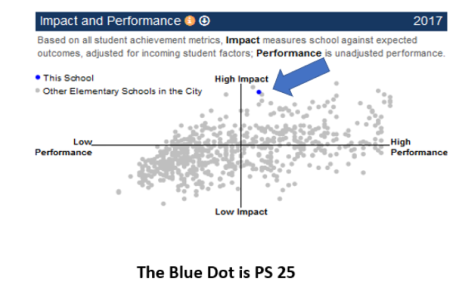
According to the DOE’s School Performance Dashboard, (according to Chancellor Farina, the “the most advanced tool of its kind,” PS 25 has the fourth highest positive impact of any public elementary school in the city and the second best in the entire borough of Brooklyn, when the need level of its incoming students is taken into account.
Picture1

According to this metric, the positive impact of PS 25 also exceeds that of any charter school in the city, except for Success Academy Bronx 2, given the fact that most of its students are economically disadvantaged, have disabilities and/or are homeless.

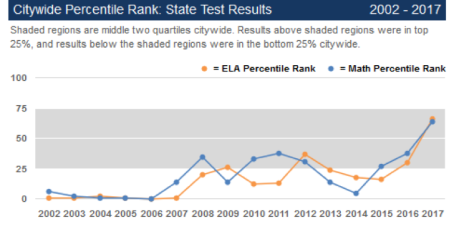
The test scores from PS 25 on the state exams show a sharp upward trajectory, with its students now exceeding the city average in both ELA and math.
Picture2

In fact, controlling for background and need, the students at PS 25 now outperform similar students by 21 percentage points in both subjects.

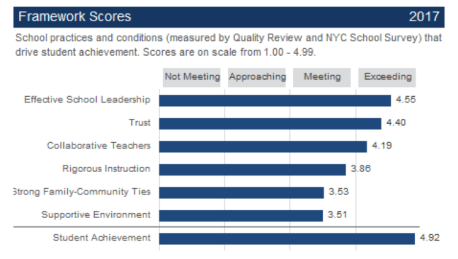
Now for those who say test scores aren’t everything, the school also excels according to all other methods the DOE uses to evaluate schools.  It exceeds or meets standards in “Effective School Leadership”, “Trust”, “Collaborative Teachers”, “Rigorous Instruction”, “Strong Family-Community Ties” and “Supportive Environment,” according to the school’s Quality Review as well as parent and teacher surveys.
Picture3

The fact that the DOE is closing a school which is delivering such great results for its students should not have been ignored.

Also unreported by any media outlet were two other salient facts: if PS 25 is closed, the entire city-owned building will be left to a charter school – Success Academy Bed Stuy 3, the first time this has happened in NYC, to my knowledge.

Also ignored was that the Community Education Council District 16 never voted to close this zoned school. State law requires that before this can occur, the CEC must authorize this, as any changes in zoning lines can only happen with their approval. The is one of the main responsibilities of CECs and some would argue their sole veto power over the unilateral and often arbitrary decision-making of the Mayor and the Chancellor.

So why does the Chancellor say PS 25 should be closed?  Chancellor Farina argues that the school is under-enrolled.  Yet at least five other schools have smaller enrollments than PS 25 and are not being closed.  Moreover, DOE has never publicized the fact that this school outperforms nearly every other school in the city.  If they had celebrated this school’s accomplishments, surely more parents would apply.  The sad reality is that many public schools in D16 have lost enrollment because of the supersaturation of charter schools in the district –  a drain on space, funding and resources which will only worsen if this school is closed.

According to the DOE’s controversial school capacity formula, PS 25’s “underenrollment” also means there is sufficient space in the building for its small class sizes of 10 to 18 – which provide ideal learning environments and are likely a major reason for its students’ success.  The DOE could also place another preK or a 3K class in the building if they wanted its enrollment to grow.

Currently, PS 25 parents are being shown a list of other schools to apply to, most outside the district and a few schools within — but none will have the same small classes and positive impact on learning, and none of them will their children have the right to attend.

Given how difficult many of these families’ lives are already, with nearly one quarter of the students homeless, this will be yet another terrible disruption, though in this case, wholly preventable. One can only hope the DOE changes course and withdraws the proposal to close PS 25 immediately.

Below is the press release about the lawsuit, which describes a 2009 legal precedent when then-Chancellor Joel Klein withdrew a proposal to close three zoned schools in Harlem and Brooklyn after being sued.  He then signed an agreement that the DOE would never do this again without a vote of the CECs.  The legal complaint to block PS 25’s closure with more data about the school and facts about the law is posted here.


For Immediate Release: Tuesday, March 27, 2018

Contact: Leonie Haimson, 917-435-9329; leoniehaimson@gmail.com


Lawsuit filed to stop the closure of PS 25, the 4th best public elementary school in NYC according to the DOE


Today a lawsuit was filed in the Brooklyn State Supreme Court against the proposed closure of P.S. 25 Eubie Blake in District 16, Brooklyn, a zoned neighborhood school, which Chancellor Carmen Farina and the Board of Education are attempting to close without the prior approval of the Community Education Council.

Last month, on February 28, the Panel on Educational Policy voted to close the school which will require students to seek enrollment in other schools, with no assurance of admission.  Not only is it a violation of NY State Education law 2590-e to close the only zoned school in the neighborhood without the district CEC’s prior approval, but P.S. 25 is also the fourth best public elementary school in NYC in the estimation of the Department of Education, and the second best in the borough of Brooklyn, when the need level of its students is taken into account.

According to the DOE’s School Performance Dashboard, which according to Chancellor Fariña is ““the most advanced tool of its kind,” the positive impact of P.S. 25 is greater than all but three of the city’s 661 public elementary schools, and its closure would leave the entire city-owned building to Success Academy Bed Stuy 3, a charter school. [1]

Achievement levels of P.S. 25 students have steadily climbed over the last three years, and the school now exceeds the city average in state test scores, despite the fact that a large percentage of students are homeless, economically disadvantaged, and/or have disabilities. According to DOE’s figures, the school’s students outperform similar students by 21 percentage points in ELA and math.  The achievement of the more than thirty percent of students with disabilities is also exceptionally high.

The school also meets or exceeds standards in all the following areas:  Effective School Leadership, Trust, Collaborative Teachers, Rigorous Instruction, Strong Family-Community Ties, and Supportive Environment.

Plaintiff Crystal Williams, a parent of two children at P.S. 25, said: “The school has seen a big improvement in recent years.  The teachers are excellent.  They give students close support, and my kids are learning.  The teachers take their time in part because they have small classes, and I don’t believe my children would be provided with the same quality of education at whatever other schools they are forced to attend.”

“PS 25 should be honored and replicated, not closed,” said Mark Cannizzaro, President of the Council for School Supervisors and Administrators, the principals’ union. “The school has been on a clear, upward trajectory: Dedicated school leaders and teachers have helped boost English and math test scores ever higher compared to the district and the city as a whole. All the while, PS 25 has made great strides in addressing students’ social and emotional needs, and has offered them a vibrant curriculum with art, music, library skills, coding and STEM classes. We continue to oppose this decision. The students, families and educators of PS 25 deserve better.”

Said Shakema Armstead, a plaintiff who has a third grader at PS 25, “My son, who has an I.E.P, loves the school.  It gives him and other students with a sense of community and stability that allow them to thrive.  There is no reason for them to be thrown into another school where they would have to re-adjust to an entirely new environment, especially as P.S. 25 is doing so well.”

There is a precedent for this lawsuit. In 2009, a lawsuit was filed against Chancellor Joel Klein on behalf of parents at three neighborhood zoned schools, in Harlem and Ocean Hill-Brownsville area, to prevent the closure of these schools without a vote of the relevant CECs.  The lawsuit was joined by Randi Weingarten, then President of the UFT, and NYC Public Advocate Betsy Gotbaum. Within weeks, Chancellor Klein withdrew the closure proposals.[2]  He subsequently signed the following settlement agreement:

The [plaintiffs and the DOE] agree with regard to the three schools identified in the Complaint and any other traditional public school that, for those grades that are within the province of school attendance zones, [the DOE] will not close, phase-out, remove, alter or engage in conduct designed to effect the closure of any such school in a way that deprives residents of the right to send a qualifying child to his or her zoned traditional school, without either (1) obtaining, pursuant to 2590-e(11) of the Education Law, the approval of the relevant Community Education Council as to such change or (2) timely replacing such school with another zoned school within the same attendance zone.

In this case, DOE has no plans to create another zoned school for these children, and yet no vote of Community Education Council 16 has occurred.  The DOE claims that the school is being closed because it is under-enrolled, but this ignores several important factors:  Parents have not been told of the exceedingly high quality of the school according to the DOE’s own metrics, and if they had been informed of this, more of them would likely enroll their children in the school.  The DOE could also install another preK or a 3K program in the school.   The availability of space has also allowed for very small classes, which in turn have provided PS 25 students with an exceptional opportunity to learn.

Said Leonie Haimson, Executive Director of Class Size Matters, “It would be tragic if the second best elementary school in Brooklyn were closed.  PS 25 has very small classes of 10 to 18 students, which are ideal for such high-poverty students.  Given how the DOE refuses to align the school capacity formula with smaller classes, that alone makes the school appear underutilized.  It would be extremely disruptive if this closure occurs, especially for the large number of homeless children at PS 25, because the school is a sanctuary of stability in their lives. Instead of closing PS 25, the DOE should celebrate, emulate and expand it—and give more NYC children the same chance to succeed.”

A copy of the lawsuit is posted here: https://tinyurl.com/y6wjocsu

###

[1] https://tools.nycenet.edu/dashboard/#dbn=16K025&report_type=EMS&view=City

[2] https://www.nyclu.org/en/press-releases/response-nycluuft-lawsuit-doe-announces-it-will-keep-schools-open


I posted the 2012 Democrats for Education Reform list of electoral favorites, which included Cong. George Miller of California, then chair of the House Education Committee and an architect of NCLB; Senator Chris Murphy of Connecticut, who fought to keep high-stakes testing and NCLB punishments in the new ESSA and is now a possible candidate for president in 2020. A few years ago, the California Democratic Party passed a resolution denouncing DFER for advancing corporate policies and urged them to drop the D from their name.

Miller was the most powerful Congressional Democrat on education issues, and Nancy Pelosi follliwed his lead. Virginia Congressman Bobby Scott is now chair of the committee, and he too was on the DFER LIST.

A reader who lives in Miller’s district describes what happened:

“Miller was my Congressman. I too had an unpleasant encounter with him at a local hearing where he showed up to personally push to convert one of the high schools in my district to charter. Since then that high school has among other things, experienced huge teacher turnover. Key senior classes have had multiple substitutes with “emergency crediamtials.” They hired an “executive director” whom they pay a quarter million dollars a year,! whose primary job seems to be opening more charters in our county who will hire him as a “consultant” and who hired his wife as an administrator for a salary of $170,000 per year. He also recently put one of the Candidates for Superintendent if the County Office of Education on his payroll as an “Assistant Prinicipal”. The County Office approves charters if they are turned down at the District level.”


When Bill de Blasio ran for Mayor the first time, he sought my help. We met and spoke candidly. He told me he would strongly support traditional public schools. He said he would oppose the expansion of private charters into public school space. He promised to stop closing schools because of their test scores. His own children went to public schools. He would protect them and end the destructive tactics of Joel Klein, who coldly and cruelly closed schools over the tearful objections of students, parents, and teachers.

I enthusuastically endorsed him. The campaign issued a press release. De Blasio was elected in 2013, and re-elected in 2017. I wanted him to succeed and to support public schools against the privatizers.

He tried to stand up to the charters, but Eva’s billionaire backers rolled out a multi-million dollar TV campaign and donated huge sums to Governor Cuomo and key legislators. That ended de Blasio’s effort to block charter expansion. The legislature gave them a blank check in New York City, allowed them to expand at will, and even required the city to pay their rent in private facilities if it couldn’t provide suitable public space. Now his majority appointees to the city board rubber stamp charter co-locations and expansions.

Although the Mayor and Chancellor Farina have tried to support struggling schools, they have not hesitated to close them when they don’t show test score gains.

At the last meeting of the city’s Board of Education (which Mayor Bloomberg capriciously named the Panel on Education Policy to indicate its insignificance in the new era of mayoral control but which is still called the Board of Education in statute), the Mayor submitted a list of schools to close. Sadly, like Bloomberg, he has closed many schools. Unlike Bloomberg, he does not boast about it. There’s that.

At the last meeting of the Board, onee of the Mayor’s appointees, T. Elzora Cleveland, dissented and another abstained, denying the majority needed to close two of the schools on the Mayor’s list. Cleveland has resigned, and education activists assume she was forced out to make way for a more pliable board member. 

How is this different from Mayor Bloomberg’s tactics?

During the Bloomberg regime, the Mayor ousted three appointees who objected to his wish to end social promotion. The three members worried that no one had devised a plan to help the kids held back. Bloomberg fired them on the spot, and said, in effect, mayoral control means I am in charge and my appointees do as I wish. At the time, the firings were called “the Monday night massacre.”

I strongly oppose closing public schools, especially those that are historic anchors of their community. Several years back, I was on a panel with John Jackson, president of the Schott Foundation for Public Education. He said he had traveled to many countries to learn how they dealt with struggling schools. In every country, the Minister of Education said, “If a school is struggling, we send in support.” Dr. Jackson asked, “What do you do if you send support, and the school doesn’t improve?” In every case, the Minister said, “We send in more support.”

The bottom line is that accountability lies with the leadership. If a school is in trouble, it is up to the leadership to help, not punish. They control the resources. They decide whether the school will reduce class sizes and have the staff and programs it needs. Accountability begins at the top.


Another Reformer is out. Antwan Wilson, former superintendent in Oakland, graduate of the unaccredited Broad Superintendents Academy (which teaches school closings, metrics, and charters), has resigned only months after taking over.

G.F. Brandenburg has some questions for his interim successor:

”The interim successor to Antwan Wilson needs to be asked when, exactly, did she realize that:

1. Her boss, Michelle Rhee’s claimed miraculous teaching accomplishments were fraudulent;

2. Her boss, Michelle Rhee was asking principals to cheat;

3. Noyes principal Wayne Ryan was committing massive fraud by “fixing” student answer sheets;

4. Ryan had no business being promoted to supervising other principals…”

and more.


At a town hall meeting in Detroit, students, families, and teachers spoke out against the damage caused to them by the false promise of “school choice.” Allie Gross covered the meeting for the Detroit Free Press.

One parent described the wonderful school attended by his child with cerebral palsy; it was to save money.

“In 2008, Alfred Wright enrolled his son, Timothy, in kindergarten at Oakman Elementary/Orthopedic, a small school on the Detroit’s northwest side that specialized in teaching students with special needs.

“Timothy had recently been diagnosed with cerebral palsy, and the school — which came with spacious hallways, discreet changing rooms, small class sizes, and an on-site nurse — seemed like the perfect match.

“And, according to Wright, it was. For five years, he watched his son thrive in the close-knit and accepting community. Oakman not only was prepared to accommodate Timothy’s needs but it helped Wright, as a parent, better understand his child.

“But then the seemingly unexpected happened. In spring 2013, Roy Roberts, Detroit Public Schools’ second emergency manager, announced that Oakman would be one of six schools to close the following school year. It would add to the list of nearly 100 district schools that had shuttered since 2009, when the state took over DPS due to finance.

LWright and the rest of the parents were given two traditional public school options: one that was 1.2 miles away and the other that was 2.4 miles. Both choices fell within the bottom 5 percent of schools in the state for academic performance. More notably, neither were handicap accessible.

“All of the things we feared happened,” Wright said, explaining how issues at Henderson Academy, where Timothy ultimately ended up, ranged from bullying and isolation to a lack of knowledge and preparedness when it came to educating students with special needs.

”This reality — instability, uncertainty and inefficient resources — is why on Tuesday night, Wright and Timothy made their way to Wayne State University’s Law School to participate in an Education Town Hall hosted by the #WeChoose Campaign. A movement made up of 25 organizations from across that country — including the NAACP, Advancement Project, Dignity in Schools and Journey for Justice Alliance — the group is working to support racial justice and end educational inequality via, among many things, town hall gatherings that bring attention to what the group sees as “the illusion of school choice.”

“Parents, students, and educators do not choose the sabotage of their neighborhood schools, school closings, zero tolerance policies that target black and brown students, punitive standardized testing school deserts,” the group’s mission statement explains. “We choose equity, not the scam called school choice.”


During the Obama years, the Center for American Progress reliably cheered on the administration’s education policies. As one after another failed, CAP never backed down. Charter schools good. Closing schools good. Common Core great. Despite the convergence of evidence that these policies did not work, that they destabilized fragile urban neighborhoods, that they demoralized teachers and created shortages, CAP never wavered.

As Peter Greene shows in this post, the CAP has learned nothing from the past 15 years of failed reforms. They are still pushing policy ideas cribbed from the GOP.

They still are pushing state takeovers and turnarounds.

He writes:

”And what example do folks who support takeovers and turnarounds like to cite? Of course, it’s New Orleans. Do we really have to get into all the ways that the privatization of the New Orleans school system is less than a resounding success? Or let’s discus the Tennessee experiment in a recovery school district, in which the state promised to turn the bottom five percent into the top schools in the state, and they utterly failed. As in, the guy charged with making it happened gave up and admitted that it was way harder than he thought it would be, failed.

“The whole premise of a state takeover is that somebody in the state capital somehow knows more about how to make a school work than the people who work there (or, in most cases, can hire some guy who knows because he graduated from an ivy league school and spent two years in a classroom once). The takeover model still holds onto a premise that many reformsters, to their credit, have moved past: that trained professional educators who have devoted their adult lives to working in schools– those people are the whole problem. It’s insulting, it’s stupid, and it’s a great way to let some folks off the hook, like, say, the policy makers who consistently underfund some schools.

“Most importantly, at this point, there isn’t a lick of evidence that it works.

“We have the results of the School Improvement Grants used by the Obama administration to “fix” schools, and the results were that SIG didn’t accomplish anything (other than, I suppose, keeping a bunch of consultants well-paid). SIG also did damage because it allowed the current administration and their ilk to say, “See? Throwing money at schools doesn’t help.” But the real lesson of SIG, which came with very specific Fix Your School instructions attached, was that when the state or federal government try to tell a local school district exactly how things should be fixed, instead of listening to the people who live and work there, nothing gets better. That same fundamental flaw is part of the DNA of the takeover/turnaround approach.

“But CAP is excited about ESSA because some states have included this model in their plan. So, yay.”

Worst of all, CAP ends it’s paean to ESSA by linking to a paper produced by a Jeb Bush’s Chiefs for Change.

If proof is needed of a mind meld between “centrist” Democrats and free-market, DeVos-style Republicans, This is it.


Julie Vassilatos writes about the latest School closing by Chicago Public Schools. It is a heart-breaking story.

The school closing is a real estate deal, she believes. It’s about gentrification, not education.

“Presto change-o, remove the public housing and the mostly-black grade school from the neighborhood, bring in a not-mostly-black high school, and watch the property values go up, up, up.

“These kinds of moves are the reason behind the twitter hashtags #RahmHatesUs and #RahmDoesntCareAboutBlackPeople. Outrageous claims, I bet you’re thinking. But the folks tweeting these hashtags know that actions speak louder than words. And Rahm’s actions via CPS in this new round of school closures tell of a man who will push his agenda no matter how many people it harms, no matter how obviously racist it looks.

“CEO Janice Jackson was not in attendance at last week’s NTA closure hearing. Neither was anyone at all from the board. The mayor wasn’t there. There was a man with a presentation, however, one man, Chip Johnson from the FACE office. He chided the crowd to be respectful this evening, and not carry on in a rowdy fashion like last time. He listened impassively to the 50+ speakers given two minutes each, never taking a note, never answering a question, positioning himself as a neutral party but very much committed to the CPS plan. This entire proceeding transported me back instantaneously to the fall and winter of 2012/13’s terrible school closing hearings, and I was glad I went up to the balcony to watch because I knew that I would probably get emotional or inappropriate or both.

“Because these events are an exercise in awfulness. Listening to one little child after another beg–someone (which public official listens to these things, again?)–to keep open the school they love, occasionally through tears, is something only a masochist can willingly do over and over. Which is maybe why no one from CPS leadership ever shows up.

“Seven children spoke, some as young as first grade. I can’t even imagine the poise of a six-year-old who takes the mic in a cavernous church sanctuary in front of a few hundred people, but I think it has much to do with the bravery that comes from despair. These little ones all love their school and wanted to tell Chip Johnson so. They spoke of their love for teachers and school family, the building, the staff, their classes. One child knew that the reason they were taking his school was that it was a good building with good things. One child knew that the reason they were taking her school was that they could. And one middle-school aged fellow who spoke of NTA’s caring staff had to pause 3 times in order not to cry. That was my cue to start weeping openly up in the balcony.”

It is no longer novel. No one listens to the parents or the children. They are the ones being removed.


A large group of students, parents, and activists demonstrated against the closing of their schools at the elite University of Chicago Lab School Where Mayor Rahm Emanuel’s are students. 

“On Wednesday, high school students, parents and education activists gathered near the University of Chicago Laboratory School, 5835 S. Kimbark Ave., to speak out against the proposed closings of their neighborhood elementary and high schools. The group staged a “tent city” outside of the Lab School, which is where Mayor Rahm Emanuel’s children attend school.

“We have stood up and demanded that the school’s in Englewood be fully funded just as schools in other neighborhoods,” said Erica Nanton, a community organizer, and Illinois co-chair for the Poor People’s Campaign. “We have been ignored, pushed aside and students have been silenced. “We come today on the grounds [in a] place where Mayor Rahm Emanuel does care.”

“The group consisted of parents and students and education advocates from the Grassroots Education Movement, Harper High School, Paul Robeson High School, Hope High School, National Teacher’s Academy, Hirsch High School Students, Hyde Park High School and the Journey for Justice Alliance.

“The group presented demands that they are asking the city and Chicago Board of Education to consider before shuttering their neighborhood elementary and high schools for good.

“What if we were your children [Mayor], Rahm Emanuel,” asked Mackenzie Turner, a freshman at Paul Robeson High School in Englewood. “None of our schools are just schools we are a family. We came together and bonded and built that school.”

“Jakil Benson, who is also a student at Robeson High School, echoed Turner’s thoughts.

“We don’t have art classes or music classes or things to help us find our gifts. We want to be doctors, lawyers, and musicians. We are being sabotaged by you, Rahm Emanuel,” Benson said. “We have low enrollment because you took our funds away these decisions affect our future. We still deserve a better education.”

“During the press conference, Lab students inside of the school cheered in support of the group.”


Tom Ultican blames Democrats for the destruction of public schools in Indianapolis, led by the well-funded Mind Trust. 

What he describes is the Democratic party’s betrayal of public education and democracy. It is a shameful legacy, and it is not about the past. It is happening right now.

He writes:

”The Mind Trust is the proto-type urban school privatizing design. Working locally, it uses a combination of national money and local money to control teacher professional development, create political hegemony and accelerate charter school growth. The destroy public education (DPE) movement has identified The Mind Trust as a model for the nation.

“A Little History

“In 1999, Bart Peterson became the first Democrat to win the Indianapolis mayor’s race since 1967. Peterson campaigned on the promise to bring charter schools to Indianapolis. He claimed, “We are simply in an age where cookie-cutter, one-size-fits-all, 1950s style education just doesn’t work for a lot of kids. The evidence is the dropout rate. The evidence is the number of at-risk kids who are failing at school.”

“The new mayor joined with Republican state senator Teresa Lubbers to finally achieve her almost decade long effort of passing a charter school law in Indiana. In the new charter school law, Lubbers provided for the mayor of Indianapolis to be a charter school authorizer. Then Democratic governor, Frank O’Bannon, signed the legislation into law.

“During his first run for office, Peterson invited David Harris a 27-year old lawyer with no education background to be his education guy. Harris became the director of the mayor’s new charter school office. By the 2006-2007, the Peterson administration had authorized 16 charter schools.”

He then goes on to quote conservatives who are thrilled to see that Democrats have embraced their privatization agenda.

Tultican lists the board of directors of the Mind Trust. Notably, none are educators.

“It is noteworthy that no school teachers or parent organization leaders are on this board which is dominated by corporate leaders and politicians. It is possible that one of the four school organization chief administrators taught at one time during their career but no one with recent classroom experience is represented.”

Mind Trust leader David Harris became a rising star in the privatization movement. Tultican helpfully lists his peers, all prominent in the “Destroy Public Education Movement.”

And then there are the funders! Gates, Walton, the usual suspects, the crowd that is contemptuous of public schools.

“December 2016 the not so Progressive Policy Institute (PPI) published a lengthy piece lauding privatization and choice in public schools. They held Indianapolis up as being a leader in developing 21st century schools and The Mind Trust as the catalyst. The paper stated:

A key reason is The Mind Trust, founded in 2006 by Mayor Peterson and David Harris as a kind of venture capital outfit for the charter sector, to raise money and recruit talent. The Mind Trust convinced Teach For America (TFA), The New Teacher Project (now TNTP), and Stand for Children to come to Indianapolis, in part by raising money for them. Since then TFA has brought in more than 500 teachers and 39 school leaders (the latter through its Indianapolis Principal Fellowship); TNTP’s Indianapolis Teaching Fellows Program has trained 498 teachers; and Stand for Children has worked to engage the community, to educate parents about school reform, and to spearhead fundraising for school board candidates. The Mind Trust has also raised millions of dollars and offered start-up space, grants, and other help to eight nonprofit organizations and 17 new schools, with more to come.

“The PPI claims that bringing in 500 teachers who commit for just two years and have only five weeks of teacher training improves education. This is supposedly better than bringing in experienced teachers or newly minted teachers who are committed to a career in education and have between one and two years of teacher training at a university.

“They are also saying that having Stand for Children invade Indianapolis with their dark money and undermining local democratic processes is desirable.

“Instead of raising millions of dollars to improve public schools, The Mind Trust is using that money in a way that undermines the education of two-thirds of the students in Indianapolis who attend those public schools.”

This is as good an analysis of the privatization movement as you will read. And an ansolutely devastating critique of the role of the Democratic Party in promoting this anti-democratic attack on public education.

The Mind Trust has taken the lead role in destroying public education in Indianapolis. It is a shameful legacy.


Please tweet:


“2 Hours of Power”

Social Media Action Thursday, Jan. 4th

10am-12pm

#WeChoose
#RahmHatesUs

Overview; Rahm Emanuel seeks to close ALL of the high schools in the Englewood community. and a high performing neighborhood school in the south loop. ALL BLACK SCHOOLS. We have united our efforts and launching campaign targeting Rahm TOMORROW. WE NEED YOUR HELP AND SUPPORT as we will start w/ direct action @ 10am CST tomorrow.

Target tweets at:
@cnnbrk
@cnn
@msnbc
@maddow
@Suntimes
@chicagotribune
@ChicagosMayor
@mharrisperry

WE NEED EMERGENCY MEMES!