Archives for category: Charter Schools

The Education Research Alliance for New Orleans released a report today that has some troubling implications for those who think charter schools will reduce the cost of schooling by eliminating bureaucratic “bloat.” Back in the late 1980s and early 1990s, when the charter school idea was germinating, advocates claimed that charter schools would save money because there would be fewer administrators and a sharp reduction in central office costs. But this turns out not to be the case in New Orleans.


The report by Christian Buerger and Douglas N. Harris of Tulane University is titled:

DOES SCHOOL REFORM = SPENDING REFORM?

THE EFFECT OF THE NEW ORLEANS SCHOOL REFORMS ON THE USE AND LEVEL OF SCHOOL EXPENDITURES

The key findings are these:

  • New Orleans publicly funded schools spent 13% ($1,358 per student) more per pupil on operating expenditures than the comparison group after the reforms, even though the comparison group had nearly identical spending before the reforms.
  • Spending on administration in New Orleans’ publicly funded schools increased by 66% ($699 per student) relative to the comparison group, far more than the overall spending increase. Of this increase, 52% ($363 per student) is due to a rise in total administrative salaries. Roughly one-third of the increase in administrative salaries is due to hiring more administrators, and the remainder is due to higher average salaries per administrator.
  • Instructional expenditures in New Orleans’ publicly funded schools actually declined by 10% ($706 per student) relative to the comparison group. This decline is driven by a drop in spending for instructional staff benefits ($353 per student) and in instructional staff ’s salaries ($233 per student). Almost all of the decrease in total instructional salaries is due to lower average salaries per instructor, though new teachers still earn more today than teachers pre-Katrina who had the same years of experience.
  • Transportation spending and other expenditures, which typically include contracts to outside firms, each increased by 33%. However, student support expenditures and maintenance were largely unchanged.

The authors note that the charters lose the advantages of economies of scale.


There is no one right way to use educational resources, and it is worth noting that these changes in spending levels and patterns came alongside a large improvement in education outcomes for students. Still, these results are somewhat surprising given the common concern that traditional school districts spend too much on large bureaucracies. We find that charter schools spend even more in that area.


Whatever the reasons, it is clear that the post-Katrina reforms led to more spending in total and different spending patterns in New Orleans’ publicly funded schools…


Critics point out…that district rules and union contracts serve useful purposes, freeing up school leaders to focus on instruction, preventing problems, and creating good working conditions and compensation for teachers. There are also concerns about transparency in how charter schools use funding, especially in the case of for-pro t charters that might be more likely to use funds for private gain over student bene t. While New Orleans does not have for-pro t charters, some of the same issues may arise with non-pro ts, which can use increases in revenue to pay higher salaries to their leaders….


In larger traditional districts, schools can share a single system for accounting, busing, and food service. As an additional example, districts can have a single lawyer on retainer rather than having each separate CMO hire its own. Individual charter schools also tend to have fewer students than traditional public schools, creating the same economies of scale problem with extracurricular activities and other specialized services.


Mercedes Schneider here does a close reading of one of Betsy DeVos’ greatest hits, the speech where she says that government sucks and the way to improve education is to let everyone get public money to go to school wherever they want without any oversight. Also, fire more teachers.


Betsy DeVos: “Government Sucks” and “We Don’t Fire Teachers Enough”


That pretty much sums up her deep philosophy.


Spurred by the financial clout and political power of the DeVos family, Michigan has embraced choice. A charter advocate wrote earlier to claim that the state has made unparalleled gains, thanks to choice. I knew this was wrong, but was on a car trip and couldn’t look up the NAEP data. In fact, Michigan’s academic performance relative to other states is in free fall.


On the National Assessment of Educational Progress, the only reliable barometer of test performance, Michigan has gone into a decline over the past dozen years.


Michigan, already sliding toward the bottom nationally for fourth-grade reading performance on a rigorous national exam, is projected to fall to 48th place by 2030 if the state does nothing to improve education.


That finding is included in a report out today from Education Trust-Midwest, a nonpartisan education research and policy organization based in Royal Oak. The organization analyzed more than a decade’s worth of results from the National Assessment of Educational Progress — or NAEP, a tough exam given to a representative sample of students in each state.


In 2003, Michigan ranked 28th in fourth-grade reading. In 2015, the state was ranked 41st.


“We’re certainly not on track to become a top 10 state any time soon,” said Amber Arellano, executive director of the organization. “It’s totally unacceptable for the economy, for business and especially for kids themselves.”
Among the 2015 NAEP results highlighted in the report:


• Michigan ranked 41st in fourth-grade reading, down from 28th in 2003.


• The state ranked 42nd in fourth-grade math, down from 27 in 2003.


• It ranked 31st in eighth-grade reading, down from 27th in 2003.


• It ranked 38th in eight-grade math, down from 34th.


The report is focused on the fourth-grade reading results because of how crucial it is for students to be able to read well by the end of third grade. But students have also struggled in math.


The achievement problem crosses demographic lines. Consider how various demographic groups in Michigan compared with similar demographic groups nationwide in fourth-grade reading in 2015: White students in Michigan ranked 49th, higher-income students in Michigan ranked 48th, and black students ranked 41st.


The problem? Many other states are outpacing Michigan, which has posted mostly stagnant — and in some cases declining — results on the NAEP.


“When you look at leading states … they’re like on a rocket ship and we’re on a snail,” Arellano said.


State officials are busily mapping plans and goals to become one of the top 10 states in the nation. But they are falling farther and farther down towards the bottom. If they keep up the DeVos formula, they will soon rank among the Southern states, where academic achievement has historically been low because of underfunding and high poverty.


Detroit has most of the charter schools in the state of Michigan. It is the lowest ranking urban district on the National Assessment of Education Progress. Many of the charter schools are far worse academically than the chronically underfunded public schools.


Don’t let anyone tell you that Michigan or Detroit have been improved by choice. The only reliable measure is the NAEP, and both Michigan and the city of Detroit are in terrible shape.


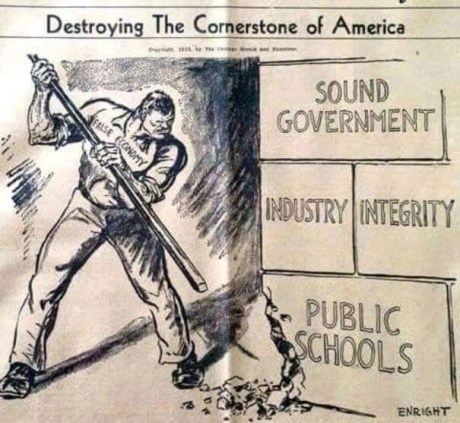
Today, the U.S. Senate Health, Education, Labor, and Pensions Committee will consider the nomination of Betsy DeVos as U.S. Secretary of Education. DeVos and her family have devoted many millions of dollars to destroying public schools and turning the clock back by more than a century. She wants the government to pay tuition at religious schools, voucher schools, for-profit schools, any alternative to public schools is her goal.


American public education is one of the essential institutions of our democratic society. The guarantee to everyone in this country that they could attend a free public school was a hard-fought victory. First, it required persuading the public to tax themselves to pay for schools for the children of the community. Second, it required separating the schools from religious institutions, which had long been the source of education. Third, it meant expanding access to all: to boys and girls, to children of all races and cultures, to children whose first language was not English, and to children with disabilities.


None of of these changes came easily.


And the struggle to provide good schools is ongoing, since so many states base school funding on property taxes, which privileges those who are already advantaged.


DeVos is ignorant of the history of public education in America and the role of public schools in our society. Her hostility to public schools should disqualify her from consideration for this position.


img_3801


Nina Rees thinks Betsy DeVos is a great choice for US Secretary of Education. She would. She is the president and CEO of the National Alliance for “Public” Charter Schools and like DeVos, is devoted to privatization of community public schools.


I first met Nina when she worked for Vice President Dick Cheney as his education advisor. Before that, she worked for the extremely conservative Heritage Foundation. She subsequently worked for ex-felon Michael Milken, when he was entering the education industry.


What you will learn from her article:


The U.S. Department of Education has spent $3 billion on privately managed charter schools, through the administrations of Bill Clinton, George W. Bush and Barack Obama.


What you will will NOT learn from this article:


That charter schools and vouchers have NOT improved education.


That education in Michigan has suffered because of DeVos’ zeal for the unregulated free market.


That the destruction of democratic public education is a crime against children, families, and our society.


That NO high-performing nation in the world has turned public funding for schools over to the free market.


Robert Cotto Jr. says on Jon Pelto’s blog that charter cheerleaders have oversold the “success” of charter schools. Many charters have fewer students with disabilities and fewer English language learners than public schools.


When demographic differences are taken into account, the charter “success story” goes up in smoke.


GaryRubinstein writes here about the myth of YES Prep. It is run by the husband of TFA’s CEO. Wendy Kopp wrote in her last book that the YES Prep charter chain had cracked the code and was showing that every single student was capable of excellence.


Sadly, the latest school rankings show that one of the YES Prep charter schools is among the lowest ranked in the whole state of Texas! Out of some 9,000 schools in the state, a YES Prep charter is one of the 73 lowest-rated.


As Trump would tweet, “So sad!”


Just when I thought I had read everything I needed to know about the DeVos family, along comes this brilliant investigative article by Zack Stanton of Politico. Stanton shows how powerful the DeVos family is, how it works as a tightly coordinated unit, and how it uses its vast wealth to smash the union movement, force school privatization, control the Republican Party in Michigan, and extend its reach to Louisiana, Indiana, Wisconsin, New Jersey, and other states.


The DeVos family, along with the Koch brothers, are the epitome of dark money, the spawn of Citizens United, which removed limits on political spending, enabling billionaires to buy state legislatures.


Dick DeVos ran for the governorship and lost in 2006. The family learned that it was better to work behind the scenes.


“Thanks to the DeVoses, Michigan’s charter schools enjoy a virtually unregulated existence. Thanks to them, too, the center of the American automotive industry and birthplace of the modern labor movement is now a right-to-work state. They’ve funded campaigns to elect state legislators, established advocacy organizations to lobby them, buttressed their allies and primaried those they disagree with, spending at least $100 million on political campaigns and causes over the past 20 years. “The DeVos family has been far more successful not having the governor’s seat than if they had won it,” says Richard Czuba, the owner of the Glengariff Group, a bipartisan polling firm in Michigan. “They have, to some degree, created a shadow state party. And it’s been pretty darn effective.”


“Buoyed by the success in Michigan, the DeVoses have exported a scaled-down version of that template into other states, funding an archipelago of local political action committees and advocacy organizations to ease the proliferation of charter schools in Indiana, New Jersey, Ohio, Iowa, Virginia and Louisiana, among others. At the same time, DeVos-backed PACs have transformed the nature of American political campaigns. By showing the success of independent PACs that answered to a few deep-pocketed donors rather than a broad number of stakeholders associated with a union or chamber of commerce, for instance, the DeVoses precipitated the monsoon of independent expenditures that has rained down upon politicians for the past decade. In the process, they’ve reshaped political campaigns as well as the policies that result from them.


“Ten years after she watched her husband give a concession speech, Betsy DeVos was unveiled as President-elect Donald Trump’s pick for secretary of education. Across the country, public-school advocates and teachers’ unions expressed almost unanimous horror: One of the most effective advocates for breaking down the rules and protections for public schools and teachers would soon be the nation’s most powerful education policymaker.


“But people who’ve been watching the DeVoses closely knew they were seeing something else as well: One of the nation’s most ambitious, disruptive and downright unusual political families finally had a seat in Washington….


“The DeVos family is Dutch, thoroughly so. All four of Richard DeVos’ grandparents emigrated from the Netherlands, and today, the family continues to observe the tenets of the Christian Reformed Church, a Calvinist denomination. Calvinism believes that God has decided our souls’ fates before we are born, assigning them to heaven or hell. It is a duty of practitioners to show their faith in God’s plan by displaying self-confidence, as though they know they have been chosen for blessings in the afterlife. One way to display this confidence is through entrepreneurship (one of the bedrock texts of sociology, Max Weber’s 1905 Protestant Work Ethic and the Spirit of Capitalism, is expressly about the link between Calvinism and economic success)….


“Across those efforts, one constant is the DeVos family’s devout Christian beliefs, and the indivisibility they see between Christian and Calvinistic notions and their conservative politics. “The real strength of America is its religious tradition,” Richard DeVos wrote in Believe!. “Too many people today are willing to act as if God had nothing whatsoever to do with it. … This country was built on a religious heritage, and we’d better get back to it. We had better start telling people that faith in God is the real strength of America!” In the mid-1970s, DeVos made major donations to the Christian Freedom Foundation and Third Century Publishers, an outlet that printed books and pamphlets designed to strengthen the ties between Christianity and free-market conservatism; among those products was a guidebook instructing conservative Christians how to win elections and help America become “as it was when first founded—a ‘Christian Republic.


“Though they aren’t quite as large or wealthy as the DeVoses, the Prince family—even further west, in Holland, Michigan—shares one big trait in common with their in-laws: the idea that patriotism and politics are inseparable from Christianity. Elsa Prince Broekhuizen, Betsy’s mother, donated $75,000 to the successful 2004 ballot measure to ban same-sex marriage in Michigan; four years later, she gave $450,000 to an identical initiative in California. Betsy’s brother, Erik Prince, founded Blackwater, the military contractor that gained notoriety in 2007, when its employees fired into a crowd of Iraqi civilians, killing 17. (In 2009, two former Blackwater employees alleged in federal court that Prince “views himself as a Christian crusader.”)


“Throughout his adult life, Betsy’s father, Ed, donated handsomely to two religious colleges in Michigan, Hope and Calvin, the latter being his wife’s beloved alma mater in Grand Rapids. But his most important contribution—one that has shaped much of the past three decades of conservative politics—came in 1988, when Prince donated millions in seed funding to launch the Family Research Council, the conservative Christian group that became one of the most potent political forces on the religious right. “Ed Prince was not an empire builder,” Family Research Council President Gary Bauer wrote to supporters after Prince’s sudden death in 1995. “He was a Kingdom builder.”


“In the 1960s and ’70s, Ed and Elsa Prince advanced God’s Kingdom from the end of a cul-de-sac just a few miles from Lake Michigan. There, they taught their four children—Elisabeth (Betsy), Eileen, Emilie and Erik—a deeply religious, conservative, free-market view of the world, emphasizing the importance of self-reliance and sending them to private schools that would reinforce the values they celebrated at home, small-government conservatism chief among them….


“When Dick and Betsy DeVos are asked why they’ve chosen to mount a personal crusade for education reform, they often cite their family’s charitable giving, which puts them into contact with scholarship applicants. For years, the DeVoses read reams of personal essays filled with wrenching stories of dire finances and an abiding hope in the transformative impact of education. Those stories, the DeVoses have said, made it clear that something had to change.


“But there’s another reason why Dick and Betsy DeVos want to change America’s schools. They see it as the literal battleground for making a more Christian, God-centered society.


“In 2001, Betsy DeVos spoke at “The Gathering,” an annual meeting of some of America’s wealthiest Christians. There, she told her fellow believers about the animating force behind her education-reform campaigning, referencing the biblical battlefield where the Israelites fought the Philistines: “It goes back to what I mentioned, the concept of really being active in the Shephelah of our culture—to impact our culture in ways that are not the traditional funding-the-Christian-organization route, but that really may have greater Kingdom gain in the long run by changing the way we approach things—in this case, the system of education in the country.”


“Dick DeVos, on stage with his wife, echoed her sentiments with a lament of his own. “The church—which ought to be, in our view, far more central to the life of the community—has been displaced by the public school,” Dick DeVos said. “We just can think of no better way to rebuild our families and our communities than to have that circle of church and school and family much more tightly focused and built on a consistent worldview.”


Folks, if Betsy DeVos is confirmed, which is likely, we will have a major battle on our hands to protect public education and to maintain a separation of church and state. She is not a normal candidate for Secretary of Education. She is a religious zealot and a radical extremist. She will speak of her admiration for all successful schools, including public schools, but don’t believe it. She is a determined foe of public education.


Excellent video on DeVos focusing on failure of charter schools in Detroit/Michigan, her support of for-profit charters; privatization agenda. Less than 10 minutes long; well produced; interviews with parents, film clips, etc.


Please circulate, especially to people who will call Senators on Health, Education, Labor Committee. DeVos hearing is this Tuesday.


Facebook link:

 
YouTube link: https://www.youtube.com/watch?v=47OC7wZbwzM&feature=youtu.be


Carol Burris has been traveling the country, meeting with educators. Parents, and local officials to learn how charter schools are working, how they affect the local public schools.


She wrote a four-part series about the charter mess in California. This article is about Pennsylvania, specifically about Bethlehem, which has a good school system. The schools have to cut services for the neediest kids because of funding lost to charters.


Burris goes on to detail the startlingly corrupt real estate dealings of certain Pennsylvania charter operators. Not only are the hurting community public schools, but they are ripping off taxpayers.