Archives for category: Billionaires

Mike Bloomberg knows there are many ways to buy an election. Such as flooding airwaves with campaign commercials.

Then there is hiring the vice-chair of the state Democratic Parties in Texas and California. In addition to their influence in the party, they just happen to be superdelegates who will get to cast a vote if no candidate wins a majority of votes on the first round. Have any other candidates thought of putting superdelegates on their campaign payroll? Doesn’t it appear kind of like a conflict of interest or a bribe?

Why not hire all the superdelegates to guarantee their second ballot vote at the convention?

FORMER NEW YORK City Mayor Mike Bloomberg has hired two state Democratic party vice chairs in Super Tuesday states with two of the top three highest number of pledged delegates. Bloomberg hired Texas Democratic Party Vice Chair Carla Brailey as a senior adviser to his campaign in December, and he hired California State Democratic Party Vice Chair Alexandra Rooker for a similar role in January.

Both Brailey and Rooker are superdelegates who will likely vote for the Democratic presidential nominee at the party’s national convention this summer. Hiring the leadership of a state party doesn’t appear to break any campaign laws, but it indicates Bloomberg’s intent to effectively purchase political support, said Brendan Fischer, the federal reform program director at the Campaign Legal Center. “This does seem to fit a longstanding pattern of Bloomberg using his billions to help generate support among political elites,” he said.

Rooker is one of two members of Bloomberg’s campaign staff who also sits on the Democratic National Committee’s rules committee, which recommends rules for the convention, the convention agenda, the convention’s permanent officers, amendments to the party’s charter, and other resolutions. In November, the month he entered the presidential race, Bloomberg gave $320,000 to the DNC, his first contributions to the committee since 1998. (He was a registered Republican from 2001 to 2007, after which he became an independent. He registered as a Democrat in 2018.) He also donated $10,000 to the Texas Democratic Party, where Brailey has been vice chair since June 2018, as well as $10,000 to the California Democratic Party. Brailey, Rooker, and the Bloomberg campaign did not respond to requests for comment on their hiring.

Brailey rose through the local Washington Democratic Party structure, as a protege of former Mayor Adrian Fenty, who was himself the patron of current D.C. Mayor Muriel Bowser, a high-profile backer of Bloomberg.

Bloomberg will appear on the ballot for the first time on Super Tuesday, March 3. His campaign has poured tens of millions of dollars into both Texas and California where there are 228 and 416 delegates up for grabs, respectively.

In California, Bloomberg has hired a number of party alums in addition to Rooker, who was also previously a vice president and shop steward for the Communication Workers Association Local 9400. Former state Democratic Party executive director Chris Masami Myers is leading Bloomberg’s California strategy, and Courtni Pugh is a senior adviser focusing on outreach to black and Latino voters; Pugh previously led Sen. Kamala Harris’s California strategy before she dropped out of the presidential race in December. Bloomberg has spent at least $46.3 million on television ads in California so far, has dozens of offices there, and his campaign has said they planned to hire at least 800 staffers in the state. (They had hired around 300 staffers by the first week of February.)

.

By now, the California Charter Schools Association knows that they are harming public schools, where 80-90% of California’s students are educated.

By now, the CCSA knows that charter schools do not get higher test scores than public schools.

By now, they know that their industry is rife with corruption and fraud, and some of its leaders are serving jail time or on the lam.

By now, they know that charters do not have a secret sauce.

By now, they know that all they fight for is survival and power.

But they are pouring millions into the four contested seats on the Los Angeles Unified School District races, hoping to regain control so they can continue to do the bidding of Eli Broad, Reed Hastings, Michael Bloomberg, and Bill Bloomfield.

Here is the latest from the LA Education Examiner in the closing days of the campaign. 

See here for the money dump in the closing days of the campaign, with nearly one million going to a charter candidate running against Scott Schmerelson.

Here is Howard Blume in the Los Angeles Times, reporting on the ugly smear campaign against Scott Schmerelson. 

Charter supporters are angry at Schmerelson, first because he supports public schools, but also because he revealed that more than 80% of the LA charters have vacancies.

Blume writes:

A million-dollar attack campaign is underway portraying Los Angeles school board member Scott Schmerelson as greedy, corrupt and determined to score fast cash by exposing children to deadly vaping and McDonald’s French fries.

One mailer — which included a cartoonish image of Schmerelson, who is Jewish, bedecked with a gold dollar-sign chain and holding a cigar and fistful of cash — came under fire as anti-Semitic and its use was halted.

Behind the surge of negative mailers in this West San Fernando Valley board district is an intense effort by charter school supporters to defeat Schmerelson and elect Marilyn Koziatek, a district parent who works at a local charter school managing community outreach efforts.

The pivotal race could tip the board majority toward the protection and expansion of charter schools, which enroll about 1 in 5 district students. Charter advocates are especially concerned about a new law that will soon give school boards more authority to reject new charters.

Blume reports that the charter industry has stopped sending out its antiSemitic image of Schmerelson but that’s a meaningless gesture since it was already sent out in a mass mailing.


Mark Green was a young, vigorous, popular progressive who won the Democratic primary for mayor in 2001. New York City is overwhelmingly Democratic, and usually the Democratic nomination is enough to assure election.

But Mark Green faced an unusual Republican opponent, billionaire MIchael Bloomberg. No one knew much about Bloomberg, but he had the endorsement of Republican Mayor Rudy Guiliani, who had turned into a symbol of resilience and heroism after the devastating attack of September 11, 2001.

Green is now supporting Elizabeth Warren.

Mark Green writes here about what happened next in 2001.

Three weeks before the New York mayoral election in November of 2001, I got a call from Mark Mellman, the pollster working on my race against Michael Bloomberg.

“Well, I have good and bad news. The good news is that I’ve never had a client 20 points ahead this late in a campaign who lost. The bad news is that Bloomberg is spending a million dollars a day — not a month but a day — and gaining a point a day.” I quickly did the math and shuddered.

I lost the race by a margin of 50% to 48%, after being outspent $73.9 million to $16.3 million. Ironically, I raised more money than any other U.S. mayoral candidate in history, making 30,000 phone calls and receiving 11,000 contributions. But Mike, who didn’t have to make phone calls, spent the most money ever on a mayoral campaign. He simply wrote checks.

It’s no great surprise that after buying the mayoralty, Bloomberg decided to see if he could do the same with the presidency. There have been other self-funded candidates, of course, and they have all failed. Ross Perot spent $79 million in 1992 and Steve Forbes $60 million in 2000.

But if Mike gets the nomination, his spending already has dwarfed what they spent. He is a bank posing as a person.

I know what that looks like. In the closing weeks of our 2001 race, I had the helpless feeling that there was no strategy that could counter his spending. Everywhere I went I saw or heard a Bloomberg ad: in between innings during the Yankees’ World Series games, on hip-hop stations, on walls in Chinatown, on the rotating billboard at a Knicks game, on mailings that piled up in the lobbies of buildings across the city. He even sent small radios with his name on them….

Bloomberg does have some solid liberal credibility — on climate, guns and public health — but on many core issues his record is a liability. He has called Social Security “a Ponzi Scheme.” He opposed raising the minimum wage. He blamed the 2008 Great Recession, in part, on laws against predatory lending. He denounced Obamacare and Dodd-Frank. He enthusiastically endorsed the Bush-Cheney ticket in 2004, was an apologist for the Russian takeover of Crimea and has a long record of making demeaning comments about women. And, as late as last year, he was still advocating a “stop-and-frisk” approach and defending his record on the practice.

Given Bloomberg’s shaky performance in the Nevada debate, it’s hard to feel confident he can reassure liberal Democrats on those issues.

Based on my knowledge of him from our own two debates, as well as his record as mayor and now presidential candidate, I have three questions about his prospects for 2020:

First, will his ability to carpet-bomb the country with ads be enough to overcome the liabilities of his record in the minds of millions of Democrats? Maybe. That certainly worked in New York City in 2001.

Second, if no candidate wins enough delegates to secure a majority, will Bloomberg have a large enough bloc of convention delegates to influence who the party’s choice of a nominee will be on a second or third ballot? Again, the answer is maybe.

Finally, in the event that Bloomberg secured the nomination, would liberals embrace him if Trump is the alternative? Here, there’s no maybe, even for a Warren supporter like me. After four years of watching Trump try to destroy democracy, the answer is yes.

Audrey Watters asks the question that we should all be asking: is our democracy for sale to the candidate with the most billions? 

Apparently our schools sold out years ago when money was dabbled before them.

People who take money from that powerful education foundation — you know the one, the one that turns 20 years old this year — always insist to me that they’ve never been compelled to change their policies or practices. Of course, it doesn’t have to coerce its grantees to say and do things. People self-censor. They shape their initiatives to suit the foundation’s philosophy and its goals. They value the things the foundation says it values; they measure the way the foundation says it measures. Because if they rely on the foundation for funding, they know to fall in line. They needn’t be told. That’s how the power of philanthropy works. It sets the agenda. Personalized learning. The Common Core. Charter schools. Measures of Effective Teaching. It didn’t push for these ideas because that’s what people wanted. It helped convince politicians that these were the ideas that education needed. That is to say, education policy has not been shaped by democratic forces as much as it has been by philanthropic ones — by the billionaires who wield immense political power through their “charity.”

Actually, I don’t blame schools—few of whom had a say in decisions to follow the Gates money trail—so much as I blame the policy elites, who fell in love with the idea of sitting at the feet of billionaires and following their commands. The billionaires didn’t know what they were doing, but they were so confident in the virtues of testing, accountability, competition, choice. Who could resist?

Bill Raden of Capital and Main writes here about the charter school advocates’ frantic efforts to pour millions of dollars and tons of lies into the race for four school board seats in Los Angeles. They are churning out scurrilous and defamatory lies about Jackie Goldberg and Scott Schmerelson, both of whom are veteran public school educators.

Schmerelson has received a heavy dose of filthy fliers that call him greedy, unethical and unfit, very likely because he had the nerve to reveal that at least 80% of the city’s charter schools have empty seats. In Los Angeles, the charter lobby despises critics who defy them.

If you live in their districts, vote for Jackie Goldberg, Scott Schmerelson, George McKenna and Patty Castellanos.

Stop Eli Broad, Reed Hastings, Betsy DeVos, Donald Trump, and Bill Bloomfield from buying seats on the LAUSD school board.

Ross Douhat is a conservative columnist for the New York Times. Maybe he wrote this column to help Trump, yet it rings true.

He writes:

For a long time the notion of a Michael Bloomberg presidential candidacy seemed like a Manhattan fancy, a conceit with elite appeal but no mass constituency, a fantasy for Acela riders who imagine that the American people are clamoring for a rich person’s idea of centrism.

This was especially true in the days when Bloomberg would advertise his interest in a third-party candidacy. Third parties are generally founded on ideas that elites are neglecting, like the combination of economic populism, social conservatism and America-first foreign policy that propelled Donald Trump to power. Whereas Bloombergism is elite thinking perfectly distilled: Social liberalism and technocracy, hawkish internationalism and business-friendly environmentalism, plus a dose of authoritarianism to make the streets safe for gentrification.

But with a populist in the White House, a socialist winning primaries, a Democratic electorate desperate for a winning candidate and an establishment desperate for a champion, Bloomberg has become a somewhat more plausible presidential candidate than I imagined even six months back. So it’s worth pondering exactly what his still-highly-unlikely, but not-entirely-unimaginable nomination might mean, and what he offers as an alternative to both his Democratic rivals and to Donald Trump.

Inside the Democratic Party, Bloomberg’s ascent would put a sharp brake on the two major post-Obama trends in liberalism: The Great Awokening on race and sex and culture, and the turn against technocracy in economic policymaking.

Yes, Bloomberg has adapted his policy views to better fit the current liberal consensus, and his views on social issues were liberal to begin with. But he has the record of a deficit and foreign policy hawk, the soul of a Wall Street centrist, and a history of racial and religious profiling and sexist misbehavior. More than any other contender, his nomination would pull the party back toward where it stood before the rise of Bernie Sanders and Black Lives Matter and #MeToo, and root liberalism once more in professional-class interests and a Washington-Wall Street mindmeld.

These are good reasons to assume that he cannot be the nominee, and excellent reasons for social progressives and socialists alike to want to beat him. The only way they will fail is if Bloomberg succeeds in casting himself as the unusual answer to an unusual incumbent — combining the Democratic fear of a Trump second term, his own reputation for effective management and the promise of spending his fortune to crush Trump into a more compelling electability pitch than the race’s other moderates.

But Democrats considering this sales pitch should be very clear on what a Bloomberg presidency would mean. Bloomberg does not have Trump’s flagrant vices (though some of his alleged behavior with women is pretty bad) or his bald disdain for norms and rules and legal niceties, and so a Bloomberg presidency will feel less institutionally threatening, less constitutionally perilous, than the ongoing wildness of the Trump era — in addition to delivering at least some of the policy changes that liberals and Democrats desire.

However, feelings can be deceiving. Trump’s authoritarian tendencies are naked on his Twitter feed, but Bloomberg’s imperial instincts, his indifference to limits on his power, are a conspicuous feature of his career. Trump jokes about running for a third term; Bloomberg actually managed it, bulldozing through the necessary legal changes. Trump tries to bully the F.B.I. and undermine civil liberties; Bloomberg ran New York as a miniature surveillance state. Trump has cowed the Republican Party with celebrity and bombast; Bloomberg has spent his political career buying organizations and politicians that might otherwise impede him. Trump blusters and bullies the press; Bloomberg literally owns a major media organization. Trump has Putin envy; Bloomberg hearts Xi Jinping.

In our era of congressional abdication, all presidents are prodded or tempted toward power grabs and caesarism. But Bloomberg’s career, no less than Trump’s, suggest that as president this would be less a temptation than a default approach. And the former mayor, unlike the former “Apprentice” star, is ferociously competent, with a worldview very much aligned with the great and good, from D.C. to Silicon Valley — which means that he would have much more room to behave abnormally without facing a Resistance movement of activists and journalists and judges.

To choose Bloomberg as the alternative to Trump, then, is to bet that a chaotic, corrupt populist is a graver danger to what remains of the Republic than a grimly-competent plutocrat with a history of executive overreach and strong natural support in all our major power centers.

That seems like a very unwise bet. Democrats who want to leverage Trump’s unpopularity to move the country leftward should support Bernie Sanders. Democrats who prefer a return-to-normalcy campaign should unite behind a normal politician like Amy Klobuchar. Those who choose Bloomberg should know what they’re inviting: An exchange of Trumpian black comedy for oligarchy’s velvet fist.

David Dayen, executive editor of The American Prospect, expresses his concern about billionaire Michael Bloomberg, who is a plutocrat and an autocrat.

In many ways, Dayen writes, Bloomberg is like Trump, only richer. How strange would it be for the Democrats to nominate a Republican to run against Trump.

He writes:

This is an astonishing report about the destruction and privatization of public schools in Oakland, California, and the billionaires who facilitated the looting of that city. The article by Eugene Stovall appeared in “Black Agenda Report.” The audacity of this attack on public education is astonishing. The mechanism for the destroyers were graduates of the Broad Academy, known as Broadies. Since billionaire Eli Broad gave Yale University $100 million to take charge of his program, someone should warn Yale about its record.

Read it all. It will take your breath away.

Stovall writes:

Eli Broad (rhymes with “toad”) conconcted a scheme to privatize Oakland’s public schools and produce a revenue stream for his billionaire cronies.

Operating unethically and illegally, Broad managers used their training to cripple and plunder Oakland’s schools.”

Eli Broad is a liberal Democrat. He opposes Trump’s Muslim ban, immigration policies and withdrawal from the climate change treaty. In fact, like Democratic billionaires Tom Steyer and Michael Blloomberg, Broad opposes Trump’s entire right wing agenda. However, just as the Trump Foundation created the Trump University scam, the Eli Broad Foundation created the Broad Superintendent Academy, an educational enterprise that has become so successful that it is now associated with the home of the Skull and Bones Society, Yale University. But despite its aura of respectability, the Broad Superintendent Academy is no less a scam than Trump University.

Billionaires Want More

Eli Broad created two Fortune 500  companies, Kaufmann-Broad Homes and SunAmerica Bank. With an estimated net worth of $6.7 billion, Eli Broad ranks as Forbes  Magazine’s 78th wealthiest man in the United States. But like many billionaires who create mechanisms to increase their wealth, Broad created a “non-profit” academy as his entré into the private education market. The Broad Superintendent Academy attracts applicants who willingly pay exorbitant tuition fees for the chance to get placed in a top management public education position. Broad academy applicants do not need educational degrees or teaching certificates. Neither are they experienced teachers or successful school administrators. The Broad academy is uninterested in strategies for improving student achievement and does not teach its students about fundamental educational issues, pedagogies and methodologies. The Broad academy only indoctrinates and commits its students to the privatization of public education and the generation of revenues for private corporations. Broad Academy attendees are taught the disruptive management tactics needed to ignore “best educational practices.” They are taught how to overcome objections when mandating school closures and school property sell offs to the billionaire-owners of private schools. When Broad placed his academy graduates in management positions at the Oakland Unified School District, they left a trail of fiscal mismanagement, budget overruns and demoralized staff, students and teachers. Operating unethically and illegally, Broad managers used their training to cripple and plunder Oakland’s schools.

The Broadies Who Plundered Oakland’s Schools

In 1998, Eli Broad recruited Jerry Brown, the former Governor of California and a former presidential contender, to become mayor of Oakland. Broad needed someone with Brown’s political clout with the Democratic Party to implement his plan to privatize Oakland’s schools. Broad had been a close personal friend of Jerry Brown’s father, Pat Brown, and had financed all of Jerry Brown’s political campaigns. Now Broad realized California’s top Democrat and his control over the statewide Democratic Party machine gave him a unique opportunity to make money from private education.

Broad’s scheme to privatize Oakland’s public education resources required the support of other billionaires capitalizing on the private education market. Netflix founder, Reed Hastings, a Bay Area resident with a net worth of $3.7 billion, was associated with the multi-million dollar Rocketship Charter Schools. The late founder of The Gap, Don Fisher, with a net worth of $3.3 billion, was associated with the Knowledge is Power Program (KIPP), one of the largest chains of charter schools in the country. With a net worth of $3.5 billion, John Doerr, partner in the investment firm, Kleiner, Perkins, Caufield & Byers, the firm that brought Google and Amazon to the market, cofounded the New Schools Venture Fund which sucks public school resources into for-profit K-12 corporations. Another critical partner in Broad’s clique of billionaires was the bishop of Oakland’s catholic diocese, a representative of the multi-billion dollar, worldwide Vatican empire. With its profound interest in co-opting public funds and real estate for its own network of parochial schools, Oakland’s catholic bishop gave Broad’s unholy coalition a solid block of votes that not only put Jerry Brown in City Hall, but changed Oakland’s charter into the ‘strong mayor” form of government, that gave “Boss” Brown the power function as Eli Broad’s “bag man.” In return for its electoral support, the diocese of Oakland received a multi-million dollar cathedral on the downtown shore of Lake Merritt.

Once “Boss” Brown controlled City Hall, Reed Hastings went into action. Hastings funded another charter amendment that gave the mayor the authority to pack the school board with his own unelected appointees. Greasing the wheels of the Democratic machine, Hastings financed the passage of a State Assembly bill that permitted charter schools to operate without  accreditation and to hire teachers without  teaching credentials. Then Hastings funded the Proposition 39 campaign to force local school districts to share revenues with charter schools. “Boss” Brown’s buddy, Democratic Governor Gray Davis, who later was recalled on corruption charges, put Reed Hastings on the State Board of Education. In the meantime, Don Fisher gave Jerry Brown’s wife, Gust Brown, the position of CEO over The Gap Corporation.

Getting Control Of The Schools … And The Money

In 2001, the Oakland Unified School District had a $37 million budget deficit. The district’s fiscal managers decided to resolve the shortfall by borrowing from its construction fund, a practice other California school districts in similar situations routinely used. But Brown and Broad saw the school deficit as an opportunity to advance their scheme.

Brown contacted Tom Henry, CEO of the Fiscal Crisis and Management Team (FCMAT), a firm located in Sacramento and staffed by lobbyists and political hacks. Brown used Henry’s services, on occasion, when he was governor. FCMAT did “hit” jobs for anyone willing to pay. Brown paid Tom Henry to prevent Oakland from solving its fiscal problem. FCMAT lobbied the State Attorney General, Bill Lockyer, the former Democratic Assemblyman from Alameda, to rule that Oakland’s plan to borrow construction funds was a violation of state and local law. Then Henry worked with Don Perata, the State Senator for Alameda County, to lobby a bill through the state legislature that forced the Oakland school district to accept a $100 million loan to cover its $37 million shortfall. In addition, the bill put the Oakland school district under the control of a state administrator to be appointed by Jack O’Connell, the State Superintendent of Public Education. When Jack O’Connell campaigned for state superintendent, he received financial support from Eli Broad’s billionaire cabal. Reed Hastings contributed $250,000, John Doerr $205,000 and Eli Broad, himself, contributed $100,000 to O’Connell’s campaign. With the state takeover of Oakland’s schools, O’Connell agreed to appoint anyone “Boss” Brown wanted. Thus Eli Broad and his cronies got complete control over the $63 million slush fund  forced on the Alameda County tax payers. Jerry Brown described the state takeover as a “total win” for Oakland’s schools. In reality, the state takeover was a total win for Eli Broad and his billionaire cronies. For the tax payers forced to repay the loan and for the Oakland school children whose schools were plundered by malicious billionaires, the state takeover was a disaster.

The Table Was Set And The Feasting Began

The Democratic state superintendent of education, Jack O’Connell, appointed Randolph Ward, a graduate of Broad’s superintendent academy, as Oakland’s state administrator. Ward appointed Arnold Carter, another Broad academy graduate, to serve as his chief of staff. Both state administrators appointed a bevy of Broadies  to fill the Oakland school district’s top management positions. Then Ward implemented Broad’s privatization agenda. He closed public schools and opened charter schools. He created additional management positions for Broad academy graduates and issued multi-million dollar consultation and construction contracts to private corporations. Randolph Ward gave Broad’s billionaire cronies complete access to the $63 million slush fund created by top Democrats, Jerry Brown, Bill Lockyer, Don Perata, Jack O’Connell, Tom Henry as well as other members of “Boss” Brown’s Democratic machine.

When the state took over the Oakland schools in 2002, Randolph Ward fired the superintendent, Dennis Chaconas. When Ward resigned in 2006, Broadie Kimberly Statham replaced him. A year later, Statham left and her chief of staff, Vincent Matthews, another Broadie, took her place.

In 2008, Oakland Assemblyman Sandre Swanson broke with “Boss” Brown and introduced a bill to force the state to relinquish its control over Oakland schools. Eli Broad gave a Sacramento lobbyist $350,000 to oppose Swanson’s legislation, but Swanson’s bill passed and local control was returned to the Oakland School Board. In July 2009, the school board hired Anthony “Tony” Smith as the district’s superintendent.

Smith was not associated with Eli Broad. However, even though local school board resumed control over the schools, Eli Broad was not finished, He funded a front group, Greater Oakland [GO], which financed the election of five Broadies to the Oakland school board. In 2014, the Broadie school board forced school superintendent Tony Smith to resign and appointed another graduate from Broad’s academy, Antwan Wilson , Oakland’s next school superintendent, resuming Broad’s decade-long privatization scheme.

A Decade of Corruption

Under Randolph Ward, Oakland Schools struggled with the overwhelming debt imposed by the Democratic Party machine. When Ward left Oakland, millions of dollars went missing with him. Though FCMAT received a multi-year contract to help manage the debt, Tom Henry provided little substantive support, financial or operational. In 2007, Jerry Brown left Oakland for his cattle ranch in Northern California. In its 2007-08 report, an Alameda County grand jury investigation found that the Oakland Unified School District had been looted.

Between 2003 and 2006, Ward shut down 14 public schools and opened 13 charter schools. He increased the district’s shortfall by nearly $15 million. Ward’s successor, Kimberly Statham, another Broadie, opened 4 charter schools and Broadie Vincent Matthews, who followed Stratham as state administrator, opened 9 charter schools. Under state control, the district’s debt ballooned from $37 million to $89 million while school enrollment, the district’s primary source of funding, dropped from 55,000 in 2002 to 38,000 in 2009. When Assemblyman Sandré Swanson forced the state to return local control, Oakland’s schools had $5.6 million less than what was reported and a total of $9 million unaccounted for and completely missing. But with the return of local control, the district’s fiscal mismanagement problems only worsened. Eli Broad now directed his Broadie school board to support his schemes. 

Antwan Wilson: The Most Corrupt Broadie Of Them All 

When the Broadie school board replaced Tony Smith with Antwan Wilson, it hired a thoroughly corrupt, incompetent and morally reprehensible superintendent to run the Oakland Unified School District. Ignoring all budgetary, ethical and legal constraints, Wilson zealously implemented Broad’sprivatization plan. Wilson overspent the school district budget by overpaying Broadie administrators and conniving with Broadie consultants. In 2015, though the school board authorized only $10.4 million, Wilson paid consultants $22.6 million. The board approved only $7.1 million for administrators and supervisors, but Wilson spent $22.3 million. From July 2014 to January 2015, Wilson spent $22.3 million on district office managers while Smith spent only $13.1 million the entire previous year. From 2013-2014, Tony Smith spent $10 million on classified managers, but in 2015-2016, Antwan Wilson spent $22.3 million. Under Wilson, the number of students shrunk, but spending for administrators and supervisors with teaching certificates grew from $13.9 million in 2013-2014 to $20 million in 2015-2016. Wilson increased spending on outside consultants from $22.7 million in 2013-2014 to $28.3 million in 2016-2017. In Wilson’s last year with Oakland schools, he exceeded the budget for consultants by 32 percent.

These revelations galvanized Tom Henry’s FCMAT into action. Henry immediately lobbied for another state take over even as he collaborated with the Broadie school board to close even more schools and make even more valuable real estate available to billionaire-owned charter schools. But without Boss Brown’s backing, Henry was unsuccessful in getting Governor Gavin Newson’s support for another state takeover.

Open the article and read the ending. It doesn’t get better for the students of Oakland. Eli Broad, Jerry Brown, and their allies used Oakland as their Petri dish. Oakland was raided and looted. Antwan Wilson left Oakland to become chancellor of the D.C.schools, where he was booted out after seeking preferential treatment for his own child. Upon Wilson’s abrupt departure, the mayor of D.C. replaced him with Lewis Ferebee, superintendent of Indianapolis, who is also a graduate of the Broad Academy.
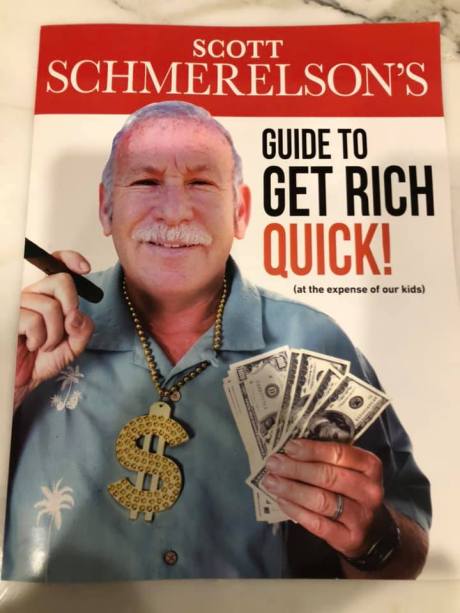
A front group for the California Charter Schools lobby, which calls itself “Families and Teachers United,” released a flyer that attacked school board member Scott Schmerelson, a pro-public school member of the LAUSD school board and well-qualified educator. Schmerelson has been endorsed by every Democratic club in Los Angeles.

The scurrilous flyer accuses him of investing in mutual funds that include products that are harmful to children (tobacco). Anyone whose pension is invested in large mutual funds knows that individual shareholders do not choose the stocks in the fund’s portfolio. My own pension fund includes companies I find abhorrent and there’s nothing I can do about it.

The flyer accuses Schmerelson of “double dipping” because he collects a pension for his decades of service as an educator in the LAUSD schools and a salary as a board member, like other board members.The flyer does not mention that board salaries were increased in 2017 based on the recommendation of an independent commission.

Should he give up his well-earned pension? Of course not! Should he refuse to take the same salary as other board members? Of course not!

Who paid for this vile, lying, unethical anti-Semitic ad?

Ad paid for by Families and Teachers United, sponsored by California Charter Schools Association Advocates. Committee major funding from
Charter Public Schools PAC
Not authorized by a candidate or a committee controlled by a candidate.
Funding details at http://www.fppc.ca.gov.

This may be the most expensive school board election in LA history, even though the billionaires have no ideas other than charter schools. None.

Who are they? Blogger Sara Roos names names. 

How about full public disclosure of the income and investments of the billionaires who fund the CCSSA?

Sara declined to reproduce the flyer, so as not to give more visibility to this trash.

Methinks the charter billionaires  are angry at Scott for telling the public that more than 80% of LA’s charters have empty seats.

Schmerelson, a man of unblemished integrity, responded to the anti-Semitic flyer with a statement denouncing the depths to which the charter lobby is willing to sink. He notes that the group that produced the flyers by the billionaire Waltons and Reed Hastings.

The election is March 3 but early  voting has started.  VOTE  FOR SCOTT SCHMERELSON!

86390772_10157937802082866_79698186238689280_n

The munificently-funded Thomas B. Fordham Institute, based in D.C., controls Educatuon Policy, graduation requirements, curriculum, and testing in Ohio. Mr. Fordham, for whom the institute is named, had no known interest in education, but his namesake is part of the rightwing ALEC nexus, where contempt for public schools, hatred for unions, contempt for gun control and environmental regulation are reflexive.

Laura Chapman, who lives in Ohio, writes:


This numbers game is routinely pushed by the Ohio arm of Thomas B. Fordham Institute/Foundation. Oped’s written by employees at criticize the Fordham routinely criticize teacher unions for pointing out the debilitating affects of poverty on students. In a typical rhetorical move, the Fordham “expert” will find one exceptional school with an “A” rating of the state report card rigged to ensure few schools are rated A. Then when you read in detail, you will see that the most exceptional thing about this school is really rare. The same principal has been there for 18 years, lives in the community, and has an uncommon level of trust from her community, the teachers, and students. Test scores were a byproduct of that not the aim of her work as an educator.

In Ohio, the writer most responsible for this misleading journalism and “research” is Aaron Churchill, the Institute’s Ohio Research Director. The Institute says this: Since 2012, Aaron has worked on “strengthening” Ohio policy on standardized testing and accountability, school evaluation, school funding, educational markets, human-resource policies and charter school sponsorship. He writes for the Fordham’s blog, the Ohio Gadfly Daily and contributes op-eds to the Columbus Dispatch, Cleveland Plain-Dealer, Dayton Daily News, and Cincinnati Enquirer. Aaron previously worked for Junior Achievement.”

He has not an ounce of documented experience in teaching or studies of education as an undergraduate or graduate student. He gets a free pass on almost everything he submits to the Columbus Dispatch, Cleveland Plain-Dealer, Dayton Daily News, and Cincinnati Enquirer. These local newspapers are shrinking and have few if any staff available for questioning this “throughput” of misleading but ready to post news.