Archives for category: Biden

He begins:

Robert Kuttner, co-editor of The American Prospect, assesses the role of Senator Manchin in sinking President Biden’s signature legislation. Manchin surely sunk his constituents: West Virginia is one of the poorest states in the nation. He says he was worried about the cost, especially the cost of lifting children out of poverty. But economists lowered their estimates of economic growth for 2022 after Manchin said no, and the stock market tumbled. What a guy.

Kuttner writes:

You can understand the pent-up rage and frustration. With his yacht and his Maserati, his fake concern for the suffering people of West Virginia, his bad economics and his penchant for moving the goalposts, Joe Manchin III is a first-class phony.

But that doesn’t make rage smart politics. And there is another unfortunate R-word at play this week in Bidenland—recriminations.

Let’s see, who screwed up? Was it Biden for not just taking the $1.75 trillion deal when Manchin made his bargain with Chuck Schumer in July? (Except that Manchin left himself some wiggle room.)

Was it Biden for not shelving Build Back Better in favor of making voting rights legislation the top priority? (Except that Manchin is almost certain to screw his fellow Democrats on this, too.)

Did the Progressive Caucus overplay its hand? Did Pelosi mess up the very complex bargain between progressives and corporate Dems over the bipartisan infrastructure deal? Was it a mistake to whip the House Democrats to pass Build Back Better at $2.2 trillion in the hope of then giving up some of it to Manchin?

Jeezus, give these people a break. They have been dealt a really lousy hand, and Manchin has all the cards.

Jan Resseger, one of our best informed bloggers and social justice advocates, lauds President Biden’s Build Back Better program for its benefits for children. It would end decades of policies that punish poor children. Our nation has dramatically reduced poverty among the elderly, but neglected our children.

She writes:

The U.S. House of Representatives finally passed President Biden’s infrastructure plan last Friday. The Senate passed it a while ago, and the bill is headed to Biden’s desk for signature.  At the same time, Democrats in the U. S. House of Representatives pledged that if the Congressional Budget Office confirms cost estimates for the Build Back Better Bill, Democrats in the House will pass the current version of the plan and send it on to the Senate for consideration. For months, Congress has been debating the programs that are part of this plan, and even if Congress passes it, it won’t be perfect.

Even if imperfect, however, the Build Back Better Bill in its current form would signify a truly revolutionary investment in America’s children. That is because the United States has, for decades, utterly failed to use government to begin to eradicate a morally reprehensible level of childhood economic inequality.

Cara Baldari of the First Focus Campaign for Children explains: “For the first time in generations, we are on the precipice of making serious and long-term progress to reduce our stubbornly high rate of child poverty in the United States. Historically, the United States has had a significantly higher rate of child poverty than other developed countries because we have continually failed to sufficiently invest in our children. While the establishment of Social Security has permanently reduced poverty for seniors, children have remained the poorest group in America. This situation is not due to a lack of evidence on what works to reduce child poverty, but rather the lack of political will to act.”

Since 1997, families who earn enough income to pay federal income taxes have benefited from a tax credit for each child. Last spring’s American Rescue Plan Covid-relief bill made the full Child Tax Credit available to children in families with low earnings or without income, and it increased the credit’s maximum amount—$2,000 per-child last year— to $3,000 per child and $3,600 for children under age 6—but only through the end of 2021. Without the extension of this reform, many children will fall back into deep poverty in 2022.

Balderi presents some recent history: In 2015, advocates for children “worked with Reps. Lucille Roybal-Allard (D-CA) and Barbara Lee (D-CA) to secure federal funding for the landmark National Academy of Sciences study, A Roadmap to Reducing Child Poverty, which was published in 2019. This study, written by a committee of experts… confirmed that… providing families with flexible cash assistance through a monthly child allowance was the most effective way to combat child poverty, reduce racial-economic inequality, and improve children’s long-term outcomes.”  In a tragic irony, until this year families without income or with income so low they payed little in federal income taxes could not receive the full tax credit, while middle class and even wealthy parents could receive the full credit, thereby reducing their federal income tax.

Last week the Center on Budget and Policy Priorities examined several provisions of the Build Back Better Bill which will, if the law is passed in its current draft form, reduce racial disparities.  The brief leads with the Bill’s provision to reduce child poverty by extending last spring’s expansion of the Child Tax Credit: “Build Back Better extends the American Rescue Plan’s expansion of the Child Tax Credit for 2022, which is expected to lift 4 million children above the poverty line and narrow the difference between poverty rates for Black and white children by 44 percent (compared to what the rates would be otherwise) and to narrow the difference between the poverty rates for Latino and white children by 41 percent.  Build Back Better also permanently ensures that the full Child Tax Credit is available to children in families with low or no earnings in a year.This is particularly important for Black and Latino children, about half of whom received a partial credit or no credit at all before the Rescue Plan expansion because their families’ incomes were too low, compared to about 20 percent of white children.”

In late October, a Center on Budget and Policy Priorities Senior Research Analyst, Claire Zippel reported data collected from late July through September by the U.S. Census’s Household Pulse Survey. These data documented that, “Some 91 percent of families with low incomes (less than $35,000) are using their monthly Child Tax Credit payments for the most basic household expenses—food, clothing, shelter, and utilities—or education… Many of these households are receiving the full Child Tax Credit for the first time thanks to the American Rescue Plan’s credit expansion. The Rescue Plan temporarily increased the credit amount, provided for the credit to be paid monthly rather than once a year at tax time, and halted a policy that prevented 27 million children from receiving the full credit because their parents earned too little or lacked earnings in a given year.”

How did parents use the money?  Zippel continues: “Among households with incomes below $35,000 who received the Child Tax Credit, 88 percent spent their payments on the most basic needs: food, clothing, rent, a mortgage, or utility bills.  The Child Tax Credit payments also helped many parents and other caregivers invest in their children’s education, Pulse data suggest. Some 40 percent of families with low incomes used their Child Tax Credit payments to cover education costs such as school books and supplies, tuition, after-school programs, and transportation to and from school. (In some cases, these expenses may be for adults’ own education. About 5 percent of adults in low-income households with children are enrolled in school, other Census data show.)

The NY Times’ Claire Cain Miller adds that in its current form in the U.S. House of Representatives: “The Build Back Better Bill also includes extensive investment in pre-Kindergarten for 3 and 4-year-olds and assistance for parents to afford childcare as well as dollars to ensure that “teachers in child care classrooms be paid a livable wage, equivalent to that of elementary teachers with the same credentials… Also as part of the proposal, pre-K lead teachers must have a bachelor’s degree in early childhood education or a related field, though they would be given six years to get the degree with some exemptions based on professional experience.”

Nobel Prize winning economist Paul Krugman strongly endorses these and other proposals to help families and their children: “Democrats may—may—finally be about to agree on a revenue and spending plan. It will clearly be smaller than President Biden’s original proposal, and much smaller than what progressives wanted. It will, however, be infinitely bigger than what Republicans would have done, because if the G.O.P. controlled Congress, we would be doing nothing at all to invest in America’s future. But what will the plan do?  Far too much reporting has focused mainly on the headline spending number.”

Krugman continues: “So let me propose a one-liner: Tax the rich, help America’s children.  This gets at much of what the legislation is likely to do. Reporting suggests that the final bill will include taxes on billionaires’ incomes and minimum taxes for corporations, along with a number of child-oriented programs.”

Krugman, the economist, comments on the economic arguments for Congressional passage of this bill: “(T)here is overwhelming evidence that helping children, in addition to being the right thing to do, has big economic payoffs. Children who benefited from safety-net programs like food stamps became healthier, more productive adults. Children who were enrolled in pre-K education were more likely to graduate from high school and go to college…. As I’ve argued in the past, the economic case for investing in children is even stronger than the case for investing in physical infrastructure.”

Krugman also believes that President Biden’s Build Back Better Bill, philosophically conforms to American political tradition: “Remember, we are the nation that basically invented universal education… America led the way in creating ‘common schools’ that were meant to include students from all social classes, and were justified by many of the same arguments now being made for universal pre-K and other forms of aid to children. So when Republicans denounce pro-child policies as socialist and try to promote private schools, they, not Democrats, are rejecting our nation’s traditions.”

This article by Ed Montini in the Arizona Republic explains the childish behavior of Republican leaders, who engage in taunts instead of reasoned discourse about their agenda. They don’t want to expand Medicare. They don’t want universal pre-K. They don’t support efforts to combat climate change. They oppose paid family leave for families in need after surgery or childhood. They are against a federal guarantee of two years tuition-free community college. They oppose higher taxes on billionaires. They don’t care about voting rights. They don’t want to expand opportunity. They don’t want to reduce inequality. They don’t invest in the future.

What are they for? Tax breaks for the rich.

Since they have no agenda, their goal is to make sure Biden can’t succeed. After blocking everything he proposes (with the help of Senator Manchin of West Virginia and Senator Krysten Sinema), they have nothing to offer other than the schoolyard chant.

Ed Mancini was walking his dog early one morning, and he saw two other dog owners engage in conversation, a man and a woman. As they part ways, the man says to the woman, “Let’s go, Brandon!” then turning away.

The woman is puzzled and asks Montini if he knows what that phrase means.

So, first thing in the morning I am called upon to explain this recent cultural phenomenon to one of the few American grown-ups who has managed to remain a fully functioning adult, while most of the rest of us have been transformed by social media into crude, smart-alecky 8-year-olds.

There’s that Southwest Airlines pilot

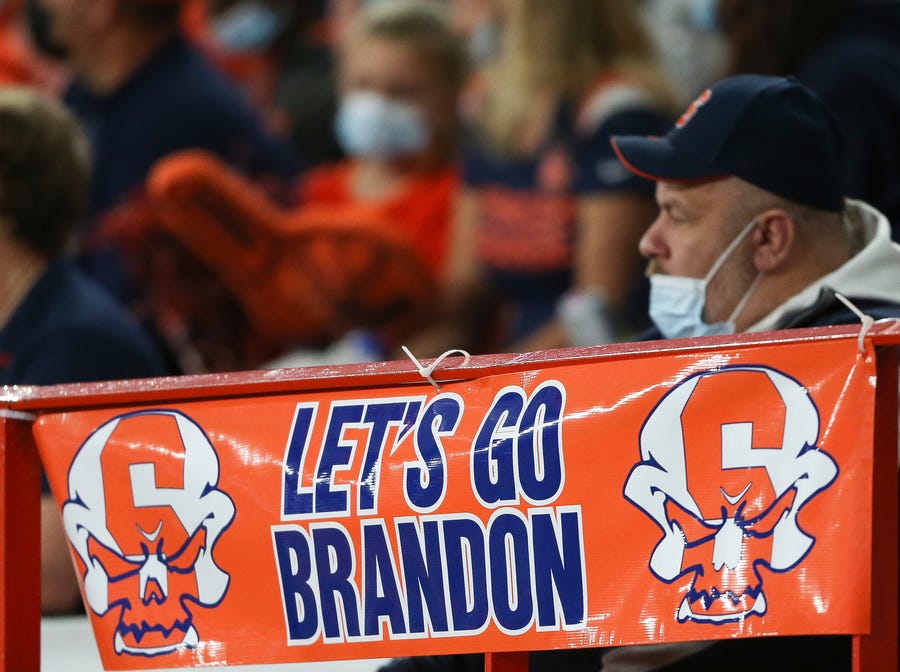
This particular sign was a the Boston College-Syracuse football game Oct. 30. A fan’s juvenile jab at President Joe Biden.Joshua Bessex

For instance, the woman had not heard about the Southwest Airlines pilot who recently signed off on a flight, telling passengers, “Let’s go, Brandon.”

Or about how the whole thing began when a race car driver named Brandon Brown won a NASCAR race and, while being interviewed on TV, the crowd started chanting, “F–k Joe Biden.” The flummoxed interviewer suggested they might be saying, “Let’s go, Brandon.”

After that, the phrase became a way for grown-up 8-year-olds to say the f-word about Biden without actually using it.

Really.

Elected Republican politicians in Washington, D.C., started using the phrase.

Donald Trump began selling “Let’s go Brandon” T-shirts through his Save America PAC for $45, and grown-up 8-year-olds in America actually purchased them.

$45.

There are adults who channel their 8-year-old selves by bringing signs saying, “Let’s go, Brandon” to public events, as well as some who scribble the message in paint on the rear window of their automobiles….

How to answer someone who says such a thing

Of course, we all learned as children that infantile behavior tends to draw some type of backlash….

After I explain the whole “Let’s go, Brandon” thing to the woman who’d been walking her dog she says, “That seems incredibly childish. How are you supposed to answer someone who says such a thing?”

I tell her that, as a grown-up, she would be best served simply ignoring it.

As for the rest of us, suffering as we do from social-media-induced age regression, I’d respond, “I’m rubber and you’re glue …”

Reach Montini at ed.montini@arizonarepublic.com.

Problem viewing email? View in browser

After months of negotiations among Democrats over the fate of President Biden’s historic $3.5 trillion proposal, a compromise seems to have been reached (although nothing is certain). At the insistence of Democratic Senators Manchin and Sinema, the size of the ambitious plan has been cut in half. Many of its parts were cut away, including two years of free community college and 12 weeks of paid family leave for medical reasons (the U.S. is the only major nation that doesn’t provide it). Three Democratic members of the House killed the provision to lower prescription drugs. And of course the Republicans opposed everything.

This is how Harold Meyerson of The American Prospect described it.

World’s Biggest Half-Full, Half-Empty Glass

Biden’s bill is historically great and bitterly disappointing.


Well—had we not anticipated, had it never seemed, that the Democrats, having won control of Congress and the White House, would proceed to enact paid family leave, expansions of Medicare, a permanent Child Tax Credit, disincentives to fossil fuel use, the ability to negotiate down drug prices, and such—had we not counted on that, then today would be a day of unmitigated celebration. Instead, celebration of the groundbreaking social provisions that actually are in the bill President Biden outlined today—universal pre-K, child care subsidies, incentives for clean energy, commonsense tax reforms that will compel corporations to pay some taxes, and the like—has to be mitigated by the fate of the even more commonsense provisions that now lie on the cutting-room floor.

For me, the most absurd relegation to that floor has been killing the proposal to give Medicare the ability to bring down drug prices. Seldom is a serious change to social and economic policy backed by more than three-fourths of the public, but this one surely was. Reportedly, President Biden has persuaded Kyrsten Sinema to accept a deal so preposterously weak—one that enables Medicare to negotiate down the price of drugs whose patents have expired (that is, after the big drug companies have wrung out the lion’s share of profits on those drugs, and which simply incentivizes those companies to extend their patents)—that few Democrats on the Hill seem inclined to vote for it. (Its merits are so nonexistent that the provision was omitted from Biden’s bill.)

By opposing giving Medicare the capacity to stop Big Pharma from charging Americans vastly more for their medications than they charge the citizens of any other nation, Sinema and three House Democrats effectively killed the one provision of the proposed $3.5 trillion package that would have most reduced the cost of living, significantly slowed the pace of inflation, and quite possibly moved more swing votes into the Democrats’ column than any other.

Leading the resistance to this measure in the House was Scott Peters, the California Democrat whose North San Diego County district includes many of the biotech companies that reap fortunes from high drug prices. While Sinema and the two other House Democrats who joined with Peters can likely be successfully primaried, the economy of Peters’s district is so dependent on high drug prices that he might well survive such a challenge…

One provision of the PRO Act—which, taken as a whole, would have been a new Magna Carta for American workers—has made it into Biden’s bill. The provision requires employers to pay fines ranging from $50,000 to $100,000 when they commit unfair labor practices, such as firing employees for their pro-union activities. Under current law, there are effectively no penalties assessed on employers when they’re found guilty of such practices. By excluding the more fundamental provisions of the PRO Act from Biden’s bill, chiefly because they don’t fit under rules of reconciliation, the employer-employee playing field remains steeply tilted toward employers, but if these fines pass muster with the Senate parliamentarian (an open question), they do reduce that tilt by a decidedly modest margin.

As befits a half-empty, if also half-full, glass.


~ HAROLD MEYERSON

Harold Meyerson of The American Prospect warns that Senator Joe Manchin of West Virginia and Senator Krysten Sinema of Arizona threaten the fate of their party in 2022 by their stubborn opposition to President Biden’s ambitious $3.5 trillion budget plan (over ten years). In addition to rebuilding the nation’s highways, bridges, tunnels, and other parts of its essential infrastructure, Biden wants to lessen the nation’s dependence on fossil fuels and combat climate change. His proposal would expand Medicare and Medicare and lower the cost of prescription drugs. It would provide child care credits that would lift millions out of poverty. The plan would make two years of community college free. Republicans oppose everything in his plan, even though it would bring economic relief and jobs to their constituents. Manchin and Sinema have forced their party to drop major parts of the plan and have thus far opposed raising revenue to fund it.

Meyerson writes:

I’m not aware of any poll that has asked the question “Do you think President Biden is being jerked around by two senators?” but I think a large number of Americans, if asked, would answer that in the affirmative. Of course, it’s not just Biden but the entire Democratic Party, root and branch, that’s being jerked around by Sens. Manchin and Sinema—and it’s the entire Democratic Party that will likely pay a price for this in next year’s midterm elections.

We’ve been here before. During the initial two years of his presidency, Barack Obama engaged in what seemed at the time like an endless succession of negotiations with Republicans and centrist Democratic senators over his proposed Affordable Care Act. In the end, the Republicans flatly rejected it in any way, shape, or form, but perhaps even more nettlesome was the determination on the part of two Democratic senators in particular—Finance Committee Chair Max Baucus of Montana and Connecticut’s Joe Lieberman—to pare back the bill. And pared it was, with Obama and his fellow Democrats forced to bow to Baucus and Lieberman’s demand to scuttle the establishment of a public option that could compete with profit-driven, coverage-denying private health insurance corporations.

As I’ve written in the current print issue of the Prospect, time plays a crucial role in the public’s assessment of elected officials and their programs. A program that’s slow to roll out and slow to deliver its benefits to the public doesn’t usually benefit its authors in the election following its enactment. Similarly, a president who proclaims a bold program, only to spend months being compelled to hack away at it due to the obstinate resistance of a handful of legislators who have the upper hand in the proceedings, doesn’t emerge unscathed from that process. Obama surely didn’t, though his inability to persuade some nominally Democratic renegades to support the public good over their insurance industry donors was only one reason why the Democrats bombed in the 2010 midterms, losing both houses of Congress in the process.

My concern is that Joe Biden is trapped in the same dynamic that plagued Obama, with his polling dropping precipitously as the two Democratic renegades, similarly more in the sway of donors (and innumerate economics) than the public interest, are prevailing over the president and the rest of the party in paring back a long-overdue shift to bolstering the fortunes of most Americans. Indeed, Biden has publicly stated that with only 50 Democrats in the Senate, just one senator—or in this case, two—effectively has presidential powers. What with Manchin compelling his fellow Democrats to halve their proposals (or, if he won’t budge from $1.5 trillion, cut them to three-sevenths), and Sinema rejecting an increase to tax rates on the wealthy and corporations, they’ve clearly diminished the appearance and actuality of Biden’s power, whether that’s their intention or not.

To be sure, there are other factors behind the erosion of Biden’s public support, as there was with Obama’s, and there’s a distinct possibility that when the infrastructure and Build Back Better bills are finally passed, and their programs promptly (one hopes) implemented, Biden will rebound. But just as Baucus and Lieberman played a role in dragging Obama down and giving the Congress over to the Republicans, so Manchin and Sinema seem poised to have a kindred effect over the fortunes of Biden and their congressional colleagues.

Sometimes, tragedy repeats itself as tragedy. 

Anand Giridharadas interviewed Senator Ron Wyden of Oregon, who is sponsoring a ”billionaires’ tax,” which would tax assets, not just income. This tax on the growth in their assets would affect between 600-700 billionaires. The revenue from the billionaires’ tax would pay for a large part of President Biden’s proposed budget plan. Two members of the Democratic Party—Senator Joe Manchin of West Virginia and Senator Kyrsten Sinema of Arizona—have blocked the bill, objecting to its cost and to raising taxes to pay for it. Republicans will unanimously oppose it, so Biden can’t afford to lose even one vote. The discussion has gone on for months, and the Republicans hope to stall and stall, then win enough seats a year from now to destroy Biden’s plans and his presidency.

In another interview, Anand talks with Berkeley economist Gabriel Zucman, who explains how the wealth tax would work. In a fascinating overview, he says the tax would affect fewer than 1,000 people: it’s the most progressive tax possible, targeted at the tippy top. It’s also technically different from a wealth tax in that it does not tax wealth itself, but the increase in wealth — what economists call unrealized capital gains.

To get an idea of who will pay the tax, scan Bloomberg’s Billionaires Index. Elon Musk is #1, with more than $200 billion. Jeff Bezos is #2.

If The.Ink interviews are behind a paywall, you should subscribe. Anand is consistently interesting.

ANAND: Is the wealth tax on? Is this in the final package? Is this thing happening?

SENATOR WYDEN: We’re pulling out all the stops. Tonight we’re going to start talking about it in more detail. I have been unable to see even one senator getting up and actually saying, “Gee, I think it’s OK that billionaires are not paying any taxes for years on end.”

What the opponents are trying to do, because they aren’t willing to get up and actually act like they’re sympathetic to billionaires, they’re running the old FUD strategy — fear, uncertainty and doubt. If you can just throw enough FUD at it, then senators say, “Oh, gee, I really don’t know.”

ANAND: I’m hearing from a lot of people that Senators Joe Manchin and Kyrsten Sinema, who have resisted even modest tax increases on corporations and rich people, that they’re with you on this. I’m curious: How did they get behind an unprecedented and historic wealth tax instead of relatively more modest ideas?

SENATOR WYDEN: Well, first of all, we’re calling this the “billionaires’ income tax,” so that people know that billionaires should pay taxes every year, just the way nurses and firefighters are.

All of the members are still making up their minds and saying we want to know more information about this and that, but around here, everything is always impossible until 15 minutes before it comes together — and particularly when you’re taking on such enormous, concentrated power. Billionaires know lots and lots of United States senators.

Editor’s Note (me): After Anand published this interview, and after Senator Wyden released his bill, Senator Manchin said he was not likely to support it because it targets such a small and specific number of people. It’s “divisive,” he said, to single out billionaires. When you don’t want to do something (like tax billionaires), any excuse will do.

President Biden announced that the U.S. Department of Education will take legal action against the eight states that do not permit school districts to require students and staff to wear masks. In so doing, these states put students at risk and violate their right to education.

Sheryl Gay Stolberg and Erica L. Green wrote in the New York Times:

President Biden, escalating his fight with Republican governors who are blocking local school districts from requiring masks to protect against the coronavirus, said Wednesday that his Education Department would use its broad powers — including taking possible legal action — to deter states from barring universal masking in classrooms.

Mr. Biden said he had directed Miguel Cardona, his education secretary, “to take additional steps to protect our children,” including against governors who he said are “setting a dangerous tone” in issuing executive orders banning mask mandates and threatening to penalize school officials who defy them.

“Unfortunately, as you’ve seen throughout this pandemic, some politicians are trying to turn public safety measures — that is, children wearing masks in school — into political disputes for their own political gain,” Mr. Biden said in remarks from the East Room of the White House, adding, “We are not going to sit by as governors try to block and intimidate educators protecting our children.”

Valerie Strauss wrote in the Washington Post about Biden’s announcement:

He did not name any specific governor, but Republican governors Ron DeSantis of Florida, Greg Abbott of Texas and Doug Ducey of Arizona, are among those state leaders who have threatened to withhold funding from districts or take other action against those districts that defy them. In Florida, Miami-Dade County Public Schools, the fourth largest district in the country, on Wednesday passed a universal masking mandate — with only a medical opt-out — as did Hillsborough County Public Schools.

“I’m directing the secretary of education to take additional steps to protect our children,” Biden said. “This includes using all of his oversight authorities and legal action if appropriate against governors who are trying to block and intimidate local schools officials and educators.”

The Centers for Disease Control and Prevention has said masking is one of the strongest tools that can be taken to protect the spread of the delta variant, which has caused a rise in pediatric coronavirus cases. The agency this summer, in a shift in guidance, recommended everyone over the age of 2 — even those who are vaccinated — wear masks inside school buildings.

In letters to the governors of Arizona, Florida, Iowa, Oklahoma, South Carolina, Tennessee, Texas, and Utah, Cardona said bans on school masking mandates are putting students at risk and “may infringe upon a school district’s authority to adopt policies to protect students and educators as they develop their safe return to in-person instruction plans required by federal law.”

Cardona, in a Wednesday post on the department’s Homeroom Blog, said the department can investigate any state educational agency whose policies or actions “may infringe on the rights of every student to access public education equally.”

“The department will also receive and respond as appropriate to complaints from the public, including parents, guardians, and others about students who may experience discrimination as a result of states not allowing local school districts to reduce virus transmission risk through masking requirements and other mitigation measures,” he wrote. “As always, the Department’s Office for Civil Rights evaluates allegations of discrimination on a case-by-case basis, looking at the specific facts of each case.

Heather Cox Richardson is an historian whose blog is called “Letters from an American.” She has a free version and a subscription version. She carefully documents whatever she writes.

In her free version yesterday, she wrote about Republican resistance to vaccination, as well as a few Republicans who now regret their resistance, like Arkansas Governor Asa Hutchinson. Just remember, as the COVID death toll rises, who fought against mask mandates and vaccinations. First among them: Ron DeSantis of Florida.

She wrote, in part:

Today seemed to mark a popular backlash against Republican lawmakers who have been downplaying the coronavirus pandemic. The Delta variant of the deadly virus is ripping through unvaccinated populations in the U.S. with an average of 85,000 new cases a day, numbers that rival those of February, before we had accessible vaccines. One in three cases in the nation comes from either Florida or Texas.

Lawmakers in South Carolina, Iowa, Florida, Oklahoma, Texas, Arizona, and Utah have prohibited schools from requiring masks, and South Carolina, Iowa, Florida, Montana, Arizona, South Dakota, Texas, and Tennessee prohibit local governments from doing so.

Yesterday, President Joe Biden called out governors, especially Florida Governor Ron DeSantis and Texas Governor Greg Abbott, for banning mask mandates and refusing to require the vaccine. At a press conference, Biden said “to these governors, ‘Please, help.’ But if you aren’t going to help, at least get out of the way of the people who are trying to do the right thing. Use your power to save lives.”

Today DeSantis responded: “I am standing in your way.” After sitting on Biden’s criticism for almost a day, DeSantis could find as a response only an attack on Biden for allegedly ignoring the “border crisis.” DeSantis blamed Florida’s devastating virus numbers on immigrants coming over the nation’s border with Mexico into Texas. 

The recent attention to the methods of Hungarian Prime Minister Viktor Orbán, who rose to power by stoking anti-immigrant hatred and who continues to whip up a frenzy over immigration despite the fact that refugees coming into Hungary have dropped to unremarkable levels, shows the Republican fallback on immigrant caravans to distract from their own scandals in a new light. 

In fact, our southern border remains closed because of public health directives put in place by the Centers for Disease Control and Prevention. Unaccompanied minors are admitted so that they do not become victims of gangs or sex traffickers, and their numbers likely hit an all-time high of about 19,000 in July. Those children are processed and then transferred to facilities run by the Department of Health and Human Services, which then finds suitable foster situations for them while they await immigration hearings. 

Interestingly in terms of the timing of DeSantis’s outburst, today the Mexican government sued a number of U.S.-based gun manufacturers for lax controls that permit illegal weapons to flow over the border. A 2016 study by the U.S. Government Accountability Office showed that about 70% of the weapons seized in Mexico came from the United States.

Paul Waldman is on the staff of the Washington Post. In this excerpt of his column, he says that Trump zealots will refuse to believe what the police officers said about the events of January 6. Nor will Trump devotees in the Congress be moved. The police officers saved their lives on that day, but they won’t heed what they testified. The Republican members of Congress were there as rioters plundered the U.S. Capitol and threatened the lives of Speaker Nancy Pelosi and Vice President Mike Pence. Only a thin blue line separated the mob and the esteemed members of Congress, who were only a few feet apart as they scurried to their hiding places. Yet still they say things like, “It was a normal tourist crowd,” or “it was a peaceful protest.” And they have response when Trump expresses his admiration and love for the mob that beat up police officers, shattered windows, and broke down doors in their absurd effort to reverse the election results.

Waldman writes:

There are people who believe that the moon landing never happened, that the astronauts in the footage all the world saw were actually bouncing around on a soundstage hidden away somewhere. But they aren’t making our laws, they aren’t invited on TV to discuss their perspective, and they don’t have the ability to influence millions.


Yet there are people who deny the truth of what happened in Washington on Jan. 6, despite all the video, all the contemporaneous reports, all the guilty pleas, and all the testimony. And they have a lot more power.


Tuesday’s first hearing of the select House committee investigating the insurrection, with vivid testimony from four police officers who stood against a mob of President Donald Trump’s supporters overrunning the Capitol in an attempt to overturn a presidential election, should put at least some questions about that day to rest.

Still recovering from their physical and mental injuries, the officers seemed particularly incensed that the truth of what happened that day is denied by so many on the right, from Trump himself on down.
“To me, it’s insulting, just demoralizing because of everything that we did to prevent everyone in the Capitol from getting hurt,” said Capitol Police Sgt. Aquilino Gonell about the effort to minimize what happened that day, including by Trump. (“It was a loving crowd,” the former president told Post reporters Carol Leonnig and Philip Rucker, “There was a lot of love. I’ve heard that from everybody.”)

Gonnell also addressed the various conspiracy theories propagated by some very high-profile figures on the right, claiming that the insurrection might have been a false-flag operation. “It was not antifa,” he said. “It was not Black Lives Matter. It was not the FBI. It was his supporters that he sent them over to the Capitol that day.”
“The indifference shown to my colleagues is disgraceful,” said D.C. police officer Michael Fanone, slamming his fist on the table. “Nothing, truly nothing, has prepared me to address those elected members of our government who continue to deny the events of that day.”

That denial takes various forms. Some, like Trump, assert that the riot was no big deal (“By and large it was peaceful protest,” said Republican Sen. Ron Johnson of Wisconsin). Others say that, while it was certainly bad, it doesn’t have anything to do with any larger political forces and should be put behind us.

But the truth is that there was nothing isolated about the event. Those rioters came to Washington at Trump’s behest. They assaulted the seat of our government in an effort to prevent the final certification of an American presidential election. And to this day, most of the GOP continues to stoke the fires of racial resentment and contempt for the democracy that made it possible.

One of the few exceptions in the Republican Party, Rep. Adam Kinzinger (Ill.) dispatched the bad-faith argument so many in his party made that any investigation of Jan. 6 should also spend time talking about protests last summer against police misconduct, during which violence broke out:

“Some have concocted a counternarrative to discredit this process on the grounds that we didn’t launch a similar investigation into the urban riots and looting last summer. Mr. Chairman, I was called on to serve during the summer riots as an Air National Guardsman. I condemn those riots and the destruction of property that resulted. But not once did I ever feel that the future of self-governance was threatened like I did on January 6. There is a difference between breaking the law and rejecting the rule of law, between a crime, even grave crimes, and a coup.


That is the heart of what made January 6 so threatening: Not just the physical violence, but the assault on the American system.

The hearings about the January 6 storming of the U.S. Capitol opened with testimony by four police officers who were beaten and brutalized by the pro-Trump mob, trying to stop the certification of the election of President Biden.

This story appeared in USA Today.

The officers’ accounts provided a dramatic opening for the House select committee investigating the Jan. 6 Capitol attack, when Trump’s fanatical supporters tried to stop the certification of Joe Biden’s 2020 election win.

“Here are highlights from their testimony.

“Capitol Police Sgt. Aquilino Gonell

“An Army veteran, Gonell said his experience during the insurrection was more terrifying than serving in Iraq, where he had to conduct supply missions on roads laced with improvised explosive devices.

“Nothing in my experience in the Army or as a law enforcement officer prepared me for what we confronted on Jan. 6,” he told the panel, recounting hand-to-hand combat with the rioters that likened to a “medieval” battle.

“I did not recognize my fellow citizens,” Gonell said. One rioter, he said, “shouted that I —an Army veteran and a police officer — should be executed.”

“As he and his fellow officers were punched, kicked and sprayed with chemicals, “I could feel myself losing oxygen and recall thinking to myself, ‘This is how I’m going to die’,” Gonell said.

“Six months after the riot, Gonell said he is still recovering from injuries.”

DC Metro officer Michael Fanone

Fanone, who nearly died on Jan. 6, has emerged as one of the most outspoken enforcement officials in the wake of the Capitol riot, during which he was beaten unconscious and suffered a heart attack.

In the months since Jan. 6, he has lobbied Congress to create a bipartisan, independent commission to probe the riot and lashed Republicans for downplaying the attack.

At Tuesday’s hearing, he moved into the spotlight once again.

“As I was swarmed by a violent mob, they ripped off my badge, they grabbed and stripped me of my radio, they seized a munition that was secured to my body,” Fanone recalled. “They began to beat me with their fists and what felt like hard metal objects.”

At one point during the riot, Fanone was pulled from a line of police by a rioter who shouted “I got one!”

As he was beaten, he heard a rioter shout to “Get his gun! Kill him with his own weapon.”

” … I was electrocuted again and again and again with a taser. I’m sure I was screaming but I don’t think I could even hear my own voice,” he recounted.

“I have kids,” he responded in a plea for his life.

“I still hear those words in my head today,” Fanone told lawmakers.

An unconscious Fanone was later driven by another injured officer to a nearby hospital, where he was told he suffered a heart attack and multiple life-threatening injuries. He now suffers from post-traumatic stress disorder.

“I thought I had seen it all, many times over,” Fanone said. “Yet what I witnessed and experience on Jan. 6, 2021, was unlike anything I had ever seen, anything I had ever experienced or could have imagined in my country.”

U.S. Capitol Police officer Harry Dunn

U.S. Capitol Police Officer Harry Dunn recounted how pro-Trump protestors continued to swell at the side of the Capitol all morning on Jan. 6 before becoming violent after thousands had assembled.

Rioters chanted “Stop the steal!,” clinging to the false claim that Trump was still the true elected leader of the country. When Dunn said that he’d voted for Biden and inquired if his vote didn’t matter, the already hostile crowd became irate.

“One woman in a pink ‘MAGA’ shirt yelled, “You hear that, guys, this (N-word) voted for Joe Biden!” he remembered.

“No one had ever called me a (N-word) while wearing my Capitol Police uniform,” Dunn testified.

Dunn also recounted how the aftermath of the day had been a “blur” to him. At one point he broke down in despair in the Capitol rotunda and asked how the attack was even possible, he said.

In the months since the attack, Dunn has said he’s been in support groups for his mental health to deal with the trauma of the attack, declaring that “there’s absolutely nothing wrong” with seeking help. Two Capitol police officers have died by suicide in the months since the attack.

Dunn also directly addressed the rioters and insurrectionists who were at the Capitol that day, saying “democracy went on that night and still continues to this day… you all tried to disrupt democracy, and you all failed.”

DC Metro Police officer Daniel Hodges

Hodges said rioters bashed his head, kicked him in the chest, and sprayed him with a chemical irritant during the riot, among other assaults.

One attacker told him he would “die on your knees.”

During one scuffle, a rioter tried to take Hodges’ baton and another kicked him in the chest and moved his mask over his eyes, leaving him temporarily blind while under attack.

While at his post as rioters began to assemble, he saw people in the crowd in tactical gear, wearing ballistic vests, helmets and goggles, appearing “to be prepared for much more than listening to politicians speak at a park,” he recalled.

“Terrorists were breaking apart the middle fencing and bike racks and the individual pieces, presumably to use weapons,” Hodges told the committee.

In the haze, Hodges said he remembers seeing the “thin blue line flag, a symbol of support for law enforcement” being carried by the rioters who then attacked the very officers they claimed to support. Hodges was told he was “on the wrong team” by one of the attackers.

As he was being gassed and having his head smashed, Hodges recounted screaming for help until fellow officers were able to save him from the attackers.