Archives for category: Betsy DeVos

Russ Walsh posted this column earlier this year. I am reposting it now because it is an insightful critique of DeVos’s ideology that choice is always good.

Walsh points out that there are many choices we used to have that we don’t have any more. We are not free to smoke where we want. He remembers the thick smoke in the teachers’ lounge. I remember the smokers on the commercial airplanes. He remembers the days when we drove without seat belts. We no longer have those choices. One could make a long list of the things you cannot do because of their effect on the common good, which overrides your personal choice.

School choice undermines the common good by taking resources from the schools that we are all obliged to support, even if we don’t have children.

Preston Green III is a scholar at the University of Connecticut who studies the legal and political issues associated with school choice. He fears that school choice, unregulated and unaccountable, will be the new Enron, a financial scandal of massive proportions.

Professor Green says:

As school choice champions like Secretary of Education Betsy DeVos push to make charter schools a larger part of the educational landscape, it’s important to understand the Enron scandal and how charter schools are vulnerable to similar schemes.

Enron’s downfall was caused largely by something called “related-party transactions.” Understanding this concept is crucial for grasping how charter schools may also be in danger.

Related-party transactions are business arrangements between companies with close associations: It could be between two companies owned or managed by the same group or it could be between one large company and a smaller company that it owns. Although related-party transactions are legal, they can create severe conflicts of interest, allowing those in power to profit from employees, investors and even taxpayers.

This is what happened at Enron. Because Enron wanted to look good to investors, the company created thousands of “special purpose entities” to hide its debt. Because of these off-the-books partnerships, Enron was able to artificially boost its profits, thus tricking investors.

Enron’s Chief Financial Officer Andrew Fastow managed several of these special purpose entities, benefiting from his position of power at the expense of the company’s shareholders. For instance, these companies paid him US$30 million in management fees – far more than his Enron salary.

Fastow also conspired with other Enron employees to pocket another $30 million from one of these entities, and he moved $4.5 million from this scheme into his family foundation.

Enron’s collapse revealed the weaknesses of the gatekeepers – including boards of directors and the Securities and Exchange Commission – that are responsible for protecting the markets. Because of lax accountability and federal deregulation, these watchdogs failed to detect the dangers posed by Fastow’s conflict of interest until it was too late. Congress responded by passing the Sarbanes-Oxley Act, which tightened the requirements for oversight.

Forty-four states and the District of Columbia have legislation that allows for charter schools. Just like public schools, charter schools receive public funding. However, unlike public schools, charter schools are exempt from many laws governing financial transparency.

Without strict regulation, some bad actors have been able to take advantage of charter schools as an opportunity for private investment. In the worst cases, individuals have been able to use related-party transactions to fraudulently funnel public money intended for charter schools into other business ventures that they control.

Such was the case with Ivy Academia, a Los Angeles-area charter school. The co-founders, Yevgeny Selivanov and Tatayana Berkovich, also owned a private preschool that shared facilities with the charter school. The preschool entered into a sublease for the facilities at a monthly rent of $18,390 – the fair-market value. The preschool then assigned the sublease to the charter school at a monthly rent of $43,870.

The Los Angeles district attorney’s office charged the husband-and-wife team with multiple counts of fraud. Selivanov was sentenced to nearly five years in jail in 2013.

Fraudulent related-party transactions can also occur between education management organizations (EMOs) and their affiliates. EMOs are for-profit or nonprofit entities that sometimes manage charter schools, and might also own smaller companies that could provide services to those schools.

For example, Imagine Schools is a nonprofit EMO that runs 63 charter schools enrolling 33,000 students across the country. It also owns SchoolHouse Finance, a for-profit company that, among other things, handles real estate for many of Imagine’s charter schools. Though charter schools typically spend around 14 percent of their funding on rent, some of the Imagine Schools were paying SchoolHouse Finance up to 40 percent of their funding for rent.

One of the charter schools operated by Imagine Schools, Renaissance Academy in Kansas City, sued the company for charging it excessive rent. In 2015, a federal judge agreed, ordering Imagine Schools to pay almost $1 million in damages to Renaissance. The court’s ruling suggested that Imagine Schools was essentially taking advantage of the charter school: The EMO profited from the excessive rent and failed to tell the school’s board of directors how the cost might disrupt the school’s ability to pay for textbooks and teacher salaries.

Because of insufficient oversight, Fastow’s fraudulent use of related-party transactions at Enron was not stopped until it was too late. Similarly, the Ivy Academia and Renaissance Academy examples reveal insufficient checks and balances in the charter school sector. In both cases, the monitors responsible for protecting charter schools found nothing wrong with the rental agreements.

Green says these cases are not isolated. The risks grow as degulation grows. It is already obvious that DeVos and Trump will prevent regulation to the greatest extent possible. The conditions will be right for massive fraud.

Jennifer Berkshire, once known as EduShyster, raised the money to follow Betsy and Randi to Van Wert, Ohio.

This is a powerful article and a first-hand report. I hope you will read it in full.

Here is her perceptive report on the trip, what she saw, what she learned.

Clearly, Randi and the local educators wanted her to see wonderful public schools where students were happily engaged in learning. Perhaps she might think twice about the budget cuts that the Trump administration is set to inflict, even on those who voted for him, like the good people of Van Wert. Maybe she would hesitate to harm them. Maybe she might advocate for them.

When the two leaders visited the elementary schools, the fifth grade students were learning about the Great Depression, and how awful it was for people who lost their jobs and their futures because of decisions made by bankers far away. The parallels with the present are unavoidable.

Jennifer couldn’t help noting that Betsy DeVos and Trump want to roll back all the laws and regulations that were created to prevent another Depression and to protect ordinary people from the predatory malefactors of great wealth.

The tour’s next stop was the fifth grade classroom of Nate Hoverman, a Van Wert grad, whose students have spent weeks working on a project-based learning unit about how kids experienced the Great Depression. On this day, the students were reading an excerpt from Russell Freedman’s Children of the Great Depression about how the economic crisis crippled schools across the country.

Out of work and out of money, people couldn’t pay the taxes that paid for their schools. Schools closed down or shortened their school years and teachers everywhere were laid off, which meant huge classes for the students who still had schools to go to. In Chicago, teachers, who hadn’t been paid for months, joined with parents and students and marched on the city’s banks, demanding that the bankers loan the city enough money to pay their salaries. When some of the teachers occupied the banks, the cops moved in. Freedman cites a newspaper report: “In a moment, unpaid policemen were cracking their clubs against the heads of unpaid school teachers.”

The timing of the reading was a coincidence, Hoverman told me. The students had started the unit reading the acclaimed novel Bud, Not Buddy, about an orphan making his way in Flint, MI in 1936, but they wanted to know more about the “why” behind the story. Still, it would be hard to conjure up a more fitting frame for our present precipice. For DeVos and her peeps, this was the period of American history when the nation went pear-shaped, the government using its might on behalf of working people like it never had before. The regulatory state was born, the unions were newly powerful, and those students who marched through the streets of Chicago with their teachers grew up to become Democrats with a deep distrust of the free market.

Both DeVos’ own family and the one she married into were part of the business-led crusade to roll back the New Deal’s accomplishments that began practically as soon as the New Deal did. Seven decades later, the fever dream of low taxes, little regulation and shriveled public services may finally be at hand.

Jennifer goes on to describe the heavy hand of ALEC behind the choice movement, not only to demolish public schools, but to lower the wages of construction workers. And the heavy and successful lobbying for cyber charters, which have terrible results but are very adept at getting more and more taxpayer money with no accountability for students or performance or finances.

Jennifer met a local education activist, Brianne Kramer, who had taught at one of the online schools and knew how dreadful they are. She asked her the question: where is this leading?

She answered without missing a beat.

“They don’t believe in the idea of common schools because they don’t believe in the common good,” said Kramer.

Kramer and I were meeting for the first time. A friend of hers from the Bad Ass Teachers Association had alerted her that I was heading to this corner of Ohio, and here we were 36 hours later, discussing the future of public education in the Buckeye State over biscuits and broasted chicken (a thing!) at a Bob Evans. Kramer has become something of an expert on the influence of ALEC in Ohio. Last year, she testified before the Senate Finance Committee in favor of a bill that would have subjected the state’s notoriously awful virtual schools to more oversight. Her testimony is well worth watching, but make sure you stick around for the Q and A portion, when Senator Bill Coley, ALEC’s Ohio state chairman and a veritable ambassador for ECOT, interrogates Kramer and makes the case for why virtual schooling is the best kind of schooling. The bill never made it out of committee.

I needed Kramer to help me understand the endgame for public education in a state like Ohio. Her vision was bleak enough to make me wish that Bob Evans served alcohol. She thinks that the controversial plan to blow up the Youngstown schools, hatched with charter school lobbyists and Catholic school groups, and passed under cover of darkness in 2015, is likely a model for how the GOP plans to break up and sell off other school districts throughout the state. It sounds conspiratorial until you consider that the chair of the House Education Committee has called for doing just that: “sell[ing] off the existing buildings, equipment and real estate to those in the private sector.”

Kramer says that she can envision a not-so-distant future in which online schools will be the only option for Ohio’s low-income students; anyone with the means will attend private and religious schools. “The people pushing this agenda don’t want a common good where everyone has a fair chance. A common good requires that you give citizens the tools they need to operate within the framework of democracy,” Kramer told me. “Everything that’s happening in Ohio is aimed at undermining that notion.”

The only good news is that Trump supporters seem as unhappy about that as do public education advocates.
A federal evaluation of the D.C. voucher program came up with negative results. Students in elementary schools who participated saw their scores drop, a finding similar to recent studies in Louisiana, Indiana, and Ohio.

https://www.washingtonpost.com/local/education/federal-study-of-dc-voucher-program-finds-negative-impact-on-student-achievement/2017/04/27/e545ef28-2536-11e7-bb9d-8cd6118e1409_story.html

What did Betsy DeVos say?

“DeVos defended the D.C. program, saying it is part of an expansive school-choice market in the nation’s capital that includes a robust public charter school sector.


“When school choice policies are fully implemented, there should not be differences in achievement among the various types of schools,” she said in a statement. She added that the study found that parents “overwhelmingly support” the voucher program “and that, at the same time, these schools need to improve upon how they serve some of D.C.’s most vulnerable students.”

So her assumption is that voucher programs are not likely to have better outcomes than public schools. Students who are performing poorly in public schools will perform poorly in voucher or charter schools. As long as parents are satisfied, that’s it. Reform.

That’s quite a theory of action. Or inaction.

When Betsy DeVos piously explains that she is wild for “great public schools,” please remember that she has spent most of her life advocating for alternatives to public schools. Can anyone recall her advocating for any public schools?

The group she founded and funded, American Federation for Children, just ran TV ads in Arizona thanking Governor Doug Ducey and his allies in the legislature for expanding the state’s voucher program, which will allow public funds to flow to religious and private schools.

AFC never loses an opportunity to support anything but public schools. It won’t be happy until every child in the nation attends a religious or private schools. It is never a friend of public education.

I suppose it was inevitable that Betsy DeVos’s ED Department would side with for-profit colleges that have defrauded students. After all, she invested in such colleges, and Trump notoriously opened Trump University, which was ordered to repay students $25 million for its fraudulent courses.

Politico reports:

DEBT FORGIVENESS SLOWDOWN: Student loan recipients defrauded by their for-profit colleges might have to wait longer to see that debt forgiven by the Education Department. Since President Donald Trump took office, the department appears to have drastically slowed the approval of debt relief to tens of thousands of student borrowers seeking to have their federal loans canceled on the grounds their colleges defrauded them. That’s according to several current and former government officials.

– A department spokesman said in an email to POLITICO that the department “has not stopped approving borrower defensed repayments,” but declined to say how many claims the department had approved since Jan. 20. The spokesman said that Education Department career staff members are leading “a full review of the Borrower Defense to Repayment program and that Education Secretary Betsy DeVos “is committed to protecting students who have been defrauded by schools.”

– Consumer advocates and some state attorneys general are raising alarm bells, however. “The Trump administration is turning its back on struggling borrowers,” said Massachusetts Attorney General Maura Healey, a Democrat who worked closely with the Obama administration on loan forgiveness for defrauded students.

Recently, Betsy DeVos visited the public schools of Van Wert, Ohio, with Randi Weingarten. Randi picked the district to show DeVos public schools that are the heart of their rural community, which is in Trump country. DeVos talked school choice, but encountered the reality of a community with high poverty and no interest in vouchers or charters.

In this article, Indianan Jill Long THOMPSON explains why vouchers would be a disaster for rural schools.

Jill Long Thompson is a former member of Congress and former USDA Under Secretary for Rural Development. She was board chair and CEO of the Farm Credit Administration and is now an associate professor at the Kelley School of Business and the School of Public and Environmental Affairs at Indiana University. She lives on a farm in northern Indiana.

Jill Long Thompson is a former member of Congress from Indiana. She is also a former USDA Undersecretary for Rural Development. She is a visiting associate professor at the Kelley School of Business and the School of Public and Environmental Affairs at Indiana University Bloomington.


Public schools are a cornerstone of communities, and they are a very important component of the rural infrastructure….

For rural communities, in particular, voucher programs create a business model that simply will not work. Running a rural school is very challenging because the resources are always limited, and oftentimes scarce.

Vouchers encourage the creation of small private schools. But, we don’t need more schools in rural communities; we need more resources to strengthen the schools we have. Increasing the number of schools means increasing the overhead, which is why vouchers dilute resources even further.

A school voucher program is the education policy equivalent of a county highway program that would give residents money to build little private roads anywhere they want.

That would not only be costly and inefficient; it would not serve the community’s transportation needs.

One must look no further than our own state, with its aggressive voucher program, to see the problems it causes for small rural school systems.

Since 2011, Indiana has shifted $520 million into the state voucher program.

Unfortunately, many of the schools receiving the vouchers have not performed as well as the public schools that lost funding because of the vouchers.

A voucher program is not the solution to the challenges facing public education.

According to the Penn Wharton Public Policy Initiative at the University of Pennsylvania, “Studies of the federally funded (Washington, D.C.) voucher program found that there was no conclusive evidence that vouchers affected student achievement. In fact, children who were given the school voucher performed no better in math and reading than the children who weren’t given vouchers.”

Additionally, “Similar studies of the longest-running school voucher program in the country in Milwaukee actually found that public school students outperformed voucher students at every grade level on the statewide reading and math tests.”

My husband and I are products of rural public schools. We live on a farm in the same district where my husband completed his elementary and high school education, and where he and his father both served on the local school board.

I know firsthand what the public school means to a rural community. Our school is not just a place to educate our children, but also a vehicle for bringing people together. Our local school is a big part of our identity.

I can think of nothing more important to the rural infrastructure than schools. President Trump’s voucher policies would cause irreparable harm to communities across rural America.

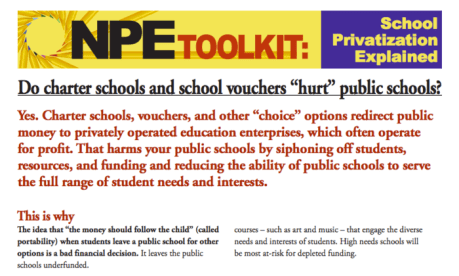
The Network for Public Education has created a toolkit to equip you to fight privatization of our public schools. In it, you will find concise summaries of important issues, with links to research, and ways that you can join with your colleagues , friends, and neighbors to block the Trump-DeVos agenda.

For the full report click here.

npe

A reader sent this comment about the Van Wert, Ohio, public schools, and how the state grades them. It shows how wacky Ohio’s school grading is.

“Van Wert is a rural community where half the district’s 2,000 students come from low-income families yet 96% graduate from high school—on time. With top-line results like that, you’d expect the district would be getting top grades in Ohio’s standardized school assessment system, but you’d be only half-right: A’s for graduation rate and progress in math and reading, but F’s for achievement gaps and K-3 literacy.

“So where did DeVos focus her post-visit remarks? On school choice, of course. Faced with the dearth of charter schools and private schools and vouchers in rural Ohio, she seized on the fact that the parents of nearly 20% of the students in Van Wert city schools choose to send their children to public schools in other districts.

“She also promised to lift the burden of government-mandated paperwork that takes time away from teaching. When asked for examples of that burdensome paperwork, however, she couldn’t cite any. Suggesting that she’s been getting alternative-fact lessons in Washington.”

In the wake of Betsy and Randi’s visit together to a public school in Ohio, Russ Walsh reflects on how school choice affects democracy. Every dollar that goes to a charter or voucher is taken away from public schools like those they visited. “Choice” means budget cuts to the public school, and it means that public dollars go to privately controlled schools.


“While the school that DeVos and Weingarten visited is in a heavily Republican district in Ohio, the voters there are no fans of school choice. As one voter put it, vouchers are “like theft.” “It’s saying we passed a levy to go to our school district, and it’s going somewhere else.” Exactly. School choice is theft of our tax dollars and theft of our democracy.

Choice sounds so democratic, so quintessentially American that voucher and charter school champions keep using the term to hoodwink people into thinking that choice in schooling is a good thing. I suggest that those of us who oppose vouchers and charter schools call school choice what it is in the eyes of that Ohio voter, tax theft. The government collects our taxes in order to provide essential services to all of us. There is no choice involved, we all must pay taxes (unless, apparently, we are hugely wealthy). Those essential services include providing for a military, promoting research on health and welfare, providing for police and fire protection, and funding public schools. When money is diverted from the support of the public schools, it amounts to, as the Ohio voter said, theft. Or maybe another way to say it is “taxation without representation”, since voters have no voice and no oversight of how tax money is spent in schools that receive money through vouchers or charters.

It should be readily apparent that corporate education reformers are anti-democracy. In city after city around the country democratically elected school boards have been replaced by boards appointed by the mayor or governor. In Philadelphia, an appointed board has been in place for nearly two decades and the deterioration of the schools has continued unabated. In Detroit, in Betsy DeVos’ home state, the state took over the schools and has systematically led them into chaos. And let us remember that DeVos has spent millions to get legislation passed in Michigan that limits any kind of oversight for voucher and charter schools. So quite literally these schools are stealing public funds with no accountability as to how they spend it…

When parents send their children to charter schools or voucher schools, they are looking for a better opportunity for their children. We can all understand the appeal of that. What parents may not realize is that they have entered into a Faustian bargain. In order to get this shiny new toy of a voucher, they must give up their voice in their child’s education. No elected school board, no independent audit, no budget vote, no say in school policies.

In this drama, Betsy DeVos plays a willing Mephistopheles, offering choice, but getting you to sign away your voice. Without a voice, there is no democracy.