Readers know that the State Board of education in Arizona actually turned down a parent’s request to use voucher money to buy three dune buggies. Amazing!
Mercedes Schneider digs deeper. In this post, she transcribes the discussion about the vote at the State Board meeting. She includes a list of eight dune buggies at different price points, from about $600 to $$18,000 each. Which did the parent choose?
And she closes with this pertinent question:
If the state of Arizona approves an educational program that involves riding a dune buggy purchased with state money, does the state then open itself up to liability if something happens to the child while operating that state-purchased dune buggy?
Laurie Roberts, a columnist for The Arizona Republic, asks a sensible question that has probably occurred to most voters in Arizona, but not to Republican legislators. What expenditures should be disallowed with state voucher money? Until recently, the sky was the limit. But then the state board turned down a parent who paid for three dune buggies (each of which costs thousands of dollars).
Under former Governor Doug Ducey, a Republican, the legislature kept expanding the state’s voucher program. Parents and educators organized a state referendum on voucher expansion in 2018, and the voters overwhelmingly opposed it. But the Republicans pushed forward and made vouchers universal, available to every student in the state. And of course, the state board was extremely lax in allowing dubious expenditures.
Roberts wrote:
Good news for taxpayers, especially the ones who think public money ought to go to public schools.
Kayaks, apparently, still are allowed as an acceptable educational expense under the state’s universal school voucher program, as are $900 Lego sets, trampoline sessions, Broadway tickets and espresso machines.
But isn’t it nice to know we absolutely are digging in our heels at the ridiculous notion of taxpayers shelling out for dune buggies?
So far, anyway.
Dune buggies fail the ‘reasonableness’ test
The Arizona State Board of Education on Monday rejected a parent’s appeal to use her kids’ state school Empowerment Scholarship Accounts to buy three dune buggies.
“At some point, I think the question of reasonableness comes to mind,” Board President Daniel Corr said, in voting to order the woman to pay for her own darn dune buggies.
If you’re inclined to reply, “duh,” know that Monday’s vote overturns the ruling of an appeal hearing officer who recommended that we foot the bill for the buggies.
And the Department of Education, which at first denied the expense then approved it — “mistakenly,” it claims.
DOE in March suspended the family’s school voucher accounts and requested reimbursement for the dune buggies, prompting the mother to appeal and decry “crass incompetence.”
“Telling us months later that we have to pay back something that was approved by the department has to be illegal in 50 states and a few territories,” she wrote in the appeal.
Yeah, and trying to sucker the state into paying for dune buggies ought to be galling in 50 states and more than a few territories.
In this case, the system worked … so far. Though I’ve got to wonder how a dune buggy ever got approved in the first place.
And how the state plans to recover our money.
According to The Arizona Republic’s Nick Sullivan, the parent got an occupational therapist to testify that her kids learn better after a trek through the desert, allowing them “to engage in movement before returning to more traditional learning environments.”
So, buy kids some bikes. With your own funds, not ours.
Or take them to the park.
Save Our Schools Arizona has been sounding the alarm about the state’s runaway ESA program all year, pointing to more than $100 million in non-educational spending approved without any academic justification.
Curiously, those fiscal hawks over at the Legislature had no concerns.
Vouchers shouldn’t leave taxpayers high and dry
Fortunately, Attorney General Kris Mayes does.
In July, she opened an investigation into the ESA program. Specifically, into Superintendent Tom Horne’s well-used rubber stamp — the one his department employs to approve “supplemental” educational expenses like $900 Lego sets and ninja training and ski passes.
Jenny Clark, an ESA parent who runs an organization to help parents get vouchers and was appointed by then-Gov. Doug Ducey to the state Board of Education, cast the only vote Monday to approve the dune buggy boondoggle. She noted that it’s the first time since she joined the board in 2022 that it has rejected a hearing officer’s recommendation in a voucher appeal.
Corr, meanwhile, indicated the parent could appeal the board’s decision.
If ever there was a case that illustrates the need for better oversight of ESAs — something the Republican-run Legislature refuses to consider — surely, this is it.
It shouldn’t have taken a trip all the way to the state Board of Education to declare that you don’t need a recreational vehicle to chase down a good education.
Arizona is truly the Wild West of privatization. Its voucher program started small and grew fast. Parents and teachers organized a state referendum on vouchers in 2018, and the voters overwhelmingly rejected their expansion, by 65-35%.
But the Republican legislature ignored the public smack down and opened the nation’s first universal voucher program. Anyone can get a voucher, even if they are rich, even if they have never attended a public school.
The Arizona State Board of Education on Monday struck down a parent’s appeal to use state school voucher money to finance three dune buggy purchases.
The parent sought reimbursement for the recreational vehicles through the Empowerment Scholarship Account program, citing her children’s need for interactive learning. Since 2022, the school voucher program has allowed any child in Arizona to receive public money to pay for education expenses such as private school tuition, supplies, tutoring and supplemental materials.
The board’s near-unanimous decision broke from an appeal hearing officer’s recommendation this spring that the family should be reimbursed. Several board members suggested the purchases were needlessly extravagant, even under the broad statute governing the ESA voucher program.
Board member Jennifer Clark, who cast the sole dissenting vote, said the board had voted in line with the hearing officer’s recommendation in every voucher appeal case since she joined in 2022. She said the board should defer to the officer.
The family can appeal the board’s decision, said Board President Daniel Corr.
“Regardless of your feelings on ESA — and I think they range along a spectrum — at some point, I think the question of reasonableness comes to mind,” Corr said. “And this particular purchase, purchases, exceeds my definition of reasonableness.”
The Arizona Department of Education first denied the parent’s request for reimbursement in December. The parent appealed, according to board meeting agenda materials, and then the department “mistakenly approved” her reimbursement request in January.
The department suspended the family’s school voucher accounts in March and requested repayment for the dune buggies. The parent appealed again to the Education Board and described the department’s handling of her case as “crass incompetence.”
“Telling us months later that we have to pay back something that was approved by the department has to be illegal in 50 states and a few territories,” she wrote in the appeal.
The department testified during the May hearing that the dune buggies “are not primarily education items, are disallowed by the ESA Parent Handbook, and are not items funded in a public-school setting,” according to the board agenda materials. Textbooks and supplemental materials, such as dune buggies, must be tied to a curriculum for a purchase to be justified under the voucher program, according to the department.
This interpretation was affirmed by the Attorney General’s Office in a July 1 letter alleging the department had allowed expenditures not supported by curriculum and directing the department to stop approving those expenses.
The parent later provided a curriculum plan that was “narrowly tailored” with help from an occupational therapist, according to agenda materials. The therapist testified during the hearing that the students engaged more effectively with learning materials that involved physical interaction, such as dune buggies, which allowed them “to engage in movement before returning to more traditional learning environments.”
Voters in Arizona voted overwhelmingly against voucher expansion in a state referendum in 2018, but Republican Governor Doug Ducey and the Republican legislature expanded them anyway. The pro-voucher campaign was funded by Charles Koch and Betsy DeVos.
The financial blow to the state has been devastating. As in every other state, most vouchers are used by private and religious school students from affluent families.
In 2022, Arizona pioneered the largest school voucher program in the history of education. Under a new law, any parent in the state, no matter how affluent, could get a taxpayer-funded voucher worth up to tens of thousands of dollars to spend on private school tuition, extracurricular programs or homeschooling supplies.
In just the past two years, nearly a dozen states have enacted sweeping voucher programs similar to Arizona’s Empowerment Scholarship Account system, with many using it as a model.
Yet in a lesson for these other states, Arizona’s voucher experiment has since precipitated a budget meltdown. The state this year faced a $1.4 billion budget shortfall, much of which was a result of the new voucher spending, according to the Grand Canyon Institute, a local nonpartisan fiscal and economic policy think tank. Last fiscal year alone, the price tag of universal vouchers in Arizona skyrocketed from an original official estimate of just under $65 million to roughly $332 million, the Grand Canyon analysis found; another $429 million in costs is expected this year.
As a result of all this unexpected spending, alongside some recent revenue losses, Arizona is now having to make deep cuts to a wide swath of critical state programs and projects, the pain of which will be felt by average Arizonans who may or may not have school-aged children.
Among the funding slashed: $333 million for water infrastructure projects, in a state where water scarcity will shape the future, and tens of millions of dollars for highway expansions and repairs in congested areas of one of the nation’s fastest-growing metropolises — Phoenix and its suburbs. Also nixed were improvements to the air conditioning in state prisons, where temperatures can soar above 100 degrees. Arizona’s community colleges, too, are seeing their budgets cut by $54 million.
Still, Arizona-style universal school voucher programs — available to all, including the wealthiest parents — continue to sweep the nation, from Florida to Utah.
In Florida, one lawmaker pointed out last year that Arizona’s program seemed to be having a negative budgetary impact. “This is what Arizona did not anticipate,” said Florida Democratic Rep. Robin Bartleman, during a floor debate. “What is our backup plan to fill that budget hole?”
Advocates for Arizona’s universal voucher initiative had originally said that it wouldn’t cost the public — and might even save taxpayers money. The Goldwater Institute, a conservative think tank that helped craft the state’s 2022 voucher bill, claimed in its promotional materialsat the time that the vouchers would “save taxpayers thousands per student, millions statewide.” Families that received the new cash, the institute said, would be educating their kids “for less than it would cost taxpayers if they were in the public school system.”
But as it turns out, the parents most likely to apply for these vouchers are the ones who were already sending their kids to private school or homeschooling. They use the dollars to subsidize what they were already paying for.
The result is new money coming out of the state budget. After all, the public wasn’t paying for private school kids’ tuition before…
Arizona doesn’t have a comprehensive tally of how many private schoolers and homeschoolers are out there, so it remains an open question how much higher the cost of vouchers could go and therefore how much cash should be kept on hand to fund them. The director of the state’s nonpartisan Joint Legislative Budget Committee told lawmakers that “we’ve never really faced that circumstance before where you’ve got this requirement” — that anyone can get a voucher — “but it isn’t funded.”
Most importantly, said Beth Lewis, executive director of the public-school-advocacy group Save Our Schools Arizona, only a small amount of the new spending on private schools and homeschooling is going toward poor children, which means that already-extreme educational inequality in Arizona is being exacerbated. The state is 49th in the country in per-pupil public school funding, and as a result, year after year, district schools in lower-income areas are plagued by some of the nation’s worst staffing ratios and largest class sizes.
Spending hundreds of millions of dollars on vouchers to help kids who are already going to private school keep going to private school won’t just sink the budget, Lewis said. It’s funding that’s not going to the public schools, keeping them from becoming what they could and should be.
As you might have noticed, the mainstream media has not paid much attention to the reckless privatization of America’s public schools. This “movement” is a response to billionaire dollars, not to public demand. The beneficiaries are students who were already enrolled in private schools, whose parents can afford the tuition, not poor students.
It’s rare when a major TV show or newspaper features a story on the billionaire funded effort to destroy our nation’s public schools.
The feature story aired on Anderson Cooper’s CNN program. Even Ja’han Jones, who writes the blog for Joy Reid’s show, noticed the story.
CNN pointed out that rightwing evangelical churches are expanding as nearby public schools are drained of resources.
CNN reported:
Near the edge of the Phoenix metro’s urban sprawl, surrounded by a wide expanse of saguaro-studded scrubland, Dream City Christian School is in the midst of a major expansion.
The private school, which is affiliated with a local megachurch where former President Donald Trump held a campaign rally this month, recently broke ground on a new wing that will feature modern, airy classrooms and a pickleball court. It’s a sign of growth at a school that has partnered with a Trump-aligned advocacy group, and advertises to parents by vowing to fight “liberal ideology” such as “evolutionism” and “gender identification.”
Just a few miles away, the public Paradise Valley Unified School District is shrinking, not expanding. The district shuttered three of its schools last month amid falling enrollment, a cost-saving measure that has disrupted life for hundreds of families.
One of the factors behind Dream City’s success and Paradise Valley’s struggles: In Arizona, taxpayer dollars that previously went to public schools like the ones that closed are increasingly flowing to private schools – including those that adopt a right-wing philosophy.
Arizona was the first state in the country to enact a universal “education savings account” program – a form of voucher that allows any family to take tax dollars that would have gone to their child’s public education and spend the money instead on private schooling.
ACNN investigation found that the program has cost hundreds of millions of dollars more than anticipated, disproportionately benefited richer areas, and funneled taxpayer funds to unregulated private schools that don’t face the same educational standards and antidiscrimination protections that public schools do. Since Arizona’s expanded program took effect in 2022, according to state data, it has sent nearly $2 million to Dream City and likely sapped millions of dollars from Paradise Valley’s budget.
And Arizona is hardly alone: universal voucher programs are sweeping Republican-led states, making it one of the right’s most successful efforts to rewrite state policy after decades of setbacks.
This expansion of vouchers in red states was facilitated by millions of dollars spent to fund far-right legislators in state races by Betsy DeVos’s American Federation for Children and other billionaires, like Jeff Yass, a Trump supporter and the richest man in Pennsylvania. Yass said to CNN: “School choice is the civil rights issue of our time,” an oft-cited but phony claim.
In fact, school choice benefits the haves, not the have-nots, and it encourages segregation. Schools choose, not students or families.
In an internal presentation obtained by the progressive watchdog group Documented and provided to CNN, AFC boasted that it had “deployed” $250 million “to advance school choice over the last 13 years,” and that that spending had led to “$25+ billion in government funding directed towards student choice.”
In 2018, nearly 2/3 of Arizonavoters rejected universal vouchers. Koch-funded Governor Doug Ducey kept pushing them, ignoring the will of the voters, and they were adopted in 2022. Now every student in the state can get a voucher, and most who take them come from families that can afford to pay their own tuition bills.
But unlike some other states that have adopted voucher programs, Arizona has no standardsrequiring private schools to be accredited or licensed by the state, or follow all but the most basic curriculum standards. That means there is no way to compare test scores in public schools to students in the ESA program.
“There’s zero accreditation, there’s zero accountability, and there’s zero transparency,” said Beth Lewis, a former teacher who leads an Arizona nonprofit that advocates against school privatization.
Arizona’s voucher program is busting the state’s budget. The state is facing a $1 billion deficit, caused largely by funding private schools that are discriminatory and whose academic progress is unknown.
On the other side of the Phoenix metro area, the private Valley Christian Schools received nearly $1.1 million in ESA funding last year despite facing allegations of LGBTQ discrimination in federal court. Valley Christian fired high school English teacher Adam McDorman after he voiced support for a student who came out as pansexual, McDorman alleged in a 2022 lawsuit. In an email that McDorman provided to CNN, the school’s then-principal argued that the idea that it was possible to be both “homosexual or otherwise sexually deviant and also a Christian” was a “hideous lie.”
Public schools are barred from discriminating against students because of characteristics like their religion or sexuality, but no such rules cover private schools. In court documents, Valley Christian lawyers have argued that the school had the religious liberty to fire McDorman. The school declined to comment because the case is pending.
In an interview, McDorman said his former school taught creationism as a scientific fact, and “whitewashed” American history to downplay the harms of slavery. He was surprised to learn about the level of public funding it was receiving.
Will the defunding of public schools be an issue in the Presidential election? Trump will surely boast about the progress of.school choice. Will Biden speak up against this nefarious effort to destroy public schools?
Jon Valant and Nicolas Zerbino of the prestigious nonpartisan Brookings Institution examined the Arizona voucher program and were surprised to find that it was a giveaway to the richest families in the state.
Voucher advocates did not like their findings and tried to discredit their analysis.
In May, we released a short Brookings report showing which families are most likely to get voucher funding through Arizona’s now-universal Empowerment Scholarship Account (ESA) program. The analysis isn’t complicated, and the results couldn’t be much clearer. A highly disproportionate share of Arizona’s ESA recipients come from the state’s wealthiest and most educated areas. That’s an important finding, even beyond Arizona, since this program is at the forefront of a wave of universal voucher initiatives that’s currently sweeping across red states (and some purple states). What happens with Arizona’s program could foreshadow what’s to come in many parts of the country.
These universal (or near-universal) programs are much more threatening to public education systems than the smaller, more targeted voucher programs that preceded them. They raise concerns about fundamental issues such as civil rights protections and the separation of church and state. Early research and reporting points to ballooning state budgets, wasteful spending, and tuition increases from opportunistic private schools. Meanwhile, hardly anything in the academic literature suggests that universal ESA programs will improve student performance. And yet, the push to remake the U.S. education system in the form of universal school voucher programs continues.
Having entered the fray with our own analysis of a universal ESA program, we’ve gotten a close look at the information environment surrounding these recent initiatives. Suffice to say, it isn’t healthy, at least if we hope for a functional policymaking process. A network of pro-voucher interest groups, think tanks, funders, and politicians are filling an information vacuum with misleading data, faulty or disingenuous arguments, and advocacy that masquerades as research.
Here, we’ll respond to four critiques we’ve heard from that crowd. Part of our goal is to show why their specific critiques of our work are baseless, misleading, or just kind of odd. In doing so, we also hope to illuminate how dangerous the information environment surrounding universal ESAs has become now that many state leaders are dragging their education systems into uncharted territory based on little more than ideology, political calculation, and a fingers-crossed hope that the voucher advocates aren’t leading them astray.
Here are the critiques:
Critique 1: We got our analysis wrong because someone else found something different
Our main results are probably best summarized by Figure 1, below, which appeared in our original post.
FIGURE 1
The Arizona ZCTAs (ZIP codes, basically) with the lowest poverty rates have the highest share of school-age children who received an ESA. The ZCTAs with the highest poverty rates have the lowest rates of ESA take-up. It’s an extremely straightforward analysis, and we provide a detailed description of what we did in the piece.
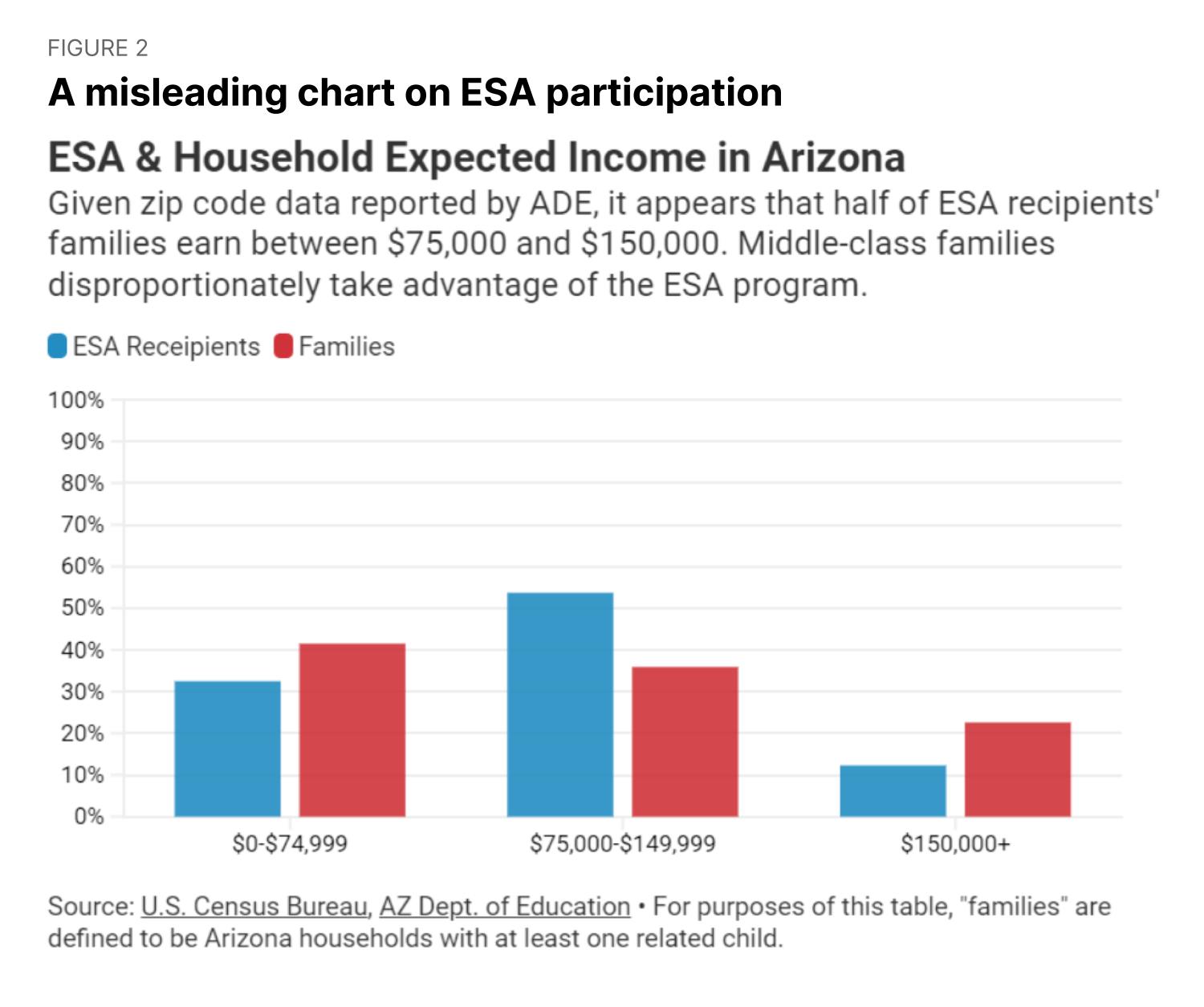
Before we published our post, an organization called the Common Sense Institute (CSI) of Arizona—a “non-partisan research organization” with several staff members from former governor Doug Ducey’s administration—looked into a similar question. CSI’s chart, below, tells a completely different story from our chart.
CSI makes it look like relatively few wealthy families in Arizona get ESAs. So, why the discrepancy?
It’s because CSI presented an apples-to-oranges comparison that’s bound to tell that story. The data issue is subtle, but they present ZIP code-level data for ESA recipients (blue bars, on the left) and household-level data for families (red bars, on the right). Many households in Arizona make $150,000 or more, so the far-right, red bar is quite tall. However, few ZIP codes have enough households earning more than $150,000 that the median household income rises above that threshold. As a result, many ESA recipients who earn more than $150,000 aren’t included in the $150,000+ category in this chart. Instead, these households—which earn more than $150,000 themselves but live in ZIP codes where the median income is below $150,000—are included in one of the other blue bars.
Maybe that’s an innocent mistake, but it’s certainly not an accurate representation of which Arizona residents are getting ESAs.
Critique 2: We didn’t place Arizona’s ESA program in the proper context of its other school choice programs
Education Next published an article from Jason Bedrick of the Heritage Foundation that accuses us of omitting key context that, if presented, would markedly change the takeaways from our analysis. Bedrick points out that Arizona’s universal ESA program exists alongside several tax-credit scholarship programs (true) and that families are prohibited from participating in the ESA and tax-credit scholarships simultaneously (also true). He then shares a few numbers, does some hand-waving, and concludes that our “fatally flawed” analysis is deeply misleading because of this omission.
Curiously, Bedrick doesn’t show the relative size of the ESA and tax-credit scholarship programs in Arizona. Here’s the obvious chart to illustrate that comparison—one that EdNext maybe could have requested before publishing yet another round of Heritage Foundation talking points on ESAs:
FIGURE 3
These tax-credit scholarship (TCS) programs are small relative to a large-and-growing universal ESA program that’s projected to exceed $900 million this year. On top of that, most TCS dollars are going to recipients above 185% of the federal poverty level—the threshold for reduced-price lunch eligibility. (One note: the most recent numbers available for the ESA program come from FY24, while the most recent numbers available for TCS programs come from FY23.)
In other words, this critique—which really isn’t about the universal ESA program we analyzed in the first place—doesn’t even point to context that meaningfully changes the interpretation of our data.
It’s important to emphasize, too, that our analysis was primarily about the high-income households that are obtaining a disproportionate share of Arizona’s ESAs. In that post, we tried to present data in the most straightforward, defensible way possible. If our goal had been to present the most damning data possible, there’s more we’d have said.
Here’s a doozy of an example. According to U.S. Census Bureau data, Arizona has 300 ZCTAs with at least 250 children under age 18. (The other 60 ZCTAs are smaller, which makes them difficult to analyze.) Of those 300 ZCTAs, the one with the single-highest take-up rate for ESAs (236 of every 1,000 children) is the one with the single-highest median household income (about $173,000).
Critique 3: Arizona’s ESA program is too new to assess who will participate
Maybe the most peculiar response we’ve seen is from Mike McShane of EdChoice, who published an op-ed in Forbes.
McShane appeals to Everett M. Rogers’ “diffusion of innovation” theory, which suggests that new technologies and ideas are adopted sequentially by different groups (from early adopters to laggards). McShane asserts that we should expect wealthier and more educated families to be the early adopters of a universal ESA program. He implores us to “think of the first people to own a personal computer, or a cell phone. They started with tech nerds and the wealthy, and eventually worked their way to everyone else.”
Let’s play a game of “one of these things is not like the others” with personal computers, cell phones, and a universal ESA program. Yes, we’d expect wealthier families to be the first to buy computers and cell phones. Those things cost a lot of money. A universal ESA program gives you money. We might expect poorer families—with fewer resources and potentially worse public-school options—to jump first at that opportunity. Even the usual dynamic of uneven information diffusion is complicated in this context, as the ESA program was available to families with children in low-rated schools long before it became universal.
Regardless, there’s reason for concern that vouchers will be more exclusively adopted by the wealthy over time. Jason Fontana and Jennifer Jennings studied the early implementation of a universal ESA account in Iowa. They found that private schools responded to ESA eligibility by increasing their tuition. If this response continues to play out, we might see desirable private schools becoming unaffordable to low-income families that cannot cover a growing gap between the value of their voucher and cost of enrollment. In the long term, this creates a risk of extreme stratification across the public and private sectors.
Chile may provide a glimpse of that potential future. In a 2006 paper in the “Journal of Public Economics”, Chang-Tai Hsieh and Miguel Urquiola analyzed a universal voucher program in Chile. They found suggestive evidence that “the main effect of unrestricted school choice was an exodus of ‘middle-class’ students from the public sector… [which] had a major effect on academic outcomes in the public sector.” These patterns, along with widening achievement gaps between rich and poor, led Chile to drastically modify that program.
Critique 4: We’re targeting ESA programs when the real villains are public schools
A fourth set of critiques presents more conceptual arguments about education reform. Perhaps the most data-infused of these comes from The Goldwater Institute, which notes that Arizona spends a great deal of money to “subsidize public school instruction” for wealthy families. It accuses us (and/or others) of a double standard in how we object to using government funds to pay for wealthy students’ private schooling but not public schooling.
We think this critique reveals just how far the rhetoric surrounding universal ESAs has drifted from Americans’ traditionally held views about education. Americans have long accepted—in fact, embraced—a double standard for public and private schools. Our public education system, with all its flaws, has been a foundational institution for supporting the country’s economic, social, and democratic well-being. Americans have found a rough consensus on how to approach K-12 education: provide free public schooling to everyone (including the wealthy!), allow families to pay for private education if they’d like to opt out of the public system, and maybe create a few opt-out opportunities via school choice policy for those unable to pay.
We’ve entered a period in which conservative lawmakers are confronted with legacy-defining decisions about whether to abandon that long tradition and embrace universal vouchers at the risk of kneecapping their states’ public education systems. Worse, they’re doing it in a polluted information environment that has plenty of loud voices but hardly any credible research to guide or support their decision-making. Now that a few states—including Arizona—have taken that risky leap of faith, the least we can ask of other state leaders is to wait and see what happens
The highly restrictive ban on abortion passed in 1864 was repealed by the Arizona Senate today, as two Republicans broke with their party to join all Democratic Senators.
Arizona lawmakers secured enough votes on Wednesday to repeal an abortion ban that first became law when Abraham Lincoln was president and a half-century before women won the right to vote.
A bill to repeal the law appeared to be on track to narrowly pass in the Republican-controlled State Senate with the support of every Democratic senator and two Republicans who were breaking with anti-abortion conservatives in their own party. If it passes as expected, it would go to Gov. Katie Hobbs, a Democrat, who is expected to sign it.
The vote taking place Wednesday afternoon was the culmination of a fevered effort to repeal the law that has made abortion a central focus of Arizona’s politics.
Two Republican state senators, T.J. Shope and Shawnna Bolick, joined with Democrats on Wednesday to force that repeal bill to a vote over furious attempts by far-right Republicans to block it.
The 1864 law had gathered dust on the books for decades. But it exploded into an election-year flashpoint three weeks ago when a 4-2 decision by the State Supreme Court, whose justices are all Republican-appointed, said the ban could now be enforced because of the overturning of Roe v. Wade.
Before casting her pivotal vote, Ms. Bolick stood up and began a long, deeply personal speech describing her own three challenging pregnancies, including one that ended with an abortion procedure in her first trimester because the fetus was not viable.
“Would Arizona’s pre-Roe law have allowed me to have this medical procedure even though my life wasn’t in danger?” she asked.
Republican leaders, including Trump and gubernatorial candidate Kari Lake, were appalled when Arizona’s Supreme Court overturned the state’s 15-week abortion and upheld an 1864 abortion ban.
Democrats wanted to introduce a bill to repeal the 1864 law. But today Republicans refused to consider their motion.
CNN reported:
The Republican-controlled Arizona House of Representatives once again failed to advance a repeal of the state’s 160-year-old abortion banWednesday, days after the state Supreme Court roiled state politics by reviving the law.
The vote is a blow to reproductive rights as well as GOP candidates in competitive races, who have been scrambling to distance themselves from the court’s decision. Republicans facing competitive races in the state, including former President Donald Trump and US Senate candidate Kari Lake, called on the GOP-controlled legislature to work with Democratic Gov. Katie Hobbs to take a more moderate path.
On Wednesday, following two attempts to discuss a bill that would repeal Arizona’s 1864 ban on abortions, lawmakers voted not to discuss the measure on the House floor.
The representatives’ votes were evenly split, with the chair making the tie-breaking decision. The bill itself was not brought up for a vote.
“The last thing we should be doing today is rushing a bill through the legislative process to repeal a law that has been enacted and affirmed by the legislature several times,” House Speaker Ben Toma said during debate.
If the 1864 law were repealed, Arizona would revert back to a 15-week abortion restriction signed into law in 2022 by then-Gov. Doug Ducey, a Republican. The state court delayed enforcement of the ban for at least 14 days to allow plaintiffs to challenge it, meaning abortions are still allowed in the state.
The ban prohibits the procedure except to save the life of the pregnant person and threatens providers with prison sentences between two and five years.
If the 1864 law goes into effect, Arizona would join 14 states that have passed near total abortion bans, some with no exceptions for victims of rape or incest…
A March Wall Street Journal poll, conducted before the state Supreme Court ruling, found that 59% of registered voters in Arizona believe abortion should be legal in all cases or most cases with some restrictions. Another 27% said they believe abortion should be illegal with exceptions for rape, incest or when the pregnant person’s life is endangered. Nine percent said the procedure should be illegal in all cases.
Arizona Democrats, aided by a pair of Republicans in each chamber of the Legislature, appear to have the votes to pass a bill repealing the state’s 1864 abortion ban.
Almost anything is possible with a vote of 31 out of 60 in the state House, or 16 out of 30 in the state Senate.
Lawmakers say they expect to see a vote on the repeal when they return to work on Wednesday, even though the Legislature’s leaders don’t want it. The process almost started last week but stalled when Republicans didn’t get behind it.
Republicans hold one-seat majorities in the House and Senate, but Democrats can reach a majority with help from a few Republicans. Rules normally require that bills get heard by committees and move along the process according to set timelines, but a majority of members can vote to waive the rules.
The public reaction against the 1864 ban has been so intense that some Republicans might vote to overturn it. But there may be some Democrats wondering if they should take the issue off the table before November.
Dave Wells, research director of the Grand Canyon Institute, a nonpartisan research center in Arizona, released the following statement:
Phoenix —The Grand Canyon Institute expresses deep distress over the implications for women’s health and rights in response to the Arizona Supreme Court’s decision to uphold a territorial-era law from 1864 that bans nearly all abortions. This ruling poses a significant threat to reproductive freedom and will have profound economic consequences for individuals and families across the state.
While the immediate harm will be experienced by women denied access to healthcare, today’s decision will have negative repercussions for all Arizonans. An analysis published in January 2024 by the Institute for Women’s Policy Research (IWPR) sheds light on the ongoing impact of abortion restrictions, highlighting the negative impacts of such policies on economic prosperity in addition to women’s health. Women constitute a considerable segment of the workforce; restrictions on healthcare access harm not only women and their families but also have adverse effects on local economies.
This research emphasizes, in the two years before Roe was overturned, the economic toll of abortion restrictions (e.g., required ultrasound), estimating an average annual cost of $173 billion to the United States economy due to reduced labor force participation, earnings levels, and increased turnover among women. This figure understates the substantial economic repercussions of post-Roe abortion bans. Arizona already was facing an average annual economic loss of $4.5 billion, equivalent to 1% of the state’s GDP due to its restrictive measures.
If reproductive health restrictions were removed, almost 597,000 additional women would join the nation’s labor force each year. The national GDP would experience an increase of nearly 0.7%, and employed women aged 15 to 44 would collectively earn an extra $4.3 billion annually.
“By allowing a 160-year-old law to take precedence over the 15-week law passed two years ago, the Arizona Supreme Court has condemned pregnant people to healthcare restrictions reminiscent of an era when slavery remained Constitutionally endorsed” states Dave Wells, research director of the Grand Canyon Institute. “The Court’s decision will also have significant economic consequences for the state. Our previous restrictive abortion laws already result in an economic cost of $4.5 billion annually, this cost will certainly increase going forward and will be felt by all Arizonans.”
The Grand Canyon Institute emphasizes the importance of safeguarding reproductive rights. As an organization deeply committed to advancing evidence-based policymaking, we are actively engaging in research to further understand the detrimental effects of abortion restrictions on the Arizona economy. This is an area of research we are currently prioritizing, recognizing the profound economic implications of restrictive reproductive health policies.
The Grand Canyon Institute, a 501(c) 3 nonprofit organization, is a centrist think tank led by a bipartisan group of former state lawmakers, economists, community leaders and academicians. The Grand Canyon Institute serves as an independent voice reflecting a pragmatic approach to addressing economic, fiscal, budgetary and taxation issues confronting Arizona.

 Diane Ravitch's blog