Archives for category: Administrators, superintendents

A dozen superintendents in Connecticut issued a manifesto for real reform. It is one that parents and teachers–and students too!–would happily embrace in place of the current stale and test-driven juggernaut that crushes learning and creativity.

They say, in part:

“Our public school landscape is littered with initiatives, while the vision for learning in Connecticut lacks clarity and coherence. In this “vision void” our measures (i.e. test scores) have become our goals, confounding the purpose of schooling and perpetuating yet another round of piecemeal initiatives.

“The path we should avoid taking is the one that implements the NCLB waiver plan as the de facto vision for the education of Connecticut’s children. Instead we should identify a clear and compelling vision for education in our state and employ all of our resources to achieve it. Staying the course of current reform efforts without a deep analysis of the effects in actual classrooms across the state will further cement the system of compliance and “one size fits all” that grips our very diverse school districts like a vise.

“One way to clarify the vision is to answer the direct and simple questions:

“What are the most worthy outcomes of our public education system?

“Are we preparing our students for the world they will enter when they graduate?

“Is our public education system positioned for continuous improvement, as opposed to ranking, sorting and punishing?

“To what extent do our laws increase conformity at the expense of innovation?

“The answers to these questions imply the need to foster the cognitive, social/emotional and interpersonal student capacities for work, citizenship and life. Additionally, they demand a deep analysis of the systemic efforts to continuously improve. Confronting these questions, and others, will require:

“A redefinition of the role of testing,

“An accountability model (mandatory in the NCLB waiver) matched to a clarified vision for 21st Century learning in Connecticut

“Statewide systems that incentivize innovation and a broad sharing of innovative programs…”

“Districts and teachers are suffocating from a “one size fits all”, compliance-based approach to schooling. One size does not fit all in education, no more than it does in medicine, social work or any other endeavor in which human beings are at the core of the enterprise. In an era that rewards and requires innovative thinking to solve complex problems, public schools have endured a stifling of professional autonomy through increased standardization and homogenization. As a result, energy is drained, a passion for teaching and learning evaporates, and many teachers and leaders question the lack of purpose to their work. Some ways to foster innovation include:

“Creating a “Districts of Innovation” program through which the State Department of Education would administer a rigorous process identifying various district approaches to current challenges faced by schools, such as, reducing bullying, improving school climate, evaluating the performance of individual teachers and administrators, etc. These districts would apply for a waiver or modification from state requirements in order to innovate their practices, while analyzing the impact. These districts could be required to partner with a university, commit to sharing their results, and, if successful, serve as a provider of professional development for other districts. The incubation of fresh, innovative ideas, by classroom teachers and administrators would exponentially grow the capacity of educators in the state.

“Working with Regional Education Service Centers (RESC) to develop an “expert in residence” program with area districts. Districts could grant a yearlong sabbatical to individual teachers to share their innovative work and provide professional development to schools across the state.
Pairing schools to work across different districts to collaboratively confront professional challenges. These partnerships could foster such promising practices as “lesson study”, peer to peer observations, and collaborative analysis of student work.”

These are but a few of the good ideas, grounded in experience and research, that these thoughtful superintendents propose. It is a vision for positive reform that should replace the sterile strategy of carrots and sticks.
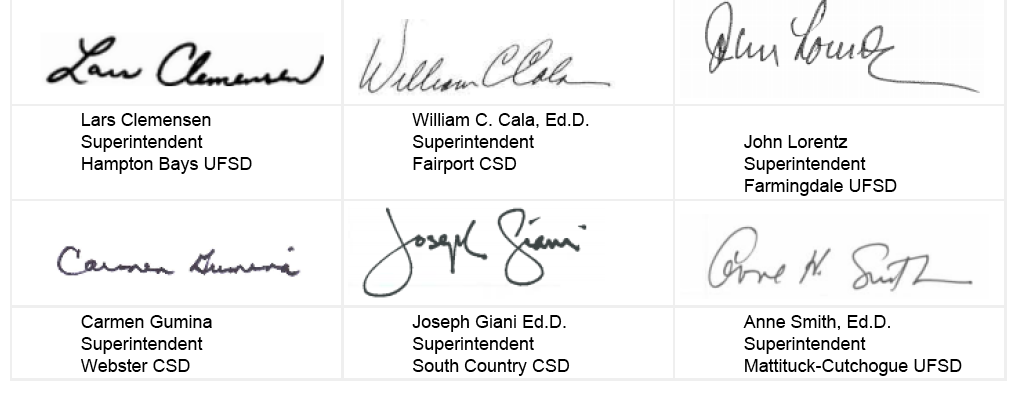
A group of school superintendents in New York banded together in late February to form The Alliance to Save Public Education.  They currently number 30 superintendents from Nassau County, Suffolk County, Westchester County, and Monroe County. They invite other superintendents from across the state to join them in signing their Declaration below. They welcome the signatures of school board presidents and leaders of parent associations as well.


Please contact your Superintendent, Board President, or PTA President to sign:


Print it, then sign the printout with a dark flair-type pen in a blank spot 


Scan & email it (or fax it) back to dgamberg@southoldufsd.com

You can download the letter to print here.


Here is the text of the letter:


March X, 2015


Dear Lawmaker:


Every day, nearly three million children and adolescents attend New York State’s public schools:  upstate and downstate, rural, urban and suburban, small, medium and large.  The variety is immense.  It may be painfully true that 109,000 students attend failing schools in New York State, but it also means that between 2.8 and 2.9 million students are attending successful schools.  Even in successful schools, we are familiar with a certain percentage of our children who fail.  We are constantly looking for ways within those systems to discover new and better methods to teach those struggling students and eliminate failure from the landscape of our public schools.  However, we must continue to support the segments of our systems that can create success.  In fact, they should be celebrated and replicated where possible.  The current effort at State reform, rather than focusing on our success and supporting what works effectively, appears to focus only on the State’s failures.  Failures can never be ignored, and do in fact need to be fixed, but not at the expense of damaging what creates our successful schools.


The Governor’s agenda is connecting the politics of State aid to education policy … AT WHAT COST?


The Governor’s agenda is removing control of our schools from our local communities … AT WHAT COST?


At what cost do we over test our students?  It must not be at the cost of our children, and our communities.


New York’s public schools include many that sustain student learning at high levels, and also some schools that fall below everyone’s expectations.  We believe the best use of our resources allows schools that work to continue to do so, and, at the same time, to support schools that need help to engage their students at the level we expect for all children.  In a state as varied as New York, a one-size-fits-all approach to school improvement is bound to damage schools that already engender students success, while dissipating the focused support that failing school require, to meet the needs of their students.


We urge the legislature to refrain from enacting the Governor’s proposals without a thoughtful debate.


Sincerely,


Screen shot 2015-03-11 at 8.43.08 PMScreen shot 2015-03-11 at 8.43.18 PMScreen shot 2015-03-11 at 8.43.28 PMScreen shot 2015-03-11 at 8.42.50 PMScreen shot 2015-03-11 at 8.42.20 PM

Art Tate, the superintendent of Davenport, Iowa, public schools announced at a school board meeting that he was going to break the law by spending more money for his students than state law allows. He said the district has ample reserves to pay for the additional spending. The Legislature imposed a formula that gives Davenport schools less than 170 other districts. Two-thirds of the students in the district are eligible for free or reduced price lunch. Art Tate joins the honor roll of this blog for his courage and readiness to take a stand on behalf of students.


Davenport schools Superintendent Art Tate Monday said he intends to “violate state law” and use more money than the state of Iowa has authorized.


The move will stave off budget cuts that Tate and the board had been discussing for months.


“I am taking this action after careful consideration and understanding the possible personal consequence,” Tate said. “I take full and sole responsibility for the violation of state law.


“With this action, I am following the example of our state Legislature, which has ignored the law this year by not providing districts with the state supplemental aid amount by Feb. 12, 2015.”


Tate’s address to the board and the audience was greeted with thunderous applause and a standing ovation.


Tate said a legislative forum on Saturday, when he saw some of his students wearing T-shirts that said “I’m Worth-Less,” influenced his decision.


Three students wore those T-shirts to the Monday board meeting and spoke about the inequity of the state funding system for education.


“We won’t stand for our schools being underfunded,” North High School student Anthony DeSalvo said. “We won’t stand for inequality. Our students are not worth less than anyone else.”


All three students briefly stood behind Tate during the board meeting.


The forum, Tate said, made him realize his personal responsibility as the district leader to take action. The students’ T-shirts, he said, are literally correct….


Earlier, Tate had planned for the district to slash $3.5 million from the general fund budget for the 2015-16 school year and $5 million from the next year’s budget.
Several board members spoke in support of Tate.
“I think it’s criminal that we’re put in this position and that our children are made to wear shirts that say ‘I’m Worth-Less,'” said board member Jamie Snyder. “What investment does the state of Iowa think is more important than our children?”
“I applaud you, Dr. Tate,” said board member Ken Krumwiede, who also attended the Saturday forum. He said he was disappointed in the legislators who were there. “I hope you’re all listening out there … you need to contact your legislators to get things changed in Des Moines.”
Board Vice President Rich Clewell said, to much laughter, that he felt like he had “walked out of a board meeting and into a Baptist revival.”
“Although the cost of education might be high, what is the cost of ignorance?” Clewell asked.
Tate said he will make budget cuts with early retirement, utility savings through an energy conservation program, moving maintenance contracts from the general fund to the management fund and curtailing professional development during the school day, amounting to $1.4 million in savings.
“I will be asking no other reductions to programs and personnel, and most notably, I will not be increasing class size in order to reduce teacher positions,” he said.
Tate said he intends to use up to $1 million to support new programs to reduce the achievement gap, to “fight the effects of poverty, and to address diversion programs needed to turn around our out-of-school suspension numbers.”


I am pleased to add Superintendent Greg Power to the honor roll. He spoke up to those in power in Ohio, bluntly castigating them for the “assessment madness” that is ruining education. His statement was posted online by the Ohio Coalition for Equity and Adequacy.


Bill Phillis of the Coalition writes:


“The email from Greg Power (posted below) to State Superintendent Dr. Ross expresses the viewpoint of a lot of school administrators and teachers throughout the state and nation. As the Governor and 131st General Assembly gear up to unleash more K-12 public education legislation, other public school personnel may wish to weigh in on policy matters that relate to the education of Ohio’s children.”


Dear Superintendent Ross:


I write from the field to provide feedback regarding the ongoing drive by our state and federal governments to make public education “accountable.” As an advocate for the children of the Little Miami Learning Community, I can no longer remain silent regarding the legislated testing and assessment madness that has been thrust upon our schools. What has been occurring over the last several years and what is about to be unleashed upon our students and staff is nothing short of government malpractice. In fact, I believe the following quote from the 1983 A Nation at Risk is most applicable to what is being done to public education: “If an unfriendly foreign power had attempted to impose on America the mediocre educational performance that exists today, we might well have viewed it as an act of war.” Simply replace the phrase “unfriendly power” and insert our “state and federal governments.” In essence, the narrow assessment frenzy is moving us toward achieving the mediocrity referenced in the above quote.


In the name of “accountability” the new, different, and increased high-stakes assessments are in fact driving our learning environments to become so narrowly focused that the state and federal governments are creating a generation of stressed and bewildered test takers. What is being done to our children does not place their needs in proper perspective, nor does it properly support the efforts of our teachers with our children. Our schools cannot create successful, well-rounded students when there is such an overemphasis on high-stakes assessments. I would hope that it is not public education’s goal to create adults who perform well on high stakes tests, but rather adults who are good citizens with the requisite skills necessary to be economically successful citizens. Do employers require their employees to take annual high-stakes assessments on the job? What is going on now is wrong!


Recently, you made some recommendations to reduce and modify assessments and indicated this will require changes in the law. However, it appears that the “fix” will be to legislate a limit, resulting in local districts doing away with meaningful assessments that support the specific learning needs of students while maintaining the high-stakes state assessments. My district uses student assessments to progress monitor so we can ensure each student is progressing with appropriate supports and interventions. I would hate to see this go away because of a state mandated time limit on assessments. There are assessment frameworks available which provide both progress monitoring for formative instruction as well as providing summative student data which shows growth over time. Wouldn’t it be wonderful for the state to adopt such a framework absent the current high stakes framework?


As we prepare for the state-wide infrastructure test this Thursday and for the first of two twenty-day test windows beginning in February, our curriculum director, special education director, EMIS coordinator, technology director, principals, assistant principals and teachers are being required to abandon their primary functional roles to prepare for these assessments. These staff members have spent countless hours and will continue to spend countless hours in these preparation activities as we continue to receive ever changing protocol guidance that often contradicts and causes follow-on support requests from your Ohio Department of Education offices. Departmental guidance has certainly been untimely, ever changing, and at certain points unknowable. I believe the unrealistically legislated timelines of implementation for all of these changes cause even more concern. Why would anyone create such a set of circumstances? We certainly will be seeing the “fruits” of this legislative wisdom coming to full fruition in the coming months.


Of added note, our district continues to incur added expenses as we work to meet all of the requirements needed to support this mandated testing without the benefit of any added financial support from the state or federal levels. Our district has spent and will continue to spend dollars on technology to support the online components of this testing, and will most likely add staff to support this assessment framework. The costs associated with all of this are being borne in large part by the local tax payers. These dollars are better spent on other needs to support our students and their learning needs.


A guideline limitation of 6%-10% has been placed on the number of students who can utilize the “read aloud” accommodation on the ELA portion of the state assessment. We have been in contact with the Ohio Department of Education Office of Exceptional Children and have discussed our concern with this limitation at length. We do not wish to be out of compliance with the federal IDEA requirements related to our students who possess an IEP. We have been informed by your department that if we cannot attain the 6%-10% limitation on the “read aloud” accommodation, our test results above this threshold may be invalidated. After having been informed last November that districts needed to work toward this 6%-10% guideline threshold (not achieve it) we now receive ODE guidance that we must be at or below this threshold. All of this just days before the first test. Our district will endeavor to do what is right for our kids and provide the “read aloud” accommodation as verified by our teams. We will do this irrespective of what appears to us to be the arbitrary 6%-10% limitation.


Each community should have the kinds of schools it desires. We believe very strongly in local community control. My district, like many across the state, has been blessed with great kids, families, and staff. Little Miami is a great community where all of our stakeholders work toward supporting each child. In the current context of what has been legislated and mandated, continuing with measuring, assessing, quantifying, and grading our kids, staff, and schools does not provide the supports necessary for each child to succeed. In fact, the current state and federal approach hinders our schools from being able to do so. There is growing displeasure and mistrust of all that is being done to public education in the name of accountability. Please work with us to stop this madness.


Best regards,


Greg Power, Lt. Col. USAF Retired
Superintendent
Little Miami Local Schools

Lyndsey Layton wrote a compelling account in the “Washington Post” about Governor Chris Christie’s calamitous and non-productive attempt to burnish his credentials as a school reformer in Newark.

Five years ago , Christie boasted that he would turn Newark into a national model of school reform. He and then-Mayor Cory Booker persuaded Facebook founder Mark Zuckerberg to donate $100 million for such reforms as merit pay and charters. Christie and his then-state Commissioner Chris Cerf.

What’s happened in the past five years has not enhanced Christie’s reputation as a reformer. His appointee as superintendent, Cami Anderson, has alienated students, educators, parents, the clergy, and legislators. Her plan, One Newark, was imposed without community support. Ras Baraka was elected mayor in large part because of Anderson’s unpopularity.

“Five years after Christie launched what could have been a career-defining policy initiative for an aspiring future president, city leaders are in revolt. On Wednesday, a band of city, county and state elected officials, along with leaders from the NAACP and others, will board a train bound for Washington for a meeting with Obama administration officials. Newark parents have filed a federal civil rights complaint with the U.S. Department of Education, alleging that the plan, called “One Newark,” disproportionately affects African Americans, and the local officials plan to ask the administration to help halt a plan they say has thrown their city into chaos.

“The plan, which fully took effect during this academic year, essentially blew up the old system. It eliminated neighborhood schools in favor of a citywide lottery designed to give parents more choices. It prompted mass firings of principals and teachers, and it led to numerous school closures and a sharp rise in the city’s reliance on charter schools, which are publicly funded but privately run.

“Many families saw their children spread among multiple schools or sent across town. The scattering has been problematic for a city divided along gang lines, where four in 10 residents don’t own cars.

“In addition, state test scores have stayed the same or even declined. Amid protests, Christie’s hand-picked Newark superintendent, Cami Anderson, faces calls for her removal — even from some of her onetime allies.”

Newark is turning out to be a drag on Christie’s presidential ambitions, says Layton.

What’s astonishing is to read defenders of “reform” finding silver linings or straws to grasp at. Some claim that Cami has plenty of supporters, others say that success is around the corner. Just be patient. Christie’s state commissioner says, “Christie, through a spokesman, declined to comment. According to Christie’s education commissioner:

“It will take time to see the type of progress we all want,” he said. “Whatever we’re doing, we need to double down.”

Astonishing. If they double down, they are likely to face open rebellion from the parents of Newark.

Christie, in his typical bully style, makes clear that he doesn’t care what the people of Newark think. He likes her and that is all that matters. He just reappointed her for another one-year term.

Anderson is paid nearly $300,000 a year. In 2011, Christie capped superintendents’ salaries at $125,000-175,000, depending on the size of the district. Charter school leaders and Cami Anderson are exempt from the state salary cap.

EduShyster lives in Massachusetts, so she has more than a passing interest in the selection of the new superintendent of schools.


She presents us with the four finalists here.


One, Guadalupe Guerrero, led a school that was taken over by the state. Worse, she says, he was kicked out of a doctoral program at Harvard. She thinks he is at the back of the pack.


Then there is Tommy Chang, a TFA alum who had a speedy ascent up the administrative pole to become principal of a Green Dot charter school, and most recently, “special assistant to LA’s then superintendent, the ethically embattled Dr. John Deasy, who then further elevated Chang to a special position overseeing LA high schools in need of special attention.” One of the schools for which he was responsible was Jefferson High School, where students walked out in protest because they had no schedules; Chang removed the principal without having a replacement. Chaos. A good choice? EduShyster thinks not.


Next is Pedro Martinez, who has the dubious distinction of being a graduate of the unaccredited Broad Superintendents Academy, whose graduates tend to leave in a huff, after alienating large numbers of parents with their top-down, take-no-prisoners management style.


And last, there is Dana Bedden of Richmond, Virginia. What distinguishes him from the others is that the stakeholders in Richmond don’t want him to leave. Imagine that! There is actually a petition drive to persuade him to stay in Richmond. EduShyster notes with astonishment that he does not speak edujargon. He is her candidate. Given such a field, he should be everyone’s candidate.

Denis Smith, formerly a state official in charge of charter schools, here reviews Governor Kasich’s penchant for colorful and inaccurate statements.

Smith writes:

“According to the Columbus Dispatch, the governor said “We need more superintendents who are educators, and less superintendents who are politicians.”

Evidently, Kasich doesn’t know that Ohio law requires its superintendents to be highly professional:

“State law directs that the head of an Ohio school district must hold a professional school administrator license to serve as a superintendent. According to the Ohio Department of Education website, a superintendent must “Earn a master’s degree from an accredited university; Complete an approved preparation program; Receive a recommendation from the dean or head of teacher education at the institution where he or she completed the preparation program; Complete the Ohio Assessment for Educators licensure exam #015, Educational Leadership, prescribed by the State Board of Education.”

“In addition to all of these requirements, Ohio professional administrator licensure requires that a school superintendent “must have three years of successful experience in a position requiring a principal or administrative specialist license.”

Contrast this with the lack of requirements to lead a charter school:

“Under Ohio law, there are no education or professional requirements for an individual to serve as a public charter school superintendent or principal. None. As Woody Allen might have put it, if 80% of success in life is just showing up, you’ve got a good chance of becoming the top administrator of a charter school just by showing up, with a new start-up school proposal in hand, at the offices of a charter school sponsor.

“And yes, governor, let’s say it again: there are absolutely no administrative licensure requirements in charterdom. You don’t even have to be an educator in order to open and become a superintendent of a “public” charter school.”

As for politicians, no requirements there either.

According to those who were there, about 1,000 parents, educators, and other citizens packed the statehouse in Indianapolis to let the Governor and Legislature know that they support State Superintendent Glenda Ritz, and they don’t want their 1.3 million votes for her to be nullified by petty politics.


Here is a video and text from the Indiana Coalition for Public Education.


Here is Cathy Fuentes Rohwer speaking to the crowd in a riotous speech that had everyone cheering. Cathy wrote a passionate letter that ran on this blog. Cathy said what every teacher and parent knows: “My child is not college-and-career-ready because he is a child!” She also said: “Standards don’t educate children, teachers do!”


Here is the text of her great speech. “We can’t afford a three-tiered system of charters, vouchers, and public. We tried segregation and it didn’t work.”


Here is the video of Phyllis Bush’s wonderful speech.


And if you want even more, here are articles about the rally:


http://in.chalkbeat.org/2015/02/16/photos-ritz-supporters-rally-at-statehouse/#.VOj8jkK4mCR


http://www.journalgazette.net/…/Disdain-shown-for-Repub…


http://www.tribstar.com/news/local_news/statehouse-rally-supports-ritz-slams-gop/article_a7487dc5-457a-5c62-a06b-5c2a31acc6d4.html


http://thestatehousefile.com/supporters-rally-superintendent-ritz-public-education/20256/


Teachers, parents rally for Ritz


http://www.indystar.com/story/news/politics/2015/02/16/ritz-declares-teacher-rally-know-need/23515403/


http://www.wthr.com/story/28117025/statehouse-rally-today-to-support-superintendent-ritz


http://www.idsnews.com/article/2015/02/rally-for-ritz-to-take-place-in-indy-today


http://www.wfyi.org/news/articles/rally-for-ritz-packs-the-statehouse


http://www.heraldtimesonline.com/news/opinion/our-opinion-does-the-fight-over-hoosier-education-policy-have/article_56a45910-76c8-5e70-b048-8a49a4a54150.html


Mark Neal, superintendent of the Tri-Valley Local Schools in Ohio, wrote a sharply worded statement about parents’ right to opt their child out of testing.


When parents asked if they had the right to opt out, he responded with this advice:


While I am not (and never have been) an advocate of the PARCC Testing, Ohio got into this testing debacle with little to no input from local school officials. Therefore, I feel no responsibility to stick my neck out for the Department of Education by defending their decisions. What’s happening now, in my opinion, is that parents have figured out what is being forced upon their children, and the proverbial rubber… is beginning to meet the road. However, it is not our goal to discourage nor undermine the laws of our governing body.


Therefore, our position as a school district is that we do not discourage nor encourage a parent’s decision to opt out their child. We must respect parental rights at all costs. This is the very reason I advocate for local control. Our own Tri-Valley Board of Education is in a much better position to make sound decisions for the families of our school district, than are the bureaucrats in Columbus and Washington. I say that with no disrespect toward our own legislators, whom have worked diligently behind the scenes to address the over-testing issue. The unfortunate reality is that the parents who have contacted the school district up to this point, are the parents of high achieving students who undoubtedly would do well on these assessments. We will effectively be rating school districts and individual teachers based on test scores that do not include many of their highest achieving students….


I am quite confident that reason will ultimately prevail. In the meantime, we will respect the rights of our parents to make the best decisions for their children while simultaneously following the laws and policies of the Ohio Department of Education.


For defending common sense and speaking plainly to his community, I place Mark Neal on the honor roll of the blog as a champion of American public education.

This afternoon many educators and friends of public education gathered to show their support for Glenda Ritz in Indianapolis. Ritz, as you know, is trying to do her job as state superintendent while Governor Mike Pence is undercutting her at every turn and trying to nullify her election in 2012. She won more votes than Pence. This has to bother him.

Here is a first-hand account of the rally:

“I heard on the 6 pm news that it was “hundreds” but I am pretty sure it was near a thousand. I shared an elevator in parking garage with a group of teachers and one of them had spoken to a security person (we had to be metal detected one at a time as we entered the state house with our coats off and belongings scanned like airport…I had to be wanded and lift my pants legs to show my shoes) who told her it was just over 1000. I think that was what I would have guessed…maybe 900. Some of those could have been there for other business but the atrium was packed, as many standing as seated and up the stairs and around the balconies during the 2 hours of speaking.

“Glenda opened her office after she spoke and greeted all who entered and posed for pictures. I was touched by the college students who were there and obviously they were impressed to be there and so excited to pose with Glenda.

“The cheering and chanting were quite loud at times and the speakers well received. I lost count but 10-12 speeches were given. My favorite was Cathy Fuentes Rawher, an Indiana parent whose “rant” was posted last week in this blog. I saw children as young as two and elders who looked near 80. I saw school buses as well as motor coaches delivering folks.

“We had a couple of inches of snow early this morning and the southern part of the state got 6-7 inches and wind chills were an issue. I think it was an impressive turnout considering the bad weather and that many schools were making up days missed due to snow. The legislators were meeting and we were LOUD!”