Archives for category: Administrators, superintendents

Steve Matthews, superintendent of the Novi school district, here explains how the education profession has been attacked and demonized, with premeditation.


He begins:


So you want to kill a profession.


It’s easy.


First you demonize the profession. To do this you will need a well-organized, broad-based public relations campaign that casts everyone associated with the profession as incompetent and doing harm. As an example, a well-orchestrated public relations campaign could get the front cover of a historically influential magazine to invoke an image that those associated with the profession are “rotten apples.”


Then you remove revenue control from the budget responsibilities of those at the local level. Then you tell the organization to run like a business which they clearly cannot do because they no longer have control of the revenue. As an example, you could create a system that places the control for revenue in the hands of the state legislature instead of with the local school board or local community.


Then you provide revenue that gives a local agency two choices: Give raises and go into deficit or don’t give raises so that you can maintain a fund balance but in the process demoralize employees. As an example, in Michigan there are school districts that have little to no fund balance who have continued to give raises to employees and you have school districts that have relatively healthy fund balances that have not given employees raises for several years.


Then have the state tell the local agency that it must tighten its belt to balance revenue and expenses. The underlying, unspoken assumption being that the employees will take up the slack and pay for needed supplies out of their own pockets.


Additionally , introduce “independent” charters so that “competition” and “market-forces” will “drive” the industry. However, many of these charters, when examined, give the illusion of a better environment but when examined show no improvement in service. The charters also offer no comprehensive benefits or significantly fewer benefits for employees. So the charters offer no better quality for “customers” and no security for employees but they ravage the local environment.


Then create a state-mandated evaluation system in an effort to improve quality…..


That is how it begins.


For his willingness to speak out honestly and courageously, I add Steve Matthews to the blog’s honor roll as a hero of public education.


The issue of mayoral control of the schools in New York City is now before the State Legislature, as its authorization expires in 2016. The current form of mayoral control was established in 2002, when the Legislature responded to newly elected Mayor Michael Bloomberg’s request for complete control of the sprawling school system. Mayoral control was renewed by the Legislature in 2009. Bloomberg promised to bring efficiency to the system and managerial expertise. Now the Legislature must decide whether to renew mayoral control or to tweak it or to substitute some other form of management.


I have written about mayoral control on many occasions over the years. My first book, published in 1974, was a history of the New York City public schools, and a large part of the story consists of the search for a competent way to govern the schools of a huge city. The city as we now know it was created by popular vote in 1898 (many people in Brooklyn, who opposed consolidation, thought the vote was rigged). In the nineteenth century, New York City consisted only of what is now Manhattan. Brooklyn was a separate city, and the other regions were towns and villages in what are now the boroughs of Queens, the Bronx, and Staten Island.


I won’t recapitulate the history of governance here; I wrote a paper on the subject a few years ago. It is not necessary to go into the twists and turns of the nineteenth century other than to point out that there was only one time in the past when the Mayor took total control of the previously independent New York City Board of Education and turned it into a department of the city government. That was during the heyday of the Tweed Ring. William Marcy Tweed (Boss Tweed), then in the legislature, steered through “reform” legislation in 1869 that gave over the entire school system of New York to his crony, who packed the board with allies and steered contracts to favorites of the Tweed Ring. The Tweed board canceled all book contracts with Harper Brothers as punishment for its publication of Thomas Nast cartoons ridiculing Boss Tweed. In 1871, the Tweed Ring was exposed, and its members eventually prosecuted. In 1873. the legislature restored the independent Board of Education.


For most of the history of New York City’s public schools, the members of the central board were appointed by the mayor. Mayoral control was typical, not atypical. In addition, there were local boards where citizens could participate in the governance of their community public schools and make their views known. For a time in the nineteenth century, the central board and the local boards were elected. After the debacle of the Tweed takeover, both boards were appointed, not elected, in an attempt to insulate them from politics. It is clear, however, that politics can intrude on any arrangement, whether appointed or elected.


When the city was consolidated as the Greater Metropolitan New York City in 1898, each borough had its own school board. However, there were frequent conflicts over money, curriculum, hiring policy, and other issues. The city leaders agreed that uniformity was needed, so in 1902, the legislature established the New York City Board of Education as a single governing body for the large school system. The new board consisted of 46 members, all appointed by the Mayor, representing all the boroughs. The city was divided into 46 local school districts, each of which had its own appointed local school board.


True power in the new, consolidated system rested in the hands of the professional Superintendent of Schools and his Board of Deputy Superintendents. As it happened, New York City had an outstanding educator as its first Superintendent, William Henry Maxwell. He was a superb administrator and a visionary, who saw the responsibilities of the schools as extending beyond academics to the health and well-being of children. He served for 20 years in that post, setting academic standards, opening schools for children with disabilities, creating adult education centers, and producing a host of innovative reforms that benefited the city. The city also had a Board of Examiners, which tested those who wanted to teach in the system.


Over the course of the twentieth century, the size of the school board was reduced from 46 to 7 and then expanded to 9, but it continued to be appointed by the mayor. The system was highly centralized until 1969.


From the mid-60s until 1969, black and Hispanic activists engaged in demonstrations and protests to demand desegregation. When their demands were ignored, they sought community control of the schools. The Ford Foundation subsidized an experiment in community control in three districts. In 1968, the city’s teachers went on strike for two months to protest the firing of union teachers without due process in one of those districts, Ocean Hill-Brownsville in Brooklyn. Mayor John Lindsay sided with the black community leaders. In 1969, the Legislature passed a new decentralization law, establishing a seven-member central board and local community boards (which for a time were elected). The seven-member board consisted of five members appointed by the five borough presidents and only two members appointed by the mayor. This was most certainly a rebuke to Mayor Lindsay. Even under this new form of decentralization, the mayor still exerted considerable control, both through his control over the budget and his alliances with at least two of the borough presidents.


Almost every mayor subsequently asked for a larger role in the running of the schools but was ignored by the Legislature. When Michael Bloomberg was elected in 2001, one of his major campaign promises was to gain control of the schools and reform them. The Legislature complied and granted him full control in mid-2002. What was once the New York City Board of Education is now the New York City Department of Education, just another city agency, akin to the Police Department, the Fire Department, the Sanitation Department. The legislation kept a central board of 13, but the majority (8) was appointed by the mayor and serve at his pleasure (Mayor Bloomberg called it the Panel on Educational Policy, to signify its powerlessness). Local school boards were replaced by powerless community education councils. Mayor Bloomberg appointed attorney Joel Klein as his first chancellor (and subsequently replaced him with publisher Cathie Black, who had a brief and stormy three-month tenure, then replaced her with Deputy Mayor Dennis Walcott). The system went through several reorganizations. The Bloomberg administration relied on test scores to close low-performing schools and to open many new small schools and more than 100 charter schools.


What should be done now? Mayor Bill de Blasio and former Mayor Rudy Guiliani have appealed to the state legislature to retain mayoral control and to make it permanent.


Here is what I think, based on what I know: I agree that there should be mayoral control. But it should be modified to add checks and balances. No one chief executive should have total control of the public’s schools. No one chief executive should have the unlimited power to change the schools without referring to anyone else. No one mayor should be able to ignore the views of public school parents.


The mayor should continue to appoint the members of the New York City Board of Education. Those who wish to serve should be vetted by a review panel composed of representatives of civic and educational organizations (this was the practice in the early 1960s). This prevents the mayor from stacking the board with campaign donors and friends.


Members of the Board of Education should serve for a set term of three or four or five years, to ensure their independence. At present, they serve at the pleasure of the mayor, making the Board a rubber-stamp.


The Board of Education, not the mayor, should select the Chancellor. The Chancellor should report to the Board of Education and seek their approval for his/her proposals and budget.


Local school boards should be elected by parent associations, with the approval of the borough presidents.


Mayor Bloomberg was right to restore mayoral control, but it should now be improved upon by inserting checks and balances. The mayor should appoint the Board of Education, and this board should serve set terms and be responsible for the appointment and replacement of the chancellor.


No one should imagine that mayoral control is a panacea. It is not. Cleveland has had mayoral control for many years, and it continues to be one of the nation’s lowest-performing cities (and also a city with extreme poverty). Detroit had mayoral control for a few years, until voters eliminated it (one of the city’s mayors went to jail a few years ago). Chicago has mayoral control, and this enabled the mayor to close 50 public schools and to ignore the outcry from the affected communities; no one (except perhaps Arne Duncan) would consider Chicago to be a national model. Boston has mayoral control, and performance varies with economics, as it does everywhere. The District of Columbia has mayoral control, and it also has the largest black-white, Hispanic-white achievement gaps of any urban district tested by NAEP. The highest performing districts on NAEP (Charlotte and Austin) do not have mayoral control.


Mayoral control, with the checks and balances I described, makes sense organizationally. By itself, it solves no problems. It still requires the hard work of school improvement, the hard work of creating good schools and a good working environment for students, teachers, and principals. And schools in urban districts still require the resources to meet the needs of the children they enroll, regardless of who appoints the central board.


Ken Mitchell, who recently retired as a school superintendent, attempts to shed light on thorny problems in current education policy in this article.


No Child Left Behind and Race to the Top have been dismal failures, and their main result appears to be the creation of chaos and incoherence at the local level. Both assume that standardized tests are not only the measure of education but the goal of education. Legislators are reacting by passing laws about how to evaluate teachers, a subject about which they are not expert and not well-informed.


Mitchell calls for the creation of an education summit, but with a twist:


It is time for an education summit, but not one that emanates from the governor’s office.


The governor has appointed commissions on mandate relief, school reform, and Common Core, naming members who often lacked expertise or objectivity. This time we need a summit involving stakeholders: teachers, principals, superintendents, parents and school boards. We need a de-politicized venue to ensure an objective analysis of the evidence behind current and proposed reforms related to assessment, teacher evaluation, Common Core and charter schools. If policymakers continue to mandate without evidence and allow profiteers to influence educational decisions, children will be harmed and public education ruined.


His suggestion makes sense. The Legislature should listen to the experts, rather than attempt to regulate the teaching profession. They would never dream of passing laws to evaluate the medical profession or any other profession. Why should they tell principals and superintendents how to evaluate teachers?

David Gamberg, superintendent of schools in Greenport and Southold, two neighboring towns on the North Fork of Long Island in Néw York, sent a letter home to parents, outlining the procedure they should follow if they don’t want their child to take the Common Core tests.

He assured parents that students will not be compelled to “sit and stare,” a punitive approach in some districts.

An enlightened educator, Gamberg is a strong supporter of the arts in schools. The elementary school in Southold has its own orchestra and a vegetable garden where children raise food for the cafeteria.

Laura H. Chapman offered the following comments about Ohio’s shell game of assessment. Among other troublesome issues, Ohio will encourage “shared attribution” for evaluating teachers; that means that teachers who do not teach tested subjects will be assigned a rating based on the scores of students they do not teach.


Chapman writes:


In Ohio, the State Superintendent of Public instruction, Dr Ross, has a request in to Governor and the legislators to lighten the testing load. The “Testing Report and Recommendations” ( January 15, 2015) includes some cockamamie statements about the purposes of tests, along with some revealing stats.


Among these highlights are there. Ohio students in grades K-12 spend about 19.8 hours a year taking tests on average. Ohio students spend approximately 15 additional hours practicing for tests each year.


A chart on page 5 shows that Kindergarten students are tested for 11.3 hours on average, and grade 1 students 11.6 hours on average. These are the lowest times. Add the test prep for a total of 26.3 hours and 26. 6 hours respectively for testing. That is slightly more than the time allocation for elementary school instruction in the visual arts in the era before test-driven policies determined everything about K-12 education.


The highest testing times are in grade 3–28 hours, and at grade 10–28.4 hours, not counting the test prep. The spike at grade 3 is from Kasich’s guarantee–“read by grade three” or repeat the whole grade. Dr. Ross wants to cut out some of the current test time for reading (about four hours) by letting grade three teachers do those super high stakes at will, more than once if necessary, with a summer grade three test being decisive for students who have not passed muster earlier. This strikes me as a shell game, not really a reduction but an increase for students who are still learning to read.


This report also recommends that testing time be reduced by cutting tests for SLOs. “Eliminate the use of student learning objective (SLO) tests as part of the teacher evaluation system for grades pre-K to 3 and for teachers teaching in non-core subject areas in grades 4-12. The core areas are English language arts, mathematics, science and social studies.”


“Teachers teaching in grades and subject areas in which student learning objectives are no longer permitted will demonstrate student growth through the expanded use of shared attribution, although at a reduced level overall. In cases where shared attribution isn’t possible, the department will provide guidance on alternative ways of measuring growth” (p.10).”


This obscure language about the expansion of “shared attribution” as a way to measure student learning is not clarified by the following statement (pp. 10-11).


”…when no Value-Added or approved vendor assessment data is available, the department gives teachers and administrators the following advice.


First, educators should not test solely to collect evidence for a student learning objective. The purpose of all tests, including tests administered for purposes of complying with teacher evaluation requirements, should be to measure what the educator is teaching and what students are learning.


Second, to the extent possible, eliminate the use of student learning objective pre-tests. When other, pre-existing data points are available, teachers and schools should use those instead of giving a pre-test.” (pp. 10-11).


The convoluted reasoning and ignorance about testing is amazing. “The purpose of all tests, including tests administered for purposes of complying with teacher evaluation requirements, should be to measure what the educator is teaching and what students are learning.” Student tests are not direct measures of what teachers are teaching. Many tests document what students have or have not learned beyond school. Compliance with legislative mandates means you can ignore undisputed facts and sound reasoning about testing.


In the proposed policy, teachers who do not receive a VAM based on scores from PARCC tests (ELA and math) and/or tests from AIR (science and social studies) or from some other VAM-friendly standardized test from an “approved vendor” are asked to get used to the idea of “sharing scores” produced by students and teachers of subjects they do not teach and state-wide scores processed through the VAM calculations. There is no evidence these tests are instructionally sensitive, meaning suitable for teacher evaluation. The state approved tests seriously misrepresent student achievement, especially those from PARCC, because those tests assume learning of the CCSS have been in place, fully implemented, with cumulative learning from prior years.


SLOs and the district-approved tests for these appear to be dead (or dying) in Ohio, not because they were seriously flawed concepts from the get-go, but because those tests took longer to administer on average than others. The “loud and clear” demands for less testing are most easily met by cutting the SLO tests (those usually designed by teacher collaboration) in favor scores allocated to teachers under the banner of “shared attribution.”


Like many other states where governors and legislators are trying to micromanage teachers, there is an unconscionable insistence that any data point is as good as another, that tests are “objective,” and that junk science marketed as VAM is not a problem.


Unfortunately, all of the talk about “high quality” this and that does not extend to expectations for fair, ample, and ethical portrayals of student and teacher achievement.

Ohio seems to have an amazing number of district superintendents with integrity, unafraid to speak up. Superintendent Steve Kramer of the Madeira City schools wrote an open letter to the state superintendent Richard Ross, describing the unnecessary burden of testing.

For standing up for students, I name Steve Kramer to the honor roll.

He writes:

Dr. Richard Ross, Superintendent Ohio Department of Education
25 South Front Street
Columbus, OH 43215-4183

Dear Dr. Ross:

This week the Madeira City School District joined districts across the state and nation in implementing the new PARCC and AIR state-mandated testing. After witnessing the monumental amount of time and resources our faculty, staff and administrators have spent in preparing for, and now executing these tests, I am profoundly concerned that they are neither relevant nor important to the high quality instruction Madeira City Schools has been proud to provide for over 80 years.

State and federal legislation regarding high stakes testing has been enacted with little or no regard to best educational practice. Public school districts have been given no option but to administer the tests as mandated by law. And yet, many of our parents are now seeing first hand the amount of time that these tests are taking and questioning the overall value of their results. I would tend to agree with them.

The Madeira City Schools Board of Education and I have discussed these concerns at great length. While everyone can agree that school districts should have some measure of accountability to its taxpayers, I would argue that when those measures impact an organization’s ability to accomplish its core mission, assessment in the name of accountability has gone too far. This is certainly the case in our K-12 public schools. I urge you as an educational leader in this state to advocate for reducing the amount of state mandated testing and demand a more common sense approach that balances the needs of what we know about our students with how they learn. In Madeira, we are about kids and high quality teaching and learning, not testing.

Three clear recommendations have been talked about amongst my colleagues that I would like you to consider:

1. Continue to review the state mandated test schedule and advocate for reducing the amount of testing to one content area per grade level, per school year, starting no sooner than the third grade.

2. In your review of testing, stay focused on the state mandated tests and not on limiting the amount of diagnostic or meaningful formative assessments that actually help teachers in guiding instruction. The survey you
recently sent out neglected to focus on the state mandated tests.

3. As more mandates are discussed and debated amongst the politicians in Columbus, I urge you to support your
colleagues in the field and stand up for public education and against the misguided policies of lawmakers. Insist that lawmakers and the Ohio Department of Education involve local school leaders on any educational changes PRIOR to implementing new laws. The students of Ohio demand nothing less from the state superintendent of public instruction. Students and valuable instructional time are at risk when we chase practices that are not research-based or for that matter, are contrary to what educational research would say is effective.

I have been meeting the past few months with area superintendents and board members from southwest Ohio about how we can work together to effect change and return local control back to our communities. To that end, parents and community members of Madeira will be asked to join me in sharing their views with our elected officials on state and federally mandated testing as well as other significant issues related to our loss of local control.

Sincerely,

Steve Kramer Superintendent Madeira City Schools

cc:
Senator Bill Seitz
Representative Jonathan Dever
Ohio School Board Representative Pat Bruns, District 4

Su

A dozen superintendents in Connecticut issued a manifesto for real reform. It is one that parents and teachers–and students too!–would happily embrace in place of the current stale and test-driven juggernaut that crushes learning and creativity.

They say, in part:

“Our public school landscape is littered with initiatives, while the vision for learning in Connecticut lacks clarity and coherence. In this “vision void” our measures (i.e. test scores) have become our goals, confounding the purpose of schooling and perpetuating yet another round of piecemeal initiatives.

“The path we should avoid taking is the one that implements the NCLB waiver plan as the de facto vision for the education of Connecticut’s children. Instead we should identify a clear and compelling vision for education in our state and employ all of our resources to achieve it. Staying the course of current reform efforts without a deep analysis of the effects in actual classrooms across the state will further cement the system of compliance and “one size fits all” that grips our very diverse school districts like a vise.

“One way to clarify the vision is to answer the direct and simple questions:

“What are the most worthy outcomes of our public education system?

“Are we preparing our students for the world they will enter when they graduate?

“Is our public education system positioned for continuous improvement, as opposed to ranking, sorting and punishing?

“To what extent do our laws increase conformity at the expense of innovation?

“The answers to these questions imply the need to foster the cognitive, social/emotional and interpersonal student capacities for work, citizenship and life. Additionally, they demand a deep analysis of the systemic efforts to continuously improve. Confronting these questions, and others, will require:

“A redefinition of the role of testing,

“An accountability model (mandatory in the NCLB waiver) matched to a clarified vision for 21st Century learning in Connecticut

“Statewide systems that incentivize innovation and a broad sharing of innovative programs…”

“Districts and teachers are suffocating from a “one size fits all”, compliance-based approach to schooling. One size does not fit all in education, no more than it does in medicine, social work or any other endeavor in which human beings are at the core of the enterprise. In an era that rewards and requires innovative thinking to solve complex problems, public schools have endured a stifling of professional autonomy through increased standardization and homogenization. As a result, energy is drained, a passion for teaching and learning evaporates, and many teachers and leaders question the lack of purpose to their work. Some ways to foster innovation include:

“Creating a “Districts of Innovation” program through which the State Department of Education would administer a rigorous process identifying various district approaches to current challenges faced by schools, such as, reducing bullying, improving school climate, evaluating the performance of individual teachers and administrators, etc. These districts would apply for a waiver or modification from state requirements in order to innovate their practices, while analyzing the impact. These districts could be required to partner with a university, commit to sharing their results, and, if successful, serve as a provider of professional development for other districts. The incubation of fresh, innovative ideas, by classroom teachers and administrators would exponentially grow the capacity of educators in the state.

“Working with Regional Education Service Centers (RESC) to develop an “expert in residence” program with area districts. Districts could grant a yearlong sabbatical to individual teachers to share their innovative work and provide professional development to schools across the state.
Pairing schools to work across different districts to collaboratively confront professional challenges. These partnerships could foster such promising practices as “lesson study”, peer to peer observations, and collaborative analysis of student work.”

These are but a few of the good ideas, grounded in experience and research, that these thoughtful superintendents propose. It is a vision for positive reform that should replace the sterile strategy of carrots and sticks.

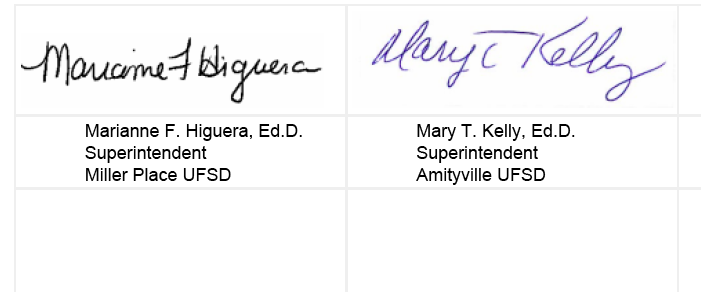
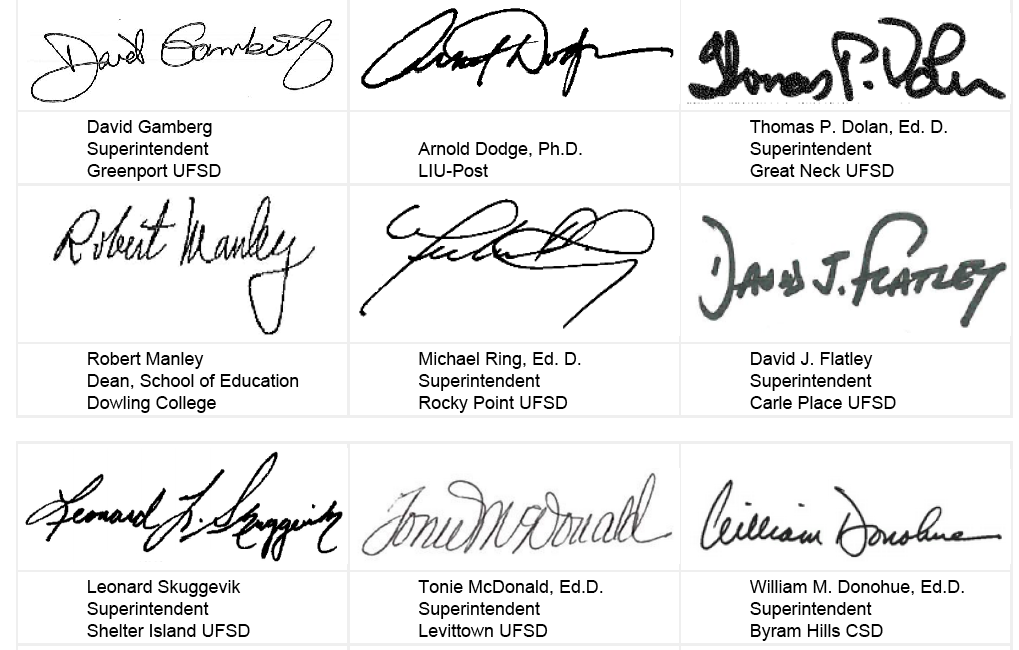
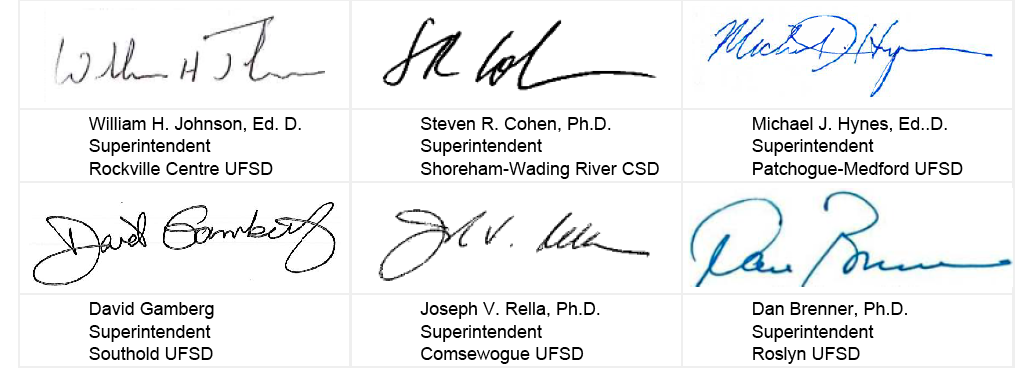
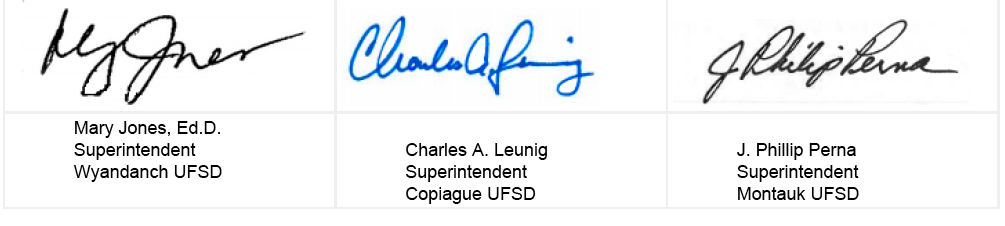
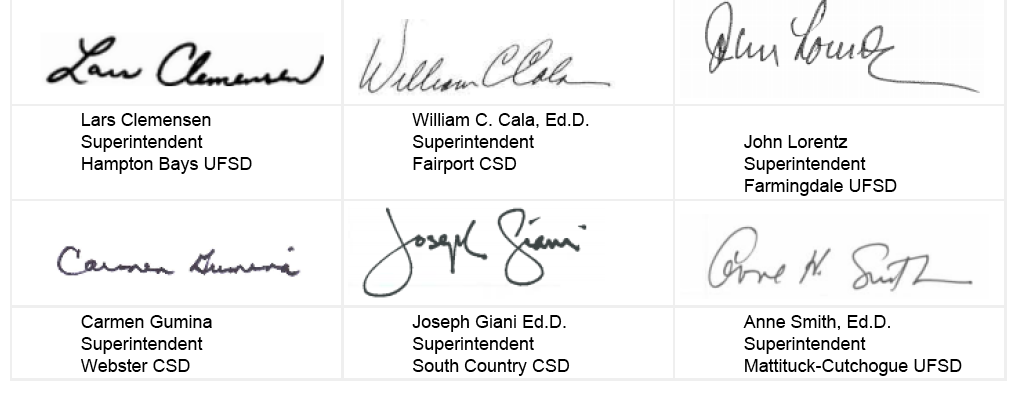
A group of school superintendents in New York banded together in late February to form The Alliance to Save Public Education.  They currently number 30 superintendents from Nassau County, Suffolk County, Westchester County, and Monroe County. They invite other superintendents from across the state to join them in signing their Declaration below. They welcome the signatures of school board presidents and leaders of parent associations as well.


Please contact your Superintendent, Board President, or PTA President to sign:


Print it, then sign the printout with a dark flair-type pen in a blank spot 


Scan & email it (or fax it) back to dgamberg@southoldufsd.com

You can download the letter to print here.


Here is the text of the letter:


March X, 2015


Dear Lawmaker:


Every day, nearly three million children and adolescents attend New York State’s public schools:  upstate and downstate, rural, urban and suburban, small, medium and large.  The variety is immense.  It may be painfully true that 109,000 students attend failing schools in New York State, but it also means that between 2.8 and 2.9 million students are attending successful schools.  Even in successful schools, we are familiar with a certain percentage of our children who fail.  We are constantly looking for ways within those systems to discover new and better methods to teach those struggling students and eliminate failure from the landscape of our public schools.  However, we must continue to support the segments of our systems that can create success.  In fact, they should be celebrated and replicated where possible.  The current effort at State reform, rather than focusing on our success and supporting what works effectively, appears to focus only on the State’s failures.  Failures can never be ignored, and do in fact need to be fixed, but not at the expense of damaging what creates our successful schools.


The Governor’s agenda is connecting the politics of State aid to education policy … AT WHAT COST?


The Governor’s agenda is removing control of our schools from our local communities … AT WHAT COST?


At what cost do we over test our students?  It must not be at the cost of our children, and our communities.


New York’s public schools include many that sustain student learning at high levels, and also some schools that fall below everyone’s expectations.  We believe the best use of our resources allows schools that work to continue to do so, and, at the same time, to support schools that need help to engage their students at the level we expect for all children.  In a state as varied as New York, a one-size-fits-all approach to school improvement is bound to damage schools that already engender students success, while dissipating the focused support that failing school require, to meet the needs of their students.


We urge the legislature to refrain from enacting the Governor’s proposals without a thoughtful debate.


Sincerely,


Screen shot 2015-03-11 at 8.43.08 PMScreen shot 2015-03-11 at 8.43.18 PMScreen shot 2015-03-11 at 8.43.28 PMScreen shot 2015-03-11 at 8.42.50 PMScreen shot 2015-03-11 at 8.42.20 PM

Art Tate, the superintendent of Davenport, Iowa, public schools announced at a school board meeting that he was going to break the law by spending more money for his students than state law allows. He said the district has ample reserves to pay for the additional spending. The Legislature imposed a formula that gives Davenport schools less than 170 other districts. Two-thirds of the students in the district are eligible for free or reduced price lunch. Art Tate joins the honor roll of this blog for his courage and readiness to take a stand on behalf of students.


Davenport schools Superintendent Art Tate Monday said he intends to “violate state law” and use more money than the state of Iowa has authorized.


The move will stave off budget cuts that Tate and the board had been discussing for months.


“I am taking this action after careful consideration and understanding the possible personal consequence,” Tate said. “I take full and sole responsibility for the violation of state law.


“With this action, I am following the example of our state Legislature, which has ignored the law this year by not providing districts with the state supplemental aid amount by Feb. 12, 2015.”


Tate’s address to the board and the audience was greeted with thunderous applause and a standing ovation.


Tate said a legislative forum on Saturday, when he saw some of his students wearing T-shirts that said “I’m Worth-Less,” influenced his decision.


Three students wore those T-shirts to the Monday board meeting and spoke about the inequity of the state funding system for education.


“We won’t stand for our schools being underfunded,” North High School student Anthony DeSalvo said. “We won’t stand for inequality. Our students are not worth less than anyone else.”


All three students briefly stood behind Tate during the board meeting.


The forum, Tate said, made him realize his personal responsibility as the district leader to take action. The students’ T-shirts, he said, are literally correct….


Earlier, Tate had planned for the district to slash $3.5 million from the general fund budget for the 2015-16 school year and $5 million from the next year’s budget.
Several board members spoke in support of Tate.
“I think it’s criminal that we’re put in this position and that our children are made to wear shirts that say ‘I’m Worth-Less,'” said board member Jamie Snyder. “What investment does the state of Iowa think is more important than our children?”
“I applaud you, Dr. Tate,” said board member Ken Krumwiede, who also attended the Saturday forum. He said he was disappointed in the legislators who were there. “I hope you’re all listening out there … you need to contact your legislators to get things changed in Des Moines.”
Board Vice President Rich Clewell said, to much laughter, that he felt like he had “walked out of a board meeting and into a Baptist revival.”
“Although the cost of education might be high, what is the cost of ignorance?” Clewell asked.
Tate said he will make budget cuts with early retirement, utility savings through an energy conservation program, moving maintenance contracts from the general fund to the management fund and curtailing professional development during the school day, amounting to $1.4 million in savings.
“I will be asking no other reductions to programs and personnel, and most notably, I will not be increasing class size in order to reduce teacher positions,” he said.
Tate said he intends to use up to $1 million to support new programs to reduce the achievement gap, to “fight the effects of poverty, and to address diversion programs needed to turn around our out-of-school suspension numbers.”


I am pleased to add Superintendent Greg Power to the honor roll. He spoke up to those in power in Ohio, bluntly castigating them for the “assessment madness” that is ruining education. His statement was posted online by the Ohio Coalition for Equity and Adequacy.


Bill Phillis of the Coalition writes:


“The email from Greg Power (posted below) to State Superintendent Dr. Ross expresses the viewpoint of a lot of school administrators and teachers throughout the state and nation. As the Governor and 131st General Assembly gear up to unleash more K-12 public education legislation, other public school personnel may wish to weigh in on policy matters that relate to the education of Ohio’s children.”


Dear Superintendent Ross:


I write from the field to provide feedback regarding the ongoing drive by our state and federal governments to make public education “accountable.” As an advocate for the children of the Little Miami Learning Community, I can no longer remain silent regarding the legislated testing and assessment madness that has been thrust upon our schools. What has been occurring over the last several years and what is about to be unleashed upon our students and staff is nothing short of government malpractice. In fact, I believe the following quote from the 1983 A Nation at Risk is most applicable to what is being done to public education: “If an unfriendly foreign power had attempted to impose on America the mediocre educational performance that exists today, we might well have viewed it as an act of war.” Simply replace the phrase “unfriendly power” and insert our “state and federal governments.” In essence, the narrow assessment frenzy is moving us toward achieving the mediocrity referenced in the above quote.


In the name of “accountability” the new, different, and increased high-stakes assessments are in fact driving our learning environments to become so narrowly focused that the state and federal governments are creating a generation of stressed and bewildered test takers. What is being done to our children does not place their needs in proper perspective, nor does it properly support the efforts of our teachers with our children. Our schools cannot create successful, well-rounded students when there is such an overemphasis on high-stakes assessments. I would hope that it is not public education’s goal to create adults who perform well on high stakes tests, but rather adults who are good citizens with the requisite skills necessary to be economically successful citizens. Do employers require their employees to take annual high-stakes assessments on the job? What is going on now is wrong!


Recently, you made some recommendations to reduce and modify assessments and indicated this will require changes in the law. However, it appears that the “fix” will be to legislate a limit, resulting in local districts doing away with meaningful assessments that support the specific learning needs of students while maintaining the high-stakes state assessments. My district uses student assessments to progress monitor so we can ensure each student is progressing with appropriate supports and interventions. I would hate to see this go away because of a state mandated time limit on assessments. There are assessment frameworks available which provide both progress monitoring for formative instruction as well as providing summative student data which shows growth over time. Wouldn’t it be wonderful for the state to adopt such a framework absent the current high stakes framework?


As we prepare for the state-wide infrastructure test this Thursday and for the first of two twenty-day test windows beginning in February, our curriculum director, special education director, EMIS coordinator, technology director, principals, assistant principals and teachers are being required to abandon their primary functional roles to prepare for these assessments. These staff members have spent countless hours and will continue to spend countless hours in these preparation activities as we continue to receive ever changing protocol guidance that often contradicts and causes follow-on support requests from your Ohio Department of Education offices. Departmental guidance has certainly been untimely, ever changing, and at certain points unknowable. I believe the unrealistically legislated timelines of implementation for all of these changes cause even more concern. Why would anyone create such a set of circumstances? We certainly will be seeing the “fruits” of this legislative wisdom coming to full fruition in the coming months.


Of added note, our district continues to incur added expenses as we work to meet all of the requirements needed to support this mandated testing without the benefit of any added financial support from the state or federal levels. Our district has spent and will continue to spend dollars on technology to support the online components of this testing, and will most likely add staff to support this assessment framework. The costs associated with all of this are being borne in large part by the local tax payers. These dollars are better spent on other needs to support our students and their learning needs.


A guideline limitation of 6%-10% has been placed on the number of students who can utilize the “read aloud” accommodation on the ELA portion of the state assessment. We have been in contact with the Ohio Department of Education Office of Exceptional Children and have discussed our concern with this limitation at length. We do not wish to be out of compliance with the federal IDEA requirements related to our students who possess an IEP. We have been informed by your department that if we cannot attain the 6%-10% limitation on the “read aloud” accommodation, our test results above this threshold may be invalidated. After having been informed last November that districts needed to work toward this 6%-10% guideline threshold (not achieve it) we now receive ODE guidance that we must be at or below this threshold. All of this just days before the first test. Our district will endeavor to do what is right for our kids and provide the “read aloud” accommodation as verified by our teams. We will do this irrespective of what appears to us to be the arbitrary 6%-10% limitation.


Each community should have the kinds of schools it desires. We believe very strongly in local community control. My district, like many across the state, has been blessed with great kids, families, and staff. Little Miami is a great community where all of our stakeholders work toward supporting each child. In the current context of what has been legislated and mandated, continuing with measuring, assessing, quantifying, and grading our kids, staff, and schools does not provide the supports necessary for each child to succeed. In fact, the current state and federal approach hinders our schools from being able to do so. There is growing displeasure and mistrust of all that is being done to public education in the name of accountability. Please work with us to stop this madness.


Best regards,


Greg Power, Lt. Col. USAF Retired
Superintendent
Little Miami Local Schools