Archives for category: Accountability

The Resistance has opened a new front in Wisconsin!

The proper place for accountability is at the top: with those who decide how much money is available, and those who write the laws and the mandates and the regulations.

The legislature determines whether funding is available to reduce class size, to provide adequate staff, to offer appropriate compensation to those who work in the schools.

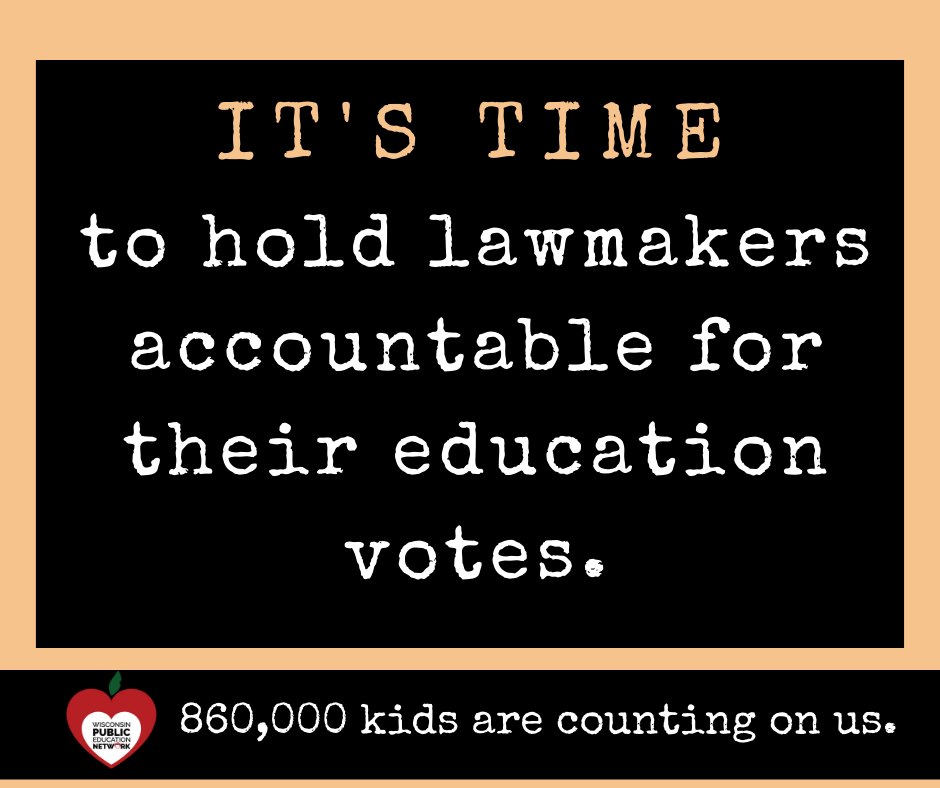
The lawmakers should be held accountable!

Get active! Get involved!

This notice was distributed by Heather DuBois Bourenane <hdb@wisconsinnetwork.org>


The Department of Public Instruction issues its school and district report cards today, a legislative mandate which requires our students and schools to be held accountable for many things they cannot control.

It’s only fair to hold our lawmakers accountable for the one thing they can control: their votes.

Today we have issued a new tool to help hold them accountable: our first ever Legislative Report Cards that help connect the dots between the performance of our legislators and the needs of our children.

Despite the countless successes of students and public schools around the state, we have invested in widening the gaps between “haves” and “have nots” — gaps that are reflected very clearly in standardized test results.  We know that Wisconsin has the worst racial performance gaps in the nation. We know that our funding formula is profoundly inequitable, unpredictable, and inadequate. We know we are worst in the nation for how we fund special education. Our support for bilingual and bicultural needs – which increased by zero dollars in this year’s budget – has been described as “pitiful.”

The 2019-2021 state budget made gains in some areas, but failed to even meet the 2/3 funding mark. 40% of districts received less aid this year than last year. We did not move the needle for our kids. How can we continue to hold our kids and schools “accountable” but not those whose votes reflect the state’s failure to meet our most basic expectations?

You asked for a tool for holding legislators accountable, and we created one: a rubric for assessing budget votes based on the priority needs of our students as outlined by the bipartisan Blue Ribbon Commission on School Funding and put forward in the budget requests of Governor Evers.

Click here to read the full release and access our Legislative Report Cards for all Wisconsin lawmakers: http://www.WisconsinNetwork.org/blog/report-cards.

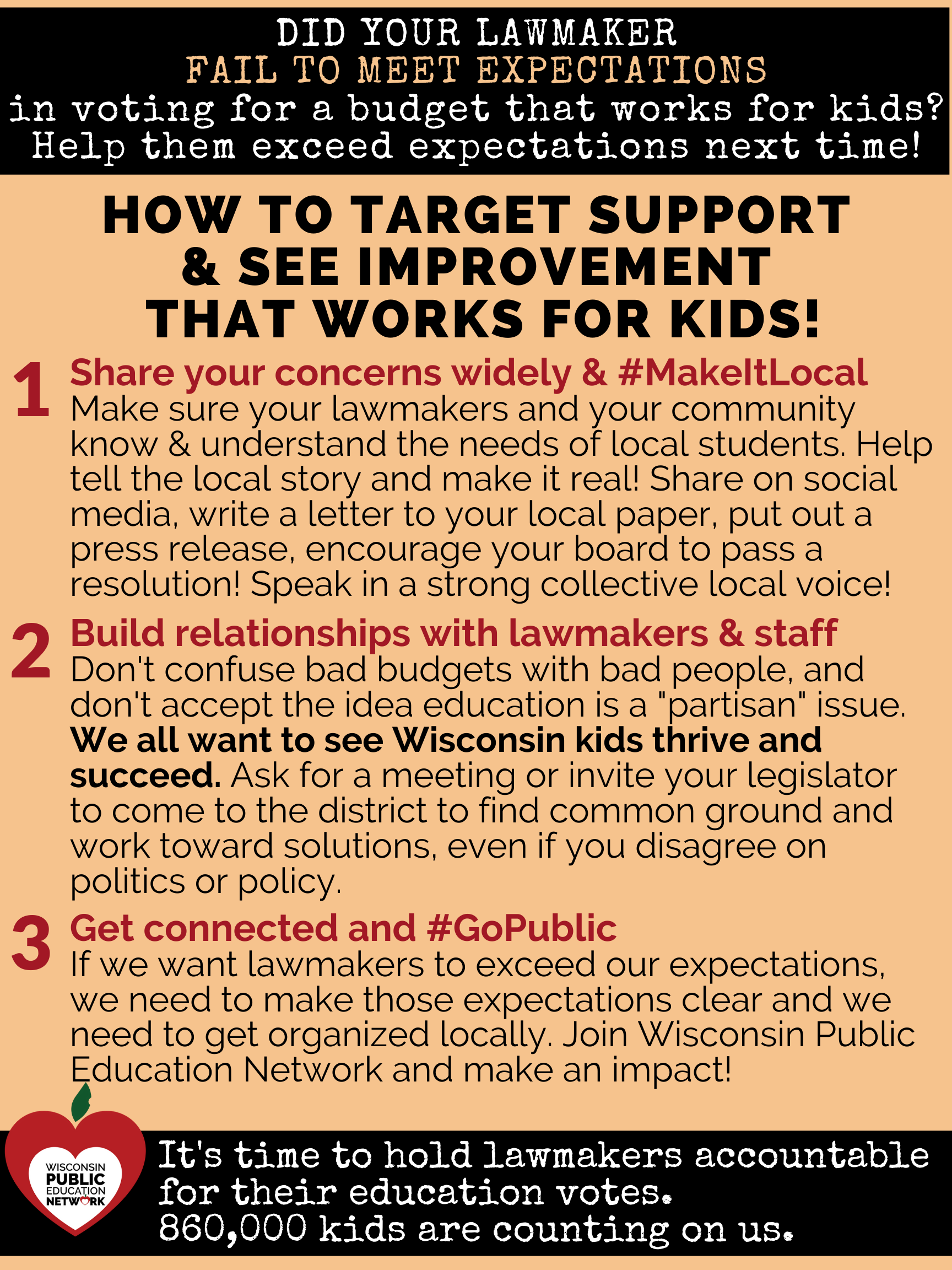
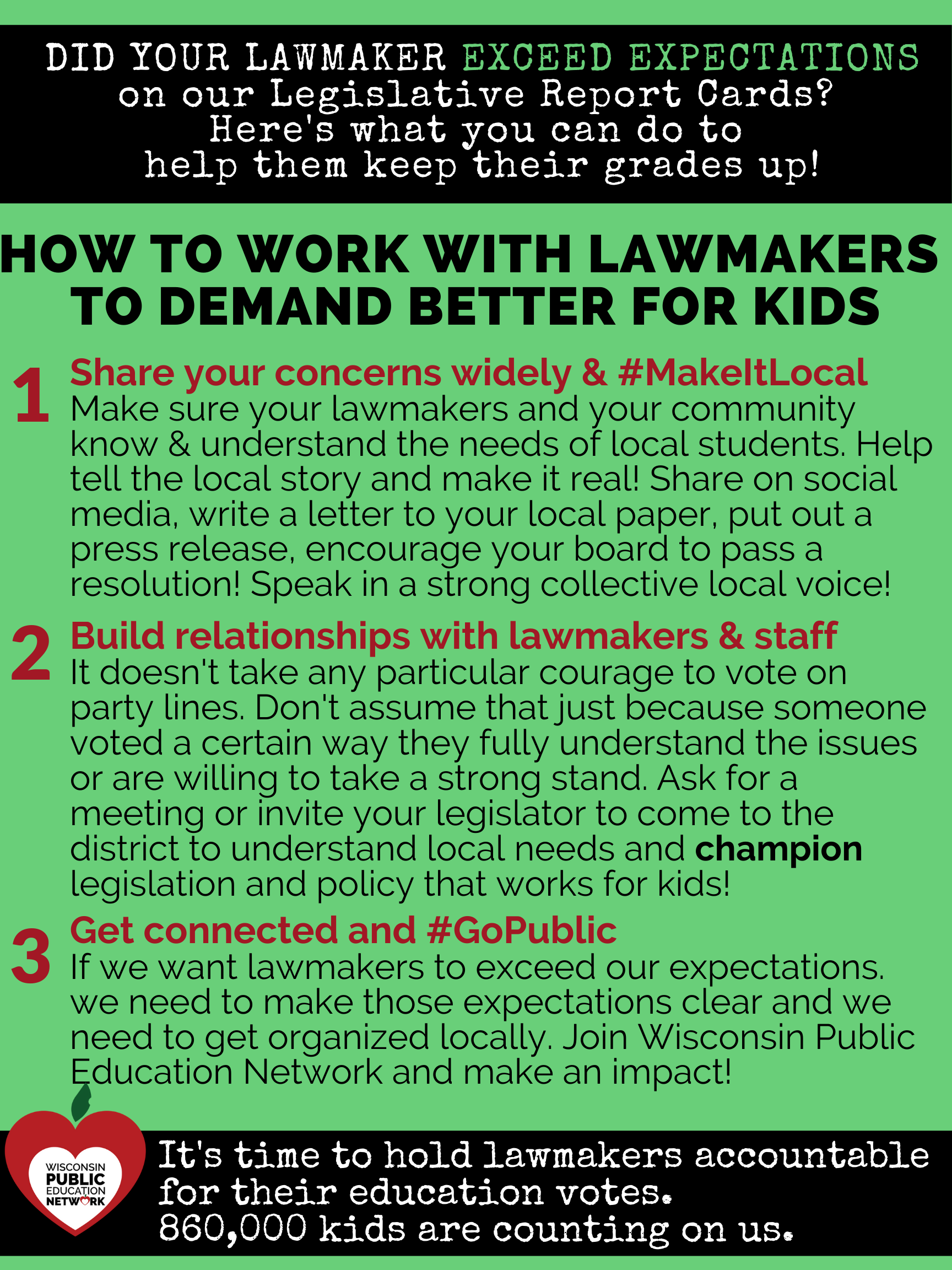
Then use the tools below to demand better. This isn’t about people – it’s about policy. It’s not about politics – it’s about what’s best for our kids. Take time to tell your local funding story and share details on what might have been different in your district if nearly a billion dollars hadn’t been cut from the proposed education budget this year. Look for local releases from our partners around the state and use them to shine a flashlight on Wisconsin’s school funding crisis.

Whether your lawmaker “exceeds” or “fails to meet” our high expectations, we all need to work together to ensure every student in every public school has equal opportunity thrive. We believe we can make that happen, and we call on all of you to join us in holding lawmakers accountable for making success a reality for every child in every public school in Wisconsin.

FOR IMMEDIATE RELEASE


Contacts: Heather DuBois Bourenane, Executive Director, Wisconsin Public Education Network, (608) 572-1696, hdb@WisconsinNetwork.org; Dr. Julie Underwood, President of the Wisconsin Alliance for Excellent Schools board of directors, julie.madison.wisconsin@gmail.com, (608) 469-2287

View this release online here.


Lawmakers Held Accountable for Votes on Education with Report Cards

As districts statewide receive state-mandated report cards, public education advocates demand an assessment of lawmakers who set budgets that determine schools’ ability to succeed


As the Wisconsin Department of Public Instruction issues its annual school and district report cards today, the nonpartisan Wisconsin Public Education Network is doing the same for state legislators.


The organization’s Legislative Report Cards provide much-needed political context for understanding how the DPI assesses school and district performance. They assess state lawmakers across five categories: K-12 budget overall, special education, bilingual/bicultural needs, mental health and public funding of private schools. The report cards are available to the public at http://www.WisconsinNetwork.org/blog/report-cards.


The DPI’s school and district report cards fulfill a state mandate to hold all schools “accountable” to taxpayers. That mandate was put forward in 2011, the same year Wisconsin saw the largest cuts to education funding in state history.


In conjunction with its Legislative Report Cards, the Wisconsin Public Education Network has issued the following statement:


“In Wisconsin, our lawmakers use report cards to hold our children and their schools accountable for circumstances and state-level policy decisions that are beyond their control. How well a school does on a report card is often closely connected to factors like revenue limits, the number of students living in poverty, the number of English-language learners and the resources available for serving students with disabilities. 


What the report cards do not reveal is the fact that Wisconsin is last in the nation in state support for students with disabilities, and last in the nation in state support for English language learners. The state does not live up to its commitment to support student mental needs and we lack a coherent state policy to support children challenged by poverty. We can trace these failures back to the statehouse, not the classroom.


 It only makes sense that we hold lawmakers accountable for their education votes.


Parents and communities are told that school report cards represent a single ‘snapshot’ of student performance, but that snapshot becomes a frozen image impacting property values and undermining the successes that cannot be accounted for using test scores and other data points. Research shows that test scores often measure little more than economic status. Holding our schools accountable for student needs while failing to provide sufficient resources to ensure student success is unfair and unethical.


Senator Luther Olsen has often said the state report cards should be used as a ‘flashlight’ and ‘not a hammer’ to demonstrate where we can best meet the needs of our students and schools.


We present these legislative report cards in the same spirit. They reflect a single snapshot: a picture of the budget votes of the elected officials who determine how much state aid is provided to our public schools. 


In 2019, Wisconsin legislators approved a budget that cut nearly $1 billion from the governor’s proposed public education budget, withholding much-needed aids for special education, mental health and English language learners, while failing to meet the much-touted goal of providing two-thirds of school funding.


Given the state’s continued refusal to provide the funding needed to close Wisconsin’s opportunity gaps, we are holding lawmakers accountable for their education votes.


The 2019 Legislative Report Cards reflect a failure to meet the expectations that were outlined clearly by the Blue Ribbon Commission on School Funding, at the budget hearings of the Joint Committee on Finance and by parents, board members, educators and school leaders statewide.


Public education should not be a partisan issue. Support for schools should not fall along party lines. We strongly encourage all who care about great public schools to take time to provide targeted support and encourage improvement from those legislators who fail to meet Wisconsin’s high expectations for supporting student success. Every child attending public school in Wisconsin deserves an equal opportunity to succeed, and our lawmakers, just as our schools, must be held accountable for making that opportunity equally accessible to all.”


About Wisconsin Public Education Network (WPEN)


Wisconsin Public Education Network is a nonpartisan grassroots coalition supporting strong public schools that provide equal opportunity for all students to thrive. The Network is a project of the Wisconsin Alliance for Excellent Schools (WAES), a 501(c)(3) nonprofit organization. Contributions can be sent to: P.O. Box 6592, Monona, WI 53716. Learn more at http://www.WisconsinNetwork.org.


A friend share this link about a program in which the United Negro College Fund is funded by the far-right Walton Family Foundation to give summer internships to young African Americans to work in organizations that undermine public education, unions, and the teaching profession. The purpose of the program is to build a “robust pipeline of African Americans engaged in education reform in America.”

All of the summer interns will serve with trusted arms of the ultra-conservative movement.

Summer Internship – One of the principal elements of the paid summer internship program that exposes fellows to professional careers at leading K-12 education organizations and schools focused on education reform. Specifically, fellows are deployed as interns to organizations and schools located in such cities as Boston, New York, Washington, DC, Atlanta, New Orleans, Chicago, Indianapolis, Memphis and Nashville. Examples of internship host organizations include Teach for America, New Schools Venture Fund, Paul Public Charter School, BUILD, Black Alliance for Educational Options, Thomas B. Fordham Research Institute and Stand for Children. During their internships, fellows apply what they have learned, acquire new skills, gain an understanding of the professional needs of education reform organizations and make meaningful contributions.

You can be certain that none of these bright young people will be assigned as interns at the NAACP, which called for a moratorium on charter schools in 2016.

Nor will any be detailed to work for Journey for Justice, a grassroots civil rights group that fights for democratically controlled community public schools.

Nor do I expect that any will have a chance to learn about the Walton assault on public education by spending a summer as an intern for the Network for Public Education.

They are not likely to have the chance to offer their services at any of the scores of local and state organizations that are fighting the power of billionaires like the Waltons and could really use their help.

Instead they will be trained up by the faithful servants of the privatizers and the oligarchy.


Shawgi Tell is a professor of education at Nazareth College in New York.

He points out that “More than 765 Charter Schools Have Closed in Three Years.”

This is what Disrupters refer to as “high-quality seats.” Here today, gone tomorrow.

Currently, about 3.2 million students are enrolled in roughly 7,000 privately-operated charter schools across the country. This represents less than 7% of all students and 7% of all schools in the country.

According to the National Center for Education Statistics, more than 765 charter schools closed between 2014-15 and 2016-2017, leaving thousands of families stressed, abandoned, dislocated,and angry. This figure represents more than one out of ten charter schools in the country by today’s numbers. The real closure figure is likely higher. To be sure, more than 3,000 charter schools have closed in under three decades.

The top three reasons privately-operated charter schools close are financial malfeasance, poor academic performance, and low enrollment.

With regard to academic performance, the Washington Post (November 1, 2019) reminds us that:

When you take all charters and all public schools into consideration, students at charters do worse than those at public schools. According to the Department of Education’s National Assessment of Educational Progress, public school students in fourth, eighth and 12th grades outperform charter school students in math, reading and science.

It is also worth recalling that the vast majority of high-performing nations do not have charter schools.

Today, nearly 60% of charter schools are in urban settings where schools tend to be under-funded, over-tested, constantly-shamed, and attended mostly by poor and low-income minority students. Charter school advocates prefer to target urban schools because this is where they can make the most profit given economies of scale and other factors.

While “choice” has worked out well for major owners of capital, what good is “choice” when it cannot deliver stable, reliable, high-quality education free of corruption, segregation, and overpaid administrators? How does funneling billions of dollars annually from public schools to unstable privately-operated charter schools that frequently perform poorly help the economy, education, or society? Do pay-the-rich schemes like charter schools advance the national interest?

There is no justification for the existence of privately-operated non-profit and for-profit charter schools. They do not provide a net public benefit. Endless news reports show that charter schools are always mired in scandal and controversy. It is time to stop bashing public education, reject the hype surrounding charter schools, fully fund all public schools, and vest real decision-making power in the hands of the public. The rich must be deprived of their ability to privatize public education with impunity. The content, purpose, and direction of education must not be in the hands of privatizers, neoliberals, and corporate school reformers.


Nancy Bailey read a list of organizations who were blaming teachers for not adhering to the “science” of reading and thus blaming teachers for NAEP reading scores.

She got steamed and pointed out that none of these individuals or organizations criticizing teachers are known as teachers themselves.

She got so steamed that she names names in this post. 

These are the organizations, she says, that have the sheer audacity to blame teachers for what they themselves can’t do!

They write the policies that constrain teachers but take no responsibility when their policies fail.

Busybodies! When are they held accountable?

After listing the groups, she concludes:

This conversation should take place, because something is wrong when parents are unhappy with their child’s schooling. It isn’t a debate that will be won by yelling at each other on social media, but by working together at the school level.

It should include a state department of education in each state that investigates problems and isn’t about getting rid of public education. The U.S. Department of Education should also be working to better address the controversy surrounding reading and what’s behind denying students with reading disabilities their IDEA rights.

Universities should review how they teach reading, but they also shouldn’t be forced by these groups to destroy reading practices that have worked for years.

It is, however, difficult to do this at this time. Education Secretary Betsy DeVos, and the previous education secretaries, never taught, never studied reading in a university setting or worked to remediate student difficulties, and have themselves been about the business of destroying schools and de-professionalizing the teaching profession.

If you think the NAEP scores are poor, look at the groups mentioned here. It has been a rigged game for years!

Last night there was a grand event at the Kennedy Center where veterans of the Bush and Obama education world joined together to wring their hands about the crisis at hand. The crisis is not the mess they made of American education for the past 20 years. The crisis is that the tests are not hard enough, the punishments are not tough enough, and the nation needs to buckle down and keep on testing and firing and demanding more from everyone. Except them. Of course.

Our reader Laura Chapman explains what was behind the big party:

“I wanted to look past the PR for this one event. The event is a launch for a new campaign capitalizing on “stagnating” NAEP scores and persistent gaps among students “who have been underserved.”

“The reformists are calling for “evidence based” methods of teaching using only “high quality, standards-aligned, content-rich curriculum.” Suddenly these reformists think “deficits in content-knowledge” matter. But these reformists are really fans of the Common Core and have a lonh history of ignoring much else worthy of study, content in the arts and humanities for example.

“In addition to being sponsored by the Collaborative for Student Success, this “new literacy campaign” is sponsored by Achieve, The Alliance for Excellent Education, The Thomas B. Fordham Institute, Learning Heroes, Literacy Now, National Association of Elementary School Principals, National Council on Teacher Quality, National Urban Alliance, National Urban League, Military Child Coalition, and The Education Trust. These have been supporters of the Common Core, and many love high-stakes tests.

“The Collaborative for Student Success is a multi-faced project of the New Venture Fund. It is supported by: Bloomberg Foundation, Carnegie Corporation of New York, ExxonMobil, Bill & Melinda Gates Foundation, William and Flora Hewlett Foundation, The Charles and Lynn Schusterman Family Foundation. The website markets three of the Collaborative’s favorite math programs, but it also features “campaigns” of the Collaborative. Each campaign has a separate website. All campaigns are based on the premise that states are not living up to the requirements of ESSA. Truly, the sponsors of the Literacy Initiative are die-hard defenders of the Common Core and ESSA. Here are the camaigns in progress.

“A web-based “Assessment HQ” offers test scores and demographic breakouts for test scores “for more than half of states in grades 3-8.” This campaign is designed to claim that state assessments are not tough enough or fully reported to parents. The Collaborative scoops up state assessment results in math and ELA and puts these together in an interactive map. The Assessment HQ is actually sluggish and out of date. It is presenting data from the 2014-15 school year and it was designed to push PARCC and Smarter Balanced tests.

“The “Check State Plans” campaign offers ratings of the state plans for ESSA based on their strict conformity to ESSA. The Collaborative asked 45 reviewers to judge state plans, back in 2017, at about the same time that Bellwether Education Partners also put together a panel to review state ESSA plans. The Collaborative wanted to see “the following principles” honored in state plans. “Set the bar high for what students need to know and understand; Focus on closing the achievement gap in math and English; Ensure that parents and communities have access to meaningful data; Have a real plan for helping those schools that have been historically failing.”

“The “Educators for High Standards” campaign has offered about 12 fellowships to teachers willing to voice enthusiasm for ESSA, along with “partners” from the following groups, all known to push for high-stakes tests and the Common Core: The National Network of State Teachers of the Year, Smarter Balanced Assessment Consortium, PARCC, Teach Plus, Student Achievement Partners (Achieve the Core), National Board of Professional Teaching Standards, Council of Chief State School Officers (CCSSO), Hope Street Group, The New Teacher Project (TNTP), Teach for America, Center for Teacher Quality, and Educators4Excellece.
The” Military Families for High Standards” campaign features the work of advocates for schools serving military families. Among the resources is an article from the Center for American Progress titled “How the Common Core Improves Education for Military-Connected Children.”

“The Honesty Gap” campaign asserts that states must take NAEP’s definition of “proficiency” as the standard for judging the “honesty” in state tests. State tests that claim students are “proficient “are dishonest unless the state standard is the same as for NAEP tests. The “honesty gaps” for each state are shown on an interactive map. The explicit message is that schools are often lying to parents about student achievement. The website should be called Arne Duncan’s BS. https://www.npr.org/templates/story/story.php?storyId=246201831
The “Understanding ESSA” campaign provides news about USDE activities (up-to-date) and links to state actions that comply with ESSA.

The whole website is devoted to belligerent judgments of states, districts, and schools while bolstering advocacy groups who will insist on “strict fidelity” to ESSA in state plans.

These birds of a feather intent on repeating the misery of two decades of top down reform.


Campbell Brown was a CNN anchor. Then she became the new face of the Education Disruption movement after the disappearance of Michelle Rhee. Brown advocated for charters and vouchers and she opposed teachers’ unions and teacher tenure. She claimed in various articles in the New York City press that the schools were overrun by teachers who were sexual predators, protected by the union. She created a news site called “The 74” to express her views; it was funded by the usual cast of billionaires (Walton, Bloomberg, Gates, Broad, etc.). She is anti-public school, anti-union, anti-tenure and pro-privatization. When Betsy DeVos was chosen as Secretary of Education, Campbell Brown acknowledged that she was a personal friend and that Betsy funded “The 74,” while Brown served on the board of Betsy’s pro-voucher American Federation for Children.

Those with a longish memory might recall that Brown started the “Partnership for Educational Justice” to file court cases in several states in an effort to destroy teacher tenure–a copycat of the Vergara lawsuit in California, which was eventually tossed out by the state’s highest court. Thus far, all of the PEJ lawsuits have also been thrown out by state judges who said that teacher tenure was unrelated to test scores. (There are probably more tenured teachers in affluent districts than in low-performing, high-poverty districts.)

Then Campbell Brown was chosen by Mark Zuckerberg to be in charge of media relations for Facebook.

Popular Information revealed the multiple roles that Campbell Brown is now playing.

The 74 = has heaped scorn on Elizabeth Warren since she released her K-12 plan, which proposes an end to federal support for new charter schools.

The 74 has (not surprisingly) lavished praise on Betsy DeVos.

Now Brown is in charge of deciding what news gets featured on Facebook.

While Brown served as editor-in-chief of The 74, the site featured at least 11 pieces from Eric Owens, an editor at The Daily Caller. Owens “has a long history of penning racially insensitive, sexist, and transphobic attacks on students and teachers.” 

Owens, for example, wrote in The Daily Caller that white privilege is a “radical and bizarre political theory that white people enjoy a bunch of wonderful privileges while everyone else suffers under the yoke of invisible oppression.” In another Daily Caller column, Owens called college students “delicate, immature wusses who become traumatized, get the vapors and seek professional counseling any time they face adversity.”

Owens is also obsessed with female teachers who sexually assault male students, repeatedly writing exploitative stories about the incidents.

After Brown joined Facebook, The Daily Caller was named an official Facebook fact-checking partner, despite The Daily Caller’s history of inaccurate reporting. 

Brown thinks Breitbart is a “quality” news source

Brown’s role with The 74 raises further questions about the ideological underpinnings of Facebook’s nascent news tab, which has not been rolled out to all users. Brown’s team elected to include Breitbart — an unreliable and noxious right-wing site that was literally caught laundering white nationalist talking points —  among the 200 “quality” sources included in the launch. 

Of course, Mark Zuckerberg hates Elizabeth Warren too, because she has talked about breaking up the big tech monopolies, such as Facebook, and taxing the personal wealth of billionaires.

Gary Rubinstein read a story in the local Rupert Murdoch newspaper saluting Eva Moskowitz’s charter chain for its high SAT scores, but then noticed how many students were in the senior class. (Billionaire media mogul Rupert Murdoch is a multimillion-dollar donor to the  Success Academy charter chain.)

What school advertises its SAT scores? Success Academy!

Gary noticed that of the students who started in second grade, nearly 70% did not make it to the senior year.

He writes:

The New York Post recently ran an editorial about the SAT scores of the Success Academy senior class of 2020.  Of all the different numbers they referenced, one that I took note of was 114 — the apparent number of students in the senior class.

The class of 2020 is the third graduating class of Success Academy.  The class of 2018 had 17 seniors out of a cohort of 73 first graders in 2006-2007.  The class of 2019 had 26 seniors out of a cohort of 83 kindergartners in 2006-2007.  Some of the class of 2019 were students who had been held back from the class of 2018 — probably in a comparable number to the number of 2019 students who will graduate this year.  So the 26 out of 83, or 31% persistence rate probably accounts for students who take an extra year to graduate.

For the class of 2020, things get a bit more complicated since in 2008 Success Academy did its first expansion and grew from one school, now called Harlem 1, into four schools now including Harlem 2, Harlem 3, and Harlem 4.  Some of the past records are incomplete for these schools, but when the 2020 cohort was in 2nd grade in 2009-2010, I find that there was a combined 353 students in the cohort.  By 6th grade, they were down to 263 students and by 9th grade it was 191.  In 10th grade they were 161 students and in 11th grade, 146.  And now, according to the New York Post article based on a Success Academy press release, they have 114 seniors.  So only 32% of the students who were there in second grade made it through their program.

Better test scores through attrition, a surefire formula for success!

I have had a long-running exchange with a wealthy pundit who gives six-figure amounts to Success Academy. He says they have found the secret sauce for educating all children in the New York City public schools, and for all schools everywhere. I ask him what should be done about the majority of students they accept who don’t survive. He seems to think they don’t matter. Only the strong survive. Or deserve to survive.

Political Morning Education reports a big event in D.C. tonight where partisans of the test-and-punish education policies of the past twenty years will gather to rededicate themselves to their failed programs. Will these advocates for accountability accept any accountability for the misguided practices they have foisted on American education? Will they hold themselves accountable for the billions of dollars spent on testing and privatization that should have been spent on reducing class sizes and raising teachers salaries and opening health clinics in schools? Wouldn’t it be something if they invited someone like Jonathan Kozol or Anthony Cody to explain why NCLB and RTTT failed and how to have a better approach to teaching and learning other than carrots and sticks?


BUSHES SPOTLIGHT READING, LITERACY AMID GRIM ASSESSMENTS: Events starting tonight at the John F. Kennedy Center for the Performing Arts will bring together members of the Bush family, best-selling authors and entertainers, philanthropists, and education and business leaders to celebrate reading and mark the foundation’s 30th anniversary.

— “I believe that literacy is an essential foundation for democracy,” former first lady Laura Bush said in a statement provided to POLITICO. Bush, one of tonight’s honorary co-chairs, will deliver remarks during a program that will include a special performance by country music singer Tim McGraw and Pulitzer Prize-winning biographer Jon Meacham, co-authors of “Songs of America: Patriotism, Protest, and the Music that Made a Nation.”

— The events, including the foundation’s inaugural summit on adult literacy on Wednesday, coincide with grim results on the Nation’s Report Card and an announcement today from the Collaborative for Student Success about an effort with 11 other organizations to address the results.

— Among the organizations are The Education Trust, the National Urban League, the Thomas B. Fordham Institute and the National Association of Elementary School Principals. They’re calling for, among other things, increasing federal investment in evidence-based, comprehensive literacy efforts at the state and local levels.

— “The persistent gaps in reading achievement for students from low-income backgrounds, students of color, English learners, and students with disabilities on the NAEP require urgent action,” said John B. King Jr., former Education secretary and president and CEO of The Education Trust.

Grassroots Arkansas reports that the teachers of Little Rock will strike this Thursday. It will be a one-day strike. The State Board of Education (a wholly-owned subsidiary of the Walton family) stripped the local union of its collective bargaining rights and is trying to destroy and privatize public education in that city. For the billionaire Waltons, Little Rock is the petri dish that is near at hand. They have so many petri dishes, all of which have failed. Why don’t they leave this small but historic district alone? (Answer: Because the Waltons want everything; having $150 billions has made them willful and arrogant.) The state took control of the district in 2015 and has agreed to return limited control, with a powerless board still controlled by the state.

Little Rock educators have announced a strike this Thursday, November 14, to demand that the state stop its re-segregation plan, return democracy through full local control of the LRSD, and recognize the union’s bargaining rights. Our educators and students need all of us to stand up for them before unlicensed subs and private companies complete the destruction and further segregation of our public education system.

There are several ways that you can support students and teachers. If you are a caregiver, please do whatever you can to keep your students home on Thursday, or send them to one of the childcare sites to be announced soon. The money follows the students, and the only power we have is if the students stay home. If they go to school, they will be babysat by unlicensed subs. Other ways you can support include:

  • Donate and share the Bread for Ed campaign to feed kids while the schools are shut down.

  • Tuesday and Wednesday: Pass out flyers at schools during drop-off and pickup times. Go by the AEA building at 1500 W 4th Street or call them at (501)375-4611 to see which schools most need coverage.

  • Tuesday and Wednesday: 4:00-7:00 Sign making at the AEA building. 1500 W 4th St by the Capitol.

  • Thursday: Picketing at schools from 7-9:30. Picket the State Board of Education meeting at 11:00. Sign up here.

Together, we can reclaim democracy and a world-class education for ALL students!

STRIKE DATE SET IN ARKANSAS: The Little Rock Education Association is calling for one locally elected city school board with full decision-making authority following the state’s takeover of the district in January 2015. The union planned the strike for the day of the next state board of education meeting, when the district is on the agenda.

— The state board last month voted to stop recognizing the union as a bargaining agent for its members. The state board also voted to return control of Little Rock schools to a locally elected school board by 2020, but limited its authority.

— “They specifically stated that the school board, once elected, would not be able to reinstate our recognition, nor would they be able to hire or fire a superintendent and that the commissioner of education would still have veto power over any decisions that the state or that the school board makes,” Knapp Gordon said.

— The announcement said the union is working with #OneLRSD to stop Gov. Asa Hutchinson and his appointed state board from “segregating the city’s public schools.” The board last month backed away from a plan to divide the district under separate governing systems amid complaints that it would segregate the district. But Knapp Gordon said “by retaining control over the district, they still get to make those decisions that will lead to the resegregation of our school district.”