Archives for category: Accountability

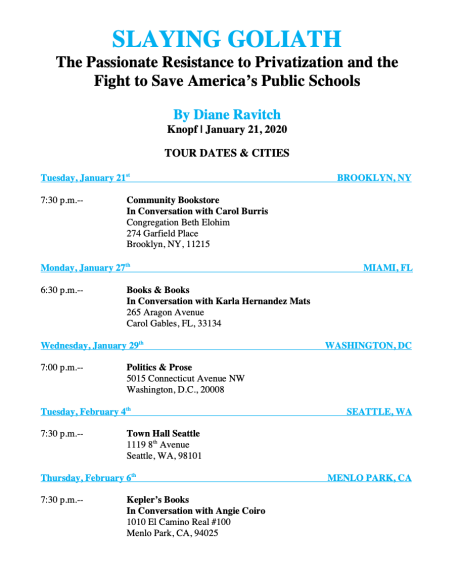
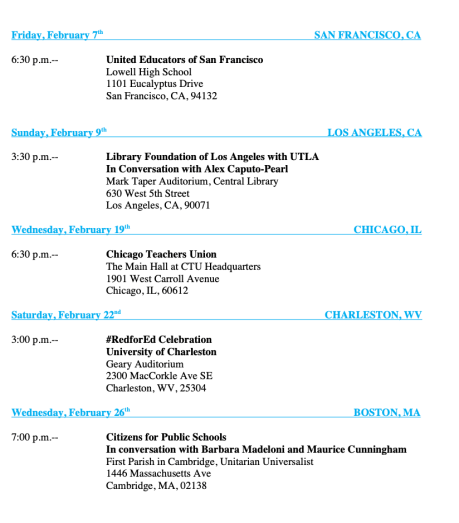
This is the current (and evolving) list of my speaking engagements in connection with the publication of my new book: SLAYING GOLIATH: THE PASSIONATE RESISTANCE TO PRIVATIZATION AND THE FIGHT TO SAVE AMERICA’S PUBLIC SCHOOLS.

I am trying not to wear myself out. Ten years ago, I hopped from city to city like a mountain goat.

But now I am 81 years old, and my knees are worn out. I have to pace myself.

Come out and say hello if you are in one of these cities.

SLAYING GOLIATH is a pro-public education, pro-teacher, pro-social justice, pro-common-good book. It is a book meant to give hope and encouragement to those who stand up to the billionaires and fight the status quo of choice and high-stakes testing. It contains inspiring stories of parents, students, teachers, and civil rights activists who took action against the powerful and won. At some of these events, the bookstore charges a modest fee to cover its expenses. Most are free.

Screen Shot 2020-01-11 at 10.07.57 PMScreen Shot 2020-01-11 at 10.08.06 PM

Nimet Eren, principal of the public Kensington Health Sciences Academy, runs a public school for 465 students that is open to all and offers four career pathways. Recently the school learned that a new charter would open nearby offering the same program. 

The principal was told that the competition would “help” her school by providing a “model” of what her school was already doing successfully.

She writes:

During the summer of 2019, the Philadelphia School Partnership (PSP), a nonprofit organization that invests in educational projects across the city, met with me to discuss the goals we had for our school. We talked extensively about what we have learned from the partnerships we have created, especially in medical settings. Then, PSP asked to visit us on Sept. 25 for the morning. It was a wonderful visit, and our teachers and students were engaged in great learning, as they are every day. The day finished with an in-depth conversation about the challenges of building partnerships with settings such as hospitals and clinics.

Then, before Thanksgiving break, I received an email from PSP stating that they had “an exciting opportunity for KHSA” and that they wanted to share it with me. I was, of course, elated and scheduled a meeting with them on Dec. 2.

The news they wanted to share was that they were giving seed money to a potential charter founder to form a health sciences charter high school in North Philly. I was confused. How was this an exciting opportunity for KHSA?

It actually felt like creating unfair competition for my school for resources that are already scarce, especially because charters can manipulate admissions and enrollment policies to their benefit, and neighborhood schools cannot.

I asked PSP how this charter school would be helpful to KHSA, and they said that my school “could learn from their charter model.” I replied that we are trying to build a model for our neighborhood students and that we need support. They then explained what I believe is the real answer as to why they were not investing in us: Because KHSA is a neighborhood school and not a charter school, they cannot control enrollment for their dream school.

Although it might appear that KHSA does not want a health sciences charter school to exist just because they copied our school’s theme, that is not the reason. The reason actually is that many charter schools create the illusion that they are educating children better than neighborhood high schools. The reality is that neighborhood high schools are serving our highest-needs children and that society should be investing the most in them.

The children who come to my school each day are the most resilient, charismatic, and loving people I have ever known. Some of my students’ reading and math levels are not as high, but that’s not their fault. It is society’s fault for not better supporting the children who are most in need. PSP’s explanation of why it is not investing in a neighborhood high school perpetuates this inequity.

I testified at the school board meeting on Dec. 12 and a charter school hearing on Dec. 20. I have had countless conversations with colleagues and opponents and have thought tirelessly about the charter vs. traditional school debate. I have heard so many arguments for both sides of the story, but the idea that I find the most compelling is one shared by one of my teachers, Jenifer Felix: Parents want what’s best for their own children. Teachers want what’s best for all children.

The problem with school choice is that it creates segregation. Choice takes away limited resources from inclusive neighborhood schools and leads to even fewer resources being spent on our students who are most in need.

A few weeks ago, Democrats in the New Hampshire legislature’s Fiscal Oversight Committee rejected $46 million from Betsy DeVos and the federal Charter Schools Program. The vote was 7-3 on partisan lines.

The grant would have doubled the number of charters in the state at a time of declining enrollment statewide.

The Republican State Commissioner of  Education, Frank Edelblut, came back to the committee with the same request, reminding the committee that the previous Democratic Governor Maggie Hassan had supported charter schools.

The Democratic-controlled committee again voted 7-3 to reject the $46 million, warning of additional costs to the state when the federal funds were expended. 

Edelblut is a home schooler who was appointed by the far-right Republican Governor Chris Sununu.

Congratulations to the wise Democrats of New Hampshire, who practiced fiscal restraint and protected the state’s public schools.

Be sure to read Peter Greene’s detailed account of this happy event. He points out that the existing New Hampshire charter schools have produced no lessons for public schools and they have empty seats.

https://www.concordmonitor.com/New-Hampshire-again-rejects-federal-money-for-charter-school-expansion-31904290

The New York State Board of Regents received a grant of $100,000 from the Gates Foundation to hire a consultant to evaluate its testing illness. The Regents hired Achieve, an organization devoted to standardized testing and it’s proliferation. In addition, Achieve was deeply involved in the development of the Common Core.

After hearing outrage from constituents, the Regents broke ties with Achieve and replaced them with California-based consultant WestEd.

Michael Kohlhaas, the blogger who has used the California Public Records Act to obtain emails among charter leaders, the California Charter Schools Association, and their enablers, reveals here what happened when protestors shut down a charter board meeting last March, accusing the charter school of taking money from the nefarious Eli Broad and the Waltons. Broad and Walton have a shell takeover corporation deceptively titled “Great Public Schools Now,” whose goal is to turn public schools into privately managed charter schools. The leader of the Extera Charter School did not directly answer the question, but Kohlhaas answers it now. Yes, the charter did take money from the Waltons and Broad.

The public is getting wise to the deceptive tactics of the charter lobby. Public schools are accountable and transparent. Charter schools are not. Public schools are audited and overseen by public officials. Charter schools answer to no one but their self-selected private boards.

Kohlhaas writes:

So you probably heard about how activists from Centro CSO and the United Teachers of Los Angeles and Eastside Padres Unidos Contra la Privatizacion protested vigorously and shut down the March 19, 2019 meeting of the Extera Charter Conspiracy Board of Directors to express their opposition to Extera’s colonial co-location at Eastman Avenue Elementary School in Boyle Heights.

And one of the key exchanges was between a protester, whose name I don’t know, and self-proclaimed doctor and supreme Extera commander Jim Kennedy, and you can watch it here.1 The backstory is that Corri Ravare had been talking previously about how Extera was getting some money from famous Walton/Broad privatizing front organization Great Public Schools Now, which, as the protester notes, is extraordinarily revealing with respect to which team Extera plays for.2

The protester called Dr. Jim Kennedy out on this and he denied that they had taken any money from GPSN: “At this point we have not …” But the truth, as the protester said, is that Corri Ravare had already “said we pretty much have the money.” And the problem with this? Well, clearly, it is that “Great Public Schools Now have declared themselves an enemy of public education. Those are the people we have to work against because they are selling out our public schools to Eli Broad and the Walton Foundation.”

She’s absolutely right about that, of course, and Doctor Jim Kennedy seems to understand that, or at least to realize that Extera’s association with GPSN doesn’t look so good. No doubt this is why he went on to tell her straight out that “[Extera has] not yet accepted that money.” But, as you may already have guessed, Doctor JK is being extraordinarily deceptive here with his mumbled half-denials. In fact Extera had been actively pursuing money from GPSN since December 2018, four months before the date of this meeting.

And the money they were pursuing was not innocuous. Not meant for important things like supplies, textbooks, instructional materials, anything at all to be used to actually educate actual children. They were seeking money from GPSN’s charter school expansion funding program for a planning grant to support their continued colonial charter conspiracy expansion, this time into the majority-Latino Montebello Unified School District. In other words, the protester’s criticism was right on target.

Things are going badly for the charter industry when their mask of beneficence is stripped away and behind it are the same voracious billionaires, eager to strip democratic control away and privatize public schools.

The Texas-based IDEA charter chain, along with the Noble Network in Chicago and the Match charter school in Boston, is trying to boost its college graduation rates by encouraging its former students who dropped out of college to enlist in an online college program where requirements are minimal. 

By partnering with Southern New Hampshire University, which enrolls tens of thousands of students from across the country in its low-cost online college programs, the charter operators are coaching students through college. The university provides the coursework and confers degrees, while an arm or affiliate of the charter networks recruits and mentors students.

The Noble charter network in Chicago launched its partnership last year, following the IDEA network in Texas and Match Charter School in Boston. Together, the three programs now enroll nearly 1,000 students, and other charter operators say they’re watching closely.

It’s a notable extension of those networks’ mission, which for years has been to send their mostly low-income students of color to college. More recently, though, it’s become harder to ignore the reality that many of their alumni are leaving higher education without degrees…

If successful, these programs will provide students another chance to earn a degree that could bolster their financial futures, while also boosting the charter networks’ college completion rates…

So far, though, students in the programs have earned only a few dozen bachelor’s degrees. And the expansion of these programs worries some observers, who question whether students are getting a high-quality college experience — and whether the degrees students do earn will pay off in the job market.

IDEA launched IDEA-U in 2017 with around 40 students, including Chapa. Now, the program has around 400 students from across Texas enrolled, about half of whom are IDEA graduates.

Around 95 students are enrolled in Noble’s program, known as Noble Forward, which launched last year. Nearly all are graduates of a Noble school in Chicago.

Match’s program, initially called Match Beyond, began in 2013 by enrolling mostly Match alumni, but was spun off as a nonprofit called Duet in 2018. It now serves around 500 students who graduated from high schools across the Boston area.

The programs differ slightly, but the academics work the same way. Students enroll in one of a handful of “competency-based” degree programs offered by Southern New Hampshire University and progress by completing projects designed to show they’ve mastered key skills.

There are no lectures, professors, or class discussions, but students are assigned readings and videos. Students work at their own pace — instead of on a set academic calendar — re-submitting projects as many times as they need, though the university says students average around two tries. Their projects are evaluated by a university “reviewer” with at least a master’s degree.

Underlying question: Is the goal of this program to provide a valuable education to students or to improve the data of the sponsors?


The Eau Claire County Board was asked to endorse a resolution saluting “School Choice Week,” but homeowners turned out to denounce the loss of money from their public schools that was sent to voucher schools.

One after another, homeowners asked why they were supporting two school systems, why the money intended for their public schools was being diverted to religious schools, why their taxes were being used to subsidize the tuition of students who had never attended public schools.

That discussion followed a report by the state Department of Public Instruction showing Wisconsin taxpayers will spend $349.6 million on school vouchers this school year, up from $302 million the previous year. A total of 43,450 students are receiving voucher funds this year, an increase of 3,411, or 8.5 percent,  from last school year..

Concerns about the impact of that funding shift on public schools surfaced at a December meeting of the Eau Claire County Board, where residents spoke against a resolution proclaiming Jan. 26 to Feb. 1 as Eau Claire County “School Choice Week.” Speakers told board supervisors that school choice is just another term for voucher schools, and that taxpayer funding for those schools hurts Wisconsin’s public schools.  

After hearing from eight speakers, County Board supervisors voted 24-2 against the measure. The city of Eau Claire is home not only to a public school district but to the Regis Catholic Schools system, where 182 of the 800 students (22.8 percent) enrolled this school year receive voucher scholarships, according to DPI data. 

The County Board action in Eau Claire is a sign that public school advocates are being increasingly vocal about the expansion of private school vouchers at the expense of public school districts and making taxpayers fund two different education systems.

Yes, your voice matters. Speak up against the diversion of money from public schools to privately operated charters and religious school vouchers.

Eight homeowners spoke out, and the board voted 24-2 NOT to pass a resolution supporting “school choice week.”

“School Choice Week” is “Defund Public Schools” week.

Do not celebrate the underfunding of your public schools!

One of the very exciting episodes in my new book SLAYING GOLIATH describes the struggle in Massachusetts  surrounding a 2016 referendum to expand the number of charter schools in the state. The referendum was called Question 2. Yes on 2 received funding from billionaires (the Waltons and Bloomberg), DFER (hedge fund managers), and out-of-state groups whose donors were unknown. The last group is called “Dark Money” because it hides the names of the donors.

On February 26, I will be at the First UU Church in Cambridge at an event sponsored by Citizens for Public Schools, joined in conversation with two of the prominent figures in that campaign, Barbara Madeloni (who was president of the Massachusetts Teachers Union) and Maurice Cunningham (a professor of political science at the U of Mass whose blogs reported on Dark Money in the campaign),

The groups that fought Question 2 were teachers’ unions, civil rights groups, and local school boards.

The referendum was overwhelmingly defeated.

After the election, the Massachusetts Office of Campaign and Political Finance investigated the funding of the campaigns. It found that one of the funders of the “Yes on 2” side was a Dark Money front based in New York City. It required the group to disclose the names of its donors and fined the group nearly $500,000, which cleaned out its bank account. Not long after, the Dark Money Group (which had also stacked the deck in New York State without being exposed) collapsed and closed its doors.

Recently, the director of this state office retired, and parents thanked him for upholding the integrity of state elections.

This letter to the editor by a parent activist appeared in the Boston Globe.


“Watchdogs have state’s outgoing campaign finance chief to thank
 

What a pleasure to read Matt Stout’s folksy portrait of Michael Sullivan, who retired last month as director of the Office of Campaign and Political Finance (“A career spent helping people ‘do things right,’ ” Business, Dec. 25). I met Sullivan at a “hackathon” sponsored by the New England Center for Investigative Reporting. The center needed volunteers to test computer software. We got pizza, and a little orientation from the state’s campaign finance chief, who trained neophytes to navigate Office of Campaign and Political Finance databases.

Behind the scenes, Sullivan’s staff investigated an unusual pattern of financial transactions. They discovered that Families for Excellent Schools – Advocacy Inc. of New York illegally solicited, received, and funneled funds to the Great Schools Massachusetts ballot question committee to influence the 2016 Massachusetts election and increase charter school market share. Sullivan skillfully negotiated a six-figure fine.

Thanks to Sullivan, citizens can comb campaign finance data for evidence of expenditures that reveal fake-news media events. Remember those rallies with people wearing blue T-shirts demanding “Great Schools Now”? It turns out Great Schools Massachusetts paid for the T-shirts and had people show up at events to give the illusion of massive dissatisfaction with our public schools.

If only I had a “Great Schools Now” campaign T-shirt, I would give it to Sullivan in gratitude for providing me a political education I never received in school.

Peggy A. Wiesenberg

Boston

Jan Resseger asks the ultimate cost about vouchers, in response to the Ohio legislature’s recent decision to expand vouchers to two-thirds of all school districts in the state, including high-performing districts.

Should public money be subtracted from public schools to underwrite vouchers for private and religious schools? The state’s public schools will be hit hard by the voucher law. And since research funded by the rightwing Thomas B. Fordham Institute showed that kids lose ground in voucher schools, the expansion of vouchers will lower the overall quality of education in the state. Does Ohio have a death wish?

As Resseger shows, the expansion of vouchers is not about education; it is not about improving opportunities for poor kids. It is about damaging public schools and compelling the public to pay for religious education for children who never attended public schools, ever. All the blather about opportunity is blather.

She writes:

Wisconsin and Ohio were the pioneers, the states which launched school vouchers—public tax dollars covering private school tuition.  Wisconsin launched Milwaukee vouchers in 1990, and Ohio followed suit in 1996 with a Cleveland voucher program.

What are the problems with the idea of vouchers?

Vouchers have always been endorsed by their proponents as providing an escape for promising students from so-called “failing” public schools—as measured by test scores.  But research demonstrates (see here and here) that test scores correlate not with school quality but instead with the aggregate income of the neighborhoods where public schools are located and the families who live there.  Research demonstrates that ameliorating student poverty would more directly address students’ needs.

The idea that vouchers help students academically hasn’t held up either.  A study by the pro-voucher Thomas Fordham Institute demonstrates that in Ohio, voucher students regularly fall behind their public school counterparts.  But proponents of school privatization (including the Thomas Fordham Institute itself) regularly ignore the evidence.

In a recent summary published in The Nation, Jennifer Berkshire explains that while there is a lack of empirical evidence justifying vouchers, their proponents support them ideologically: “But the GOP’s true policy aim these days is much more ambitious: private school vouchers for all. In Ohio, students in two-thirds of the state’s school districts are now eligible for vouchers, a ballooning program that is on track to cost taxpayers $350 million by the end of the school year. And in Florida, school vouchers are now being offered to middle-class students, the latest gambit by conservatives in their effort to redefine public education as anything parents want to spend taxpayer money on. ‘For me, if the taxpayer is paying for the education, it’s public education,’ Florida’s governor Ron DeSantis proclaimed earlier this year.”

In Ohio, based on state report card grades which legislators from both parties seem to agree are deeply flawed, vouchers are now to be awarded to students in so-called ‘under-performing’ schools in 400 of the state’s 610 school districts. The Columbus Dispatch‘s Anna Staver explains, “(T)he legislature has widened the definition of a low-performing school to the point of absurdity, expanding the list of districts with ‘under-performing’ schools from 40 in the fall of 2018, to 139 in 2019, and around 400—nearly two-thirds of all districts in the state—by 2020.”

And EdChoice, one of the Ohio’s four statewide voucher programs, takes the money through the deduction method, counting the voucher student as enrolled in the local school and then extracting $4,650 for each elementary school voucher and $6,000 for each high school voucherright out of the public school district’s budget. But a serious problem arises because in Ohio, state funding is allocated at different rates from school district to school district, and in many cases the vouchers extract more dollars per pupil from the local school budget than the state awards to that district in per pupil state aid.

This year’s state budget brought a new threat to public schools via an amendment quietly added and never debated. Until this year, to qualify for a voucher, an Ohio student must have been enrolled in the public school in the year previous to applying for the voucher.  But, secreted into the state budget last summer was an amendment providing that high school students may now receive a voucher even if they have never been enrolled in a public school…

What is rarely mentioned in the voucher debates is that no state legislature creating a voucher program has added a new tax to pay for it.  Instead the money always comes out of the coffers of the state education budget and, as in Ohio today, out of local school district budgets.

Please read the rest. As usual, Resseger is right on target with deep context and analysis, informed by her keen sense of social justice and equity.
What happens when Florida’s biggest for-profit charter chain takes over three low-performing public schools? Follow the money. Ka-Ching!

Sue Legg of the Florida League of Women Voters guides you through a path paved with greenbacks. 

Here is her summary:

The whole sordid affair was orchestrated by the current Senate Ed. Committee Chair.  Millions of dollars were poured into the K12 consolidated school that were not available until the state took the school over. The political and financial maneuvers were beyond sad.  Problem students were given 45 day suspensions.  They were given laptops and access to online courses made available by the once bankrupt Doral College which the Ed Chair manages.  Most disappeared. The school grades rose the first year, and now the elementary students are back to a ‘D’ grade.  These racially and economically segregated schools are the result of choice policies. 

Remember when the three Jefferson County schools were closed and taken over by Academica, the largest for-profit charter management company in the state?  The story makes your hair curl.  Here is a report by WLRN news that details where the money came from and where it went.

New funding included a $2.5 million special appropriation from the Florida Legislature, $2 million from federal startup grant funds, and a $1.9 million interest free loan from Academica’s Somerset division.  This was funding denied unless it became a charter district. Academica received $327,000 in fees in 2017-18 to manage the fewer than 800 student K12 school.  The per student cost rose to $16,600 which school leaders recognize cannot be sustained.  The state pays much less.

The behind the scenes orchestrators for the takeover were Senators Manny Diaz and Anitere Flores, both of whom have close ties to Academica. Diaz is an administrator at Doral College and is Chair of the Senate Education Committee.  Flores is deputy Majority Leader for the Florida Senate and moved from being the head of Doral College to the Academica foundation.  The current Doral College president, Rodriquez,  was named to supervise the transition of the Jefferson County schools to Academica.

In previous posts, I reported on a series of misdeedsassociated with Diaz and Flores related to their association with Doral College.  The college was bankrupt and had no students or faculty when Academica took it on.  It now offers online courses to Academica students.  The credit was worthless because the college had no accreditation.  Diaz worked to get a private school accreditation agency to recognize the college.  Diaz’s personal interest is noted here.  

What is the result of the takeover?  Behavioral specialists were hired to help students, teacher salaries increased, and the physical facilities were improved. Initially, the school grades rose to a ‘C’, but the elementary school has now reverted to a ‘D’.  The increase in the percentage of students passing the FSA state examinations in order to raise the school grades may have had as much to do with discipline policies as with learning strategies.  The charter school policy created a 45 day suspension policy in which students were given a laptop and sent home.  They were to take online classes from Doral College.  Many students never returned.  It is one way to raise school grades…just limit which students take the tests.

How convenient when those who give and those who receive public funds are one and the same.