Over the next couple of weeks, I will write several pieces about the upcoming election in Texas. More than any other state. I will explain why.
First of all, I was born there, and I’m tired of Texas being a laughing stock. Texans are better than that.
Second, if Texas flips blue, it will be a political earthquake. The state has been owned by oil and gas billionaires for decades. It’s time for a change. It’s time for leaders who care for the people of Texas, not the 1%.
Third, Texas has two great candidates in James Talarico and Gina Hinojosa. Talarico is a religious man, actually a seminarian, who speaks eloquently about our obligations to one another. Gina Hinojosa is running to give the regular people of Texas a voice.
Fourth, Gina understands the sham of Abbott’s “vouchers for all” program. She has pledged to roll back the voucher scheme and invest in the state’s public schools, where almost 90% of the state’s 5.5 million children are enrolled. Under the voucher regime, rural schools are at risk of closing. Gina will fire State Commissioner of Education Mike Morath, who has used his power to take control of entire urban districts, despite the well-documented history of the failure of state takeovers.
Fingers crossed for a new day in Texas, free of the control of billionaires, corrupt politicians, and grifters.
The polls in Texas show a close race between Governor Greg Abbbott and challenger Gina Hinojosa. Abbott has about $91.5 million in campaign funds, Hinojosa has about $21.7 million.
Abbott’s single biggest donor is S. Javaid Anwar, who has given $4,122,086. Anwar is Muslim but supports Abbott despite the Governor’s anti-Muslim rhetoric. Abbott’s top five donors have each donated at least $2 million.
Hinojosa’s biggest donor is the American Federation of Teachers, which appreciates Hinojosa’s strong support for public schools and teachers. The AFT has contributed $345,000.
Abbott is running for his fourth term. Abbott is a hard-hearted MAGA man. He is the favorite of billionaires in Texas and beyond.
Gina is the only candidate in the nation running for governor who has made public schools her number 1 issue. She has pledged to fire Abbott’s State Commissioner of Education Mike Morath and to roll back the billion-dollar “voucher scam.”
Abbott and Hinojosa are one point apart in the polls, a statistical tie.
A few days ago, the biggest newspaper in the state–The Houston Chronicle–endorsed Hinojosa.
In February, when state Rep. Gina Hinojosa visited the Chronicle editorial board as one of six Democrats who imagined themselves taking up residence in the Governor’s Mansion, we were impressed but saw little reason for Gov. Greg Abbott to worry. What we saw in Hinojosa was a capable, experienced lawmaker with a passion for public education, clearly the best candidate among the six but with little name recognition beyond her Austin district. An even more daunting prospect if she happened to prevail in the primary would be campaigning in the general election under the Everest-sized shadow of a $106 million war chest the governor could avalanche onto her effort if he needed to.
We didn’t think he’d need to. In Abbott’s quest for an unprecedented fourth term, we expected Hinojosa to be the next in a line of hapless Democrats willing to take one for the party. Hinojosa herself acknowledged that she decided to run for governor only after it became obvious that none of her fellow Democrats were willing to offer themselves up for the quadrennial double-digit beat-down the party has endured for more than three decades. If the ebullient, well-known and well-funded Beto O’Rourke couldn’t come within single digits of Abbott four years ago, why would Texans expect an earnest, relatively low-key unknown to do any better?
For Governor: Gina Hinojosa
Gina Hinojosa ★★★★ — This Democratic challenger and five-term state representative is running one of the most impressive populist campaigns anywhere in the country. She’s fighting to put everyday Texans back in charge.
Greg Abbott ★★1/2 — After 12 years as governor, this Republican incumbent seems to care only about billionaire donors and partisan extremists.
When Hinojosa visited the editorial board a few weeks ago, the descriptor “low-key” didn’t come to mind. She made a full-throated, confident call for change. As with her Democratic cohort, the now-nationally known U.S. Senate candidate, James Talarico, her campaign is riding a wave of Trump fatigue and economic angst that has spread nationwide like algae in a reflecting pool. The success of her populist economic message — and the fact that Abbott finally deigned to mention her name only recently — suggests that fiery-red Texas might be slipping toward something closer to crimson, or even purple, on the political color spectrum. Despite the incumbent governor’s advantages — money and name recognition, primarily — the 52-year-old Rio Grande Valley native and five-term House member is within striking distance in most polls.
And it’s not just Hinojosa who has changed: There’s also Abbott himself. The GOP candidate Texans first met way back in the mid-’90s when he ran for district judge here in Houston, the office-holder we got to know through his successful campaigns for the Texas Supreme Court, attorney general and three terms as governor, has transmogrified. In the three decades Abbott has held public office, the seemingly moderate, Bush-era Republican — who even attracted Democratic votes when he ran for the state Supreme Court — has become a relentless, hardcore MAGA standard-bearer. This is the governor whose billion-dollar border boondoggle, Operation Lone Star, pleased the true believers but did nothing to resolve the nation’s immigration remorse. The governor who, in the pursuit of absolute and centralized power, trashed any notion of “local control,” long a Republican value. The governor who sneers at urban Texas, including Harris County, despite its function as the economic engine of a growing state.
Perhaps that’s the type of pol he has always been, but he has no interest in disguising it now, as he seeks a fourth term as governor (and perhaps a launching pad for the presidency).
But the biggest change of all — bigger than any individual candidate — is happening all over Texas, where Republicans have dominated statewide elections for the past 30 years. Like a barnacled Moby Dick, parties in power too long grow tired, weighted down, ineffective. Poked and prodded by unrelenting schools of special-interest pilot fish, they lose a sense of a larger public-service mission. They may be politically dominant, but in fact they’re netted and enmeshed by the privileged and powerful. Like an unfree Willy, they come to feel they have no choice but to acquiesce, even as they seek to distract the citizenry with trivialities. (The Furries Act, anyone?) In an ocean of new ideas, new directions and unfamiliar challenges, they founder.
“I will tell you that with 30 years of Democratic rule, it would probably be just as corrupt,” Hinojosa said. “That’s what happens when you have one-party control for so long.”
Those of a certain age will remember the Sharpstown scandal that hastened the demise of Texas Democrats. Now, after decades of near-total dominance by Republicans, a dozen years under one governor, it’s time for a change.
We had an opening question for the candidate who seeks to forge a new approach for the state: Why would we change leadership given how much Texas is growing, how strong our economy is and, overall, how well things are going?
We found Hinojosa’s answer compelling: “That narrative does not match the experience of everyday Texans. Despite the fact that Texans work more hours than the national average, we have the most people without health insurance, we have the most children without health insurance of any state, we have the most people being disconnected from their electricity because they can’t afford to pay their bills, despite the fact that we are the energy powerhouse of this country. We have the most bankruptcies of any state in the union, and that is affecting our small businesses in a big way. Small businesses are really struggling to keep their doors open, and all this despite the fact that our property taxes have skyrocketed under Greg Abbott.”
Hinojosa has a name for those economic burdens those bankrupt businesses and everyday Texans carry constantly. She calls it “the Greg Abbott corruption tax.”
We prefer a Watergate-era cliche: “Follow the money.” Billionaires seem to have an outsized influence on Abbott’s governing priorities. Consider natural gas tycoon Kelcy Warren, whose Energy Transfer vacuumed up $2.5 billion during devastating Winter Storm Uri in 2021. When Abbott showed little interest in determining how the gas industry managed to collect $11 billion in profit during the ensuing blackouts, the Dallas billionaire conveniently showed his appreciation with a $1 million contribution to the governor’s campaign coffers.
Or consider billionaire school-voucher zealot Jeff Yass of Pennsylvania, who donated $12 million to Abbott in apparent appreciation of his unrelenting efforts to establish a billion-dollar school voucher program. The governor got his money from Yass and other political extremists, such as the billionaire Wilks brothers of Cisco, Texas, but public schools, particularly those in rural Texas, lost out: The program siphons much-needed money away from them and into private schools.
Or consider, more recently, AI tech billionairesgetting all manner of tax goodies from our governor — to the tune of $1 billion per year — as gigantic data centers sprawl across acres and acres of the Lone Star State.
Of course, Abbott isn’t the only governor — Democrat and Republican — who fell hard for data centers. He’s also not the only governor who suddenly feels compelled to respond to the growing rumble of unrest. He can’t help but notice that much of the opposition is coming from rural and small-town Texans, likely Abbott/Trump supporters who have legitimate concerns about water and energy use, incessant noise just across the fence line from their properties, or simply a desire to have some local control over their own communities.
The growing grassroots fury at elected officials who initially ignored their concerns is democracy in action. We expect that a respect for a government of, by and for the people of Texas, a respect for their needs and concerns, would be the fundamental governing principle in a Hinojosa administration.
Priorities for what Hinojosa calls her “economic populist agenda” include firing Texas Education Commissioner Mike Morath “and putting an educator in that position;” freezing electricity rates and insisting that corporations and industry — including data centers — pay their fair share; and making sure that every Texas child has access to quality healthcare.
Her most surprising priority is to write a check for $1,500 for every Texas household. The money would come from the state’s Rainy Day Fund, now at $27 billion, although in recent history it’s been closer to $10 billion.
“The economists we talk to say it’s so irresponsible to have $27 billion hoarded in Austin,” Hinojosa said. “That money belongs in the economy, working for the economy, especially at a time when working Texans are really struggling. Not only that, but people don’t believe that government can do anything to make their lives easier.”
We asked how a $1,500 check for every Texas household differs from Trump’s proposal to send every American household a check for $5,000.
“We have the money,” Hinojosa said — wryly, but also accurately.
An offhand remark as Hinojosa prepared to leave the editorial board meeting stayed with us. “I think people are tired of fighting,” she said.
We agree. After a dozen years under the leadership of a governor keenly attuned to the needs of the privileged and the powerful, we look forward to a successor dedicated to serving her fellow Texans.
As a lawmaker, Hinojosa has proven herself to be a smart, pragmatic and resourceful public servant, one who has realized during her decade in office that if she was going to get anything done, she had to work with the opposition, not divide and denigrate. We’re confident she’ll be a smart, pragmatic and resourceful governor. Gina Hinojosa has our wholehearted endorsement.
Trump despises Representative Ilhan Omar. She represents everything he hates. She was born in Somalia, which he considers a “shithole” country. He has referred to the Somalis in Minnesota as “garbage.” He has also called Omar “garbage,” “totally crooked,” and told her to “get the hell out.”
Ilhan Omar is a fierce critic of Trump, and he is a fierce critic of Omar.
On October 12, Trump crossed a bright line. The Department of Homeland Security sent agents to raid Representative Omar’s home in Washington, D.C. They carried away boxes of material as well as her cellphone and her computer.
From all reports, they were searching for evidence of immigration fraud.
Omar was born in Somalia in 1982. She and her family escaped the country, which was at war and lived in a refugee camp in Kenya for four years. In 1995, the family immigrated to the United States. She became a naturalized citizen in 2000, when she was 17.
The family settled in Minneapolis, and she graduated from Thomas Edison High School. She then earned her bachelor’s degree from Notth Dakota State University.
She was elected to the Minnesota Hiusee of Representatives in 2017. She was elected to Congress in 2019. She was re-elected three times. She is standing for re-election on November 3.
There is a rule–not a law–that federal officials are not supposed to interfere in political campaigns within the 60-day period before an election.
The only time I recall that this rule was broken was when FBI Director James Comey announced that the FBI was reopening an investigation of Hillary Clinton’s emails about 10 days before the 2016 election. A few days later, he closed the investigation, having found nothing. But it very likely cost her the election.
Trump’s investigation of Omar is motivated by malice. Markwayne Mullin, the former plumber who now leads the Department of Homeland Security, has admitted that his agents were looking for irregularities in the immigration paperwork filed by her father in 1995.
The assumption is that Trump is seeking an excuse to strip her of her citizenship and deport her to Somalia. What a victory that would be for the haters!
Trump is investigating whether her father (deceased) committed immigration fraud in 1995, when he and his family were admitted to this country. Ilhan at the time was 12 years old.
This is an outrageous abuse of power.
It is fascist.
She will be re-elected. In time, a federal judge will rebuke the Trump administration.
Add this to the long list of outrages committed by this lawless administration.
I have been in Morocco for a week. I am part of a group of 29 people, almost all of whom are Catholic and members of St. Boniface, a church in downtown Brooklyn. I am with my partner Mary, who is a member of the parish. The group is led by Father Dennis, a retired priest whom I adore.
First stop, Rabat, a beautiful city whose major streets are lined with carefully trimmed topiary. We had our first Moroccan meal and saw the sights. Lots of walking as we visited mosques, museums, and a grand mausoleum.
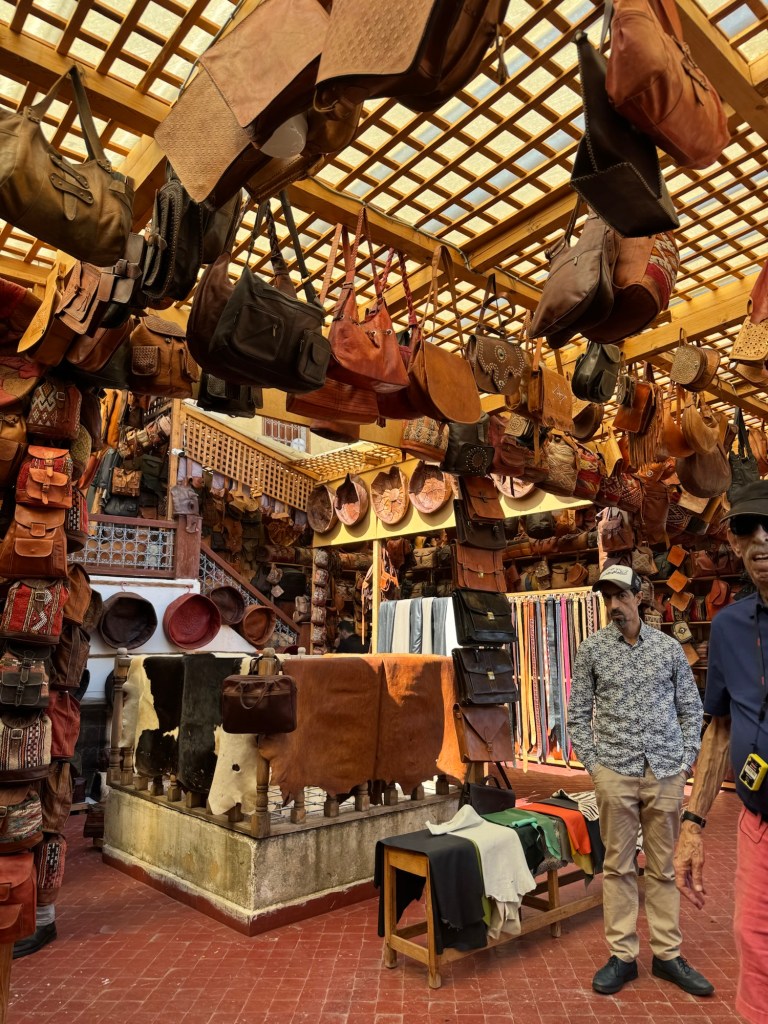
Second stop, Fez, which was notable for its Medina, an underground labyrinth of tiny shops selling almost everything: food, spices, clothing, leather goods, rugs. There were booths with dates and figs, with multiple varieties of olives, with freshly baked pastries. There were butcher shops, fishmongers, vegetables, and souvenirs.
It was an overwhelming experience, topped by stopping at a restaurant in the souk that was beautiful, serene, and served traditional Moroccan food. Another night we had dinner at one of the most astonishingly beautiful restaurants I had ever seen, with an interior courtyard that was four stories high; its walls and floors were covered with gorgeous tiles.
Third stop, Marrakech. We began with a visit to its mosque, which is fairly new, built in the late 20th century. It is the third largest mosque in the world. The mosaics and tiles were spectacular. We had a knowledgeable guide, who taught us about Islam and some of its rituals.
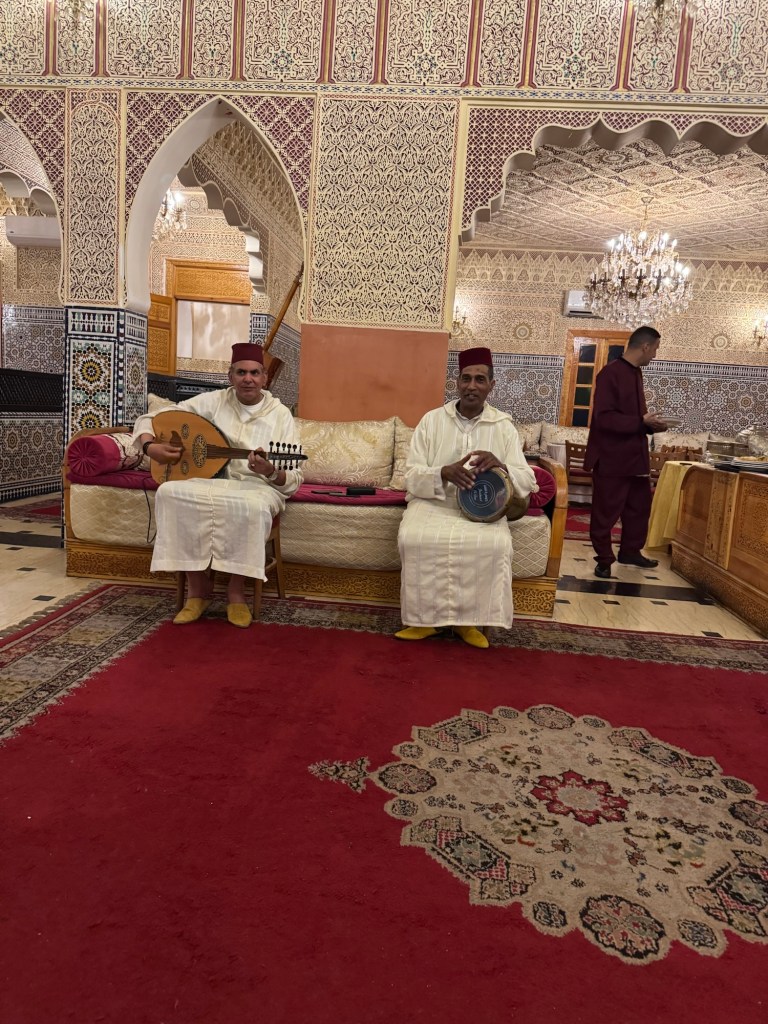
We had dinner in a restaurant that featured traditional Moroccan music. As we entered, we were greeted by eight men in long white robes beating their drums in ear-splitting unison. Then, dinner: traditional Moroccan food, chicken pastille and couscous. All though dinner, two musicians played Moroccan music. One played an oud, which is somewhat like a lute. The other played a drum.
With the arrival of dessert, a dancer appeared, carrying a large silver tray of lit candles and tea pots on her head. As she sought out volunteers, I managed to avoid her gaze, and Mary–ever venturesome–volunteered. The two of them danced for about five minutes, and at one point the dancer put her tray of lit candles on Mary’s head. I thought I was taping the whole thing on my cell phone but I pressed the wrong button and was mortified to discover I filmed none of it. One of the other members of the group did capture a minute or so, when the dancer put the tray on Mary’s head. But I felt badly that I had made such a dumb error. (In the video, I am sitting on the left, holding up my cell phone and imagining that I was taping the event).
Today being Sunday, the group wanted to celebrate Mass. The hotel would not give them a conference room for a “religious ceremony,” so we all crowded into Father Dennis’ room, where he said the Mass, and everyone participated. He gave me a special blessing. It felt like a covert gathering. It was certainly a moving experience.
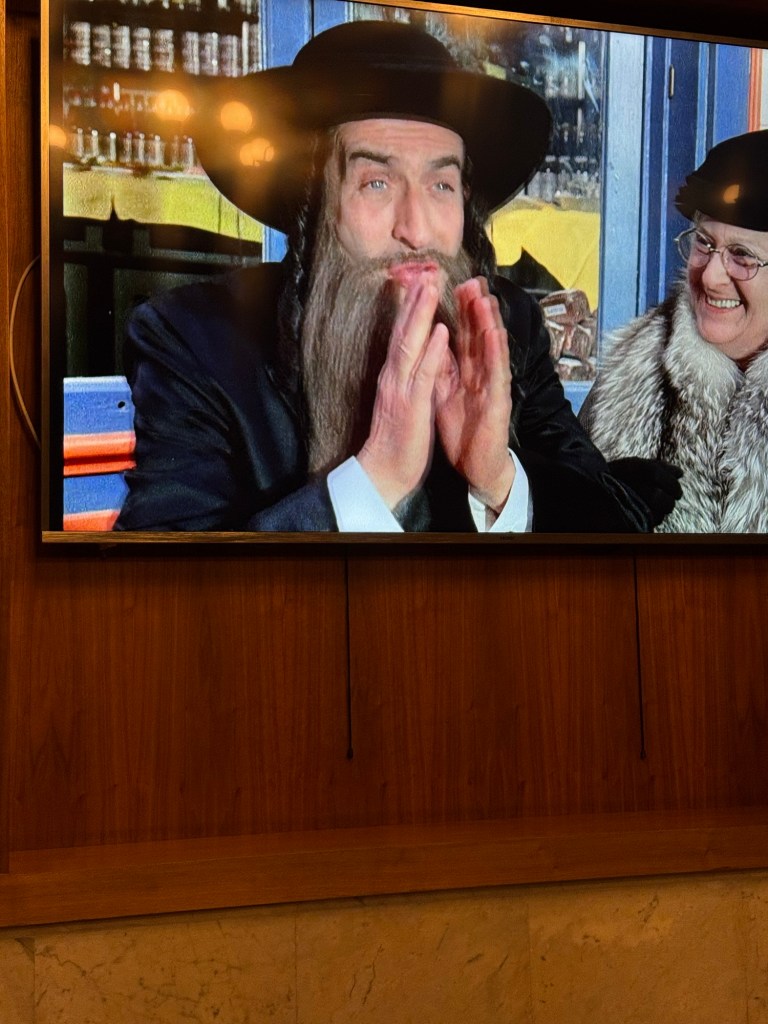
I won’t add any more other than one anecdote. Tonight, after sharing a pizza at the hotel (skipping the traditional Moroccan meal), Mary and I walked through a small lounge where a large-screen TV was playing a film we had seen many years ago: “The Mad Adventures of Rabbi Jacob.” There was no sound and no captions, but we watched until it ended, laughing uproariously. It’s one of the funniest, most outrageous films I have ever seen, as two men–one, a wealthy bigoted Frenchman and other, an Arab revolutionary– evade their pursuers by pretending to be orthodox rabbis. Behind the film is an implicit message about tolerance. We couldn’t get over the fact that we were watching this particular film in Morocco.
No more to report. It’s a lovely country and we have enjoyed our too-brief visit.
Mary L. Trump is Donald Trump’s niece, the daughter of his late older brother. She knows him well. She is a trained psychologist. She has beeen earning the world about him since early in his first term. It’s safe to say that she loathes Uncle Donald.
Hello, and welcome to this week’s episode of Trump Trolls Trump. It has been 635 interminable days since Inauguration Day, January 20th, 2025. But there’s good news. The midterm elections are just 17 days away. So first up, make sure your voter registration is up to date. And if you can vote early, please do so. As always, we are here to ridicule and mock mercilessly this inept, corrupt, and dangerous regime.
Let’s dive right in with a truism that has become increasingly difficult to deny. Donald lies like most people breathe. In fact, I think in some cases he lies more fluently than I breathe. It’s second nature to him at this point, or maybe it’s just his nature.
Sometimes those lies get us into serious trouble. Earlier we saw Donald promising, as he has done time and time and time again, that he would bring energy prices down by 50 percent. That hasn’t happened. And actually the very opposite has happened because his war on Iran, his war of choice, has helped drive energy prices up across the board.
I think it’s worth remembering that Donald lied about this too, because back in 2024 when he was asking Americans to put him back in the White House, which sadly 78 million of us thought was a good idea, this is what he had to say.
We will expel the war mongers from our government. Look at Trump. Just look at this guy. He’s going to go to war. He’s going to take us. No, no. Look at me. I’m the one that kept us out of war. I’m the only president that didn’t start a war. I didn’t start a war. Started no war. I was the first president in decades who started no new war. There are wars all over. He said, “Bring back Trump. It’ll all end. It all ended. We had no problem. I’m going to keep you out of wars. I kept you out of wars. We had no wars with Donald Trump as your president. Remember when crooked Hillary Clinton used to say, “He’s going to get us into a war. Look at him. Look at his rhetoric.” I said, “No, my rhetoric’s going to keep us out of wars.
Really? Threatening genocide is not going to keep us out of wars. Oh, wait a second. He’s threatening genocide against the country he went to war with, an unprovoked war of choice. No one knows how long this war is going to last because he keeps lying about that too. In fact, he told us it would be a matter of days or a couple of weeks. It’s been over six months.
The truth of the matter is, although we are actively still at war with Iran, a war that is expanding because Donald has completely lost control of it, we lost simply by getting involved. Back in June, Vice President Baby JD Vance told us that a deal with Iran was just around the corner. So it isn’t just Donald who is lying to our faces about how things are going. This is Vance in an interview with Robert Costa on CBS’s Sunday morning recorded on June 9th.
Right now, I feel that we are in a position to get a deal that is good for the United States economically and that really does deal with the Iranian nuclear program, not just now, not just while Donald Trump is president, but for the long term, to where my kids can say when they’re adults, Iran is not going to have a nuclear weapon. That’s the goal of the policy, and I think we’re very close to achieving that goal, but we still got some wood to chop and we’re going to keep doing it. You say very close. How soon could the deal happen before the midterm elections? Oh, absolutely. No, I think we’re going to know a lot before the midterm elections. Look, I think that the deal could happen in the next week, but the deal could also happen months from now.
Well, it’s not like there’s much difference between a week and months from now. Before the midterm elections though, absolutely, which as I mentioned, are only 17 days away. Also, remember the goal of this war is to make sure that Iran doesn’t have nuclear capability. And if that’s really what Donald and his ilk were interested in, then guess what he shouldn’t have done? Rip up the Joint Comprehensive Plan of Action, or the Iran nuclear deal, which actually had Iran agreeing not to develop nuclear weapon capability. These guys cannot win for losing.
Speaking of which, back in April, South Carolina Senator Tim Scott appeared on Fox Business with Maria Bartiromo. Remember her? I mean, I know she is much missed and lamented, but Scott’s message was simple. Sure, the war is raging kind of out of control. Sure, prices are rising, but don’t worry your pretty little heads about that. Everything’s on track. And we of course have Donald to thank for all of that. Scott had another message for the American people though, and this is what it was.
Great news, by the way. The fact of the matter is that all of the cylinders are kicking. It is good news. You can even feel in our environment how good things are getting. Gas prices continue to come down, which means that your groceries will come down a little bit as well. We’ve got a lot of good signs in the economy. We just need to continue to execute and have confidence in the choices the American people have made by making President Trump their president and keeping Republican majorities in both the House and the Senate. Let me just say for the average person in the country, President Trump loves you.
Well, I don’t know. Does he? Considering he doesn’t know what love is, I find that highly suspect and untrue. Gas prices are coming down, aren’t they? Well, no, they’re not, because Brent crude oil is now over 105 dollars a barrel, which translates to diesel, the stuff that trucks need to get around, at 6.27 dollars a gallon. So I don’t think Donald loves you. The economy is not doing well.
As I mentioned, with the midterms this close, I can’t wait until I can actually say the midterms are two weeks away. But Donald, he’s not quite taking in what’s happening. How does he think things are doing? How does he think he’s doing? Because really, that’s the only thing he’s concerned about. Well, let me ask you this question. If Donald were asked to grade his own performance on the economy, what grade do you think he would give himself in the midst of economic catastrophe?
We’re doing an unbelievable job. Costs are coming way down. I inherited very, very high costs and they’re all coming down now. The food, the groceries, it’s all coming down. We’ve done a great job. I think we should be giving an A plus on the economy, but I think it’s coming. People are starting to talk about it.
Interviewer: I do want to talk about the economy, sir, here at home, and I wonder what grade you would give.
A plus, Donald responds.
A plus, the interviewer repeats.
Yeah. A plus, plus, plus, plus, plus, Donald says.
Well, it makes sense that he would give himself a grade that doesn’t exist. Now, Donald is laser focused on the needs of the American people. He’s working day and night to make sure that our lives are improved. I mean, you can tell by the fact that crews are working around the clock to get the ballroom built. That’s not making my life better. He’s making oil deals with Russia to help refill their much depleted coffers to aid them in attacking our ally Ukraine. That’s definitely not making my life better.
Unfortunately though, according to him and his enablers, we’re still dealing with the damage Joe Biden left behind. Donald has a few words for his predecessor. Donald has told us that he is working his considerable ass off.
He has one ability I don’t have. He sleeps. He can sleep. This guy goes on a beach and he lays down on one of those beach chairs. They weigh six ounces and he can’t lift it, but he has an ability to fall asleep while on camera. He can lie down on one of those things and in minutes, he’s stone cold out. How does he do it? And he’s got cameras because he’s in prison, so they have cameras on him. And then they show him sleeping on the beach. You’ll never see me sleeping in front of camera. I have to tell you, he’s a different guy. He looks different than he used to. He acts different than he used to. He’s even slower than he used to be. And I wouldn’t say he’s at the top of his game. Would you think their message is Sleepy Joe because he’s not all there? Right now, I think I’m sharper than I was 25 years ago, but who the hell does? You’ll never see me sleeping in front of Joe.
I mean, that’s the reaction to listening to Donald talk about himself because I have never seen a sleepier person. That hypersomnia is not a good thing, but it’s so much nicer when he’s sleeping, isn’t it? Again, as we’ve talked about before, Donald is a master of projection, and clearly when he’s talking about Sleepy Joe Biden, he’s talking about himself because I have never met such a hypersomnolent person in my life. Although to be fair, sleepy Donald is my favorite mode of Donald.
I want to turn now to Donald’s relentless crusade against corruption. Wait a minute, sorry. Is crusade a synonym for embrace? Embrace of corruption? Well, let’s find out.
We know that Baby JD Vance is in charge of the White House Task Force to Eliminate Fraud, which is fabulous. This was established by executive order back in March. The only thing that surprised me about that is that he didn’t ask Elon Musk or Ken Paxton to head that task force, but we’re talking about criminals here, hardened criminals, and Donald, as is his want, is looking at them very strongly, which is a phrase I still cannot make sense of. I do not know what it means to look at something very strongly. I think Superman was able to do that, but he had laser beams coming out of his eyes.
Now, Donald explains exactly what he has done to crack down on criminality. Before you get excited, it does not mean he’s had himself arrested. As I listen to him describe these criminals, I have a lingering question. You may have the same one, here is what he said:
91 percent of the crime in Washington DC, as an example, was caused by 2.1 percent of the population. These are many career criminals, sick people, mental problems.
Okay. I mean, I know DC’s a small town, but I didn’t think it was so small that Donald comprised 2.1 percent of the population. Oh wait, but it’s not just him. He has a lot of co-conspirators out there. If you add in all of his co-conspirators, then maybe yes, those hardened career criminals, the Vances and the Hegseths and the Musks and the Bessents and all of them might indeed make up 2.1 percent of the DC population, and they are absolutely committing over 90 percent of the crime there.
As we approach the midterms, please, please make sure your voter registration is up to date and know where your polling location is. Check both of those things repeatedly because people can get struck off the voter rolls without their knowing it right before the election, and sometimes polling places change. Republicans are going to pull out all the stops, so we need to stay on top of this.
You don’t want any surprises when you go to vote on election day if you vote in person. A lot of states offer early voting, so check your options and if you can vote early, please do so. I am one of those people. I’m old school. I like to go vote on election day, but vote early, vote by mail in states where you still think that’s the safe thing to do.
And when you step into that voting booth, remember how we got here and who brought us to this very dark time in our history. Encourage other people to vote and remind them that Donald himself said he wants us to pretend he’s on the ballot. So that’s very clear. Vote Democratic up and down the ballot.
“I can always say that the next president will get a lot of credit for what I’ve done. Please remember it was me, not them,” Donald says.
Oh, we will remember. We will remember. And as we’re remembering, we are going to tear down everything on the planet that has your name on it.
Thank you so much for joining us for Trump Trolls Trump week 91. Remember, mockery is our superpower, and we will be here every single week to call out the hypocrisy, the ineptitude, and the outright corruption of this incredibly dangerous and misguided regime.
Good evening, everyone. I want to start tonight with Ukraine, because the messages I’ve been getting from people there over the past few days have been some of the hardest I’ve read since this war began. People are telling me it’s getting worse. They are terrified. They’re watching Russia systematically knock out power plants and substations as winter closes in, and now they’re reading reports of an intercepted Russian document that lays out the goal in plain terms: cut the electricity, cut the water, and make Ukraine’s cities unlivable until people flee.
And at that exact moment, Donald Trump chose to waive the sanctions Congress passed to stop it. A law he signed himself just last month. Ukraine wasn’t even warned.
In response to a lawsuit filed by more than 300 public school districts, a state appeals court ruled vouchers unconstitutional. The vote was unanimous.
Article VI, Section 2 of the Ohio State constitution says:
The General Assembly shall make such provisions, by taxation, or otherwise, as, with the income arising from the school trust fund, will secure a thorough and efficient system of common schools throughout the state; but no religious or other sect, or sects, shall ever have any exclusive right to, or control of, any part of the school funds of this state.
An Ohio appellate court has ruled that the state’s “EdChoice” private school voucher program is unconstitutional. The program uses public taxpayer dollars to fund private school tuition.
The program will still be able to exist, as the judges expect the state to appeal. An appeal will go to the 6-1 Republican-controlled Ohio Supreme Court. Ohio Republican state lawmakers made Ohio Supreme Court races overtly partisan by adding party labels in 2021.
The state Attorney General will appeal. He responded that parents should send their children to the school of their choice, and the state wants to help them.
A panel of Democratic judges on the 10th District Court of Appeals in Franklin County unanimously sided with the more than 300 public school districts that sued, alleging that the EdChoice private school voucher program was violating the Ohio Constitution by funding a separate school system, one with a lack of oversight that isn’t available to rural students.
“EdChoice, as presently structured and funded, secures with taxpayer funds a competing system of uncommon schools that is not subject to the same obligations imposed on Ohio’s system of common schools,” Judge Dave Leland wrote.
The voucher program is also illegal because it draws taxpayer money away from schools and cherry-picks the students it wants, which harms public schools.
Former Attorney General Dave Yost appealed Judge Jaiza Page’s 2025 ruling that the EdChoice universal school voucher program was unconstitutional. Less than a year later, Yost resigned as Ohio Attorney General to work for the Christian conservative legal group Alliance Defending Freedom, which actively defends and promotes universal school vouchers and public funding access for faith-based and religious schools. Alliance Defending Freedom is one of the most outspoken defenders of vouchers in the nation.
It’s not clear how the highest court of the state will rule, given its domination 6-1 by Republicans.
After almost two years of Trump’s second term, we know he is not wiser or more efficient than a democratically elected leader. Indeed, he is most assuredly less wise and less efficient than any democratically elected leader.
He repeatedly makes decisions that drive up prices and impoverish American citizens, while cutting taxes for the richest Americans.
He launches vendettas to pursue and punish anyone he dislikes.
He has built tributes to himself and hung giant flags on government buildings to celebrate his face.
He has virtually destroyed the John F. Kennedy Center for the Performing Arts.
He has gilded the austere and elegant Oval Office by covering it with gold doodads.
He speaks at public events with crude and vulgar language that demeans the Presidency.
He has alienated our allies and honored our adversaries with his fawning friendship and obsequious admiration.
He has attacked and insulted the free press.
We do not need a king or a dictator.
We need leaders who honor the Constitution and uphold the rule of law.
This Saturday is “No Kings” day across the nation.
Find a group standing up for democracy and the rule of law and stand with them. March with them. Honor the best in our ideals.
Tom Ultican, retired teacher of physics and advanced mathematics, writes powerful columns about the value of public schools and the misguided efforts of those who vilify public schools.
In this post, he wonders why Ohio adopted an expansive voucher program without bothering to get the consent of the public. He writes, “Even though vouchers are very unpopular, residents in Ohio will never have the opportunity to vote against them. “
He writes:
At NPE Houston, a woman from Ohio gave me the book Right Down the Drain. It is a product of the Department of Education graduate school at Miami University Oxford, Ohio. In 2023, the state created the EdChoice Expansion Voucher Program which takes more than $1 billion a year away from public education with no audits. I have visited Ohio a few times and really liked what I saw but do not believe it is immune to corruption. Having no oversight for a billion dollars of taxpayer money is bizarre. As Education Professor Thomas Poetter wrote, “… the EdChoice Expansion Voucher Program feels to us like throwing Public money right down the drain?” (Right Down the Drain [RDTD] page 13)
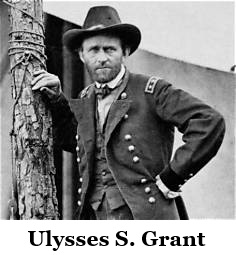
President Ulysses S. Grant saw the Common Schools as a tool to enhance democracy. In his 1875 address to the Army of Tennessee, He stated, “Encourage free schools, and resolve that not one dollar of money appropriated for their support, no matter how raised, shall be appropriated to the support of any sectarian school.” He concluded:
“Leave the matter of religion to the family circle, the church, and the private school, supported entirely by private contribution. Keep the Church and State forever separate. With these safeguards I believe that battles which create us ‘The Army of Tennessee,’ will not have been fought in vain.”
Grant Ignored in Ohio
Curiously, Grant was a Republican born in Ohio. Strikingly, the Ohio GOP of today completely rejects Grant’s admonition. In 1995, Republicans in Ohio’s legislature passed the Cleveland Scholarship and Tutoring Program. A coalition of parents and teachers sued to stop the program because among other reasons it allowed for taxpayer money going to religious institutions. This turned into a protracted legal struggle that saw victories for both sides. Finally, on June 27, 2002, the United States Supreme Court in a 5-4 decision declared that vouchers were constitutional. This opened the door for sectarian institutions to receive taxpayer money.
2023 saw Matt Huffman, one of the most powerful politician in Ohio, push through the billion dollar a year EdChoice Expansion Voucher Program. Huffman comes from the small isolated and shrinking old city of Lima, Ohio. An illustration of his political power is for the first time since the 19th century this politician was able to serve first as president of the Ohio senate and then became speaker of the house with no interruption between positions. The change was forced on him by term limits.
EdChoice’s adoption is an example of authoritarian government in action. Ohio is deeply gerrymandered and even though vouchers are very unpopular, residents will never be given the opportunity to vote against them.
The top 100 schools receiving the most cash for vouchers in Ohio are religious institutions. (RDTD page 51) In fact, 90% of Ohio voucher money is going to religious schools. (RDTD page 75) Even if Ohioans are not Catholic or Hindu, they are sending tax dollars to those institutions. So, the modern Ohio GOP supports sectarian schools and is unconcerned with the separation of church and state.
Maybe we should send taxpayer funds to religious schools but shouldn’t the public have some say in this?
What is the GOP Motive?
In 1955, economist Milton Friedman wrote an essay calling for the creation of a voucher system in America. The political establishment including President Eisenhower, the GOP and Democrats ignored what they perceived as a crackpot. It was Ronald Reagan who gave Friedman credibility in the 1980s which for the first time gave the voucher movement legs. In the early 2000’s, Friedman told the American Legislative Exchange Council that parents should pay for educating of their own children. Today, voucher zealots following Friedman’s lead are working to end taxpayer supported public education. (RDTD page 67) This appears to be the Ohio GOP motive.
Vouchers are a state-designed mechanism for channeling public dollars to private education providers. For the GOP, it is important that this money is provided without state oversight. For example, in June, Democrats put forward the Take the Dough, We Gotta Know Act that calls for state audits and monitoring enrollment, capacity, student demographics, tuition, services offered, and accreditation. This bill is probably already dead because House Speaker Huffman has contended that the fact parents enroll their kids in private schools constitutes accountability, and he is concerned that the bill might infringe on a private business. (RDTD page 77)
A Privatization Outcome
In their essay, Elijah L. Fenwick-Sanders and Anthony W. Rose state:
“When large amounts of public money are permitted to flow through private systems with limited transparency, the risk of corruption increases.”
“Public trust requires more than good intentions. It requires rules, records, audits, transparency and consequences.” (RDTD pages 84 and 85)
If a school does not want public audits, public reporting, nondiscrimination requirements, academic transparency or fiscal oversight it can opt not to accept public funds. That is a reasonable choice.
Support or opposition to vouchers is not a Left-Right situation. Many conservatives support public schools and some liberals support privatization. Emma Errang, who grew up in traditionally conservative Kentucky, bolstered this point in her essay when writing about the 2024 constitutional amendment vote that would have allowed school privatization in her state:
“The coalition against Amendment 2 was not liberal or conservative, nor was it Democrat or Republican. It included progressive voters like me and conservative voters like my father, who believe that choosing private education is a right but not something that should be funded at the expense of public education.” ( page 128)
Conclusion
I side with President Grant when he advised, “Encourage free schools, and resolve that not one dollar of money appropriated for their support, no matter how raised, shall be appropriated to the support of any sectarian school.” I would go a step farther and say that all private schools, not just those from religious institutions, be on their own and receive no taxpayer funding. Of course, the public has the right to support private schools if it desires, but that choice has the potential to undermine public schools and that would be a tragedy.
Reagan’s fraudulent A Nation at Risk report claimed, “We report to the American people that while we can take justifiable pride in what our schools and colleges have historically accomplished and contributed to the United States and the well-being of its people, the educational foundations of our society are presently being eroded by a rising tide of mediocrity that threatens our very future as a Nation and a people.” SAT scores were cited to defend this statement. Seven years later, the Sandia Laboratories in New Mexico found that using proper statistical techniques all groups disaggregated by race and gender showed improved scores in 1983. This is where the ongoing attack on public schools began in earnest and it was based on a fraud.
In America, public education has been a great bulwark for democracy. It is a shared democratic obligation that must be defended from greedy entrepreneurs and misguided social theorists.
It’s easy to get overwhelmed by the daily news if you care about the scandals of the Trump administration. There’s so much happening, so many news stories about corruption. Who can keep count?
Heather Cox Richardson today gives us an account of current corruption scandals. Any one of us could add scandals that she didn’t have room for, like conflicts of interest and profiteering. My example, Presidential pardons. Is it mere coincidence that wealthy donors get pardoned quickly? Is it coincidence that they are relieved of their obligation to repay the people they defrauded?
One thing is sure. The Trump administration is a stark illustration of kakistocracy, corruption, and greed.
There is an old saying about rats and sinking ships. There’s also an old saying about how a democratic system taken over by a single party quickly becomes corrupt because the ruling party lacks oversight. Then, as corruption becomes the party’s driving force, the only people willing to work for it are either corrupt themselves or so unqualified they support the corrupt leadership to gain power, knowing that in a merit-based system it would be entirely out of their reach.
OK, that second old saying is shared mostly among political scientists, but it’s accurate, and it’s right up there with the rats and the ships to describe what’s happening in Trump’s orbit now.
The saga of Kimberly Guilfoyle, who was recently forced to resign from her post as U.S. Ambassador to Greece, continues to expand. Guilfoyle left her post after news broke that she had tried to get a donor, Eric Deters, to pay down her credit card debt. She and her lawyers countered the story by claiming Deters was withholding money she had earned, and said the text messages he shared with news outlets were false.
Guilfoyle dated Don Jr. from 2018 to 2024 and was engaged to him the last four years of that time. Now there are rumors that during her time inside the family as a trusted loyalist, she kept a “burn book” about the family.
While that may or may not be true, the fact that there’s such a threat out there reflects the cracking loyalties of Trump insiders. More to the point might be the video released today by Deters himself, saying that he had launched a lawsuit against Guilfoyle for defamation and that he would depose her and Don Jr. and demand subpoenas to clear his name. He also vowed to play a 16-minute phone conversation tomorrow that he claims has information which “might just bring down the entire Trump administration, an administration which I have supported from Day One.”
Note that the story of Guilfoyle’s alleged shakedown is breaking now, although it happened more than a year ago.
Also in the category of old stories coming to the surface is one reported yesterday by Marc Caputo of Axios. He wrote that Trump’s former lawyer Alina Habba is saying that another one of Trump’s advisors, Ric Grenell, did not deposit her billionaire husband’s $5.6 million donation to the Kennedy Center. According to Habba, Grenell asked that the donation be routed through a $17.6 million payment for a business deal, an accusation Grenell called “absurd.”
Trump appointed Grenell to be U.S. ambassador to Germany and then acting director of national intelligence during his first term. After retaking office, he named Grenell as a special envoy to Venezuela before putting him in charge of the Kennedy Center.
A fight that has been going on for more than a year in the administration broke into the open this morning in a Politico story by Daniel Lippman. He explained that Trump named Italian Paolo Zampolli, a former modeling agent who introduced Trump to First Lady Melania Trump at a party in New York City, as a special envoy at the State Department with a portfolio of cultural diplomacy. But Zampolli apparently ignored that assignment and struck out on his own on a wide range of issues, infuriating Deputy Secretary of State Christopher Landau.
“My number-one boss is the president of America,” Zampolli told James Fontanella-Khan of the Financial Times in April. “I get my instructions from the White House, Commerce and the Department of War…anything to advance the America First agenda.” More than 16 administration officials have been included in the angry email chains Zampolli and Landau have exchanged, which at one point led to communications about the fight with a top-level foreign official.
At one point Zampolli accused Landau of leaking to reporters what appeared to be the story that Zampolli had tried to get custody of his son by asking Immigrations and Customs Enforcement to deport Amanda Ungaro, the boy’s mother. That story created its own scandal when Ungaro, a former model, threatened to expose information about the president and first lady. Landau responded to Zampolli’s accusation, which he sent to more than a dozen other officials, saying: “Your threats and accusations are getting more and more bizarre, defamatory, and inappropriate for broad dissemination on email.”
An administration official told Lippman that the State Department was “generally squeaky clean and professional and above it all.” In contrast, these exchanges were “cartoonish and embarrassing.”
By this afternoon, Lippman had a follow-up story: Zampolli had been fired.
It is not just the current associates of the president who are problematic. Today, news broke that two women have named former Republican representative Matt Gaetz (R-FL), along with his friend former Seminole County tax collector Joel Greenberg and others, in a civil lawsuit, alleging that from 2017 through January 2019, “Gaetz and Greenberg coordinated recruitment, payments, drugs, and travel to obtain commercial sexual acts….”
In 2024, the House Ethics Committee reported that Gaetz “regularly” paid women, as well as a 17-year-old girl, for sex, and bought and used illicit drugs while a member of Congress. Those accusations helped to sink Trump’s nomination of Gaetz for U.S. attorney general in 2025.
Gaetz’s response was hardly a denial: “I look forward to taking the plaintiffs’ depositions because much of the conduct alleged against me is false,” he wrote. “The lawsuit relies almost exclusively on a Congressional Committee Report that didn’t allow me to confront my accusers. Now I will finally have that chance.”
One has to wonder why anyone would want to be part of such a mess, but Trump’s new White House press secretary provides an answer: in a normal administration she would never make it through the door. Trump has described Katie Zacharia as an “attorney,” and she has identified herself as a “general counsel” and seemed to claim she worked as an attorney in China.
But after Judd Legum of Popular Information noted there was no sign she had ever passed the bar exam or been admitted to a state bar, Philip Wegmann and Alexandra Bruell of the Wall Street Journal reported today that, in fact, she failed the California bar exam when she took it. That, itself, is not unusual—the California bar exam is notoriously difficult—but it does mean she is not qualified to call herself an attorney.
Democracy Defenders Fund, a nonpartisan team defending democracy led by attorney Norm Eisen, has asked the State Bar of California and California Attorney General Rob Bonta to investigate whether Zacharia practiced law without a license in California, where doing so is a crime.
Tonight, on his show, Fox News Channel personality Sean Hannity seemed to undercut Zacharia, asking her why she had chosen to describe herself as an attorney when she could just have said she “went to Pepperdine Law School and then took a different career path.” Josh Marshall of Talking Points Memo noted that Hannity’s stance likely reflected that Trump is turning on her.
Rhein Amacher, the man who started a right-wing media frenzy when he claimed to have proof that Democratic Texas Senate candidate James Talarico had sought mental health treatment in Ohio, backed away from that claim today…sort of. Amid suggestions that he might well have run afoul of HIPAA penalties for trying to obtain health information duplicitously, he posted that “this entire situation has been blown completely out of proportion,” and wrote, “As far as I’m concerned, this matter is closed.” Later, in response to a post saying he had lied, he added: “Never lied, I just doubled down on wrong information.”
A blockbuster story by Jonathan O’Connell, Sarah Blaskey, and Aaron Schaffer of the Washington Post today explained that the administration has been able to keep donations for Trump’s ballroom largely secret by using a nonprofit to collect the donations and then channeling that money “into a White House account the president directly controls.”
The reporters gained access to a list of the 57 donors who have committed to giving $100,000 or more to the project. They found that “the vast majority of the funds raised came from companies and wealthy individuals with interests before the federal government.” Large technology companies Nvidia and Apple committed $25 million each. Microsoft, Palantir, and Lockheed Martin pledged $10 million each.
Individuals on the list who are associated with Trump include Commerce Secretary Howard Lutnick’s son Brandon, chair of investment bank Cantor Fitzgerald, who contributed stock worth more than $2.5 million, and the U.S. ambassador to the Netherlands, Republican donor Joseph Popolo Jr., and his wife, who gave $1 million. Missing from the list is Trump himself, who claimed he would be helping to pay for the project.
Sarah Longwell of The Bulwark was right when she called the ballroom being constructed where the East Wing of the White House used to be “a monument to corruption” built by “a corrupt American president.”
On Tuesday, Charles Gorrivan, Lydia Beyoud, and Nicola M. White of Bloomberg reported that on March 23, a few traders placed billions of dollars of contracts predicting that the price of oil would fall just 15 minutes before Trump posted on his social media platform that he had changed his mind about striking Iranian power plants. The deals were worth billions, and analysts from the U.S. Commodity Futures Trading Commission (CFTC) flagged the traders and the deals and sent a referral to the Division of Enforcement to decide whether to open an investigation into insider trading. But in a virtually unheard-of move, the administration asked the CFTC to withdraw the referral.
The journalists note both that there have been many trades apparently tied to Trump’s announcements and that between a 20% cut to CFTC staff during Trump’s second term and the agency chair’s vow to curb “over-zealous regulation,” enforcement actions have dropped dramatically from the numbers during the Biden administration.
Steven Portnoy and Katherine Faulders of ABC News reported today that the White House is claiming that all Trump’s conversations about plans to renovate the Kennedy Center are covered by executive privilege and therefore can be kept secret. This is a dramatic expansion of the concept of executive privilege, which enables the president to shield conversations with key advisors from public scrutiny, extending it to consider virtually all conversations private.
Apparently in anticipation of Democratic investigations, Attorney General Todd Blanche issued a memo as soon as he took office, claiming presidents can shield “presidential communications with private advisers so long as the communications relate to official presidential decisionmaking.”
A new Fox News poll released today showed that voters’ top concern is “corruption in government,” with 88% worried about it compared to 12% who are not. Corruption tops even “inflation and high prices,” which comes in at 85%, and “gas prices,” which concern 83% of voters.
In a conversation with Rob Finnerty of Newsmax, aired tonight, Trump suggested he would pardon everyone in the administration, including himself, to make sure none of the people around him have to “go through years of nonsense, hire lawyers and everything else, all for nothing.”
It is no wonder that Republicans eager to stop Trump are backing Democratic candidates for the midterms. Today 58 Republicans and Independents in New Hampshire declared their support for the Democratic Senate candidate, Representative Chris Pappas, over Republican candidate John Sununu. Those supporters include Don Bolduc, who was Trump’s pick for the Senate in 2022 but who lost to Democrat Maggie Hassan by 9 points after he embraced Trump’s claim to have won the 2020 election.
One of the Republicans supporting Pappas told Kevin Landrigan of the New Hampshire Union Leader: “Donald Trump has turned the Republican Party into something I no longer recognize.”
Amanda Ungaro, the Brazilian model and former U.N. ambassador who roiled First Lady Melania Trump in April by threatening to expose unspecified information she has on President Trump and the First Lady, is apparently talking to the House Oversight Committee…