Paul Thomas is a professor at Furman University. He has taken a leading role in refuting claims for the “science of reading.”
There are many successful ways to teach reading. some children arrive at school knowing how to read, because a parent read with them every day. Phonics is important. The joy of reading is important. Comprehension is important. Legislatures should not mandate one way to teach.
In his latest post, he writes:
If you pay attention to the non-stop moral panicking around reading fanned by mainstream media, you may have seen this click-bait headline: Did New York blow $10 million on reading instruction that doesn’t work?
The article repeats tired and misleading (often false) stories about the failures of balanced literacy, NAEP reading scores, the “success” of Mississippi and Louisiana, the promise of structured literacy, and the National Reading Panel as well as the one research study on phonics that is linked.
Let’s consider these:
*No scientific studies identify a reading crisis in the US causally linked to balanced literacy, reading programs, lack of phonics instruction, or inadequacy of teacher education. (Aydarova, 2025; Reinking, Hruby, & Risko, 2023).
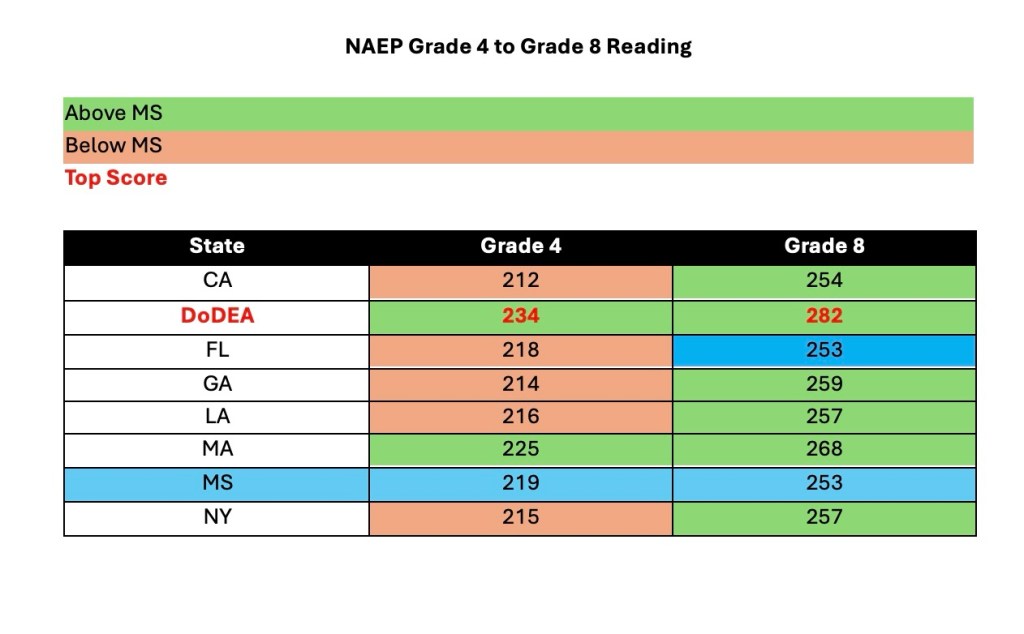
*The media hyper-focuses only on grade 4 NAEP reading scores, but notice how the story changes once we consider grade 8—states behind MS in grade 4 catch and pass MS by grade 8 (primarily because MS inflates their grade 4 scores by excessive grade retention, like FL):
*Structured literacy (scripted curriculum) is whitewashing the reading curriculum and restricting teacher autonomy and professionalism. (Khan, et al., 2022; Parsons, et al., 2025; Rigell, et al., 2022).
*The linked research suggests it replicates findings of the NRP; however, the NRP did not prove systematic phonics outperformed whole language or was a silver bullet. As Diane Stephens explains about the findings on phonics: “Minimal value in kindergarten; no conclusion about phonics beyond grade 1 for ‘normally developing readers’; systematic phonics instruction in grades 2-6 with struggling readers has a weak impact on reading text and spelling; systematic phonics instruction has a positive effect in grade 1 on reading (pronouncing) real and nonsense words but not comprehension; at-risk students benefit from whole language instruction, Reading Recovery, and direct instruction.” Further, while the article quotes from the research report, it doesn’t include this much more tentative hedge: “These findings suggest that SL approaches may yield larger positive effects on student learning compared to BL approaches.” At best, structured literacy is no better or worse than whole language or balanced literacy, but to be clear, there is no “settled science” that is works.
But the bigger problem is not that mainstream media continues to repeat misinformation, but that it fails to offer the full story.
Note that the “literacy experts” quoted in the article are supporting structured literacy programs (scripted curriculum), and some of those experts are co-authors of those programs.
Further, these experts are promoting a different teacher training program than the one being attacked in the article, and many states are spending 10s of millions of dollars on that program—LETRS. (My home state of SC a few years ago allocated $11 million for one year, for example.)
What’s missing in this story?
There are two high-quality studies that were released in 2025 on the effectiveness of LETRS, but so far, there have not been click-bait scare headlines about those findings:
*A review (Rowe & Thrailkill, 2025) of reading policy in North Carolina concludes:
Despite LETRS’ claim that it helps educators “distinguish between the research base for best practices and other competing ideas not supported by scientific evidence” (Lexia Learning, 2022, p. 4), we noticed a pattern of misinterpretation, selective inclusion, and omission of literacy research. LETRS is a prime example of a common problem with the deployment of research for educational policy and instructional decision-making, in that multiple claims are not substantiated by a close reading of the original research cited (cf. Hodge et al., 2020).
*And Gearin, et al. (2025) found:
[Abstract] We investigated whether Language Essentials for Teachers of Reading and Spelling: 3rd Edition (LETRS) was related to student reading ability by comparing the average third-grade reading achievement of schools that used LETRS to that of schools that used exclusively other professional development experiences in the context of Colorado’s Read Act. Guided by What Works Clearinghouse Standards, we conducted a quasi-experiment with propensity score matching and an active comparison group. We supplemented our primary intent-to-treat analysis with three sensitivity analyses designed to demonstrate the robustness of our claims. Effect estimates for completing a LETRS volume on educator knowledge ranged from 0.82 to 0.94. Students’ third-grade reading achievement did not statistically differ for schools that adopted LETRS compared with other professional development experiences in any model, suggesting that LETRS was comparable to the other programs at improving third-grade reading achievement at the school level.
The “science of reading” movement is a political, ideological, and market-based attack on teachers and public education, and the only people profiting off yet another moral panic are the media, political leaders, education reformers, entrepreneurs, and of course, the education market place.
The full story is never covered, because the real story about reading simply isn’t that profitable.
To get the links to research, open the article.


They manufacture crisis so they can use them as an excuse to promote their preferred products and services. I watched this happen in Arkansas with the science of reading program!
LikeLiked by 1 person
Most competent reading teachers are effective when they diversify instruction based on the needs of the learner. Generally, the first step in effective reading instruction is to assess students. What often results in elementary classrooms is that teachers often end up placing students into a group with other students with similar needs. Some students arrive in kindergarten reading fluently. They have clearly mastered phonics so there is no need to spend time on phonics lessons the student does not need. Both Diane Ravitch and myself grew up in the “See, Say” era of reading instruction. We didn’t learn phonics. We deduced the sound system from reading it. This method will not work for many students, but there are some that would be successful with this approach.
All learners have strengths and weaknesses. Other students may have other issues like a difficulty with auditory discrimination, and teachers should have the freedom to adjust instruction based on the needs of students. By the way a student with auditory discrimination or memory problems will struggle and flounder in a science of reading environment. This student may have to write the word in order to basically memorize it.
I am a certified reading teacher. I have taught many struggling students, most of whom were English language learners, to read successfully and fluently in English. Part of the reason for positive results was due to the assessing and addressing what the student needed to understand and apply the skill and become a good reader. There is no magic to this process. It is called diversifying instruction, and many competent teachers adjust teaching to meet student needs. Whatever method is used, it needs to meet students’ needs, offer the student a degree of success through application, and be engaging. Professional teachers should have the freedom to adjust instruction without government interference.
LikeLiked by 1 person
I disagree. As a trained OG/ALTA tutor the use of structure and explicit teaching of a spiral curriculum benefits all children. The poorest readers need it and the better readers become better knowing phonics and morphology. The Science of Reading supports explicit instruction in phoneme awareness, phonological awareness, morphology, vocabulary and comprehension. To be the best possible reader none of these parts of reading can be left out of the curriculum. Where we fail as an educational system is in not training teachers to assess/ diagnose reading behaviors and then prescribe the needed tracing and reinforcement. While ‘ scripted lessons’ from programs are helpful , they are not a quick fix. Teachers thinking this is another bandwagon to jump on dive into structured language and multi sensory teaching without the pedagogy to support their efforts. I see so many teachers trying to use these practices without proper training and are helpless when students ask questions about how words work. Great training is essential for teachers to use best practices based on science and research.
I was a highly sought after reading tutor for 25 years and can say that multi sensory structured language approach has improved all aspects of reading and writing and spelling for all the students I worked with. I used it as a classroom educator before retiring. I even applied some strategies to college students that lacked knowledge of language for reading and comprehension. The Science of Reading is , unfortunately, a term used to reflect what we should be doing n reading rather than reading itself. Training takes time and practice. Teachers are reluctant to change their schema of reading. Universities need to teach best practices to all education majors High-school math teachers need to understand how reading and comprehension affects students learning
respectfully,
Deidra Chandler MA Early Childhood Ed; MA Reading; formerly OG and ALTA certified. Retired.
dchan0924@gmail.com
LikeLike
I don’t disapprove of phonics. I disapprove of mandating one way of teaching reading.
LikeLiked by 1 person