Paul Thomas was a teacher in South Carolina for many years; he is now a professor of education at Furman University. He believes that the movement to mandate “the science of reading” is a fraud, as is the so-called “Mississippi Miracle.” The key to the alleged miracle, he says, is holding back third-graders with low reading scores. That is the magic bullet, not the reading curriculum.
In this post, he compares the claims for SOR with research.
He writes:
Journalists and politicians are both drawn to and depend on compelling stories.
Regretfully, whether or not those stories are factually true is less and less important, and in some cases, what makes the stories compelling is over-simplification while the truth is complicated or often not clearly defined.
The stories told about education have a long history of being trapped in compelling but false claims. Currently, the most popular and compelling education story is about reading proficiency among US students; this story is grounded in a very compelling story about reading reform in Mississippi, identified as reform labeled the “science of reading.”
The repetition of the so-called Mississippi “miracle” has occurred dozens of times since 2019—and here are just two of the most recent:
•Rahm Emanuel on Twitter:
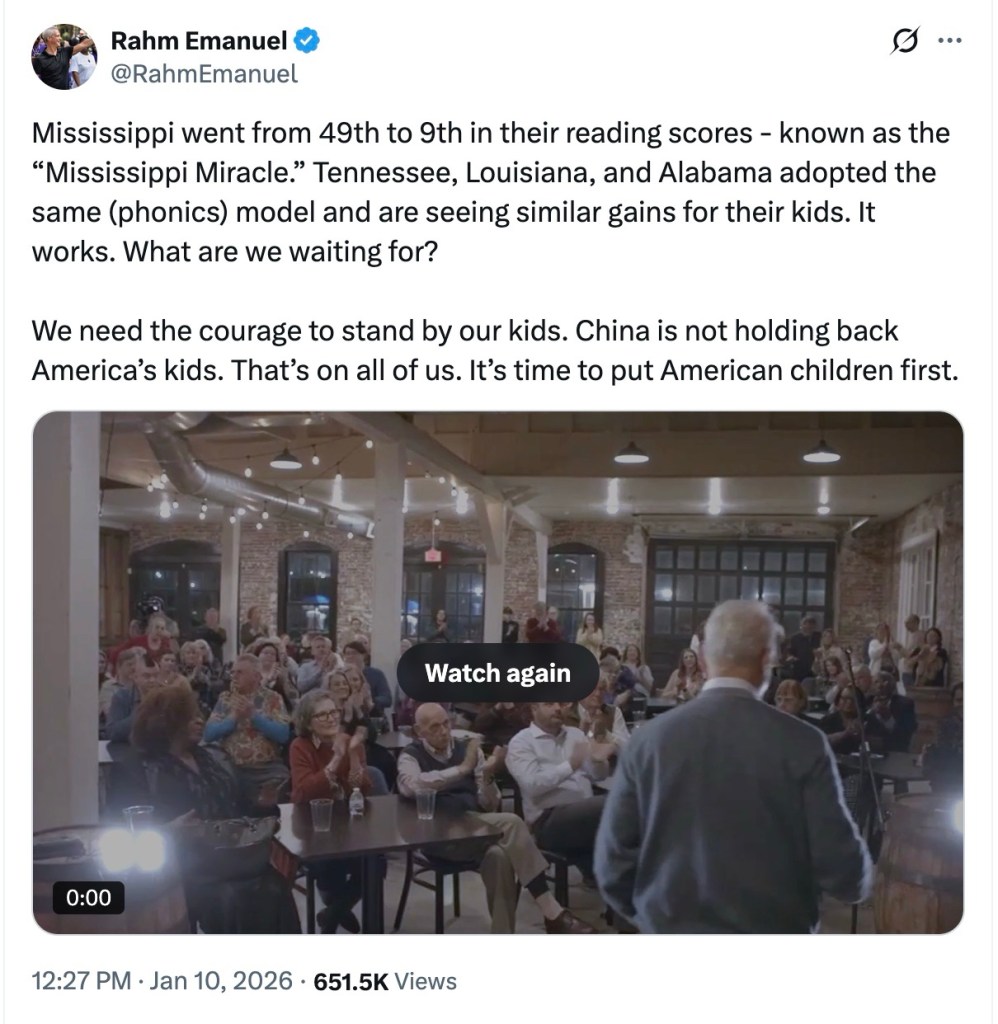
•And yet another article in The New York Times: How Mississippi Transformed Its Schools From Worst to Best.
Everything about the Mississippi story fits perfectly into the larger stories that Americans love.
So there is now a recurring accusatory question: If high-poverty poverty state with a large proportion of Black students can radically improve reading proficiency among their students, why don’t all states adopt that policy?
From that, it gets uglier because the implication and direct accusations that follow are damning: The education establishment, bolstered by teachers unions, simply don’t think poor and Black students can learn; the education establishment uses poverty as an excuse and will not let go of the soft bigotry of low expectations.
Throughout the stories being told about reading, teachers, and education, there is a discouraging pattern: The stories are not supported by the evidence (ironically, the stories behind the “science of reading” lack scientific research), and in many cases, the evidence contradicts the story being told.
Is poverty an excuse for student achievement and is teacher quality/knowledge a major reason students underachieve?
Poverty, inequity, and other out-of-school factors are the primary cause factors in measurable student achievement (test scores), accounting for 60% or more of those scores.
Teacher quality impacts measurable student achievement at rates of about 1-14%.
Research:
If you want to read the research that directly contradicts the received wisdom about how to teach reading, open the link.

 Diane Ravitch's blog
“The Science of Reading” miracle is a politically driven media campaign. Retention of students as in Mississippi will offer short term gains, but does not address the bigger issue of poverty and lack of resources. People like Emily Hanford, who is a right wing ideologue, not a reading teacher or scholar, managed to promote this myth nationally, and it has even seeped into the pedagogy of many blue states.
A someone with a good understanding of applied linguistics and who is a certified reading teacher, I have taught many very poor English language learners to read successfully without the so-called science of reading. While all students must know how to decode to read, a bigger issue for poor students that Thomas mentions is comprehension which depends on prior knowledge. Poor students usually know very little about the world, and their experience and language skills generally are limited, even if they are not ELs.
When I taught disadvantaged students to read, there was no miracle. It was slower process that included reading, writing, thinking, language development and lots of exposure to the world around them. I was not the hero in their success story. The heroes are all the teachers in their public school experience that supported and challenged them along the way and were determined to help them to get a solid academic background that would serve them well in life. There is no miracle in teaching disadvantaged young people to read, just a lot of years of hard work and repeated opportunities for these young people to learn and discover, and it takes a village.
LikeLiked by 1 person
WWNBS is my motto. What would Nancy Bailey say?
LikeLike
As it turns out, Nancy has eviscerated the third grade retention idea, which led to a post on this blog July 2, 2023. Thirty comments attested to the nature of the beast, an ongoing professional debate about what works in the teaching of reading.
LikeLike
👏👏👏👏👏
LikeLike
As the author of this blog has pointed out several times viz this particular (and particularly stupid) debate, Jeanne Chall is the voice of reason on this issue. Unfortunately, the book in which Dr. Chall expounded her ideas on reading education, “Learning to Read: The Great Debate,” is out of print–and appears to have long been so. There are copies (both hardcover and paperback) available on Amazon for north of $500, which is well beyond the budget of this special education teacher. I’ve read other of her books, and a basic internet search of her name discloses that her colleagues at Harvard held–and continue to hold–her in high esteem….
LikeLike
Jeanne Chall was sensible, a former kindergarten teacher, an esteemed scholar. She recommended phonics early, good children’s literature asap.
LikeLike
Some readers of this blog may be familiar with learning disability simulation workshops. Richard Lavoie is the retired head of a school for students with learning disabilities. The video “How Difficult Can This Be? The F. A. T. workshop has been very helpful for the families of dyslexic students and the teachers who want to understand learning disabilities.
Many public libraries have the DVD.
The segment on the practice of using vocabulary for teaching reading comprehension is brilliant.
LikeLike
Students who entered kindergarten when Mississippi launched its literacy reforms in 2013 are now 17 or 18 and nearing graduation. If reading methodology alone were the key to ending poverty — as Vivek Ramaswamy claims when he says it’s “statistically impossible” to become poor if you read by third grade — then Mississippi’s poverty rate, still around 19%, should begin dropping sharply as this group enters the workforce. I have a strong feeling that ain’t gonna happen.
LikeLike
David, I’m with you.
LikeLike
https://ohiocapitaljournal.com/2026/01/13/disappointing-ohios-science-of-reading-switch-not-yet-bringing-results/
As per every other failed reform, we just need patience. When patience doesn’t work, it must be the teachers’ faults. By the time we’re almost done blaming teachers it will be time to be “sold” another solution to a new crisis(or story).
LikeLike
Politicians that know little except the fact they expect instant results. Learning is incremental and is rarely explosive. I think of education almost like a builder. We have to start by building a strong foundation. Then we build on it, one brick at a time. Miracles and magic may grab headlines, but they are often politicized smoke and mirrors like the “science of reading.”
LikeLike
Actually, the recent NYT article by Sarah Mervosh about how MS transformed its schools from worst to best is much better than most in the news media about the MS Miracle. It acknowledges a wide range of moves that MS made, not just a shift in how reading is taught.
LikeLike
Nothing improves 4th grade reading scores as effectively as retaining the lowest-scoring readers in 3rd grade.
LikeLike
Retention likely has some influence, but published analyses suggest it is not a major factor. The law that required retention in MS also included improving teaching and providing assistance to students needing help. An analysis of that policy change as a package revealed an increase of .14 standard deviation. It is difficult to disentangle grade retention from the other two factors. Nonetheless, the overall increase was relatively small and the effects of retention even smaller.
LikeLike