Robert Hubbell is one of my favorite bloggers. I could not resist reposting his Thanksgiving commentary. It’s so beautiful!
He wrote:
We are living through challenging times. It isn’t easy to feel gratitude in the midst of trying circumstances. The answer to regaining a sense of gratitude is to expand our perspective—which allows us to look beyond today’s troubles to the greater blessings that will endure for generations to come.
To help regain perspective, I suggest reading an excerpt from Carl Sagan’s book Pale Blue Dot, which references our home planet. The Planetary Society website explains the background for Sagan’s reflection and quotes the most famous passage from his book. It is a fitting reflection for Thanksgiving.
Many readers have used Sagan’s Pale Blue Dot as their reflection for Thanksgiving dinner.
First, this introduction from The Planetary Society:
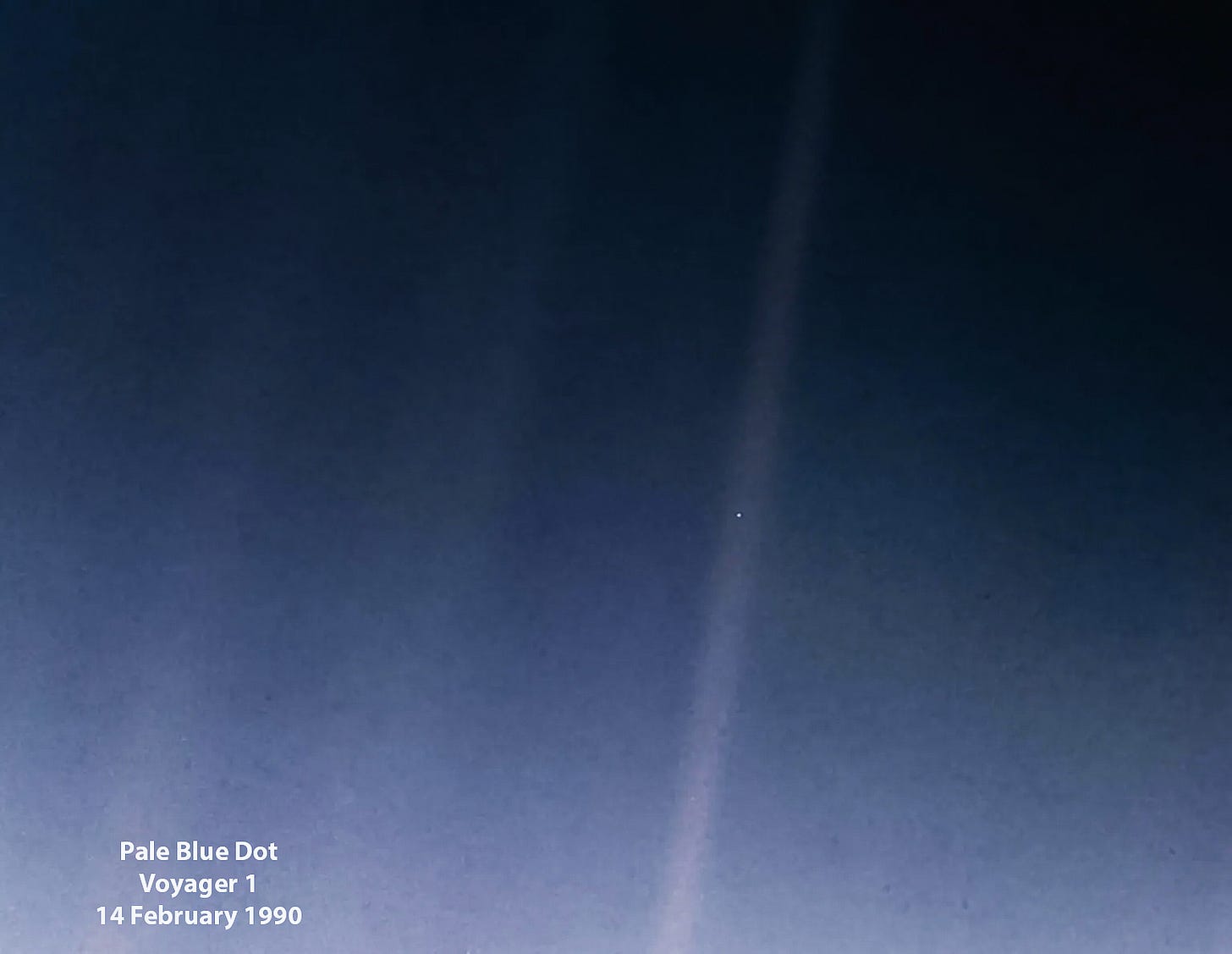
The following excerpt from Carl Sagan’s book Pale Blue Dot was inspired by an image taken, at Sagan’s suggestion, by Voyager 1 on 14 February 1990. As the spacecraft was departing our planetary neighborhood for the fringes of the solar system, it turned around for one last look at its home planet.
Voyager 1 was about 6.4 billion kilometers (4 billion miles) away, and approximately 32 degrees above the ecliptic plane, when it captured this portrait of our world. Caught in the center of scattered light rays (a result of taking the picture so close to the Sun), Earth appears as a tiny point of light, a crescent only 0.12 pixel in size.
Here is Carl Sagan’s reflection on the photo and our place in the cosmos:
Look again at that dot. That’s here. That’s home. That’s us. On it everyone you love, everyone you know, everyone you ever heard of, every human being who ever was, lived out their lives. The aggregate of our joy and suffering, thousands of confident religions, ideologies, and economic doctrines, every hunter and forager, every hero and coward, every creator and destroyer of civilization, every king and peasant, every young couple in love, every mother and father, hopeful child, inventor and explorer, every teacher of morals, every corrupt politician, every “superstar,” every “supreme leader,” every saint and sinner in the history of our species lived there–on a mote of dust suspended in a sunbeam.
The Earth is a very small stage in a vast cosmic arena. Think of the rivers of blood spilled by all those generals and emperors so that, in glory and triumph, they could become the momentary masters of a fraction of a dot. Think of the endless cruelties visited by the inhabitants of one corner of this pixel on the scarcely distinguishable inhabitants of some other corner, how frequent their misunderstandings, how eager they are to kill one another, how fervent their hatreds.
Our posturings, our imagined self-importance, the delusion that we have some privileged position in the Universe, are challenged by this point of pale light. Our planet is a lonely speck in the great enveloping cosmic dark. In our obscurity, in all this vastness, there is no hint that help will come from elsewhere to save us from ourselves.
The Earth is the only world known so far to harbor life. There is nowhere else, at least in the near future, to which our species could migrate. Visit, yes. Settle, not yet. Like it or not, for the moment the Earth is where we make our stand.
It has been said that astronomy is a humbling and character-building experience. There is perhaps no better demonstration of the folly of human conceits than this distant image of our tiny world. To me, it underscores our responsibility to deal more kindly with one another, and to preserve and cherish the pale blue dot, the only home we’ve ever known.
COSMOS: A Spacetime Odyssey, with Neil Degrass Tyson and featuring beautiful orchestral music by Alan Silvestri that slips easily past the ears to be heard unfiltered in the heart and soul.
That dot may also be the only planet that supports our species and all other life that evolved here.
“Yes, all life on Earth shares some DNA because all living organisms are believed to have descended from a common ancestor, meaning their genetic code is fundamentally similar and contains shared DNA sequences across all species; the more closely related organisms are, the more DNA they share.”
We even share DNA with redwood trees.
“Humans share a very small amount of DNA with a redwood tree, as the redwood genome is significantly larger and contains vastly different genetic information, with estimates suggesting that the redwood genome is roughly nine times the size of the human genome, meaning humans share only a very small percentage of genetic similarity with a redwood tree.”
What all life on Earth shares through DNA is the link that sets us apart from all other alleged life in the universe.Other planets that support life may have different environmental influences that will not work for our species.
“Earth’s environment influences the evolution of DNA by shaping which genetic traits are advantageous for survival in a particular ecosystem, leading to natural selection where organisms with beneficial traits are more likely to reproduce and pass those traits on to their offspring, thus altering the genetic makeup of a population over time; this process is primarily driven by factors like climate, food availability, predators, and environmental stressors, which can influence gene expression through mechanisms like epigenetics.”
One astronomical factoid always blows my socks off. There are more stars in the heavens than there are grains of sand on all the beaches of the earth. It was something repeated on PBS astronomy shows a couple of decades ago.
One NASA estimate puts the number of habitable planets in the observable universe at 26 sextillion. That’s 26 followed by 21 zeros. Unlike Earth, many of these probably have intelligent life on them.

 Diane Ravitch's blog
Love Hubbell’s posts. This one is good. Thank you, Diane.
Have a great Thanksgiving. I am grateful for you.
LikeLike
Thank you, Yvonne!
LikeLike
Apart from being a brilliant scientist, Sagan was an outstanding writer. It’s a shame we lost him so young.
LikeLike
Indeed. Still, Sagan left us a protégé who continues much the same scientific brilliance. We might be thankful for that.
LikeLike
And that protégé is???
LikeLike
Tyson, Neil Degrasse. Astrophysicist.
COSMOS: A Personal Journey, with Carl Sagan…
https://archive.org/details/cosmos_1980
COSMOS: A Spacetime Odyssey, with Neil Degrass Tyson and featuring beautiful orchestral music by Alan Silvestri that slips easily past the ears to be heard unfiltered in the heart and soul.
https://watchdocumentaries.com/cosmos-a-spacetime-odyssey/
LikeLike
That dot may also be the only planet that supports our species and all other life that evolved here.
“Yes, all life on Earth shares some DNA because all living organisms are believed to have descended from a common ancestor, meaning their genetic code is fundamentally similar and contains shared DNA sequences across all species; the more closely related organisms are, the more DNA they share.”
We even share DNA with redwood trees.
“Humans share a very small amount of DNA with a redwood tree, as the redwood genome is significantly larger and contains vastly different genetic information, with estimates suggesting that the redwood genome is roughly nine times the size of the human genome, meaning humans share only a very small percentage of genetic similarity with a redwood tree.”
What all life on Earth shares through DNA is the link that sets us apart from all other alleged life in the universe. Other planets that support life may have different environmental influences that will not work for our species.
“Earth’s environment influences the evolution of DNA by shaping which genetic traits are advantageous for survival in a particular ecosystem, leading to natural selection where organisms with beneficial traits are more likely to reproduce and pass those traits on to their offspring, thus altering the genetic makeup of a population over time; this process is primarily driven by factors like climate, food availability, predators, and environmental stressors, which can influence gene expression through mechanisms like epigenetics.”
LikeLike
Happy Thanksgiving, Diane and everyone.
LikeLike
One astronomical factoid always blows my socks off. There are more stars in the heavens than there are grains of sand on all the beaches of the earth. It was something repeated on PBS astronomy shows a couple of decades ago.
LikeLike
One NASA estimate puts the number of habitable planets in the observable universe at 26 sextillion. That’s 26 followed by 21 zeros. Unlike Earth, many of these probably have intelligent life on them.
LikeLike
LOL!!!
LikeLike