The latest poll from Marist/NPR/PBS had good news for Biden and bad news for Trump: the public does not like liars. Being a liar is worse than being old. Note to Biden: Keep reminding people about Trump’s nonstop lying.
Greg Sargent writes for The New Republic:
JOE RAEDLE/GETTY IMAGES
A new Marist poll takes the novel step of asking registered voters which is more off-putting in an occupant of the Oval Office: dishonesty or excessive age. The results are surprising, and along with other polling along these lines, it should influence how Joe Biden’s and Donald Trump’s relative qualifications for the presidency are covered from here on out.
The poll asked: Which is more concerning in a president, someone who doesn’t tell the truth, or someone who might be too old to serve? The results were lopsided: By 68 to 32 percent, respondents were more concerned about the lying than the aging. Given the relentless media focus on presidential age of late, that’s simply remarkable.
While the poll doesn’t directly compare Trump and Biden on that particular question, it also finds that 52 percent of Americans say Biden has the “character to serve as president,” whereas only 43 percent say this about Trump. Fifty-six percent say Trump lacks the character to serve, which surely reflects public perceptions of Trump’s dishonesty.
The new Marist poll, by the way, also shows Biden leading Trump by 50 to 48 percent. But that’s out of sync with polling averages, so we should be cautious about that finding. Still, even if the overall poll is off by a few points, the numbers on dishonesty and age remain striking.
Trump was probably the most dishonest president in U.S. history. His lies and distortions topped 30,000 during his presidency, accordingto The Washington Post. That has continued unabated: CNN fact-checker Daniel Dale tallied up over 30 lies from Trump at the recent presidential debate, while Biden’s falsehoods amounted to maybe a third of that. Critically, many of Trump’s whoppers were far more gargantuan lies—such as the claim that Democratic states execute babies—leading Dale to describe Trump’s lying as “staggering.”
Voters grasp Trump’s world-historical levels of dishonesty. This week’s Pew poll found that only 36 percent of voters view Trump as “honest.” By contrast, 48 percent view Biden that way—not good enough, clearly, but Biden’s large advantage here is especially notable given that as president, he has been subjected to a far harsher media spotlight for the last four years.
What the new Marist poll adds to this debate is the idea that voters see excessive lying as a serious problem in a president. Yet ask yourself this: How often is Trump’s lying covered that way? Trump’s dishonesty is rarely treated as a sign of his temperamental unfitness for the presidency. Biden’s age, of course, is constantly covered as an important factor in determining his fitness for the office. Biden’s age should be covered this way, to be clear. But so should Trump’s relentless lying.
Last year, the extremist Florida legislature passed a law that requires unions to apply for recertification if their membership drops below 60% of eligible workers. The long-term goal was to drive unions out of the state. So far, the law has caused a drop in 50,000 union members. If you are a Republican, that’s good news. If you are a Democrat or just someone who believes workers should have rights, that’s bad news. This law is the product of Ron DeSantis’ hatred of unions.
A new teachers “union” that is reportedly financed at least in part by the anti-union Freedom Foundation will soon appear on the ballot with the United Teachers of Dade, an existing teachers union in Miami-Dade County that represents nearly 24,000 public school educators and school staff.
United Teachers of Dade, the largest local teachers union in the state, was recently forced to petition the state for an election to recertify — essentially, to remain formally recognized as a bargaining agent — due to consequences of a state law in Florida approved last year.
Specifically, the union was forced to petition for recertification after reporting less than 60% dues-paying membership in annual paperwork—a threshold they’re now required to meet under Florida law to remain certified. The new “union” — the Miami Dade Education Coalition — boasts itself as a viable alternative that wants to replace United Teachers of Dade.
State records show the organization officially registered with the state Public Employees Relations Commission (PERC) in February, with the backing of the Freedom Foundation, a right-wing think tank based in Washington that’s funded by billionaires. Brent Urbanik, a social studies teacher in a public magnet school in Miami-Dade County, is reportedly the new union’s president.
Unlike United Teachers of Dade, which was required gather cards in support of recertification from at least 30% of the thousands of school staff they represent, state law only requires “intervenors” like the Miami-Dade Education Coalition to gather 10% of signed cards to appear on the ballot with them.
According to state records, the new “union” failed to even do that…on the first try…
So, MDEC tried again.
This time, the organization only submitted 11 invalid or duplicate cards.
But, sure, they made the cut…
Broadly speaking, there are dozens of unions across Florida that have petitioned for recertification following the passage of last year’s Senate Bill 256, a sweeping anti-union bill that was over a decade in the making.
The law essentially makes it harder for workers to pay union dues, by prohibiting payroll dues deductions, while requiring more workers to do so in order for a union to remain certified. Membership information has to be reported to PERC annually…
So far, more than 50,000 public sector workers have lost their union representation following the passage of the new law. The Freedom Foundation, which lobbied in favor of last year’s law and sent mailers to union members telling them to ditch their unions, hasn’t been shy in sharing its delight.
On X, formerly known as Twitter, the organization shared a screenshot of my recent article for In These Times on this fallout, declaring that these workers had “been freed from union bondage.”
“[W]e’re just getting started,” the organization added in a June 7 post.
Senator Bernie Sanders of Vermont wrote a strong opinion piece endorsing President Joe Biden’s campaign for the Presidency. Under normal circumstances, this would not be news. A Democratic Senator endorsing an incumbent Democratic President who has already won all the primary elections. But Biden performed horribly in his debate with Trump, and the media has demanded nonstop that he drop out of the race.
I will do all that I can to see that President Biden is re-elected. Why? Despite my disagreements with him on particular issues, he has been the most effective president in the modern history of our country and is the strongest candidate to defeat Donald Trump — a demagogue and pathological liar. It’s time to learn a lesson from the progressive and centrist forces in France who, despite profound political differences, came togetherthis week to soundly defeat right-wing extremism.
I strongly disagree with Mr. Biden on the question of U.S. support for Israel’s horrific war against the Palestinian people. The United States should not provide Benjamin Netanyahu’s right-wing extremist government with another nickel as it continues to create one of the worst humanitarian disasters in modern history.
I strongly disagree with the president’s belief that the Affordable Care Act, as useful as it has been, will ever address America’s health care crisis. Our health care system is broken, dysfunctional and wildly expensive and needs to be replaced with a “Medicare for all” single-payer system. Health care is a human right.
And those are not my only disagreements with Mr. Biden.
But for over two weeks now, the corporate media has obsessively focused on the June presidential debate and the cognitive capabilities of a man who has, perhaps, the most difficult and stressful job in the world. The media has frantically searched for every living human being who no longer supports the president or any neurologist who wants to appear on TV. Unfortunately, too many Democrats have joined that circular firing squad.
Yes. I know: Mr. Biden is old, is prone to gaffes, walks stiffly and had a disastrous debate with Mr. Trump. But this I also know: A presidential election is not an entertainment contest. It does not begin or end with a 90-minute debate.
Enough! Mr. Biden may not be the ideal candidate, but he will be the candidate and should be the candidate. And with an effective campaign that speaks to the needs of working families, he will not only defeat Mr. Trump but beat him badly. It’s time for Democrats to stop the bickering and nit-picking.
I understand that some Democrats get nervous about having to explain the president’s gaffes and misspeaking names. But unlike the Republicans, they do not have to explain away a candidate who now has 34 felony convictions and faces charges that could lead to dozens of additional convictions, who has been hit with a $5 million judgment after he was found liable in a sexual abuse case, who has been involved in more than 4,000 lawsuits, who has repeatedly gone bankrupt and who has told thousands of documented lies and falsehoods.
Supporters of Mr. Biden can speak proudly about a good and decent Democratic president with a record of real accomplishment. The Biden administration, as a result of the American Rescue Plan, helped rebuild the economy during the pandemic far faster than economists thought possible. At a time when people were terrified about the future, the president and those of us who supported him in Congress put Americans back to work, provided cash benefits to desperate parents and protected small businesses, hospitals, schools and child care centers.
After decades of talk about our crumbling roads, bridges and water systems, we put more money into rebuilding America’s infrastructure than ever before — which is projected to create millions of well-paying jobs. And we did not stop there. We made the largest-ever investment in climate action to save the planet. We canceled student debt for nearly five million financially strapped Americans. We cut prices for insulin and asthma inhalers, capped out-of-pocket costs for prescription drugs and got free vaccines to the American people. We battled to defend women’s rights in the face of moves by Trump-appointed jurists to roll back reproductive freedom and deny women the right to control their own bodies.
So, yes, Mr. Biden has a record to run on. A strong record. But he and his supporters should never suggest that what’s been accomplished is sufficient. To win the election, the president must do more than just defend his excellent record. He needs to propose and fight for a bold agenda that speaks to the needs of the vast majority of our people — the working families of this country, the people who have been left behind for far too long.
At a time when the billionaires have never had it so good and when the United States is experiencing virtually unprecedented income and wealth inequality, over 60 percent of Americans live paycheck to paycheck, real weekly wages for the average worker have not risen in over 50 years, 25 percent of seniors live each year on $15,000 or less, we have a higher rate of childhood poverty than almost any other major country, and housing is becoming more and more unaffordable — among other crises.
This is the wealthiest country in the history of the world. We can do better. We must do better. Joe Biden knows that. Donald Trump does not. Joe Biden wants to tax the rich so that we can fund the needs of working families, the elderly, the children, the sick and the poor. Donald Trump wants to cut taxes for the billionaire class. Joe Biden wants to expand Social Security benefits. Donald Trump and his friends want to weaken Social Security. Joe Biden wants to make it easier for workers to form unions and collectively bargain for better wages and benefits. Donald Trump wants to let multinational corporations get away with exploiting workers and ripping off consumers. Joe Biden respects democracy. Donald Trump attacks it.
This election offers a stark choice on issue after issue. If Mr. Biden and his supporters focus on these issues — and refuse to be divided and distracted — the president will rally working families to his side in the industrial Midwest swing states and elsewhere and win the November election. And let me say this as emphatically as I can: For the sake of our kids and future generations, he must win.
I want to discuss what we know so far about the shooter, what the response from officials from both parties have been, and a Trump bump in the polls. My view is that bump is likely to be temporary and will be mixed in with his expected convention bounce. I don’t think that we are “screwed” by this, as some in my circles have lamented, because Trump is now some kind of martyr. On the contrary, I expect that Trump, being Trump, more likely than not will overplay his hand and squander whatever goodwill he might have gained from it.
Let’s walk through this together.
What we know already about the shooter
When it was clear that the shooter was dead and the immediate danger had passed, my first thought was, “Please don’t let it be a minority / immigrant / trans person.” We know how that would be milked by the right.
Instead, it appears the shooter fit a familiar profile: A young white male armed with an AR-15 style semiautomatic assault rifle. His name was Thomas Matthew Crooks, 20 years old, and he was from a town 40 miles from the rally called Bethel Park, Pennsylvania.
He was also apparently a gun aficionado, as evidenced by the T-shirt he was wearing featuring the “Demolition Ranch” logo. According to writer Robert Evans, that brand is “probably the largest / most monetized gun YouTube media empire.”
And, given this profile, it was not really a surprise to learn that Crooks was also a registered Republican and had voted in the 2022 primary.
But just to confuse things a bit, eight months before he registered as a Republican, Crooks also appears to have donated $15 to a progressive liberal GOTV group, back when he was still 17. But he did so on the day of Biden’s inauguration on January 20, 2021, so who knows what he was thinking.
We have yet to hear from his family as to any possible motive or circumstance.
Given this profile, it will be difficult for Republicans to make the case that a crazed leftist tried to take out their presidential candidate. Crooks was a registered Republican with an assault rifle.
But wait! Why on earth would a radicalized Republican want to assassinate Trump? That makes zero sense, right? It turns out that the idea that a Trump assassination would be somehow beneficial for the right was actually advanced publicly five months ago, according to right-wing watch group Patriot Takes. On Infowars, Alex Jones and a guest spoke openlyabout how a Trump assassination would be “so much better for us and so much worse for them” because it would lead to retaliatory in-kind assassinations of a “deep state” list that included President Joe Biden. It’s just the kind of insane idea that a young and troubled zealot might attempt.
We may not ever know what motivated Crooks to shoot at Trump. But agitators on the fringe right should not be ruled out. And in any event, we should be renewing calls for banning AR-15 style semiautomatic rifles, requiring background checks and waiting periods, and imposing an age limit of 21 on all purchases. Perhaps Democrats should reintroduce legislation to do all that, call it the “Trump Assault Ban,” and force the GOP to vote against or filibuster it.
What officials are saying
There is a stark contrast between how high level Democratic officials and GOP officials are messaging around the attack. Democratic leaders have universally condemned the action and called for unity, while many in the GOP have sought to exploit the moment for politics and even leveled baseless accusations against Joe Biden.
But unity was far from the minds of many in the GOP. Top VP top contender JD Vance posted, without evidence or basis,
Today is not just some isolated incident.
The central premise of the Biden campaign is that President Donald Trump is an authoritarian fascist who must be stopped at all costs.
That rhetoric led directly to President Trump’s attempted assassination.
It is the height of irony to claim that Biden campaign rhetoric, which has never called for violence, somehow led to an attack, when Trump himself has engaged in non-stop attacks upon his perceived enemies that have led directly to death threats, doxxing, and even judicial gag orders to put a stop to it.
Rep. Mike Collins (R-GA) took things even further, calling for the Butler County, PA prosecutor to charge Joe Biden with inciting an assassination. He also claimed, without basis and to inflame his followers, that Joe Biden “sent the orders” for the attack.
Many commentators have already contrasted Biden’s grace and calls for unity to Trump’s callous mocking of the brutal attack on Nancy Pelosi’s husband and his open questioning of the attempted kidnapping of Gov. Gretchen Whitmer as a “fake deal” at the CPAC gathering in 2022. Among independents and undecided voters, this could become a point of comparison and contrast on the question of character, which voters value as highly as honesty and strength. As the threat of chaos and violence grows, there is a strong case to be made that Biden is the candidate who will turn down the national temperature, while Trump will ignite bloodshed. Voters who are sick of political warfare may see that the Democratic ticket offers the only way out of it.
The dreaded Trump bump
Another popular hot take is that the election will now swing irrevocably to Trump as a martyr and survivor of an assassination attempt. Historically speaking, however, the aftermath of unsuccessful assassination attempts is a mixed bag for candidates…
I suspect that the race will remain essentially tied once the news cycle moves on. After all, it would be different if Trump had never played the “victim” and “martyr” cards before. But he has been singing that tune for some time, and those who already see him as a hero for enduring attacks were already baked into the numbers. It’s quite possible Trump doesn’t gain a whole lot more as a “victim” today.
I also suspect that Trump and the GOP will overplay this for sympathy. Already, they are trying to raise money on the news, selling digital collector cards showing Trump with his fist raised high after the attack. That may work with his hardcore base, but among people who don’t like either candidate—the so-called double doubters—it might come off as highly inauthentic and crass….
For the record, Trump remains an authoritarian fascist who must be stopped. We can’t stop saying it in response to bad faith GOP claims that we are actually the ones stoking violence. That is basic Republican gaslighting, and we should pay it no heed.
So, yes, we will stop Trump. But we will do it with ballots, not bullets.
The report, written by Jay Greene, Ian Kingsbury, and Jason Bedrick, asserts that the major philanthropic foundations supporting charter schools—the Walton Family Foundation and the Gates Foundation—are also woke. This is where it gets crazy. Walton is woke? The anti-union, rightwing Waltons?
The solution the authors prefer is a fully funded voucher system, where schools are not regulated by the state and do not need money from woke philanthropies like Walton or Gates. That way, parents who are racist, homophobic, and sexist can find a school that teaches their values.
They begin:
There is a loose set of political and social values that can succinctly be labeled as “woke.” These woke values tend to be characterized by a departure from traditional American and classical-liberal values of individual responsibility and equal treatment in favor of emphasizing differentiated treatment by group identity and social rather than individual justice. Of course, there is a constituency of parents who favor an education infused with these woke values—but they tend to be a distinct minority. As past research suggests, when parents have more control over the education of their own children, that education tends to be less woke.
Given that parental empowerment is associated with less woke education, one might expect that charter schools—which are chosen by parents rather than strictly assigned based on the location of a family’s home—are less woke than nearby public schools operated by school districts. But school choice could produce more woke options if those choices are highly regulated and controlled by distant regulators and philanthropists. School districts still retain a fair amount of responsiveness to the preferences of the communities they serve given their democratic governance.
Charter schools, on the other hand, might become less responsive to the preferences of local parents if they have to please state authorizers to be established and remain open and if they are overly dependent on national philanthropies to subsidize their operations. Those charter schools may have to adopt woke values to gain permission to open from the public authorities that grant them their charter and to receive funding, especially for capital expenses, from large donors with progressive values.
Parents may nevertheless choose woke charter schools, either because they are among the minority that hold those values or because safety and quality of instruction may induce parents to select a school that is otherwise at odds with their values. By contrast, policies that permit private school choice with vouchers or K–12 education savings accounts do not require permission from an authorizer for schools to open their doors and therefore are less likely to require capital funds from donors since they often already have school buildings. That means that private schools are typically more directly accountable to parents than charter schools and so are more likely to reflect the values of the families they serve.
It is an open question whether highly constrained and regulated types of school choice, like charter schools, are actually less responsive to parental preferences regarding values than are public district schools, which are also regulated and insulated from parental control by unions and the imperfections of democratic governance.
The purpose of this Backgrounder is to examine whether, on average, charter schools embrace a woke education more strongly than do nearby public schools operated by school districts. By analyzing key words in student handbooks as a proxy for wokeness, the authors find that charter schools actually tend to be more woke than traditional district schools. The authors consider how regulatory and donor capture of charter schools could be reduced so that this type of school choice could be more responsive to parental preferences regarding the values emphasized in the education of their own children.
They conclude:
School choice should empower parents to obtain an education for their own children that is consistent with their values. That is still occurring with private school choice, but with charter school choice it is falling short. Regulatory and financial constraints need to be removed from charter schools so they can better align with the values preferences of parents. In states and localities where charter schools have not been able to be more responsive to parents, private school choice is the better path for avoiding the woke capture of school choice.
Well before the attempted assassination of former President trump, Michael Hiltzik wrote a column about gun control for The Los Angeles Times. In this column, he expresses hope that the extraordinary gun violence in the United States might produce a moderating trend among policy makers. I confess that I am not as hopeful as he. Maybe it’s possible that the conservative majority might have second thoughts about their objection to sensible gun control. Hiltzik is encouraged by their recent decision that a man with a history of domestic abuse should not own a gun. I hope he is right.
He writes:
For decades, gun control policy in the U.S. has been virtually untouchable — except through efforts to make America’s gun culture deadlier, raising the toll of innocent victims.
Two recent developments suggest that the ground may finally be shifting toward rationality.
One is an “advisory” from Surgeon General Vivek Murthy identifying firearm violence as a public health crisis — the boldest statement from a government official calling attention to the horrific consequences of the nation’s turn away from common sense gun control.
Originalism tells judges not to consider the practical consequences of their interpretations.
— Former Supreme Court Justice Stephen Breyer explains why America can’t pass workable gun laws
As Murthy himself observes, that initiative placed the U.S. on a course of tobacco regulation that reduced the prevalence of smoking from 42% of adults in 1964 to 11.5% in 2022.
The other is a June 21 Supreme Court decision finding that laws barring domestic abusers from possessing guns are constitutional. The ruling is an indication — albeit slight — that a majority on the court has concluded that earlier decisions that found almost any state and local restrictions violated the 2nd Amendment were far too indulgent.
Let’s take the advisory and ruling in order.
Murthy’s advisory is an extraordinary synopsis of the toll of America’s fascination with firearms and its failure to regulate gun ownership.
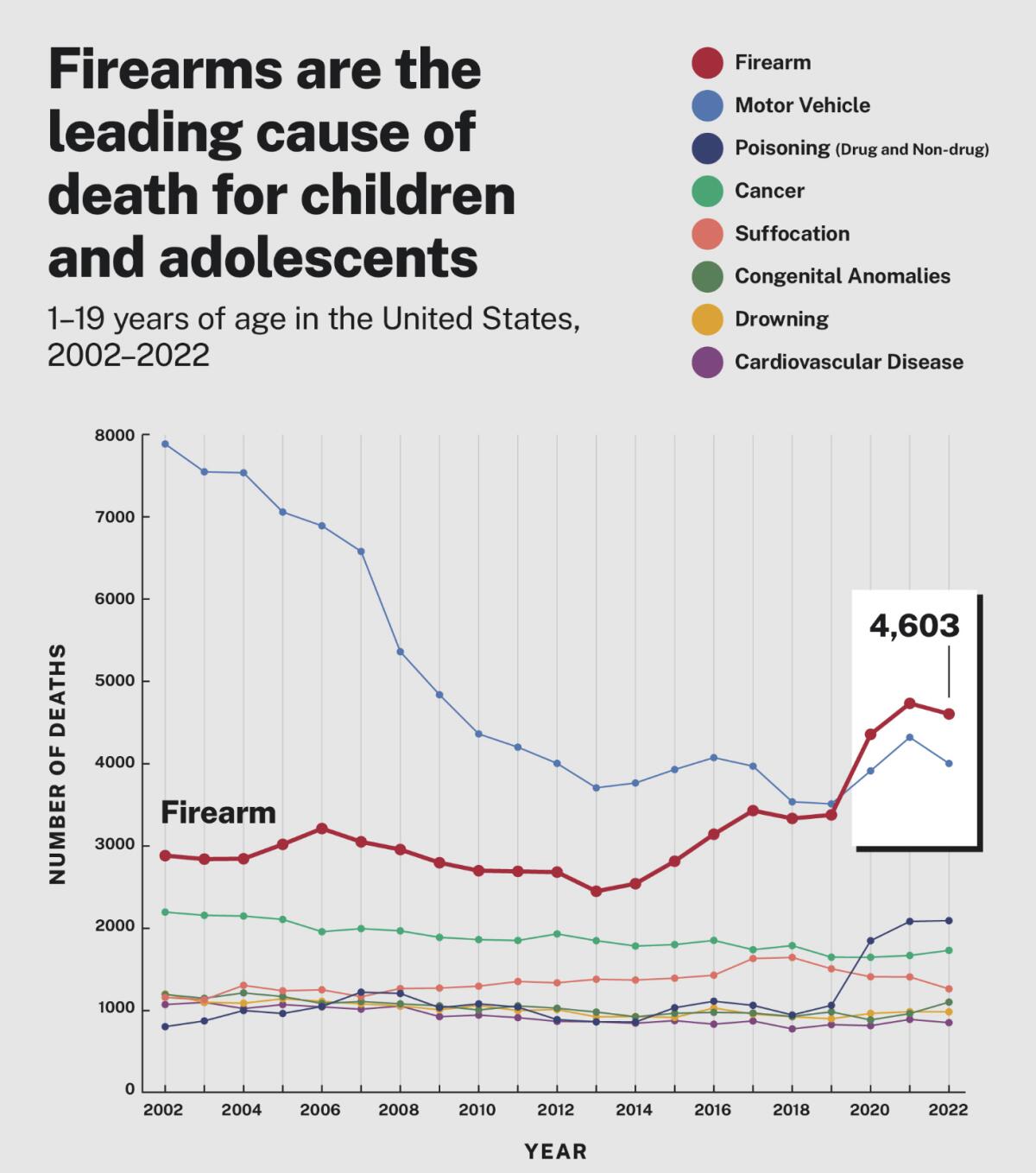
Firearms passed motor vehicles as the leading cause of death of children and adolescents in the U.S. in 2019. (U.S. Surgeon General)
He reports that firearms are now the leading cause of death among children and adolescents, having passed motor vehicles in 2019. In 2022, guns killed more than 48,200 Americans through homicides, suicides and accidents, rising by about 16,000 over the previous 10 years.
Murthy’s report notes that guns are used in 55% of all suicide attempts and that their lethality in those cases is unmatched — nearly 90% end in death, higher than any other method.
The report treats mass shootings (defined as those with four or more victims, not counting the shooter) soberly. These account for only about 1% of all firearm deaths, but their impact is far greater due to their “outsized collective trauma on society” and their “strong negative effect on the public’s perception of safety.” One in three adults “say fear prevents them from going to certain places or events.”
Murthy’s report puts the lie to the familiar claim by Republicans and gun rights fanatics that the problem, especially when it comes to mass shooting, is mental health, not firearms.
House Speaker Mike Johnson (R-La.), for instance, told Fox News anchor Sean Hannity in October, after a gunman killed 18 people in Lewiston, Maine: “Mental health, obviously, as in this case, is a big issue, and we have got to seriously address that as a society and as a government.”
Yet Murthy reports that “one’s mental health diagnosis or psychological profile alone is not a strong predictor of perpetrating violence of any type…. Importantly, most people with serious mental illness are not violent against others. In fact, people with serious mental illnesses are more likely to be victims of violence.”
For all their nattering about the need to address mental health, anyway, Republicans have never lifted a finger to promote any programs to do so.
Now to the Supreme Court.
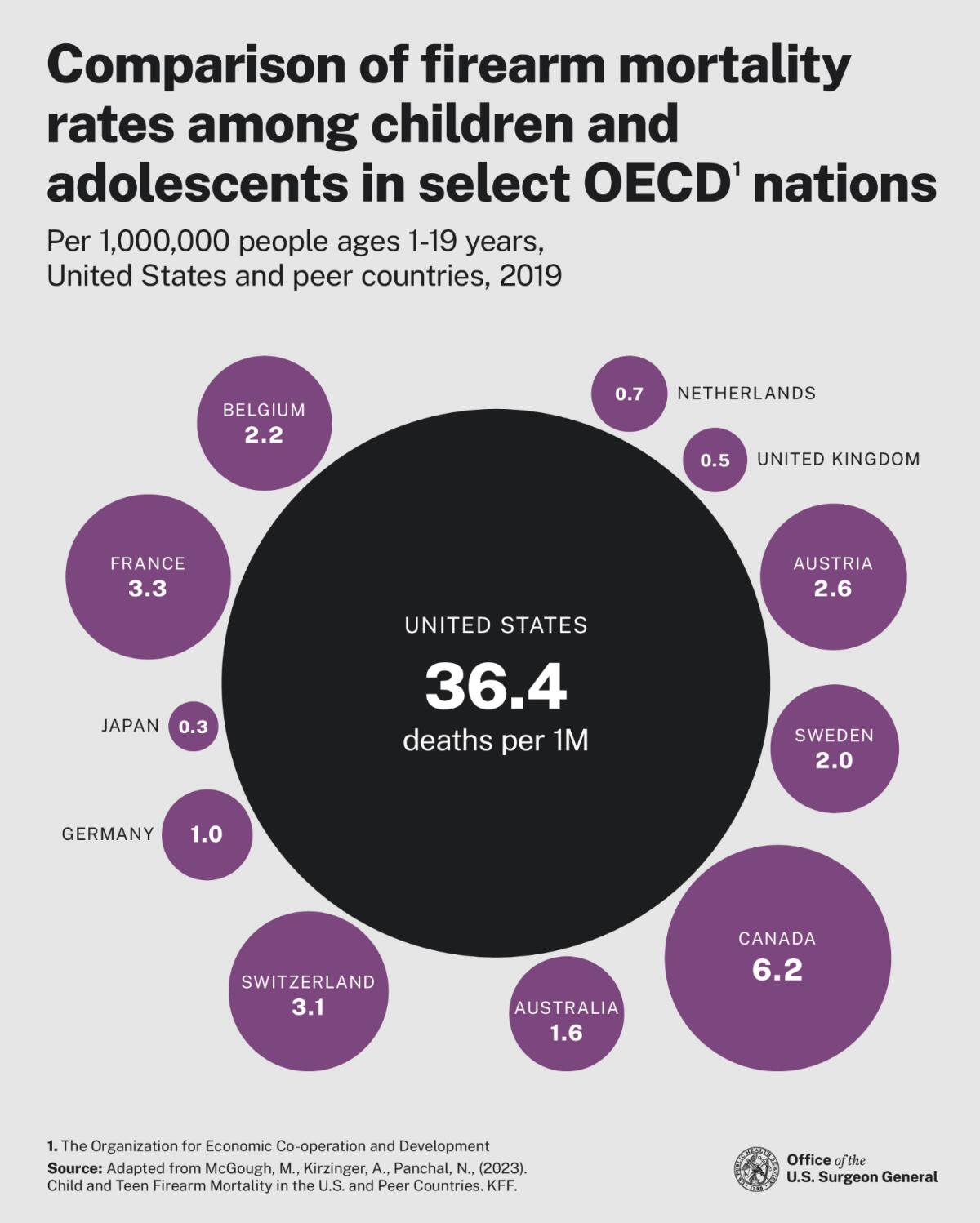
The rate of firearm deaths of childen and adolescents in the U.S. vastly surpassed the rates in other developed countries.
(U.S. Surgeon General)
Rahimi v. United States, which yielded an 8-1 decision on June 21, is the first gun-rights case to come before the court since a 2022 decision known as Bruen, in which Clarence Thomas, writing for a 6-3 majority, essentially found that all modern efforts to regulate firearms are unconstitutional.
Thomas held, in effect, that the only legitimate basis for judging gun laws is historical — weighing the laws against the language of the 2nd Amendment to determine how the amendment was viewed by its drafters in 1789 and how their approach was dictated by the political and social context of that time.
In Bruen, Thomas ridiculed Justice Stephen Breyer’s dissent (with which justices Sonia Sotomayor and Elena Kagan concurred). Breyer had opened his argument with nine pages of statistics about gun ownership and its consequences for health and safety.
“It is hard to see what legitimate purpose can possibly be served” by Breyer’s figures, Thomas sneered. “Why, for example, does the dissent think it is relevant to recount the mass shootings that have occurred in recent years?”
In Rahimi, however, Chief Justice John G. Roberts Jr. asserted that the consequences of unrestricted gun ownership were highly relevant. To be fair, this was easy. The record made clear that Zackey Rahimi, the gun owner at the center of the case, was one vicious specimen indeed. As Roberts laid out in the opening three pages of his majority opinion, Rahimi had beat up his girlfriend (the mother of his child) and fired in her direction or at a bystander as she fled his grasp.
After she got a restraining order against him, he stalked her, threatened a different woman with a gun, was suspected by police of at least five other shootings, fired at motorists in at least two road-rage incidents and fired his gun indiscriminately at least two other times. Police searched his home and found a pistol and a rifle. He was charged under a Texas law that criminalized possessing a gun while under a retraining order due to domestic violence.
Despite all that, the 5th Circuit Court of Appeals overturned Rahimi’s conviction, citing Bruen.
Roberts’ decision in Rahimi is a step toward ratcheting back the Bruen effect, in which almost every gun regulation is suspect. That brings us to the “originalism” principle, which undergirds the court conservatives’ distaste for restrictions on gun rights. As expressed by Thomas in his Bruen opinion, originalism holds that interpreting the constitution must depend on the “public understanding of a legal text in the period after its enactment or ratification.”
As the now-retired Breyer put it in a recent essay, “the originalist, instead of looking to the text and asking what the words mean now, may well ask what they would have meant to an ordinary eighteenth-century person” and applies them to the world of today. (Breyer isn’t a fan of originalism.)
Scholars such as Stanford historian Jack Rakove argue that interpretations of the 2nd Amendment depend more on originalism than any other provisions of the Constitution. Its impact emerged most notably in the Supreme Court’s so-called Heller decision. In that 2008 decision written by Justice Antonin Scalia, a 5-4 majority overturned a Washington, D.C., ordinance largely barring citizens from possessing handguns for self-defense in their own home.
Heller overturned more than the D.C. law — it upended more than 200 years of scholarship about the meaning of the 2nd Amendment’s preamble, which links “the right of the people to keep and bear arms” to the establishment of “a well regulated Militia.”
As Breyer pointed out, historians and linguists had argued (in a friend-of-the-court brief in the Bruen case) that the phrase “bear arms” overwhelmingly referred to “war, soldiering, or other forms of armed action by a group” — not to an individual right. Heller, however, established an individual right to gun ownership for the first time.
Bruen expanded that right to gun ownership outside the home. The ruling deemed unconstitutional a New York law requiring citizens to have a license to carry firearms in public. America’s rising tide of gun violence can fairly be traced to Heller.
Scholars have pointed to numerous problems with originalism. One is that judges are (usually) not historians. They may be utterly at sea when trying to find the apposite historical application to contemporary conditions.
The drafters of the 2nd Amendment, as it happens, were concerned about the public threat of a government’s standing army; historians argue that the amendment was designed to prevent the federal government from interfering with the creation of state militias.
Firearms in the 18th century were “not nearly as threatening or lethal as those available today,” Rakove writes; people in that era were concerned not with threats from “casual strangers, embittered family members, violent youth gangs, freeway snipers, and careless weapons keepers.”
In other words, applying an 18th century mind-set to 21st century conditions is a fool’s errand. “Originalism” only interferes with judges’ responsibility to ponder the real-world impacts of their decision — their option, Rakove says, is to “ransack” the historical record for quotations that can support their preexisting goals.
“Originalism,” says Breyer, “tells judges not to consider the practical consequences of their interpretations.” Its product is the paralysis of federal, state, and local efforts to regulate gun ownership. It’s also responsible for the contraction of individual rights being rolled back almost gleefully by the current Supreme Court majority, notably abortion and other women’s reproductive healthcare rights, as originalists argue that the concept of privacy on which those other rights are based can’t be found in the Constitution.
It’s also proper to note that the public during the time the 2nd Amendment was drafted, enacted and ratified is very different from the public affected by its consequences today. In 1791, among other distinctions, enslaved people were not considered citizens and women could not vote. Who set the terms back then under which today’s Americans must live?
Rahimi won’t solve the mess in gun regulation created by the Heller and Bruen rulings. A multitude of pending cases might strengthen it or undermine it. But at least it’s a step back from the abyss.
Murthy’s advisory gives a similar impression of being a first step on a path that might lead nowhere. He calls for more research on violence prevention strategies and laws preventing children’s access to guns, universal background checks, banning assault weapons and restricting the carrying of loaded firearms in public.
The bottom line, of course, is that America’s gun violence crisis can only be solved by fewer guns. There’s a long road ahead to reaching that goal.
Public officials condemned the attempted assassination of Donald Trump and said as one, “There is no room for political violence in this country,” and some said “This is not who we are.”
Sadly, both sentiments are understandable, but as a matter of fact, they are not true.
There is a long history of political violence in this country, and yes, thisiswho we are.
Much as we try to cocoon our elected officials and aspirants for public office to protect them from would-be killers, time and again the killers have succeeded. Fortunately, former President Trump survived, but a bullet missed his head by far less than an inch. How close we came to another national tragedy.
This is who we are.
Four Presidents have been assassinated by killers with guns: President Abraham Lincoln, President James Garfield, President William McKinley, and President John F. Kennedy. Some survived assassination attempts: President Theodore Roosevelt, President Ronald Reagan, President Gerald Ford.
Other political muders shook the nation to its core: most recently, Robert F. Kennedy, Dr. Martin Luther King, Jr. The list of political murders of civil rights leaders and workers is long, including not only Dr. King, but Medgar Evers, Violet Liuzzo, and the three men who were murdered as they were trying to register Black people to vote in Mississippi: Michael Schwerner, James Chaney, and Andrew Goodman.
School children have been training for active shooters for years, yet the school massacres keep happening: most recently, in Uvalde, Texas, but unforgettably at the Sandy Hook Elementary School in Newtown, Connecticut, where 5- and 6-year-olds were gunned down mercilessly; at the Marjory Stoneman Douglas High School in Parkland, Florida; at Columbine High School in Colorado, and more and more and more.
So many other massacres: in Las Vegas, where a lone gunman in a hotel high above a music festival slaughtered dozens of people; at the Pulse nightclub in Orlando, where a lone gunman gunned down dozens of people; in Monterrey, California, where a lone gunman murdered people at a dance club last year; in Maine, where a lone gunman went from spot to spot, killing people without warning.
And yet the U. S. Supreme Court recently struck down most restrictions on gun ownership and possession; the majority claimed that it was adhering to the original intent of the Second Amendment. The fact that assault weapons were banned by Congress from 1994 until 2004 did not give the Court majority pause.
One of our two major political parties is dedicated to preserving the right of almost every individual to buy and own guns, even high-powered assault weapons. Republicans will meet in a matter of days in Milwaukee and will undoubtedly reaffirm their strong, unwavering devotion to the rights of gun owners, but not to the “right to life” of their intended victims.
Some states under Republican control have eliminated any restriction on the right to carry guns openly in public.
Despite the attempted assassination of their Presidential candidate, the Republican Party will remain unwaveringly committed to gun rights.
It’s all over the news. Trump was speaking at a rally in Butler, Pennsylvania. Shots rang out, and one of them seemed to graze his right ear. He went to the ground and was quickly surrounded by Secret Service agents, who hustled him away to safety in an armored limousine.
At this point, no one has been identified or apprehended as a suspect.
Two points:
1. America needs gun control, which Trump opposes.
2. Political violence is horrifying. Gun violence is horrifying. No candidate has done more to encourage violence for political ends than Trump, whether it is his alliance with the Proud Boys or a dozen other extremist, militant white Christian nationalists that have rallied to his cause.
All that said, I am deeply saddened that Trump was targeted by a shooter. I wish him a speedy recovery, good health, and a new understanding of the importance of comprehensive gun control
Heather Cox Richardson points out that the Republican Party has been captured by its most extreme members, who hope to roll back the laws to enshrine the power of white men. At the same time that they vote against Biden’s legislation, they take credit for what it does for their states. She watched Biden’s rally in Detroit and was impressed, as was I, by his slashing critique of Trump and his vision for the future.
She writes:
Representative Glenn Grothman (R-WI) said yesterday that if Trump wins reelection, the U.S. should work its way back to 1960, before “the angry feminist movement…took the purpose out of the man’s life.” Grothman said that President Lyndon Baines Johnson’s War on Poverty was actually a “war on marriage,” in a communist attempt to hand control of children over to the government.
Grothman was waxing nostalgic for a fantasy past when laws and society discriminated against women, who could not get credit cards in their own name until 1974—meaning that, among other things, they could not build credit scores to borrow money on their own—and who were forced into dependence on men. The 1960 date Grothman chose was notable in another way, too: it was before the 1964 Civil Rights Act and the 1965 Voting Rights Act with which Congress tried to make the racial equality promised in the 1868 Fourteenth Amendment and the voting rights promised in the 1870 Fifteenth Amendment become real.
At stake in Grothman’s erasure of the last sixty years is the equality of women and minorities to the white men who previously exercised virtually complete control of American society. That equality translates into a struggle over the nature of the American government. Since the 1870s, during the reconstruction of the American government after the Civil War, white reactionaries insisted that opening the vote to anyone but white men would result in socialism.
Their argument was that poor voters—by which they meant Black men—would elect leaders who would promise them roads and schools and hospitals, and so on. Those public benefits could be paid for only with tax levies, and since white men held most of the property in the country in those days, they insisted such benefits amounted to a redistribution of wealth from hardworking white men to undeserving Black Americans, even though poor white people would benefit from those public works as much as or more than Black people did.
This argument resurfaced after World War II as an argument against Black and Brown voting and, in the 1970s, against the electoral power of “women’s libbers,” that is, women who called for the federal government to protect the rights of women equally to those of men. Beginning in 1980, when Republican presidential candidate Ronald Reagan called for rolling back the government regulations and social safety net that underpinned society, a gap appeared in voting behavior. Women, especially Black women, tended to back the Democrats, while men moved toward Republican candidates. Increasingly, Republican leaders used racist and sexist tropes to undermine the active government whose business regulations they hated.
For the radical extremists who have taken over the Republican Party, getting rid of the modern government that regulates business, provides a basic social safety net, promotes infrastructure, and protects civil rights is now gospel as they try to replace it with Christian nationalism. But that active government remains popular.
That popularity was reflected today as Republicans continued to take credit for laws passed by Democrats to maintain or expand an active government. In Tennessee, Republican Governor Bill Lee boasted that the state had “secured historic funding to modernize Memphis infrastructure with the single-largest transportation investment in state history.” All the Republicans in the Tennessee delegation opposed the measure, leaving Democratic representative Steve Cohen to provide the state’s only yes vote. Indeed, Tennessee senator Marsha Blackburn posted on social media that “Americans do not want [Biden’s] ‘socialist Build Back Broke’ plan.”
In Alabama, Senator Tommy Tuberville boasted about a bridge project funded by a $550 million Department of Transportation grant, writing: “Since I took office, I have been working to secure funding for the Mobile bridge and get this project underway.” But as Representative Terri Sewell, an Alabama Democrat, pointed out, Tuberville voted against the bill that provided the money.
Like Governor Lee and Senator Blackburn, Tuberville knows such government policies are enormously popular and so takes credit for them, even while voting against them.
Union workers also historically have supported a government that regulates business and provides a social safety net and infrastructure investment, but those workers turned to Reagan in 1980 and have tended to make their home in the Republican Party ever since. Now they appear to be shifting back.
Today the president of the 600,000-member International Association of Machinist and Aerospace Workers urged Biden to stay in the race, writing: “For the first time in decades, we have an Administration that has leveled the playing field for workers trying to organize. The IAM is one of the fastest growing unions in the labor movement because we have a President who goes toe to toe with corporations on behalf of working people.”
Union president Brian Bryant noted that Biden “saved hundreds of thousands of our members’ jobs” and thanked him for “strengthen[ing] the Buy American regulations that have helped to create millions of jobs, including nearly 800,000 in manufacturing.” Bryant also credited Biden with helping to save 83 pension plans that covered more than a million workers and retirees. Bryant noted that “[i]n the IAM, we value seniority.”
United Auto Workers president Shawn Fain told Netroots Nation today that “humanity is at stake” in the 2024 election. “This has everything to do with our shot at life, liberty, and the pursuit of happiness. Our wages. Having health care. Our retirement security, and our time…. Those are the four core issues that unite the entire working-class people in a fight against the billionaire class as we saw in our contract campaign last fall when 75% of Americans supported us in that fight, for those reasons.”
“The dream and the scheme of a man like Donald Trump is that the vast majority of working-class people, who literally make our country run, will remain divided. That’s how they win. They want us to not unite in a common cause to take on the billionaire class…. They divide us by race. They divide us by gender, by who we love. They divide us by what language we speak or where we were born….”
Today, in Detroit, in a barnburner of a speech, President Joe Biden pitched his plan for the first 100 days of a second term with a Democratic Congress. He promised to restore Roe v. Wade, eliminate medical debt, raise the minimum wage, protect workers’ right to organize, ban assault weapons, and to “keep leading the world” on clean energy and addressing climate change. He also vowed to sign into law the John Lewis Voting Rights Act, which would end voter suppression, and the Freedom to Vote Act, which would protect voter rights and election systems, as well as end partisan gerrymandering.
Biden forcefully contrasted his own record with Trump’s. He reminded the audience that he was the first president to walk a picket line, because “when labor does well, everybody does well.” “When Trump comes here to tell you how great he is for the auto industry, remember this: when Trump was president we lost 86,000 jobs in unions. I created 275,000 auto jobs in America. In fact, what’s been true in the auto industry is true all over America: since I became president, we created nearly 16 million new jobs nationwide, 390,000 of those jobs right here in Michigan. We’ve created 800,000 manufacturing jobs nationwide, including 24,000 in Michigan.”
Biden hammered Trump, saying “no more free passes.” He reminded that audience that Trump is a convicted criminal and that a judge had found him liable for sexual abuse. Biden quoted the judge: “Mr. Trump raped her.” Biden reminded the audience that Trump lost his license to do business in New York state and is still facing criminal charges for retaining classified documents and trying to overturn the results of the 2020 presidential election, as well as charges in Georgia for election interference. Biden said: “It’s time for us to stop treating politics like entertainment and reality TV.”
Today the European Union charged Trump donor Elon Musk’s social media company X, formerly Twitter, for failing to curb disinformation and illegal hate speech.
Also today, a judge ruled that Trump ally Rudy Giuliani is not entitled to bankruptcy protection. The judge cited Giuliani’s “lack of financial transparency” and noted that Giuliani “has engaged in self-dealing.” This decision means that election workers Ruby Freeman and Shaye Moss, as well as other creditors, are free to collect what they can of the $150 million he owes them. A lawyer for the two said: “We’re pleased the Court saw through Mr. Giuliani’s games and put a stop to his abuse of the bankruptcy proceeding. We will move forward as quickly as possible to begin enforcing our judgment against him.”
Meanwhile, Trump appeared to be trying to recapture attention by teasing an unveiling of his vice presidential nominee at next week’s Republican National Convention. He compared the selection process to “a highly sophisticated version of The Apprentice,” the reality TV show in which he appeared before he became president, and which centered around firing people.



 Diane Ravitch's blog