Archives for the month of: March, 2024

Historian Heather Cox Richardson brilliantly analyzes the current moment.

She writes:

Behind the horse race–type coverage of the contest for presidential nominations, a major realignment is underway in United States politics. The Republican Party is dying as Trump and his supporters take it over, but there is a larger story behind that crash. This moment looks much like the other times in our history when a formerly stable two-party system has fallen apart and Americans reevaluated what they want out of their government.

Trump’s takeover of the party has been clear at the state level, where during his term he worked to install loyalists in leadership positions. From there, they have pushed the Big Lie that he won the 2020 election and have continued to advance his claims to power. 

The growing radicalism of the party has also been clear in Congress, where Trump loyalists refuse to permit legislation that does not reflect their demands and where, after they threw House speaker Kevin McCarthy (R-CA) out of office—dumping a speaker midterm for the first time in history—Trump lieutenant Jim Jordan (R-OH) threatened holdouts to vote him in as speaker. Jordan failed, but the speaker Republican representatives did choose, Mike Johnson (R-LA), is himself a Trump loyalist, just one who had made fewer enemies than Jordan. 

The radicalization of the House conference has led 21 members of the party who gravitate toward actual lawmaking to announce they are not running for reelection. Many of them are from safe Republican districts, meaning they will almost certainly be replaced by radicals.  

The Senate has tended to hang back from this radicalization, but in a dramatic illustration of Trump’s takeover of the party, Senate minority leader Mitch McConnell today announced he would step down from his leadership position in November. McConnell is the leading symbol of the pre-Trump party, a man whose determination to cut taxes and regulation led him to manipulate the rules of the Senate and silence warnings that Russian disinformation was polluting the 2016 campaign so long as it meant keeping a Democrat out of the White House and Republicans in control of the Senate.

The extremist House Freedom Caucus promptly tweeted: “Our thoughts are with our Democrat colleagues in the Senate on the retirement of their Co-Majority Leader Mitch McConnell (D-Ukraine). No need to wait till November…Senate Republicans should IMMEDIATELY elect a *Republican* Minority Leader.”

Trump has also taken control of the Republican National Committee (RNC) itself. On Monday, RNC chair Ronna McDaniel announced that she is resigning on March 8. Trump picked McDaniel himself in 2016 but has come to blame her both for the party’s continued underperformance since 2016 and for its current lack of money.

Now Trump has made it clear he wants even closer loyalists at the top of the party, including his own daughter-in-law, Lara Trump. She has suggested she is open to using RNC money exclusively for Trump. This might be what has prompted the Koch-backed Americans for Prosperity to pull support from Nikki Haley in order to invest in downballot races. 

But the party that is consolidating around Trump is alienating a majority of Americans. It has abandoned the principles that the party embraced from 1980 until 2016. In that era, Republicans called for a government that cut taxes and regulations with the idea that consolidating wealth at the top of the economy would enable businessmen to invest far more effectively in new development than they could if the government interfered, and the economy would boom. They also embraced global leadership through the expansion of capitalism and a strong military to protect it. 

Under Trump, though, the party has turned away from global leadership to the idea that strong countries can do what they like to their neighbors, and from small government to big government that imposes religious rules. Far from protecting equality before the law, Republican-dominated states have discriminated against LGBTQ+ individuals, racial and ethnic minorities, and women. And, of course, the party is catering to Trump’s authoritarian plans. Neo-nazis attended the Conservative Political Action Conference a week ago. 

But these changes are not popular. Tuesday’s Michigan primary revealed the story we had already seen in the Republican presidential primaries and caucuses in Iowa, New Hampshire, and South Carolina. Trump won all those contests, but by significantly less than polls had predicted. He has also been dogged by the strength of former South Carolina governor Nikki Haley. With Trump essentially running as an incumbent, he should be showing the sort of strength Biden is showing—with challengers garnering only a few percentage points—but even among the fervent Republicans who tend to turn out for primaries, Trump’s support is soft.

It seems that the same policies that attract Trump’s base are turning other voters against him. Republican leadership, for example, is far out of step with the American people on abortion rights—69% of Americans want the right to abortion put into law—and that gulf has only widened over the Alabama Supreme Court decision endangering in vitro fertilization by saying that embryos have the same rights as children from the moment of conception. That decision created such an outcry that Republicans felt obliged to claim they supported IVF. But push came to shove today when Senator Tammy Duckworth (D-IL) reintroduced a bill to protect IVF that Republicans had previously rejected and Senator Cindy Hyde-Smith (R-MS) killed it again. 

The party has also tied itself to a deeply problematic leader. Trump is facing 91 criminal charges in four different cases—two state, two federal—but the recently-decided civil case in which he, the Trump Organization, his older sons, and two associates were found liable for fraud is presenting a more immediate threat to Trump’s political career.

Trump owes writer E. Jean Carroll $88.3 million; he owes the state of New York $454 million, with interest accruing at more than $100,000 a day. Trump had 30 days from the time the judgments were filed to produce the money or a bond for it. Today he asked the court for permission to post only $100 million rather than the full amount in the New York case, as required by law, because he would have to sell property at fire-sale prices to come up with the money.

In addition to making it clear to donors that their investment in his campaign now might end up in the hands of lawyers or the victorious plaintiffs, the admission that Trump does not have the money he has claimed punctures the image at the heart of his political success: that of a billionaire businessman.   

Judge Anil C. Singh rejected Trump’s request but did stay the prohibition on Trump’s getting loans from New York banks, potentially allowing him to get the money he needs.  

As Trump’s invincible image cracks with this admission, as well as with the increased coverage of his wild statements, others are starting to push back on him and his loyalists. President Biden’s son Hunter Biden testified behind closed doors to members of the House Oversight and Judiciary Committees today, after their previous key witness turned out to be working with Russian operatives and got indicted for lying.

Hunter Biden began the day with a scathing statement saying unequivocally that he had never involved his father in his business dealings and that all the evidence the committee had compiled proved that. In their “partisan political pursuit,” he said, they had “trafficked in innuendo, distortion, and sensationalism—all the while ignoring the clear and convincing evidence staring you in the face. You do not have evidence to support the baseless and MAGA-motivated conspiracies about my father because there isn’t any.” 

After an hour, Democratic committee members described to the press what was going on in the hearing room. They reported that the Republicans’ case had fallen apart entirely and that Biden had had a “very understandable, coherent business explanation for every single thing that they asked for.” While former president Trump invoked his Fifth Amendment right not to incriminate himself more than 440 times during a deposition in his fraud trial, Biden did not take the Fifth at all. 

The discrediting of the Republicans continued later. When Representative Tim Burchett (R-TN) tried to recycle the discredited claim that “$20 million flowed through” to then–vice president Biden, CNN host Boris Sanchez fact-checked him and said, “I’m not going to let you say things that aren’t true.” 

That willingness to push back on the Republicans suggests a new political moment in which Americans, as they have done before when one of the two parties devolved into minority rule, wake up to the reality that the system has been hijacked and begin to reclaim their government. 

But can they prevail over the extremists MAGA Republicans have stowed into critical positions in the government? Tonight the Supreme Court, stacked with Trump appointees, announced that rather than let the decision of a lower court stay in place, it would take up the question of whether Trump is immune from criminal prosecution for his actions in trying to overturn the 2020 presidential election. That decision means a significant delay in Trump’s trial for that attempt. 

“This is a momentous decision, just to hear this case,” conservative judge Michael Luttig told Nicolle Wallace of MSNBC. “There was no reason in this world for the Supreme Court to take this case…. Under the constitutional laws of the United States, there has never been an argument that a former president is immune from prosecution for crimes that he committed while in office.” 

–- 
Former federal prosecutor Barbara McQuade writes on the website Cafe Insider that social media should require commenters to use their real name. Anonymity enables trolls and invective.

We have seen what happens on this blog. Anonymous posters attack others, make wild accusations, and vent their inner demons. I take down as many of these comments as I can, but I’m not online 24/7. One Trump troll repeatedly changes his IP address to evade being blocked.

There are a number of rules in this blog. First, I don’t allow comments that insult me; the blog is my online living room and I eject offensive visitors. Second, I don’t tolerate conspiracy theories: Sandy Hook happened, 9/11 was not “an inside job,” Trump lost the 2020 election. I also will not post racist, sexist, anti-Semitic, xenophobic, or homophobic comments.

The reason I allow anonymous comments is because many educators are afraid to speak their mind about what they know. They fear retribution from their superior.

What do you think?

McQuade writes:

Dear Reader,

One of my favorite New Yorker cartoons depicts two dogs sitting at a computer with one saying to the other, “On the Internet, nobody knows you’re a dog.” 

This image came to mind recently when one of my hometown newspapers, The Detroit Free Press, announced it would no longer post reader comments on its website. In a letter to readers, Editor Nicole Avery Nichols explained the decision was necessary “due to the time investment needed to produce a safe and constructive dialogue.” The real culprit, I believe, is anonymity. 

Reader comments became commonplace when news outlets went online in the 1990s. The idea for such comments is laudable. Members of the community may engage with writers, editors, and each other to discuss a matter in the news, adding to the discussion the perspectives of other voices and experiences. 

Yet, the Free Press has decided to eliminate reader comments, following the lead of other media outlets such as NPRCNN and the Washington Post. The Free Press now invites readers to comment on social media, where it has no duty to moderate the conversation, or through letters to the editor, which are screened before publication. Letters to the editor of the Free Press also require one important component that online comments do not – the identity of the author. To have a letter considered for publication, writers must include their “full name, full home address and day and evening telephone numbers.” The Free Press may be onto something. 

In researching my forthcoming book on disinformation, Attack From Within, one of the things I learned was the danger of anonymity online. When people can hide behind a false name, they have license to say all manner of inappropriate things. As Free Press columnist Mitch Albom wrote regarding the new policy, a typical commenter can use a pseudonym like SEXYDUDE313 and say all manner of despicable things with no accountability. And so, instead of a thoughtful discussion exchanging diverse viewpoints, the conversation quickly devolves into a barrage of insults aimed at not only the reporter, but also other readers posting comments. Commenters typically attack one another with slurs based on their presumed political affiliation, their level of education, or even their race. Comments have become a sort of online heckling, but in real life, even hecklers can be thrown out of the nightclub. 

The danger of anonymity online was a key finding of Robert Mueller’s special counsel report on Russian interference in the 2016 election. Mueller’s report noted that members of the Internet Research Agency, a Russian organization alleged to have engaged in a disinformation campaign, used false names, such as “Blacktivist,” “United Muslims of America,” and “Heart of Texas,” to pose as members of various groups and sow discord in American society. Operatives, posing as members of certain racial or ethnic groups, would post inflammatory content to provoke outrage. Some posts were designed to favor Donald Trump over Hillary Clinton, and some discouraged minority voters from casting a ballot at all. While we will never know the full extent to which Russia’s influence campaign affected the outcome of that election, this kind of foreign interference in political discourse is a danger to our democracy. 

To combat disinformation on social media, one easy step could be to eliminate anonymous users. The Free Press’s example demonstrates that anonymity enables behavior that is rude, harassing, and deceptive. Congress could mandate that social media platforms require users to verify their identities. At one time, before Twitter became X, a user could become verified by providing identifying information to the platform. A blue check signaled that the person was who they said they were. Mandatory verification could help reduce threats, trolling, and the spread of disinformation. Although it would be resource-intensive, to be sure, it should be part of the cost of doing business for social media platforms. 

Such a policy could face First Amendment challenges. As a general matter, the First Amendment protects anonymous speech because it permits people to engage in political speech even when it’s unpopular, and to criticize powerful people without fear of retribution. But, like all rights, the right to free speech is not absolute. The Supreme Court has routinely held that fundamental rights, such as freedom of speech, may be limited when the government has a compelling interest in the restriction and the measure is narrowly tailored to achieve that interest. Here, Congress could investigate whether eliminating anonymity online effectively reduces threats, harassment, and disinformation, serving a compelling government interest. By limiting the restriction to social media, and not all speech, the law could be sufficiently narrow. 

Requiring people to use their real names when posting comments online could make digital spaces safer. It would also allow readers to assess the credibility of those posting comments, making it much more difficult to be fooled by manipulative political operatives and hostile foreign actors. 

And perhaps even by dogs.

Stay Informed, 

Barb

One of the oft-told tales is about Ukraine’s failure to make a deal with Russia at the beginning of the Russian invasion in 2022. But, writes Yaridlov Trofimov, the chief foreign-affairs writer for the Wall Street Journal, there was a catch to the deal: Russia wanted Ukraine to capitulate, not to negotiate.

He writes:

The lead Ukrainian negotiator, David Arakhamia, pointed to a bottle of sanitizing gel on the table, covered by a crisp white cloth, as Russian and Ukrainian peace delegations gathered in Istanbul’s Dolmabahçe Palace.

“That’s an antiseptic,” Arakhamia told his Russian counterpart, President Vladimir Putin’s adviser Vladimir Medinsky.

 “Ah, I thought it’s vodka,” Medinsky joked.

There was plenty of tension behind the jovial appearances during that pivotal meeting on March 29, 2022. Dmytro Kuleba, the Ukrainian foreign minister, had just publicly advised Ukrainian negotiators not to accept any beverages from the Russians and not to touch any surfaces, lest they be poisoned. After all, Russian forces were still at the gates of Kyiv, trying to overthrow President Volodymyr Zelensky and his government.

What actually happened on that momentous Tuesday and in the immediate aftermath has since turned into a matter of fundamental disagreement among Ukraine, Western nations and Russia. The Istanbul meeting has also emerged as a key point of discord in America’s own debate about the war, as indispensable U.S. aid to Ukraine remains stalled in Congress because of Republican opposition. Some argue that Ukraine blew a chance at the time to end the war. The real story paints a different, and far more complicated, picture. 


The first meeting between Ukrainian and Russian negotiators happened on Feb. 28, 2022, in the Belarusian city of Gomel, four days after Russian tanks crossed the Ukrainian border. At that encounter, Medinsky recited a long list of the Kremlin’s demands. It included the replacement of Zelensky’s administration with a puppet regime, Ukrainian troops handing over all their tanks and artillery, the arrest and trial of “Nazis”—a Russian euphemism for any Ukrainian opposed to Moscow’s rule—and the restoration of Russian as Ukraine’s official language. Medinsky even demanded that city streets named after Ukrainian national heroes be returned to their old Soviet names.

“We listened to them, and we realized that these are not people sent for talks but for our capitulation,” recalled one of the Ukrainian negotiators, Zelensky’s adviser Mykhailo Podolyak. Yet to gain time the Ukrainians agreed to keep talking.     

The story continues. The point remains the same. Putin had nothing to offer. He had demands.

I am a native Texan. I was born and raised in Houston. I attended Houston public schools from kindergarten until my high school graduation. The public schools of Texas gave me a strong foundation, and I will always be grateful to my teachers and my schools.

The public schools in Texas will be harmed by vouchers. Yet Governor Greg Abbott is demanding that the Legislature endorse vouchers, so that the public will subsidize every student who goes to private and religious schools. No wonder he campaigned for vouchers by visiting private and religious schools.

Some Republican legislators know that vouchers will hurt their public schools.

Governor Abbott has spent millions of dollars to defeat those brave Republican legislators who oppose vouchers.

The primary is March 5.

Funded by oil and gas billionaires and by Jeff Yass, a Pennsylvania billionaire, Abbott has tried and repeatedly failed to pass a voucher bill. He failed because these Republican legislators stood up for their communities and their public schools.

These legislators know their local teachers. They are friends and neighbors. The legislators know they are hard-working dedicated teachers. They teach the children; they don’t “indoctrinate” them, as Governor Abbott falsely claims. Many have taught in the same schools for decades, raising up the children in the way they should go.

The teachers are underpaid, and the school buildings need upgrades. But the Governor won’t put another penny into paying teachers and funding public schools unless he gets his vouchers.

In every state that has vouchers, most of them are used by students who never attended public schools. Vouchers are nothing more than a public subsidy for students already attending private and religious schools.

Voucher schools are free to discriminate and are excused from all accountability.

These heroic and principled legislators deserve your thanks and your vote on March 5:

  • Steve Allison, District 121, San Antonio
  • Ernest Bailes, District 18, Shepherd
  • Keith Bell, District 4, Forney;
  • DeWayne Burns, District 58, Cleburne;
  • Travis Clardy, District 11, Nacogdoches
  • Drew Darby, District 72, San Angelo
  • Jay Dean, District 7, Longview
  • Charlie Geren, District 99, Fort Worth
  • Justin Holland, District 33, Rockwall
  • Ken King, District 88, Canadian
  • John Kuempel, District 44, Seguin
  • Stan Lambert, District 71, Abilene
  • Glenn Rogers, District 60, Mineral Wells
  • Hugh Shine, District 55, Temple
  • Reggie Smith, District 62, Sherman
  • Gary VanDeaver, District 1, New Boston

For their courage in defending their community schools, their teachers, their parents, and their students, I place them on the blog’s Honor Roll.

Now get out there and vote for them!

Cameron Vickrey is a pastor in Texas who works as communications director for Fellowship Southwest. Her father was a pastor, her husband is a pastor, and she believes in public schools. This idea of adding pastors as mental health counselors is catching on in the South. At the moment, the Florida legislature is discussing the idea, as are other states. It’s one more way to erode the line between church and state. Will schools have pastors for every sect? Imams? Rabbis? What about the students who are atheists? Will they be denied counseling?

Cameron Vickrey wrote against this idea for the San Antonio Express-News

The deadline looms. Every public school district in Texas has been given until March 1 to choose between what seems to be two options for the role of chaplains in their  schools. 

But many are finding their way forward with a third way. This third way might at first seem like a people-pleasing, nondecision that avoids conflict and ignores the issue, but there’s wisdom in it.

In the regular session of the Texas Legislature last spring, lawmakers made several attempts to incorporate additional religious expression into public schools. Most of those efforts, like posting the Ten Commandments in every classroom and instituting a period for prayer and Bible study, failed. But SB 763 became law.

The chaplain bill, as it is known, requires school districts to choose whether they will allow paid or volunteer chaplains to serve students in public schools.

The National School Chaplain Association advocated for this legislation to fill a self-proclaimed need for more counselors in public schools to meet the mental health needs of students.

Not coincidentally, the leader of this association runs another organization,  Mission Generation. Mission Generation hopes to have 100 million people in discipleship with Jesus Christ by 2025 by offering school chaplain programs in public schools. So while it’s clearly not a way to meet mental health needs, at least not a safe way, it may very well be a way to turn schools into mission fields.

With all the political rhetoric about public schools being godless or hostile to religion, you might be surprised at how much leeway is given for religious expression.

So, back to our options, which  conventionally have been viewed as two: Either, yes, we will allow paid and/or volunteer chaplains to serve as counselors;  or, no, we will not. The Legislature is forcing school boards to take sides, inviting  further polarization. It sets the stage for activists to enter school districts and accuse board members on either side of the issue of bending to political will.

Under the Constitution, students are free to pray in school. They can wear religious clothing and accessories. They can share their faith with other students. They can read Scripture. Teachers, too, can discuss religion in class from an academic or objective perspective. And religious groups have the right to meet on campus outside of school.

There will be a public record of how each trustee of Texas’s 1,200 districts voted. Which side will they choose? Will they go on record supporting evangelistic efforts in public schools or not? It’s a political pickle.

Enter the third way: Avoid taking sides by passing a resolution affirming a current volunteer policy that doesn’t discriminate against chaplains.

My initial beef with this option is rooted in these districts’ unwillingness to stop the intrusion of religious influence into public schools. But I’m starting to like it. Finding a workaround to the Legislature’s demands is deliciously subversive. By refusing to play their game, these school boards are protecting their districts from political polarization, which is the biggest problem facing public education today.

I heartily commend those school boards that have rejected SB 763, including a majority of those in Bexar County. These districts have made sure the religious liberty of all students will continue to be protected from those who confuse schools with churches.

My kids’ district, North East ISD, has not yet voted. It is in an interesting position since the passing of trustee Terri Williams last fall has resulted in the potential for an evenly split vote. I urge the NEISD school board to protect our students from religious overreach. I believe they will, whether that comes in the form of a complete rejection of SB 763 or the subversive third way.

And if I’m totally surprised and they approve a chaplaincy program, well, that’s what elections are for.

Jess Piper is a Democratic activist in rural Missouri. She is a fierce advocate for rural communities and public schools. She lives on a farm where she and her husband raise hogs and chickens. She blogs, she makes videos for TikTok, she tweets, she hosts a podcast called Dirt Road Democrats and is executive director of Blue Missouri. She taught American literature for 16 years. She often writes about the absurdity of vouchers and school choice. In this post, she goes to towns in her district to gather signatures to restore abortion rights in Missouri..

I live at the tippy top of NWMO on a small 7 acre farm in a 125 year old farmhouse with a few dogs, a couple cows, a gaggle of kids and grandkids, and a miniature donkey. Everyone perks up when I mention the donkey…he’s 36 inches high and his name is Augustus.

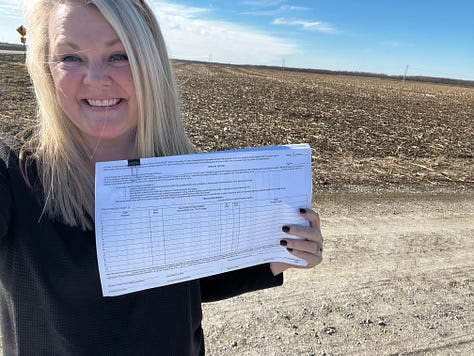
I drive across the state often these days and I am usually headed to a small town and this week was no different—I visited Chillicothe (the home of sliced bread), Carrolton, and Marceline and you’ll never guess why. I was getting rural folks and their Bible groups to sign the petition to restore abortion rights in Missouri.

Dirt Road organizing.

Missouri is in the process of putting abortion on the ballot and I have the petition—I have to tell you it’s kind of hard to get a petition, so I was excited to get them and also overwhelmed. I have to get this out to rural folks, and it’s not as easy as it would seem. 

First, there is the opposition to the petition—the Missouri Right to Life (Right to force others to gestate and deliver) has a literal snitch line to report folks accepting signatures. Now, I have no idea what they plan to do if they find us accepting signatures. I was raised to take care of myself and they shouldn’t mess with me, and I’m not the least bit intimidated, but I don’t want them to harass other rural folks who are signing quietly.

Second, folks have written off my congressional district—even some progressives who need signatures on a ballot initiative. They assume that we are too red to get enough signatures, so what’s the point, right? I’ll tell you the point: it creates excitement and solidarity in rural spaces. It acts to uplift us living in among MAGA extremists. It gives us hope.

Chillicothe was my first stop, and it is a pretty big town at over 9K folks. Chilli is also known for having a “patriot” group who have been successful in putting their extremists on the local health board — they also regularly object to school library books. Folks were on long text chains to get others to the event. I was able to gather about 30 signatures on a Tuesday at 9am. 

I was directing folks to the petition and how to fill it in correctly. One woman filled it out, stood up, and started texting. She told me, “I’m reminding my Bible group to come sign.” 

Wait…what?

The second place I drove was Carrolton, with a population of about 3,400. Still not tiny, but small. I sat in the basement of the library for almost 2 hours with…wait for it…a local pastor. A woman pastor. She signed the petition and then stayed the length of the signing event and visited with every single person who came in. Several folks attended her church or a neighboring church. 

Are you seeing a theme here?

My last stop of the day was in Marceline, population 2,100. I sat in the fire station with a local Dem organizer and we accepted signatures a few feet from the active train crossing. I met with a local candidate running for state house and again, folks signed, stood up, texted friends and relatives and their church community, and then headed back out to their farms and rural life.

This is why I organize in rural spaces across the state. This is why I drive 5 or 6 or 10 hours to meet with rural folks. They matter—we matter.

When we cede ground because it’s too red, because it’s too evangelical, because it’s too far of a drive, we create a self-fulfilling prophecy. It’s become more red, more uncontested. When we tell rural folks that their votes and signatures don’t matter because there aren’t enough of them, they agree and stop showing up. When we say Democrats and progressives support everyone, yet fail to have a presence in rural spaces, they notice…they know it’s a lie.

We can’t win Missouri if we avoid rural parts of the state. Missouri is 1/3 rural…33% of the state is outstate. 

I’m here and so are thousands of my friends. If state-level organizers will remember us, we can bring sanity back to the entire state.

Dirt Road Democrats are here.

~Jess