Justin Parmenter, NBCT teacher in North Carolina tweeted that the the state is funding Christian fundamentalist schools with vouchers. He identified on Christian school is not academics but devotion to the words of the Bible.
He tweeted:
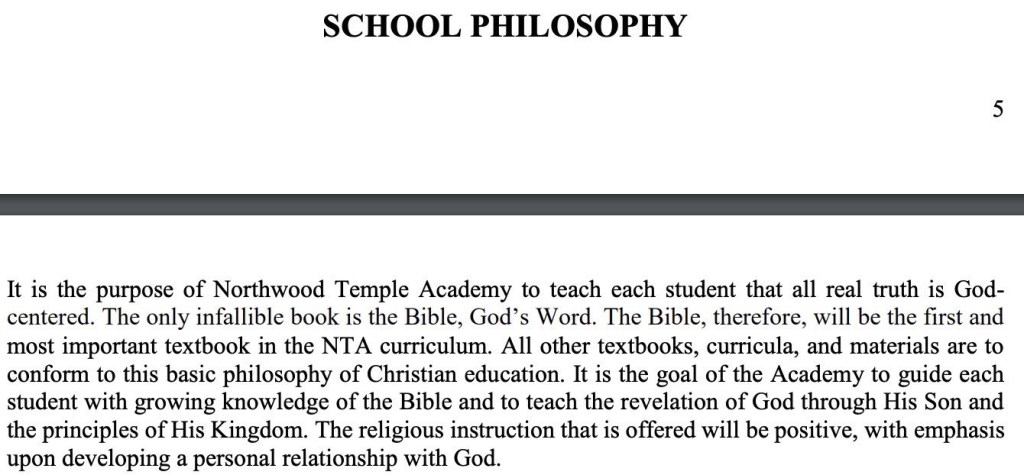
Northwood Temple Academy in Fayetteville got more than $1.1 million in NC taxpayer voucher funds this year.
Their school philosophy is “The Bible, therefore, will be the first and most important textbook in the NTA curriculum.”
They should not get public $ #nced #ncga

 Diane Ravitch's blog
What version of the bible?
https://www.cambridge.org/us/bibles/bible-versions
What about all the sex scenes in the bible? Will those pages be blacked out?
https://www.cracked.com/article_16546_the-6-raunchiest-most-depraved-sex-acts-from-bible.html
LikeLike
Wow! Certainly seems unconstitutional, but with the current Supreme Court, a challenge could reverse separation of church and state. We’ve really gone off the deep end in the last 10 years. The inmates are running the asylum.
LikeLike
yup
LikeLike
On that very day Noah and his sons, Shem, Ham and Japheth, together with his wife and the wives of his three sons, entered the ark. They had with them every wild animal according to its kind, all livestock according to their kinds, every creature that moves along the ground according to its kind and every bird according to its kind, everything with wings. –Genesis 7:13-14, NIV.
Yup , infallible.
LikeLike
All 8.7 million species.
Mora, C., Tittensor, D. P., Adl, S., Simpson, A. G., & Worm, B. (2011). How many species are there on Earth and in the ocean?. PLoS Biol, 9(8), e1001127
LikeLike
Bob About your Bible quotations, which I appreciate greatly. Knowing about how interpretation flows over the centuries, and cannot do otherwise, I read in those many passages and stories a mixture of:
(1) writers’ early historical and cultural context, as you also note;
(2) metaphors, analogies, and generalities that are a part of ANY storied literature, especially ones that, for centuries, readers have appreciated; and
(3) ways of understanding and living life in the particular . . . in my case, my own and those around me that I am trying to better understand.
But of course, you already know that, or at least should. CBK
LikeLike
Particular literary forms are found in particular societies, and often, people are simply saying what they meant. My copy of the King James Bible, given me by my grandmother, has next to the passage from Song of Solomon the note “Christ’s love for his church.” ROFL. Hardly. This is a Persian love poem with common love poem motifs from the time and place, that oddly made its way into Hebrew scripture. And that is the only description of fellatio, to my knowledge, in the collection of books known as the Bible.
One cannot rationalize away everything from the ancient past that sounds strange or out of place to a modern ear. People 3,500 years ago did not think like people today. This should be obvious enough. The urge among modern believers to try to rationalize away weirdness in these ancient texts is ahistorical. And the rationalizations are transparently that.
That said, I DO NOT, EMPHATICALLY DO NOT, want to get into another long back and forth about this, CBK. If you post apologia for absurdities, though, I will feel compelled to respond.
When the ancient text said, “Thou shalt not suffer a witch to live,” it’s not some metaphor. It’s because these primitive people who wrote this stuff believed in witches and thought that they should be sought out and killed.
LikeLike
Bob I think you’ve made a straw man out of my statements about this, for some reason beyond my understanding. Some of what I have said is exactly what you have “responded” with, as if I were opposed. Who are you arguing with? . . . certainly not me. CBK
LikeLiked by 1 person
think you’ve made a straw man out of my statements about this
I am very glad to hear this, CBK. My apologies. I thought that you were making one of those rationalizations for ancient myths that people create in order to facilitate their clinging onto them–stuff like the anachronistic “day of the Lord” notion. So, my apologies.
LikeLike
Bob Thank you . . . glad we cleared that up. I’d like to say again that, in my view, many serious problems that occur today that are called “religious” really have their roots in philosophical oversights and errors; but also in huge misunderstandings of history and how people thought, just as one example, before the scientific revolution. That’s a frustrating Cassandra-like thing to understand because in “hot” conversations, no one wants to go back, recover, and perhaps change the assortment of old assumptions they bring to their arguments about such serious things as their religious thought.
On the other hand (from having taught sections of philosophy to k-12 teachers), I have found that many also think, because the early Greeks, including Plato and Aristotle, were “off” about (what we would refer to as) the natural and physical science, that their philosophical writings were also primitive, and nothing could be farther from the truth.
As a cultural aside, I noticed a long time ago that most anyone I read in European and American literature and history from circa the 19th and 20th century and before, who I found fostered huge insights and trails of thought, had Plato in their background somewhere.
Even in my courses in education (and not philosophy) I made a place to teach a section where we took apart Plato’s cave from the Republic; and, if there was time, readings from Aristotle’s Ethics . . . not only for the philosophical insights, but also to debunk their erred idea that any writings from so long ago could be so rich and even life changing. CBK
LikeLiked by 1 person
Bob An addendum to this conversation: I think that many people (especially presently on the “right”) are fueled by two sets of deep-set philosophical fears that provide a kind of double whammy, with a chaser, to their emotional lives . . . more so because those fears commonly are not completely conscious.
First, we fear that life is “flat,” has no meaning at all, and so is not worthwhile living; so that deep down we flirt with a sense of nihilism we really don’t want to accept;
. . . and, second, at some place deep in our thought processes we realize that life is so full of meaning that we fear being totally overwhelmed by it. We want desperately to know ALL of it; but somehow, we also know we cannot possibly get ahold of it or its complexity; and so NOT knowing scares the living daylights out of us.
To say that both fears are covered over by a dogmatic attitude (the chaser) hardly lends temper to their import on our lives and on those we share it with. That these philosophical concerns are conflicting opposites that remain buried under piles of experiences doesn’t help the matter, especially where (literally) explosive events are already in the making.
The early Greeks thought that it took great courage just to face the fears associated with living, but also with dying. I think they were right. CBK
LikeLike
“First, we fear that life is “flat,” has no meaning at all, and so is not worthwhile living”
Refutation of that proposition, that “life has no meaning”:
LikeLike
Bob Did you think that I proposed that life is flat and has no meaning? For the record, I didn’t. CBK
LikeLike
I made no such claim, CBK.
LikeLike
Bob So glad to hear it. CBK
LikeLike
Catherine, people in ancient times thought the world a lot smaller than it is. Most never traveled more than a few miles from where they lived. So it was natural for them to think that the number of animals was easily countable. Natural, but wrong. And we know that these flood stories were taken from other, previously existing Mesopotamian flood stories involving sky gods. It’s ahistorical to attempt to rationalize them away. These are primitive tales from a primitive people. but enough. I do not want to get into a back and forth about this again.
LikeLike
However, if you post apologia and rationalizations for obviously primitive superstition found in other mythologies as well at the time, I will feel that I have to respond. And there we shall be again, going back and forth fruitlessly.
LikeLike
And, ofc, we also know what literary forms were available to what peoples at what times, so we know that extended metaphor or allegory were not part of the EARLY Hebrew literary toolkit. It simply is NOT the case that “metaphors, analogies, and generalities area part of ANY storied literature.” No, some forms were used by some peoples in some places and times. Others were not.
LikeLike
Allegory and extended metaphor, for example, were LATE introductions to Ancient Hebrew literature, found in Daniel (167–163 BC) and The Book of Revelations (95-96 CE).
LikeLike
Bob The reflective discovery of metaphor and allegory, for instance, does not mean that pre-discovery myths, verbal stories, parables, primitive biographies and histories, etc., even wall writings, cannot hold various forms of condensed meanings that can serve those later-reflectively discovered language functions and inspire new insights and thinking patterns as our differentiation of mind occurs in history.
That doesn’t mean such activities are necessarily illusory, mythical in the bad sense, or “bunk.” It just means that we are meaning-seeking beings and that the world is, in fact, meaningful. CBK
LikeLike
Attempts to rationalize away ancient superstitions found in books of the Bible are TYPICALLY ahistorical and anachronistic. They impute modern ways of thinking to folks who did not think in those ways.
LikeLike
Bob Again, that’s what I meant by #1 in my note. This is also when they thought kings were ACTUALLY divine. They were trying to figure out how things worked, they didn’t think like we do (duh); and that’s how they understood things that were so totally powerful over their lives. And still, there were some great and meaningful truths to be had in their writings and sayings.
The problems are with the later generations of interpretations of what they said and meant, and why they meant what they said, and said what they meant. I don’t see the same problems with that (apparently) as you do. It’s just the way history works. Even in science, we keep what works and what remains meaningful to and for us, and peel away and leave behind what doesn’t . . . it’s called sublation.
But if you think some people are terribly and dangerously wrong in how they think of either interpretation, or history, or “olden times,” you’d be right. So what else is new? CBK
LikeLike
Well said, CBK
LikeLike
So, no, when superstitious ancient peoples wrote that god created everything in six days, that’s what they meant. They weren’t using metaphor, some sort of “a day of god = 175 million years” sort of thing. We know that the straightforward interpretation is correct because peoples with other mythological systems writing around the same time had similar notions. They believed in gods who created things in one fell swoop. Presto, land and sky. Presto, animals. Presto, people. This is how primitives thought. Hebrew primitives. Babylonian primitives. etc.
LikeLike
Bob On centuries-old religious meanings: Maybe I didn’t make #1 below clear enough.
(1) writers’ early historical and cultural context, as you also note;
(2) metaphors, analogies, and generalities that are a part of ANY storied literature, especially ones that, for centuries, readers have appreciated; and
(3) ways of understanding and living life in the particular . . . in my case, my own and those around me that I am trying to better understand. CBK
LikeLike
A good summary from Wikipedia:
For well over a century, scholars have recognized that the Bible’s story of Noah’s Ark is based on older Mesopotamian models.[13] Because all these flood stories deal with events that allegedly happened at the dawn of history, they give the impression that the myths themselves must come from very primitive origins, but the myth of the global flood that destroys all life only begins to appear in the Old Babylonian period (20th–16th centuries BCE).[14] The reasons for this emergence of the typical Mesopotamian flood myth may have been bound up with the specific circumstances of the end of the Third Dynasty of Ur around 2004 BCE and the restoration of order by the First Dynasty of Isin.[15]
Nine versions of the Mesopotamian flood story are known, each more or less adapted from an earlier version. In the oldest version, inscribed in the Sumerian city of Nippur around 1600 BCE, the hero is King Ziusudra. This story, the Sumerian flood myth, probably derives from an earlier version. The Ziusudra version tells how he builds a boat and rescues life when the gods decide to destroy it. This basic plot is common in several subsequent flood stories and heroes, including Noah. Ziusudra’s Sumerian name means “He of long life.” In Babylonian versions, his name is Atrahasis, but the meaning is the same. In the Atrahasis version, the flood is a river flood.[16]: 20–27
The version closest to the biblical story of Noah, as well as its most likely source, is that of Utnapishtim in the Epic of Gilgamesh.[17] A complete text of Utnapishtim’s story is a clay tablet dating from the seventh century BCE, but fragments of the story have been found from as far back as the 19th-century BCE.[17] The last known version of the Mesopotamian flood story was written in Greek in the third century BCE by a Babylonian priest named Berossus. From the fragments that survive, it seems little changed from the versions of 2,000 years before.[18]
The parallels between Noah’s Ark and the arks of Babylonian flood heroes Atrahasis and Utnapishtim have often been noted. Atrahasis’ Ark was circular, resembling an enormous quffa, with one or two decks.[19] Utnapishtim’s ark was a cube with six decks of seven compartments, each divided into nine subcompartments (63 subcompartments per deck, 378 total). Noah’s Ark was rectangular with three decks. A progression is believed to exist from a circular to a cubic or square to rectangular. The most striking similarity is the near-identical deck areas of the three arks: 14,400 cubits2, 14,400 cubits2, and 15,000 cubits2 for Atrahasis, Utnapishtim, and Noah, only 4% different. Professor Finkel concluded, “the iconic story of the Flood, Noah, and the Ark as we know it today certainly originated in the landscape of ancient Mesopotamia, modern Iraq.”[20]
Linguistic parallels between Noah’s and Atrahasis’ arks have also been noted. The word used for “pitch” (sealing tar or resin) in Genesis is not the normal Hebrew word, but is closely related to the word used in the Babylonian story.[21] Likewise, the Hebrew word for “ark” (tevah) is nearly identical to the Babylonian word for an oblong boat (ṭubbû), especially given that “v” and “b” are the same letter in Hebrew: bet (ב).[20]
However, the causes for God or the gods sending the flood differ in the various stories. In the Hebrew myth, the flood inflicts God’s judgment on wicked humanity. The Babylonian Epic of Gilgamesh gives no reasons, and the flood appears the result of divine caprice.[22] In the Babylonian Atrahasis version, the flood is sent to reduce human overpopulation, and after the flood, other measures were introduced to limit humanity.[23][24][25]
LikeLike
Another Putin “ally” dies under mysterious circumstances:
https://www.msn.com/en-us/news/world/mounting-death-toll-putin-ally-and-belarusian-minister-dies-under-mysterious-circumstances-at-yearsold/ar-AA1dsio2?ocid=sapphireappshare
LikeLike
!!!!
LikeLike
Stalin killed so many of his own relatives that his young daughter once asked him, “Where did everybody go?”
LikeLike
Bob . . . and . . . .? CBK
LikeLike
[T]he sons of God saw the daughters of men that they were fair; and they took them wives of all which they chose. . . .
There were giants in the earth in those days; and also after that, when the sons of God came in unto the daughters of men, and they bare children to them, the same became mighty men which were of old, men of renown.
–Genesis 6: 2, 4, KJV
Yup, infallible. Not at all like a myth or fairytale.
LikeLike
Those were the good old days, about 5,000 years ago. How do I know? The Bible tells me so.
LikeLiked by 1 person
I freaking love these books.
LikeLike
Imagine dying and finding out that all the absurdities of one of these ancient mythological systems were actually true. Now THAT would be miraculous indeed.
LikeLike
Isn’t this just a form of coerced speech? — Taxpayers being forced to pay for the preaching of religious beliefs they can have no control over?
I thought our Supreme Church Lads and Ladies were against that very sort of thing. I mean, even apart from the problems they have grasping that whole Bearing False Witness bit.
LikeLike
(Edit) that should be Church Lady (not Ladies)
LikeLike
Wait a minute, Genesis is full of gratuitous sex. I mean a drunken Lot cavorting with his manipulative daughters. Are Christian schools allowing this in their library?
LikeLike
The violence in Leviticus is horrific.
LikeLike